Alkenes as substituents
Prepared by
M.Maruthamuthu,M.pharm,
Assistant professor,
Department of pharmaceutical chemistry,
Svcp , Tiruchengode.
 In some cases, a group containing an
alkene may need to be treated as a
substituent.
 In these cases the substituent is named in
a similar fashion to simple alkyl
substituents.
 The method is required when the alkene
is not the priority group.
 The substituent is named in a similar way
to the parent alkene.
 It is named based on the number of
carbon atoms in the branch plus the suffix
- yl. i.e. alkenyl
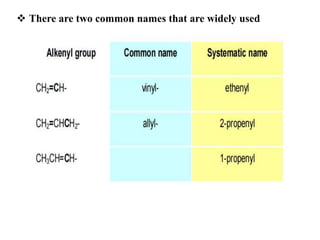
 There are two common names that are widely used
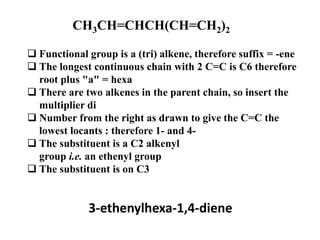
CH3CH=CHCH(CH=CH2)2
 Functional group is a (tri) alkene, therefore suffix = -ene
 The longest continuous chain with 2 C=C is C6 therefore
root plus "a" = hexa
 There are two alkenes in the parent chain, so insert the
multiplier di
 Number from the right as drawn to give the C=C the
lowest locants : therefore 1- and 4-
 The substituent is a C2 alkenyl
group i.e. an ethenyl group
 The substituent is on C3
3-ethenylhexa-1,4-diene
Markovnikov rule
When an unsymmetrical reagent adds to an unsymmetrical
double bond, the positive part of the reagent becomes
attached to the double-bonded carbon atom which bears the
greatest number of hydrogen atoms.
Consider the addition of HBr to propene. The mechanism of
this reaction involves the following steps:
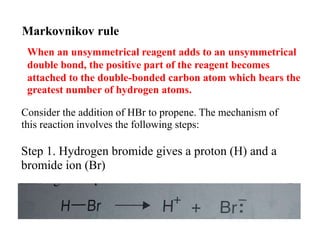
Step 1. Hydrogen bromide gives a proton (H) and a
bromide ion (Br)
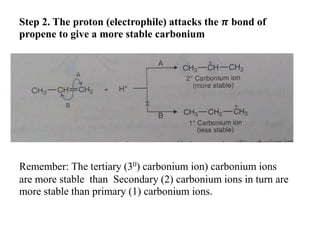
Step 2. The proton (electrophile) attacks the 𝝅 bond of
propene to give a more stable carbonium
Remember: The tertiary (30) carbonium ion) carbonium ions
are more stable than Secondary (2) carbonium ions in turn are
more stable than primary (1) carbonium ions.
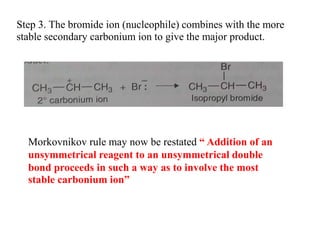
Step 3. The bromide ion (nucleophile) combines with the more
stable secondary carbonium ion to give the major product.
Morkovnikov rule may now be restated “ Addition of an
unsymmetrical reagent to an unsymmetrical double
bond proceeds in such a way as to involve the most
stable carbonium ion”
Halogenation of Alkenes
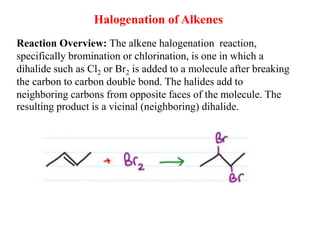
Reaction Overview: The alkene halogenation reaction,
specifically bromination or chlorination, is one in which a
dihalide such as Cl2 or Br2 is added to a molecule after breaking
the carbon to carbon double bond. The halides add to
neighboring carbons from opposite faces of the molecule. The
resulting product is a vicinal (neighboring) dihalide.
What Exactly Goes On In This Reaction?
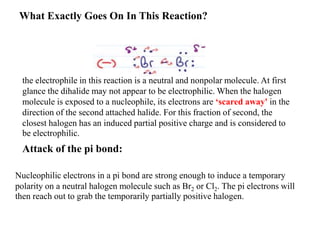
the electrophile in this reaction is a neutral and nonpolar molecule. At first
glance the dihalide may not appear to be electrophilic. When the halogen
molecule is exposed to a nucleophile, its electrons are ‘scared away' in the
direction of the second attached halide. For this fraction of second, the
closest halogen has an induced partial positive charge and is considered to
be electrophilic.
Attack of the pi bond:
Nucleophilic electrons in a pi bond are strong enough to induce a temporary
polarity on a neutral halogen molecule such as Br2 or Cl2. The pi electrons will
then reach out to grab the temporarily partially positive halogen.
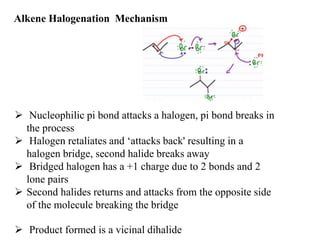
Alkene Halogenation Mechanism
 Nucleophilic pi bond attacks a halogen, pi bond breaks in
the process
 Halogen retaliates and ‘attacks back' resulting in a
halogen bridge, second halide breaks away
 Bridged halogen has a +1 charge due to 2 bonds and 2
lone pairs
 Second halides returns and attacks from the opposite side
of the molecule breaking the bridge
 Product formed is a vicinal dihalide
Key Reaction Notes
This reaction does NOT have a carbocation intermediate
Positive halogens are unhappy, unstable, and very reactive
Product is anti-addition with 1 halogen facing up, the other down
This reaction MUST take place in an inert solvent to avoid
unexpected products
This reaction is ideal for Cl2 and Br2. F2 and I2 are seldom used
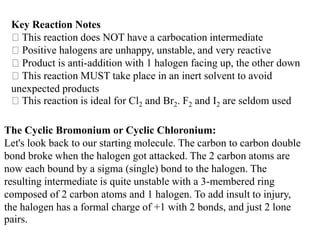
The Cyclic Bromonium or Cyclic Chloronium:
Let's look back to our starting molecule. The carbon to carbon double
bond broke when the halogen got attacked. The 2 carbon atoms are
now each bound by a sigma (single) bond to the halogen. The
resulting intermediate is quite unstable with a 3-membered ring
composed of 2 carbon atoms and 1 halogen. To add insult to injury,
the halogen has a formal charge of +1 with 2 bonds, and just 2 lone
pairs.
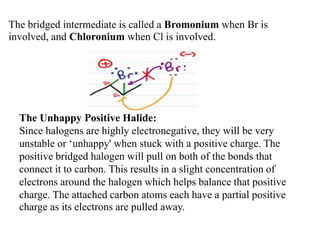
The bridged intermediate is called a Bromonium when Br is
involved, and Chloronium when Cl is involved.
The Unhappy Positive Halide:
Since halogens are highly electronegative, they will be very
unstable or ‘unhappy' when stuck with a positive charge. The
positive bridged halogen will pull on both of the bonds that
connect it to carbon. This results in a slight concentration of
electrons around the halogen which helps balance that positive
charge. The attached carbon atoms each have a partial positive
charge as its electrons are pulled away.
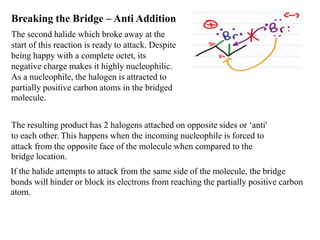
Breaking the Bridge – Anti Addition
The second halide which broke away at the
start of this reaction is ready to attack. Despite
being happy with a complete octet, its
negative charge makes it highly nucleophilic.
As a nucleophile, the halogen is attracted to
partially positive carbon atoms in the bridged
molecule.
The resulting product has 2 halogens attached on opposite sides or ‘anti'
to each other. This happens when the incoming nucleophile is forced to
attack from the opposite face of the molecule when compared to the
bridge location.
If the halide attempts to attack from the same side of the molecule, the bridge
bonds will hinder or block its electrons from reaching the partially positive carbon
atom.
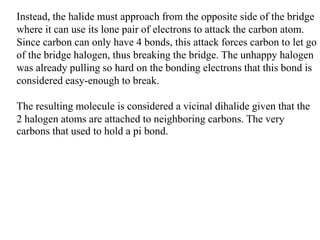
Instead, the halide must approach from the opposite side of the bridge
where it can use its lone pair of electrons to attack the carbon atom.
Since carbon can only have 4 bonds, this attack forces carbon to let go
of the bridge halogen, thus breaking the bridge. The unhappy halogen
was already pulling so hard on the bonding electrons that this bond is
considered easy-enough to break.
The resulting molecule is considered a vicinal dihalide given that the
2 halogen atoms are attached to neighboring carbons. The very
carbons that used to hold a pi bond.
A Note About The Solvent:
This reaction must be carried out in an inert solvent
such as CH2Cl2 and CCl4. An inert solvent serves a single
purpose – to dissolve the reactants. If this reaction is
carried out in a polar protic solvent such as water or
alcohol, the solvent molecules will ‘interfere' and take part
in the mechanism.
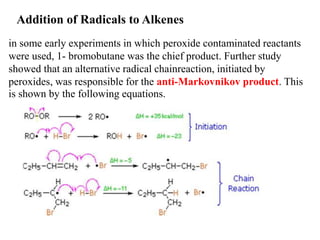
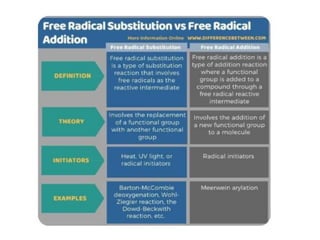
Addition of Radicals to Alkenes
in some early experiments in which peroxide contaminated reactants
were used, 1- bromobutane was the chief product. Further study
showed that an alternative radical chainreaction, initiated by
peroxides, was responsible for the anti-Markovnikov product. This
is shown by the following equations.
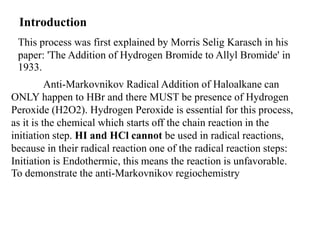
Introduction
This process was first explained by Morris Selig Karasch in his
paper: 'The Addition of Hydrogen Bromide to Allyl Bromide' in
1933.
Anti-Markovnikov Radical Addition of Haloalkane can
ONLY happen to HBr and there MUST be presence of Hydrogen
Peroxide (H2O2). Hydrogen Peroxide is essential for this process,
as it is the chemical which starts off the chain reaction in the
initiation step. HI and HCl cannot be used in radical reactions,
because in their radical reaction one of the radical reaction steps:
Initiation is Endothermic, this means the reaction is unfavorable.
To demonstrate the anti-Markovnikov regiochemistry
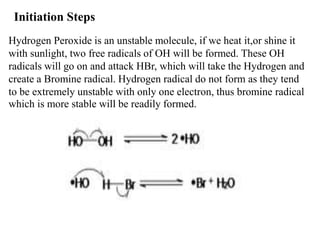
Initiation Steps
Hydrogen Peroxide is an unstable molecule, if we heat it,or shine it
with sunlight, two free radicals of OH will be formed. These OH
radicals will go on and attack HBr, which will take the Hydrogen and
create a Bromine radical. Hydrogen radical do not form as they tend
to be extremely unstable with only one electron, thus bromine radical
which is more stable will be readily formed.
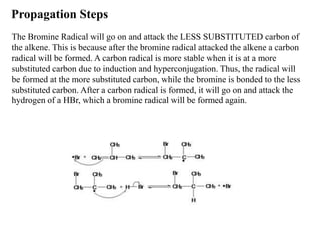
Propagation Steps
The Bromine Radical will go on and attack the LESS SUBSTITUTED carbon of
the alkene. This is because after the bromine radical attacked the alkene a carbon
radical will be formed. A carbon radical is more stable when it is at a more
substituted carbon due to induction and hyperconjugation. Thus, the radical will
be formed at the more substituted carbon, while the bromine is bonded to the less
substituted carbon. After a carbon radical is formed, it will go on and attack the
hydrogen of a HBr, which a bromine radical will be formed again.
Termination Steps
There are also Termination Steps, but we do not concern about
the termination steps as they are just the radicals combining to
create waste products. For example two bromine radical
combined to give bromine. This radical addition of bromine to
alkene by radical addition reaction will go on until all the
alkene turns into bromoalkane, and this process will take some
time to finish.
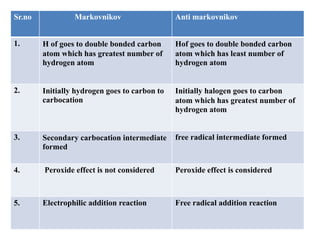
Sr.no Markovnikov Anti markovnikov
1. H of goes to double bonded carbon
atom which has greatest number of
hydrogen atom
Hof goes to double bonded carbon
atom which has least number of
hydrogen atom
2. Initially hydrogen goes to carbon to
carbocation
Initially halogen goes to carbon
atom which has greatest number of
hydrogen atom
3. Secondary carbocation intermediate
formed
free radical intermediate formed
4. Peroxide effect is not considered Peroxide effect is considered
5. Electrophilic addition reaction Free radical addition reaction
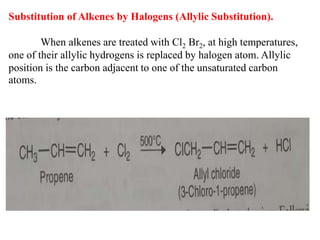
Substitution of Alkenes by Halogens (Allylic Substitution).
When alkenes are treated with Cl2 Br2, at high temperatures,
one of their allylic hydrogens is replaced by halogen atom. Allylic
position is the carbon adjacent to one of the unsaturated carbon
atoms.
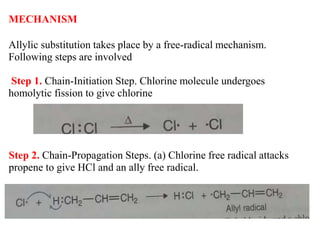
MECHANISM
Allylic substitution takes place by a free-radical mechanism.
Following steps are involved
Step 1. Chain-Initiation Step. Chlorine molecule undergoes
homolytic fission to give chlorine
Step 2. Chain-Propagation Steps. (a) Chlorine free radical attacks
propene to give HCl and an ally free radical.
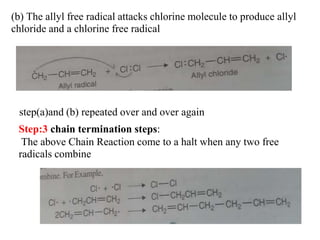
(b) The allyl free radical attacks chlorine molecule to produce allyl
chloride and a chlorine free radical
step(a)and (b) repeated over and over again
Step:3 chain termination steps:
The above Chain Reaction come to a halt when any two free
radicals combine
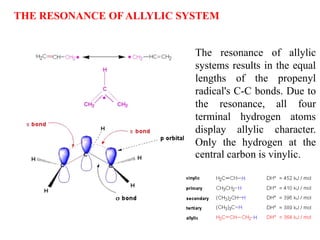
THE RESONANCE OF ALLYLIC SYSTEM
The resonance of allylic
systems results in the equal
lengths of the propenyl
radical's C-C bonds. Due to
the resonance, all four
terminal hydrogen atoms
display allylic character.
Only the hydrogen at the
central carbon is vinylic.
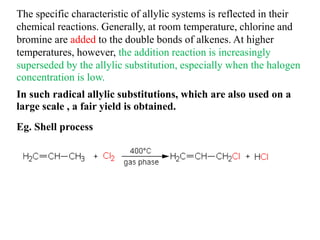
The specific characteristic of allylic systems is reflected in their
chemical reactions. Generally, at room temperature, chlorine and
bromine are added to the double bonds of alkenes. At higher
temperatures, however, the addition reaction is increasingly
superseded by the allylic substitution, especially when the halogen
concentration is low.
In such radical allylic substitutions, which are also used on a
large scale , a fair yield is obtained.
Eg. Shell process
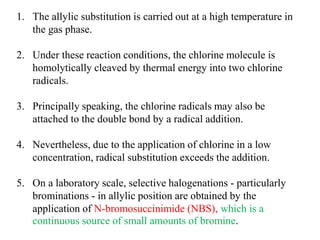
1. The allylic substitution is carried out at a high temperature in
the gas phase.
2. Under these reaction conditions, the chlorine molecule is
homolytically cleaved by thermal energy into two chlorine
radicals.
3. Principally speaking, the chlorine radicals may also be
attached to the double bond by a radical addition.
4. Nevertheless, due to the application of chlorine in a low
concentration, radical substitution exceeds the addition.
5. On a laboratory scale, selective halogenations - particularly
brominations - in allylic position are obtained by the
application of N-bromosuccinimide (NBS), which is a
continuous source of small amounts of bromine.
ORIENTATION AND REACTIVITY
All of the halides (HBr, HCl, HI, HF) can participate in this
reaction and add on in the same manner. Although different halides
do have different rates of reaction, due to the H-X bond getting
weaker as X (halogen size ) gets larger (poor overlap of orbitals)s.
VARIATION OF RATES WHEN YOU CHANGE THE
HALOGEN
Reaction rates increase in the order HF – HCl – HBr – HI.
Hydrogen fluoride reacts much more slowly than the other three,
and is normally ignored in talking about these reactions. When the
hydrogen halides react with alkenes, the hydrogen-halogen bond
has to be broken. The bond strength falls as you go from HF to HI,
and the hydrogen-fluorine bond is particularly strong. Because it is
difficult to break the bond between the hydrogen and the fluorine,
the addition of HF is bound to be slow.
Variation of rates when you change the alkene
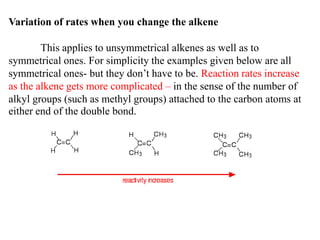
This applies to unsymmetrical alkenes as well as to
symmetrical ones. For simplicity the examples given below are all
symmetrical ones- but they don’t have to be. Reaction rates increase
as the alkene gets more complicated – in the sense of the number of
alkyl groups (such as methyl groups) attached to the carbon atoms at
either end of the double bond.
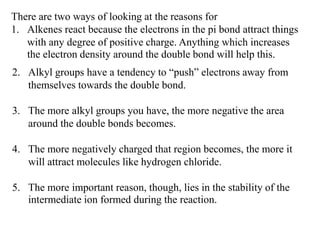
There are two ways of looking at the reasons for
1. Alkenes react because the electrons in the pi bond attract things
with any degree of positive charge. Anything which increases
the electron density around the double bond will help this.
2. Alkyl groups have a tendency to “push” electrons away from
themselves towards the double bond.
3. The more alkyl groups you have, the more negative the area
around the double bonds becomes.
4. The more negatively charged that region becomes, the more it
will attract molecules like hydrogen chloride.
5. The more important reason, though, lies in the stability of the
intermediate ion formed during the reaction.
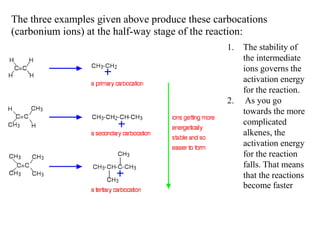
The three examples given above produce these carbocations
(carbonium ions) at the half-way stage of the reaction:
1. The stability of
the intermediate
ions governs the
activation energy
for the reaction.
2. As you go
towards the more
complicated
alkenes, the
activation energy
for the reaction
falls. That means
that the reactions
become faster
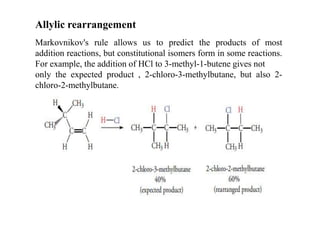
Markovnikov's rule allows us to predict the products of most
addition reactions, but constitutional isomers form in some reactions.
For example, the addition of HCl to 3-methyl-1-butene gives not
only the expected product , 2-chloro-3-methylbutane, but also 2-
chloro-2-methylbutane.
Allylic rearrangement
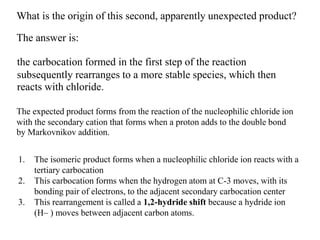
What is the origin of this second, apparently unexpected product?
The answer is:
the carbocation formed in the first step of the reaction
subsequently rearranges to a more stable species, which then
reacts with chloride.
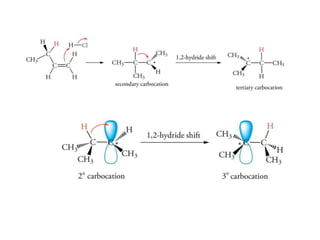
The expected product forms from the reaction of the nucleophilic chloride ion
with the secondary cation that forms when a proton adds to the double bond
by Markovnikov addition.
1. The isomeric product forms when a nucleophilic chloride ion reacts with a
tertiary carbocation
2. This carbocation forms when the hydrogen atom at C-3 moves, with its
bonding pair of electrons, to the adjacent secondary carbocation center
3. This rearrangement is called a 1,2-hydride shift because a hydride ion
(H– ) moves between adjacent carbon atoms.
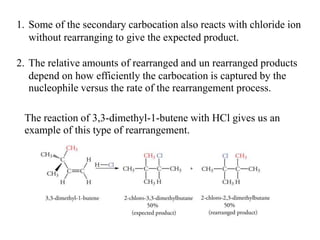
1. Some of the secondary carbocation also reacts with chloride ion
without rearranging to give the expected product.
2. The relative amounts of rearranged and un rearranged products
depend on how efficiently the carbocation is captured by the
nucleophile versus the rate of the rearrangement process.
The reaction of 3,3-dimethyl-1-butene with HCl gives us an
example of this type of rearrangement.
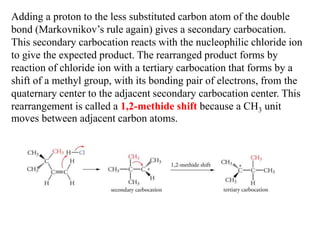
Adding a proton to the less substituted carbon atom of the double
bond (Markovnikov’s rule again) gives a secondary carbocation.
This secondary carbocation reacts with the nucleophilic chloride ion
to give the expected product. The rearranged product forms by
reaction of chloride ion with a tertiary carbocation that forms by a
shift of a methyl group, with its bonding pair of electrons, from the
quaternary center to the adjacent secondary carbocation center. This
rearrangement is called a 1,2-methide shift because a CH3 unit
moves between adjacent carbon atoms.
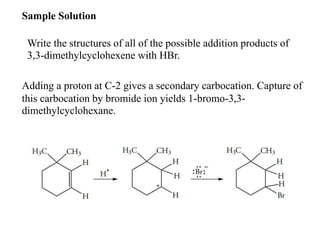
Sample Solution
Write the structures of all of the possible addition products of
3,3-dimethylcyclohexene with HBr.
Adding a proton at C-2 gives a secondary carbocation. Capture of
this carbocation by bromide ion yields 1-bromo-3,3-
dimethylcyclohexane.
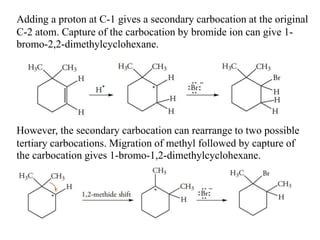
Adding a proton at C-1 gives a secondary carbocation at the original
C-2 atom. Capture of the carbocation by bromide ion can give 1-
bromo-2,2-dimethylcyclohexane.
However, the secondary carbocation can rearrange to two possible
tertiary carbocations. Migration of methyl followed by capture of
the carbocation gives 1-bromo-1,2-dimethylcyclohexane.
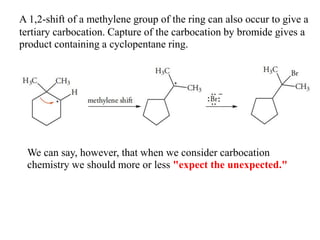
A 1,2-shift of a methylene group of the ring can also occur to give a
tertiary carbocation. Capture of the carbocation by bromide gives a
product containing a cyclopentane ring.
We can say, however, that when we consider carbocation
chemistry we should more or less "expect the unexpected."
Alkenes as substituents

Alkenes as substituents

  • 1.
    Alkenes as substituents Preparedby M.Maruthamuthu,M.pharm, Assistant professor, Department of pharmaceutical chemistry, Svcp , Tiruchengode.
  • 2.
     In somecases, a group containing an alkene may need to be treated as a substituent.  In these cases the substituent is named in a similar fashion to simple alkyl substituents.  The method is required when the alkene is not the priority group.  The substituent is named in a similar way to the parent alkene.  It is named based on the number of carbon atoms in the branch plus the suffix - yl. i.e. alkenyl
  • 3.
     There aretwo common names that are widely used
  • 4.
    CH3CH=CHCH(CH=CH2)2  Functional groupis a (tri) alkene, therefore suffix = -ene  The longest continuous chain with 2 C=C is C6 therefore root plus "a" = hexa  There are two alkenes in the parent chain, so insert the multiplier di  Number from the right as drawn to give the C=C the lowest locants : therefore 1- and 4-  The substituent is a C2 alkenyl group i.e. an ethenyl group  The substituent is on C3 3-ethenylhexa-1,4-diene
  • 5.
    Markovnikov rule When anunsymmetrical reagent adds to an unsymmetrical double bond, the positive part of the reagent becomes attached to the double-bonded carbon atom which bears the greatest number of hydrogen atoms. Consider the addition of HBr to propene. The mechanism of this reaction involves the following steps: Step 1. Hydrogen bromide gives a proton (H) and a bromide ion (Br)
  • 6.
    Step 2. Theproton (electrophile) attacks the 𝝅 bond of propene to give a more stable carbonium Remember: The tertiary (30) carbonium ion) carbonium ions are more stable than Secondary (2) carbonium ions in turn are more stable than primary (1) carbonium ions.
  • 7.
    Step 3. Thebromide ion (nucleophile) combines with the more stable secondary carbonium ion to give the major product. Morkovnikov rule may now be restated “ Addition of an unsymmetrical reagent to an unsymmetrical double bond proceeds in such a way as to involve the most stable carbonium ion”
  • 8.
    Halogenation of Alkenes ReactionOverview: The alkene halogenation reaction, specifically bromination or chlorination, is one in which a dihalide such as Cl2 or Br2 is added to a molecule after breaking the carbon to carbon double bond. The halides add to neighboring carbons from opposite faces of the molecule. The resulting product is a vicinal (neighboring) dihalide.
  • 9.
    What Exactly GoesOn In This Reaction? the electrophile in this reaction is a neutral and nonpolar molecule. At first glance the dihalide may not appear to be electrophilic. When the halogen molecule is exposed to a nucleophile, its electrons are ‘scared away' in the direction of the second attached halide. For this fraction of second, the closest halogen has an induced partial positive charge and is considered to be electrophilic. Attack of the pi bond: Nucleophilic electrons in a pi bond are strong enough to induce a temporary polarity on a neutral halogen molecule such as Br2 or Cl2. The pi electrons will then reach out to grab the temporarily partially positive halogen.
  • 10.
    Alkene Halogenation Mechanism Nucleophilic pi bond attacks a halogen, pi bond breaks in the process  Halogen retaliates and ‘attacks back' resulting in a halogen bridge, second halide breaks away  Bridged halogen has a +1 charge due to 2 bonds and 2 lone pairs  Second halides returns and attacks from the opposite side of the molecule breaking the bridge  Product formed is a vicinal dihalide
  • 11.
    Key Reaction Notes Thisreaction does NOT have a carbocation intermediate Positive halogens are unhappy, unstable, and very reactive Product is anti-addition with 1 halogen facing up, the other down This reaction MUST take place in an inert solvent to avoid unexpected products This reaction is ideal for Cl2 and Br2. F2 and I2 are seldom used The Cyclic Bromonium or Cyclic Chloronium: Let's look back to our starting molecule. The carbon to carbon double bond broke when the halogen got attacked. The 2 carbon atoms are now each bound by a sigma (single) bond to the halogen. The resulting intermediate is quite unstable with a 3-membered ring composed of 2 carbon atoms and 1 halogen. To add insult to injury, the halogen has a formal charge of +1 with 2 bonds, and just 2 lone pairs.
  • 12.
    The bridged intermediateis called a Bromonium when Br is involved, and Chloronium when Cl is involved. The Unhappy Positive Halide: Since halogens are highly electronegative, they will be very unstable or ‘unhappy' when stuck with a positive charge. The positive bridged halogen will pull on both of the bonds that connect it to carbon. This results in a slight concentration of electrons around the halogen which helps balance that positive charge. The attached carbon atoms each have a partial positive charge as its electrons are pulled away.
  • 13.
    Breaking the Bridge– Anti Addition The second halide which broke away at the start of this reaction is ready to attack. Despite being happy with a complete octet, its negative charge makes it highly nucleophilic. As a nucleophile, the halogen is attracted to partially positive carbon atoms in the bridged molecule. The resulting product has 2 halogens attached on opposite sides or ‘anti' to each other. This happens when the incoming nucleophile is forced to attack from the opposite face of the molecule when compared to the bridge location. If the halide attempts to attack from the same side of the molecule, the bridge bonds will hinder or block its electrons from reaching the partially positive carbon atom.
  • 14.
    Instead, the halidemust approach from the opposite side of the bridge where it can use its lone pair of electrons to attack the carbon atom. Since carbon can only have 4 bonds, this attack forces carbon to let go of the bridge halogen, thus breaking the bridge. The unhappy halogen was already pulling so hard on the bonding electrons that this bond is considered easy-enough to break. The resulting molecule is considered a vicinal dihalide given that the 2 halogen atoms are attached to neighboring carbons. The very carbons that used to hold a pi bond.
  • 15.
    A Note AboutThe Solvent: This reaction must be carried out in an inert solvent such as CH2Cl2 and CCl4. An inert solvent serves a single purpose – to dissolve the reactants. If this reaction is carried out in a polar protic solvent such as water or alcohol, the solvent molecules will ‘interfere' and take part in the mechanism.
  • 16.
    Addition of Radicalsto Alkenes in some early experiments in which peroxide contaminated reactants were used, 1- bromobutane was the chief product. Further study showed that an alternative radical chainreaction, initiated by peroxides, was responsible for the anti-Markovnikov product. This is shown by the following equations.
  • 17.
    Introduction This process wasfirst explained by Morris Selig Karasch in his paper: 'The Addition of Hydrogen Bromide to Allyl Bromide' in 1933. Anti-Markovnikov Radical Addition of Haloalkane can ONLY happen to HBr and there MUST be presence of Hydrogen Peroxide (H2O2). Hydrogen Peroxide is essential for this process, as it is the chemical which starts off the chain reaction in the initiation step. HI and HCl cannot be used in radical reactions, because in their radical reaction one of the radical reaction steps: Initiation is Endothermic, this means the reaction is unfavorable. To demonstrate the anti-Markovnikov regiochemistry
  • 18.
    Initiation Steps Hydrogen Peroxideis an unstable molecule, if we heat it,or shine it with sunlight, two free radicals of OH will be formed. These OH radicals will go on and attack HBr, which will take the Hydrogen and create a Bromine radical. Hydrogen radical do not form as they tend to be extremely unstable with only one electron, thus bromine radical which is more stable will be readily formed.
  • 19.
    Propagation Steps The BromineRadical will go on and attack the LESS SUBSTITUTED carbon of the alkene. This is because after the bromine radical attacked the alkene a carbon radical will be formed. A carbon radical is more stable when it is at a more substituted carbon due to induction and hyperconjugation. Thus, the radical will be formed at the more substituted carbon, while the bromine is bonded to the less substituted carbon. After a carbon radical is formed, it will go on and attack the hydrogen of a HBr, which a bromine radical will be formed again.
  • 20.
    Termination Steps There arealso Termination Steps, but we do not concern about the termination steps as they are just the radicals combining to create waste products. For example two bromine radical combined to give bromine. This radical addition of bromine to alkene by radical addition reaction will go on until all the alkene turns into bromoalkane, and this process will take some time to finish.
  • 21.
    Sr.no Markovnikov Antimarkovnikov 1. H of goes to double bonded carbon atom which has greatest number of hydrogen atom Hof goes to double bonded carbon atom which has least number of hydrogen atom 2. Initially hydrogen goes to carbon to carbocation Initially halogen goes to carbon atom which has greatest number of hydrogen atom 3. Secondary carbocation intermediate formed free radical intermediate formed 4. Peroxide effect is not considered Peroxide effect is considered 5. Electrophilic addition reaction Free radical addition reaction
  • 22.
    Substitution of Alkenesby Halogens (Allylic Substitution). When alkenes are treated with Cl2 Br2, at high temperatures, one of their allylic hydrogens is replaced by halogen atom. Allylic position is the carbon adjacent to one of the unsaturated carbon atoms.
  • 23.
    MECHANISM Allylic substitution takesplace by a free-radical mechanism. Following steps are involved Step 1. Chain-Initiation Step. Chlorine molecule undergoes homolytic fission to give chlorine Step 2. Chain-Propagation Steps. (a) Chlorine free radical attacks propene to give HCl and an ally free radical.
  • 24.
    (b) The allylfree radical attacks chlorine molecule to produce allyl chloride and a chlorine free radical step(a)and (b) repeated over and over again Step:3 chain termination steps: The above Chain Reaction come to a halt when any two free radicals combine
  • 25.
    THE RESONANCE OFALLYLIC SYSTEM The resonance of allylic systems results in the equal lengths of the propenyl radical's C-C bonds. Due to the resonance, all four terminal hydrogen atoms display allylic character. Only the hydrogen at the central carbon is vinylic.
  • 26.
    The specific characteristicof allylic systems is reflected in their chemical reactions. Generally, at room temperature, chlorine and bromine are added to the double bonds of alkenes. At higher temperatures, however, the addition reaction is increasingly superseded by the allylic substitution, especially when the halogen concentration is low. In such radical allylic substitutions, which are also used on a large scale , a fair yield is obtained. Eg. Shell process
  • 27.
    1. The allylicsubstitution is carried out at a high temperature in the gas phase. 2. Under these reaction conditions, the chlorine molecule is homolytically cleaved by thermal energy into two chlorine radicals. 3. Principally speaking, the chlorine radicals may also be attached to the double bond by a radical addition. 4. Nevertheless, due to the application of chlorine in a low concentration, radical substitution exceeds the addition. 5. On a laboratory scale, selective halogenations - particularly brominations - in allylic position are obtained by the application of N-bromosuccinimide (NBS), which is a continuous source of small amounts of bromine.
  • 29.
    ORIENTATION AND REACTIVITY Allof the halides (HBr, HCl, HI, HF) can participate in this reaction and add on in the same manner. Although different halides do have different rates of reaction, due to the H-X bond getting weaker as X (halogen size ) gets larger (poor overlap of orbitals)s. VARIATION OF RATES WHEN YOU CHANGE THE HALOGEN Reaction rates increase in the order HF – HCl – HBr – HI. Hydrogen fluoride reacts much more slowly than the other three, and is normally ignored in talking about these reactions. When the hydrogen halides react with alkenes, the hydrogen-halogen bond has to be broken. The bond strength falls as you go from HF to HI, and the hydrogen-fluorine bond is particularly strong. Because it is difficult to break the bond between the hydrogen and the fluorine, the addition of HF is bound to be slow.
  • 30.
    Variation of rateswhen you change the alkene This applies to unsymmetrical alkenes as well as to symmetrical ones. For simplicity the examples given below are all symmetrical ones- but they don’t have to be. Reaction rates increase as the alkene gets more complicated – in the sense of the number of alkyl groups (such as methyl groups) attached to the carbon atoms at either end of the double bond.
  • 31.
    There are twoways of looking at the reasons for 1. Alkenes react because the electrons in the pi bond attract things with any degree of positive charge. Anything which increases the electron density around the double bond will help this. 2. Alkyl groups have a tendency to “push” electrons away from themselves towards the double bond. 3. The more alkyl groups you have, the more negative the area around the double bonds becomes. 4. The more negatively charged that region becomes, the more it will attract molecules like hydrogen chloride. 5. The more important reason, though, lies in the stability of the intermediate ion formed during the reaction.
  • 32.
    The three examplesgiven above produce these carbocations (carbonium ions) at the half-way stage of the reaction: 1. The stability of the intermediate ions governs the activation energy for the reaction. 2. As you go towards the more complicated alkenes, the activation energy for the reaction falls. That means that the reactions become faster
  • 33.
    Markovnikov's rule allowsus to predict the products of most addition reactions, but constitutional isomers form in some reactions. For example, the addition of HCl to 3-methyl-1-butene gives not only the expected product , 2-chloro-3-methylbutane, but also 2- chloro-2-methylbutane. Allylic rearrangement
  • 34.
    What is theorigin of this second, apparently unexpected product? The answer is: the carbocation formed in the first step of the reaction subsequently rearranges to a more stable species, which then reacts with chloride. The expected product forms from the reaction of the nucleophilic chloride ion with the secondary cation that forms when a proton adds to the double bond by Markovnikov addition. 1. The isomeric product forms when a nucleophilic chloride ion reacts with a tertiary carbocation 2. This carbocation forms when the hydrogen atom at C-3 moves, with its bonding pair of electrons, to the adjacent secondary carbocation center 3. This rearrangement is called a 1,2-hydride shift because a hydride ion (H– ) moves between adjacent carbon atoms.
  • 36.
    1. Some ofthe secondary carbocation also reacts with chloride ion without rearranging to give the expected product. 2. The relative amounts of rearranged and un rearranged products depend on how efficiently the carbocation is captured by the nucleophile versus the rate of the rearrangement process. The reaction of 3,3-dimethyl-1-butene with HCl gives us an example of this type of rearrangement.
  • 37.
    Adding a protonto the less substituted carbon atom of the double bond (Markovnikov’s rule again) gives a secondary carbocation. This secondary carbocation reacts with the nucleophilic chloride ion to give the expected product. The rearranged product forms by reaction of chloride ion with a tertiary carbocation that forms by a shift of a methyl group, with its bonding pair of electrons, from the quaternary center to the adjacent secondary carbocation center. This rearrangement is called a 1,2-methide shift because a CH3 unit moves between adjacent carbon atoms.
  • 38.
    Sample Solution Write thestructures of all of the possible addition products of 3,3-dimethylcyclohexene with HBr. Adding a proton at C-2 gives a secondary carbocation. Capture of this carbocation by bromide ion yields 1-bromo-3,3- dimethylcyclohexane.
  • 39.
    Adding a protonat C-1 gives a secondary carbocation at the original C-2 atom. Capture of the carbocation by bromide ion can give 1- bromo-2,2-dimethylcyclohexane. However, the secondary carbocation can rearrange to two possible tertiary carbocations. Migration of methyl followed by capture of the carbocation gives 1-bromo-1,2-dimethylcyclohexane.
  • 40.
    A 1,2-shift ofa methylene group of the ring can also occur to give a tertiary carbocation. Capture of the carbocation by bromide gives a product containing a cyclopentane ring. We can say, however, that when we consider carbocation chemistry we should more or less "expect the unexpected."