Hernia & PR
Dr.AbdulWAHID M Salih
M.D. Surgery
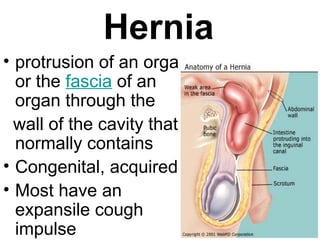
Hernia
• protrusion of an organ
or the fascia of an
organ through the
wall of the cavity that
normally contains
• Congenital, acquired
• Most have an
expansile cough
impulse
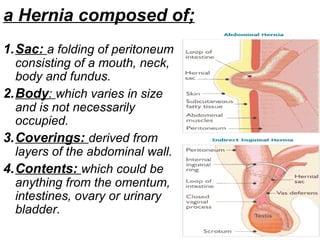
a Hernia composed of;
1.Sac: a folding of peritoneum
consisting of a mouth, neck,
body and fundus.
2.Body: which varies in size
and is not necessarily
occupied.
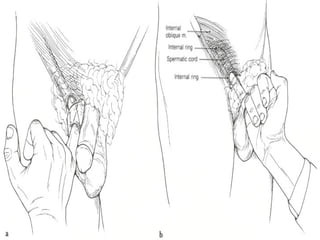
3.Coverings: derived from
layers of the abdominal wall.
4.Contents: which could be
anything from the omentum,
intestines, ovary or urinary
bladder.
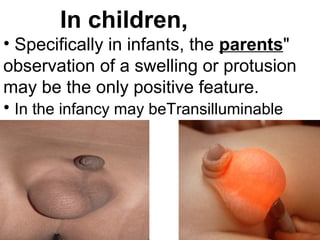
In children,
• Specifically in infants, the parents"
observation of a swelling or protusion
may be the only positive feature.
• In the infancy may beTransilluminable
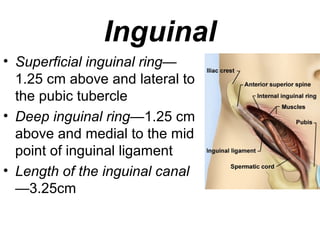
Inguinal
• Superficial inguinal ring—
1.25 cm above and lateral to
the pubic tubercle
• Deep inguinal ring—1.25 cm
above and medial to the mid
point of inguinal ligament
• Length of the inguinal canal
—3.25cm
Ingiunal canal Boundaries
MALT: 2M 2A, 2L, 2T:
Superior wall [roof]: 2 Muscles:
• Internal oblique Muscle
• Transverse abdominus Muscle
Anterior wall: 2 Aponeuroses:
• Aponeurosis of external oblique
• Aponeurosis of internal oblique
Lower wall [floor]: 2 Ligaments:
• Inguinal Ligament
• Lacunar Ligament
Posterior wall: 2Ts:
• Transversalis fascia [laterally]
• Conjoint Tendon [medially]
Ingiunal canal Contents
Ilioinguinal nerve.
Spermatic cord, which contains:
3 arteries:
• Testicular a.
• Ductus deferens a.
• Cremasteric a.
3 nerves:
• Cremasteric n.
• Genital branch of the genitofemoral n.
• Autonomics
3 other things:
• Ductus deferens
• Pampiniform plexus
• Lymphatics
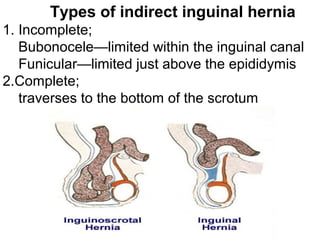
Types of indirect inguinal hernia
1. Incomplete;
Bubonocele—limited within the inguinal canal
Funicular—limited just above the epididymis
2.Complete;
traverses to the bottom of the scrotum
• Introduce yourself
• Wash hands
• Chaperone
• Standing up
• Undressed from waist down
• Look for an visible lumps
• Any scars, overlying skin changes.
• The lump extends into the scrotum
position
•Pt. stands, exposed area
visible.
•best performed with the patient
standing and in supine
•the physician seated on a stool
prepare
• Stand at the side of the patient,
• one hand on the patients back to support him.
• hand and arm should be roughly parallel to the
inguinal ligament when palpating the lump.
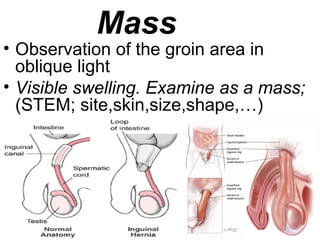
• Observation of the groin area in
oblique light
• Visible swelling. Examine as a mass;
(STEM; site,skin,size,shape,…)
Mass
Most important
1. Can you get above it?
2. Reducibility test
3. Expansile Cough Impulse;
4. Invagination test
5. Three finger test
Zieman’s technique
6. Ring occlusion test
Also Asses
• Intra or extra abdominal
• Tension
• Composition
• Percussion and auscultation;
Bowel Sounds
• Always examine both groins
• Tranillumination
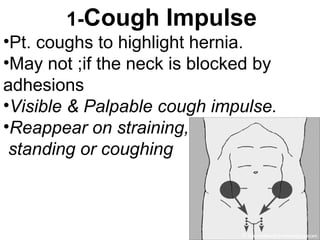
1-Cough Impulse
•Pt. coughs to highlight hernia.
•May not ;if the neck is blocked by
adhesions
•Visible & Palpable cough impulse.
•Reappear on straining,
standing or coughing
2-Reducibility test
• Ask pt. to reduce hernia himselves
• usually done in lying position.
• The thigh of the affected side should be flexed,
adducted and internally rotated.
• Finger guard of the inguinal canal by thumb
and index finger and then the scrotum is gently
squeezed.
Relation to Pubic
Tubercle
INGUINAL HERNIA;
The neck above
and medial to the
pubic tubercle
FEMORAL HERNIA;
The neck below and
lateral to pubic
tubercle
3-Get above the swelling test
• Done in standing position
• At the root of the scrotum place the
thumb in front and the index behind
•Try to reach above the swelling.
• Inguinal hernia; cannot get above
• Pure scrotal swelling; will get above
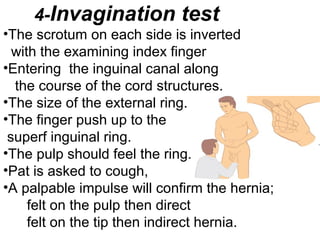
4-Invagination test
•The scrotum on each side is inverted
with the examining index finger
•Entering the inguinal canal along
the course of the cord structures.
•The size of the external ring.
•The finger push up to the
superf inguinal ring.
•The pulp should feel the ring.
•Pat is asked to cough,
•A palpable impulse will confirm the hernia;
felt on the pulp then direct
felt on the tip then indirect hernia.
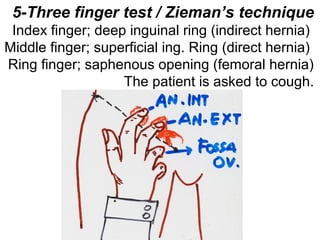
5-Three finger test / Zieman’s technique
Index finger; deep inguinal ring (indirect hernia)
Middle finger; superficial ing. Ring (direct hernia)
Ring finger; saphenous opening (femoral hernia)
The patient is asked to cough.
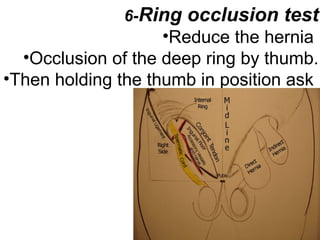
6-Ring occlusion test
•Reduce the hernia
•Occlusion of the deep ring by thumb.
•Then holding the thumb in position ask
The pt to stand
then cough
•If no bulging;
indirect
•If bulging;
direct .
Beside
• Beside; at the level of inguinal region
at the affected side;
Notice a small bulge
Compare to the other side.
• Stand beside the pt; your shoulder
behind the opposite shoulder of pt;
Reduce the hernia.
Ask the pt to cough
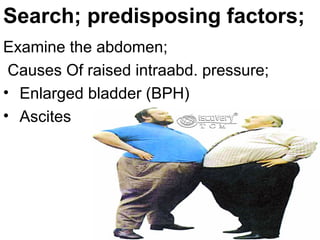
Examine the abdomen;
Causes Of raised intraabd. pressure;
• Enlarged bladder (BPH)
• Ascites
Search; predisposing factors;
describe the hernia
1. Site (inguinal)
2. Right/Left
3. Reducible/Irreducible
4. Complete/Incomplete
5. Direct/Indirect
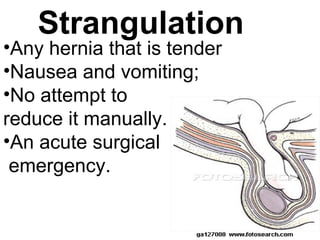
•Any hernia that is tender
•Nausea and vomiting;
•No attempt to
reduce it manually.
•An acute surgical
emergency.
Strangulation
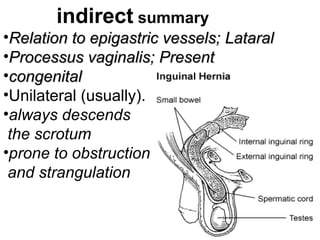
indirect summary
•Relation to epigastric vessels;Relation to epigastric vessels; LataralLataral
•Processus vaginalis;Processus vaginalis; PresentPresent
•congenitalcongenital
•Unilateral (usually).
•always descends
the scrotum
•prone to obstruction
and strangulation
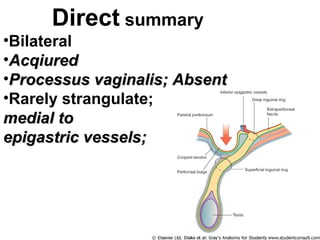
Direct summary
•Bilateral
•AcqiuredAcqiured
•Processus vaginalis;Processus vaginalis; AbsentAbsent
•Rarely strangulate;
medial tomedial to
epigastric vessels;epigastric vessels;
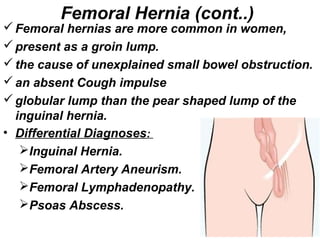
Femoral Hernia (cont..)
Femoral hernias are more common in women,
present as a groin lump.
the cause of unexplained small bowel obstruction.
an absent Cough impulse
globular lump than the pear shaped lump of the
inguinal hernia.
• Differential Diagnoses:
Inguinal Hernia.
Femoral Artery Aneurism.
Femoral Lymphadenopathy.
Psoas Abscess.
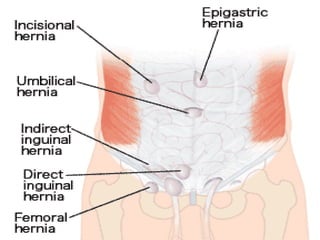
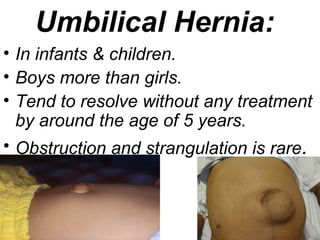
Umbilical Hernia:
• In infants & children.
• Boys more than girls.
• Tend to resolve without any treatment
by around the age of 5 years.
• Obstruction and strangulation is rare.
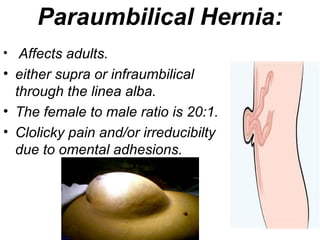
Paraumbilical Hernia:
• Affects adults.
• either supra or infraumbilical
through the linea alba.
• The female to male ratio is 20:1.
• Clolicky pain and/or irreducibilty
due to omental adhesions.
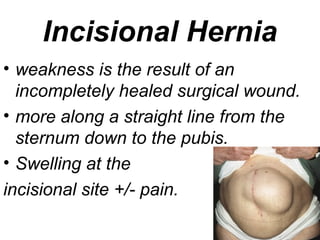
Incisional Hernia
• weakness is the result of an
incompletely healed surgical wound.
• more along a straight line from the
sternum down to the pubis.
• Swelling at the
incisional site +/- pain.
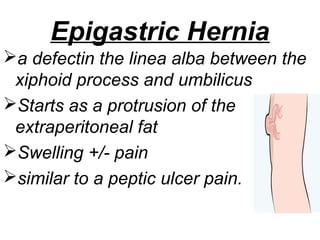
Epigastric Hernia
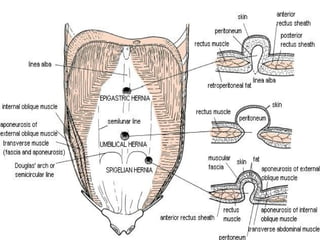
a defectin the linea alba between the
xiphoid process and umbilicus
Starts as a protrusion of the
extraperitoneal fat
Swelling +/- pain
similar to a peptic ulcer pain.
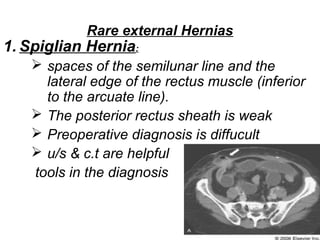
Rare external Hernias
1. Spiglian Hernia:
 spaces of the semilunar line and the
lateral edge of the rectus muscle (inferior
to the arcuate line).
 The posterior rectus sheath is weak
 Preoperative diagnosis is diffucult
 u/s & c.t are helpful
tools in the diagnosis
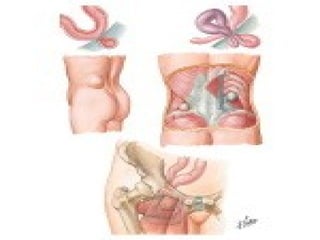
2-Lumbar Hernias:
broad bulging hernia
not vulnerable to incarceration.
A. Petit’s hernia: inferior lumbar triangle.
B. Grynfeltt’s Hernia:superior lumbar
triangle and is less common than Petit’s.
9 hernia

9 hernia

  • 1.
    Hernia & PR Dr.AbdulWAHIDM Salih M.D. Surgery
  • 2.
    Hernia • protrusion ofan organ or the fascia of an organ through the wall of the cavity that normally contains • Congenital, acquired • Most have an expansile cough impulse
  • 3.
    a Hernia composedof; 1.Sac: a folding of peritoneum consisting of a mouth, neck, body and fundus. 2.Body: which varies in size and is not necessarily occupied. 3.Coverings: derived from layers of the abdominal wall. 4.Contents: which could be anything from the omentum, intestines, ovary or urinary bladder.
  • 5.
    In children, • Specificallyin infants, the parents" observation of a swelling or protusion may be the only positive feature. • In the infancy may beTransilluminable
  • 6.
    Inguinal • Superficial inguinalring— 1.25 cm above and lateral to the pubic tubercle • Deep inguinal ring—1.25 cm above and medial to the mid point of inguinal ligament • Length of the inguinal canal —3.25cm
  • 7.
    Ingiunal canal Boundaries MALT:2M 2A, 2L, 2T: Superior wall [roof]: 2 Muscles: • Internal oblique Muscle • Transverse abdominus Muscle Anterior wall: 2 Aponeuroses: • Aponeurosis of external oblique • Aponeurosis of internal oblique Lower wall [floor]: 2 Ligaments: • Inguinal Ligament • Lacunar Ligament Posterior wall: 2Ts: • Transversalis fascia [laterally] • Conjoint Tendon [medially]
  • 8.
    Ingiunal canal Contents Ilioinguinalnerve. Spermatic cord, which contains: 3 arteries: • Testicular a. • Ductus deferens a. • Cremasteric a. 3 nerves: • Cremasteric n. • Genital branch of the genitofemoral n. • Autonomics 3 other things: • Ductus deferens • Pampiniform plexus • Lymphatics
  • 9.
    Types of indirectinguinal hernia 1. Incomplete; Bubonocele—limited within the inguinal canal Funicular—limited just above the epididymis 2.Complete; traverses to the bottom of the scrotum
  • 10.
    • Introduce yourself •Wash hands • Chaperone • Standing up • Undressed from waist down • Look for an visible lumps • Any scars, overlying skin changes. • The lump extends into the scrotum
  • 11.
    position •Pt. stands, exposedarea visible. •best performed with the patient standing and in supine •the physician seated on a stool
  • 12.
    prepare • Stand atthe side of the patient, • one hand on the patients back to support him. • hand and arm should be roughly parallel to the inguinal ligament when palpating the lump.
  • 13.
    • Observation ofthe groin area in oblique light • Visible swelling. Examine as a mass; (STEM; site,skin,size,shape,…) Mass
  • 14.
    Most important 1. Canyou get above it? 2. Reducibility test 3. Expansile Cough Impulse; 4. Invagination test 5. Three finger test Zieman’s technique 6. Ring occlusion test
  • 15.
    Also Asses • Intraor extra abdominal • Tension • Composition • Percussion and auscultation; Bowel Sounds • Always examine both groins • Tranillumination
  • 16.
    1-Cough Impulse •Pt. coughsto highlight hernia. •May not ;if the neck is blocked by adhesions •Visible & Palpable cough impulse. •Reappear on straining, standing or coughing
  • 17.
    2-Reducibility test • Askpt. to reduce hernia himselves • usually done in lying position. • The thigh of the affected side should be flexed, adducted and internally rotated. • Finger guard of the inguinal canal by thumb and index finger and then the scrotum is gently squeezed.
  • 18.
    Relation to Pubic Tubercle INGUINALHERNIA; The neck above and medial to the pubic tubercle FEMORAL HERNIA; The neck below and lateral to pubic tubercle
  • 19.
    3-Get above theswelling test • Done in standing position • At the root of the scrotum place the thumb in front and the index behind •Try to reach above the swelling. • Inguinal hernia; cannot get above • Pure scrotal swelling; will get above
  • 20.
    4-Invagination test •The scrotumon each side is inverted with the examining index finger •Entering the inguinal canal along the course of the cord structures. •The size of the external ring. •The finger push up to the superf inguinal ring. •The pulp should feel the ring. •Pat is asked to cough, •A palpable impulse will confirm the hernia; felt on the pulp then direct felt on the tip then indirect hernia.
  • 22.
    5-Three finger test/ Zieman’s technique Index finger; deep inguinal ring (indirect hernia) Middle finger; superficial ing. Ring (direct hernia) Ring finger; saphenous opening (femoral hernia) The patient is asked to cough.
  • 23.
    6-Ring occlusion test •Reducethe hernia •Occlusion of the deep ring by thumb. •Then holding the thumb in position ask The pt to stand then cough •If no bulging; indirect •If bulging; direct .
  • 24.
    Beside • Beside; atthe level of inguinal region at the affected side; Notice a small bulge Compare to the other side. • Stand beside the pt; your shoulder behind the opposite shoulder of pt; Reduce the hernia. Ask the pt to cough
  • 25.
    Examine the abdomen; CausesOf raised intraabd. pressure; • Enlarged bladder (BPH) • Ascites Search; predisposing factors;
  • 26.
    describe the hernia 1.Site (inguinal) 2. Right/Left 3. Reducible/Irreducible 4. Complete/Incomplete 5. Direct/Indirect
  • 27.
    •Any hernia thatis tender •Nausea and vomiting; •No attempt to reduce it manually. •An acute surgical emergency. Strangulation
  • 28.
    indirect summary •Relation toepigastric vessels;Relation to epigastric vessels; LataralLataral •Processus vaginalis;Processus vaginalis; PresentPresent •congenitalcongenital •Unilateral (usually). •always descends the scrotum •prone to obstruction and strangulation
  • 29.
    Direct summary •Bilateral •AcqiuredAcqiured •Processus vaginalis;Processusvaginalis; AbsentAbsent •Rarely strangulate; medial tomedial to epigastric vessels;epigastric vessels;
  • 30.
    Femoral Hernia (cont..) Femoralhernias are more common in women, present as a groin lump. the cause of unexplained small bowel obstruction. an absent Cough impulse globular lump than the pear shaped lump of the inguinal hernia. • Differential Diagnoses: Inguinal Hernia. Femoral Artery Aneurism. Femoral Lymphadenopathy. Psoas Abscess.
  • 31.
    Umbilical Hernia: • Ininfants & children. • Boys more than girls. • Tend to resolve without any treatment by around the age of 5 years. • Obstruction and strangulation is rare.
  • 32.
    Paraumbilical Hernia: • Affectsadults. • either supra or infraumbilical through the linea alba. • The female to male ratio is 20:1. • Clolicky pain and/or irreducibilty due to omental adhesions.
  • 33.
    Incisional Hernia • weaknessis the result of an incompletely healed surgical wound. • more along a straight line from the sternum down to the pubis. • Swelling at the incisional site +/- pain.
  • 34.
    Epigastric Hernia a defectinthe linea alba between the xiphoid process and umbilicus Starts as a protrusion of the extraperitoneal fat Swelling +/- pain similar to a peptic ulcer pain.
  • 35.
    Rare external Hernias 1.Spiglian Hernia:  spaces of the semilunar line and the lateral edge of the rectus muscle (inferior to the arcuate line).  The posterior rectus sheath is weak  Preoperative diagnosis is diffucult  u/s & c.t are helpful tools in the diagnosis
  • 37.
    2-Lumbar Hernias: broad bulginghernia not vulnerable to incarceration. A. Petit’s hernia: inferior lumbar triangle. B. Grynfeltt’s Hernia:superior lumbar triangle and is less common than Petit’s.