-Dr.Dnyanoba S. Holambe.
M.S.; D.N.B.(Surgery).
HERNIA
HERNI
A
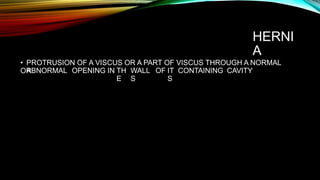
• PROTRUSION OF A VISCUS OR A PART OF VISCUS THROUGH A NORMAL
OR
ABNORMAL OPENING IN TH
E
WALL
S
OF IT
S
CONTAINING CAVITY
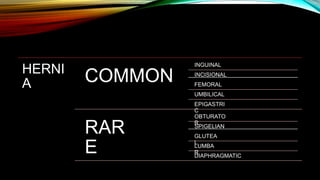
INGUINAL
HERNI
A COMMON INCISIONAL
FEMORAL
UMBILICAL
EPIGASTRI
C
OBTURATO
R
RAR
E
SPIGELIAN
GLUTEA
L
LUMBA
R
DIAPHRAGMATIC
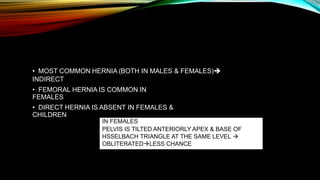
• MOST COMMON HERNIA (BOTH IN MALES & FEMALES)
INDIRECT
• FEMORAL HERNIA IS COMMON IN
FEMALES
• DIRECT HERNIA IS ABSENT IN FEMALES &
CHILDREN
IN FEMALES
PELVIS IS TILTED ANTERIORLY APEX & BASE OF
HSSELBACH TRIANGLE AT THE SAME LEVEL 
OBLITERATEDLESS CHANCE
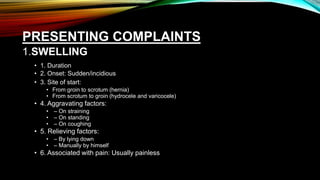
PRESENTING COMPLAINTS
1.SWELLING
• 1. Duration
• 2. Onset: Sudden/incidious
• 3. Site of start:
• From groin to scrotum (hernia)
• From scrotum to groin (hydrocele and varicocele)
• 4. Aggravating factors:
• – On straining
• – On standing
• – On coughing
• 5. Relieving factors:
• – By lying down
• – Manually by himself
• 6. Associated with pain: Usually painless
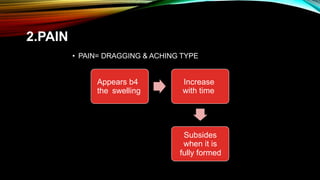
2.PAIN
• PAIN= DRAGGING & ACHING TYPE
Appears b4 Increase
with time
the swelling
Subsides
when it is
fully formed
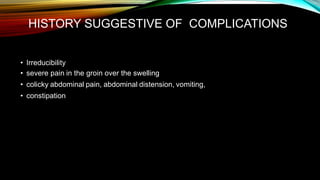
HISTORY SUGGESTIVE OF COMPLICATIONS
• Irreducibility
• severe pain in the groin over the swelling
• colicky abdominal pain, abdominal distension, vomiting,
• constipation
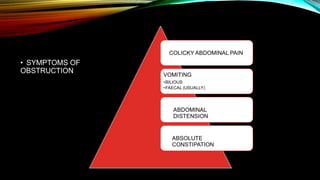
COLICKY ABDOMINAL PAIN
• SYMPTOMS OF
OBSTRUCTION VOMITING
•BILIOUS
•FAECAL (USUALLY)
ABDOMINAL
DISTENSION
ABSOLUTE
CONSTIPATION
PAS
T
HISTOR
Y
• TB BA
• PREVIOUS
SURGERY
•Damage to ilioinguinal nerve
 weak abdominal wall
DIRECT hernia
APPENDICECTOM
Y
•Same side
•Opposite side
RECURRENT
HERNIA
FAMILY HISTOR
Y
• CONNECTIVE TISSUE
DISORDERS
PERSONA
L
HISTOR
Y
• History of Smoking:
• Smoking leads to chronic bronchitis
• Collagen deficiency occurs in smokers.
LOCAL EXAMINATION
INSPECTIO
N
•
•
•
•
•
•
•
•
•
•
•
•
•
Patient in standing position
1. Site
2. Size
3. Shape
4. Extent
5. Surface
6. Skin over the swelling
7. Visible peristalsis
8. Cough impulse
9. Draining lymph nodes
10. Penis
11. Urethral meatus
12. Opposite scrotum
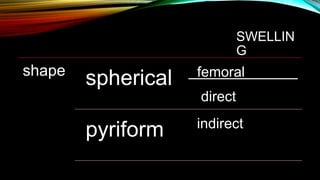
SWELLIN
G
shape femoral
spherical
direct
indirect
pyriform
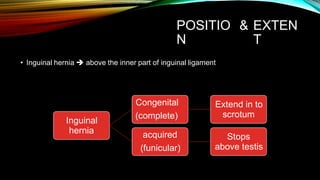
POSITIO
N
& EXTEN
T
• Inguinal hernia  above the inner part of inguinal ligament
Congenital
(complete)
Extend in to
scrotum
Inguinal
hernia acquired
(funicular)
Stops
above testis
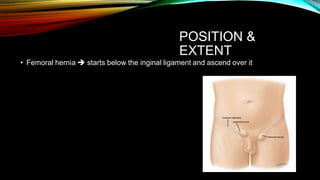
POSITION &
EXTENT
• Femoral hernia  starts below the inginal ligament and ascend over it
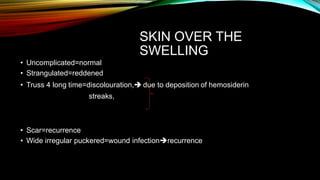
SKIN OVER THE
SWELLING
• Uncomplicated=normal
• Strangulated=reddened
• Truss 4 long time=discolouration, due to deposition of hemosiderin
streaks,
• Scar=recurrence
• Wide irregular puckered=wound infectionrecurrence
PALPATION
• 1. Temperature
• 2. Tenderness
• 3. Site
• 4. Size
• 5. Shape
• 6. Extent
• 7. Surface
• 8. Skin over the swelling
• 9. Consistency
• 10. Reducibility
• 11. Get above the swelling
• 12. Cough impulse
• 13. Invagination test
• 14. Ring occlusion test
• 15. Zieman's technique.
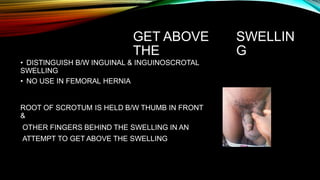
GET ABOVE
THE
SWELLIN
G
• DISTINGUISH B/W INGUINAL & INGUINOSCROTAL
SWELLING
• NO USE IN FEMORAL HERNIA
ROOT OF SCROTUM IS HELD B/W THUMB IN FRONT
&
OTHER FINGERS BEHIND THE SWELLING IN AN
ATTEMPT TO GET ABOVE THE SWELLING
CONSISTENC
Y
• DOUGHY & GRANULAR-
OMENTUM=OMENTOCELE
• ELASTIC-
INTESTINE=ENTEROCELE
• TENSE & TENDER- STRANGULATED
HERNIA
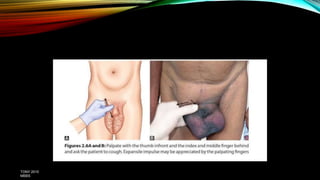
EXPANSILE IMPULSE
ON
COUGHING
• STANDING POSITION
• ABSENT IN CASE OF STRANGULATED & INCARCERATED
HERNIA
1. MOMENTARY BULGE IN SUPERFICIAL RING ON COUGHING
2. ROOT OF SCROTUM B/W INDEX FINGER & THUMB IS
SEPARATED
ON
COUGHING
TONY 2010
MBBS
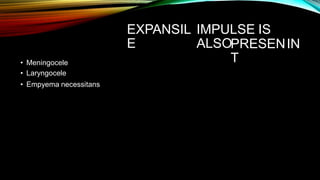
EXPANSIL
E
IMPULSE IS
ALSOPRESEN
T
IN
• Meningocele
• Laryngocele
• Empyema necessitans
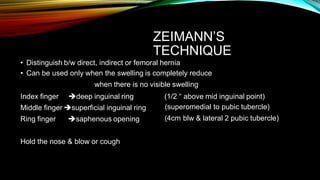
ZEIMANN’S
TECHNIQUE
• Distinguish b/w direct, indirect or femoral hernia
• Can be used only when the swelling is completely reduce
when there is no visible swelling
Index finger deep inguinal ring (1/2 “ above mid inguinal point)
(superomedial to pubic tubercle)
(4cm blw & lateral 2 pubic tubercle)
Middle finger superficial inguinal ring
Ring finger saphenous opening
Hold the nose & blow or cough
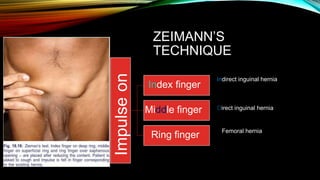
ZEIMANN’S
TECHNIQUE
Indirect inguinal hernia
Direct inguinal hernia
Femoral hernia
Impulse
on
Index finger
Middle finger
Ring finger
REDUCIBILIT
Y
• Reduces on lying down 
• Using TAXIS
direct hernia
Relaxes
superficial
inguinal ring +
oblique muscles
• Flexes the thigh
• Adduct the thigh
• Rotate internally
• Reduces with gurgling=>ENTEROCELE  Difficult to reduce initially but last
part slips of easily
• First part reduces easily last part difficultomentocele
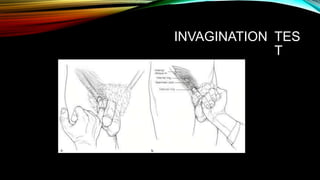
INVAGINATION TES
T
• After reduction of hernia in recumbent position
• Using little finger  rt. Hand side for rt. Side
lt. hand side for lt. side
• Invaginate skin 4m the bottom of scrotum & the little finger is pushed to
palpate pubic tubercle
• Finger is then rotated & pushed further up in to superficial inguinal ring
• Nail will be against spermatic cord pulp will feel walls of ring
• Normal ring transmits only tip of finger ,>1 finger}abnormally large
INVAGINATION TES
T
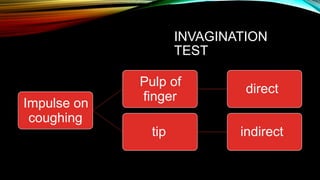
INVAGINATION
TEST
Pulp of
finger
direct
Impulse on
coughing
tip indirect
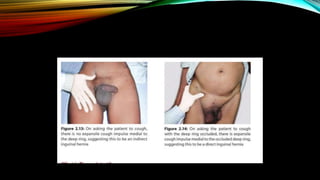
RING OCCLUSION TES
T
• Swelling appears even when deep ring is occluded=direct hernia
• No swelling when deep ring is occluded = indirect hernia
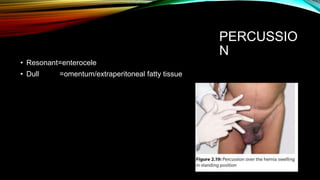
PERCUSSIO
N
• Resonant=enterocele
• Dull =omentum/extraperitoneal fatty tissue
AUSCULTATIO
N
• Peristaltic sounds=enterocele
EXAMINATION OF
TESTIS
,SPERMATIC CORDS &
EPIDIDYMIS
• Testis traction test: pull testis downwards
encysted hydrocele – descends Slightly & become fixed
inguinal Hernia-cant be fixed
EXAMINATION OF TONE
OF ABDOMINAL
• Inspectionprotrusion of lower abdominal wall
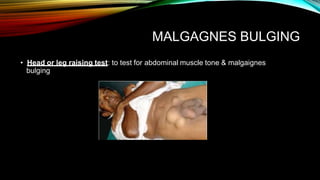
• Malgaigne’s bulging:
• oval shaped b/l bulge on straining above & parallel to medial
ligament
• weakness of abdominal wall
• DIRECT HERNIA
• HERNIOPLASTY IS REQUIRED
MUSCLE
S
half of inguinal
ABDOMINAL MUSCL
E
STRENGT
H
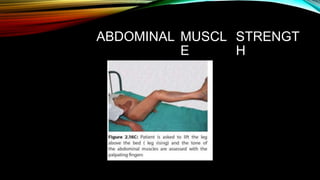
MALGAGNES BULGING
• Head or leg raising test: to test for abdominal muscle tone & malgaignes
bulging
SYSTEMI
C
EXAMINATION
• RESPIRATORY
SYSTEM
• R/O
• C/C BRONCHITIS
,TB
• ABDOMEN
• MASS
• ASCITES
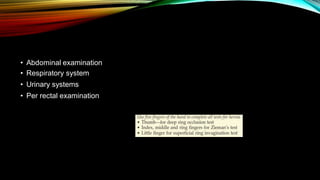
• Abdominal examination
• Respiratory system
• Urinary systems
• Per rectal examination
PER-
RECTAL
EXAMINATION
• 1. Benign Prostate hypertrophy—micturition difficulty
• 2.Malignant obstruction
• 3. Chronic fissure—constipation
• Diagnosis
• • Side—right/left
• • Type—indirect/direct
• • Inguinal—femoral
• • Complete/Incomplete
• • Complicated/Uncomplicated
• • Content—enterocele/omentocele
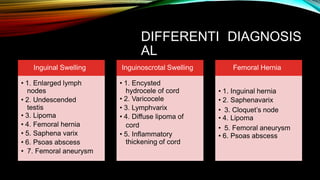
DIFFERENTI
AL
DIAGNOSIS
• 3. Cloquet’s node
• 5. Femoral aneurysm
Femoral Hernia
• 1. Inguinal hernia
• 2. Saphenavarix
• 4. Lipoma
• 6. Psoas abscess
Inguinoscrotal Swelling
• 1. Encysted
hydrocele of cord
• 2. Varicocele
• 3. Lymphvarix
• 4. Diffuse lipoma of
cord
• 5. Inflammatory
thickening of cord
Inguinal Swelling
• 1. Enlarged lymph
nodes
• 2. Undescended
testis
• 3. Lipoma
• 4. Femoral hernia
• 5. Saphena varix
• 6. Psoas abscess
• 7. Femoral aneurysm
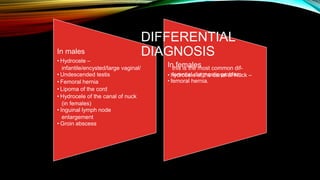
DIFFERENTIAL
DIAGNOSIS
In females
• hydrocele of the canal of Nuck –
In males
• Hydrocele –
infantile/encysted/large vaginal/
• Undescended testis
• Femoral hernia
• Lipoma of the cord
• Hydrocele of the canal of nuck
(in females)
• Inguinal lymph node
enlargement
• Groin abscess
this is the most common dif-
ferential diagnostic problem
• femoral hernia.
INVESTIGATION
S
• I. Routine
• • Hemoglobin
• • Bleeding time/Clotting time
• • Total count, differential count, ESR
• • Urine—albumin, sugar deposits
• • Blood—urea, sugar
• • Blood grouping/typing—for irreducible hernia/huge hernia
• II. Anesthetic Purpose
• • X-ray chest (Chronic TB, Asthma—precipitate hernia)
• • ECG all leads
• III. USG Abdomen and Pelvis
• • In old age group—to find benign prostate hyperplasia calculate post-voidal
residual urine. If >100 ml it is significant
• • To find any mass
TREATMEN
T
• TREATMENT
• Treat the precipitating cause of hernia first.
• 1. Benign prostate hypertrophy
• 2. Tuberculosis
• 3. Stop smoking
• Conservative management
• indicated only in cases of very old man with direct hernia; since there is no
chance of obstruction.
• TRUSS
• surgery
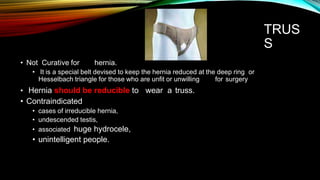
TRUS
S
• Not Curative for hernia.
• It is a special belt devised to keep the hernia reduced at the deep ring or
Hesselbach triangle for those who are unfit or unwilling for surgery
• Hernia should be reducible to
• Contraindicated
• cases of irreducible hernia,
• undescended testis,
• associated huge hydrocele,
• unintelligent people.
wear a truss.
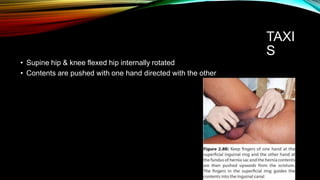
TAXI
S
• Supine hip & knee flexed hip internally rotated
• Contents are pushed with one hand directed with the other
TREATMEN
T
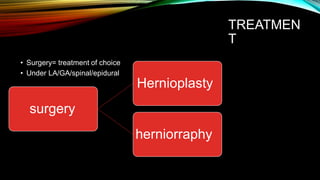
• Surgery= treatment of choice
• Under LA/GA/spinal/epidural
Hernioplasty
surgery
herniorraphy
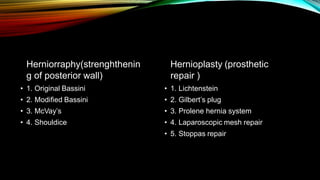
Herniorraphy(strenghthenin
g of posterior wall)
• 1. Original Bassini
• 2. Modified Bassini
• 3. McVay’s
• 4. Shouldice
Hernioplasty (prosthetic
repair )
• 1. Lichtenstein
• 2. Gilbert’s plug
• 3. Prolene hernia system
• 4. Laparoscopic mesh repair
• 5. Stoppas repair
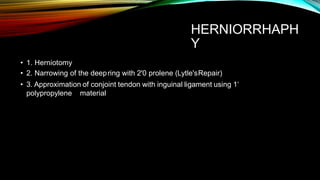
HERNIORRHAPH
Y
• 1. Herniotomy
• 2. Narrowing of the deepring with 2'0 prolene (Lytle'sRepair)
• 3. Approximation of conjoint tendon with inguinal ligament using 1‘
polypropylene material
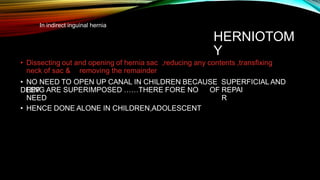
In indirect inguinal hernia
HERNIOTOM
Y
• Dissecting out and opening of hernia sac ,reducing any contents ,transfixing
neck of sac & removing the remainder
• NO NEED TO OPEN UP CANAL IN CHILDREN BECAUSE SUPERFICIAL AND
DEEP
RING ARE SUPERIMPOSED ……THERE FORE NO
NEED
• HENCE DONE ALONE IN CHILDREN,ADOLESCENT
OF REPAI
R
PROCEDUR
E
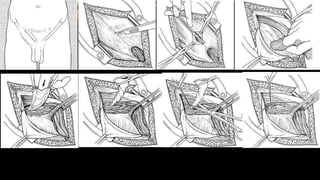
• ANAESTHESIA: spinal or G/A
• Incision is made parallel to medial 2/3rd of inguinal ligament about 1.25 cm
above inguinal ligament
• After dividing superficial fascia and securing hemostasis
• Identify external oblique muscle & superficial inguinal ring
• External oblique Apo neurosis is incised in the line of its fibers and is reflected
above and below.thus visualize inguinal ligament
• Ilioinguinal nerve is thus identified and preserved
• Herniotomy = ligation & excision of sac only
• Herniorraphy = herniotomy + repair of posterior wall
• Hernioplasty= herniotomy + reconstruction of posterior wall with prosthetics
HERNIORRHAPH
Y
• HERNIOTOMY+ REPAIR OF THE POSTERIOR WALL OF INGUINAL CANAL
BY
APPOSING CONJOINED MUSCLE TO THE
INGUINAL
LIGAMEN
T
• INDICATION
• IN ALL INDIRECT HERNIA EXCEPT IN
CHILDREN
• IN ADULTS WITH GOOD MUSCLE TONE
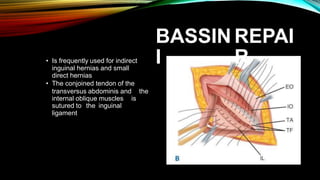
BASSIN
I
REPAI
R
• Is frequently used for indirect
inguinal hernias and small
direct hernias
• The conjoined tendon of the
transversus abdominis and the
internal oblique muscles is
sutured to
ligament
the inguinal
BASSINI
REPAIR
• The conjoined tendon is retracted upward
• the aponeurosis of the transversus abdominis muscle is approximated to the
iliopubic tract that lies adjacent to the inguinal ligament with several
interrupted 3-0 silk sutures.
• The second layer of the repair involves suturing the conjoined tendon to the
inguinal ligament with interrupted 2-0 silk sutures.
• This suture line extends from the pubic tubercle to the medial border of the
internal ring.
MODIFIED BASSINIS
REPAIR
• Most commonly used EARLIER
• Using non absorbable monofilament interrupted suture material
strengthening of posterior wall of inguinal canal approximation of conjoint tendon
to inguinal ligament
• Nonsorbable  adequate tensile strength for about 6 months
• Monofilamentpolyfilament has crevices=infn
• Interrupted continuous suture= decrease blood supply interfere with
healing
SHOULDICE
REPAIR
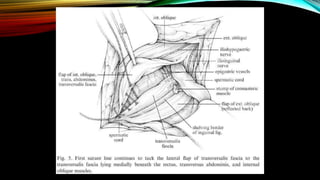
• With a no. 15 scalpel an incision is made in the transversalis fascia. This
incision is extended from the internal ring to the pubic tubercle.
• The repair involves placing four lines of sutures.
SHOULDICE
REPAIR
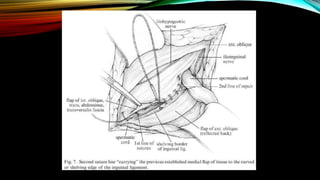
• The first suture line
• is started at the pubic tubercle using 3-0 continuous polypropylene, and the white
line is approximated to the free edge of the inferior transversalis fascial flap.
2nd
• The suture line :
• At the internal ring the suture is tied and then continued medially by
approximating the free edge of the superior flap to the shelving edge of the
inguinal ligament. When the pubic tubercle is reached, the suture is tied and divided.
SHOULDICE
REPAIR
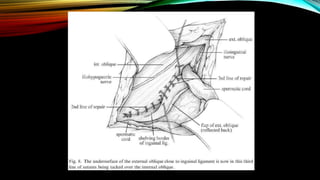
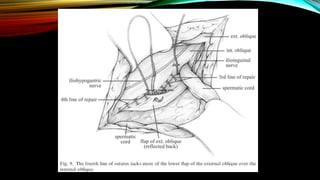
• The third suture line is started at the level of the internal ring where the conjoined
tendon is approximated to the inguinal ligament and tied when the pubic tubercle
is reached.
• Using the same suture, the fourth suture line attaches these same structures
to one another and istied at the level of the internal ring.
SHOULDICE
REPAIR
• The cord is replaced within the inguinal canal, and the external inguinal
aponeurosis isreapproximated with continuous 2-0 absorbable sutures
Tanner's muscle slide
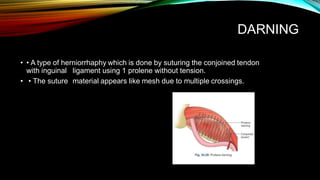
DARNING
• • A type of herniorrhaphy which is done by suturing the conjoined tendon
with inguinal
• • The suture
ligament using 1 prolene without tension.
material appears like mesh due to multiple crossings.
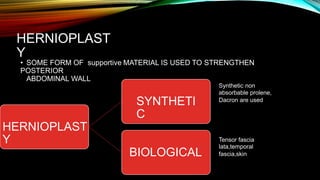
HERNIOPLAST
Y
• SOME FORM OF supportive MATERIAL IS USED TO STRENGTHEN
POSTERIOR
ABDOMINAL WALL
Synthetic non
absorbable prolene,
Dacron are used
SYNTHETI
C
HERNIOPLAST
Y Tensor fascia
lata,temporal
fascia,skin
BIOLOGICAL
INDICATION FORHERNIOPLAST
Y
• Direct hernia,
• Indirect hernia with poor muscle tone
• Recurrent hernia
• Re-recurrent hernia
• Incisional hernia
• Old age
• Sliding hernia
COMPLICATION
• Mesh extrusion
• Foreign body reaction
• infection
PRINCIPL
E
• Size of mesh >size of defect
• Attached above & below to conjoint tendon & inguinal ligament/abdominal
wall using non absorbable sutures
• Haemostasis, reduce risk of infection
TYPE
S
OF MES
H
REPAI
R
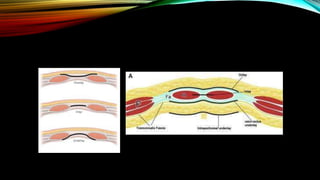
• 1. In lay mesh
• 2. On lay mesh
• 3. Nyhus preperitoneal mesh repair
• 4. Stoppa procedure
• 5. Gilbert mesh repair
• 6. Lichtenstein’s method
• 7. TAPP
• 8. TEP
ONLAY MESH
METHOD:
• repair by placing mesh in front…..using monofilament non absorbable suture
material….above to conjoint tendon & below to inguinal ligament
INLAY MES
H
METHOD
• mesh deep to conjoint tendon
NYHUS PREPERITONEAL MESH
REPAIR
• Broad mesh is kept in the preperitoneal space in b/l direct or recurrent hernia
LICHTENSTE
IN
TENSION FREE
MESH
REPAI
R
• Less recurrence
• Cord is covered with mesh and is sutured as in onlay method
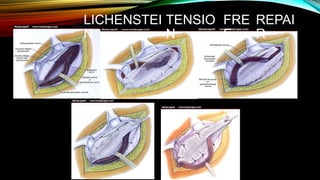
LICHENSTEI
N
TENSIO
N
FRE
E
REPAI
R
LAPAROSCOPI
CHERNI
A
REPAI
R
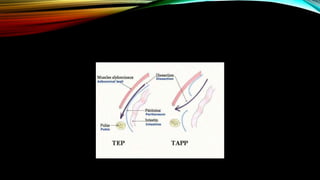
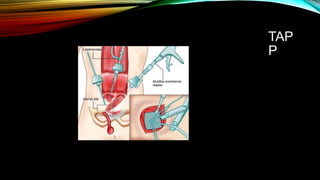
• Transabdominal Preperitoneal Procedure (TAPP)
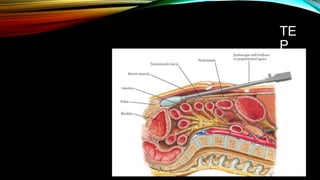
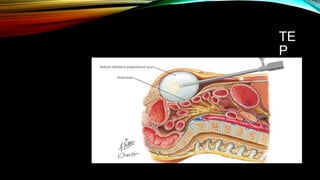
• Totally Extraperitoneal (TEP) Repair
• Indications include bilateral inguinal hernia, recurring
hernia, need for early recovery
TE
P
TE
P
TAP
P
COMPLICATIONS OF HERNI
A
REPAI
R
IMMEDIATE
1. Injury to the
LATE
1. Recurrence
2. Numbness over the
local region if the
nerve was cut during
surgery
EARLY
1. Urine retention
blood vessels
2.
3.
4.
Hematoma
Infection
Periostitis of pubic tubercle (as
(inferior epigastric and
femoral)
2. Injury to bowel and the stitch is taken from periosteum)
5. Postherniorrhaphy hydrocele
(due to obstruction of lymphatics
At deep ring when narrowed tightly)
bladder
3. Injury to ilioinguinal and
iliohypogastric nerves
4. Injury to cord structures
DISCUSSIO
N
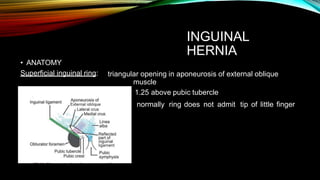
INGUINAL
HERNIA
• ANATOMY
Superficial inguinal ring: triangular opening in aponeurosis of external oblique
muscle
1.25 above pubic tubercle
normally ring does not admit tip of little finger
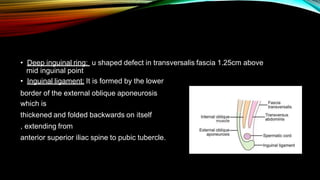
• Deep inguinal ring: u shaped defect in transversalis fascia 1.25cm above
mid inguinal point
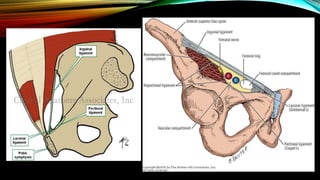
• Inguinal ligament: It is formed by the lower
border of the external oblique aponeurosis
which is
thickened and folded backwards on itself
, extending from
anterior superior iliac spine to pubic tubercle.
• Inguinal canal :
It is an oblique passage in lower part of abdominal wall, 4 cm long, situated
above the medial ½ of inguinal ligament,
extending from deep inguinal ring to superficial inguinal ring.
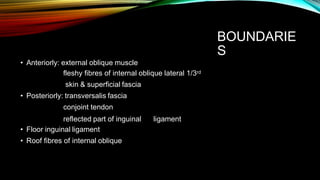
BOUNDARIE
S
• Anteriorly: external oblique muscle
fleshy fibres of internal oblique lateral 1/3rd
skin & superficial fascia
• Posteriorly: transversalis fascia
conjoint tendon
reflected part of inguinal
• Floor inguinal ligament
• Roof fibres of internal oblique
ligament
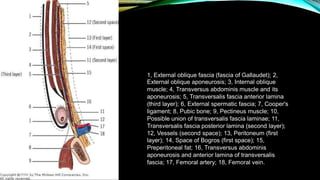
1, External oblique fascia (fascia of Gallaudet); 2,
External oblique aponeurosis; 3, Internal oblique
muscle; 4, Transversus abdominis muscle and its
aponeurosis; 5, Transversalis fascia anterior lamina
(third layer); 6, External spermatic fascia; 7, Cooper's
ligament; 8, Pubic bone; 9, Pectineus muscle; 10,
Possible union of transversalis fascia laminae; 11,
Transversalis fascia posterior lamina (second layer);
12, Vessels (second space); 13, Peritoneum (first
layer); 14, Space of Bogros (first space); 15,
Preperitoneal fat; 16, Transversus abdominis
aponeurosis and anterior lamina of transversalis
fascia; 17, Femoral artery; 18, Femoral vein.
TONY 2010
MBBS
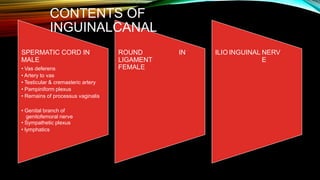
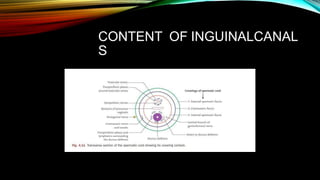
CONTENTS OF
INGUINALCANAL
SPERMATIC CORD IN
MALE
• Vas deferens
• Artery to vas
• Testicular & cremasteric artery
• Pampiniform plexus
• Remains of processus vaginalis
ROUND
LIGAMENT
FEMALE
IN ILIO INGUINAL NERV
E
• Genital branch of
genitofemoral nerve
• Sympathetic plexus
• lymphatics
CONTENT
S
OF INGUINALCANAL
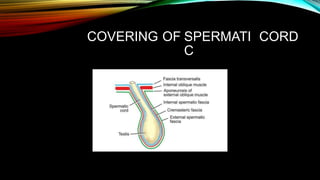
COVERING OF SPERMATI
C
CORD
DEFENCE MECHANISM
OF
INGUINAL CANAL
• Obliquity of inguinal canal
• Arching of conjoint tendon
• Shutter mechanism of internal oblique
• Ball valve mechanism due to contraction of cremasteric muscle
• Slit valve mechanism due to contraction of external oblique muscle
• hormone
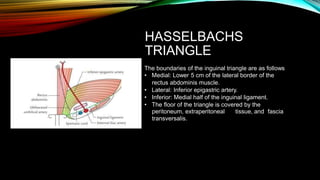
HASSELBACHS
TRIANGLE
The boundaries of the inguinal triangle are as follows
• Medial: Lower 5 cm of the lateral border of the
rectus abdominis muscle.
• Lateral: Inferior epigastric artery.
• Inferior: Medial half of the inguinal ligament.
• The floor of the triangle is covered by the
peritoneum, extraperitoneal
transversalis.
tissue, and fascia
ETIOLOG
Y
• STRAINING
C/C CONSTIPATION
(HABITUAL,STRICTURE)
URINARY PROBLEMS
 OLD AGE =BPH, Ca prostate
 YOUNG AGE=STRICTURE URETHRA
 VERY YOUNG=PHIMOSIS,MEATAL
STENOSIS
LIFTING OF HEAVY WEIGHT
• C/C COUGH =T.B, B.A, C/C BRONCHITIS
• OBESITY
• PREGNANCY
• SMOKING
• ASCITES
ETIOLOG
Y
•
APPENDICECTOMY
McBURNEYS INCISION
 DESTROY ILIO INGUINAL NDIRECT
INGUINALHERNIA
• FAMILIAL COLLAGEN DISORDER
• CONGENITAL PREFORMED SAC (REMAINS OF PROCESSUS
VAGINALIS)
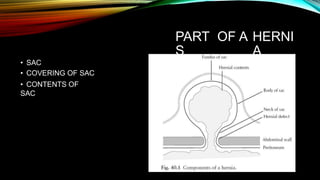
PART
S
OF A HERNI
A
• SAC
• COVERING OF SAC
• CONTENTS OF
SAC
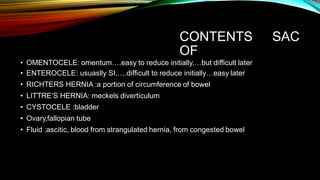
CONTENTS
OF
SAC
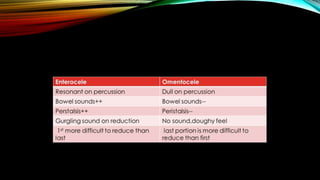
• OMENTOCELE: omentum….easy to reduce initially,…but difficult later
• ENTEROCELE: usuaslly SI,….difficult to reduce initially…easy later
• RICHTERS HERNIA :a portion of circumference of bowel
• LITTRE’S HERNIA: meckels diverticulum
• CYSTOCELE :bladder
• Ovary,fallopian tube
• Fluid :ascitic, blood from strangulated hernia, from congested bowel
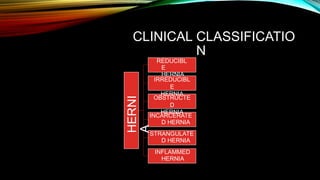
CLINICAL CLASSIFICATIO
N
HERNI
A
REDUCIBL
E
HERNIA
IRREDUCIBL
E
HERNIA
OBSTRUCTE
D
HERNIA
INCARCERATE
D HERNIA
STRANGULATE
D HERNIA
INFLAMMED
HERNIA
CLINICAL
CLASSIFICATION
• REDUCIBLE HERNIA contents can be reduced by the patient or surgeon
expansile impulse on coughing
• IRREDUCIBLE HERNIA
can’t be reduced …due to adhesions b/w contents
and sac…or due to crowding
irreducibility + no other symptoms}OMENTOCELE
Irreducibility predisposes to strangulation
 OBSTRUCTED HERNIA : bowel is obstructed…but blood supply is good
 INCARCERATED
HERNIA
that the lumen of that portion of the colon
occupying a hernial sac is blocked with faeces. In this case, the
scybalous contents of the bowel should be capable of being
indented with the finger, like putty.
In incarcerated hernia, sac and contents are densely
adherent to each other (contents are fixed to sac). It
is always irreducible; often obstructed but may not
be strangulated.
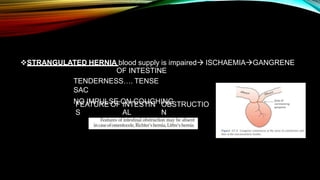
STRANGULATED HERNIA blood supply is impaired ISCHAEMIAGANGRENE
OF INTESTINE
TENDERNESS…. TENSE
SAC
NO IMPULSE ON COUGHING
FEATURE
S
OF INTESTIN
AL
OBSTRUCTIO
N
• INFLAMMED HERNIA
inflammation of contents
appendicitis,salpingitis
of hernia sac
CLASSIFICATIO
N
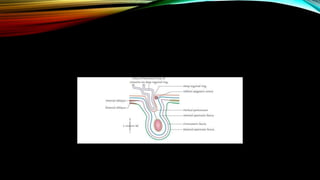
congenital
hernia
acquired
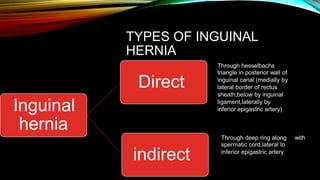
TYPES OF INGUINAL
HERNIA
Through hesselbachs
triangle in posterior wall of
inguinal canal (medially by
lateral border of rectus
sheath,below by inguinal
ligament,laterally by
inferior epigastric artery)
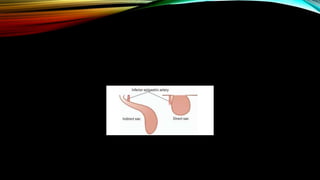
Direct
Inguinal
hernia
Through deep ring along
spermatic cord,lateral to
inferior epigastric artery
with
indirect
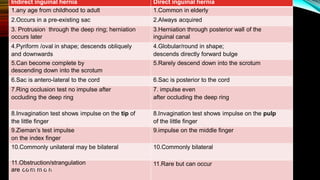
Indirect inguinal hernia Direct inguinal hernia
1.any age from childhood to adult 1.Common in elderly
2.Occurs in a pre-existing sac 2.Always acquired
3. Protrusion through the deep ring; herniation
occurs later
3.Herniation through posterior wall of the
inguinal canal
4.Pyriform /oval in shape; descends obliquely
and downwards
4.Globular/round in shape;
descends directly forward bulge
5.Can become complete by
descending down into the scrotum
5.Rarely descend down into the scrotum
6.Sac is antero-lateral to the cord 6.Sac is posterior to the cord
7.Ring occlusion test no impulse after
occluding the deep ring
7. impulse even
after occluding the deep ring
8.Invagination test shows impulse on the tip of
the little finger
8.Invagination test shows impulse on the pulp
of the little finger
9.Zieman’s test impulse
on the index finger
9.impulse on the middle finger
10.Commonly unilateral may be bilateral 10.Commonly bilateral
11.Obstruction/strangulation
areTO
cN
o
Y m
201m
0 M
o
BB
n
S
11.Rare but can occur
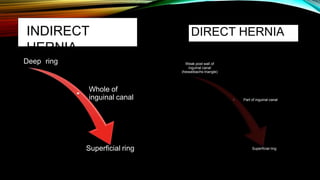
Deep ring Weak post wall of
inguinal canal
(hesselbachs triangle)
Whole of
inguinal canal Part of inguinal canal
Superficial ring Superficial ring
DIRECT HERNIA
INDIRECT
HERNIA
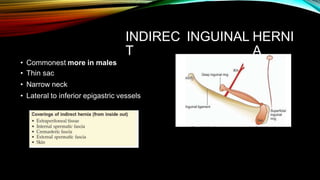
INDIREC
T
INGUINAL HERNI
A
• Commonest more in males
• Thin sac
• Narrow neck
• Lateral to inferior epigastric vessels
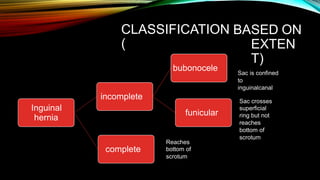
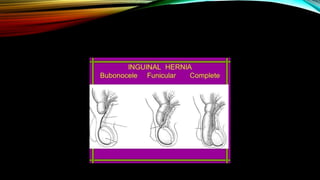
CLASSIFICATION
(
BASED ON
EXTEN
T)
Sac is confined
to
inguinalcanal
bubonocele
incomplete Sac crosses
superficial
ring but not
reaches
bottom of
scrotum
Inguinal
hernia
funicular
Reaches
bottom of
scrotum
complete
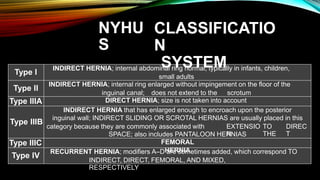
NYHU
S
CLASSIFICATIO
N
SYSTEM
small adults
inguinal canal; does not extend to the scrotum
category because they are commonly associated with EXTENSIO
N
TO
THE
DIREC
T
INDIRECT, DIRECT, FEMORAL, AND MIXED,
RESPECTIVELY
Type I
INDIRECT HERNIA; internal abdominal ring normal; typically in infants, children,
Type II
INDIRECT HERNIA; internal ring enlarged without impingement on the floor of the
Type IIIA DIRECT HERNIA; size is not taken into account
Type IIIB
INDIRECT HERNIA that has enlarged enough to encroach upon the posterior
inguinal wall; INDIRECT SLIDING OR SCROTAL HERNIAS are usually placed in this
SPACE; also includes PANTALOON HERNIAS
Type IIIC FEMORAL
HERNIA
Type IV
RECURRENT HERNIA; modifiers A–D are sometimes added, which correspond TO
DIREC
T
INGUINAL HERNI
A
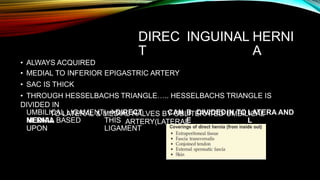
• ALWAYS ACQUIRED
• MEDIAL TO INFERIOR EPIGASTRIC ARTERY
• SAC IS THICK
• THROUGH HESSELBACHS TRIANGLE….. HESSELBACHS TRIANGLE IS
DIVIDED IN
TO LATERAL & MEDIAL HALVES BY OBLITERATED UMBILICAL
ARTERY(LATERAL
UMBILICAL LIGAMENT) DIRECT
HERNIA
CAN B
E
DIVIDEDIN TO LATERA
L
AND
MEDIAL BASED
UPON
THIS
LIGAMENT
2 CLASSICAL SIGNS
OF
UNCOMPLICATED HERNI
A
• Impulse on coughing
• Reducibility
COMPLICATIONS OF HERNI
A
• Irreducibility
• Obstructed hernia
• Strangulated hernia
• Inflammation
• Incarceration
IRREDUCIBILI
TY
• Adhesions of its contents to each other
• Adhesion of its contents with the sac
• Adhesion of one part of sac to other
• Sliding hernia
• Massive hernia (scrotal abdomen)
OBSTRUCTE
D
HERNI
A
• Irreducibility + intestinal obstruction ( lumen obstruction)
• It does not occur in
• Richters hernia
• Omentocele
• Littres hernia
• Features of obstructed hernia
• No expansile impulse on coughing
• Irreducible
• No pain
• Lax non tender
• symptoms
INCARCERATED
HERNIA
• When it contains a portion of colon with faeces  indenting with fingers
putty like feeling
STRANGULATE
D
HERNI
A
• Irredudicibility + intestinal obstruction + arrest of blood supply
• Due to constriction at the neck
SIGN
S
OF STRANGULATE
D
HERNI
A
• Tense
• Tender
• No impulse on coughing
• irreducible
• Recent increase in size
TREATMEN
T
• Raise the foot end (gravityredn of hernia)
• Ice bag applin  redue congestion & edema
• Nasogastric tube for gastric aspiration
• Iv fluid admn
• Parenteral antibiotics.
• Herniotomy open at the fundus & drain the fluid divide constriction ring &
examine the bowel for viability
• Nonviable Bowel
• Small bowel—end to end resection anastomosis
• Omentum—excise the gangrenous part.
• Non viable bowel
• Greenish/blackish in colour
• No peristalsis
• Gut is flaccid & lusture less
• Fluid of sac is bllod stained & foul smelling
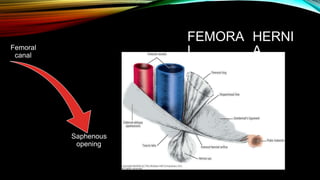
FEMORA
L
HERNI
A
Femoral
canal
Saphenous
opening
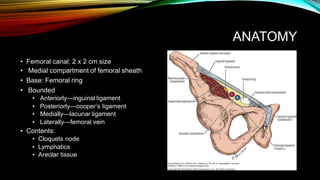
ANATOMY
• Femoral canal: 2 x 2 cm size
• Medial compartment of femoral sheath
• Base: Femoral ring
• Bounded
• Anteriorly—inguinal ligament
• Posteriorly—cooper’s ligament
• Medially—lacunar ligament
• Laterally—femoral vein
• Contents:
• Cloquets node
• Lymphatics
• Areolar tissue
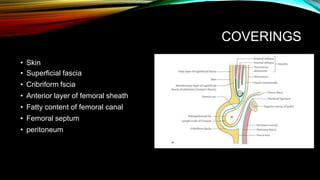
COVERINGS
• Skin
• Superficial fascia
• Cribriform fscia
• Anterior layer of femoral sheath
• Fatty content of femoral canal
• Femoral septum
• peritoneum
• Increased chance of strangulation
• F>M
• Uncommon in children
• Symptoms
• Pain
• Swelling
• Position
• Below & lateral to pubic tubercle
• Shape
• Globular/ retort (if large)
• Narrow neck
• Absent impulse on coughing
• Irreducible
• Strangulation
• consistency
• Position
• Zeimanns test
• Impulse on ring finger
• Invagination test
• Empty inguinal canal
• Ring occlusion of saphenous opening
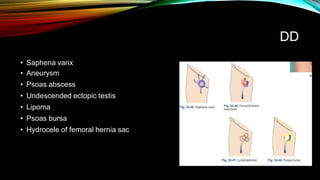
DD
• Saphena varix
• Aneurysm
• Psoas abscess
• Undescended ectopic testis
• Lipoma
• Psoas bursa
• Hydrocele of femoral hernia sac
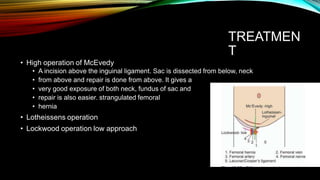
TREATMEN
T
• High operation of McEvedy
• A incision above the inguinal ligament. Sac is dissected from below, neck
• from above and repair is done from above. It gives a
• very good exposure of both neck, fundus of sac and
• repair is also easier. strangulated femoral
• hernia
• Lotheissens operation
• Lockwood operation low approach
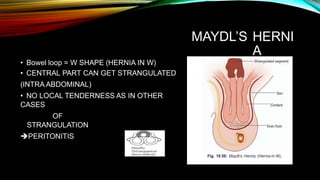
MAYDL’S HERNI
A
• Bowel loop = W SHAPE (HERNIA IN W)
• CENTRAL PART CAN GET STRANGULATED
(INTRA ABDOMINAL)
• NO LOCAL TENDERNESS AS IN OTHER
CASES
OF
STRANGULATION
PERITONITIS
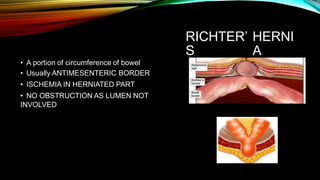
RICHTER’
S
HERNI
A
• A portion of circumference of bowel
• Usually ANTIMESENTERIC BORDER
• ISCHEMIA IN HERNIATED PART
• NO OBSTRUCTION AS LUMEN NOT
INVOLVED
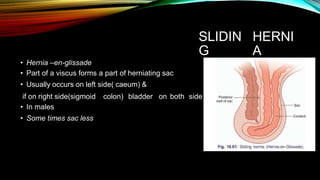
SLIDIN
G
HERNI
A
• Hernia –en-glissade
• Part of a viscus forms a part of herniating sac
• Usually occurs on left side( caeum) &
if on right side(sigmoid
• In males
• Some times sac less
colon) bladder on both side
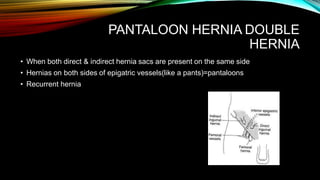
PANTALOON HERNIA DOUBLE
HERNIA
• When both direct & indirect hernia sacs are present on the same side
• Hernias on both sides of epigatric vessels(like a pants)=pantaloons
• Recurrent hernia
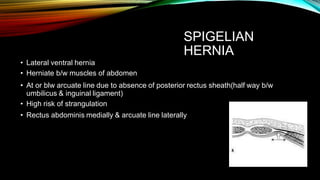
SPIGELIAN
HERNIA
• Lateral ventral hernia
• Herniate b/w muscles of abdomen
• At or blw arcuate line due to absence of posterior rectus sheath(half way b/w
umbilicus & inguinal ligament)
• High risk of strangulation
• Rectus abdominis medially & arcuate line laterally
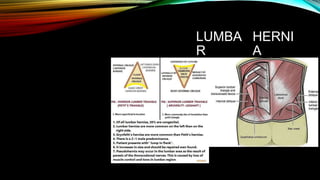
LUMBA
R
HERNI
A
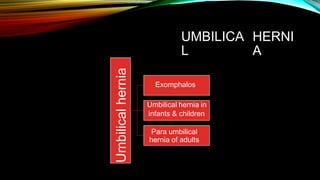
UMBILICA
L
HERNI
A
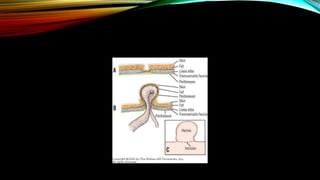
Umbilical
hernia
Exomphalos
Umbilical hernia in
infants & children
Para umbilical
hernia of adults
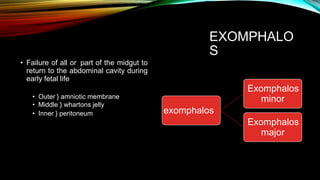
EXOMPHALO
S
• Failure of all or part of the midgut to
return to the abdominal cavity during
early fetal life
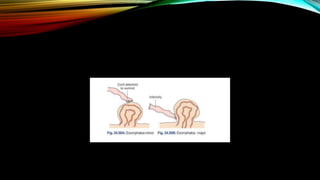
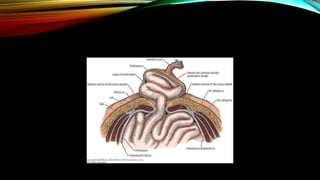
Exomphalos
minor
• Outer } amniotic membrane
• Middle } whartons jelly
• Inner } peritoneum exomphalos
Exomphalos
major
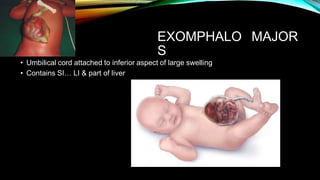
EXOMPHALO
S
MAJOR
• Umbilical cord attached to inferior aspect of large swelling
• Contains SI… LI & part of liver
• Exomphalos major may burst
• So emergency Sx is needed
EXOMPHALO
S
MINOR
• Sac is small
• Umbilical cord is attached to its summit
UMBILICA
L
HERNI
A
IN INFANTS
&
CHILDREN
S
• Through umbilical cicatrix
• Spherical in shape
• Increase in size in crying
PARAUMBILICA
L
HERNIA
OF
ADULT
S
• Not through umbilical cicatrix but through linea alba
• Above (supraumbilical)
• Below (infraumbilical)
INTERSTITI
AL
HERNI
A
• Hernial sac lies between muscle layers of abdominal wall
• Preperitoneal/intraparietal
• Interparietal
• Extraparietal
LITTRE’
S
HERNI
A
• Meckels diverticulum is the content
CAUSE
S
OF RECURRENCE
OFINGUINAL HERNI
A
• Failure to ligate the sac at the neck
• Increased tension
• Use of absorbable sutures
• Fault in selection of operation
• Infection
• Lifting of heavy weight with in 3 months
• Persistent predisposing factors
• Appearance of new hernia
HERNIA OF A HYDROCELE
LOCALIZED THINNING OF TUNICA LEADING TO PSEUDOPODIUM-LIKE
PROJECTION, USUALLY SEEN WHEN THE SAC IS THICK AND FLUID IS
UNDER
TENSION through
HYDROCELE OF A HERNIA
FLUID SEQUESTRATION IN A LOCULUS OF THE HERNIAL SAC, RESEMBLING
HYDROCELE. THIS IS SEEN IN LONG STANDING CASES WITH ADHESIONS
WITHIN
THE SAC
MORE COMMON IN VENTRAL HERNIA CONTAING OMENTUM
OGILVIE
HERNIA
• Direct hernias are always acquired. Indirect may be congenital or
acquired.
• Only congenital direct hernia is ogilvie hernia; through a rigid circular orifice
• in the conjoined tendon just lateral to where it inserts into the rectus sheath.

Hernia surgery lecture mbbs Maharashtra.pptx

  • 1.
    -Dr.Dnyanoba S. Holambe. M.S.;D.N.B.(Surgery). HERNIA
  • 2.
    HERNI A • PROTRUSION OFA VISCUS OR A PART OF VISCUS THROUGH A NORMAL OR ABNORMAL OPENING IN TH E WALL S OF IT S CONTAINING CAVITY
  • 3.
  • 4.
    • MOST COMMONHERNIA (BOTH IN MALES & FEMALES) INDIRECT • FEMORAL HERNIA IS COMMON IN FEMALES • DIRECT HERNIA IS ABSENT IN FEMALES & CHILDREN IN FEMALES PELVIS IS TILTED ANTERIORLY APEX & BASE OF HSSELBACH TRIANGLE AT THE SAME LEVEL  OBLITERATEDLESS CHANCE
  • 5.
    PRESENTING COMPLAINTS 1.SWELLING • 1.Duration • 2. Onset: Sudden/incidious • 3. Site of start: • From groin to scrotum (hernia) • From scrotum to groin (hydrocele and varicocele) • 4. Aggravating factors: • – On straining • – On standing • – On coughing • 5. Relieving factors: • – By lying down • – Manually by himself • 6. Associated with pain: Usually painless
  • 6.
    2.PAIN • PAIN= DRAGGING& ACHING TYPE Appears b4 Increase with time the swelling Subsides when it is fully formed
  • 7.
    HISTORY SUGGESTIVE OFCOMPLICATIONS • Irreducibility • severe pain in the groin over the swelling • colicky abdominal pain, abdominal distension, vomiting, • constipation
  • 8.
    COLICKY ABDOMINAL PAIN •SYMPTOMS OF OBSTRUCTION VOMITING •BILIOUS •FAECAL (USUALLY) ABDOMINAL DISTENSION ABSOLUTE CONSTIPATION
  • 9.
    PAS T HISTOR Y • TB BA •PREVIOUS SURGERY •Damage to ilioinguinal nerve  weak abdominal wall DIRECT hernia APPENDICECTOM Y •Same side •Opposite side RECURRENT HERNIA
  • 10.
  • 11.
    PERSONA L HISTOR Y • History ofSmoking: • Smoking leads to chronic bronchitis • Collagen deficiency occurs in smokers.
  • 12.
  • 13.
    INSPECTIO N • • • • • • • • • • • • • Patient in standingposition 1. Site 2. Size 3. Shape 4. Extent 5. Surface 6. Skin over the swelling 7. Visible peristalsis 8. Cough impulse 9. Draining lymph nodes 10. Penis 11. Urethral meatus 12. Opposite scrotum
  • 14.
  • 15.
    POSITIO N & EXTEN T • Inguinalhernia  above the inner part of inguinal ligament Congenital (complete) Extend in to scrotum Inguinal hernia acquired (funicular) Stops above testis
  • 16.
    POSITION & EXTENT • Femoralhernia  starts below the inginal ligament and ascend over it
  • 17.
    SKIN OVER THE SWELLING •Uncomplicated=normal • Strangulated=reddened • Truss 4 long time=discolouration, due to deposition of hemosiderin streaks, • Scar=recurrence • Wide irregular puckered=wound infectionrecurrence
  • 18.
    PALPATION • 1. Temperature •2. Tenderness • 3. Site • 4. Size • 5. Shape • 6. Extent • 7. Surface • 8. Skin over the swelling • 9. Consistency • 10. Reducibility • 11. Get above the swelling • 12. Cough impulse • 13. Invagination test • 14. Ring occlusion test • 15. Zieman's technique.
  • 19.
    GET ABOVE THE SWELLIN G • DISTINGUISHB/W INGUINAL & INGUINOSCROTAL SWELLING • NO USE IN FEMORAL HERNIA ROOT OF SCROTUM IS HELD B/W THUMB IN FRONT & OTHER FINGERS BEHIND THE SWELLING IN AN ATTEMPT TO GET ABOVE THE SWELLING
  • 20.
    CONSISTENC Y • DOUGHY &GRANULAR- OMENTUM=OMENTOCELE • ELASTIC- INTESTINE=ENTEROCELE • TENSE & TENDER- STRANGULATED HERNIA
  • 21.
    EXPANSILE IMPULSE ON COUGHING • STANDINGPOSITION • ABSENT IN CASE OF STRANGULATED & INCARCERATED HERNIA 1. MOMENTARY BULGE IN SUPERFICIAL RING ON COUGHING 2. ROOT OF SCROTUM B/W INDEX FINGER & THUMB IS SEPARATED ON COUGHING
  • 22.
  • 23.
  • 24.
    ZEIMANN’S TECHNIQUE • Distinguish b/wdirect, indirect or femoral hernia • Can be used only when the swelling is completely reduce when there is no visible swelling Index finger deep inguinal ring (1/2 “ above mid inguinal point) (superomedial to pubic tubercle) (4cm blw & lateral 2 pubic tubercle) Middle finger superficial inguinal ring Ring finger saphenous opening Hold the nose & blow or cough
  • 25.
    ZEIMANN’S TECHNIQUE Indirect inguinal hernia Directinguinal hernia Femoral hernia Impulse on Index finger Middle finger Ring finger
  • 26.
    REDUCIBILIT Y • Reduces onlying down  • Using TAXIS direct hernia Relaxes superficial inguinal ring + oblique muscles • Flexes the thigh • Adduct the thigh • Rotate internally • Reduces with gurgling=>ENTEROCELE  Difficult to reduce initially but last part slips of easily • First part reduces easily last part difficultomentocele
  • 27.
    INVAGINATION TES T • Afterreduction of hernia in recumbent position • Using little finger  rt. Hand side for rt. Side lt. hand side for lt. side • Invaginate skin 4m the bottom of scrotum & the little finger is pushed to palpate pubic tubercle • Finger is then rotated & pushed further up in to superficial inguinal ring • Nail will be against spermatic cord pulp will feel walls of ring • Normal ring transmits only tip of finger ,>1 finger}abnormally large
  • 28.
  • 29.
  • 30.
    RING OCCLUSION TES T •Swelling appears even when deep ring is occluded=direct hernia • No swelling when deep ring is occluded = indirect hernia
  • 32.
    PERCUSSIO N • Resonant=enterocele • Dull=omentum/extraperitoneal fatty tissue
  • 33.
  • 34.
    EXAMINATION OF TESTIS ,SPERMATIC CORDS& EPIDIDYMIS • Testis traction test: pull testis downwards encysted hydrocele – descends Slightly & become fixed inguinal Hernia-cant be fixed
  • 35.
    EXAMINATION OF TONE OFABDOMINAL • Inspectionprotrusion of lower abdominal wall • Malgaigne’s bulging: • oval shaped b/l bulge on straining above & parallel to medial ligament • weakness of abdominal wall • DIRECT HERNIA • HERNIOPLASTY IS REQUIRED MUSCLE S half of inguinal
  • 36.
  • 37.
    MALGAGNES BULGING • Heador leg raising test: to test for abdominal muscle tone & malgaignes bulging
  • 38.
    SYSTEMI C EXAMINATION • RESPIRATORY SYSTEM • R/O •C/C BRONCHITIS ,TB • ABDOMEN • MASS • ASCITES
  • 39.
    • Abdominal examination •Respiratory system • Urinary systems • Per rectal examination
  • 40.
    PER- RECTAL EXAMINATION • 1. BenignProstate hypertrophy—micturition difficulty • 2.Malignant obstruction • 3. Chronic fissure—constipation
  • 41.
    • Diagnosis • •Side—right/left • • Type—indirect/direct • • Inguinal—femoral • • Complete/Incomplete • • Complicated/Uncomplicated • • Content—enterocele/omentocele
  • 42.
    DIFFERENTI AL DIAGNOSIS • 3. Cloquet’snode • 5. Femoral aneurysm Femoral Hernia • 1. Inguinal hernia • 2. Saphenavarix • 4. Lipoma • 6. Psoas abscess Inguinoscrotal Swelling • 1. Encysted hydrocele of cord • 2. Varicocele • 3. Lymphvarix • 4. Diffuse lipoma of cord • 5. Inflammatory thickening of cord Inguinal Swelling • 1. Enlarged lymph nodes • 2. Undescended testis • 3. Lipoma • 4. Femoral hernia • 5. Saphena varix • 6. Psoas abscess • 7. Femoral aneurysm
  • 43.
    DIFFERENTIAL DIAGNOSIS In females • hydroceleof the canal of Nuck – In males • Hydrocele – infantile/encysted/large vaginal/ • Undescended testis • Femoral hernia • Lipoma of the cord • Hydrocele of the canal of nuck (in females) • Inguinal lymph node enlargement • Groin abscess this is the most common dif- ferential diagnostic problem • femoral hernia.
  • 44.
    INVESTIGATION S • I. Routine •• Hemoglobin • • Bleeding time/Clotting time • • Total count, differential count, ESR • • Urine—albumin, sugar deposits • • Blood—urea, sugar • • Blood grouping/typing—for irreducible hernia/huge hernia • II. Anesthetic Purpose • • X-ray chest (Chronic TB, Asthma—precipitate hernia) • • ECG all leads • III. USG Abdomen and Pelvis • • In old age group—to find benign prostate hyperplasia calculate post-voidal residual urine. If >100 ml it is significant • • To find any mass
  • 45.
    TREATMEN T • TREATMENT • Treatthe precipitating cause of hernia first. • 1. Benign prostate hypertrophy • 2. Tuberculosis • 3. Stop smoking • Conservative management • indicated only in cases of very old man with direct hernia; since there is no chance of obstruction. • TRUSS • surgery
  • 46.
    TRUS S • Not Curativefor hernia. • It is a special belt devised to keep the hernia reduced at the deep ring or Hesselbach triangle for those who are unfit or unwilling for surgery • Hernia should be reducible to • Contraindicated • cases of irreducible hernia, • undescended testis, • associated huge hydrocele, • unintelligent people. wear a truss.
  • 47.
    TAXI S • Supine hip& knee flexed hip internally rotated • Contents are pushed with one hand directed with the other
  • 48.
    TREATMEN T • Surgery= treatmentof choice • Under LA/GA/spinal/epidural Hernioplasty surgery herniorraphy
  • 49.
    Herniorraphy(strenghthenin g of posteriorwall) • 1. Original Bassini • 2. Modified Bassini • 3. McVay’s • 4. Shouldice Hernioplasty (prosthetic repair ) • 1. Lichtenstein • 2. Gilbert’s plug • 3. Prolene hernia system • 4. Laparoscopic mesh repair • 5. Stoppas repair
  • 50.
    HERNIORRHAPH Y • 1. Herniotomy •2. Narrowing of the deepring with 2'0 prolene (Lytle'sRepair) • 3. Approximation of conjoint tendon with inguinal ligament using 1‘ polypropylene material
  • 51.
    In indirect inguinalhernia HERNIOTOM Y • Dissecting out and opening of hernia sac ,reducing any contents ,transfixing neck of sac & removing the remainder • NO NEED TO OPEN UP CANAL IN CHILDREN BECAUSE SUPERFICIAL AND DEEP RING ARE SUPERIMPOSED ……THERE FORE NO NEED • HENCE DONE ALONE IN CHILDREN,ADOLESCENT OF REPAI R
  • 53.
    PROCEDUR E • ANAESTHESIA: spinalor G/A • Incision is made parallel to medial 2/3rd of inguinal ligament about 1.25 cm above inguinal ligament • After dividing superficial fascia and securing hemostasis • Identify external oblique muscle & superficial inguinal ring • External oblique Apo neurosis is incised in the line of its fibers and is reflected above and below.thus visualize inguinal ligament • Ilioinguinal nerve is thus identified and preserved
  • 54.
    • Herniotomy =ligation & excision of sac only • Herniorraphy = herniotomy + repair of posterior wall • Hernioplasty= herniotomy + reconstruction of posterior wall with prosthetics
  • 55.
    HERNIORRHAPH Y • HERNIOTOMY+ REPAIROF THE POSTERIOR WALL OF INGUINAL CANAL BY APPOSING CONJOINED MUSCLE TO THE INGUINAL LIGAMEN T • INDICATION • IN ALL INDIRECT HERNIA EXCEPT IN CHILDREN • IN ADULTS WITH GOOD MUSCLE TONE
  • 56.
    BASSIN I REPAI R • Is frequentlyused for indirect inguinal hernias and small direct hernias • The conjoined tendon of the transversus abdominis and the internal oblique muscles is sutured to ligament the inguinal
  • 57.
    BASSINI REPAIR • The conjoinedtendon is retracted upward • the aponeurosis of the transversus abdominis muscle is approximated to the iliopubic tract that lies adjacent to the inguinal ligament with several interrupted 3-0 silk sutures. • The second layer of the repair involves suturing the conjoined tendon to the inguinal ligament with interrupted 2-0 silk sutures. • This suture line extends from the pubic tubercle to the medial border of the internal ring.
  • 58.
    MODIFIED BASSINIS REPAIR • Mostcommonly used EARLIER • Using non absorbable monofilament interrupted suture material strengthening of posterior wall of inguinal canal approximation of conjoint tendon to inguinal ligament • Nonsorbable  adequate tensile strength for about 6 months • Monofilamentpolyfilament has crevices=infn • Interrupted continuous suture= decrease blood supply interfere with healing
  • 59.
    SHOULDICE REPAIR • With ano. 15 scalpel an incision is made in the transversalis fascia. This incision is extended from the internal ring to the pubic tubercle. • The repair involves placing four lines of sutures.
  • 60.
    SHOULDICE REPAIR • The firstsuture line • is started at the pubic tubercle using 3-0 continuous polypropylene, and the white line is approximated to the free edge of the inferior transversalis fascial flap. 2nd • The suture line : • At the internal ring the suture is tied and then continued medially by approximating the free edge of the superior flap to the shelving edge of the inguinal ligament. When the pubic tubercle is reached, the suture is tied and divided.
  • 61.
    SHOULDICE REPAIR • The thirdsuture line is started at the level of the internal ring where the conjoined tendon is approximated to the inguinal ligament and tied when the pubic tubercle is reached. • Using the same suture, the fourth suture line attaches these same structures to one another and istied at the level of the internal ring.
  • 62.
    SHOULDICE REPAIR • The cordis replaced within the inguinal canal, and the external inguinal aponeurosis isreapproximated with continuous 2-0 absorbable sutures
  • 66.
  • 67.
    DARNING • • Atype of herniorrhaphy which is done by suturing the conjoined tendon with inguinal • • The suture ligament using 1 prolene without tension. material appears like mesh due to multiple crossings.
  • 68.
    HERNIOPLAST Y • SOME FORMOF supportive MATERIAL IS USED TO STRENGTHEN POSTERIOR ABDOMINAL WALL Synthetic non absorbable prolene, Dacron are used SYNTHETI C HERNIOPLAST Y Tensor fascia lata,temporal fascia,skin BIOLOGICAL
  • 69.
    INDICATION FORHERNIOPLAST Y • Directhernia, • Indirect hernia with poor muscle tone • Recurrent hernia • Re-recurrent hernia • Incisional hernia • Old age • Sliding hernia
  • 70.
    COMPLICATION • Mesh extrusion •Foreign body reaction • infection
  • 71.
    PRINCIPL E • Size ofmesh >size of defect • Attached above & below to conjoint tendon & inguinal ligament/abdominal wall using non absorbable sutures • Haemostasis, reduce risk of infection
  • 72.
    TYPE S OF MES H REPAI R • 1.In lay mesh • 2. On lay mesh • 3. Nyhus preperitoneal mesh repair • 4. Stoppa procedure • 5. Gilbert mesh repair • 6. Lichtenstein’s method • 7. TAPP • 8. TEP
  • 74.
    ONLAY MESH METHOD: • repairby placing mesh in front…..using monofilament non absorbable suture material….above to conjoint tendon & below to inguinal ligament
  • 75.
    INLAY MES H METHOD • meshdeep to conjoint tendon
  • 76.
    NYHUS PREPERITONEAL MESH REPAIR •Broad mesh is kept in the preperitoneal space in b/l direct or recurrent hernia
  • 77.
    LICHTENSTE IN TENSION FREE MESH REPAI R • Lessrecurrence • Cord is covered with mesh and is sutured as in onlay method
  • 78.
  • 79.
    LAPAROSCOPI CHERNI A REPAI R • Transabdominal PreperitonealProcedure (TAPP) • Totally Extraperitoneal (TEP) Repair • Indications include bilateral inguinal hernia, recurring hernia, need for early recovery
  • 81.
  • 82.
  • 83.
  • 84.
    COMPLICATIONS OF HERNI A REPAI R IMMEDIATE 1.Injury to the LATE 1. Recurrence 2. Numbness over the local region if the nerve was cut during surgery EARLY 1. Urine retention blood vessels 2. 3. 4. Hematoma Infection Periostitis of pubic tubercle (as (inferior epigastric and femoral) 2. Injury to bowel and the stitch is taken from periosteum) 5. Postherniorrhaphy hydrocele (due to obstruction of lymphatics At deep ring when narrowed tightly) bladder 3. Injury to ilioinguinal and iliohypogastric nerves 4. Injury to cord structures
  • 85.
  • 86.
    INGUINAL HERNIA • ANATOMY Superficial inguinalring: triangular opening in aponeurosis of external oblique muscle 1.25 above pubic tubercle normally ring does not admit tip of little finger
  • 87.
    • Deep inguinalring: u shaped defect in transversalis fascia 1.25cm above mid inguinal point • Inguinal ligament: It is formed by the lower border of the external oblique aponeurosis which is thickened and folded backwards on itself , extending from anterior superior iliac spine to pubic tubercle.
  • 88.
    • Inguinal canal: It is an oblique passage in lower part of abdominal wall, 4 cm long, situated above the medial ½ of inguinal ligament, extending from deep inguinal ring to superficial inguinal ring.
  • 89.
    BOUNDARIE S • Anteriorly: externaloblique muscle fleshy fibres of internal oblique lateral 1/3rd skin & superficial fascia • Posteriorly: transversalis fascia conjoint tendon reflected part of inguinal • Floor inguinal ligament • Roof fibres of internal oblique ligament
  • 90.
    1, External obliquefascia (fascia of Gallaudet); 2, External oblique aponeurosis; 3, Internal oblique muscle; 4, Transversus abdominis muscle and its aponeurosis; 5, Transversalis fascia anterior lamina (third layer); 6, External spermatic fascia; 7, Cooper's ligament; 8, Pubic bone; 9, Pectineus muscle; 10, Possible union of transversalis fascia laminae; 11, Transversalis fascia posterior lamina (second layer); 12, Vessels (second space); 13, Peritoneum (first layer); 14, Space of Bogros (first space); 15, Preperitoneal fat; 16, Transversus abdominis aponeurosis and anterior lamina of transversalis fascia; 17, Femoral artery; 18, Femoral vein. TONY 2010 MBBS
  • 92.
    CONTENTS OF INGUINALCANAL SPERMATIC CORDIN MALE • Vas deferens • Artery to vas • Testicular & cremasteric artery • Pampiniform plexus • Remains of processus vaginalis ROUND LIGAMENT FEMALE IN ILIO INGUINAL NERV E • Genital branch of genitofemoral nerve • Sympathetic plexus • lymphatics
  • 93.
  • 94.
  • 95.
    DEFENCE MECHANISM OF INGUINAL CANAL •Obliquity of inguinal canal • Arching of conjoint tendon • Shutter mechanism of internal oblique • Ball valve mechanism due to contraction of cremasteric muscle • Slit valve mechanism due to contraction of external oblique muscle • hormone
  • 96.
    HASSELBACHS TRIANGLE The boundaries ofthe inguinal triangle are as follows • Medial: Lower 5 cm of the lateral border of the rectus abdominis muscle. • Lateral: Inferior epigastric artery. • Inferior: Medial half of the inguinal ligament. • The floor of the triangle is covered by the peritoneum, extraperitoneal transversalis. tissue, and fascia
  • 97.
    ETIOLOG Y • STRAINING C/C CONSTIPATION (HABITUAL,STRICTURE) URINARYPROBLEMS  OLD AGE =BPH, Ca prostate  YOUNG AGE=STRICTURE URETHRA  VERY YOUNG=PHIMOSIS,MEATAL STENOSIS LIFTING OF HEAVY WEIGHT • C/C COUGH =T.B, B.A, C/C BRONCHITIS • OBESITY • PREGNANCY • SMOKING • ASCITES
  • 98.
    ETIOLOG Y • APPENDICECTOMY McBURNEYS INCISION  DESTROYILIO INGUINAL NDIRECT INGUINALHERNIA • FAMILIAL COLLAGEN DISORDER • CONGENITAL PREFORMED SAC (REMAINS OF PROCESSUS VAGINALIS)
  • 99.
    PART S OF A HERNI A •SAC • COVERING OF SAC • CONTENTS OF SAC
  • 100.
    CONTENTS OF SAC • OMENTOCELE: omentum….easyto reduce initially,…but difficult later • ENTEROCELE: usuaslly SI,….difficult to reduce initially…easy later • RICHTERS HERNIA :a portion of circumference of bowel • LITTRE’S HERNIA: meckels diverticulum • CYSTOCELE :bladder • Ovary,fallopian tube • Fluid :ascitic, blood from strangulated hernia, from congested bowel
  • 102.
  • 103.
    CLINICAL CLASSIFICATION • REDUCIBLE HERNIAcontents can be reduced by the patient or surgeon expansile impulse on coughing
  • 104.
    • IRREDUCIBLE HERNIA can’tbe reduced …due to adhesions b/w contents and sac…or due to crowding irreducibility + no other symptoms}OMENTOCELE Irreducibility predisposes to strangulation
  • 105.
     OBSTRUCTED HERNIA: bowel is obstructed…but blood supply is good
  • 106.
     INCARCERATED HERNIA that thelumen of that portion of the colon occupying a hernial sac is blocked with faeces. In this case, the scybalous contents of the bowel should be capable of being indented with the finger, like putty. In incarcerated hernia, sac and contents are densely adherent to each other (contents are fixed to sac). It is always irreducible; often obstructed but may not be strangulated.
  • 107.
    STRANGULATED HERNIA bloodsupply is impaired ISCHAEMIAGANGRENE OF INTESTINE TENDERNESS…. TENSE SAC NO IMPULSE ON COUGHING FEATURE S OF INTESTIN AL OBSTRUCTIO N
  • 108.
    • INFLAMMED HERNIA inflammationof contents appendicitis,salpingitis of hernia sac
  • 109.
  • 110.
    TYPES OF INGUINAL HERNIA Throughhesselbachs triangle in posterior wall of inguinal canal (medially by lateral border of rectus sheath,below by inguinal ligament,laterally by inferior epigastric artery) Direct Inguinal hernia Through deep ring along spermatic cord,lateral to inferior epigastric artery with indirect
  • 111.
    Indirect inguinal herniaDirect inguinal hernia 1.any age from childhood to adult 1.Common in elderly 2.Occurs in a pre-existing sac 2.Always acquired 3. Protrusion through the deep ring; herniation occurs later 3.Herniation through posterior wall of the inguinal canal 4.Pyriform /oval in shape; descends obliquely and downwards 4.Globular/round in shape; descends directly forward bulge 5.Can become complete by descending down into the scrotum 5.Rarely descend down into the scrotum 6.Sac is antero-lateral to the cord 6.Sac is posterior to the cord 7.Ring occlusion test no impulse after occluding the deep ring 7. impulse even after occluding the deep ring 8.Invagination test shows impulse on the tip of the little finger 8.Invagination test shows impulse on the pulp of the little finger 9.Zieman’s test impulse on the index finger 9.impulse on the middle finger 10.Commonly unilateral may be bilateral 10.Commonly bilateral 11.Obstruction/strangulation areTO cN o Y m 201m 0 M o BB n S 11.Rare but can occur
  • 113.
    Deep ring Weakpost wall of inguinal canal (hesselbachs triangle) Whole of inguinal canal Part of inguinal canal Superficial ring Superficial ring DIRECT HERNIA INDIRECT HERNIA
  • 114.
    INDIREC T INGUINAL HERNI A • Commonestmore in males • Thin sac • Narrow neck • Lateral to inferior epigastric vessels
  • 116.
    CLASSIFICATION ( BASED ON EXTEN T) Sac isconfined to inguinalcanal bubonocele incomplete Sac crosses superficial ring but not reaches bottom of scrotum Inguinal hernia funicular Reaches bottom of scrotum complete
  • 118.
    NYHU S CLASSIFICATIO N SYSTEM small adults inguinal canal;does not extend to the scrotum category because they are commonly associated with EXTENSIO N TO THE DIREC T INDIRECT, DIRECT, FEMORAL, AND MIXED, RESPECTIVELY Type I INDIRECT HERNIA; internal abdominal ring normal; typically in infants, children, Type II INDIRECT HERNIA; internal ring enlarged without impingement on the floor of the Type IIIA DIRECT HERNIA; size is not taken into account Type IIIB INDIRECT HERNIA that has enlarged enough to encroach upon the posterior inguinal wall; INDIRECT SLIDING OR SCROTAL HERNIAS are usually placed in this SPACE; also includes PANTALOON HERNIAS Type IIIC FEMORAL HERNIA Type IV RECURRENT HERNIA; modifiers A–D are sometimes added, which correspond TO
  • 119.
    DIREC T INGUINAL HERNI A • ALWAYSACQUIRED • MEDIAL TO INFERIOR EPIGASTRIC ARTERY • SAC IS THICK • THROUGH HESSELBACHS TRIANGLE….. HESSELBACHS TRIANGLE IS DIVIDED IN TO LATERAL & MEDIAL HALVES BY OBLITERATED UMBILICAL ARTERY(LATERAL UMBILICAL LIGAMENT) DIRECT HERNIA CAN B E DIVIDEDIN TO LATERA L AND MEDIAL BASED UPON THIS LIGAMENT
  • 120.
    2 CLASSICAL SIGNS OF UNCOMPLICATEDHERNI A • Impulse on coughing • Reducibility
  • 121.
    COMPLICATIONS OF HERNI A •Irreducibility • Obstructed hernia • Strangulated hernia • Inflammation • Incarceration
  • 122.
    IRREDUCIBILI TY • Adhesions ofits contents to each other • Adhesion of its contents with the sac • Adhesion of one part of sac to other • Sliding hernia • Massive hernia (scrotal abdomen)
  • 123.
    OBSTRUCTE D HERNI A • Irreducibility +intestinal obstruction ( lumen obstruction) • It does not occur in • Richters hernia • Omentocele • Littres hernia • Features of obstructed hernia • No expansile impulse on coughing • Irreducible • No pain • Lax non tender • symptoms
  • 124.
    INCARCERATED HERNIA • When itcontains a portion of colon with faeces  indenting with fingers putty like feeling
  • 125.
    STRANGULATE D HERNI A • Irredudicibility +intestinal obstruction + arrest of blood supply • Due to constriction at the neck
  • 126.
    SIGN S OF STRANGULATE D HERNI A • Tense •Tender • No impulse on coughing • irreducible • Recent increase in size
  • 127.
    TREATMEN T • Raise thefoot end (gravityredn of hernia) • Ice bag applin  redue congestion & edema • Nasogastric tube for gastric aspiration • Iv fluid admn • Parenteral antibiotics. • Herniotomy open at the fundus & drain the fluid divide constriction ring & examine the bowel for viability • Nonviable Bowel • Small bowel—end to end resection anastomosis • Omentum—excise the gangrenous part.
  • 128.
    • Non viablebowel • Greenish/blackish in colour • No peristalsis • Gut is flaccid & lusture less • Fluid of sac is bllod stained & foul smelling
  • 129.
  • 130.
    ANATOMY • Femoral canal:2 x 2 cm size • Medial compartment of femoral sheath • Base: Femoral ring • Bounded • Anteriorly—inguinal ligament • Posteriorly—cooper’s ligament • Medially—lacunar ligament • Laterally—femoral vein • Contents: • Cloquets node • Lymphatics • Areolar tissue
  • 131.
    COVERINGS • Skin • Superficialfascia • Cribriform fscia • Anterior layer of femoral sheath • Fatty content of femoral canal • Femoral septum • peritoneum
  • 132.
    • Increased chanceof strangulation • F>M • Uncommon in children • Symptoms • Pain • Swelling
  • 133.
    • Position • Below& lateral to pubic tubercle • Shape • Globular/ retort (if large) • Narrow neck • Absent impulse on coughing • Irreducible • Strangulation • consistency
  • 134.
    • Position • Zeimannstest • Impulse on ring finger • Invagination test • Empty inguinal canal • Ring occlusion of saphenous opening
  • 135.
    DD • Saphena varix •Aneurysm • Psoas abscess • Undescended ectopic testis • Lipoma • Psoas bursa • Hydrocele of femoral hernia sac
  • 136.
    TREATMEN T • High operationof McEvedy • A incision above the inguinal ligament. Sac is dissected from below, neck • from above and repair is done from above. It gives a • very good exposure of both neck, fundus of sac and • repair is also easier. strangulated femoral • hernia • Lotheissens operation • Lockwood operation low approach
  • 137.
    MAYDL’S HERNI A • Bowelloop = W SHAPE (HERNIA IN W) • CENTRAL PART CAN GET STRANGULATED (INTRA ABDOMINAL) • NO LOCAL TENDERNESS AS IN OTHER CASES OF STRANGULATION PERITONITIS
  • 138.
    RICHTER’ S HERNI A • A portionof circumference of bowel • Usually ANTIMESENTERIC BORDER • ISCHEMIA IN HERNIATED PART • NO OBSTRUCTION AS LUMEN NOT INVOLVED
  • 139.
    SLIDIN G HERNI A • Hernia –en-glissade •Part of a viscus forms a part of herniating sac • Usually occurs on left side( caeum) & if on right side(sigmoid • In males • Some times sac less colon) bladder on both side
  • 140.
    PANTALOON HERNIA DOUBLE HERNIA •When both direct & indirect hernia sacs are present on the same side • Hernias on both sides of epigatric vessels(like a pants)=pantaloons • Recurrent hernia
  • 141.
    SPIGELIAN HERNIA • Lateral ventralhernia • Herniate b/w muscles of abdomen • At or blw arcuate line due to absence of posterior rectus sheath(half way b/w umbilicus & inguinal ligament) • High risk of strangulation • Rectus abdominis medially & arcuate line laterally
  • 142.
  • 143.
  • 144.
    EXOMPHALO S • Failure ofall or part of the midgut to return to the abdominal cavity during early fetal life Exomphalos minor • Outer } amniotic membrane • Middle } whartons jelly • Inner } peritoneum exomphalos Exomphalos major
  • 146.
    EXOMPHALO S MAJOR • Umbilical cordattached to inferior aspect of large swelling • Contains SI… LI & part of liver
  • 147.
    • Exomphalos majormay burst • So emergency Sx is needed
  • 148.
    EXOMPHALO S MINOR • Sac issmall • Umbilical cord is attached to its summit
  • 150.
    UMBILICA L HERNI A IN INFANTS & CHILDREN S • Throughumbilical cicatrix • Spherical in shape • Increase in size in crying
  • 152.
    PARAUMBILICA L HERNIA OF ADULT S • Not throughumbilical cicatrix but through linea alba • Above (supraumbilical) • Below (infraumbilical)
  • 153.
    INTERSTITI AL HERNI A • Hernial saclies between muscle layers of abdominal wall • Preperitoneal/intraparietal • Interparietal • Extraparietal
  • 154.
  • 155.
    CAUSE S OF RECURRENCE OFINGUINAL HERNI A •Failure to ligate the sac at the neck • Increased tension • Use of absorbable sutures • Fault in selection of operation • Infection • Lifting of heavy weight with in 3 months • Persistent predisposing factors • Appearance of new hernia
  • 156.
    HERNIA OF AHYDROCELE LOCALIZED THINNING OF TUNICA LEADING TO PSEUDOPODIUM-LIKE PROJECTION, USUALLY SEEN WHEN THE SAC IS THICK AND FLUID IS UNDER TENSION through
  • 157.
    HYDROCELE OF AHERNIA FLUID SEQUESTRATION IN A LOCULUS OF THE HERNIAL SAC, RESEMBLING HYDROCELE. THIS IS SEEN IN LONG STANDING CASES WITH ADHESIONS WITHIN THE SAC MORE COMMON IN VENTRAL HERNIA CONTAING OMENTUM
  • 158.
    OGILVIE HERNIA • Direct herniasare always acquired. Indirect may be congenital or acquired. • Only congenital direct hernia is ogilvie hernia; through a rigid circular orifice • in the conjoined tendon just lateral to where it inserts into the rectus sheath.