8.5 Polar Form
Chapter 8 Applications of Trigonometry
Concepts and Objectives
⚫ Trigonometric (Polar) Form
⚫ Complex plane and vector representation
⚫ Converting between trigonometric and rectangular
form
The Complex Plane
⚫ Unlike real numbers, complex numbers cannot be put in
order. One way to organize and illustrate them is by
using a modified coordinate system.
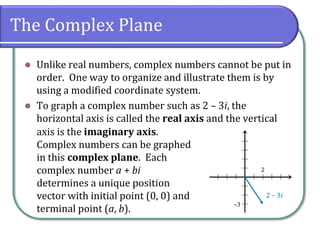
⚫ To graph a complex number such as 2 – 3i, the
horizontal axis is called the real axis and the vertical
axis is the imaginary axis.
Complex numbers can be graphed
in this complex plane. Each
complex number a + bi
determines a unique position
vector with initial point (0, 0) and
terminal point (a, b).
2
–3
2 – 3i
The Complex Plane (cont.)
⚫ This geometric representation is the reason a + bi is
called the rectangular form of a complex number.
⚫ Recall that to find the sum of two complex numbers, add
the real portions and then add the imaginary parts.
⚫ Example:
⚫ Graphically, the sum of two complex numbers is
represented by the vector that is the resultant of the
vectors corresponding to the two numbers
( ) ( ) ( ) ( )+ + + = + + + = +4 1 3 4 1 3 5 4i i i i i
The Complex Plane (cont.)
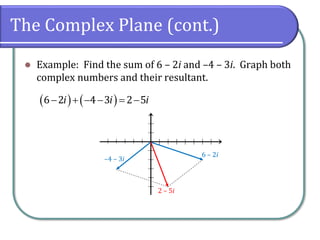
⚫ Example: Find the sum of 6 – 2i and –4 – 3i. Graph both
complex numbers and their resultant.
( ) ( )6 2 4 3 2 5i i i− + − − = −
–4 – 3i
6 – 2i
2 – 5i
Trigonometric (Polar) Form
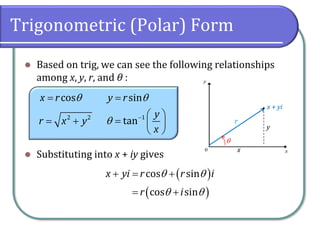
⚫ Based on trig, we can see the following relationships
among x, y, r, and θ :
⚫ Substituting into x + iy gives
x
y
x + yi
r

cosx r = siny r =
2 2
r x y= + 1
tan
y
x
 −  
=  
 
( )
( )
cos sin
cos sin
x yi r r i
r i
 
 
+ = +
= +
Polar Form (cont.)
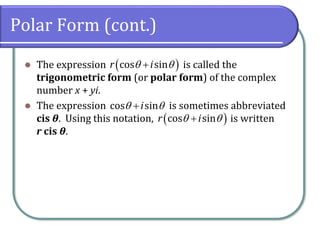
⚫ The expression is called the
trigonometric form (or polar form) of the complex
number x + yi.
⚫ The expression is sometimes abbreviated
cis θ. Using this notation, is written
r cis θ.
( )cos sinr i +
cos sini +
( )cos sinr i +
Polar to Rectangular Form
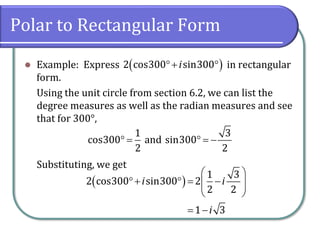
⚫ Example: Express in rectangular
form.
Using the unit circle from section 6.2, we can list the
degree measures as well as the radian measures and see
that for 300°,
Substituting, we get
( )2 cos300 sin300i+ 
1 3
cos300 and sin300
2 2
 =  = −
( )
1 3
2 cos300 sin300 2
2 2
1 3
i i
i
 
+  = − 
 
= −
Rectangular to Polar Form
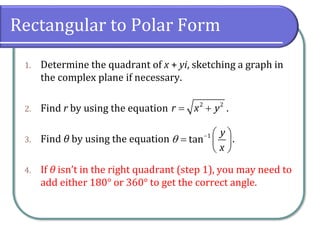
1. Determine the quadrant of x + yi, sketching a graph in
the complex plane if necessary.
2. Find r by using the equation .
3. Find θ by using the equation .
4. If θ isn’t in the right quadrant (step 1), you may need to
add either 180° or 360° to get the correct angle.
2 2
r x y= +
1
tan
y
x
 −  
=  
 
Rectangular to Polar Form (cont.)
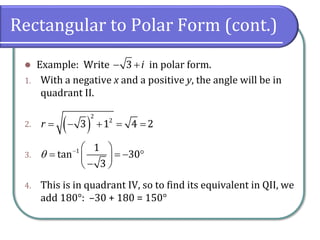
⚫ Example: Write in polar form.
1. With a negative x and a positive y, the angle will be in
quadrant II.
2.
3.
4. This is in quadrant IV, so to find its equivalent in QII, we
add 180°: –30 + 180 = 150°
3 i− +
( )
2
2
3 1 4 2r = − + = =
1 1
tan 30
3
 −  
= = −  
− 
Rectangular to Polar Form (cont.)
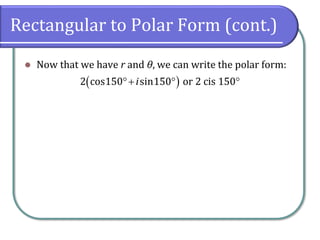
⚫ Now that we have r and θ, we can write the polar form:
( )2 cos150 sin150 or 2 cis 150i+  
Calculator Approximations
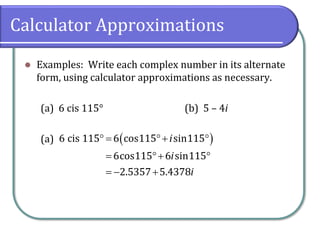
⚫ Examples: Write each complex number in its alternate
form, using calculator approximations as necessary.
(a) 6 cis 115° (b) 5 – 4i
(a) ( )6 cis 115 6 cos115 sin115
6cos115 6 sin115
2.5357 5.4378
i
i
i
 = + 
= + 
= − +
Calculator Approximations
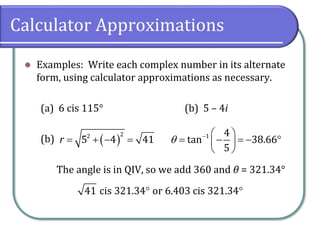
⚫ Examples: Write each complex number in its alternate
form, using calculator approximations as necessary.
(a) 6 cis 115° (b) 5 – 4i
(b)
The angle is in QIV, so we add 360 and θ = 321.34°
( )
22
5 4 41r = + − = 1 4
tan 38.66
5
 −  
= − = −  
 
41 cis 321.34 or 6.403 cis 321.34 
Classwork
⚫ Page 788: 10-20 (even); page 771: 30-36 (even), 50, 52;
page 760: 66-70 (even), 76

8.5 Polar Form

  • 1.
    8.5 Polar Form Chapter8 Applications of Trigonometry
  • 2.
    Concepts and Objectives ⚫Trigonometric (Polar) Form ⚫ Complex plane and vector representation ⚫ Converting between trigonometric and rectangular form
  • 3.
    The Complex Plane ⚫Unlike real numbers, complex numbers cannot be put in order. One way to organize and illustrate them is by using a modified coordinate system. ⚫ To graph a complex number such as 2 – 3i, the horizontal axis is called the real axis and the vertical axis is the imaginary axis. Complex numbers can be graphed in this complex plane. Each complex number a + bi determines a unique position vector with initial point (0, 0) and terminal point (a, b). 2 –3 2 – 3i
  • 4.
    The Complex Plane(cont.) ⚫ This geometric representation is the reason a + bi is called the rectangular form of a complex number. ⚫ Recall that to find the sum of two complex numbers, add the real portions and then add the imaginary parts. ⚫ Example: ⚫ Graphically, the sum of two complex numbers is represented by the vector that is the resultant of the vectors corresponding to the two numbers ( ) ( ) ( ) ( )+ + + = + + + = +4 1 3 4 1 3 5 4i i i i i
  • 5.
    The Complex Plane(cont.) ⚫ Example: Find the sum of 6 – 2i and –4 – 3i. Graph both complex numbers and their resultant. ( ) ( )6 2 4 3 2 5i i i− + − − = − –4 – 3i 6 – 2i 2 – 5i
  • 6.
    Trigonometric (Polar) Form ⚫Based on trig, we can see the following relationships among x, y, r, and θ : ⚫ Substituting into x + iy gives x y x + yi r  cosx r = siny r = 2 2 r x y= + 1 tan y x  −   =     ( ) ( ) cos sin cos sin x yi r r i r i     + = + = +
  • 7.
    Polar Form (cont.) ⚫The expression is called the trigonometric form (or polar form) of the complex number x + yi. ⚫ The expression is sometimes abbreviated cis θ. Using this notation, is written r cis θ. ( )cos sinr i + cos sini + ( )cos sinr i +
  • 8.
    Polar to RectangularForm ⚫ Example: Express in rectangular form. Using the unit circle from section 6.2, we can list the degree measures as well as the radian measures and see that for 300°, Substituting, we get ( )2 cos300 sin300i+  1 3 cos300 and sin300 2 2  =  = − ( ) 1 3 2 cos300 sin300 2 2 2 1 3 i i i   +  = −    = −
  • 9.
    Rectangular to PolarForm 1. Determine the quadrant of x + yi, sketching a graph in the complex plane if necessary. 2. Find r by using the equation . 3. Find θ by using the equation . 4. If θ isn’t in the right quadrant (step 1), you may need to add either 180° or 360° to get the correct angle. 2 2 r x y= + 1 tan y x  −   =    
  • 10.
    Rectangular to PolarForm (cont.) ⚫ Example: Write in polar form. 1. With a negative x and a positive y, the angle will be in quadrant II. 2. 3. 4. This is in quadrant IV, so to find its equivalent in QII, we add 180°: –30 + 180 = 150° 3 i− + ( ) 2 2 3 1 4 2r = − + = = 1 1 tan 30 3  −   = = −   − 
  • 11.
    Rectangular to PolarForm (cont.) ⚫ Now that we have r and θ, we can write the polar form: ( )2 cos150 sin150 or 2 cis 150i+  
  • 12.
    Calculator Approximations ⚫ Examples:Write each complex number in its alternate form, using calculator approximations as necessary. (a) 6 cis 115° (b) 5 – 4i (a) ( )6 cis 115 6 cos115 sin115 6cos115 6 sin115 2.5357 5.4378 i i i  = +  = +  = − +
  • 13.
    Calculator Approximations ⚫ Examples:Write each complex number in its alternate form, using calculator approximations as necessary. (a) 6 cis 115° (b) 5 – 4i (b) The angle is in QIV, so we add 360 and θ = 321.34° ( ) 22 5 4 41r = + − = 1 4 tan 38.66 5  −   = − = −     41 cis 321.34 or 6.403 cis 321.34 
  • 14.
    Classwork ⚫ Page 788:10-20 (even); page 771: 30-36 (even), 50, 52; page 760: 66-70 (even), 76