
COMPLEX
NUMBER
PREPARED BY :
PARMAR RONAKKUMAR VINODBHAI
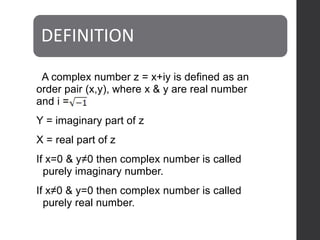
DEFINITION
A complex number z = x+iy is defined as an
order pair (x,y), where x & y are real number
and i =
Y = imaginary part of z
X = real part of z
If x=0 & y≠0 then complex number is called
purely imaginary number.
If x≠0 & y=0 then complex number is called
purely real number.
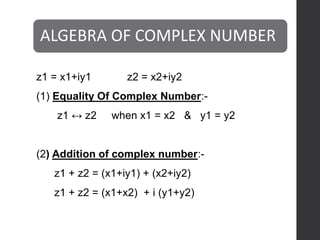
ALGEBRA OF COMPLEX NUMBER
z1 = x1+iy1 z2 = x2+iy2
(1) Equality Of Complex Number:-
z1 ↔ z2 when x1 = x2 & y1 = y2
(2) Addition of complex number:-
z1 + z2 = (x1+iy1) + (x2+iy2)
z1 + z2 = (x1+x2) + i (y1+y2)
CONTINUED…
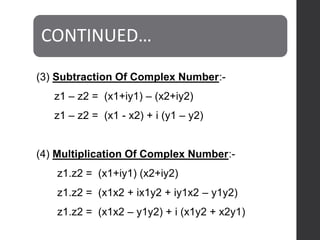
(3) Subtraction Of Complex Number:-
z1 – z2 = (x1+iy1) – (x2+iy2)
z1 – z2 = (x1 - x2) + i (y1 – y2)
(4) Multiplication Of Complex Number:-
z1.z2 = (x1+iy1) (x2+iy2)
z1.z2 = (x1x2 + ix1y2 + iy1x2 – y1y2)
z1.z2 = (x1x2 – y1y2) + i (x1y2 + x2y1)
CONTINUED…
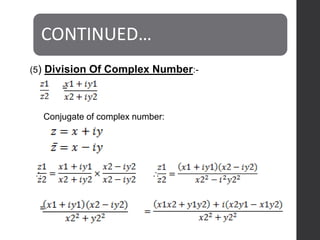
(5) Division Of Complex Number:-
=
 
=
Conjugate of complex number:
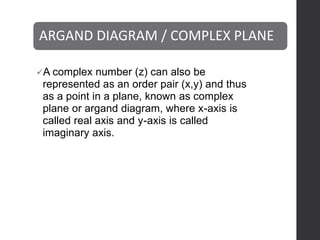
ARGAND DIAGRAM / COMPLEX PLANE
A complex number (z) can also be
represented as an order pair (x,y) and thus
as a point in a plane, known as complex
plane or argand diagram, where x-axis is
called real axis and y-axis is called
imaginary axis.
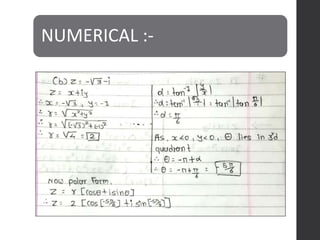
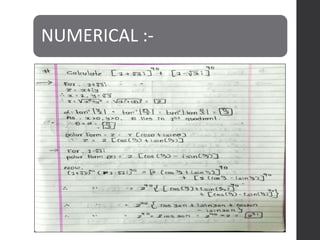
NUMERICAL :-
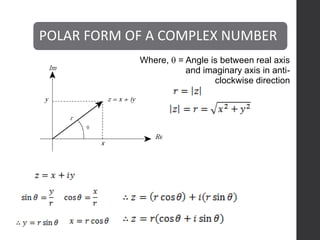
POLAR FORM OF A COMPLEX NUMBER
Where,  = Angle is between real axis
and imaginary axis in anti-
clockwise direction
CONTINUED…
Where,  = argument of z
NUMERICAL :-
NUMERICAL :-
DE MOIVRE’S THEOREM
Statement : If n be a rational number, the
value or one of the values of
is
this extends to,
NUMERICAL :-
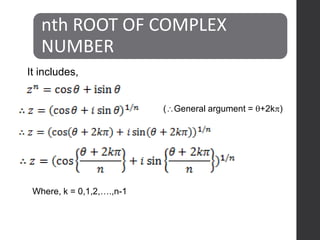
nth ROOT OF COMPLEX
NUMBER
It includes,
Where, k = 0,1,2,….,n-1
(General argument = +2k)
NUMERICAL :-
THANK
YOU

Complex number

  • 1.
  • 2.
    DEFINITION A complex numberz = x+iy is defined as an order pair (x,y), where x & y are real number and i = Y = imaginary part of z X = real part of z If x=0 & y≠0 then complex number is called purely imaginary number. If x≠0 & y=0 then complex number is called purely real number.
  • 3.
    ALGEBRA OF COMPLEXNUMBER z1 = x1+iy1 z2 = x2+iy2 (1) Equality Of Complex Number:- z1 ↔ z2 when x1 = x2 & y1 = y2 (2) Addition of complex number:- z1 + z2 = (x1+iy1) + (x2+iy2) z1 + z2 = (x1+x2) + i (y1+y2)
  • 4.
    CONTINUED… (3) Subtraction OfComplex Number:- z1 – z2 = (x1+iy1) – (x2+iy2) z1 – z2 = (x1 - x2) + i (y1 – y2) (4) Multiplication Of Complex Number:- z1.z2 = (x1+iy1) (x2+iy2) z1.z2 = (x1x2 + ix1y2 + iy1x2 – y1y2) z1.z2 = (x1x2 – y1y2) + i (x1y2 + x2y1)
  • 5.
    CONTINUED… (5) Division OfComplex Number:- =   = Conjugate of complex number:
  • 6.
    ARGAND DIAGRAM /COMPLEX PLANE A complex number (z) can also be represented as an order pair (x,y) and thus as a point in a plane, known as complex plane or argand diagram, where x-axis is called real axis and y-axis is called imaginary axis.
  • 7.
  • 8.
    POLAR FORM OFA COMPLEX NUMBER Where,  = Angle is between real axis and imaginary axis in anti- clockwise direction
  • 9.
  • 10.
  • 11.
  • 12.
    DE MOIVRE’S THEOREM Statement: If n be a rational number, the value or one of the values of is this extends to,
  • 13.
  • 14.
    nth ROOT OFCOMPLEX NUMBER It includes, Where, k = 0,1,2,….,n-1 (General argument = +2k)
  • 15.
  • 16.