ALGEBRA OF COMPLEX NUMBERS II
Dr. Gabriel Obed Fosu
Department of Mathematics
Kwame Nkrumah University of Science and Technology
Google Scholar: https://scholar.google.com/citations?user=ZJfCMyQAAAAJ&hl=en&oi=ao
ResearchGate ID: https://www.researchgate.net/profile/Gabriel_Fosu2
Dr. Gabby (KNUST-Maths) Algebra of Complex Numbers 1 / 36
Lecture Outline
1 Polar Form of Complex Numbers
Trigonometry Form
Exponential Form
The power of a complex number
2 Roots of Complex Numbers
3 Complex Logarithm
Dr. Gabby (KNUST-Maths) Algebra of Complex Numbers 2 / 36
Polar Form of Complex Numbers
Outline of Presentation
1 Polar Form of Complex Numbers
Trigonometry Form
Exponential Form
The power of a complex number
2 Roots of Complex Numbers
3 Complex Logarithm
Dr. Gabby (KNUST-Maths) Algebra of Complex Numbers 3 / 36
Polar Form of Complex Numbers Trigonometry Form
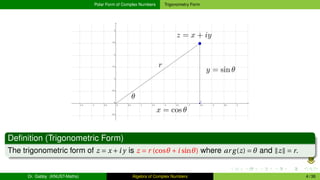
Definition (Trigonometric Form)
The trigonometric form of z = x +i y is z = r (cosθ +i sinθ) where ar g(z) = θ and ∥z∥ = r.
Dr. Gabby (KNUST-Maths) Algebra of Complex Numbers 4 / 36
Polar Form of Complex Numbers Trigonometry Form
Trigonometry and complex number
1 For a complex number z = x + yi we can write the trigonometric representation z =
r(cosθ∗
+ i sinθ∗
), where r ∈ [0,∞) and θ∗
∈ [0,2π) are the polar coordinates of the
geometric image of z.
Dr. Gabby (KNUST-Maths) Algebra of Complex Numbers 5 / 36
Polar Form of Complex Numbers Trigonometry Form
Trigonometry and complex number
1 For a complex number z = x + yi we can write the trigonometric representation z =
r(cosθ∗
+ i sinθ∗
), where r ∈ [0,∞) and θ∗
∈ [0,2π) are the polar coordinates of the
geometric image of z.
2 The polar argument θ∗
of the geometric image of z is called the argument of z, denoted
by argz.
Dr. Gabby (KNUST-Maths) Algebra of Complex Numbers 5 / 36
Polar Form of Complex Numbers Trigonometry Form
Trigonometry and complex number
1 For a complex number z = x + yi we can write the trigonometric representation z =
r(cosθ∗
+ i sinθ∗
), where r ∈ [0,∞) and θ∗
∈ [0,2π) are the polar coordinates of the
geometric image of z.
2 The polar argument θ∗
of the geometric image of z is called the argument of z, denoted
by argz.
3 The polar radius r of the geometric image of z is equal to the modulus of z.
Dr. Gabby (KNUST-Maths) Algebra of Complex Numbers 5 / 36
Polar Form of Complex Numbers Trigonometry Form
Trigonometry and complex number
1 For a complex number z = x + yi we can write the trigonometric representation z =
r(cosθ∗
+ i sinθ∗
), where r ∈ [0,∞) and θ∗
∈ [0,2π) are the polar coordinates of the
geometric image of z.
2 The polar argument θ∗
of the geometric image of z is called the argument of z, denoted
by argz.
3 The polar radius r of the geometric image of z is equal to the modulus of z.
4 The set Ar gz = {θ : θ∗
+2kπ, k ∈ Z} is called the extended argument of the complex
number z. Then
z = r(cosθ +i sinθ) = z = r[cos
¡
θ∗
+2kπ
¢
+i sin
¡
θ∗
+2kπ
¢
] (1)
Dr. Gabby (KNUST-Maths) Algebra of Complex Numbers 5 / 36
Polar Form of Complex Numbers Trigonometry Form
Example
Find the trigonometric representation of the following numbers and determine their extended
argument:
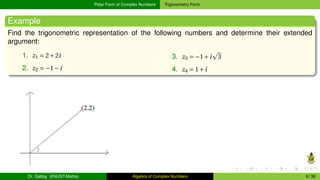
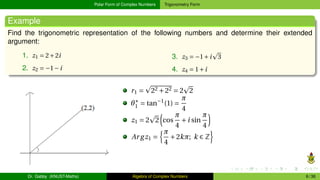
1. z1 = 2+2i
2. z2 = −1−i
3. z3 = −1+i
p
3
4. z4 = 1+i
Dr. Gabby (KNUST-Maths) Algebra of Complex Numbers 6 / 36
Polar Form of Complex Numbers Trigonometry Form
Example
Find the trigonometric representation of the following numbers and determine their extended
argument:
1. z1 = 2+2i
2. z2 = −1−i
3. z3 = −1+i
p
3
4. z4 = 1+i
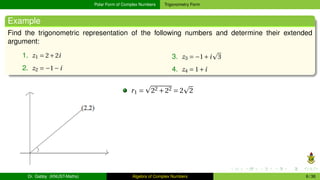
r1 =
p
22 +22 = 2
p
2
Dr. Gabby (KNUST-Maths) Algebra of Complex Numbers 6 / 36
Polar Form of Complex Numbers Trigonometry Form
Example
Find the trigonometric representation of the following numbers and determine their extended
argument:
1. z1 = 2+2i
2. z2 = −1−i
3. z3 = −1+i
p
3
4. z4 = 1+i
r1 =
p
22 +22 = 2
p
2
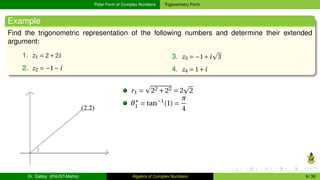
θ∗
1 = tan−1
(1) =
π
4
Dr. Gabby (KNUST-Maths) Algebra of Complex Numbers 6 / 36
Polar Form of Complex Numbers Trigonometry Form
Example
Find the trigonometric representation of the following numbers and determine their extended
argument:
1. z1 = 2+2i
2. z2 = −1−i
3. z3 = −1+i
p
3
4. z4 = 1+i
r1 =
p
22 +22 = 2
p
2
θ∗
1 = tan−1
(1) =
π
4
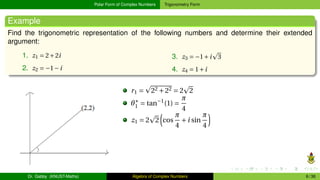
z1 = 2
p
2
³
cos
π
4
+i sin
π
4
´
Dr. Gabby (KNUST-Maths) Algebra of Complex Numbers 6 / 36
Polar Form of Complex Numbers Trigonometry Form
Example
Find the trigonometric representation of the following numbers and determine their extended
argument:
1. z1 = 2+2i
2. z2 = −1−i
3. z3 = −1+i
p
3
4. z4 = 1+i
r1 =
p
22 +22 = 2
p
2
θ∗
1 = tan−1
(1) =
π
4
z1 = 2
p
2
³
cos
π
4
+i sin
π
4
´
Ar gz1 =
nπ
4
+2kπ; k ∈ Z
o
Dr. Gabby (KNUST-Maths) Algebra of Complex Numbers 6 / 36
Polar Form of Complex Numbers Trigonometry Form
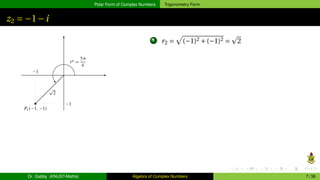
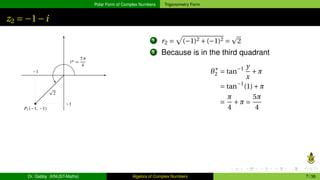
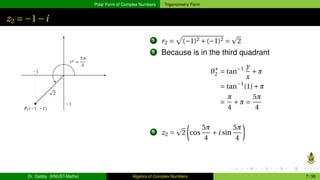
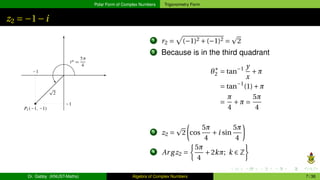
z2 = −1−i
1 r2 =
p
(−1)2 +(−1)2 =
p
2
Dr. Gabby (KNUST-Maths) Algebra of Complex Numbers 7 / 36
Polar Form of Complex Numbers Trigonometry Form
z2 = −1−i
1 r2 =
p
(−1)2 +(−1)2 =
p
2
2 Because is in the third quadrant
θ∗
2 = tan−1 y
x
+π
= tan−1
(1)+π
=
π
4
+π =
5π
4
Dr. Gabby (KNUST-Maths) Algebra of Complex Numbers 7 / 36
Polar Form of Complex Numbers Trigonometry Form
z2 = −1−i
1 r2 =
p
(−1)2 +(−1)2 =
p
2
2 Because is in the third quadrant
θ∗
2 = tan−1 y
x
+π
= tan−1
(1)+π
=
π
4
+π =
5π
4
3 z2 =
p
2
µ
cos
5π
4
+i sin
5π
4

Dr. Gabby (KNUST-Maths) Algebra of Complex Numbers 7 / 36
Polar Form of Complex Numbers Trigonometry Form
z2 = −1−i
1 r2 =
p
(−1)2 +(−1)2 =
p
2
2 Because is in the third quadrant
θ∗
2 = tan−1 y
x
+π
= tan−1
(1)+π
=
π
4
+π =
5π
4
3 z2 =
p
2
µ
cos
5π
4
+i sin
5π
4

4 Ar gz2 =
½
5π
4
+2kπ; k ∈ Z
¾
Dr. Gabby (KNUST-Maths) Algebra of Complex Numbers 7 / 36
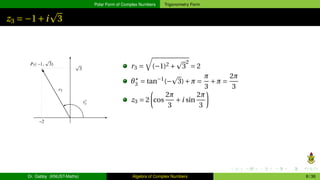
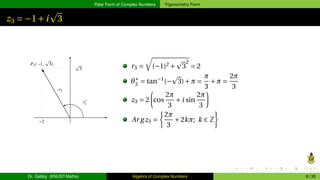
Polar Form of Complex Numbers Trigonometry Form
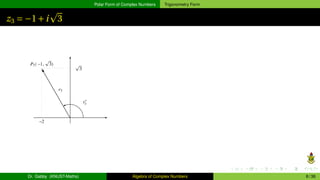
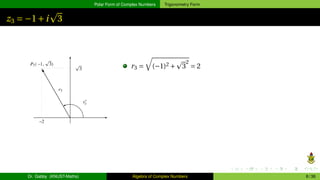
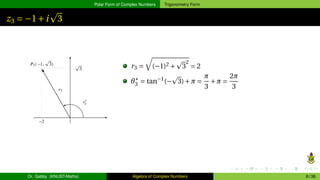
z3 = −1+i
p
3
Dr. Gabby (KNUST-Maths) Algebra of Complex Numbers 8 / 36
Polar Form of Complex Numbers Trigonometry Form
z3 = −1+i
p
3
r3 =
q
(−1)2 +
p
3
2
= 2
Dr. Gabby (KNUST-Maths) Algebra of Complex Numbers 8 / 36
Polar Form of Complex Numbers Trigonometry Form
z3 = −1+i
p
3
r3 =
q
(−1)2 +
p
3
2
= 2
θ∗
3 = tan−1
(−
p
3)+π =
π
3
+π =
2π
3
Dr. Gabby (KNUST-Maths) Algebra of Complex Numbers 8 / 36
Polar Form of Complex Numbers Trigonometry Form
z3 = −1+i
p
3
r3 =
q
(−1)2 +
p
3
2
= 2
θ∗
3 = tan−1
(−
p
3)+π =
π
3
+π =
2π
3
z3 = 2
µ
cos
2π
3
+i sin
2π
3

Dr. Gabby (KNUST-Maths) Algebra of Complex Numbers 8 / 36
Polar Form of Complex Numbers Trigonometry Form
z3 = −1+i
p
3
r3 =
q
(−1)2 +
p
3
2
= 2
θ∗
3 = tan−1
(−
p
3)+π =
π
3
+π =
2π
3
z3 = 2
µ
cos
2π
3
+i sin
2π
3

Ar gz3 =
½
2π
3
+2kπ; k ∈ Z
¾
Dr. Gabby (KNUST-Maths) Algebra of Complex Numbers 8 / 36
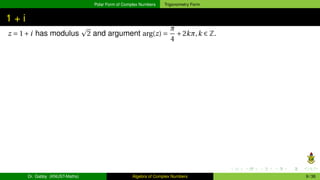
Polar Form of Complex Numbers Trigonometry Form
1 + i
z = 1+i has modulus
p
2 and argument arg(z) =
π
4
+2kπ,k ∈ Z.
Dr. Gabby (KNUST-Maths) Algebra of Complex Numbers 9 / 36
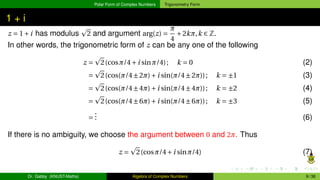
Polar Form of Complex Numbers Trigonometry Form
1 + i
z = 1+i has modulus
p
2 and argument arg(z) =
π
4
+2kπ,k ∈ Z.
In other words, the trigonometric form of z can be any one of the following
z =
p
2(cosπ/4+i sinπ/4); k = 0 (2)
=
p
2(cos(π/4±2π)+i sin(π/4±2π)); k = ±1 (3)
=
p
2(cos(π/4±4π)+i sin(π/4±4π)); k = ±2 (4)
=
p
2(cos(π/4±6π)+i sin(π/4±6π)); k = ±3 (5)
=
.
.
. (6)
If there is no ambiguity, we choose the argument between 0 and 2π. Thus
z =
p
2(cosπ/4+i sinπ/4) (7)
Dr. Gabby (KNUST-Maths) Algebra of Complex Numbers 9 / 36
Polar Form of Complex Numbers Trigonometry Form
Remarks
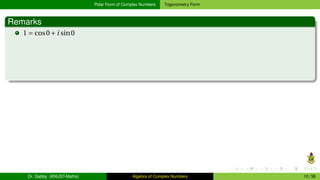
1 = cos0+i sin0
Dr. Gabby (KNUST-Maths) Algebra of Complex Numbers 10 / 36
Polar Form of Complex Numbers Trigonometry Form
Remarks
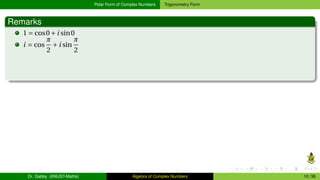
1 = cos0+i sin0
i = cos
π
2
+i sin
π
2
Dr. Gabby (KNUST-Maths) Algebra of Complex Numbers 10 / 36
Polar Form of Complex Numbers Trigonometry Form
Remarks
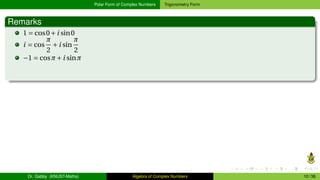
1 = cos0+i sin0
i = cos
π
2
+i sin
π
2
−1 = cosπ+i sinπ
Dr. Gabby (KNUST-Maths) Algebra of Complex Numbers 10 / 36
Polar Form of Complex Numbers Trigonometry Form
Remarks
1 = cos0+i sin0
i = cos
π
2
+i sin
π
2
−1 = cosπ+i sinπ
−i = cos
3π
2
+i sin
3π
2
Dr. Gabby (KNUST-Maths) Algebra of Complex Numbers 10 / 36
Polar Form of Complex Numbers Trigonometry Form
Remarks
1 = cos0+i sin0
i = cos
π
2
+i sin
π
2
−1 = cosπ+i sinπ
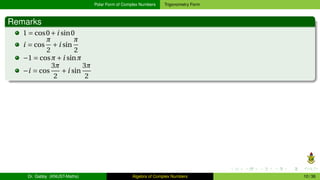
−i = cos
3π
2
+i sin
3π
2
If z1 = r1(cosθ1 +i sinθ1) and z2 = r2(cosθ2 +i sinθ2) then
z1z2 = r1r2 [cos(θ1 +θ2)+i sin(θ1 +θ2)]
Dr. Gabby (KNUST-Maths) Algebra of Complex Numbers 10 / 36
Polar Form of Complex Numbers Trigonometry Form
Remarks
1 = cos0+i sin0
i = cos
π
2
+i sin
π
2
−1 = cosπ+i sinπ
−i = cos
3π
2
+i sin
3π
2
If z1 = r1(cosθ1 +i sinθ1) and z2 = r2(cosθ2 +i sinθ2) then
z1z2 = r1r2 [cos(θ1 +θ2)+i sin(θ1 +θ2)]
If z1 = r1(cosθ1 +i sinθ1) and z2 = r2(cosθ2 +i sinθ2) ̸= 0 then
z1
z2
=
r1
r2
[cos(θ1 −θ2)+i sin(θ1 −θ2)]
Dr. Gabby (KNUST-Maths) Algebra of Complex Numbers 10 / 36
Polar Form of Complex Numbers Trigonometry Form
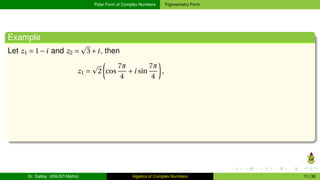
Example
Let z1 = 1−i and z2 =
p
3+i, then
z1 =
p
2
µ
cos
7π
4
+i sin
7π
4

,
Dr. Gabby (KNUST-Maths) Algebra of Complex Numbers 11 / 36
Polar Form of Complex Numbers Trigonometry Form
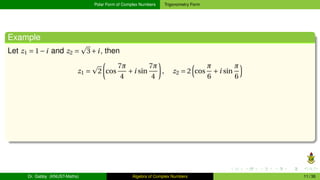
Example
Let z1 = 1−i and z2 =
p
3+i, then
z1 =
p
2
µ
cos
7π
4
+i sin
7π
4

, z2 = 2
³
cos
π
6
+i sin
π
6
´
Dr. Gabby (KNUST-Maths) Algebra of Complex Numbers 11 / 36
Polar Form of Complex Numbers Trigonometry Form
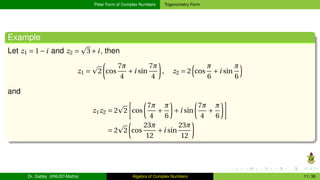
Example
Let z1 = 1−i and z2 =
p
3+i, then
z1 =
p
2
µ
cos
7π
4
+i sin
7π
4

, z2 = 2
³
cos
π
6
+i sin
π
6
´
and
z1z2 = 2
p
2
·
cos
µ
7π
4
+
π
6

+i sin
µ
7π
4
+
π
6
¶¸
= 2
p
2
µ
cos
23π
12
+i sin
23π
12

Dr. Gabby (KNUST-Maths) Algebra of Complex Numbers 11 / 36
Polar Form of Complex Numbers Trigonometry Form
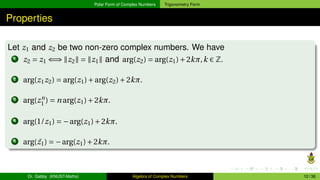
Properties
Let z1 and z2 be two non-zero complex numbers. We have
1 z2 = z1 ⇐⇒ ∥z2∥ = ∥z1∥ and arg(z2) = arg(z1)+2kπ,k ∈ Z.
2 arg(z1z2) = arg(z1)+arg(z2)+2kπ.
3 arg(zn
1 ) = n arg(z1)+2kπ.
4 arg(1/z1) = −arg(z1)+2kπ.
5 arg( ¯
z1) = −arg(z1)+2kπ.
Dr. Gabby (KNUST-Maths) Algebra of Complex Numbers 12 / 36
Polar Form of Complex Numbers Exponential Form
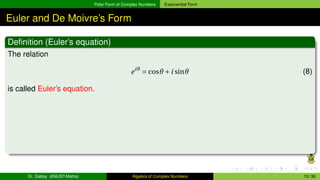
Euler and De Moivre’s Form
Definition (Euler’s equation)
The relation
eiθ
= cosθ +i sinθ (8)
is called Euler’s equation.
Dr. Gabby (KNUST-Maths) Algebra of Complex Numbers 13 / 36
Polar Form of Complex Numbers Exponential Form
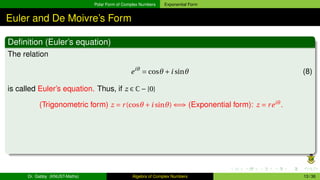
Euler and De Moivre’s Form
Definition (Euler’s equation)
The relation
eiθ
= cosθ +i sinθ (8)
is called Euler’s equation. Thus, if z ∈ C−{0}
(Trigonometric form) z = r(cosθ +i sinθ) ⇐⇒ (Exponential form): z = reiθ
.
Dr. Gabby (KNUST-Maths) Algebra of Complex Numbers 13 / 36
Polar Form of Complex Numbers Exponential Form
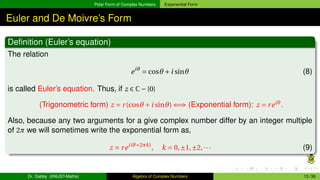
Euler and De Moivre’s Form
Definition (Euler’s equation)
The relation
eiθ
= cosθ +i sinθ (8)
is called Euler’s equation. Thus, if z ∈ C−{0}
(Trigonometric form) z = r(cosθ +i sinθ) ⇐⇒ (Exponential form): z = reiθ
.
Also, because any two arguments for a give complex number differ by an integer multiple
of 2π we will sometimes write the exponential form as,
z = rei(θ+2πk)
, k = 0,±1,±2,··· (9)
Dr. Gabby (KNUST-Maths) Algebra of Complex Numbers 13 / 36
Polar Form of Complex Numbers Exponential Form
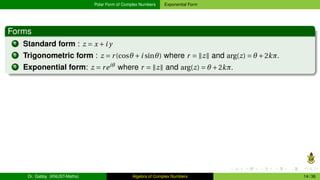
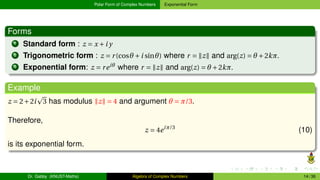
Forms
1 Standard form : z = x +i y
2 Trigonometric form : z = r(cosθ +i sinθ) where r = ∥z∥ and arg(z) = θ +2kπ.
3 Exponential form: z = reiθ
where r = ∥z∥ and arg(z) = θ +2kπ.
Dr. Gabby (KNUST-Maths) Algebra of Complex Numbers 14 / 36
Polar Form of Complex Numbers Exponential Form
Forms
1 Standard form : z = x +i y
2 Trigonometric form : z = r(cosθ +i sinθ) where r = ∥z∥ and arg(z) = θ +2kπ.
3 Exponential form: z = reiθ
where r = ∥z∥ and arg(z) = θ +2kπ.
Example
z = 2+2i
p
3 has modulus ∥z∥ = 4 and argument θ = π/3.
Therefore,
z = 4eiπ/3
(10)
is its exponential form.
Dr. Gabby (KNUST-Maths) Algebra of Complex Numbers 14 / 36
Polar Form of Complex Numbers Exponential Form
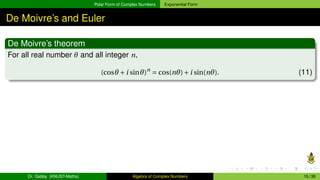
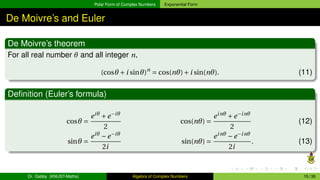
De Moivre’s and Euler
De Moivre’s theorem
For all real number θ and all integer n,
(cosθ +i sinθ)n
= cos(nθ)+i sin(nθ). (11)
Dr. Gabby (KNUST-Maths) Algebra of Complex Numbers 15 / 36
Polar Form of Complex Numbers Exponential Form
De Moivre’s and Euler
De Moivre’s theorem
For all real number θ and all integer n,
(cosθ +i sinθ)n
= cos(nθ)+i sin(nθ). (11)
Definition (Euler’s formula)
cosθ =
eiθ
+e−iθ
2
cos(nθ) =
einθ
+e−inθ
2
(12)
sinθ =
eiθ
−e−iθ
2i
sin(nθ) =
einθ
−e−inθ
2i
. (13)
Dr. Gabby (KNUST-Maths) Algebra of Complex Numbers 15 / 36
Polar Form of Complex Numbers Exponential Form
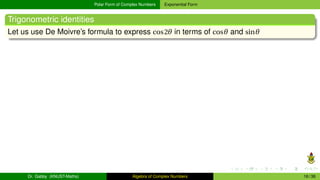
Trigonometric identities
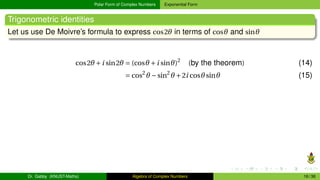
Let us use De Moivre’s formula to express cos2θ in terms of cosθ and sinθ
Dr. Gabby (KNUST-Maths) Algebra of Complex Numbers 16 / 36
Polar Form of Complex Numbers Exponential Form
Trigonometric identities
Let us use De Moivre’s formula to express cos2θ in terms of cosθ and sinθ
cos2θ +i sin2θ = (cosθ +i sinθ)2
(by the theorem) (14)
= cos2
θ −sin2
θ +2i cosθsinθ (15)
Dr. Gabby (KNUST-Maths) Algebra of Complex Numbers 16 / 36
Polar Form of Complex Numbers Exponential Form
Trigonometric identities
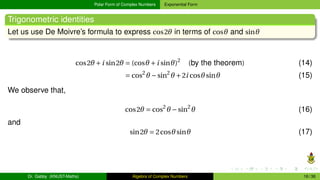
Let us use De Moivre’s formula to express cos2θ in terms of cosθ and sinθ
cos2θ +i sin2θ = (cosθ +i sinθ)2
(by the theorem) (14)
= cos2
θ −sin2
θ +2i cosθsinθ (15)
We observe that,
cos2θ = cos2
θ −sin2
θ (16)
and
sin2θ = 2cosθsinθ (17)
Dr. Gabby (KNUST-Maths) Algebra of Complex Numbers 16 / 36
Polar Form of Complex Numbers Exponential Form
Trigonometric identities
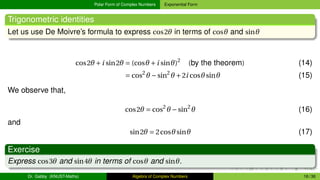
Let us use De Moivre’s formula to express cos2θ in terms of cosθ and sinθ
cos2θ +i sin2θ = (cosθ +i sinθ)2
(by the theorem) (14)
= cos2
θ −sin2
θ +2i cosθsinθ (15)
We observe that,
cos2θ = cos2
θ −sin2
θ (16)
and
sin2θ = 2cosθsinθ (17)
Exercise
Express cos3θ and sin4θ in terms of cosθ and sinθ.
Dr. Gabby (KNUST-Maths) Algebra of Complex Numbers 16 / 36
Polar Form of Complex Numbers The power of a complex number
The power of a complex number
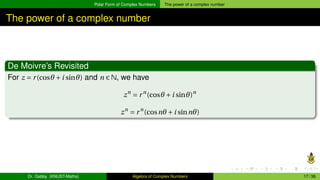
De Moivre’s Revisited
For z = r(cosθ +i sinθ) and n ∈ N, we have
zn
= rn
(cosθ +i sinθ)n
zn
= rn
(cosnθ +i sinnθ)
Dr. Gabby (KNUST-Maths) Algebra of Complex Numbers 17 / 36
Polar Form of Complex Numbers The power of a complex number
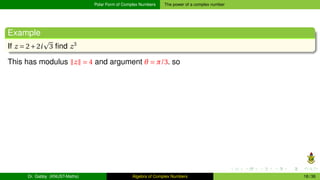
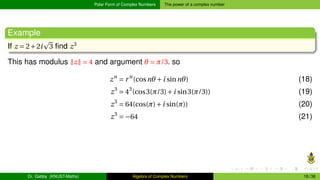
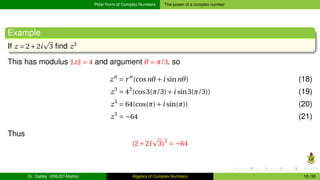
Example
If z = 2+2i
p
3 find z3
This has modulus ∥z∥ = 4 and argument θ = π/3. so
Dr. Gabby (KNUST-Maths) Algebra of Complex Numbers 18 / 36
Polar Form of Complex Numbers The power of a complex number
Example
If z = 2+2i
p
3 find z3
This has modulus ∥z∥ = 4 and argument θ = π/3. so
zn
= rn
(cosnθ +i sinnθ) (18)
z3
= 43
(cos3(π/3)+i sin3(π/3)) (19)
z3
= 64(cos(π)+i sin(π)) (20)
z3
= −64 (21)
Dr. Gabby (KNUST-Maths) Algebra of Complex Numbers 18 / 36
Polar Form of Complex Numbers The power of a complex number
Example
If z = 2+2i
p
3 find z3
This has modulus ∥z∥ = 4 and argument θ = π/3. so
zn
= rn
(cosnθ +i sinnθ) (18)
z3
= 43
(cos3(π/3)+i sin3(π/3)) (19)
z3
= 64(cos(π)+i sin(π)) (20)
z3
= −64 (21)
Thus
(2+2i
p
3)3
= −64
Dr. Gabby (KNUST-Maths) Algebra of Complex Numbers 18 / 36
Polar Form of Complex Numbers The power of a complex number
Example
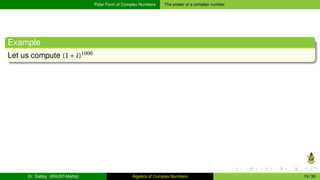
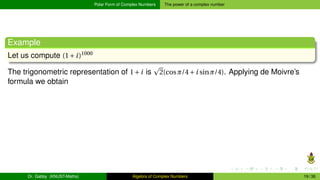
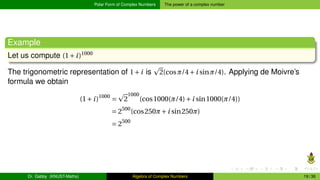
Let us compute (1+i)1000
Dr. Gabby (KNUST-Maths) Algebra of Complex Numbers 19 / 36
Polar Form of Complex Numbers The power of a complex number
Example
Let us compute (1+i)1000
The trigonometric representation of 1+i is
p
2(cosπ/4+i sinπ/4). Applying de Moivre’s
formula we obtain
Dr. Gabby (KNUST-Maths) Algebra of Complex Numbers 19 / 36
Polar Form of Complex Numbers The power of a complex number
Example
Let us compute (1+i)1000
The trigonometric representation of 1+i is
p
2(cosπ/4+i sinπ/4). Applying de Moivre’s
formula we obtain
(1+i)1000
=
p
2
1000
(cos1000(π/4)+i sin1000(π/4))
= 2500
(cos250π+i sin250π)
= 2500
Dr. Gabby (KNUST-Maths) Algebra of Complex Numbers 19 / 36
Roots of Complex Numbers
Outline of Presentation
1 Polar Form of Complex Numbers
Trigonometry Form
Exponential Form
The power of a complex number
2 Roots of Complex Numbers
3 Complex Logarithm
Dr. Gabby (KNUST-Maths) Algebra of Complex Numbers 20 / 36
Roots of Complex Numbers
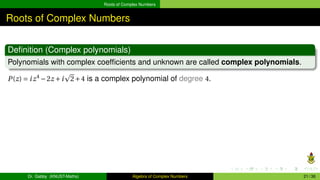
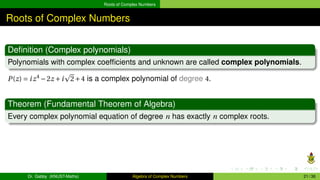
Definition (Complex polynomials)
Polynomials with complex coefficients and unknown are called complex polynomials.
P(z) = iz4
−2z +i
p
2+4 is a complex polynomial of degree 4.
Dr. Gabby (KNUST-Maths) Algebra of Complex Numbers 21 / 36
Roots of Complex Numbers
Definition (Complex polynomials)
Polynomials with complex coefficients and unknown are called complex polynomials.
P(z) = iz4
−2z +i
p
2+4 is a complex polynomial of degree 4.
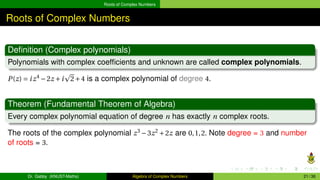
Theorem (Fundamental Theorem of Algebra)
Every complex polynomial equation of degree n has exactly n complex roots.
Dr. Gabby (KNUST-Maths) Algebra of Complex Numbers 21 / 36
Roots of Complex Numbers
Definition (Complex polynomials)
Polynomials with complex coefficients and unknown are called complex polynomials.
P(z) = iz4
−2z +i
p
2+4 is a complex polynomial of degree 4.
Theorem (Fundamental Theorem of Algebra)
Every complex polynomial equation of degree n has exactly n complex roots.
The roots of the complex polynomial z3
−3z2
+2z are 0,1,2. Note degree = 3 and number
of roots = 3.
Dr. Gabby (KNUST-Maths) Algebra of Complex Numbers 21 / 36
Roots of Complex Numbers
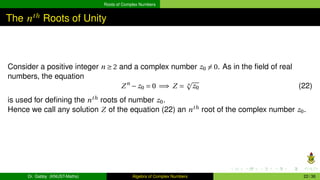
The nth
Roots of Unity
Consider a positive integer n ≥ 2 and a complex number z0 ̸= 0. As in the field of real
numbers, the equation
Zn
− z0 = 0 =⇒ Z = n
p
z0 (22)
is used for defining the nth
roots of number z0.
Hence we call any solution Z of the equation (22) an nth
root of the complex number z0.
Dr. Gabby (KNUST-Maths) Algebra of Complex Numbers 22 / 36
Roots of Complex Numbers
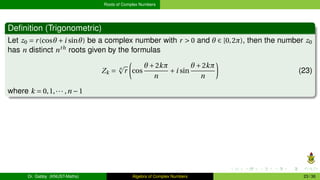
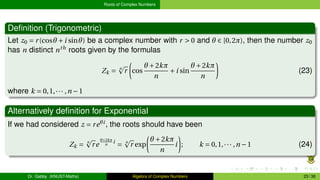
Definition (Trigonometric)
Let z0 = r(cosθ +i sinθ) be a complex number with r > 0 and θ ∈ [0,2π), then the number z0
has n distinct nth
roots given by the formulas
Zk = n
p
r
µ
cos
θ +2kπ
n
+i sin
θ +2kπ
n

(23)
where k = 0,1,··· ,n −1
Dr. Gabby (KNUST-Maths) Algebra of Complex Numbers 23 / 36
Roots of Complex Numbers
Definition (Trigonometric)
Let z0 = r(cosθ +i sinθ) be a complex number with r > 0 and θ ∈ [0,2π), then the number z0
has n distinct nth
roots given by the formulas
Zk = n
p
r
µ
cos
θ +2kπ
n
+i sin
θ +2kπ
n

(23)
where k = 0,1,··· ,n −1
Alternatively definition for Exponential
If we had considered z = reθi
, the roots should have been
Zk = n
p
re
θ+2kπ
n
i
= n
p
r exp
µ
θ +2kπ
n
i

; k = 0,1,··· ,n −1 (24)
Dr. Gabby (KNUST-Maths) Algebra of Complex Numbers 23 / 36
Roots of Complex Numbers
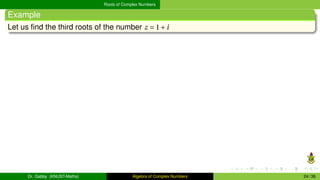
Example
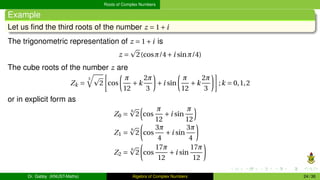
Let us find the third roots of the number z = 1+i
Dr. Gabby (KNUST-Maths) Algebra of Complex Numbers 24 / 36
Roots of Complex Numbers
Example
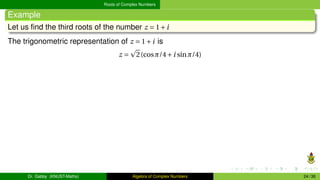
Let us find the third roots of the number z = 1+i
The trigonometric representation of z = 1+i is
z =
p
2(cosπ/4+i sinπ/4)
Dr. Gabby (KNUST-Maths) Algebra of Complex Numbers 24 / 36
Roots of Complex Numbers
Example
Let us find the third roots of the number z = 1+i
The trigonometric representation of z = 1+i is
z =
p
2(cosπ/4+i sinπ/4)
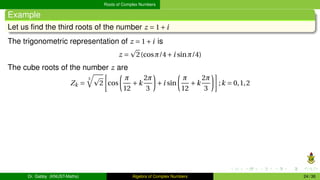
The cube roots of the number z are
Zk =
3
q
p
2
·
cos
µ
π
12
+k
2π
3

+i sin
µ
π
12
+k
2π
3
¶¸
;k = 0,1,2
Dr. Gabby (KNUST-Maths) Algebra of Complex Numbers 24 / 36
Roots of Complex Numbers
Example
Let us find the third roots of the number z = 1+i
The trigonometric representation of z = 1+i is
z =
p
2(cosπ/4+i sinπ/4)
The cube roots of the number z are
Zk =
3
q
p
2
·
cos
µ
π
12
+k
2π
3

+i sin
µ
π
12
+k
2π
3
¶¸
;k = 0,1,2
or in explicit form as
Z0 =
6
p
2
³
cos
π
12
+i sin
π
12
´
Z1 =
6
p
2
µ
cos
3π
4
+i sin
3π
4

Z2 =
6
p
2
µ
cos
17π
12
+i sin
17π
12

Dr. Gabby (KNUST-Maths) Algebra of Complex Numbers 24 / 36
Roots of Complex Numbers
Exercise
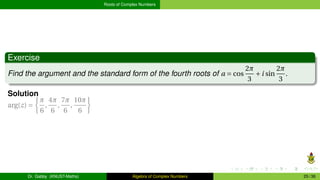
Find the argument and the standard form of the fourth roots of a = cos
2π
3
+i sin
2π
3
.
Solution
arg(z) =
½
π
6
,
4π
6
,
7π
6
,
10π
6
¾
Dr. Gabby (KNUST-Maths) Algebra of Complex Numbers 25 / 36
Roots of Complex Numbers
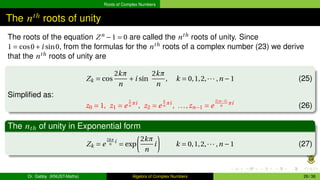
The nth
roots of unity
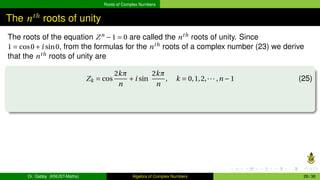
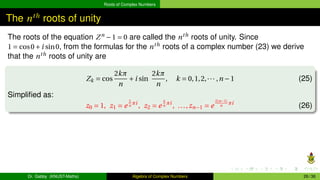
The roots of the equation Zn
−1 = 0 are called the nth
roots of unity. Since
1 = cos0+i sin0, from the formulas for the nth
roots of a complex number (23) we derive
that the nth
roots of unity are
Zk = cos
2kπ
n
+i sin
2kπ
n
, k = 0,1,2,··· ,n −1 (25)
Dr. Gabby (KNUST-Maths) Algebra of Complex Numbers 26 / 36
Roots of Complex Numbers
The nth
roots of unity
The roots of the equation Zn
−1 = 0 are called the nth
roots of unity. Since
1 = cos0+i sin0, from the formulas for the nth
roots of a complex number (23) we derive
that the nth
roots of unity are
Zk = cos
2kπ
n
+i sin
2kπ
n
, k = 0,1,2,··· ,n −1 (25)
Simplified as:
z0 = 1, z1 = e
2
n
πi
, z2 = e
4
n
πi
, ...,zn−1 = e
2(n−1)
n
πi
(26)
Dr. Gabby (KNUST-Maths) Algebra of Complex Numbers 26 / 36
Roots of Complex Numbers
The nth
roots of unity
The roots of the equation Zn
−1 = 0 are called the nth
roots of unity. Since
1 = cos0+i sin0, from the formulas for the nth
roots of a complex number (23) we derive
that the nth
roots of unity are
Zk = cos
2kπ
n
+i sin
2kπ
n
, k = 0,1,2,··· ,n −1 (25)
Simplified as:
z0 = 1, z1 = e
2
n
πi
, z2 = e
4
n
πi
, ...,zn−1 = e
2(n−1)
n
πi
(26)
The nth of unity in Exponential form
Zk = e
2kπ
n
i
= exp
µ
2kπ
n
i

k = 0,1,2,··· ,n −1 (27)
Dr. Gabby (KNUST-Maths) Algebra of Complex Numbers 26 / 36
Roots of Complex Numbers
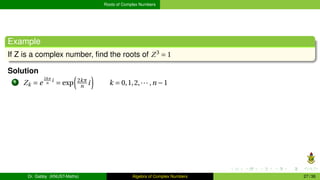
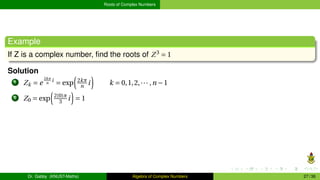
Example
If Z is a complex number, find the roots of Z3
= 1
Solution
1 Zk = e
2kπ
n
i
= exp
³
2kπ
n i
´
k = 0,1,2,··· ,n −1
Dr. Gabby (KNUST-Maths) Algebra of Complex Numbers 27 / 36
Roots of Complex Numbers
Example
If Z is a complex number, find the roots of Z3
= 1
Solution
1 Zk = e
2kπ
n
i
= exp
³
2kπ
n i
´
k = 0,1,2,··· ,n −1
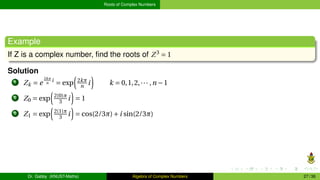
2 Z0 = exp
³
2(0)π
3 i
´
= 1
Dr. Gabby (KNUST-Maths) Algebra of Complex Numbers 27 / 36
Roots of Complex Numbers
Example
If Z is a complex number, find the roots of Z3
= 1
Solution
1 Zk = e
2kπ
n
i
= exp
³
2kπ
n i
´
k = 0,1,2,··· ,n −1
2 Z0 = exp
³
2(0)π
3 i
´
= 1
3 Z1 = exp
³
2(1)π
3 i
´
= cos(2/3π)+i sin(2/3π)
Dr. Gabby (KNUST-Maths) Algebra of Complex Numbers 27 / 36
Roots of Complex Numbers
Example
If Z is a complex number, find the roots of Z3
= 1
Solution
1 Zk = e
2kπ
n
i
= exp
³
2kπ
n i
´
k = 0,1,2,··· ,n −1
2 Z0 = exp
³
2(0)π
3 i
´
= 1
3 Z1 = exp
³
2(1)π
3 i
´
= cos(2/3π)+i sin(2/3π)
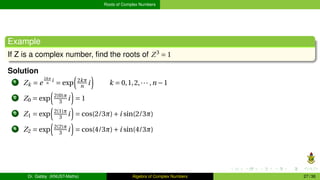
4 Z2 = exp
³
2(2)π
3 i
´
= cos(4/3π)+i sin(4/3π)
Dr. Gabby (KNUST-Maths) Algebra of Complex Numbers 27 / 36
Complex Logarithm
Outline of Presentation
1 Polar Form of Complex Numbers
Trigonometry Form
Exponential Form
The power of a complex number
2 Roots of Complex Numbers
3 Complex Logarithm
Dr. Gabby (KNUST-Maths) Algebra of Complex Numbers 28 / 36
Complex Logarithm
Complex Logarithm
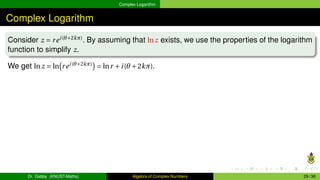
Consider z = rei(θ+2kπ)
. By assuming that lnz exists, we use the properties of the logarithm
function to simplify z.
We get lnz = ln
¡
rei(θ+2kπ)
¢
= lnr +i(θ +2kπ).
Dr. Gabby (KNUST-Maths) Algebra of Complex Numbers 29 / 36
Complex Logarithm
Complex Logarithm
Consider z = rei(θ+2kπ)
. By assuming that lnz exists, we use the properties of the logarithm
function to simplify z.
We get lnz = ln
¡
rei(θ+2kπ)
¢
= lnr +i(θ +2kπ).
Definition
The complex logarithm of a complex number z = rei arg(z)
is defined as
lnz = lnr +iθ (28)
where θ is the argument of z that lies in the range [−π, π].
In general, we use
ln(z) = lnr +i(θ+2kπ) (29)
Dr. Gabby (KNUST-Maths) Algebra of Complex Numbers 29 / 36
Complex Logarithm
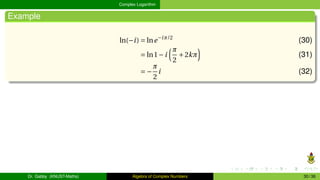
Example
ln(−i) = lne−iπ/2
(30)
= ln1−i
³π
2
+2kπ
´
(31)
= −
π
2
i (32)
Dr. Gabby (KNUST-Maths) Algebra of Complex Numbers 30 / 36
Complex Logarithm
Example
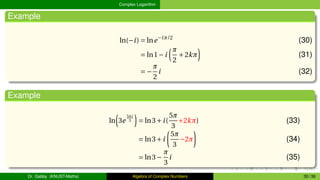
ln(−i) = lne−iπ/2
(30)
= ln1−i
³π
2
+2kπ
´
(31)
= −
π
2
i (32)
Example
ln
³
3e
5πi
3
´
= ln3+i(
5π
3
+2kπ) (33)
= ln3+i
µ
5π
3
−2π

(34)
= ln3−
π
3
i (35)
Dr. Gabby (KNUST-Maths) Algebra of Complex Numbers 30 / 36
Complex Logarithm
Example
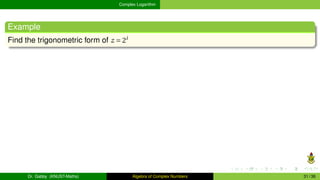
Find the trigonometric form of z = 2i
Dr. Gabby (KNUST-Maths) Algebra of Complex Numbers 31 / 36
Complex Logarithm
Example
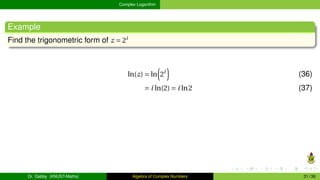
Find the trigonometric form of z = 2i
ln(z) = ln
³
2i
´
(36)
= i ln(2) = i ln2 (37)
Dr. Gabby (KNUST-Maths) Algebra of Complex Numbers 31 / 36
Complex Logarithm
Example
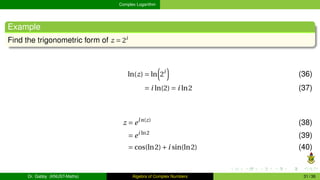
Find the trigonometric form of z = 2i
ln(z) = ln
³
2i
´
(36)
= i ln(2) = i ln2 (37)
z = eln(z)
(38)
= ei ln2
(39)
= cos(ln2)+i sin(ln2) (40)
Dr. Gabby (KNUST-Maths) Algebra of Complex Numbers 31 / 36
Complex Logarithm
Example
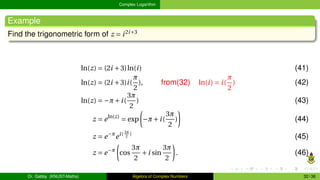
Find the trigonometric form of z = i2i+3
ln(z) = (2i +3)ln(i) (41)
ln(z) = (2i +3)i(
π
2
), from(32) ln(i) = i(
π
2
) (42)
ln(z) = −π+i(
3π
2
) (43)
z = eln(z)
= exp
µ
−π+i(
3π
2
)

(44)
z = e−π
ei( 3π
2
)
(45)
z = e−π
µ
cos
3π
2
+i sin
3π
2

. (46)
Dr. Gabby (KNUST-Maths) Algebra of Complex Numbers 32 / 36
Complex Logarithm
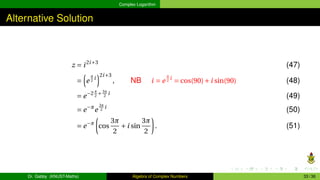
Alternative Solution
z = i2i+3
(47)
=
³
e
π
2
i
´2i+3
, NB i = e
π
2
i
= cos(90)+i sin(90) (48)
= e−2 π
2
+ 3π
2
i
(49)
= e−π
e
3π
2
i
(50)
= e−π
µ
cos
3π
2
+i sin
3π
2

. (51)
Dr. Gabby (KNUST-Maths) Algebra of Complex Numbers 33 / 36
Complex Logarithm
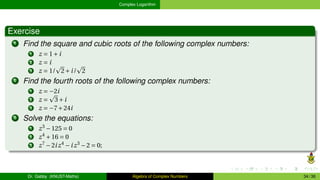
Exercise
1 Find the square and cubic roots of the following complex numbers:
1 z = 1+i
2 z = i
3 z = 1/
p
2+i/
p
2
2 Find the fourth roots of the following complex numbers:
1 z = −2i
2 z =
p
3+i
3 z = −7+24i
3 Solve the equations:
1 z3
−125 = 0
2 z4
+16 = 0
3 z7
−2iz4
−iz3
−2 = 0;
Dr. Gabby (KNUST-Maths) Algebra of Complex Numbers 34 / 36
Complex Logarithm
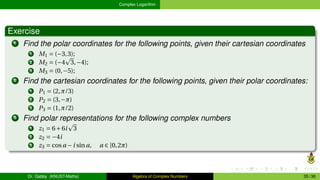
Exercise
1 Find the polar coordinates for the following points, given their cartesian coordinates
1 M1 = (−3,3);
2 M2 = (−4
p
3,−4);
3 M3 = (0,−5);
2 Find the cartesian coordinates for the following points, given their polar coordinates:
1 P1 = (2,π/3)
2 P2 = (3,−π)
3 P3 = (1,π/2)
3 Find polar representations for the following complex numbers
1 z1 = 6+6i
p
3
2 z2 = −4i
3 z3 = cosa −i sina, a ∈ [0,2π)
Dr. Gabby (KNUST-Maths) Algebra of Complex Numbers 35 / 36
END OF LECTURE
THANK YOU
Dr. Gabby (KNUST-Maths) Algebra of Complex Numbers 36 / 36

Complex Numbers 2.pdf

  • 1.
    ALGEBRA OF COMPLEXNUMBERS II Dr. Gabriel Obed Fosu Department of Mathematics Kwame Nkrumah University of Science and Technology Google Scholar: https://scholar.google.com/citations?user=ZJfCMyQAAAAJ&hl=en&oi=ao ResearchGate ID: https://www.researchgate.net/profile/Gabriel_Fosu2 Dr. Gabby (KNUST-Maths) Algebra of Complex Numbers 1 / 36
  • 2.
    Lecture Outline 1 PolarForm of Complex Numbers Trigonometry Form Exponential Form The power of a complex number 2 Roots of Complex Numbers 3 Complex Logarithm Dr. Gabby (KNUST-Maths) Algebra of Complex Numbers 2 / 36
  • 3.
    Polar Form ofComplex Numbers Outline of Presentation 1 Polar Form of Complex Numbers Trigonometry Form Exponential Form The power of a complex number 2 Roots of Complex Numbers 3 Complex Logarithm Dr. Gabby (KNUST-Maths) Algebra of Complex Numbers 3 / 36
  • 4.
    Polar Form ofComplex Numbers Trigonometry Form Definition (Trigonometric Form) The trigonometric form of z = x +i y is z = r (cosθ +i sinθ) where ar g(z) = θ and ∥z∥ = r. Dr. Gabby (KNUST-Maths) Algebra of Complex Numbers 4 / 36
  • 5.
    Polar Form ofComplex Numbers Trigonometry Form Trigonometry and complex number 1 For a complex number z = x + yi we can write the trigonometric representation z = r(cosθ∗ + i sinθ∗ ), where r ∈ [0,∞) and θ∗ ∈ [0,2π) are the polar coordinates of the geometric image of z. Dr. Gabby (KNUST-Maths) Algebra of Complex Numbers 5 / 36
  • 6.
    Polar Form ofComplex Numbers Trigonometry Form Trigonometry and complex number 1 For a complex number z = x + yi we can write the trigonometric representation z = r(cosθ∗ + i sinθ∗ ), where r ∈ [0,∞) and θ∗ ∈ [0,2π) are the polar coordinates of the geometric image of z. 2 The polar argument θ∗ of the geometric image of z is called the argument of z, denoted by argz. Dr. Gabby (KNUST-Maths) Algebra of Complex Numbers 5 / 36
  • 7.
    Polar Form ofComplex Numbers Trigonometry Form Trigonometry and complex number 1 For a complex number z = x + yi we can write the trigonometric representation z = r(cosθ∗ + i sinθ∗ ), where r ∈ [0,∞) and θ∗ ∈ [0,2π) are the polar coordinates of the geometric image of z. 2 The polar argument θ∗ of the geometric image of z is called the argument of z, denoted by argz. 3 The polar radius r of the geometric image of z is equal to the modulus of z. Dr. Gabby (KNUST-Maths) Algebra of Complex Numbers 5 / 36
  • 8.
    Polar Form ofComplex Numbers Trigonometry Form Trigonometry and complex number 1 For a complex number z = x + yi we can write the trigonometric representation z = r(cosθ∗ + i sinθ∗ ), where r ∈ [0,∞) and θ∗ ∈ [0,2π) are the polar coordinates of the geometric image of z. 2 The polar argument θ∗ of the geometric image of z is called the argument of z, denoted by argz. 3 The polar radius r of the geometric image of z is equal to the modulus of z. 4 The set Ar gz = {θ : θ∗ +2kπ, k ∈ Z} is called the extended argument of the complex number z. Then z = r(cosθ +i sinθ) = z = r[cos ¡ θ∗ +2kπ ¢ +i sin ¡ θ∗ +2kπ ¢ ] (1) Dr. Gabby (KNUST-Maths) Algebra of Complex Numbers 5 / 36
  • 9.
    Polar Form ofComplex Numbers Trigonometry Form Example Find the trigonometric representation of the following numbers and determine their extended argument: 1. z1 = 2+2i 2. z2 = −1−i 3. z3 = −1+i p 3 4. z4 = 1+i Dr. Gabby (KNUST-Maths) Algebra of Complex Numbers 6 / 36
  • 10.
    Polar Form ofComplex Numbers Trigonometry Form Example Find the trigonometric representation of the following numbers and determine their extended argument: 1. z1 = 2+2i 2. z2 = −1−i 3. z3 = −1+i p 3 4. z4 = 1+i r1 = p 22 +22 = 2 p 2 Dr. Gabby (KNUST-Maths) Algebra of Complex Numbers 6 / 36
  • 11.
    Polar Form ofComplex Numbers Trigonometry Form Example Find the trigonometric representation of the following numbers and determine their extended argument: 1. z1 = 2+2i 2. z2 = −1−i 3. z3 = −1+i p 3 4. z4 = 1+i r1 = p 22 +22 = 2 p 2 θ∗ 1 = tan−1 (1) = π 4 Dr. Gabby (KNUST-Maths) Algebra of Complex Numbers 6 / 36
  • 12.
    Polar Form ofComplex Numbers Trigonometry Form Example Find the trigonometric representation of the following numbers and determine their extended argument: 1. z1 = 2+2i 2. z2 = −1−i 3. z3 = −1+i p 3 4. z4 = 1+i r1 = p 22 +22 = 2 p 2 θ∗ 1 = tan−1 (1) = π 4 z1 = 2 p 2 ³ cos π 4 +i sin π 4 ´ Dr. Gabby (KNUST-Maths) Algebra of Complex Numbers 6 / 36
  • 13.
    Polar Form ofComplex Numbers Trigonometry Form Example Find the trigonometric representation of the following numbers and determine their extended argument: 1. z1 = 2+2i 2. z2 = −1−i 3. z3 = −1+i p 3 4. z4 = 1+i r1 = p 22 +22 = 2 p 2 θ∗ 1 = tan−1 (1) = π 4 z1 = 2 p 2 ³ cos π 4 +i sin π 4 ´ Ar gz1 = nπ 4 +2kπ; k ∈ Z o Dr. Gabby (KNUST-Maths) Algebra of Complex Numbers 6 / 36
  • 14.
    Polar Form ofComplex Numbers Trigonometry Form z2 = −1−i 1 r2 = p (−1)2 +(−1)2 = p 2 Dr. Gabby (KNUST-Maths) Algebra of Complex Numbers 7 / 36
  • 15.
    Polar Form ofComplex Numbers Trigonometry Form z2 = −1−i 1 r2 = p (−1)2 +(−1)2 = p 2 2 Because is in the third quadrant θ∗ 2 = tan−1 y x +π = tan−1 (1)+π = π 4 +π = 5π 4 Dr. Gabby (KNUST-Maths) Algebra of Complex Numbers 7 / 36
  • 16.
    Polar Form ofComplex Numbers Trigonometry Form z2 = −1−i 1 r2 = p (−1)2 +(−1)2 = p 2 2 Because is in the third quadrant θ∗ 2 = tan−1 y x +π = tan−1 (1)+π = π 4 +π = 5π 4 3 z2 = p 2 µ cos 5π 4 +i sin 5π 4 ¶ Dr. Gabby (KNUST-Maths) Algebra of Complex Numbers 7 / 36
  • 17.
    Polar Form ofComplex Numbers Trigonometry Form z2 = −1−i 1 r2 = p (−1)2 +(−1)2 = p 2 2 Because is in the third quadrant θ∗ 2 = tan−1 y x +π = tan−1 (1)+π = π 4 +π = 5π 4 3 z2 = p 2 µ cos 5π 4 +i sin 5π 4 ¶ 4 Ar gz2 = ½ 5π 4 +2kπ; k ∈ Z ¾ Dr. Gabby (KNUST-Maths) Algebra of Complex Numbers 7 / 36
  • 18.
    Polar Form ofComplex Numbers Trigonometry Form z3 = −1+i p 3 Dr. Gabby (KNUST-Maths) Algebra of Complex Numbers 8 / 36
  • 19.
    Polar Form ofComplex Numbers Trigonometry Form z3 = −1+i p 3 r3 = q (−1)2 + p 3 2 = 2 Dr. Gabby (KNUST-Maths) Algebra of Complex Numbers 8 / 36
  • 20.
    Polar Form ofComplex Numbers Trigonometry Form z3 = −1+i p 3 r3 = q (−1)2 + p 3 2 = 2 θ∗ 3 = tan−1 (− p 3)+π = π 3 +π = 2π 3 Dr. Gabby (KNUST-Maths) Algebra of Complex Numbers 8 / 36
  • 21.
    Polar Form ofComplex Numbers Trigonometry Form z3 = −1+i p 3 r3 = q (−1)2 + p 3 2 = 2 θ∗ 3 = tan−1 (− p 3)+π = π 3 +π = 2π 3 z3 = 2 µ cos 2π 3 +i sin 2π 3 ¶ Dr. Gabby (KNUST-Maths) Algebra of Complex Numbers 8 / 36
  • 22.
    Polar Form ofComplex Numbers Trigonometry Form z3 = −1+i p 3 r3 = q (−1)2 + p 3 2 = 2 θ∗ 3 = tan−1 (− p 3)+π = π 3 +π = 2π 3 z3 = 2 µ cos 2π 3 +i sin 2π 3 ¶ Ar gz3 = ½ 2π 3 +2kπ; k ∈ Z ¾ Dr. Gabby (KNUST-Maths) Algebra of Complex Numbers 8 / 36
  • 23.
    Polar Form ofComplex Numbers Trigonometry Form 1 + i z = 1+i has modulus p 2 and argument arg(z) = π 4 +2kπ,k ∈ Z. Dr. Gabby (KNUST-Maths) Algebra of Complex Numbers 9 / 36
  • 24.
    Polar Form ofComplex Numbers Trigonometry Form 1 + i z = 1+i has modulus p 2 and argument arg(z) = π 4 +2kπ,k ∈ Z. In other words, the trigonometric form of z can be any one of the following z = p 2(cosπ/4+i sinπ/4); k = 0 (2) = p 2(cos(π/4±2π)+i sin(π/4±2π)); k = ±1 (3) = p 2(cos(π/4±4π)+i sin(π/4±4π)); k = ±2 (4) = p 2(cos(π/4±6π)+i sin(π/4±6π)); k = ±3 (5) = . . . (6) If there is no ambiguity, we choose the argument between 0 and 2π. Thus z = p 2(cosπ/4+i sinπ/4) (7) Dr. Gabby (KNUST-Maths) Algebra of Complex Numbers 9 / 36
  • 25.
    Polar Form ofComplex Numbers Trigonometry Form Remarks 1 = cos0+i sin0 Dr. Gabby (KNUST-Maths) Algebra of Complex Numbers 10 / 36
  • 26.
    Polar Form ofComplex Numbers Trigonometry Form Remarks 1 = cos0+i sin0 i = cos π 2 +i sin π 2 Dr. Gabby (KNUST-Maths) Algebra of Complex Numbers 10 / 36
  • 27.
    Polar Form ofComplex Numbers Trigonometry Form Remarks 1 = cos0+i sin0 i = cos π 2 +i sin π 2 −1 = cosπ+i sinπ Dr. Gabby (KNUST-Maths) Algebra of Complex Numbers 10 / 36
  • 28.
    Polar Form ofComplex Numbers Trigonometry Form Remarks 1 = cos0+i sin0 i = cos π 2 +i sin π 2 −1 = cosπ+i sinπ −i = cos 3π 2 +i sin 3π 2 Dr. Gabby (KNUST-Maths) Algebra of Complex Numbers 10 / 36
  • 29.
    Polar Form ofComplex Numbers Trigonometry Form Remarks 1 = cos0+i sin0 i = cos π 2 +i sin π 2 −1 = cosπ+i sinπ −i = cos 3π 2 +i sin 3π 2 If z1 = r1(cosθ1 +i sinθ1) and z2 = r2(cosθ2 +i sinθ2) then z1z2 = r1r2 [cos(θ1 +θ2)+i sin(θ1 +θ2)] Dr. Gabby (KNUST-Maths) Algebra of Complex Numbers 10 / 36
  • 30.
    Polar Form ofComplex Numbers Trigonometry Form Remarks 1 = cos0+i sin0 i = cos π 2 +i sin π 2 −1 = cosπ+i sinπ −i = cos 3π 2 +i sin 3π 2 If z1 = r1(cosθ1 +i sinθ1) and z2 = r2(cosθ2 +i sinθ2) then z1z2 = r1r2 [cos(θ1 +θ2)+i sin(θ1 +θ2)] If z1 = r1(cosθ1 +i sinθ1) and z2 = r2(cosθ2 +i sinθ2) ̸= 0 then z1 z2 = r1 r2 [cos(θ1 −θ2)+i sin(θ1 −θ2)] Dr. Gabby (KNUST-Maths) Algebra of Complex Numbers 10 / 36
  • 31.
    Polar Form ofComplex Numbers Trigonometry Form Example Let z1 = 1−i and z2 = p 3+i, then z1 = p 2 µ cos 7π 4 +i sin 7π 4 ¶ , Dr. Gabby (KNUST-Maths) Algebra of Complex Numbers 11 / 36
  • 32.
    Polar Form ofComplex Numbers Trigonometry Form Example Let z1 = 1−i and z2 = p 3+i, then z1 = p 2 µ cos 7π 4 +i sin 7π 4 ¶ , z2 = 2 ³ cos π 6 +i sin π 6 ´ Dr. Gabby (KNUST-Maths) Algebra of Complex Numbers 11 / 36
  • 33.
    Polar Form ofComplex Numbers Trigonometry Form Example Let z1 = 1−i and z2 = p 3+i, then z1 = p 2 µ cos 7π 4 +i sin 7π 4 ¶ , z2 = 2 ³ cos π 6 +i sin π 6 ´ and z1z2 = 2 p 2 · cos µ 7π 4 + π 6 ¶ +i sin µ 7π 4 + π 6 ¶¸ = 2 p 2 µ cos 23π 12 +i sin 23π 12 ¶ Dr. Gabby (KNUST-Maths) Algebra of Complex Numbers 11 / 36
  • 34.
    Polar Form ofComplex Numbers Trigonometry Form Properties Let z1 and z2 be two non-zero complex numbers. We have 1 z2 = z1 ⇐⇒ ∥z2∥ = ∥z1∥ and arg(z2) = arg(z1)+2kπ,k ∈ Z. 2 arg(z1z2) = arg(z1)+arg(z2)+2kπ. 3 arg(zn 1 ) = n arg(z1)+2kπ. 4 arg(1/z1) = −arg(z1)+2kπ. 5 arg( ¯ z1) = −arg(z1)+2kπ. Dr. Gabby (KNUST-Maths) Algebra of Complex Numbers 12 / 36
  • 35.
    Polar Form ofComplex Numbers Exponential Form Euler and De Moivre’s Form Definition (Euler’s equation) The relation eiθ = cosθ +i sinθ (8) is called Euler’s equation. Dr. Gabby (KNUST-Maths) Algebra of Complex Numbers 13 / 36
  • 36.
    Polar Form ofComplex Numbers Exponential Form Euler and De Moivre’s Form Definition (Euler’s equation) The relation eiθ = cosθ +i sinθ (8) is called Euler’s equation. Thus, if z ∈ C−{0} (Trigonometric form) z = r(cosθ +i sinθ) ⇐⇒ (Exponential form): z = reiθ . Dr. Gabby (KNUST-Maths) Algebra of Complex Numbers 13 / 36
  • 37.
    Polar Form ofComplex Numbers Exponential Form Euler and De Moivre’s Form Definition (Euler’s equation) The relation eiθ = cosθ +i sinθ (8) is called Euler’s equation. Thus, if z ∈ C−{0} (Trigonometric form) z = r(cosθ +i sinθ) ⇐⇒ (Exponential form): z = reiθ . Also, because any two arguments for a give complex number differ by an integer multiple of 2π we will sometimes write the exponential form as, z = rei(θ+2πk) , k = 0,±1,±2,··· (9) Dr. Gabby (KNUST-Maths) Algebra of Complex Numbers 13 / 36
  • 38.
    Polar Form ofComplex Numbers Exponential Form Forms 1 Standard form : z = x +i y 2 Trigonometric form : z = r(cosθ +i sinθ) where r = ∥z∥ and arg(z) = θ +2kπ. 3 Exponential form: z = reiθ where r = ∥z∥ and arg(z) = θ +2kπ. Dr. Gabby (KNUST-Maths) Algebra of Complex Numbers 14 / 36
  • 39.
    Polar Form ofComplex Numbers Exponential Form Forms 1 Standard form : z = x +i y 2 Trigonometric form : z = r(cosθ +i sinθ) where r = ∥z∥ and arg(z) = θ +2kπ. 3 Exponential form: z = reiθ where r = ∥z∥ and arg(z) = θ +2kπ. Example z = 2+2i p 3 has modulus ∥z∥ = 4 and argument θ = π/3. Therefore, z = 4eiπ/3 (10) is its exponential form. Dr. Gabby (KNUST-Maths) Algebra of Complex Numbers 14 / 36
  • 40.
    Polar Form ofComplex Numbers Exponential Form De Moivre’s and Euler De Moivre’s theorem For all real number θ and all integer n, (cosθ +i sinθ)n = cos(nθ)+i sin(nθ). (11) Dr. Gabby (KNUST-Maths) Algebra of Complex Numbers 15 / 36
  • 41.
    Polar Form ofComplex Numbers Exponential Form De Moivre’s and Euler De Moivre’s theorem For all real number θ and all integer n, (cosθ +i sinθ)n = cos(nθ)+i sin(nθ). (11) Definition (Euler’s formula) cosθ = eiθ +e−iθ 2 cos(nθ) = einθ +e−inθ 2 (12) sinθ = eiθ −e−iθ 2i sin(nθ) = einθ −e−inθ 2i . (13) Dr. Gabby (KNUST-Maths) Algebra of Complex Numbers 15 / 36
  • 42.
    Polar Form ofComplex Numbers Exponential Form Trigonometric identities Let us use De Moivre’s formula to express cos2θ in terms of cosθ and sinθ Dr. Gabby (KNUST-Maths) Algebra of Complex Numbers 16 / 36
  • 43.
    Polar Form ofComplex Numbers Exponential Form Trigonometric identities Let us use De Moivre’s formula to express cos2θ in terms of cosθ and sinθ cos2θ +i sin2θ = (cosθ +i sinθ)2 (by the theorem) (14) = cos2 θ −sin2 θ +2i cosθsinθ (15) Dr. Gabby (KNUST-Maths) Algebra of Complex Numbers 16 / 36
  • 44.
    Polar Form ofComplex Numbers Exponential Form Trigonometric identities Let us use De Moivre’s formula to express cos2θ in terms of cosθ and sinθ cos2θ +i sin2θ = (cosθ +i sinθ)2 (by the theorem) (14) = cos2 θ −sin2 θ +2i cosθsinθ (15) We observe that, cos2θ = cos2 θ −sin2 θ (16) and sin2θ = 2cosθsinθ (17) Dr. Gabby (KNUST-Maths) Algebra of Complex Numbers 16 / 36
  • 45.
    Polar Form ofComplex Numbers Exponential Form Trigonometric identities Let us use De Moivre’s formula to express cos2θ in terms of cosθ and sinθ cos2θ +i sin2θ = (cosθ +i sinθ)2 (by the theorem) (14) = cos2 θ −sin2 θ +2i cosθsinθ (15) We observe that, cos2θ = cos2 θ −sin2 θ (16) and sin2θ = 2cosθsinθ (17) Exercise Express cos3θ and sin4θ in terms of cosθ and sinθ. Dr. Gabby (KNUST-Maths) Algebra of Complex Numbers 16 / 36
  • 46.
    Polar Form ofComplex Numbers The power of a complex number The power of a complex number De Moivre’s Revisited For z = r(cosθ +i sinθ) and n ∈ N, we have zn = rn (cosθ +i sinθ)n zn = rn (cosnθ +i sinnθ) Dr. Gabby (KNUST-Maths) Algebra of Complex Numbers 17 / 36
  • 47.
    Polar Form ofComplex Numbers The power of a complex number Example If z = 2+2i p 3 find z3 This has modulus ∥z∥ = 4 and argument θ = π/3. so Dr. Gabby (KNUST-Maths) Algebra of Complex Numbers 18 / 36
  • 48.
    Polar Form ofComplex Numbers The power of a complex number Example If z = 2+2i p 3 find z3 This has modulus ∥z∥ = 4 and argument θ = π/3. so zn = rn (cosnθ +i sinnθ) (18) z3 = 43 (cos3(π/3)+i sin3(π/3)) (19) z3 = 64(cos(π)+i sin(π)) (20) z3 = −64 (21) Dr. Gabby (KNUST-Maths) Algebra of Complex Numbers 18 / 36
  • 49.
    Polar Form ofComplex Numbers The power of a complex number Example If z = 2+2i p 3 find z3 This has modulus ∥z∥ = 4 and argument θ = π/3. so zn = rn (cosnθ +i sinnθ) (18) z3 = 43 (cos3(π/3)+i sin3(π/3)) (19) z3 = 64(cos(π)+i sin(π)) (20) z3 = −64 (21) Thus (2+2i p 3)3 = −64 Dr. Gabby (KNUST-Maths) Algebra of Complex Numbers 18 / 36
  • 50.
    Polar Form ofComplex Numbers The power of a complex number Example Let us compute (1+i)1000 Dr. Gabby (KNUST-Maths) Algebra of Complex Numbers 19 / 36
  • 51.
    Polar Form ofComplex Numbers The power of a complex number Example Let us compute (1+i)1000 The trigonometric representation of 1+i is p 2(cosπ/4+i sinπ/4). Applying de Moivre’s formula we obtain Dr. Gabby (KNUST-Maths) Algebra of Complex Numbers 19 / 36
  • 52.
    Polar Form ofComplex Numbers The power of a complex number Example Let us compute (1+i)1000 The trigonometric representation of 1+i is p 2(cosπ/4+i sinπ/4). Applying de Moivre’s formula we obtain (1+i)1000 = p 2 1000 (cos1000(π/4)+i sin1000(π/4)) = 2500 (cos250π+i sin250π) = 2500 Dr. Gabby (KNUST-Maths) Algebra of Complex Numbers 19 / 36
  • 53.
    Roots of ComplexNumbers Outline of Presentation 1 Polar Form of Complex Numbers Trigonometry Form Exponential Form The power of a complex number 2 Roots of Complex Numbers 3 Complex Logarithm Dr. Gabby (KNUST-Maths) Algebra of Complex Numbers 20 / 36
  • 54.
    Roots of ComplexNumbers Roots of Complex Numbers Definition (Complex polynomials) Polynomials with complex coefficients and unknown are called complex polynomials. P(z) = iz4 −2z +i p 2+4 is a complex polynomial of degree 4. Dr. Gabby (KNUST-Maths) Algebra of Complex Numbers 21 / 36
  • 55.
    Roots of ComplexNumbers Roots of Complex Numbers Definition (Complex polynomials) Polynomials with complex coefficients and unknown are called complex polynomials. P(z) = iz4 −2z +i p 2+4 is a complex polynomial of degree 4. Theorem (Fundamental Theorem of Algebra) Every complex polynomial equation of degree n has exactly n complex roots. Dr. Gabby (KNUST-Maths) Algebra of Complex Numbers 21 / 36
  • 56.
    Roots of ComplexNumbers Roots of Complex Numbers Definition (Complex polynomials) Polynomials with complex coefficients and unknown are called complex polynomials. P(z) = iz4 −2z +i p 2+4 is a complex polynomial of degree 4. Theorem (Fundamental Theorem of Algebra) Every complex polynomial equation of degree n has exactly n complex roots. The roots of the complex polynomial z3 −3z2 +2z are 0,1,2. Note degree = 3 and number of roots = 3. Dr. Gabby (KNUST-Maths) Algebra of Complex Numbers 21 / 36
  • 57.
    Roots of ComplexNumbers The nth Roots of Unity Consider a positive integer n ≥ 2 and a complex number z0 ̸= 0. As in the field of real numbers, the equation Zn − z0 = 0 =⇒ Z = n p z0 (22) is used for defining the nth roots of number z0. Hence we call any solution Z of the equation (22) an nth root of the complex number z0. Dr. Gabby (KNUST-Maths) Algebra of Complex Numbers 22 / 36
  • 58.
    Roots of ComplexNumbers Definition (Trigonometric) Let z0 = r(cosθ +i sinθ) be a complex number with r > 0 and θ ∈ [0,2π), then the number z0 has n distinct nth roots given by the formulas Zk = n p r µ cos θ +2kπ n +i sin θ +2kπ n ¶ (23) where k = 0,1,··· ,n −1 Dr. Gabby (KNUST-Maths) Algebra of Complex Numbers 23 / 36
  • 59.
    Roots of ComplexNumbers Definition (Trigonometric) Let z0 = r(cosθ +i sinθ) be a complex number with r > 0 and θ ∈ [0,2π), then the number z0 has n distinct nth roots given by the formulas Zk = n p r µ cos θ +2kπ n +i sin θ +2kπ n ¶ (23) where k = 0,1,··· ,n −1 Alternatively definition for Exponential If we had considered z = reθi , the roots should have been Zk = n p re θ+2kπ n i = n p r exp µ θ +2kπ n i ¶ ; k = 0,1,··· ,n −1 (24) Dr. Gabby (KNUST-Maths) Algebra of Complex Numbers 23 / 36
  • 60.
    Roots of ComplexNumbers Example Let us find the third roots of the number z = 1+i Dr. Gabby (KNUST-Maths) Algebra of Complex Numbers 24 / 36
  • 61.
    Roots of ComplexNumbers Example Let us find the third roots of the number z = 1+i The trigonometric representation of z = 1+i is z = p 2(cosπ/4+i sinπ/4) Dr. Gabby (KNUST-Maths) Algebra of Complex Numbers 24 / 36
  • 62.
    Roots of ComplexNumbers Example Let us find the third roots of the number z = 1+i The trigonometric representation of z = 1+i is z = p 2(cosπ/4+i sinπ/4) The cube roots of the number z are Zk = 3 q p 2 · cos µ π 12 +k 2π 3 ¶ +i sin µ π 12 +k 2π 3 ¶¸ ;k = 0,1,2 Dr. Gabby (KNUST-Maths) Algebra of Complex Numbers 24 / 36
  • 63.
    Roots of ComplexNumbers Example Let us find the third roots of the number z = 1+i The trigonometric representation of z = 1+i is z = p 2(cosπ/4+i sinπ/4) The cube roots of the number z are Zk = 3 q p 2 · cos µ π 12 +k 2π 3 ¶ +i sin µ π 12 +k 2π 3 ¶¸ ;k = 0,1,2 or in explicit form as Z0 = 6 p 2 ³ cos π 12 +i sin π 12 ´ Z1 = 6 p 2 µ cos 3π 4 +i sin 3π 4 ¶ Z2 = 6 p 2 µ cos 17π 12 +i sin 17π 12 ¶ Dr. Gabby (KNUST-Maths) Algebra of Complex Numbers 24 / 36
  • 64.
    Roots of ComplexNumbers Exercise Find the argument and the standard form of the fourth roots of a = cos 2π 3 +i sin 2π 3 . Solution arg(z) = ½ π 6 , 4π 6 , 7π 6 , 10π 6 ¾ Dr. Gabby (KNUST-Maths) Algebra of Complex Numbers 25 / 36
  • 65.
    Roots of ComplexNumbers The nth roots of unity The roots of the equation Zn −1 = 0 are called the nth roots of unity. Since 1 = cos0+i sin0, from the formulas for the nth roots of a complex number (23) we derive that the nth roots of unity are Zk = cos 2kπ n +i sin 2kπ n , k = 0,1,2,··· ,n −1 (25) Dr. Gabby (KNUST-Maths) Algebra of Complex Numbers 26 / 36
  • 66.
    Roots of ComplexNumbers The nth roots of unity The roots of the equation Zn −1 = 0 are called the nth roots of unity. Since 1 = cos0+i sin0, from the formulas for the nth roots of a complex number (23) we derive that the nth roots of unity are Zk = cos 2kπ n +i sin 2kπ n , k = 0,1,2,··· ,n −1 (25) Simplified as: z0 = 1, z1 = e 2 n πi , z2 = e 4 n πi , ...,zn−1 = e 2(n−1) n πi (26) Dr. Gabby (KNUST-Maths) Algebra of Complex Numbers 26 / 36
  • 67.
    Roots of ComplexNumbers The nth roots of unity The roots of the equation Zn −1 = 0 are called the nth roots of unity. Since 1 = cos0+i sin0, from the formulas for the nth roots of a complex number (23) we derive that the nth roots of unity are Zk = cos 2kπ n +i sin 2kπ n , k = 0,1,2,··· ,n −1 (25) Simplified as: z0 = 1, z1 = e 2 n πi , z2 = e 4 n πi , ...,zn−1 = e 2(n−1) n πi (26) The nth of unity in Exponential form Zk = e 2kπ n i = exp µ 2kπ n i ¶ k = 0,1,2,··· ,n −1 (27) Dr. Gabby (KNUST-Maths) Algebra of Complex Numbers 26 / 36
  • 68.
    Roots of ComplexNumbers Example If Z is a complex number, find the roots of Z3 = 1 Solution 1 Zk = e 2kπ n i = exp ³ 2kπ n i ´ k = 0,1,2,··· ,n −1 Dr. Gabby (KNUST-Maths) Algebra of Complex Numbers 27 / 36
  • 69.
    Roots of ComplexNumbers Example If Z is a complex number, find the roots of Z3 = 1 Solution 1 Zk = e 2kπ n i = exp ³ 2kπ n i ´ k = 0,1,2,··· ,n −1 2 Z0 = exp ³ 2(0)π 3 i ´ = 1 Dr. Gabby (KNUST-Maths) Algebra of Complex Numbers 27 / 36
  • 70.
    Roots of ComplexNumbers Example If Z is a complex number, find the roots of Z3 = 1 Solution 1 Zk = e 2kπ n i = exp ³ 2kπ n i ´ k = 0,1,2,··· ,n −1 2 Z0 = exp ³ 2(0)π 3 i ´ = 1 3 Z1 = exp ³ 2(1)π 3 i ´ = cos(2/3π)+i sin(2/3π) Dr. Gabby (KNUST-Maths) Algebra of Complex Numbers 27 / 36
  • 71.
    Roots of ComplexNumbers Example If Z is a complex number, find the roots of Z3 = 1 Solution 1 Zk = e 2kπ n i = exp ³ 2kπ n i ´ k = 0,1,2,··· ,n −1 2 Z0 = exp ³ 2(0)π 3 i ´ = 1 3 Z1 = exp ³ 2(1)π 3 i ´ = cos(2/3π)+i sin(2/3π) 4 Z2 = exp ³ 2(2)π 3 i ´ = cos(4/3π)+i sin(4/3π) Dr. Gabby (KNUST-Maths) Algebra of Complex Numbers 27 / 36
  • 72.
    Complex Logarithm Outline ofPresentation 1 Polar Form of Complex Numbers Trigonometry Form Exponential Form The power of a complex number 2 Roots of Complex Numbers 3 Complex Logarithm Dr. Gabby (KNUST-Maths) Algebra of Complex Numbers 28 / 36
  • 73.
    Complex Logarithm Complex Logarithm Considerz = rei(θ+2kπ) . By assuming that lnz exists, we use the properties of the logarithm function to simplify z. We get lnz = ln ¡ rei(θ+2kπ) ¢ = lnr +i(θ +2kπ). Dr. Gabby (KNUST-Maths) Algebra of Complex Numbers 29 / 36
  • 74.
    Complex Logarithm Complex Logarithm Considerz = rei(θ+2kπ) . By assuming that lnz exists, we use the properties of the logarithm function to simplify z. We get lnz = ln ¡ rei(θ+2kπ) ¢ = lnr +i(θ +2kπ). Definition The complex logarithm of a complex number z = rei arg(z) is defined as lnz = lnr +iθ (28) where θ is the argument of z that lies in the range [−π, π]. In general, we use ln(z) = lnr +i(θ+2kπ) (29) Dr. Gabby (KNUST-Maths) Algebra of Complex Numbers 29 / 36
  • 75.
    Complex Logarithm Example ln(−i) =lne−iπ/2 (30) = ln1−i ³π 2 +2kπ ´ (31) = − π 2 i (32) Dr. Gabby (KNUST-Maths) Algebra of Complex Numbers 30 / 36
  • 76.
    Complex Logarithm Example ln(−i) =lne−iπ/2 (30) = ln1−i ³π 2 +2kπ ´ (31) = − π 2 i (32) Example ln ³ 3e 5πi 3 ´ = ln3+i( 5π 3 +2kπ) (33) = ln3+i µ 5π 3 −2π ¶ (34) = ln3− π 3 i (35) Dr. Gabby (KNUST-Maths) Algebra of Complex Numbers 30 / 36
  • 77.
    Complex Logarithm Example Find thetrigonometric form of z = 2i Dr. Gabby (KNUST-Maths) Algebra of Complex Numbers 31 / 36
  • 78.
    Complex Logarithm Example Find thetrigonometric form of z = 2i ln(z) = ln ³ 2i ´ (36) = i ln(2) = i ln2 (37) Dr. Gabby (KNUST-Maths) Algebra of Complex Numbers 31 / 36
  • 79.
    Complex Logarithm Example Find thetrigonometric form of z = 2i ln(z) = ln ³ 2i ´ (36) = i ln(2) = i ln2 (37) z = eln(z) (38) = ei ln2 (39) = cos(ln2)+i sin(ln2) (40) Dr. Gabby (KNUST-Maths) Algebra of Complex Numbers 31 / 36
  • 80.
    Complex Logarithm Example Find thetrigonometric form of z = i2i+3 ln(z) = (2i +3)ln(i) (41) ln(z) = (2i +3)i( π 2 ), from(32) ln(i) = i( π 2 ) (42) ln(z) = −π+i( 3π 2 ) (43) z = eln(z) = exp µ −π+i( 3π 2 ) ¶ (44) z = e−π ei( 3π 2 ) (45) z = e−π µ cos 3π 2 +i sin 3π 2 ¶ . (46) Dr. Gabby (KNUST-Maths) Algebra of Complex Numbers 32 / 36
  • 81.
    Complex Logarithm Alternative Solution z= i2i+3 (47) = ³ e π 2 i ´2i+3 , NB i = e π 2 i = cos(90)+i sin(90) (48) = e−2 π 2 + 3π 2 i (49) = e−π e 3π 2 i (50) = e−π µ cos 3π 2 +i sin 3π 2 ¶ . (51) Dr. Gabby (KNUST-Maths) Algebra of Complex Numbers 33 / 36
  • 82.
    Complex Logarithm Exercise 1 Findthe square and cubic roots of the following complex numbers: 1 z = 1+i 2 z = i 3 z = 1/ p 2+i/ p 2 2 Find the fourth roots of the following complex numbers: 1 z = −2i 2 z = p 3+i 3 z = −7+24i 3 Solve the equations: 1 z3 −125 = 0 2 z4 +16 = 0 3 z7 −2iz4 −iz3 −2 = 0; Dr. Gabby (KNUST-Maths) Algebra of Complex Numbers 34 / 36
  • 83.
    Complex Logarithm Exercise 1 Findthe polar coordinates for the following points, given their cartesian coordinates 1 M1 = (−3,3); 2 M2 = (−4 p 3,−4); 3 M3 = (0,−5); 2 Find the cartesian coordinates for the following points, given their polar coordinates: 1 P1 = (2,π/3) 2 P2 = (3,−π) 3 P3 = (1,π/2) 3 Find polar representations for the following complex numbers 1 z1 = 6+6i p 3 2 z2 = −4i 3 z3 = cosa −i sina, a ∈ [0,2π) Dr. Gabby (KNUST-Maths) Algebra of Complex Numbers 35 / 36
  • 84.
    END OF LECTURE THANKYOU Dr. Gabby (KNUST-Maths) Algebra of Complex Numbers 36 / 36