+
Transforming and Solving
Exponential Functions
+
Transformation of an Exponential
Function
 We recently looked at a simple exponential function in the form of
y = cx
 Today we will look at transforming that function into a function in
the form of f(x) = a(c)b(x-h)
+ k
 If we remember from our previous chapter, we have used these
variables to represent different transformations, and in this case
they also mean the same thing
 a = vertical stretch by a factor of |a|
 b = horizontal stretch by a factor of 1/|b|
 k = vertical translation up or down
 h = horizontal translation left and right
+
Apply Transformations to Sketch a
Graph
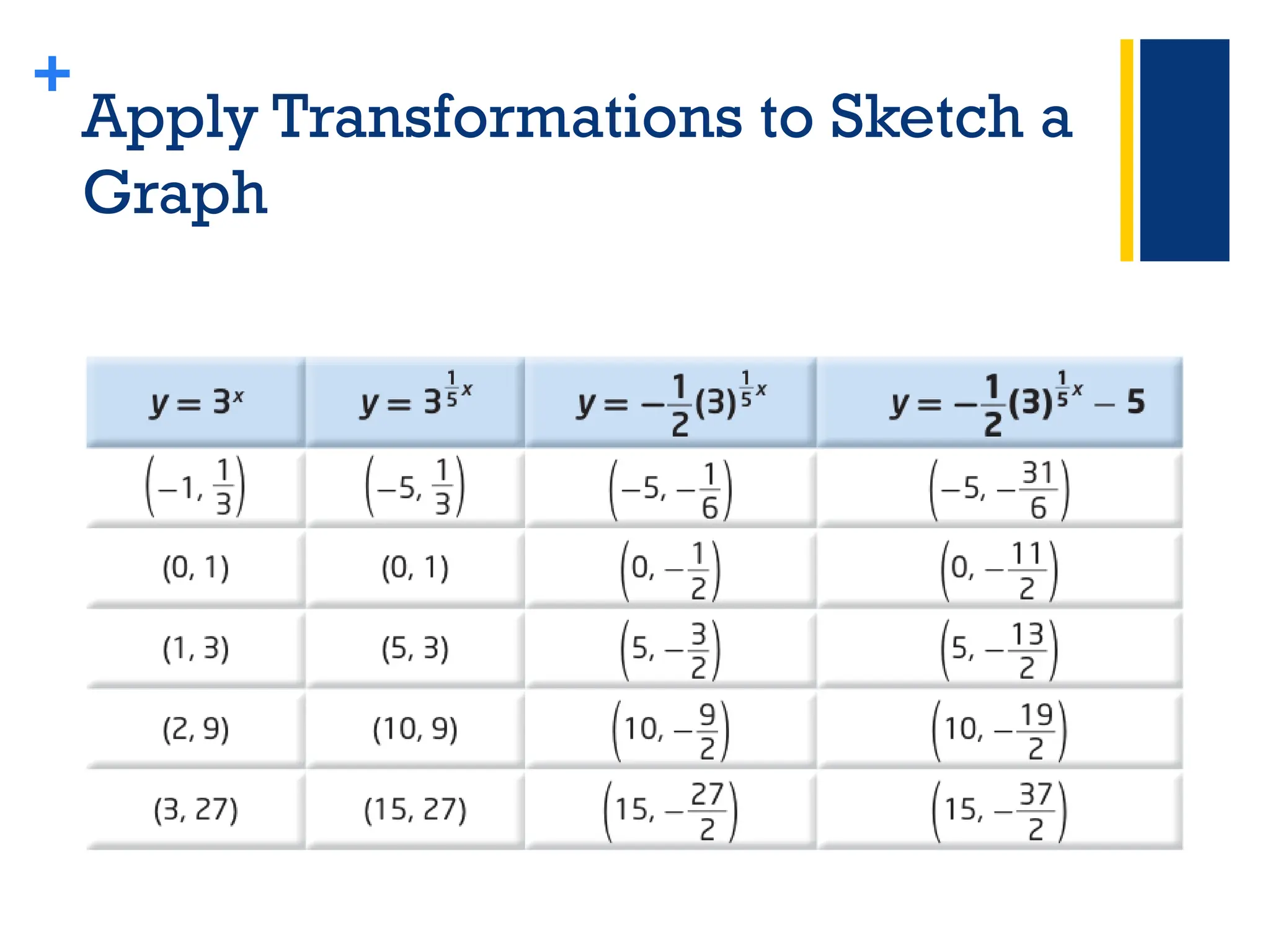
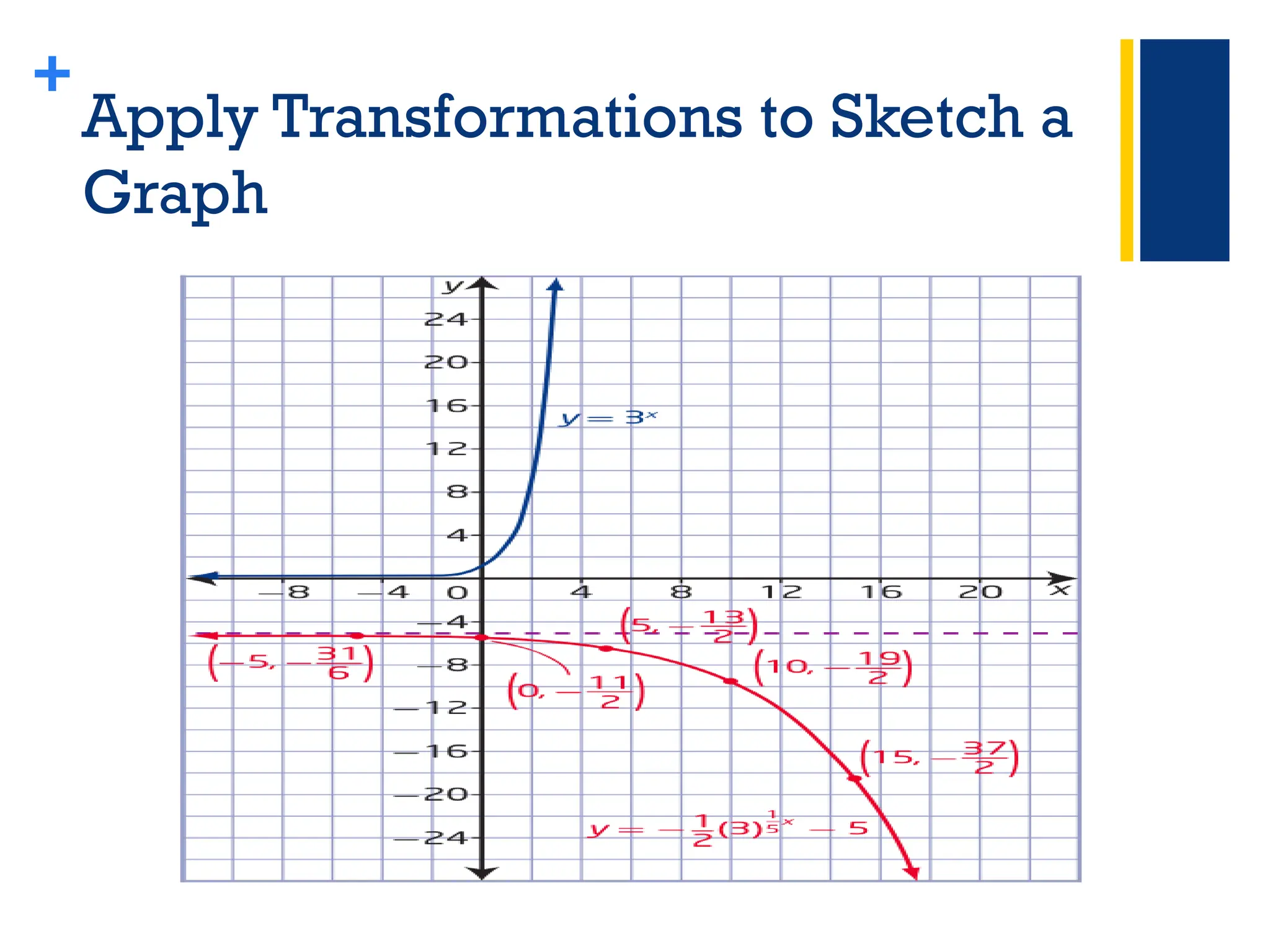
 Example: Consider the base function y = 3x
and the
transformed function y = -½(3)1/5x
– 5
1. State the parameters and describe the corresponding
transformations.
2. Sketch both the base graph and the transformed graph.
+
Apply Transformations to Sketch a
Graph
 Solution:
1. We can compare our function y = -½(3)1/5x
– 5 to the form
f(x) = a(c)b(x-h)
+ k
 a = -½ means there is a vertical stretch by the factor of ½ and a
reflection in the x – axis
 b = 1/5 means there is a horizontal stretch by a factor of 5
 h = 0, so there is no horizontal translation
 k = -5, meaning there is a vertical translation down 5 units
+
Apply Transformations to Sketch a
Graph
+
Apply Transformations to Sketch a
Graph
+Use Transformations of an
Exponential Function to Model a
Situation
+Use Transformations of an
Exponential Function to Model a
Situation
 Question: What is the transformed exponential function in the form of
f(x) = a(c)b(x-h)
+ k that can be used to represent this situation?
 Solution:
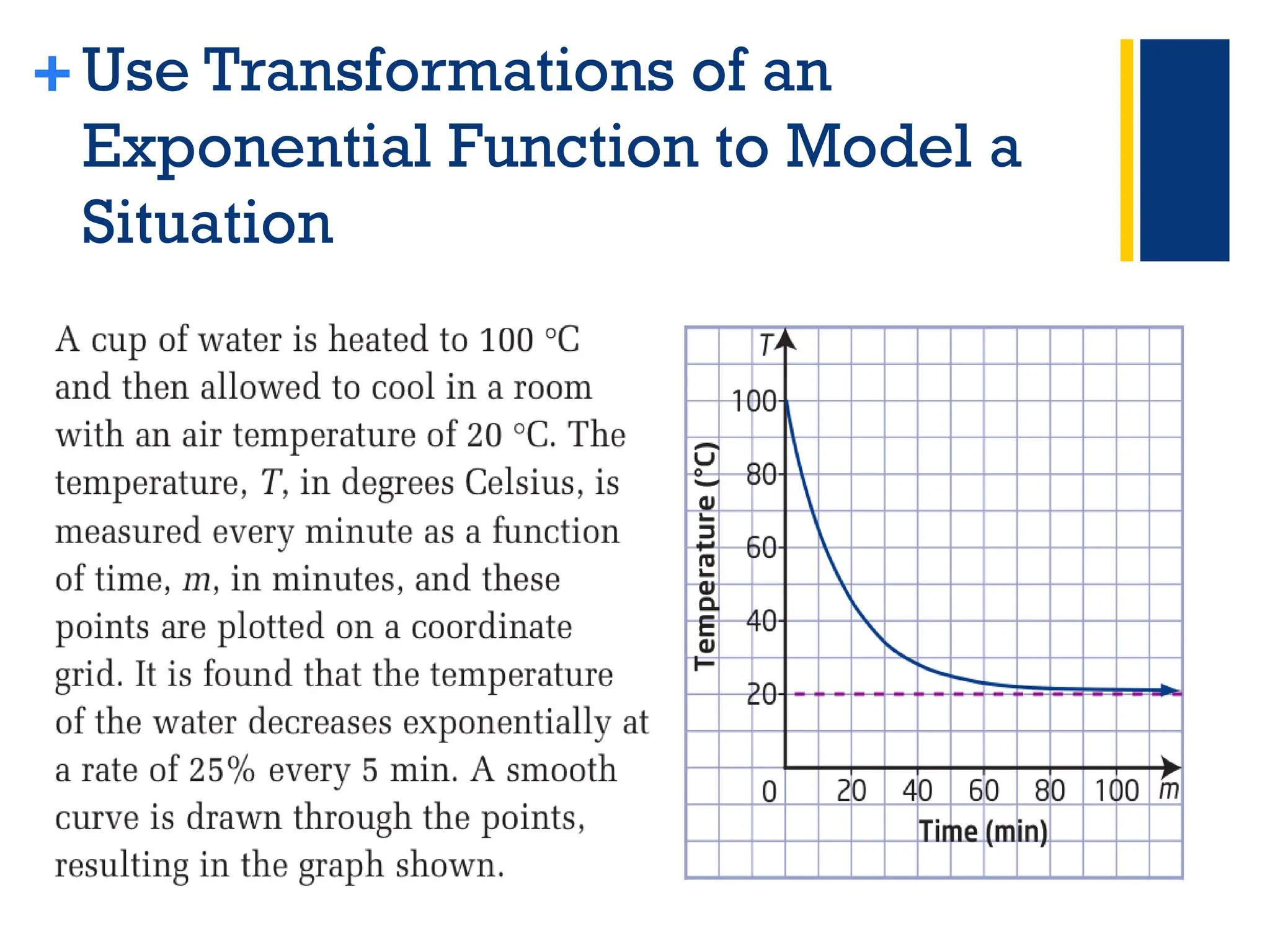
1. What we need to do first is gather some key information from our
story and our graph to help us find our missing transformations.
From our story we know that:
 The cup of water starts at 100 o
C and stops at 20 o
C
 Temperature (T) is measured every minute (m)
 Time starts at 0 minutes
 Temperature decrease by 25% (meaning there is 75% left) every 5
minutes
+Use Transformations of an
Exponential Function to Model a
Situation
2. Now let’s see how we can use this information to create a function.
3. The first thing that we can say is we are starting at y = 100, but
ending at y = 20. Usually our graph will end at y = 0.This means our
graph has been moved up (k) by 20 units. So at the moment we have
T(m) = a(c)b(m-h)
+ 20
4. Since time starts at 0 minutes, we are starting at x = 0.We are not
moving to either the left or right, so there is no horizontal shift (h =
0). Now our equation can be modified to T(m) = a(c)b(m)
+ 20
5. We know that time is measured every minute (Ex: m =
1,2,3,4,5,6,7 … ), but we are decreasing by 25% every 5 minutes.
This means that 5 minutes is one period, 10 minutes is 2 periods and
so on. So the value of b = 1/5 and we can modify our equation to
look like T(m) = a(c)1/5(m)
+ 20 or T(m) =
a(c)m/5
+ 20
+Use Transformations of an
Exponential Function to Model a
Situation
6. We know that every 5 minutes we are decreasing by 25%,
so we will have 75% percent of what we started with left.
After every interval we will have ¾ left, therefore c = ¾. So
our modified equation is T(m) = a(3/4)m/5
+ 20.
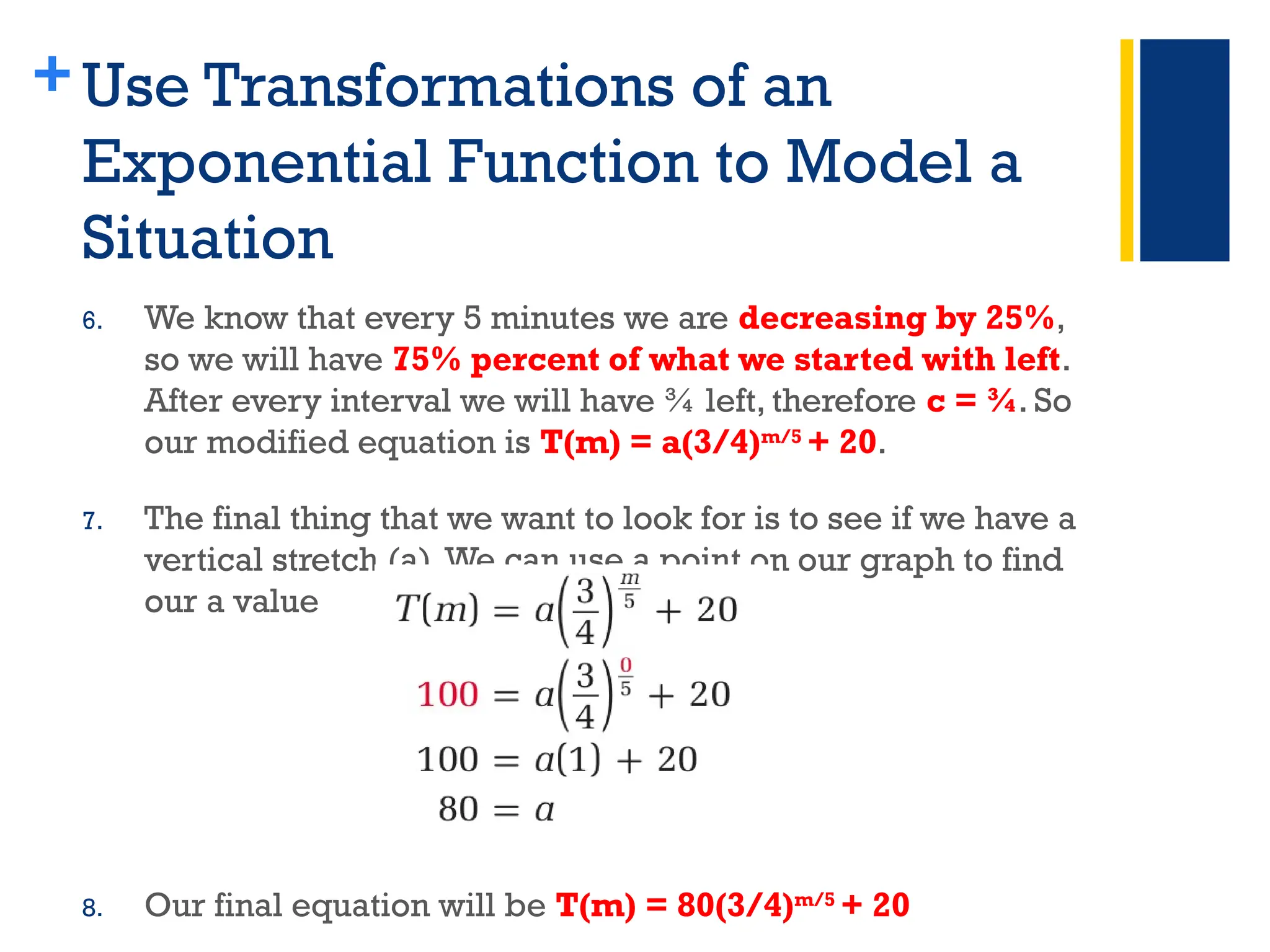
7. The final thing that we want to look for is to see if we have a
vertical stretch (a).We can use a point on our graph to find
our a value
8. Our final equation will be T(m) = 80(3/4)m/5
+ 20
+
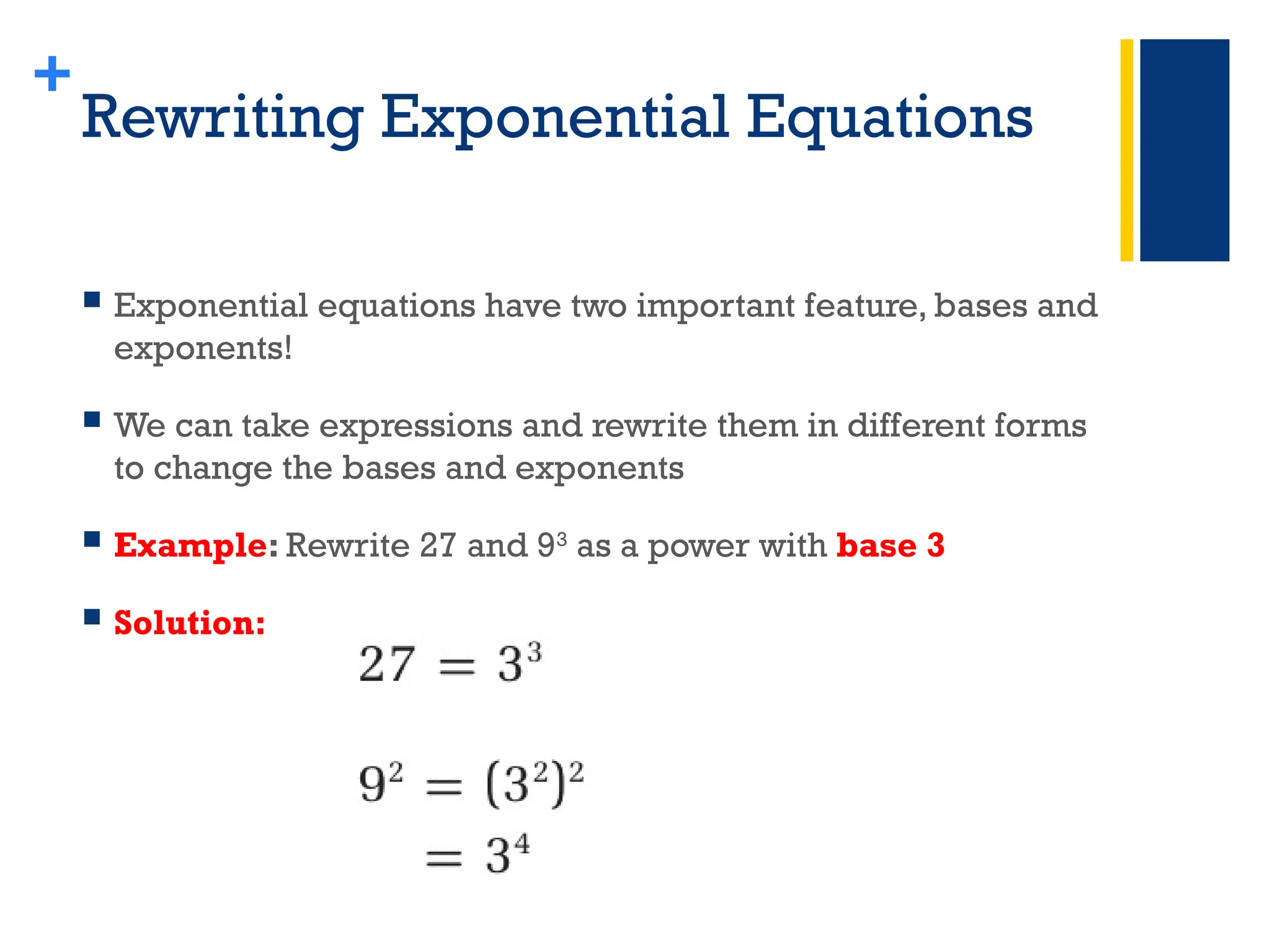
Rewriting Exponential Equations
 Exponential equations have two important feature, bases and
exponents!
 We can take expressions and rewrite them in different forms
to change the bases and exponents
 Example: Rewrite 27 and 93
as a power with base 3
 Solution:
+
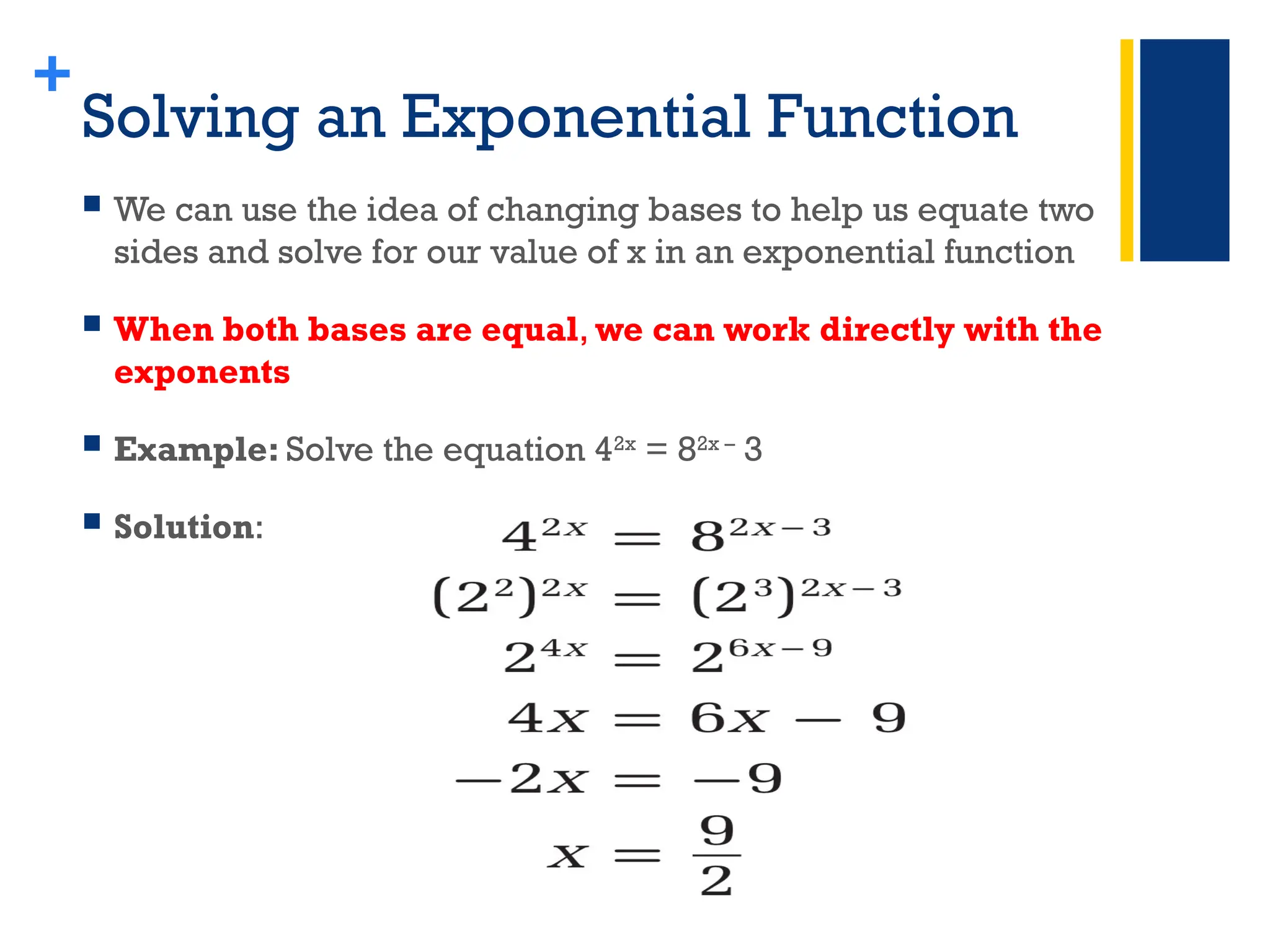
Solving an Exponential Function
 We can use the idea of changing bases to help us equate two
sides and solve for our value of x in an exponential function
 When both bases are equal, we can work directly with the
exponents
 Example: Solve the equation 42x
= 82x –
3
 Solution:
+
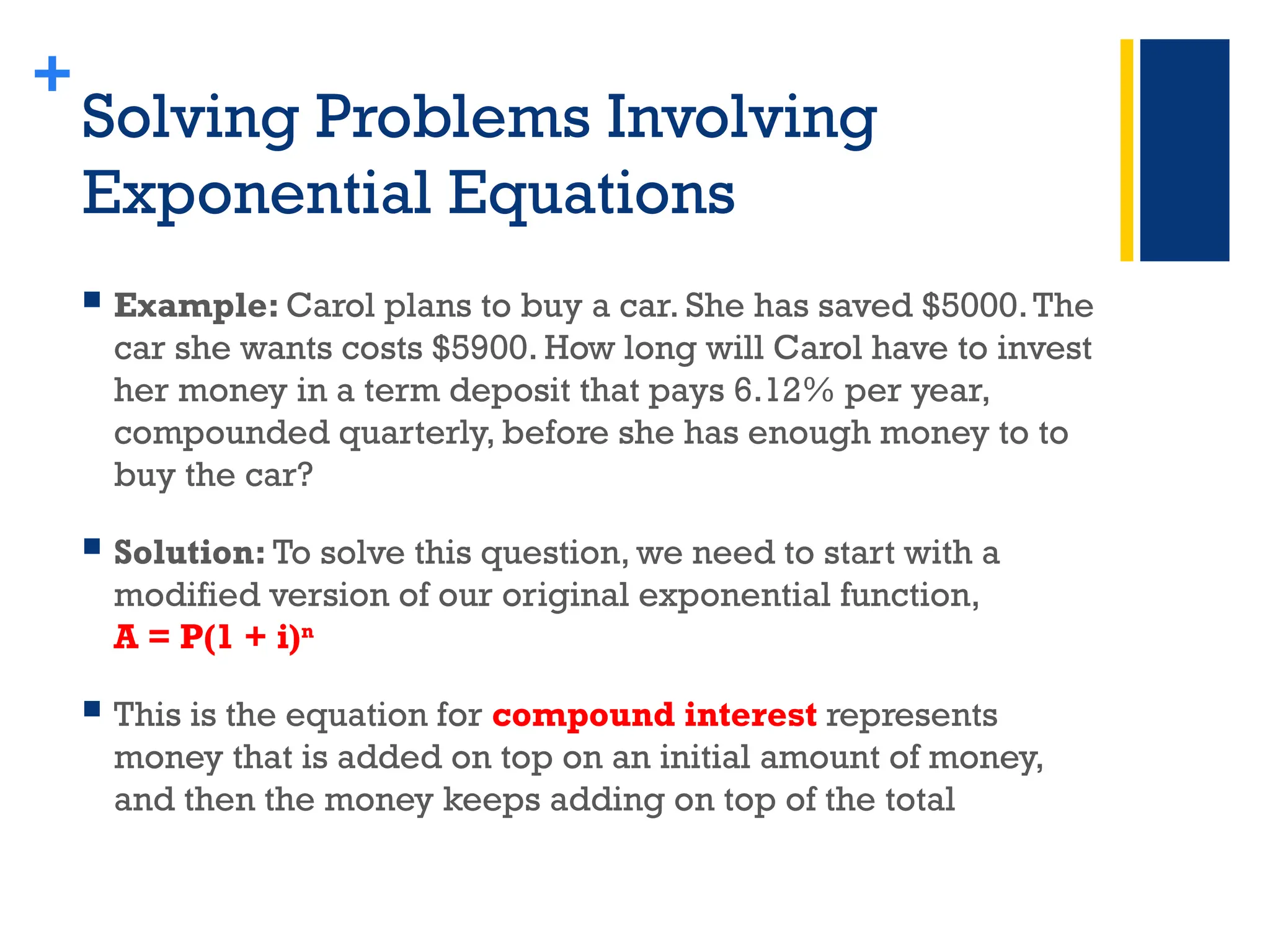
Solving Problems Involving
Exponential Equations
 Example: Carol plans to buy a car. She has saved $5000.The
car she wants costs $5900. How long will Carol have to invest
her money in a term deposit that pays 6.12% per year,
compounded quarterly, before she has enough money to to
buy the car?
 Solution: To solve this question, we need to start with a
modified version of our original exponential function,
A = P(1 + i)n
 This is the equation for compound interest represents
money that is added on top on an initial amount of money,
and then the money keeps adding on top of the total
+
Solving Problems Involving
Exponential Equations
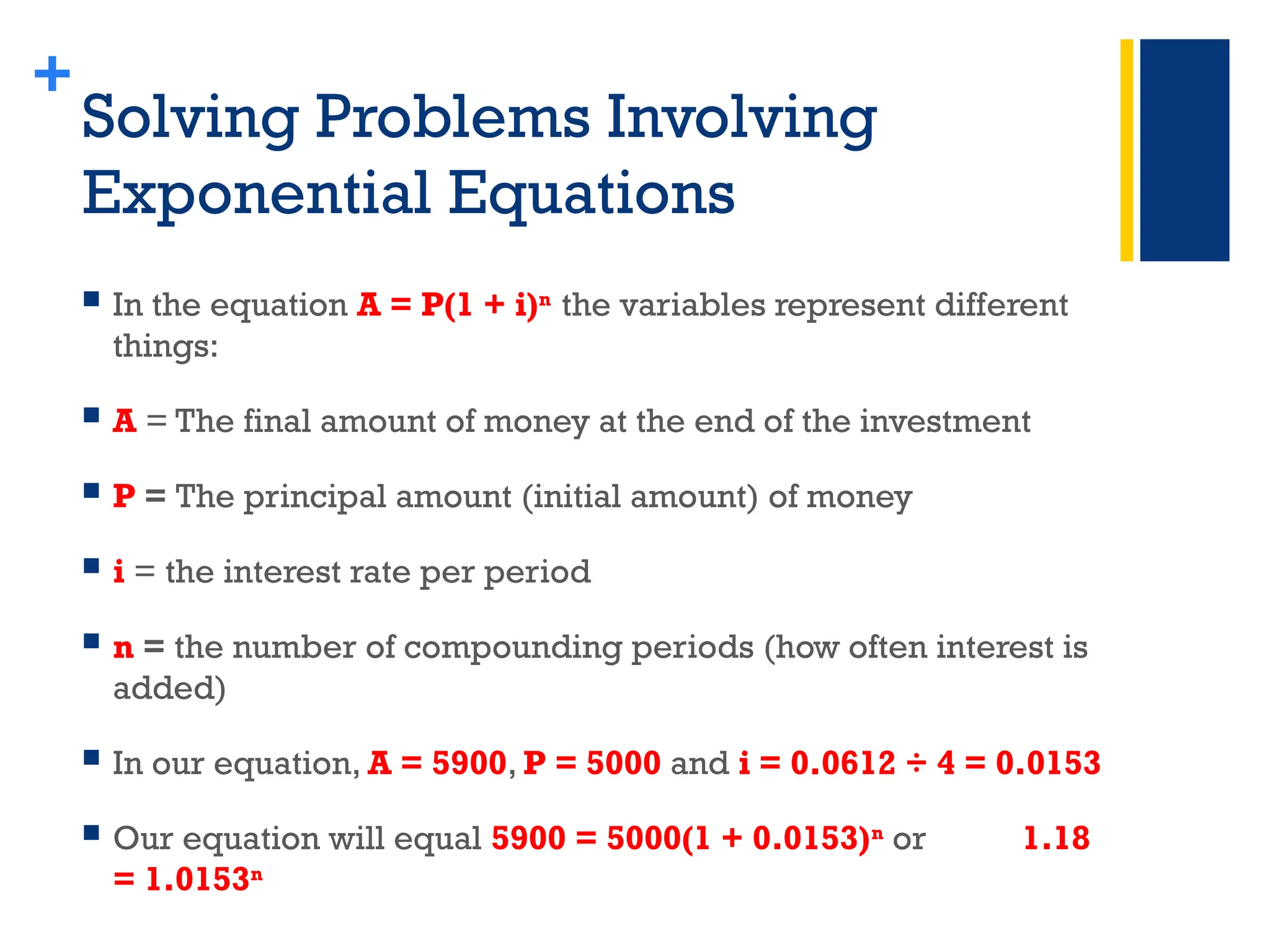
 In the equation A = P(1 + i)n
the variables represent different
things:
 A = The final amount of money at the end of the investment
 P = The principal amount (initial amount) of money
 i = the interest rate per period
 n = the number of compounding periods (how often interest is
added)
 In our equation, A = 5900, P = 5000 and i = 0.0612 ÷ 4 = 0.0153
 Our equation will equal 5900 = 5000(1 + 0.0153)n
or 1.18
= 1.0153n
+
Solving Problems Involving
Exponential Equations
 Now that we have our equation, we want to solve for n.We can do
this by using the log function on our calculator.
 We will click the log button and then put in two values:
1. The base of our function
2. The total amount
 If we do this with our two values, we get the value n =11, which is
the total number of compounding periods to reach $5900.
 We want to know the total time that she will need to invest her
money. Since interest is added 4 times a year, we can divided 11
by 4, and we will get the answer 2.75 years.

2. Transformations of Exponential Functions.pptx

  • 1.
  • 2.
    + Transformation of anExponential Function  We recently looked at a simple exponential function in the form of y = cx  Today we will look at transforming that function into a function in the form of f(x) = a(c)b(x-h) + k  If we remember from our previous chapter, we have used these variables to represent different transformations, and in this case they also mean the same thing  a = vertical stretch by a factor of |a|  b = horizontal stretch by a factor of 1/|b|  k = vertical translation up or down  h = horizontal translation left and right
  • 3.
    + Apply Transformations toSketch a Graph  Example: Consider the base function y = 3x and the transformed function y = -½(3)1/5x – 5 1. State the parameters and describe the corresponding transformations. 2. Sketch both the base graph and the transformed graph.
  • 4.
    + Apply Transformations toSketch a Graph  Solution: 1. We can compare our function y = -½(3)1/5x – 5 to the form f(x) = a(c)b(x-h) + k  a = -½ means there is a vertical stretch by the factor of ½ and a reflection in the x – axis  b = 1/5 means there is a horizontal stretch by a factor of 5  h = 0, so there is no horizontal translation  k = -5, meaning there is a vertical translation down 5 units
  • 5.
  • 6.
  • 7.
    +Use Transformations ofan Exponential Function to Model a Situation
  • 8.
    +Use Transformations ofan Exponential Function to Model a Situation  Question: What is the transformed exponential function in the form of f(x) = a(c)b(x-h) + k that can be used to represent this situation?  Solution: 1. What we need to do first is gather some key information from our story and our graph to help us find our missing transformations. From our story we know that:  The cup of water starts at 100 o C and stops at 20 o C  Temperature (T) is measured every minute (m)  Time starts at 0 minutes  Temperature decrease by 25% (meaning there is 75% left) every 5 minutes
  • 9.
    +Use Transformations ofan Exponential Function to Model a Situation 2. Now let’s see how we can use this information to create a function. 3. The first thing that we can say is we are starting at y = 100, but ending at y = 20. Usually our graph will end at y = 0.This means our graph has been moved up (k) by 20 units. So at the moment we have T(m) = a(c)b(m-h) + 20 4. Since time starts at 0 minutes, we are starting at x = 0.We are not moving to either the left or right, so there is no horizontal shift (h = 0). Now our equation can be modified to T(m) = a(c)b(m) + 20 5. We know that time is measured every minute (Ex: m = 1,2,3,4,5,6,7 … ), but we are decreasing by 25% every 5 minutes. This means that 5 minutes is one period, 10 minutes is 2 periods and so on. So the value of b = 1/5 and we can modify our equation to look like T(m) = a(c)1/5(m) + 20 or T(m) = a(c)m/5 + 20
  • 10.
    +Use Transformations ofan Exponential Function to Model a Situation 6. We know that every 5 minutes we are decreasing by 25%, so we will have 75% percent of what we started with left. After every interval we will have ¾ left, therefore c = ¾. So our modified equation is T(m) = a(3/4)m/5 + 20. 7. The final thing that we want to look for is to see if we have a vertical stretch (a).We can use a point on our graph to find our a value 8. Our final equation will be T(m) = 80(3/4)m/5 + 20
  • 11.
    + Rewriting Exponential Equations Exponential equations have two important feature, bases and exponents!  We can take expressions and rewrite them in different forms to change the bases and exponents  Example: Rewrite 27 and 93 as a power with base 3  Solution:
  • 12.
    + Solving an ExponentialFunction  We can use the idea of changing bases to help us equate two sides and solve for our value of x in an exponential function  When both bases are equal, we can work directly with the exponents  Example: Solve the equation 42x = 82x – 3  Solution:
  • 13.
    + Solving Problems Involving ExponentialEquations  Example: Carol plans to buy a car. She has saved $5000.The car she wants costs $5900. How long will Carol have to invest her money in a term deposit that pays 6.12% per year, compounded quarterly, before she has enough money to to buy the car?  Solution: To solve this question, we need to start with a modified version of our original exponential function, A = P(1 + i)n  This is the equation for compound interest represents money that is added on top on an initial amount of money, and then the money keeps adding on top of the total
  • 14.
    + Solving Problems Involving ExponentialEquations  In the equation A = P(1 + i)n the variables represent different things:  A = The final amount of money at the end of the investment  P = The principal amount (initial amount) of money  i = the interest rate per period  n = the number of compounding periods (how often interest is added)  In our equation, A = 5900, P = 5000 and i = 0.0612 ÷ 4 = 0.0153  Our equation will equal 5900 = 5000(1 + 0.0153)n or 1.18 = 1.0153n
  • 15.
    + Solving Problems Involving ExponentialEquations  Now that we have our equation, we want to solve for n.We can do this by using the log function on our calculator.  We will click the log button and then put in two values: 1. The base of our function 2. The total amount  If we do this with our two values, we get the value n =11, which is the total number of compounding periods to reach $5900.  We want to know the total time that she will need to invest her money. Since interest is added 4 times a year, we can divided 11 by 4, and we will get the answer 2.75 years.