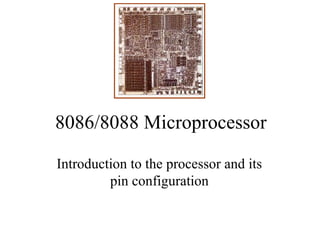
8086/8088 Microprocessor 
Introduction to the processor and its 
pin configuration
Topics 
• Basic Features 
• Pinout Diagram 
• Minimum and Maximum modes 
• Description of the pins
Basic Features 
• 8086 announced in 1978; 8086 is a 16 bit 
microprocessor with a 16 bit data bus 
• 8088 announced in 1979; 8088 is a 16 bit 
microprocessor with an 8 bit data bus 
• Both manufactured using High-performance 
Metal Oxide Semiconductor (HMOS) 
technology 
• Both contain about 29000 transistors 
• Both are packaged in 40 pin dual-in-line 
package (DIP)
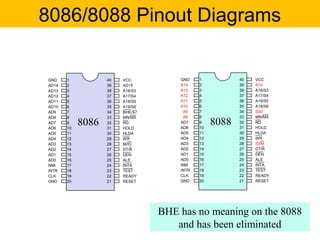
8086/8088 Pinout Diagrams 
GND 
AD14 
AD13 
AD12 
AD11 
AD10 
AD9 
AD8 
AD7 
AD6 
AD5 
AD4 
AD3 
AD2 
AD1 
AD0 
NMI 
INTR 
CLK 
GND 
VCC 
AD15 
A16/S3 
A17/S4 
A18/S5 
A19/S6 
BHE/S7 
MN/MX 
RD 
HOLD 
HLDA 
WR 
M/IO 
DT/R 
DEN 
ALE 
INTA 
TEST 
READY 
RESET 
1234567891 
0 
11 
12 
13 
14 
15 
16 
17 
18 
19 
20 
40 
39 
38 
37 
36 
35 
34 
33 
8086 32 
31 
30 
29 
28 
27 
26 
25 
24 
23 
22 
21 
GND 
A14 
A13 
A12 
A11 
A10 
A9 
A8 
AD7 
AD6 
AD5 
AD4 
AD3 
AD2 
AD1 
AD0 
NMI 
INTR 
CLK 
GND 
VCC 
A15 
A16/S3 
A17/S4 
A18/S5 
A19/S6 
SS0 
MN/MX 
RD 
HOLD 
HLDA 
WR 
IO/M 
DT/R 
DEN 
ALE 
INTA 
TEST 
READY 
RESET 
123456789 
10 
11 
12 
13 
14 
15 
16 
17 
18 
19 
20 
40 
39 
38 
37 
36 
35 
34 
33 
8088 32 
31 
30 
29 
28 
27 
26 
25 
24 
23 
22 
21 
BHE has no meaning on the 8088 
and has been eliminated
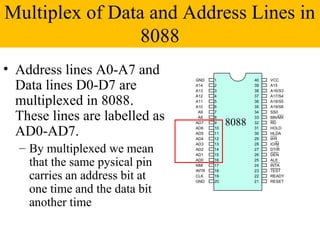
Multiplex of Data and Address Lines in 
8088 
• Address lines A0-A7 and 
Data lines D0-D7 are 
multiplexed in 8088. 
These lines are labelled as 
AD0-AD7. 
– By multiplexed we mean 
that the same pysical pin 
carries an address bit at 
one time and the data bit 
another time 
GND 
A14 
A13 
A12 
A11 
A10 
A9 
A8 
AD7 
AD6 
AD5 
AD4 
AD3 
AD2 
AD1 
AD0 
NMI 
INTR 
CLK 
GND 
VCC 
A15 
A16/S3 
A17/S4 
A18/S5 
A19/S6 
SS0 
MN/MX 
RD 
HOLD 
HLDA 
WR 
IO/M 
DT/R 
DEN 
ALE 
INTA 
TEST 
READY 
RESET 
123456789 
10 
11 
12 
13 
14 
15 
16 
17 
18 
19 
20 
40 
39 
38 
37 
36 
35 
34 
33 
8088 32 
31 
30 
29 
28 
27 
26 
25 
24 
23 
22 
21
Multiplex of Data and Address Lines in 
8086 
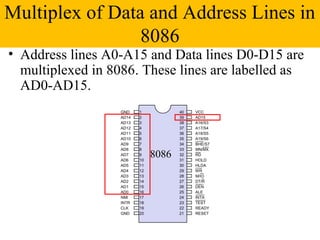
• Address lines A0-A15 and Data lines D0-D15 are 
multiplexed in 8086. These lines are labelled as 
AD0-AD15. 
GND 
AD14 
AD13 
AD12 
AD11 
AD10 
AD9 
AD8 
AD7 
AD6 
AD5 
AD4 
AD3 
AD2 
AD1 
AD0 
NMI 
INTR 
CLK 
GND 
VCC 
AD15 
A16/S3 
A17/S4 
A18/S5 
A19/S6 
BHE/S7 
MN/MX 
RD 
HOLD 
HLDA 
WR 
M/IO 
DT/R 
DEN 
ALE 
INTA 
TEST 
READY 
RESET 
123456789 
10 
11 
12 
13 
14 
15 
16 
17 
18 
19 
20 
40 
39 
38 
37 
36 
35 
34 
33 
8086 32 
31 
30 
29 
28 
27 
26 
25 
24 
23 
22 
21
Minimum-mode and Maximum-mode 
Systems 
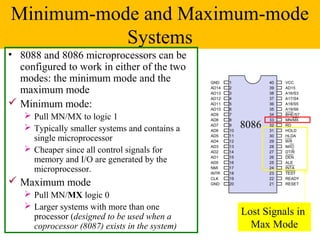
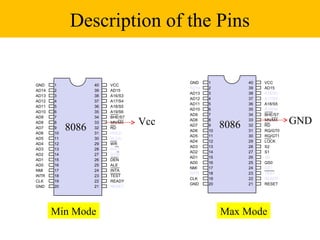
• 8088 and 8086 microprocessors can be 
configured to work in either of the two 
modes: the minimum mode and the 
maximum mode 
 Minimum mode: 
 Pull MN/MX to logic 1 
 Typically smaller systems and contains a 
single microprocessor 
 Cheaper since all control signals for 
memory and I/O are generated by the 
microprocessor. 
 Maximum mode 
 Pull MN/MX logic 0 
 Larger systems with more than one 
processor (designed to be used when a 
coprocessor (8087) exists in the system) 
GND 
AD14 
AD13 
AD12 
AD11 
AD10 
AD9 
AD8 
AD7 
AD6 
AD5 
AD4 
AD3 
AD2 
AD1 
AD0 
NMI 
INTR 
CLK 
GND 
VCC 
AD15 
A16/S3 
A17/S4 
A18/S5 
A19/S6 
BHE/S7 
MN/MX 
RD 
HOLD 
HLDA 
WR 
M/IO 
DT/R 
DEN 
ALE 
INTA 
TEST 
READY 
RESET 
1234567891 
0 
11 
12 
13 
14 
15 
16 
17 
18 
19 
20 
40 
39 
38 
37 
36 
35 
34 
33 
8086 32 
31 
30 
29 
28 
27 
26 
25 
24 
23 
22 
21 
Lost Signals in 
Max Mode
Minimum-mode and Maximum-mode 
Signals 
GND 
AD14 
AD13 
AD12 
AD11 
AD10 
AD9 
AD8 
AD7 
AD6 
AD5 
AD4 
AD3 
AD2 
AD1 
AD0 
NMI 
INTR 
CLK 
GND 
VCC 
AD15 
A16/S3 
A17/S4 
A18/S5 
A19/S6 
BHE/S7 
MN/MX 
RD 
RQ/GT0 
RQ/GT1 
LOCK 
S2 
S1 
S0 
QS0 
QS1 
TEST 
READY 
RESET 
123456789 
10 
11 
12 
13 
14 
15 
16 
17 
18 
19 
20 
40 
39 
38 
37 
36 
35 
34 
33 
8086 32 
31 
30 
29 
28 
27 
26 
25 
24 
23 
22 
21 
Max Mode 
GND 
AD14 
AD13 
AD12 
AD11 
AD10 
AD9 
AD8 
AD7 
AD6 
AD5 
AD4 
AD3 
AD2 
AD1 
AD0 
NMI 
INTR 
CLK 
GND 
VCC 
AD15 
A16/S3 
A17/S4 
A18/S5 
A19/S6 
BHE/S7 
MN/MX 
RD 
HOLD 
HLDA 
WR 
M/IO 
DT/R 
DEN 
ALE 
INTA 
TEST 
READY 
RESET 
123456789 
10 
11 
12 
13 
14 
15 
16 
17 
18 
19 
20 
40 
39 
38 
37 
36 
35 
34 
33 
8086 32 
31 
30 
29 
28 
27 
26 
25 
24 
23 
22 
21 
Min Mode 
Vcc GND
8086 System Minimum mode 
C l o c k 
g e n e r a t o r 
A E N 2 
A E N 1 
8 0 8 6 C P U F / C 
+ 5 V 
R E S 
W a i t - S t a t e 
G e n e r a t o r 
C L K 
R E A D Y 
R E S E T 
M / I O 
I N T A 
R D 
W R 
P C L K 
M N / M X + 5 V 
S T B 
O E 
8 2 8 2 
L a t c h 
A L E 
A D 0 - A D 1 5 
A 1 6 - A 1 9 
A 0 - A 1 9 
A d d r e s s B u s 
B H E B H E 
D 0 - D 1 5 
8 2 8 6 
D T / R 
D E N 
T 
O E 
1 6 
C o n t r o l 
B u s
B u s C o n t r o l le r 8086 System Maximum Mode 
8 0 8 6 C P U 
C lo c k 
g e n e r a t o r 
W a it - S t a t e 
G e n e r a t o r 
C L K 
R E A D Y 
R E S E T 
M N / M X 
A L E 
S T B 
O E 
8 2 8 2 
L a t c h 
A 0 - A 1 9 
A d d r e s s B u s 
A D 0 - A D 1 5 
A 1 6 - A 1 9 B H E 
+ 5 V 
R E S 
S 0 
S 1 
S 2 
C L K 
S 0 
S 1 
S 2 
D A T A 
8 2 8 6 
T 
O E 
T r a n s c e i v e r 
G n d 
D E N 
D T / R 
M R D C 
M W T C 
A M W C 
I O R C 
I O W C 
A I O W C 
I N T A 
8 2 8 8
Description of the Pins 
GND 
AD14 
AD13 
AD12 
AD11 
AD10 
AD9 
AD8 
AD7 
AD6 
AD5 
AD4 
AD3 
AD2 
AD1 
AD0 
NMI 
INTR 
CLK 
GND 
VCC 
AD15 
A16/S3 
A17/S4 
A18/S5 
A19/S6 
BHE/S7 
MN/MX 
RD 
RQ/GT0 
RQ/GT1 
LOCK 
S2 
S1 
S0 
QS0 
QS1 
TEST 
READY 
RESET 
123456789 
10 
11 
12 
13 
14 
15 
16 
17 
18 
19 
20 
40 
39 
38 
37 
36 
35 
34 
33 
8086 32 
31 
30 
29 
28 
27 
26 
25 
24 
23 
22 
21 
Max Mode 
GND 
AD14 
AD13 
AD12 
AD11 
AD10 
AD9 
AD8 
AD7 
AD6 
AD5 
AD4 
AD3 
AD2 
AD1 
AD0 
NMI 
INTR 
CLK 
GND 
VCC 
AD15 
A16/S3 
A17/S4 
A18/S5 
A19/S6 
BHE/S7 
MN/MX 
RD 
HOLD 
HLDA 
WR 
M/IO 
DT/R 
DEN 
ALE 
INTA 
TEST 
READY 
RESET 
123456789 
10 
11 
12 
13 
14 
15 
16 
17 
18 
19 
20 
40 
39 
38 
37 
36 
35 
34 
33 
8086 32 
31 
30 
29 
28 
27 
26 
25 
24 
23 
22 
21 
Min Mode 
Vcc GND
RESET Operation results 
CPU component Contents 
Flags Cleared 
Instruction Pointer 0000H 
CS FFFFH 
DS, SS and ES 0000H 
Queue Empty
AD0 - AD15: Address Data Bus 
AD0 – AD15 Address 
Data
A17/S4, A16/S3 Address/Status 
A17/S4 A16/S3 Function 
0 
0 Extra segment access 
0 
1 Stack segment access 
1 
0 Code segment access 
1 1 Data segment access
A19/S6, A18/S5 Address/Status 
A18/S5: The status of the 
interrupt enable flag bit is updated 
at the beginning of each cycle. The status of the flag 
is indicated through this pin 
A19/S6: When Low, it indicates that 8086 is in 
control of the bus. During a "Hold acknowledge" 
clock period, the 8086 tri-states the S6 pin and thus 
allows another bus master to take control of the 
status bus.
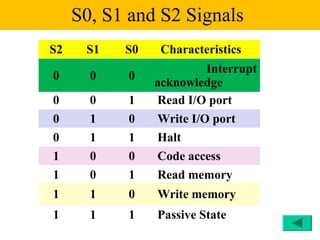
S0, S1 and S2 Signals 
S2 S1 S0 Characteristics 
0 0 0 Interrupt 
acknowledge 
0 0 1 Read I/O port 
0 1 0 Write I/O port 
0 1 1 Halt 
1 0 0 Code access 
1 0 1 Read memory 
1 1 0 Write memory 
1 1 1 Passive State
QS1 and QS2 Signals 
QS1 QS1 Characteristics 
0 0 No operation 
0 1 First byte of opcode from queue 
1 0 Empty the queue 
1 1 Subsequent byte from queue
Read Write Control Signals 
IO/M DT/R SSO CHARACTERISTICS 
0 0 0 Code Access 
0 0 1 Read Memory 
0 1 0 Write Memory 
0 1 1 Passive 
1 0 0 Interrupt Acknowledge 
1 0 1 Read I/O port 
1 1 0 Write I/O port 
1 1 1 Halt
8086 Memory Addressing 
Data can be accessed from the memory in four 
different ways: 
• 8 - bit data from Lower (Even) address Bank. 
• 8 - bit data from Higher (Odd) address Bank. 
• 16 - bit data starting from Even Address. 
• 16 - bit data starting from Odd Address.
Treating Even and Odd Addresses 
H ig h e r 
A d d r e s s 
B a n k 
( 5 1 2 K x 8 ) 
O D D 
L o w e r 
A d d r e s s 
B a n k 
( 5 1 2 K x 8 ) 
E V E N 
A 1 - A 1 9 
A d d r e s s B u s 
D a ta B u s ( D 0 - D 1 5 ) 
B H E A 0 
D 8 - D 1 5 D 0 - D 7
8-bit data from Even address Bank 
A 1 - A 1 9 
D 0 - D 1 5 
B H E = 1 
D 8 - D 1 5 D 0 - D 7 
x 
x + 2 
x + 4 
A 0 = 0 
x + 1 
x + 3 
x + 5 
O d d B a n k E v e n B a n k 
MOV SI,4000H 
MOV AL,[SI+2]
8-bit Data from Odd Address Bank 
A 1 - A 1 9 
D 0 - D 1 5 
x 
x + 2 
O d d B a n k E v e n B a n k 
x + 1 
x + 3 
B H E = 0 A 0 = 1 
D 8 - D 1 5 
D 0 - D 7 
MOV SI,4000H 
MOV AL,[SI+3]
16-bit Data Access starting from Even Address 
A 1 - A 1 9 
D 0 - D 1 5 
O d d B a n k E v e n B a n k 
B H E = 0 
x 
x + 2 
A 0 = 0 
x + 1 
x + 3 
D 8 - D 1 5 
D 0 - D 7 
MOV SI,4000H 
MOV AX,[SI+2]
16-bit Data Access starting from Odd Address 
A 1 - A 1 9 
O d d B a n k E v e n B a n k 
D 8 - D 1 5 
D 0 - D 7 
A 1 - A 9 
0 0 0 5 
0 0 0 7 
0 0 0 9 
0 0 0 4 
0 0 0 6 
0 0 0 8 
A 1 - A 1 9 
O d d B a n k E v e n B a n k 
D 8 - D 1 5 
D 0 - D 7 
A 1 - A 9 
0 0 0 5 
0 0 0 7 
0 0 0 9 
0 0 0 4 
0 0 0 6 
0 0 0 8 
( a ) F ir s t A c c e s s fr o m O d d A d d re s s ( b ) N e x t A c c e s s fr o m E v e n A d d r e s s 
MOV SI,4000H 
MOV AX,[SI+5]
T 1 T 2 T 3 T w a i t T 4 
C L K 
A D 0 - A D 1 5 
B H E 
A L E 
S 2 - S 0 
M / I O 
R D 
R E A D Y 
D T / R 
D E N 
W R 
Read Timing Diagram
Write Machine Cycle
INTR (input) 
Hardware Interrupt Request Pin 
• INTR is used to request a hardware interrupt. 
• It is recognized by the processor only when IF = 
1, otherwise it is ignored (STI instruction sets this flag bit). 
• The request on this line can be disabled (or 
masked) by making IF = 0 (use instruction CLI) 
• If INTR becomes high and IF = 1, the 8086 
enters an interrupt acknowledge cycle (INTA 
becomes active) after the current instruction has 
completed execution.
For Discussion 
• If I/O peripheral wants to interrupt the 
processor, the “interrupt controller” will send 
high pulse to the 8086 INTR pin. 
• What about if a simple system to be built and 
hardware interrupts are not needed; 
What to do with INTR and INTA?
NMI (input) Non-Maskable 
Interrupt line 
• The Non Maskable Interrupt input is similar to 
INTR except that the NMI interrupt does not 
check to see if the IF flag bit is at logic 1. 
• This interrupt cannot be masked (or disabled) 
and no acknowledgment is required. 
• It should be reserved for “catastrophic” events 
such as power failure or memory errors.
8086 External Interrupt Connections 
NMI - Non-Maskable Interrupt INTR - Interrupt Request 
Interrupt Logic 
int into 
Divide 
Error 
Single 
Step 
NMI Requesting 
Device 
8086 CPU Intel 
8259A 
PIC 
NMI 
INTR 
Software Traps 
Programmable 
Interrupt Controller 
(part of chipset)
TEST (input) 
• The TEST pin is an input that is tested by the 
WAIT instruction. 
• If TEST is at logic 0, the WAIT instruction 
functions as a NOP. 
• If TEST is at logic 1, then the WAIT instruction 
causes the 8086 to idle, until TEST input 
becomes a logic 0. 
• This pin is normally driven by the 8087 co-processor 
(numeric coprocessor) . 
• This prevents the CPU from accessing a memory 
result before the NDP has finished its calculation
Ready (input) 
• This input is used to insert wait states into 
processor Bus Cycle. 
• If the READY pin is placed at a logic 0 level, 
the microprocessor enters into wait states and 
remains idle. 
• If the READY pin is placed at a logic 1 level, it 
has no effect on the operation of the processor. 
• It is sampled at the end of the T2 clock pulse 
• Usually driven by a slow memory device
8284 Connected to 8086 Mp 
Ready 
CLK 
Reset 
+ 5 V 
R 
C 
RES 
X1 
X2 
F/C 
RDY1 
RDY2 
8284 
AEN1 
AEN2 
RESET KEY 
por ci M 6808
HOLD (input) 
• The HOLD input is used by DMA controller to 
request a Direct Memory Access (DMA) operation. 
• If the HOLD signal is at logic 1, the microprocessor 
places its address, data and control bus at the high 
impedance state. 
• If the HOLD pin is at logic 0, the microprocessor 
works normally.
HLDA (output) 
Hold Acknowledge Output 
• Hold acknowledge is made high to indicate to 
the DMA controller that the processor has 
entered hold state and it can take control over the 
system bus for DMA operation.
DMA Operation

8086 architecture

  • 1.
    8086/8088 Microprocessor Introductionto the processor and its pin configuration
  • 2.
    Topics • BasicFeatures • Pinout Diagram • Minimum and Maximum modes • Description of the pins
  • 3.
    Basic Features •8086 announced in 1978; 8086 is a 16 bit microprocessor with a 16 bit data bus • 8088 announced in 1979; 8088 is a 16 bit microprocessor with an 8 bit data bus • Both manufactured using High-performance Metal Oxide Semiconductor (HMOS) technology • Both contain about 29000 transistors • Both are packaged in 40 pin dual-in-line package (DIP)
  • 4.
    8086/8088 Pinout Diagrams GND AD14 AD13 AD12 AD11 AD10 AD9 AD8 AD7 AD6 AD5 AD4 AD3 AD2 AD1 AD0 NMI INTR CLK GND VCC AD15 A16/S3 A17/S4 A18/S5 A19/S6 BHE/S7 MN/MX RD HOLD HLDA WR M/IO DT/R DEN ALE INTA TEST READY RESET 1234567891 0 11 12 13 14 15 16 17 18 19 20 40 39 38 37 36 35 34 33 8086 32 31 30 29 28 27 26 25 24 23 22 21 GND A14 A13 A12 A11 A10 A9 A8 AD7 AD6 AD5 AD4 AD3 AD2 AD1 AD0 NMI INTR CLK GND VCC A15 A16/S3 A17/S4 A18/S5 A19/S6 SS0 MN/MX RD HOLD HLDA WR IO/M DT/R DEN ALE INTA TEST READY RESET 123456789 10 11 12 13 14 15 16 17 18 19 20 40 39 38 37 36 35 34 33 8088 32 31 30 29 28 27 26 25 24 23 22 21 BHE has no meaning on the 8088 and has been eliminated
  • 5.
    Multiplex of Dataand Address Lines in 8088 • Address lines A0-A7 and Data lines D0-D7 are multiplexed in 8088. These lines are labelled as AD0-AD7. – By multiplexed we mean that the same pysical pin carries an address bit at one time and the data bit another time GND A14 A13 A12 A11 A10 A9 A8 AD7 AD6 AD5 AD4 AD3 AD2 AD1 AD0 NMI INTR CLK GND VCC A15 A16/S3 A17/S4 A18/S5 A19/S6 SS0 MN/MX RD HOLD HLDA WR IO/M DT/R DEN ALE INTA TEST READY RESET 123456789 10 11 12 13 14 15 16 17 18 19 20 40 39 38 37 36 35 34 33 8088 32 31 30 29 28 27 26 25 24 23 22 21
  • 6.
    Multiplex of Dataand Address Lines in 8086 • Address lines A0-A15 and Data lines D0-D15 are multiplexed in 8086. These lines are labelled as AD0-AD15. GND AD14 AD13 AD12 AD11 AD10 AD9 AD8 AD7 AD6 AD5 AD4 AD3 AD2 AD1 AD0 NMI INTR CLK GND VCC AD15 A16/S3 A17/S4 A18/S5 A19/S6 BHE/S7 MN/MX RD HOLD HLDA WR M/IO DT/R DEN ALE INTA TEST READY RESET 123456789 10 11 12 13 14 15 16 17 18 19 20 40 39 38 37 36 35 34 33 8086 32 31 30 29 28 27 26 25 24 23 22 21
  • 7.
    Minimum-mode and Maximum-mode Systems • 8088 and 8086 microprocessors can be configured to work in either of the two modes: the minimum mode and the maximum mode  Minimum mode:  Pull MN/MX to logic 1  Typically smaller systems and contains a single microprocessor  Cheaper since all control signals for memory and I/O are generated by the microprocessor.  Maximum mode  Pull MN/MX logic 0  Larger systems with more than one processor (designed to be used when a coprocessor (8087) exists in the system) GND AD14 AD13 AD12 AD11 AD10 AD9 AD8 AD7 AD6 AD5 AD4 AD3 AD2 AD1 AD0 NMI INTR CLK GND VCC AD15 A16/S3 A17/S4 A18/S5 A19/S6 BHE/S7 MN/MX RD HOLD HLDA WR M/IO DT/R DEN ALE INTA TEST READY RESET 1234567891 0 11 12 13 14 15 16 17 18 19 20 40 39 38 37 36 35 34 33 8086 32 31 30 29 28 27 26 25 24 23 22 21 Lost Signals in Max Mode
  • 8.
    Minimum-mode and Maximum-mode Signals GND AD14 AD13 AD12 AD11 AD10 AD9 AD8 AD7 AD6 AD5 AD4 AD3 AD2 AD1 AD0 NMI INTR CLK GND VCC AD15 A16/S3 A17/S4 A18/S5 A19/S6 BHE/S7 MN/MX RD RQ/GT0 RQ/GT1 LOCK S2 S1 S0 QS0 QS1 TEST READY RESET 123456789 10 11 12 13 14 15 16 17 18 19 20 40 39 38 37 36 35 34 33 8086 32 31 30 29 28 27 26 25 24 23 22 21 Max Mode GND AD14 AD13 AD12 AD11 AD10 AD9 AD8 AD7 AD6 AD5 AD4 AD3 AD2 AD1 AD0 NMI INTR CLK GND VCC AD15 A16/S3 A17/S4 A18/S5 A19/S6 BHE/S7 MN/MX RD HOLD HLDA WR M/IO DT/R DEN ALE INTA TEST READY RESET 123456789 10 11 12 13 14 15 16 17 18 19 20 40 39 38 37 36 35 34 33 8086 32 31 30 29 28 27 26 25 24 23 22 21 Min Mode Vcc GND
  • 9.
    8086 System Minimummode C l o c k g e n e r a t o r A E N 2 A E N 1 8 0 8 6 C P U F / C + 5 V R E S W a i t - S t a t e G e n e r a t o r C L K R E A D Y R E S E T M / I O I N T A R D W R P C L K M N / M X + 5 V S T B O E 8 2 8 2 L a t c h A L E A D 0 - A D 1 5 A 1 6 - A 1 9 A 0 - A 1 9 A d d r e s s B u s B H E B H E D 0 - D 1 5 8 2 8 6 D T / R D E N T O E 1 6 C o n t r o l B u s
  • 10.
    B u sC o n t r o l le r 8086 System Maximum Mode 8 0 8 6 C P U C lo c k g e n e r a t o r W a it - S t a t e G e n e r a t o r C L K R E A D Y R E S E T M N / M X A L E S T B O E 8 2 8 2 L a t c h A 0 - A 1 9 A d d r e s s B u s A D 0 - A D 1 5 A 1 6 - A 1 9 B H E + 5 V R E S S 0 S 1 S 2 C L K S 0 S 1 S 2 D A T A 8 2 8 6 T O E T r a n s c e i v e r G n d D E N D T / R M R D C M W T C A M W C I O R C I O W C A I O W C I N T A 8 2 8 8
  • 11.
    Description of thePins GND AD14 AD13 AD12 AD11 AD10 AD9 AD8 AD7 AD6 AD5 AD4 AD3 AD2 AD1 AD0 NMI INTR CLK GND VCC AD15 A16/S3 A17/S4 A18/S5 A19/S6 BHE/S7 MN/MX RD RQ/GT0 RQ/GT1 LOCK S2 S1 S0 QS0 QS1 TEST READY RESET 123456789 10 11 12 13 14 15 16 17 18 19 20 40 39 38 37 36 35 34 33 8086 32 31 30 29 28 27 26 25 24 23 22 21 Max Mode GND AD14 AD13 AD12 AD11 AD10 AD9 AD8 AD7 AD6 AD5 AD4 AD3 AD2 AD1 AD0 NMI INTR CLK GND VCC AD15 A16/S3 A17/S4 A18/S5 A19/S6 BHE/S7 MN/MX RD HOLD HLDA WR M/IO DT/R DEN ALE INTA TEST READY RESET 123456789 10 11 12 13 14 15 16 17 18 19 20 40 39 38 37 36 35 34 33 8086 32 31 30 29 28 27 26 25 24 23 22 21 Min Mode Vcc GND
  • 12.
    RESET Operation results CPU component Contents Flags Cleared Instruction Pointer 0000H CS FFFFH DS, SS and ES 0000H Queue Empty
  • 13.
    AD0 - AD15:Address Data Bus AD0 – AD15 Address Data
  • 14.
    A17/S4, A16/S3 Address/Status A17/S4 A16/S3 Function 0 0 Extra segment access 0 1 Stack segment access 1 0 Code segment access 1 1 Data segment access
  • 15.
    A19/S6, A18/S5 Address/Status A18/S5: The status of the interrupt enable flag bit is updated at the beginning of each cycle. The status of the flag is indicated through this pin A19/S6: When Low, it indicates that 8086 is in control of the bus. During a "Hold acknowledge" clock period, the 8086 tri-states the S6 pin and thus allows another bus master to take control of the status bus.
  • 16.
    S0, S1 andS2 Signals S2 S1 S0 Characteristics 0 0 0 Interrupt acknowledge 0 0 1 Read I/O port 0 1 0 Write I/O port 0 1 1 Halt 1 0 0 Code access 1 0 1 Read memory 1 1 0 Write memory 1 1 1 Passive State
  • 17.
    QS1 and QS2Signals QS1 QS1 Characteristics 0 0 No operation 0 1 First byte of opcode from queue 1 0 Empty the queue 1 1 Subsequent byte from queue
  • 18.
    Read Write ControlSignals IO/M DT/R SSO CHARACTERISTICS 0 0 0 Code Access 0 0 1 Read Memory 0 1 0 Write Memory 0 1 1 Passive 1 0 0 Interrupt Acknowledge 1 0 1 Read I/O port 1 1 0 Write I/O port 1 1 1 Halt
  • 19.
    8086 Memory Addressing Data can be accessed from the memory in four different ways: • 8 - bit data from Lower (Even) address Bank. • 8 - bit data from Higher (Odd) address Bank. • 16 - bit data starting from Even Address. • 16 - bit data starting from Odd Address.
  • 20.
    Treating Even andOdd Addresses H ig h e r A d d r e s s B a n k ( 5 1 2 K x 8 ) O D D L o w e r A d d r e s s B a n k ( 5 1 2 K x 8 ) E V E N A 1 - A 1 9 A d d r e s s B u s D a ta B u s ( D 0 - D 1 5 ) B H E A 0 D 8 - D 1 5 D 0 - D 7
  • 21.
    8-bit data fromEven address Bank A 1 - A 1 9 D 0 - D 1 5 B H E = 1 D 8 - D 1 5 D 0 - D 7 x x + 2 x + 4 A 0 = 0 x + 1 x + 3 x + 5 O d d B a n k E v e n B a n k MOV SI,4000H MOV AL,[SI+2]
  • 22.
    8-bit Data fromOdd Address Bank A 1 - A 1 9 D 0 - D 1 5 x x + 2 O d d B a n k E v e n B a n k x + 1 x + 3 B H E = 0 A 0 = 1 D 8 - D 1 5 D 0 - D 7 MOV SI,4000H MOV AL,[SI+3]
  • 23.
    16-bit Data Accessstarting from Even Address A 1 - A 1 9 D 0 - D 1 5 O d d B a n k E v e n B a n k B H E = 0 x x + 2 A 0 = 0 x + 1 x + 3 D 8 - D 1 5 D 0 - D 7 MOV SI,4000H MOV AX,[SI+2]
  • 24.
    16-bit Data Accessstarting from Odd Address A 1 - A 1 9 O d d B a n k E v e n B a n k D 8 - D 1 5 D 0 - D 7 A 1 - A 9 0 0 0 5 0 0 0 7 0 0 0 9 0 0 0 4 0 0 0 6 0 0 0 8 A 1 - A 1 9 O d d B a n k E v e n B a n k D 8 - D 1 5 D 0 - D 7 A 1 - A 9 0 0 0 5 0 0 0 7 0 0 0 9 0 0 0 4 0 0 0 6 0 0 0 8 ( a ) F ir s t A c c e s s fr o m O d d A d d re s s ( b ) N e x t A c c e s s fr o m E v e n A d d r e s s MOV SI,4000H MOV AX,[SI+5]
  • 25.
    T 1 T2 T 3 T w a i t T 4 C L K A D 0 - A D 1 5 B H E A L E S 2 - S 0 M / I O R D R E A D Y D T / R D E N W R Read Timing Diagram
  • 26.
  • 27.
    INTR (input) HardwareInterrupt Request Pin • INTR is used to request a hardware interrupt. • It is recognized by the processor only when IF = 1, otherwise it is ignored (STI instruction sets this flag bit). • The request on this line can be disabled (or masked) by making IF = 0 (use instruction CLI) • If INTR becomes high and IF = 1, the 8086 enters an interrupt acknowledge cycle (INTA becomes active) after the current instruction has completed execution.
  • 28.
    For Discussion •If I/O peripheral wants to interrupt the processor, the “interrupt controller” will send high pulse to the 8086 INTR pin. • What about if a simple system to be built and hardware interrupts are not needed; What to do with INTR and INTA?
  • 29.
    NMI (input) Non-Maskable Interrupt line • The Non Maskable Interrupt input is similar to INTR except that the NMI interrupt does not check to see if the IF flag bit is at logic 1. • This interrupt cannot be masked (or disabled) and no acknowledgment is required. • It should be reserved for “catastrophic” events such as power failure or memory errors.
  • 30.
    8086 External InterruptConnections NMI - Non-Maskable Interrupt INTR - Interrupt Request Interrupt Logic int into Divide Error Single Step NMI Requesting Device 8086 CPU Intel 8259A PIC NMI INTR Software Traps Programmable Interrupt Controller (part of chipset)
  • 31.
    TEST (input) •The TEST pin is an input that is tested by the WAIT instruction. • If TEST is at logic 0, the WAIT instruction functions as a NOP. • If TEST is at logic 1, then the WAIT instruction causes the 8086 to idle, until TEST input becomes a logic 0. • This pin is normally driven by the 8087 co-processor (numeric coprocessor) . • This prevents the CPU from accessing a memory result before the NDP has finished its calculation
  • 32.
    Ready (input) •This input is used to insert wait states into processor Bus Cycle. • If the READY pin is placed at a logic 0 level, the microprocessor enters into wait states and remains idle. • If the READY pin is placed at a logic 1 level, it has no effect on the operation of the processor. • It is sampled at the end of the T2 clock pulse • Usually driven by a slow memory device
  • 33.
    8284 Connected to8086 Mp Ready CLK Reset + 5 V R C RES X1 X2 F/C RDY1 RDY2 8284 AEN1 AEN2 RESET KEY por ci M 6808
  • 34.
    HOLD (input) •The HOLD input is used by DMA controller to request a Direct Memory Access (DMA) operation. • If the HOLD signal is at logic 1, the microprocessor places its address, data and control bus at the high impedance state. • If the HOLD pin is at logic 0, the microprocessor works normally.
  • 35.
    HLDA (output) HoldAcknowledge Output • Hold acknowledge is made high to indicate to the DMA controller that the processor has entered hold state and it can take control over the system bus for DMA operation.
  • 36.