
12/20/2015
Presented by:-
1. Rohan S. Niwal.
2. Shubham Bhaskarvar.
3. Mahima M. Hirapure.
4. Shreya A. Dongre.
5. Sharayu Renghe.
6. Kartik N. Kalpande.
22/20/2015
Introduction :-
 Microprocessor is a programmable electronic device
which is used in small system such as pocket
calculator , digital watches and mostly in the
Smartphone's.
 The most of microprocessor comes in 1970 and where
is used in the calculator.
 The 8085 is an 8 bit microprocessor. It having 8 bit of
data bus and 16 bit of address bus.
 The 8085 microprocessor required only the 3MHz
clock Frequency . It having 64 KB of memory.
2/20/2015 3
Features :-
8 bit microprocessor(8085 microprocessor can read or
write or perform arithmetic and logical operations on 8-bit
data at time)
It has 8 data lines and 16 address lines hence capacity is
216 = 64 KB of Memory.
Cock frequency is 3 MHz
It requires +5V power supply.
It is a single chip NMOS device implemented with 6200
transistors.
It provides 74 instructions with five addressing modes.
It provides 5 hardware interrupt and 8 software interrupts.
42/20/2015
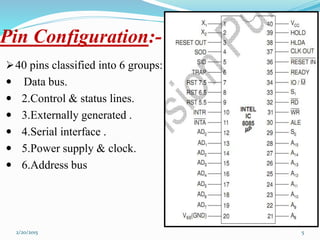
Pin Configuration:-
40 pins classified into 6 groups:
 Data bus.
 2.Control & status lines.
 3.Externally generated .
 4.Serial interface .
 5.Power supply & clock.
 6.Address bus
52/20/2015
Pin Configuration Cont…
1) Address Bus (A15-A8 and AD7-AD0):-
The microprocessor 8085 has 16 bit
address lines from A15-A8 and AD7-AD0. These
lines are used to transfer 16 bit address of
memory as well as 8-bit address of I/O ports.
2) Data Bus:-
The lower 8 lines (AD7-AD0) are often
called as multiplexed data lines.
62/20/2015
Control lines :-
RD :- RD is read as Read operation. This is active low
signal which indicates that the selected I/O or memory
device is to be read and also is available on the data
bus.
WR :-WR is read as Write operation. This is active low
signal which indicates that the data on data bus are to be
written into a selected memory location.
 IO/ M:-It is use to indicate that whether microprocessor is
working with input/ output devices or with memory. if it is
active high it works with I/O device. And if it is active low
then it is working with memory 72/20/2015
Status lines : -
8
IO/M S1 S2 Machine Cycle
0 0 1 Memory Write
0 1 0 Memory Read
0 1 1 OP- Code Latch
1 0 1 IO Write
1 0 0 IO Read
1 1 1 No Operation
2/20/2015
Status Line:-
These are the Output Signal generated by the
microprocessor used to give the status of the
operation perform by the microprocessor. These
are not generally used in small system but can be
used to generate advanced advanced control
signal for the large system
92/20/2015
Special signal :-
ALE (Address Latch Enable):
The ALE signal is used to enable or disable the external
 latch IC (74373/8212).
 The external latch IC is used for the de-multiplexing
of AD7-AD0 lines, i.e., it is used to separate the
address and data from AD7-AD0 lines.
 If ALE = 1/0 then external latch IC is enabled/disabled
respectively.
102/20/2015
Intrupt control group:-
 Intrupt is use to control intrupt related issue with the
microprocessor if user want to use intrupt service.
 Here the intrupt serice means the extra service want by the
use the user.
 INTR means Intrupt request,it is use for this extra service.
 It is active high input signal.
 And the response of giving the extra service to the user or
not is shown by the microprossesor using INTA.
 INTA means Intrupt acknowlegment.
112/20/2015
Architecture of 8085 :-
122/20/2015
Architecture 0f 8085Cont…
1 ALU.
2. Timing and Control Unit.
3. General Purpose Registers.
4. Program Status word.
5. Program Counter.
6. Stack Pointer.
7. Instruction Register and
Instruction Decoder.
8. Interrupt Control.
9.Serial I/O Control.
10.Address Bus.
11. Data Bus.
132/20/2015
Registers of 8085 (8-bit,16-bit) :-
 (A)Accumulator :-
This is an special purpose register. All the ALU
operations are performed with reference to the
contents of Accumulator.
General Purpose Resistor :-
B,C,D,E,H,L are General purpose registers. These
registers can also used for 16-bit operations in
pairs. The default pairs are BC, DE & HL.
142/20/2015
(F)Flag register :-
This register indicates the status of the ALU
operation.
 (PC) Program Counter:-
This is a 16-bit register used to address the
memory location from where an instruction is
going to be executed.
152/20/2015
ALU – Arithmetic & Logic Unit :-
ALU of 8085 performs 8-bit arithmetic & logical
operations. The operations are generally performed with
Accumulator as one of the operands. The result is saved in
accumulator register.
 Timing & Control Unit :-
This unit works as the brain of the CPU and generates
all the timing and control signals to perform all the internal
& external operations of the CPU.
 Instruction Decoder & Machine Cycle
Encoder Unit :-
This unit decodes the op-code stored in the Instruction
Register (IR) and encodes it for the timing & control unit
to perform the execution of the instruction.
162/20/2015
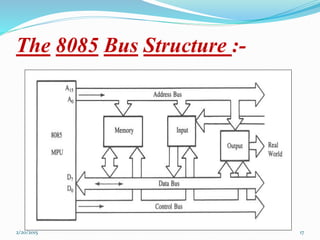
The 8085 Bus Structure :-
172/20/2015
2/20/2015 18
Demultiplexing :-
Some 8085 Processors Chips :-
192/20/2015
Advantages of 8085 :-
 It required only +5v Power Supply.
 It does not required any special or external clock
generator.
 It has 5 addressing mode.
 There are 8 software interrupts in 8085 microprocessor.
 In respond to INTR signal 8085 generates the three
different acknowledgement signal (i.e. INTA).
 It have 5 Hardware interrupts .
2/20/2015 20
Disadvantages of 8085 :-
 It does not Support Memory Segmentation.
 It does not supports Pipeline.
 Instruction Queue is not presents in 8085.
 It can handle in only one (1) mode.
 It has less memory only 64 KB.
 Only 8-bit data operation can perform.
2/20/2015 21
Conclusion :-
1. Due to this microprocessor somewhere the work of
workers get less.
2. But the size of the microprocessor is not
sufficient.
3. This 8085 has low speed .
4. It has no future scope.
5. And to solve this problem the later version of 8085
came to know as 8086.
222/20/2015
Reference by:-
1. www.google.com
2. www.yahoo.com
3. www.ask.com
4. Tech max book .
5. Nirali book.
232/20/2015
242/20/2015

8085 full discription

  • 1.
  • 2.
    Presented by:- 1. RohanS. Niwal. 2. Shubham Bhaskarvar. 3. Mahima M. Hirapure. 4. Shreya A. Dongre. 5. Sharayu Renghe. 6. Kartik N. Kalpande. 22/20/2015
  • 3.
    Introduction :-  Microprocessoris a programmable electronic device which is used in small system such as pocket calculator , digital watches and mostly in the Smartphone's.  The most of microprocessor comes in 1970 and where is used in the calculator.  The 8085 is an 8 bit microprocessor. It having 8 bit of data bus and 16 bit of address bus.  The 8085 microprocessor required only the 3MHz clock Frequency . It having 64 KB of memory. 2/20/2015 3
  • 4.
    Features :- 8 bitmicroprocessor(8085 microprocessor can read or write or perform arithmetic and logical operations on 8-bit data at time) It has 8 data lines and 16 address lines hence capacity is 216 = 64 KB of Memory. Cock frequency is 3 MHz It requires +5V power supply. It is a single chip NMOS device implemented with 6200 transistors. It provides 74 instructions with five addressing modes. It provides 5 hardware interrupt and 8 software interrupts. 42/20/2015
  • 5.
    Pin Configuration:- 40 pinsclassified into 6 groups:  Data bus.  2.Control & status lines.  3.Externally generated .  4.Serial interface .  5.Power supply & clock.  6.Address bus 52/20/2015
  • 6.
    Pin Configuration Cont… 1)Address Bus (A15-A8 and AD7-AD0):- The microprocessor 8085 has 16 bit address lines from A15-A8 and AD7-AD0. These lines are used to transfer 16 bit address of memory as well as 8-bit address of I/O ports. 2) Data Bus:- The lower 8 lines (AD7-AD0) are often called as multiplexed data lines. 62/20/2015
  • 7.
    Control lines :- RD:- RD is read as Read operation. This is active low signal which indicates that the selected I/O or memory device is to be read and also is available on the data bus. WR :-WR is read as Write operation. This is active low signal which indicates that the data on data bus are to be written into a selected memory location.  IO/ M:-It is use to indicate that whether microprocessor is working with input/ output devices or with memory. if it is active high it works with I/O device. And if it is active low then it is working with memory 72/20/2015
  • 8.
    Status lines :- 8 IO/M S1 S2 Machine Cycle 0 0 1 Memory Write 0 1 0 Memory Read 0 1 1 OP- Code Latch 1 0 1 IO Write 1 0 0 IO Read 1 1 1 No Operation 2/20/2015
  • 9.
    Status Line:- These arethe Output Signal generated by the microprocessor used to give the status of the operation perform by the microprocessor. These are not generally used in small system but can be used to generate advanced advanced control signal for the large system 92/20/2015
  • 10.
    Special signal :- ALE(Address Latch Enable): The ALE signal is used to enable or disable the external  latch IC (74373/8212).  The external latch IC is used for the de-multiplexing of AD7-AD0 lines, i.e., it is used to separate the address and data from AD7-AD0 lines.  If ALE = 1/0 then external latch IC is enabled/disabled respectively. 102/20/2015
  • 11.
    Intrupt control group:- Intrupt is use to control intrupt related issue with the microprocessor if user want to use intrupt service.  Here the intrupt serice means the extra service want by the use the user.  INTR means Intrupt request,it is use for this extra service.  It is active high input signal.  And the response of giving the extra service to the user or not is shown by the microprossesor using INTA.  INTA means Intrupt acknowlegment. 112/20/2015
  • 12.
    Architecture of 8085:- 122/20/2015
  • 13.
    Architecture 0f 8085Cont… 1ALU. 2. Timing and Control Unit. 3. General Purpose Registers. 4. Program Status word. 5. Program Counter. 6. Stack Pointer. 7. Instruction Register and Instruction Decoder. 8. Interrupt Control. 9.Serial I/O Control. 10.Address Bus. 11. Data Bus. 132/20/2015
  • 14.
    Registers of 8085(8-bit,16-bit) :-  (A)Accumulator :- This is an special purpose register. All the ALU operations are performed with reference to the contents of Accumulator. General Purpose Resistor :- B,C,D,E,H,L are General purpose registers. These registers can also used for 16-bit operations in pairs. The default pairs are BC, DE & HL. 142/20/2015
  • 15.
    (F)Flag register :- Thisregister indicates the status of the ALU operation.  (PC) Program Counter:- This is a 16-bit register used to address the memory location from where an instruction is going to be executed. 152/20/2015
  • 16.
    ALU – Arithmetic& Logic Unit :- ALU of 8085 performs 8-bit arithmetic & logical operations. The operations are generally performed with Accumulator as one of the operands. The result is saved in accumulator register.  Timing & Control Unit :- This unit works as the brain of the CPU and generates all the timing and control signals to perform all the internal & external operations of the CPU.  Instruction Decoder & Machine Cycle Encoder Unit :- This unit decodes the op-code stored in the Instruction Register (IR) and encodes it for the timing & control unit to perform the execution of the instruction. 162/20/2015
  • 17.
    The 8085 BusStructure :- 172/20/2015
  • 18.
  • 19.
    Some 8085 ProcessorsChips :- 192/20/2015
  • 20.
    Advantages of 8085:-  It required only +5v Power Supply.  It does not required any special or external clock generator.  It has 5 addressing mode.  There are 8 software interrupts in 8085 microprocessor.  In respond to INTR signal 8085 generates the three different acknowledgement signal (i.e. INTA).  It have 5 Hardware interrupts . 2/20/2015 20
  • 21.
    Disadvantages of 8085:-  It does not Support Memory Segmentation.  It does not supports Pipeline.  Instruction Queue is not presents in 8085.  It can handle in only one (1) mode.  It has less memory only 64 KB.  Only 8-bit data operation can perform. 2/20/2015 21
  • 22.
    Conclusion :- 1. Dueto this microprocessor somewhere the work of workers get less. 2. But the size of the microprocessor is not sufficient. 3. This 8085 has low speed . 4. It has no future scope. 5. And to solve this problem the later version of 8085 came to know as 8086. 222/20/2015
  • 23.
    Reference by:- 1. www.google.com 2.www.yahoo.com 3. www.ask.com 4. Tech max book . 5. Nirali book. 232/20/2015
  • 24.