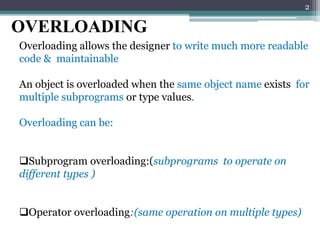
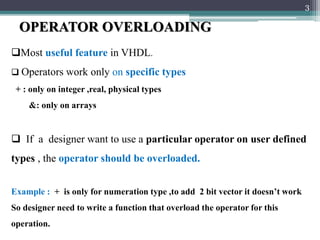
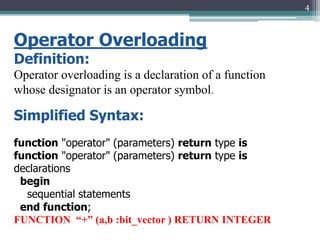
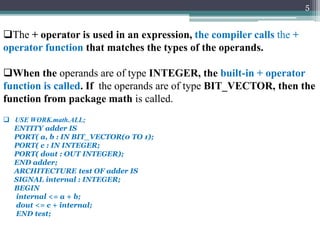
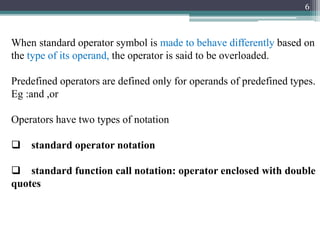
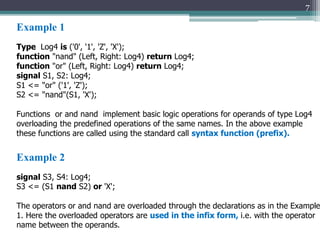
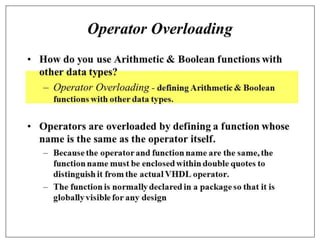
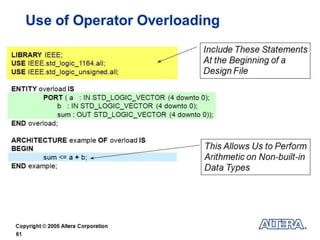
Operator overloading allows the same operation to work on multiple data types by defining functions with the operator name. It makes code more readable and maintainable. Standard operators only work on predefined types, but overloading allows operators to work on user-defined types as well. For example, the + operator only works on integer and real types by default, but overloading + allows it to add two bit vectors. This is done by defining a function called + that takes two bit vectors and returns an integer. Operator overloading uses either standard function call notation with the operator in double quotes or standard infix notation with the operator between operands.