Topic:- Microprocessor 8085
SUBMITTED TO:- SUBMITTED BY:-
Mr. Sachin Bhandari Shivanshu purwar
Ms. Ankita Jain Nikhil Gupta
 Microprocessor 8085
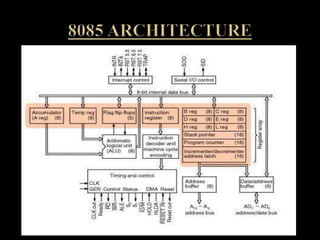
 Architecture of 8085
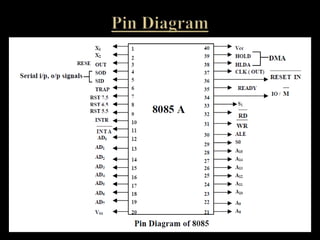
 Pin diagram of 8085
 System Bus
 Applications of 8085
 Disadvantage of 8085
 Conclusion
 Reference
 The key element of all computers, providing the
mathematical and decision making ability
 They operate at ultra-fast speeds – doing over a
billion operations very second
 Made up from a semiconductor, Silicon
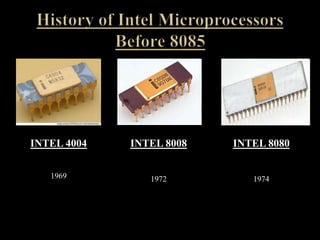
INTEL 4004
1969
INTEL 8008
1972
INTEL 8080
1974
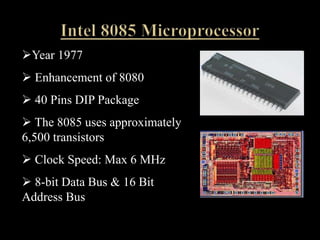
Year 1977
 Enhancement of 8080
 40 Pins DIP Package
 The 8085 uses approximately
6,500 transistors
 Clock Speed: Max 6 MHz
 8-bit Data Bus & 16 Bit
Address Bus
 It is an 8 bit processor.
 It is a single chip N-MOS(N Type Metal Oxide
Semiconductor) device with 40 pins DIP
Package.
 It uses all instructions of 808 therefore it is
program compatible with 8080
 It has multiplexed address and data bus.(AD0-
AD7)
 It works on single 5 Volt dc power supply.
 The maximum clock frequency is 6 MHz while
minimum frequency is 500kHz.
 It provides 74 instructions with 5 different
addressing modes, Two new instruction has been
added in 8085, for taking advantage of added
hardware
 It provides 16 address lines so it can access 2^16
=64K bytes of memory.
 It generates 8 bit I/O address so it can access
2^8=256 input ports.
 It provides 5 hardware interrupts : TRAP, RST 5.5,
RST 6.5, RST 7.5,INTR.
 It provides Acc ,one flag register ,6 general purpose
registers and two special purpose registers(SP,PC).
 It provides serial lines SID ,SOD . So serial
peripherals can be interfaced with 8085 directly.
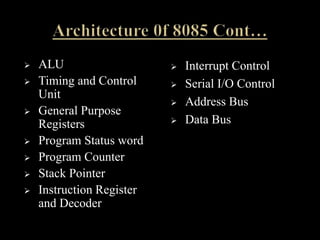
 ALU
 Timing and Control
Unit
 General Purpose
Registers
 Program Status word
 Program Counter
 Stack Pointer
 Instruction Register
and Decoder
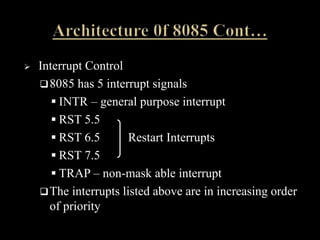
 Interrupt Control
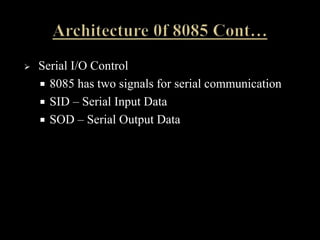
 Serial I/O Control
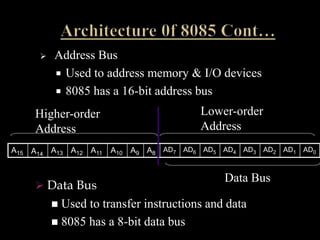
 Address Bus
 Data Bus
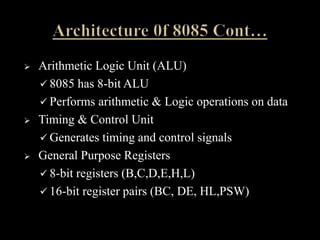
 Arithmetic Logic Unit (ALU)
 8085 has 8-bit ALU
 Performs arithmetic & Logic operations on data
 Timing & Control Unit
 Generates timing and control signals
 General Purpose Registers
 8-bit registers (B,C,D,E,H,L)
 16-bit register pairs (BC, DE, HL,PSW)
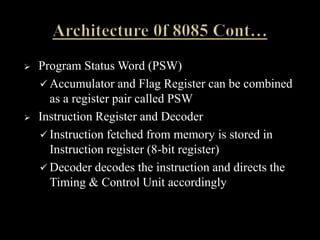
 Program Status Word (PSW)
 Accumulator and Flag Register can be combined
as a register pair called PSW
 Instruction Register and Decoder
 Instruction fetched from memory is stored in
Instruction register (8-bit register)
 Decoder decodes the instruction and directs the
Timing & Control Unit accordingly
 Interrupt Control
8085 has 5 interrupt signals
 INTR – general purpose interrupt
 RST 5.5
 RST 6.5 Restart Interrupts
 RST 7.5
 TRAP – non-mask able interrupt
The interrupts listed above are in increasing order
of priority
 Serial I/O Control
 8085 has two signals for serial communication
 SID – Serial Input Data
 SOD – Serial Output Data
 Address Bus
 Used to address memory & I/O devices
 8085 has a 16-bit address bus
A15 A14
A13 A12 A11 A10 A9 A8
AD7 AD6 AD5 AD4 AD3 AD2 AD1 AD0
Lower-order
Address
Higher-order
Address
 Data Bus
 Used to transfer instructions and data
 8085 has a 8-bit data bus
Data Bus
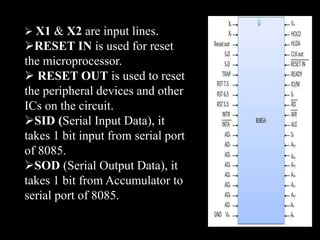
 X1 & X2 are input lines.
RESET IN is used for reset
the microprocessor.
 RESET OUT is used to reset
the peripheral devices and other
ICs on the circuit.
SID (Serial Input Data), it
takes 1 bit input from serial port
of 8085.
SOD (Serial Output Data), it
takes 1 bit from Accumulator to
serial port of 8085.
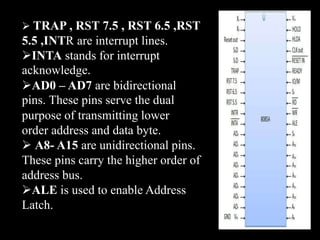
 TRAP , RST 7.5 , RST 6.5 ,RST
5.5 ,INTR are interrupt lines.
INTA stands for interrupt
acknowledge.
AD0 – AD7 are bidirectional
pins. These pins serve the dual
purpose of transmitting lower
order address and data byte.
 A8- A15 are unidirectional pins.
These pins carry the higher order of
address bus.
ALE is used to enable Address
Latch.
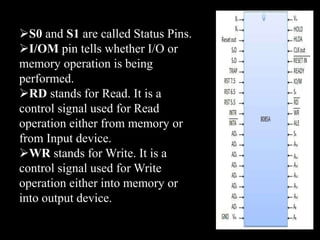
S0 and S1 are called Status Pins.
I/OM pin tells whether I/O or
memory operation is being
performed.
RD stands for Read. It is a
control signal used for Read
operation either from memory or
from Input device.
WR stands for Write. It is a
control signal used for Write
operation either into memory or
into output device.
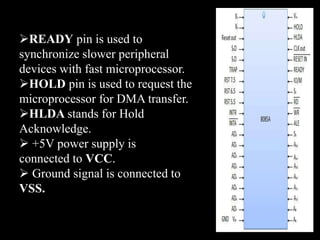
READY pin is used to
synchronize slower peripheral
devices with fast microprocessor.
HOLD pin is used to request the
microprocessor for DMA transfer.
HLDA stands for Hold
Acknowledge.
 +5V power supply is
connected to VCC.
 Ground signal is connected to
VSS.
 There are a number of possible interconnection
systems
 A communication pathway connecting two or more
devices
 Single and multiple BUS structures are most
common
 Power lines may not be shown
 e.g. Control/Address/Data bus (PC)
 Carries data
 Remember that there is no difference between
“data” and “instruction” at this level
 Width is a key determinant of performance
 8, 16, 32, 64 bit
 Identify the source or destination of data
 e.g. CPU needs to read an instruction (data) from a
given location in memory
 Bus width determines maximum memory capacity
of system
 e.g. 8080 has 16 bit address bus giving 64k
address space
 Control and timing information
 Memory read/write signal
 Interrupt request
 Clock signals
Instrumentation:- Like printing machine,
digital kiosks, credit card processing, security
systems etc
Entertainment:- Microprocessors are also used
in various gaming consoles, DVD player, etc.
Communication :- like: in digital telephone
sets, telephone exchanges, in television, satellite
communication, etc.
 It might get over-heated, and the limitation it
imposes on the size of data.
Microprocessors are the key element of any
computer. 8085 microprocessor is first famous Intel
microprocessor . Its works on 8 pins. But some
drawbacks with 8085 which overcame by the 8086
microprocessor.
 www.ehow.com
 www.slideshare.net
 www.google.com
 http://www.cpu-world.com/
microprocessor 8085

microprocessor 8085

  • 1.
    Topic:- Microprocessor 8085 SUBMITTEDTO:- SUBMITTED BY:- Mr. Sachin Bhandari Shivanshu purwar Ms. Ankita Jain Nikhil Gupta
  • 2.
     Microprocessor 8085 Architecture of 8085  Pin diagram of 8085  System Bus  Applications of 8085  Disadvantage of 8085  Conclusion  Reference
  • 4.
     The keyelement of all computers, providing the mathematical and decision making ability  They operate at ultra-fast speeds – doing over a billion operations very second  Made up from a semiconductor, Silicon
  • 5.
  • 6.
    Year 1977  Enhancementof 8080  40 Pins DIP Package  The 8085 uses approximately 6,500 transistors  Clock Speed: Max 6 MHz  8-bit Data Bus & 16 Bit Address Bus
  • 7.
     It isan 8 bit processor.  It is a single chip N-MOS(N Type Metal Oxide Semiconductor) device with 40 pins DIP Package.  It uses all instructions of 808 therefore it is program compatible with 8080  It has multiplexed address and data bus.(AD0- AD7)  It works on single 5 Volt dc power supply.
  • 8.
     The maximumclock frequency is 6 MHz while minimum frequency is 500kHz.  It provides 74 instructions with 5 different addressing modes, Two new instruction has been added in 8085, for taking advantage of added hardware  It provides 16 address lines so it can access 2^16 =64K bytes of memory.  It generates 8 bit I/O address so it can access 2^8=256 input ports.
  • 9.
     It provides5 hardware interrupts : TRAP, RST 5.5, RST 6.5, RST 7.5,INTR.  It provides Acc ,one flag register ,6 general purpose registers and two special purpose registers(SP,PC).  It provides serial lines SID ,SOD . So serial peripherals can be interfaced with 8085 directly.
  • 12.
     ALU  Timingand Control Unit  General Purpose Registers  Program Status word  Program Counter  Stack Pointer  Instruction Register and Decoder  Interrupt Control  Serial I/O Control  Address Bus  Data Bus
  • 13.
     Arithmetic LogicUnit (ALU)  8085 has 8-bit ALU  Performs arithmetic & Logic operations on data  Timing & Control Unit  Generates timing and control signals  General Purpose Registers  8-bit registers (B,C,D,E,H,L)  16-bit register pairs (BC, DE, HL,PSW)
  • 14.
     Program StatusWord (PSW)  Accumulator and Flag Register can be combined as a register pair called PSW  Instruction Register and Decoder  Instruction fetched from memory is stored in Instruction register (8-bit register)  Decoder decodes the instruction and directs the Timing & Control Unit accordingly
  • 15.
     Interrupt Control 8085has 5 interrupt signals  INTR – general purpose interrupt  RST 5.5  RST 6.5 Restart Interrupts  RST 7.5  TRAP – non-mask able interrupt The interrupts listed above are in increasing order of priority
  • 16.
     Serial I/OControl  8085 has two signals for serial communication  SID – Serial Input Data  SOD – Serial Output Data
  • 17.
     Address Bus Used to address memory & I/O devices  8085 has a 16-bit address bus A15 A14 A13 A12 A11 A10 A9 A8 AD7 AD6 AD5 AD4 AD3 AD2 AD1 AD0 Lower-order Address Higher-order Address  Data Bus  Used to transfer instructions and data  8085 has a 8-bit data bus Data Bus
  • 20.
     X1 &X2 are input lines. RESET IN is used for reset the microprocessor.  RESET OUT is used to reset the peripheral devices and other ICs on the circuit. SID (Serial Input Data), it takes 1 bit input from serial port of 8085. SOD (Serial Output Data), it takes 1 bit from Accumulator to serial port of 8085.
  • 21.
     TRAP ,RST 7.5 , RST 6.5 ,RST 5.5 ,INTR are interrupt lines. INTA stands for interrupt acknowledge. AD0 – AD7 are bidirectional pins. These pins serve the dual purpose of transmitting lower order address and data byte.  A8- A15 are unidirectional pins. These pins carry the higher order of address bus. ALE is used to enable Address Latch.
  • 22.
    S0 and S1are called Status Pins. I/OM pin tells whether I/O or memory operation is being performed. RD stands for Read. It is a control signal used for Read operation either from memory or from Input device. WR stands for Write. It is a control signal used for Write operation either into memory or into output device.
  • 23.
    READY pin isused to synchronize slower peripheral devices with fast microprocessor. HOLD pin is used to request the microprocessor for DMA transfer. HLDA stands for Hold Acknowledge.  +5V power supply is connected to VCC.  Ground signal is connected to VSS.
  • 25.
     There area number of possible interconnection systems  A communication pathway connecting two or more devices  Single and multiple BUS structures are most common  Power lines may not be shown  e.g. Control/Address/Data bus (PC)
  • 26.
     Carries data Remember that there is no difference between “data” and “instruction” at this level  Width is a key determinant of performance  8, 16, 32, 64 bit
  • 27.
     Identify thesource or destination of data  e.g. CPU needs to read an instruction (data) from a given location in memory  Bus width determines maximum memory capacity of system  e.g. 8080 has 16 bit address bus giving 64k address space
  • 28.
     Control andtiming information  Memory read/write signal  Interrupt request  Clock signals
  • 30.
    Instrumentation:- Like printingmachine, digital kiosks, credit card processing, security systems etc Entertainment:- Microprocessors are also used in various gaming consoles, DVD player, etc. Communication :- like: in digital telephone sets, telephone exchanges, in television, satellite communication, etc.
  • 31.
     It mightget over-heated, and the limitation it imposes on the size of data.
  • 32.
    Microprocessors are thekey element of any computer. 8085 microprocessor is first famous Intel microprocessor . Its works on 8 pins. But some drawbacks with 8085 which overcame by the 8086 microprocessor.
  • 33.
     www.ehow.com  www.slideshare.net www.google.com  http://www.cpu-world.com/