
DR. BIJAY KR.YADAV
Holly vision technical campus
Shankhamul, Kathmandu
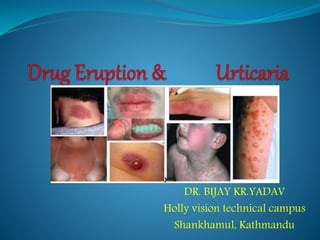
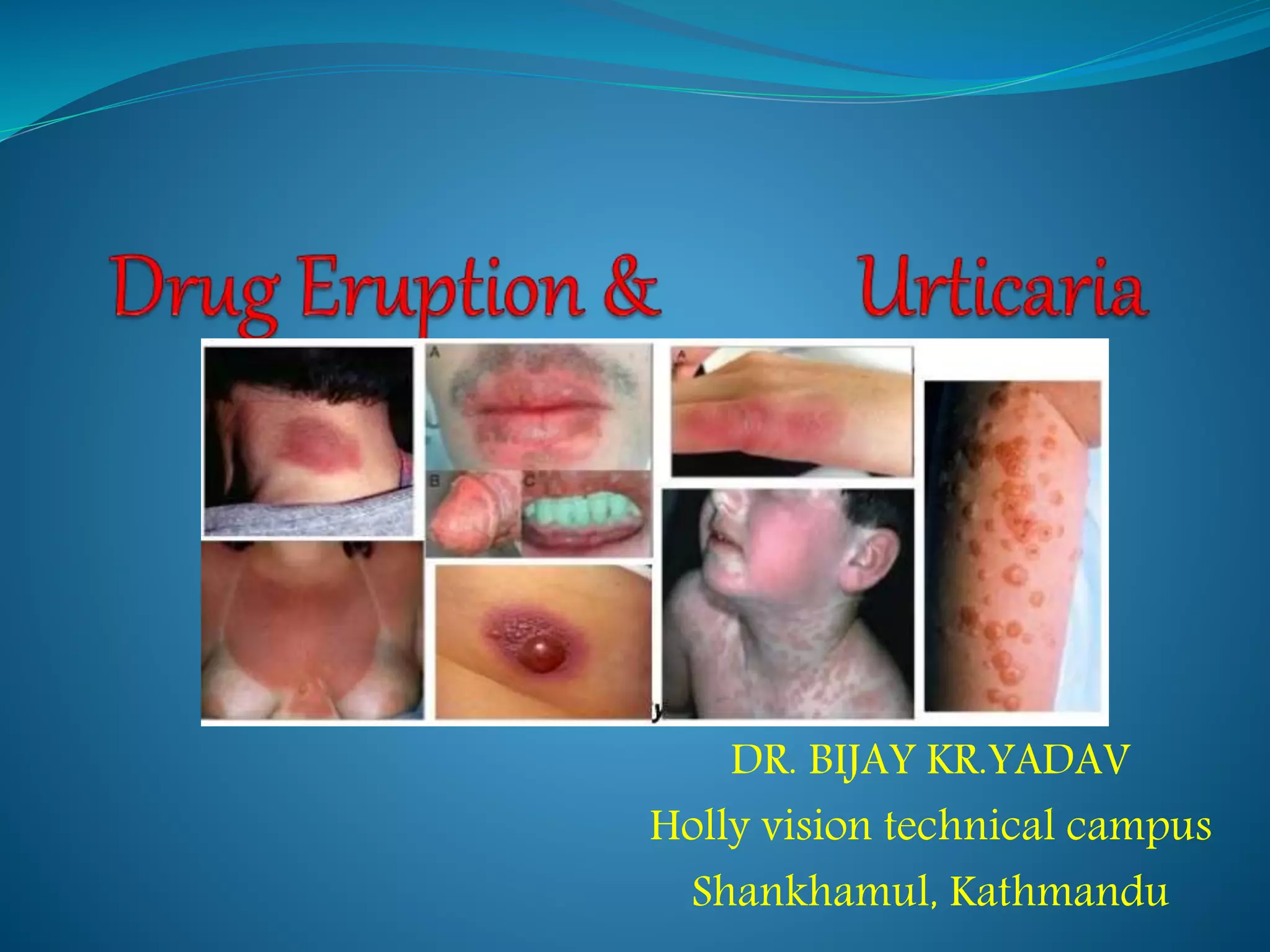
Drug eruption
 Drug eruption or Drug reaction : are the unwanted, harmful & adverse
effects of the drugs in the body organs. Skin disorder are the frequent
form of drug side effect.
 Types of drug eruption :
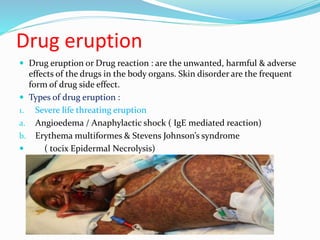
1. Severe life threating eruption
a. Angioedema / Anaphylactic shock ( IgE mediated reaction)
b. Erythema multiformes & Stevens Johnson’s syndrome
 ( tocix Epidermal Necrolysis)
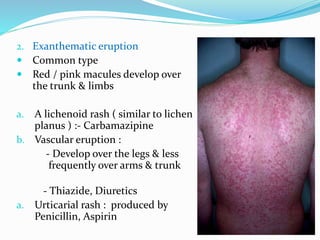
2. Exanthematic eruption
 Common type
 Red / pink macules develop over
the trunk & limbs
a. A lichenoid rash ( similar to lichen
planus ) :- Carbamazipine
b. Vascular eruption :
- Develop over the legs & less
frequently over arms & trunk
- Thiazide, Diuretics
a. Urticarial rash : produced by
Penicillin, Aspirin
3. Photosensitivity Rashes :
By solar ultraviolet spectrum - Red,
papules or plaque like rash
By drugs – like Tetracycline &
sulphonamides
4. Blistering rash :
- Furosemide, captopril, penicillamine,
Naproxen
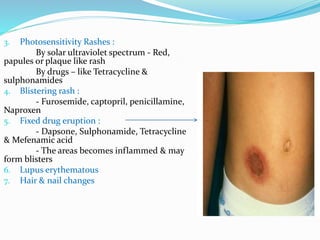
5. Fixed drug eruption :
- Dapsone, Sulphonamide, Tetracycline
& Mefenamic acid
- The areas becomes inflammed & may
form blisters
6. Lupus erythematous
7. Hair & nail changes
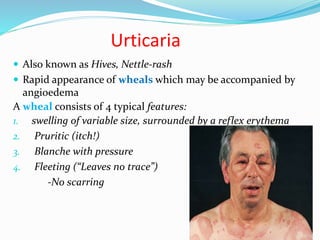
Urticaria
 Also known as Hives, Nettle-rash
 Rapid appearance of wheals which may be accompanied by
angioedema
A wheal consists of 4 typical features:
1. swelling of variable size, surrounded by a reflex erythema
2. Pruritic (itch!)
3. Blanche with pressure
4. Fleeting (“Leaves no trace”)
-No scarring
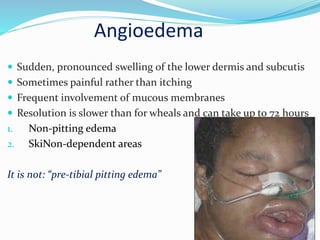
Angioedema
 Sudden, pronounced swelling of the lower dermis and subcutis
 Sometimes painful rather than itching
 Frequent involvement of mucous membranes
 Resolution is slower than for wheals and can take up to 72 hours
1. Non-pitting edema
2. SkiNon-dependent areas
It is not: “pre-tibial pitting edema”
Urticaria / Angioedema
Classification
 Acute
 < 6 weeks duration
 Chronic
 > 6 weeks duration
 Idiopathic – as much as 70%
 Autoimmune
 Urticarial vasculitis
The main types of Urticaria :
1. Physical
 Cold
 Soalr
 Heat
 Cholinergic
 Dermographism (Immediate pressure urticaria)
 Delayed pressure
2. Hypersensitivity
3. Autoimmune
4. Pharmacological
5. contact
Causes :
1. Endogenous cause :
 Infection
- Bacterial
- Viral ( Hepatitis, HIV infection during seroconversion etc )
- Mycoplasma
- Intestinal parasites
 Connective tissue disorder
 Hypereosinophilic syndrome
 Hyperthyroidism
 Cancer
 lymphomas
2. Exogenous cause :
 Drugs both systemic & topical
 Foods & food additives
 Bites
 Pollens
 Insects venoms
 Inhalants
 Animal dander
Clinical features :
 Sudden appearance of pink itchy wheals
 Anywhere in the skin and each last for less than a day
 Lesions may enlarge rapidly and some resolve centrally &
take annular shape
 In acute anaphylactic reaction – wheals cover most of skin
surface
 In chronic urticaria – only few wheals develop every day
Complications
1. Anaphylactic reactions with laryngeal edema and
asphyxiation ; edema of tracheobronchial tree leading to
Asthma.
2. Interference with sleep due to itching
3. Sedation due to antihistamines.
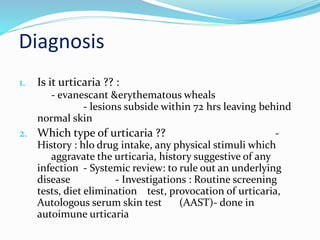
Diagnosis
1. Is it urticaria ?? :
- evanescant &erythematous wheals
- lesions subside within 72 hrs leaving behind
normal skin
2. Which type of urticaria ?? -
History : hlo drug intake, any physical stimuli which
aggravate the urticaria, history suggestive of any
infection - Systemic review: to rule out an underlying
disease - Investigations : Routine screening
tests, diet elimination test, provocation of urticaria,
Autologous serum skin test (AAST)- done in
autoimune urticaria
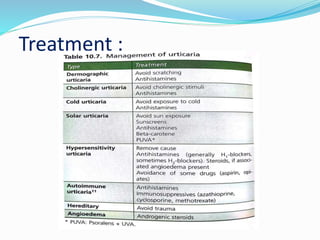
Treatment :
THANK YOU

8. Drug eruption &amp; urticaria

  • 1.
    DR. BIJAY KR.YADAV Hollyvision technical campus Shankhamul, Kathmandu
  • 2.
    Drug eruption  Drugeruption or Drug reaction : are the unwanted, harmful & adverse effects of the drugs in the body organs. Skin disorder are the frequent form of drug side effect.  Types of drug eruption : 1. Severe life threating eruption a. Angioedema / Anaphylactic shock ( IgE mediated reaction) b. Erythema multiformes & Stevens Johnson’s syndrome  ( tocix Epidermal Necrolysis)
  • 3.
    2. Exanthematic eruption Common type  Red / pink macules develop over the trunk & limbs a. A lichenoid rash ( similar to lichen planus ) :- Carbamazipine b. Vascular eruption : - Develop over the legs & less frequently over arms & trunk - Thiazide, Diuretics a. Urticarial rash : produced by Penicillin, Aspirin
  • 4.
    3. Photosensitivity Rashes: By solar ultraviolet spectrum - Red, papules or plaque like rash By drugs – like Tetracycline & sulphonamides 4. Blistering rash : - Furosemide, captopril, penicillamine, Naproxen 5. Fixed drug eruption : - Dapsone, Sulphonamide, Tetracycline & Mefenamic acid - The areas becomes inflammed & may form blisters 6. Lupus erythematous 7. Hair & nail changes
  • 5.
    Urticaria  Also knownas Hives, Nettle-rash  Rapid appearance of wheals which may be accompanied by angioedema A wheal consists of 4 typical features: 1. swelling of variable size, surrounded by a reflex erythema 2. Pruritic (itch!) 3. Blanche with pressure 4. Fleeting (“Leaves no trace”) -No scarring
  • 6.
    Angioedema  Sudden, pronouncedswelling of the lower dermis and subcutis  Sometimes painful rather than itching  Frequent involvement of mucous membranes  Resolution is slower than for wheals and can take up to 72 hours 1. Non-pitting edema 2. SkiNon-dependent areas It is not: “pre-tibial pitting edema”
  • 7.
    Urticaria / Angioedema Classification Acute  < 6 weeks duration  Chronic  > 6 weeks duration  Idiopathic – as much as 70%  Autoimmune  Urticarial vasculitis
  • 8.
    The main typesof Urticaria : 1. Physical  Cold  Soalr  Heat  Cholinergic  Dermographism (Immediate pressure urticaria)  Delayed pressure 2. Hypersensitivity 3. Autoimmune 4. Pharmacological 5. contact
  • 9.
    Causes : 1. Endogenouscause :  Infection - Bacterial - Viral ( Hepatitis, HIV infection during seroconversion etc ) - Mycoplasma - Intestinal parasites  Connective tissue disorder  Hypereosinophilic syndrome  Hyperthyroidism  Cancer  lymphomas
  • 10.
    2. Exogenous cause:  Drugs both systemic & topical  Foods & food additives  Bites  Pollens  Insects venoms  Inhalants  Animal dander
  • 11.
    Clinical features : Sudden appearance of pink itchy wheals  Anywhere in the skin and each last for less than a day  Lesions may enlarge rapidly and some resolve centrally & take annular shape  In acute anaphylactic reaction – wheals cover most of skin surface  In chronic urticaria – only few wheals develop every day
  • 12.
    Complications 1. Anaphylactic reactionswith laryngeal edema and asphyxiation ; edema of tracheobronchial tree leading to Asthma. 2. Interference with sleep due to itching 3. Sedation due to antihistamines.
  • 13.
    Diagnosis 1. Is iturticaria ?? : - evanescant &erythematous wheals - lesions subside within 72 hrs leaving behind normal skin 2. Which type of urticaria ?? - History : hlo drug intake, any physical stimuli which aggravate the urticaria, history suggestive of any infection - Systemic review: to rule out an underlying disease - Investigations : Routine screening tests, diet elimination test, provocation of urticaria, Autologous serum skin test (AAST)- done in autoimune urticaria
  • 14.
  • 15.