Dr. Yogesh Kalyanpad
Based on article IJDVL FEB 2013
ABSTRACT
 Insect bite reactions are commonly seen in clinical
practice
 Different variables influencing the susceptibility of an
individual to insect bites
 The review also presents a brief account of insects as
vectors of diseases and ends with discussion of
prevention of insect bites and some serious adverse
effects of mosquito coil smoke
INTRODUCTION
 Insects are a class of arthropods
 Latin insectum, meaning "cut into sections”
 A chitinous exoskeleton, three-part body
i.e. Three pairs of jointed legs, compound eyes, and two
antennae
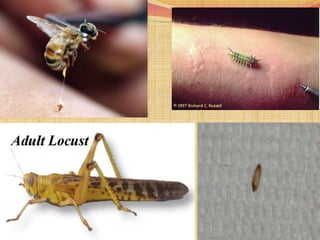
 All insects do not bite
 Some non-biting insects are beetles, locusts, moths, and
butterflies, although these may produce skin reactions by
other means such as allergic reactions to their body parts,
faeces, or body fluids
 Bees, wasps, and ants also do not bite, but produce
dermatological reactions by their stings.
Epidemiology in India
 Insect bite reactions are common, but information
about their prevalence is limited
 Children <14 years of age in dermatology outpatient
clinic in Pondicherry had a prevalence of 5.3%
 Children <5 years of age attending skin outpatient
clinic in Calcutta had 10.6% prevalence of papular
urticaria with seasonal variation
 (rainy season 16.7%, summer 6.7%, winter 5.8%)
Mosquito
Mosquito Bites
 Mosquitoes belong to order Diptera, suborder
Nematocera, and family Culicidae
 Bite reactions due to insects of order Diptera are
mostly due to allergens in saliva of insect and not due
to toxin
 Saliva of mosquitoes contains pharmacologically active
compounds inhibiting body's innate immune
responses
 Causing anticoagulation, impaired platelet formation,
vasodilation and anti-inflammatory activities
 Salivary gland surface proteins are major immunogenic
components
 Species-specific and species-shared allergens of
mosquitoes have been identified
 Which should facilitate production of specific recombinant
allergens and improvement in diagnosis and specific
immunotherapy
 Human sweat contains odorous organic compounds,
produced by skin microflora, determining its attractiveness
to mosquitoes
 Higher probability of mosquito bites is associated with
increasing age in children, male gender, large body size,
pregnancy, and alcohol ingestion
Mellanby has described 5 stages of reaction to repeated mosquito bites
Anaphylactic reaction
 Severe IgE-mediated anaphylactic reactions rarely
occurs
 Characterized by rapid onset of skin lesions which
may be associated with respiratory compromise and
may result in death.
 It is highly recommended that individuals at risk of
anaphylaxis carry an epinephrine auto-injector
whenever they are likely to encounter mosquitoes
Hypersensitivity to Mosquito Bite in Epstein-Barr Virus
Natural Killer (HMB-EBV-NK) Disease
 This disease is mainly reported from Japan, Korea, and
China.
 Persons infected with EBV may develop a severe
reaction to mosquito bites.
 In 1990, Tokura et al described a patient with HMB
with 50% to 60% of peripheral blood mononuclear
cells being NK cells
 EBV infection immortalizes NK cells, which are
activated by injection of some mosquito constituents,
thereby exhibiting HMB as primary clinical
manifestation
 Typical clinical course includes three stages
1. Initial exaggerated reaction to mosquito bites
2. Deterioration of general systemic symptoms
particularly in elderly
3. The hemophagocytic syndrome (or malignant
histiocytosis) with major life-threatening
complications at the terminal stages
Eruptive Pseudoangiomatosis
 Millet-sized erythema or small shiny red papules of angioma-like
appearance with an anaemic halo occur on exposed parts
resolving within a few days
 Possibly due to mosquito bites, as lesions have been elicited by
Culex pipiens bites
Skeeter Syndrome-
 It’s a mosquito saliva-induced large local inflammatory reaction
clinically resembling cellulites.
 Lesions are red, itchy, warm swellings appearing within minutes
of bite
 Itchy papules, ecchymotic, vesiculated, and bullous reactions
appearing 2 to 6 hours afterwards and persisting for days or
weeks with or without fever.
 Severe reactions are treated with systemic prednisone
Papular Pruritic Eruption of HIV/AIDS
 Characterized by symmetrically distributed pruritic 2
to 5 mm papules on extremities and trunk sparing
palms, soles, and digital web-spaces,usually in
advanced HIV disease
 Condition which tends to wax and wane and is
resistant to oral antihistamine and topical
corticosteroid therapy, responds to HAART.
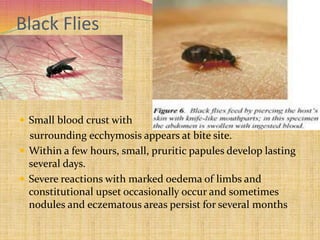
Black Flies
 Small blood crust with
surrounding ecchymosis appears at bite site.
 Within a few hours, small, pruritic papules develop lasting
several days.
 Severe reactions with marked oedema of limbs and
constitutional upset occasionally occur and sometimes
nodules and eczematous areas persist for several months
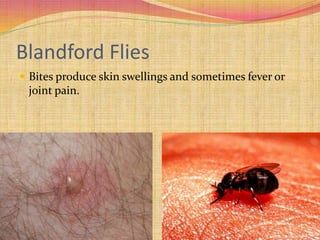
Blandford Flies
 Bites produce skin swellings and sometimes fever or
joint pain.
Horse Flies
 Bites produce painful lesions and rarely anaphylactic
reaction with generalized itching, urticaria,
paresthesia, and unconsciousness.
Louse Flies
 Deer ked (Lipoptena cervi L.), a haematophagous louse
fly of deer, causes pruritic papules, usually in forests.
 Lesions appear mostly on head and back, are resistant
to treatment and persist for weeks to months.
 Direct immunofluorescence may show
deposits of C3 in dermal vessel walls.
IgE, complement and cell-mediated
mechanisms are involved
Tsetse Fly
 Tsetse includes all species in genus Glossina
 Confined to Africa, tsetse flies are vectors of
trypanosomiasis.
 An allergen found in stinging insects (TAg5) was
detected in tsetse fly saliva.
Midges
 Biting midges prefer certain human hosts determined
by body odour
 Bite taller people first(they are abundant at heights of 1
to 4 meters above ground)
 Bites may manifest as IgE-mediated urticaria or as
presumably delayed-type reactions with papules,
ulcers, or bullae persisting for weeks
 IFN-γ, IL-6 and TNF-α are involved in delayed
reactions
Tics
 Common tick-borne diseases include:
 Lyme disease.
 Rocky Mountain spotted fever.
 Tularemia.
 Ehrlichiosis.
 Relapsing fever.
 Colorado tick fever.
 Babesiosis.
How to remove
 Use fine-tipped tweezers to grasp the tick as close to
the skin's surface as possible.
 Pull upward with steady, even pressure. Don't twist or
jerk the tick; this can cause the mouth-parts to break
off and remain in the skin. If this happens, remove the
mouth-parts with tweezers. If you are unable to
remove the mouth easily with clean tweezers, leave it
alone and let the skin heal.
 After removing the tick, thoroughly clean the bite area
and your hands with rubbing alcohol, an iodine scrub,
or soap and water.
BUGS
 Bugs are insects of the order Hemiptera with a common
arrangement of sucking mouth parts
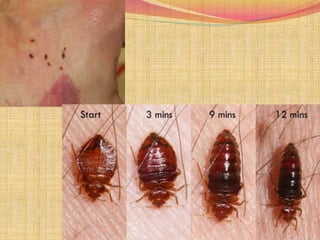
 Adult bedbugs are about 5 mm long and may be confused
with booklice, carpet beetles, and small cockroaches
 Bedbugs may survive up to a year without feeding
 Bedbug bites are known as cimicosis
 On first exposure most individuals do not develop lesions.
 With further bites, most develop an obvious skin reaction
and latency for previously reacting persons decreases
substantially
 Three salivary proteins of bedbugs, a nitric oxide-liberating
heme protein (nitrophorin), a 17-kDa anticoagulant (Factor
X),and a 40-kDa apyrase-like nucleotide-binding enzyme,
may be important immunologically.
 Infestation is facilitated by poor sanitation, overcrowding
of residences and trade in second-hand furniture
 Avoid light and feed at night
 Lesions are pruritic, usually painless, erythematous
macules, papules, nodules, urticarial wheals, and blisters.
 Bites may produce anxiety, insomnia or delusions in a
cured patient
 Heavy infestation may cause significant blood loss and
anemia in children
 Rare systemic reactions include generalized urticaria,
asthma, and anaphylaxis
Mexican chicken bugs
 Bites of Mexican chicken bugs Haematosiphon
inodorus (haematosiphoniasis) produce polymorphic
lesions (wheals, papules, vesicles, pustules, and scabs)
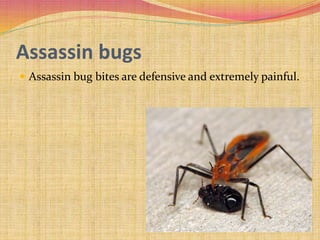
Assassin bugs
 Assassin bug bites are defensive and extremely painful.
Kissing bugs
 Bites of kissing bugs (Triatoma sanguisuga) are painless,
allowing them to feed undisturbed
 Initial bites produce little reaction, with repeated exposure
reactions ranging from pruritic papules with central
punctum to haemorrhagic nodules and bullae may occur
 Patients have multiple clustered bites, especially on face,
hence the name kissing bugs
 Often insects defecate while feeding, and parasite-laden
faeces from infected bugs are source of Trypanosoma cruzi
inocula, the causative organism of Chagas' disease
Triatoma sanguisuga
Fleas
 Fleas are wingless haematophagous ectoparasites of
birds and mammals, such as bats and humans
 Animal fleas bite humans coming in contact with
infested animals.
 Flea bites produce maculopapular or papular rashes
and severe pruritus (pulicosis)
 Treatment consists of eradication of
flea infestation in the source animal.
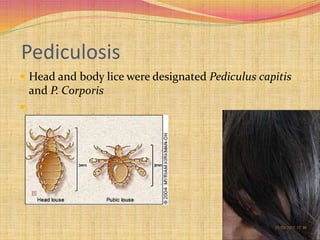
Pediculosis
 Head and body lice were designated Pediculus capitis
and P. Corporis

Prevention of insect bites
 Achievable by protective clothing, insecticide sprays,
residential insecticides, repellents
 Major classes of insecticides used to control mosquitoes are
pyrethroid, organophosphate, carbamate and dichloro-
diphenyl-trichloroethane (DDT).
 Repellents are substances applied to skin preventing
insects from biting.
 Most efficient repellents are diethyl-m-toluamide (DEET)
and dimethylphthalate (DMP), others being N, N-
diethylphenylacetamide (DEPA)
 Neem oil has been found to have larvicidal activity in field
conditions,and has been shown to possess weak mosquito
repellent activity
 Although the toxicity of topical repellent used sub-
chronically and chronically is not well studied in
paediatric age groups, current French
recommendations are as follows: once daily use of
topical repellent in infants above 6 months, 2
applications daily from ages 1 to 12 years, and 3
applications daily after 12 years
 Minimum effective concentration of each of these
agents for 3 hours efficacy against most arthropods is
20%.
 Synthetic pyrethroids are now commonly used as they
cause less ecological problems and are available as sprays,
vaporizing mats, mosquito coils or in combination with
physical means such as bed-nets
 Long-term exposure to mosquito coil smoke (MCS) might
induce asthma and persistent wheeze in children
 Mosquito coils containing pyrethroid insecticides,
particularly d-allethrin, may contain octachlorodipropyl
ether (S-2, S-421). Their use likely exposes individuals to an
extremely potent lung carcinogen bis(chloromethyl)ether
(BCME) formed from combustion of coils
 Case control studies have linked exposure to MCS to lung
cancer and nasopharyngeal carcinoma
Take home message
 It may be prudent to instead use physical means such
as bed-nets and window-nets for prevention of insect
bites
Insect bite reactions

Insect bite reactions

  • 1.
    Dr. Yogesh Kalyanpad Basedon article IJDVL FEB 2013
  • 2.
    ABSTRACT  Insect bitereactions are commonly seen in clinical practice  Different variables influencing the susceptibility of an individual to insect bites  The review also presents a brief account of insects as vectors of diseases and ends with discussion of prevention of insect bites and some serious adverse effects of mosquito coil smoke
  • 3.
    INTRODUCTION  Insects area class of arthropods  Latin insectum, meaning "cut into sections”  A chitinous exoskeleton, three-part body i.e. Three pairs of jointed legs, compound eyes, and two antennae  All insects do not bite  Some non-biting insects are beetles, locusts, moths, and butterflies, although these may produce skin reactions by other means such as allergic reactions to their body parts, faeces, or body fluids  Bees, wasps, and ants also do not bite, but produce dermatological reactions by their stings.
  • 5.
    Epidemiology in India Insect bite reactions are common, but information about their prevalence is limited  Children <14 years of age in dermatology outpatient clinic in Pondicherry had a prevalence of 5.3%  Children <5 years of age attending skin outpatient clinic in Calcutta had 10.6% prevalence of papular urticaria with seasonal variation  (rainy season 16.7%, summer 6.7%, winter 5.8%)
  • 7.
  • 8.
    Mosquito Bites  Mosquitoesbelong to order Diptera, suborder Nematocera, and family Culicidae  Bite reactions due to insects of order Diptera are mostly due to allergens in saliva of insect and not due to toxin  Saliva of mosquitoes contains pharmacologically active compounds inhibiting body's innate immune responses  Causing anticoagulation, impaired platelet formation, vasodilation and anti-inflammatory activities
  • 9.
     Salivary glandsurface proteins are major immunogenic components  Species-specific and species-shared allergens of mosquitoes have been identified  Which should facilitate production of specific recombinant allergens and improvement in diagnosis and specific immunotherapy  Human sweat contains odorous organic compounds, produced by skin microflora, determining its attractiveness to mosquitoes  Higher probability of mosquito bites is associated with increasing age in children, male gender, large body size, pregnancy, and alcohol ingestion
  • 10.
    Mellanby has described5 stages of reaction to repeated mosquito bites
  • 11.
    Anaphylactic reaction  SevereIgE-mediated anaphylactic reactions rarely occurs  Characterized by rapid onset of skin lesions which may be associated with respiratory compromise and may result in death.  It is highly recommended that individuals at risk of anaphylaxis carry an epinephrine auto-injector whenever they are likely to encounter mosquitoes
  • 12.
    Hypersensitivity to MosquitoBite in Epstein-Barr Virus Natural Killer (HMB-EBV-NK) Disease  This disease is mainly reported from Japan, Korea, and China.  Persons infected with EBV may develop a severe reaction to mosquito bites.  In 1990, Tokura et al described a patient with HMB with 50% to 60% of peripheral blood mononuclear cells being NK cells  EBV infection immortalizes NK cells, which are activated by injection of some mosquito constituents, thereby exhibiting HMB as primary clinical manifestation
  • 13.
     Typical clinicalcourse includes three stages 1. Initial exaggerated reaction to mosquito bites 2. Deterioration of general systemic symptoms particularly in elderly 3. The hemophagocytic syndrome (or malignant histiocytosis) with major life-threatening complications at the terminal stages
  • 14.
    Eruptive Pseudoangiomatosis  Millet-sizederythema or small shiny red papules of angioma-like appearance with an anaemic halo occur on exposed parts resolving within a few days  Possibly due to mosquito bites, as lesions have been elicited by Culex pipiens bites Skeeter Syndrome-  It’s a mosquito saliva-induced large local inflammatory reaction clinically resembling cellulites.  Lesions are red, itchy, warm swellings appearing within minutes of bite  Itchy papules, ecchymotic, vesiculated, and bullous reactions appearing 2 to 6 hours afterwards and persisting for days or weeks with or without fever.  Severe reactions are treated with systemic prednisone
  • 15.
    Papular Pruritic Eruptionof HIV/AIDS  Characterized by symmetrically distributed pruritic 2 to 5 mm papules on extremities and trunk sparing palms, soles, and digital web-spaces,usually in advanced HIV disease  Condition which tends to wax and wane and is resistant to oral antihistamine and topical corticosteroid therapy, responds to HAART.
  • 16.
    Black Flies  Smallblood crust with surrounding ecchymosis appears at bite site.  Within a few hours, small, pruritic papules develop lasting several days.  Severe reactions with marked oedema of limbs and constitutional upset occasionally occur and sometimes nodules and eczematous areas persist for several months
  • 17.
    Blandford Flies  Bitesproduce skin swellings and sometimes fever or joint pain.
  • 18.
    Horse Flies  Bitesproduce painful lesions and rarely anaphylactic reaction with generalized itching, urticaria, paresthesia, and unconsciousness.
  • 19.
    Louse Flies  Deerked (Lipoptena cervi L.), a haematophagous louse fly of deer, causes pruritic papules, usually in forests.  Lesions appear mostly on head and back, are resistant to treatment and persist for weeks to months.  Direct immunofluorescence may show deposits of C3 in dermal vessel walls. IgE, complement and cell-mediated mechanisms are involved
  • 20.
    Tsetse Fly  Tsetseincludes all species in genus Glossina  Confined to Africa, tsetse flies are vectors of trypanosomiasis.  An allergen found in stinging insects (TAg5) was detected in tsetse fly saliva.
  • 21.
    Midges  Biting midgesprefer certain human hosts determined by body odour  Bite taller people first(they are abundant at heights of 1 to 4 meters above ground)  Bites may manifest as IgE-mediated urticaria or as presumably delayed-type reactions with papules, ulcers, or bullae persisting for weeks  IFN-γ, IL-6 and TNF-α are involved in delayed reactions
  • 23.
    Tics  Common tick-bornediseases include:  Lyme disease.  Rocky Mountain spotted fever.  Tularemia.  Ehrlichiosis.  Relapsing fever.  Colorado tick fever.  Babesiosis.
  • 26.
    How to remove Use fine-tipped tweezers to grasp the tick as close to the skin's surface as possible.  Pull upward with steady, even pressure. Don't twist or jerk the tick; this can cause the mouth-parts to break off and remain in the skin. If this happens, remove the mouth-parts with tweezers. If you are unable to remove the mouth easily with clean tweezers, leave it alone and let the skin heal.  After removing the tick, thoroughly clean the bite area and your hands with rubbing alcohol, an iodine scrub, or soap and water.
  • 27.
    BUGS  Bugs areinsects of the order Hemiptera with a common arrangement of sucking mouth parts  Adult bedbugs are about 5 mm long and may be confused with booklice, carpet beetles, and small cockroaches  Bedbugs may survive up to a year without feeding  Bedbug bites are known as cimicosis  On first exposure most individuals do not develop lesions.  With further bites, most develop an obvious skin reaction and latency for previously reacting persons decreases substantially
  • 29.
     Three salivaryproteins of bedbugs, a nitric oxide-liberating heme protein (nitrophorin), a 17-kDa anticoagulant (Factor X),and a 40-kDa apyrase-like nucleotide-binding enzyme, may be important immunologically.  Infestation is facilitated by poor sanitation, overcrowding of residences and trade in second-hand furniture  Avoid light and feed at night  Lesions are pruritic, usually painless, erythematous macules, papules, nodules, urticarial wheals, and blisters.
  • 30.
     Bites mayproduce anxiety, insomnia or delusions in a cured patient  Heavy infestation may cause significant blood loss and anemia in children  Rare systemic reactions include generalized urticaria, asthma, and anaphylaxis
  • 31.
    Mexican chicken bugs Bites of Mexican chicken bugs Haematosiphon inodorus (haematosiphoniasis) produce polymorphic lesions (wheals, papules, vesicles, pustules, and scabs)
  • 32.
    Assassin bugs  Assassinbug bites are defensive and extremely painful.
  • 33.
    Kissing bugs  Bitesof kissing bugs (Triatoma sanguisuga) are painless, allowing them to feed undisturbed  Initial bites produce little reaction, with repeated exposure reactions ranging from pruritic papules with central punctum to haemorrhagic nodules and bullae may occur  Patients have multiple clustered bites, especially on face, hence the name kissing bugs  Often insects defecate while feeding, and parasite-laden faeces from infected bugs are source of Trypanosoma cruzi inocula, the causative organism of Chagas' disease
  • 34.
  • 35.
    Fleas  Fleas arewingless haematophagous ectoparasites of birds and mammals, such as bats and humans  Animal fleas bite humans coming in contact with infested animals.  Flea bites produce maculopapular or papular rashes and severe pruritus (pulicosis)  Treatment consists of eradication of flea infestation in the source animal.
  • 36.
    Pediculosis  Head andbody lice were designated Pediculus capitis and P. Corporis 
  • 37.
    Prevention of insectbites  Achievable by protective clothing, insecticide sprays, residential insecticides, repellents  Major classes of insecticides used to control mosquitoes are pyrethroid, organophosphate, carbamate and dichloro- diphenyl-trichloroethane (DDT).  Repellents are substances applied to skin preventing insects from biting.  Most efficient repellents are diethyl-m-toluamide (DEET) and dimethylphthalate (DMP), others being N, N- diethylphenylacetamide (DEPA)  Neem oil has been found to have larvicidal activity in field conditions,and has been shown to possess weak mosquito repellent activity
  • 38.
     Although thetoxicity of topical repellent used sub- chronically and chronically is not well studied in paediatric age groups, current French recommendations are as follows: once daily use of topical repellent in infants above 6 months, 2 applications daily from ages 1 to 12 years, and 3 applications daily after 12 years  Minimum effective concentration of each of these agents for 3 hours efficacy against most arthropods is 20%.
  • 39.
     Synthetic pyrethroidsare now commonly used as they cause less ecological problems and are available as sprays, vaporizing mats, mosquito coils or in combination with physical means such as bed-nets  Long-term exposure to mosquito coil smoke (MCS) might induce asthma and persistent wheeze in children  Mosquito coils containing pyrethroid insecticides, particularly d-allethrin, may contain octachlorodipropyl ether (S-2, S-421). Their use likely exposes individuals to an extremely potent lung carcinogen bis(chloromethyl)ether (BCME) formed from combustion of coils  Case control studies have linked exposure to MCS to lung cancer and nasopharyngeal carcinoma
  • 40.
    Take home message It may be prudent to instead use physical means such as bed-nets and window-nets for prevention of insect bites