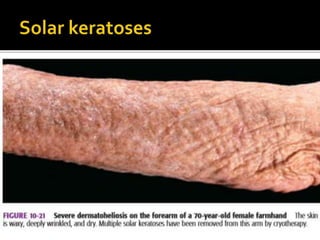
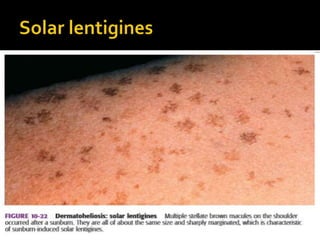
 An abnormal response to light, occurring
within minutes, hours, or days of exposure
and lasting up to weeks, months
Cutaneous photosensitivity reactions require
absorption of photon energy by appropriately
shaped molecules leading to molecular
deformity. Energy is either dispersed
harmlessly or is directed to chemical reactions
that lead to molecular, cellular, and tissue
damage resulting in clinical disease
 Sunburn-type response
Erythema,Edema,Bullae
phototoxic reactions to drugs or
phytophotodermatoses
 Urticarial response
Solar urticaria,porphyrias
 Rash response
Macules ,Papules,Plaques
photoallergic 0r idiopathic photodermatoses
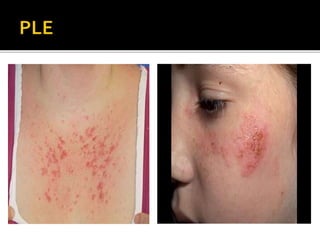
(PLE)
 Chronic &repeated sun exposures over time
result in polymorphic skin changes called as
dermatohiliosis/photoaging
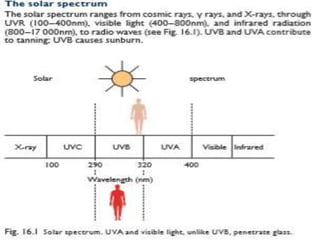
 Dermatoses which are caused by an
abnormal reaction of skin to sunlight, usually
to its UV component.
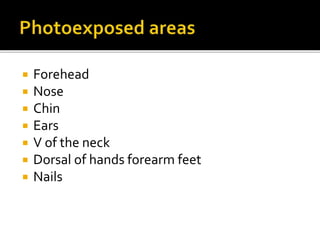
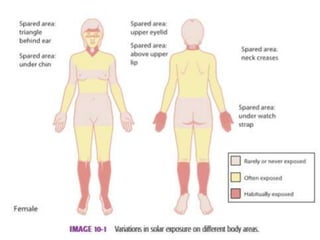
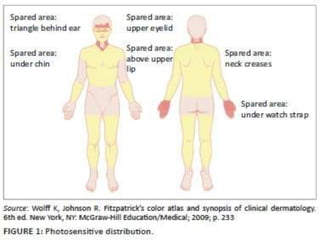
 Forehead
 Nose
 Chin
 Ears
 V of the neck
 Dorsal of hands forearm feet
 Nails
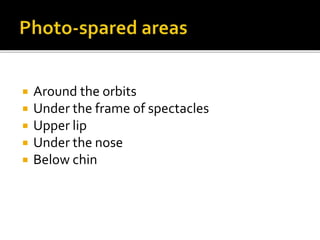
 Around the orbits
 Under the frame of spectacles
 Upper lip
 Under the nose
 Below chin
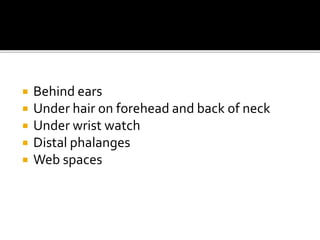
 Behind ears
 Under hair on forehead and back of neck
 Under wrist watch
 Distal phalanges
 Web spaces
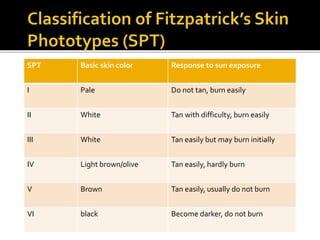
SPT Basic skin color Response to sun exposure
I Pale Do not tan, burn easily
II White Tan with difficulty, burn easily
III White Tan easily but may burn initially
IV Light brown/olive Tan easily, hardly burn
V Brown Tan easily, usually do not burn
VI black Become darker, do not burn
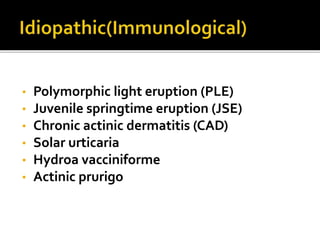
• Polymorphic light eruption (PLE)
• Juvenile springtime eruption (JSE)
• Chronic actinic dermatitis (CAD)
• Solar urticaria
• Hydroa vacciniforme
• Actinic prurigo
 Xeroderma pigmentosum
 Cockayne syndrome
 Trichothiodystrophy
 Metabolic (pellagra)
 Drugs or chemical –induced photosensitivity:
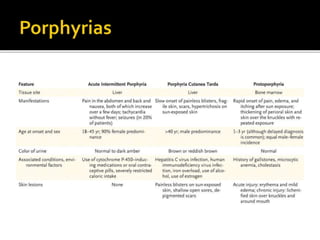
Endogenous porphyrias
Exogenous systemic/topical
drugs/chemicals
 Photo-aggravated skin disease
(L.E,LP,SLE,Psoriasis,immunobullous
disorders)
 Chronic photo-damage
• Dermatoheliosis (photoaging)
• Solar lentigo
• Actinic keratoses
• Skin cancer
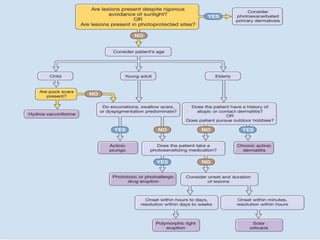
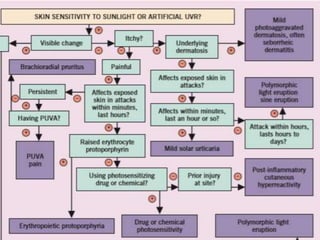
 History
 Examination
 Relevant investigations
 Management
 Light
• Type (artificial light or UVR)
• Intensity
• Duration of exposure to UVR
 Duration of onset & persistence
 Age of onset
 Exposure to photosensitizers
 Genetic predisposition (Birth history )
 Symptoms (itch,pain,burning)
 Type of Primary lesion :
Redness
Swelling
Papules
Vesicles
Blisters or Pigmentation
 Seasonal variation (What time of year does
the problem present— is there any seasonal
variation?
 What sort of exposure is required to trigger
the problem?(direct or through window glass)
 Any post-inflammatory hypo/hyper
pigmentation or scarring
 Visceral or neurological symptoms
 Connective tissue disease
 Any evidence of ‘hardening’
 Are antihistamines, sunscreen creams, or
clothing protective?
 History of eczema
 Hx of contact allergy
 Hx of drugs/chemical
 Family history
 Hobbies
 Distribution of lesion
 Morphology of lesion
 Crusting
 Scaring
 Hypo/hyper pigmentation
 Chronic sun-damage
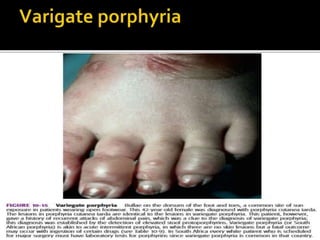
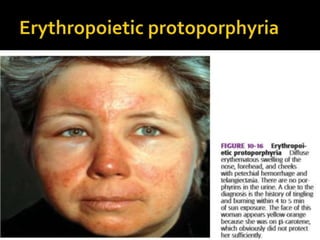
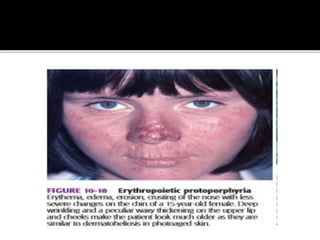
 Urticarial EPP and solar urticaria
 Papules PLE and Chronic actinic
dermatitis
 Vesicles PCT and PLE
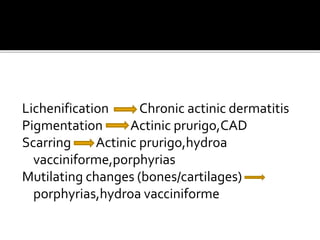
Lichenification Chronic actinic dermatitis
Pigmentation Actinic prurigo,CAD
Scarring Actinic prurigo,hydroa
vacciniforme,porphyrias
Mutilating changes (bones/cartilages)
porphyrias,hydroa vacciniforme
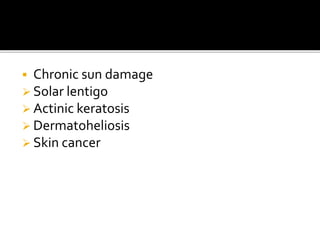
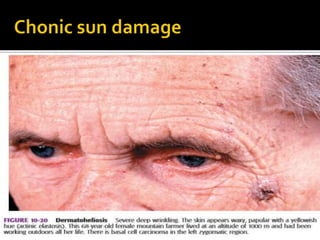
 Chronic sun damage
 Solar lentigo
 Actinic keratosis
 Dermatoheliosis
 Skin cancer
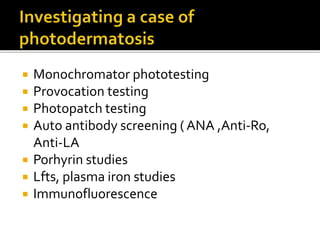
 Monochromator phototesting
 Provocation testing
 Photopatch testing
 Auto antibody screening ( ANA ,Anti-Ro,
Anti-LA
 Porhyrin studies
 Lfts, plasma iron studies
 Immunofluorescence
 Wood’s lamp
 Spectrofluorimetry
 Liver biopsy
 HLA class 2 typing ( HLA DR4 actinic
prurigo)
 Biopsy & histopathology
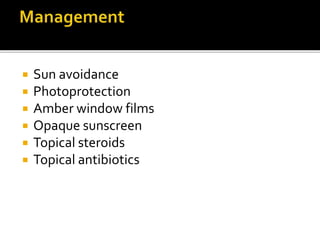
 Sun avoidance
 Photoprotection
 Amber window films
 Opaque sunscreen
 Topical steroids
 Topical antibiotics
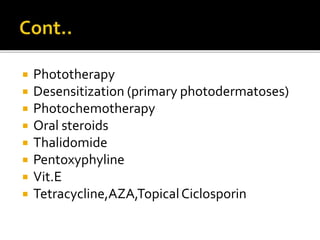
 Phototherapy
 Desensitization (primary photodermatoses)
 Photochemotherapy
 Oral steroids
 Thalidomide
 Pentoxyphyline
 Vit.E
 Tetracycline,AZA,TopicalCiclosporin
 Plasmapheresis
 Hyper-transfusion ( CEP)
 Splenectomy
 Yellow filters in O.T
 Allogenic bone marrow transplantation
 Beta carotene(porphyrias,
 Low dose anti-malarials(porphyrias,
 Genetic counseling
(Porphyrias,genodermatoses)
 Recurrent delayed onset abnormal reaction
to sunlight that resolves without scaring
 Commonest
 Young female
 Associated with L.E, Actinic prurigo,
photosensitive psoriasis
 Delayed type photosensitivity
 Spring or early summers
 Onset is usually 6hours - 2 days
 Mixed papular ,vesiculobullous lesions.
 Epidermal edema & spongiosis
 Vesicle formation
 Mild liquefaction degeneration of basal
layer,dense lymphocytic infiltrate in
dermis,edema of papillary dermis and
endothelilal swelling.
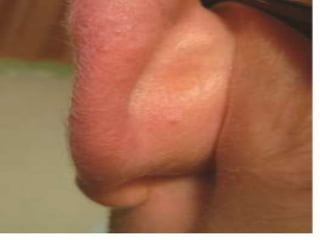
 Blistering eruption affecting the upper
pinnae
 Blisters or papules
 Boys & men
 Occurs after a few days of sun exposure
Dermal ,perivascular mononuclear cell
infiltrate
Later : Epidermal ulceration & acanthosis
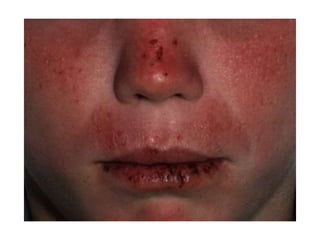
 Itchy, pink papules or small nodules and
plaques, and sometimes vesicles, which
usually become rapidly excoriated, crusted
and scabbed.
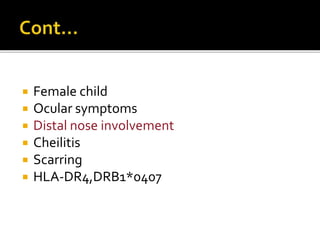
 Female child
 Ocular symptoms
 Distal nose involvement
 Cheilitis
 Scarring
 HLA-DR4,DRB1*0407
 Dermal ,perivascular mononuclear cell
infiltrate
Later : Epidermal ulceration &
acanthosis,fibrosis
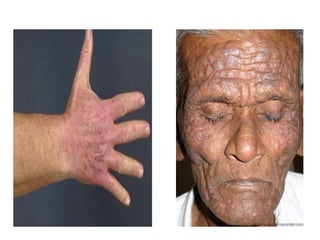
 Erythematous, exudative, vesicular
dermatitis on photo‐exposed sites; chronicity
lichenification, pseudo‐lymphomatous
infiltrative plaques.
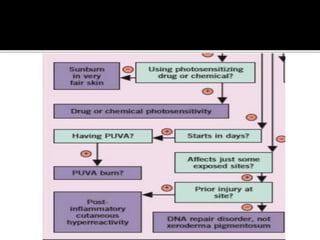
 Alopecia.
 Ectropion
 Hyper / hypo-pigmentation
 Nodular prurigo like (Skin type IV toVI )
 males > females
 Summers & springs
 Early : epidermal spongiosis,acanthosis,upper
dermal perivacsular lymphohistiocytic
infiltrate
 Later: epidermal hyperplasia, perivascular
histiocytes,granulommatous changes
 Type 1 hypersensitivity
 3rd or 4th decade of life
 Females
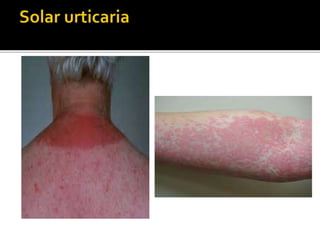
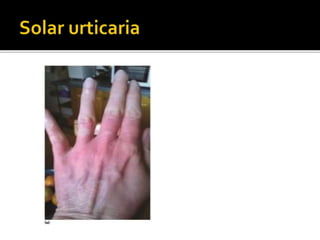
 Urticarial lesions
 Within minutes of exposure to UVR
 Resolves within 2 hrs
 Erythema persists for 24 hrs
 If lager areas are exposed then systemic
symptoms
(headache,nausea,dizziness,photophobia,wh
eeze)
 Solar angio-oedema
 2 types
 Idiopathic
 Secondary to drugs/chemicals
 Anxiety
 Depression
 Concomitant PLE
 CAD
 Actinic prurigo
 Churg strauss syndrome
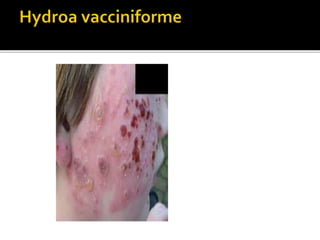
 Cheeks nose ears dorsum of hands
 Veiscles,haemorrhagic crusting
 Varoliform scaring
 Subungual haemorrhage
 Cartilage destruction
 Contractures of digits
 Females
 1-7,12-16 yrs
 Photobhobia
 Keratitis
 Conjuctivitis
 Anterior uveitis
 Corneal clouding
 Neovascularization
 Scarring
 Visual impairment
 UVA
 EBV
 Reticulate keratinocytes
degeneration,spongiosis,perivascular
inflammatory cells
 Ulceration,epidermal necrosis
 Papillary edema, upper dermal necrosis
 Scarring
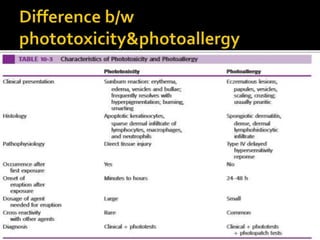
 Immediate sun-burn,erythema,urticaria.
 Delayed erythema,blisteing.
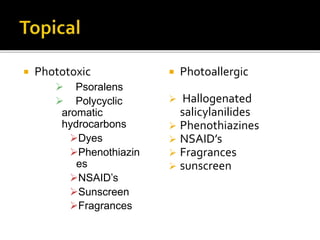
 Phototoxic
 Psoralens
 Polycyclic
aromatic
hydrocarbons
Dyes
Phenothiazin
es
NSAID’s
Sunscreen
Fragrances
 Photoallergic
 Hallogenated
salicylanilides
 Phenothiazines
 NSAID’s
 Fragrances
 sunscreen
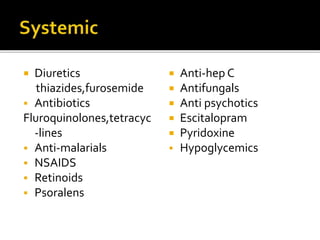
 Diuretics
thiazides,furosemide
 Antibiotics
Fluroquinolones,tetracyc
-lines
 Anti-malarials
 NSAIDS
 Retinoids
 Psoralens
 Anti-hep C
 Antifungals
 Anti psychotics
 Escitalopram
 Pyridoxine
 Hypoglycemics
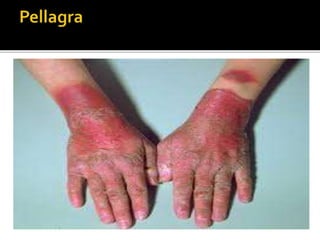
 Vit.B 3 deficiency
 Sharply marginated ,hyperpigmented &
keratotic plaques
 Dorsal hands
 Facial involvement in butterfly distribution
 Casal necklace
 Angular stomatitis,cheilitis,glossitis
 Oral and perirectal ulcers
 Reduced niacin urinary metabolites
 N-methylnicotinamide & 2-pyridone
 Fetal prognosis
 Neurological decompensation
 RDA for niacin is 14-16mg/day
 Oral replacement therapy 100mg/day
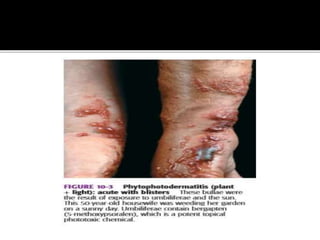
Lime, lemon, wild parsley, celery, giant
hogweed, parsnips, carrot greens, figs s walk
 Beaches containing meadow grass and
children playing in grassy meadows develop
PPD on the legs; meadow grass contains
Agrimony
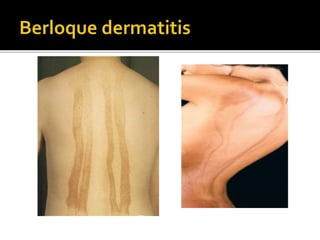
 Perfumes containing oil of bergamot (which
contains bergapten, 5-methoxypsoralen) may
develop streaks of pigmentation only in areas
where the perfume was applied
 Especially the sides of the neck
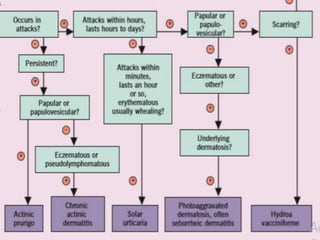
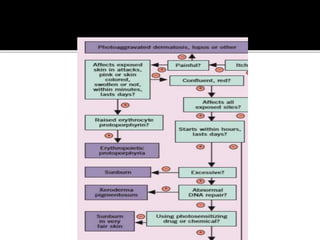
Approach to photodermatoses

Approach to photodermatoses

  • 3.
     An abnormalresponse to light, occurring within minutes, hours, or days of exposure and lasting up to weeks, months
  • 4.
    Cutaneous photosensitivity reactionsrequire absorption of photon energy by appropriately shaped molecules leading to molecular deformity. Energy is either dispersed harmlessly or is directed to chemical reactions that lead to molecular, cellular, and tissue damage resulting in clinical disease
  • 5.
     Sunburn-type response Erythema,Edema,Bullae phototoxicreactions to drugs or phytophotodermatoses  Urticarial response Solar urticaria,porphyrias
  • 6.
     Rash response Macules,Papules,Plaques photoallergic 0r idiopathic photodermatoses (PLE)
  • 7.
     Chronic &repeatedsun exposures over time result in polymorphic skin changes called as dermatohiliosis/photoaging
  • 8.
     Dermatoses whichare caused by an abnormal reaction of skin to sunlight, usually to its UV component.
  • 10.
     Forehead  Nose Chin  Ears  V of the neck  Dorsal of hands forearm feet  Nails
  • 11.
     Around theorbits  Under the frame of spectacles  Upper lip  Under the nose  Below chin
  • 12.
     Behind ears Under hair on forehead and back of neck  Under wrist watch  Distal phalanges  Web spaces
  • 15.
    SPT Basic skincolor Response to sun exposure I Pale Do not tan, burn easily II White Tan with difficulty, burn easily III White Tan easily but may burn initially IV Light brown/olive Tan easily, hardly burn V Brown Tan easily, usually do not burn VI black Become darker, do not burn
  • 16.
    • Polymorphic lighteruption (PLE) • Juvenile springtime eruption (JSE) • Chronic actinic dermatitis (CAD) • Solar urticaria • Hydroa vacciniforme • Actinic prurigo
  • 17.
     Xeroderma pigmentosum Cockayne syndrome  Trichothiodystrophy
  • 18.
     Metabolic (pellagra) Drugs or chemical –induced photosensitivity: Endogenous porphyrias Exogenous systemic/topical drugs/chemicals
  • 19.
     Photo-aggravated skindisease (L.E,LP,SLE,Psoriasis,immunobullous disorders)  Chronic photo-damage • Dermatoheliosis (photoaging) • Solar lentigo • Actinic keratoses • Skin cancer
  • 20.
     History  Examination Relevant investigations  Management
  • 21.
     Light • Type(artificial light or UVR) • Intensity • Duration of exposure to UVR  Duration of onset & persistence
  • 22.
     Age ofonset  Exposure to photosensitizers  Genetic predisposition (Birth history )  Symptoms (itch,pain,burning)
  • 23.
     Type ofPrimary lesion : Redness Swelling Papules Vesicles Blisters or Pigmentation
  • 24.
     Seasonal variation(What time of year does the problem present— is there any seasonal variation?  What sort of exposure is required to trigger the problem?(direct or through window glass)
  • 25.
     Any post-inflammatoryhypo/hyper pigmentation or scarring  Visceral or neurological symptoms  Connective tissue disease
  • 26.
     Any evidenceof ‘hardening’  Are antihistamines, sunscreen creams, or clothing protective?  History of eczema  Hx of contact allergy
  • 27.
     Hx ofdrugs/chemical  Family history  Hobbies
  • 28.
     Distribution oflesion  Morphology of lesion  Crusting  Scaring  Hypo/hyper pigmentation  Chronic sun-damage
  • 29.
     Urticarial EPPand solar urticaria  Papules PLE and Chronic actinic dermatitis  Vesicles PCT and PLE
  • 30.
    Lichenification Chronic actinicdermatitis Pigmentation Actinic prurigo,CAD Scarring Actinic prurigo,hydroa vacciniforme,porphyrias Mutilating changes (bones/cartilages) porphyrias,hydroa vacciniforme
  • 31.
     Chronic sundamage  Solar lentigo  Actinic keratosis  Dermatoheliosis  Skin cancer
  • 37.
     Monochromator phototesting Provocation testing  Photopatch testing  Auto antibody screening ( ANA ,Anti-Ro, Anti-LA  Porhyrin studies  Lfts, plasma iron studies  Immunofluorescence
  • 38.
     Wood’s lamp Spectrofluorimetry  Liver biopsy  HLA class 2 typing ( HLA DR4 actinic prurigo)  Biopsy & histopathology
  • 39.
     Sun avoidance Photoprotection  Amber window films  Opaque sunscreen  Topical steroids  Topical antibiotics
  • 40.
     Phototherapy  Desensitization(primary photodermatoses)  Photochemotherapy  Oral steroids  Thalidomide  Pentoxyphyline  Vit.E  Tetracycline,AZA,TopicalCiclosporin
  • 41.
     Plasmapheresis  Hyper-transfusion( CEP)  Splenectomy  Yellow filters in O.T  Allogenic bone marrow transplantation
  • 42.
     Beta carotene(porphyrias, Low dose anti-malarials(porphyrias,  Genetic counseling (Porphyrias,genodermatoses)
  • 43.
     Recurrent delayedonset abnormal reaction to sunlight that resolves without scaring  Commonest  Young female  Associated with L.E, Actinic prurigo, photosensitive psoriasis  Delayed type photosensitivity
  • 44.
     Spring orearly summers  Onset is usually 6hours - 2 days  Mixed papular ,vesiculobullous lesions.
  • 46.
     Epidermal edema& spongiosis  Vesicle formation  Mild liquefaction degeneration of basal layer,dense lymphocytic infiltrate in dermis,edema of papillary dermis and endothelilal swelling.
  • 47.
     Blistering eruptionaffecting the upper pinnae  Blisters or papules  Boys & men  Occurs after a few days of sun exposure
  • 48.
    Dermal ,perivascular mononuclearcell infiltrate Later : Epidermal ulceration & acanthosis
  • 50.
     Itchy, pinkpapules or small nodules and plaques, and sometimes vesicles, which usually become rapidly excoriated, crusted and scabbed.
  • 51.
     Female child Ocular symptoms  Distal nose involvement  Cheilitis  Scarring  HLA-DR4,DRB1*0407
  • 53.
     Dermal ,perivascularmononuclear cell infiltrate Later : Epidermal ulceration & acanthosis,fibrosis
  • 54.
     Erythematous, exudative,vesicular dermatitis on photo‐exposed sites; chronicity lichenification, pseudo‐lymphomatous infiltrative plaques.
  • 56.
     Alopecia.  Ectropion Hyper / hypo-pigmentation  Nodular prurigo like (Skin type IV toVI )  males > females  Summers & springs
  • 57.
     Early :epidermal spongiosis,acanthosis,upper dermal perivacsular lymphohistiocytic infiltrate  Later: epidermal hyperplasia, perivascular histiocytes,granulommatous changes
  • 58.
     Type 1hypersensitivity  3rd or 4th decade of life  Females  Urticarial lesions  Within minutes of exposure to UVR  Resolves within 2 hrs  Erythema persists for 24 hrs
  • 59.
     If lagerareas are exposed then systemic symptoms (headache,nausea,dizziness,photophobia,wh eeze)  Solar angio-oedema  2 types  Idiopathic  Secondary to drugs/chemicals
  • 62.
     Anxiety  Depression Concomitant PLE  CAD  Actinic prurigo  Churg strauss syndrome
  • 64.
     Cheeks noseears dorsum of hands  Veiscles,haemorrhagic crusting  Varoliform scaring  Subungual haemorrhage  Cartilage destruction  Contractures of digits  Females  1-7,12-16 yrs
  • 65.
     Photobhobia  Keratitis Conjuctivitis  Anterior uveitis  Corneal clouding  Neovascularization  Scarring  Visual impairment
  • 66.
     UVA  EBV Reticulate keratinocytes degeneration,spongiosis,perivascular inflammatory cells  Ulceration,epidermal necrosis  Papillary edema, upper dermal necrosis  Scarring
  • 69.
  • 70.
     Phototoxic  Psoralens Polycyclic aromatic hydrocarbons Dyes Phenothiazin es NSAID’s Sunscreen Fragrances  Photoallergic  Hallogenated salicylanilides  Phenothiazines  NSAID’s  Fragrances  sunscreen
  • 71.
     Diuretics thiazides,furosemide  Antibiotics Fluroquinolones,tetracyc -lines Anti-malarials  NSAIDS  Retinoids  Psoralens  Anti-hep C  Antifungals  Anti psychotics  Escitalopram  Pyridoxine  Hypoglycemics
  • 73.
     Vit.B 3deficiency  Sharply marginated ,hyperpigmented & keratotic plaques  Dorsal hands  Facial involvement in butterfly distribution  Casal necklace  Angular stomatitis,cheilitis,glossitis  Oral and perirectal ulcers
  • 74.
     Reduced niacinurinary metabolites  N-methylnicotinamide & 2-pyridone  Fetal prognosis  Neurological decompensation  RDA for niacin is 14-16mg/day  Oral replacement therapy 100mg/day
  • 84.
    Lime, lemon, wildparsley, celery, giant hogweed, parsnips, carrot greens, figs s walk  Beaches containing meadow grass and children playing in grassy meadows develop PPD on the legs; meadow grass contains Agrimony
  • 87.
     Perfumes containingoil of bergamot (which contains bergapten, 5-methoxypsoralen) may develop streaks of pigmentation only in areas where the perfume was applied  Especially the sides of the neck