Area Between
Curves
The Big Picture

=

-
“Proof”
Find the limit of the area of rectangles given by a
representative rectangle:
The area would be the limit of
the sum of the areas of infinite
representative rectangles with
infinitely small intervals (n → ∞):
n

lim ∑ [ f ( xi ) − g ( xi ) ] ∆x
n →∞

i −1

This is the integral:
b

∫ [ f ( x ) − g ( x ) ] dx
a
Steps, Hints, & Tricks
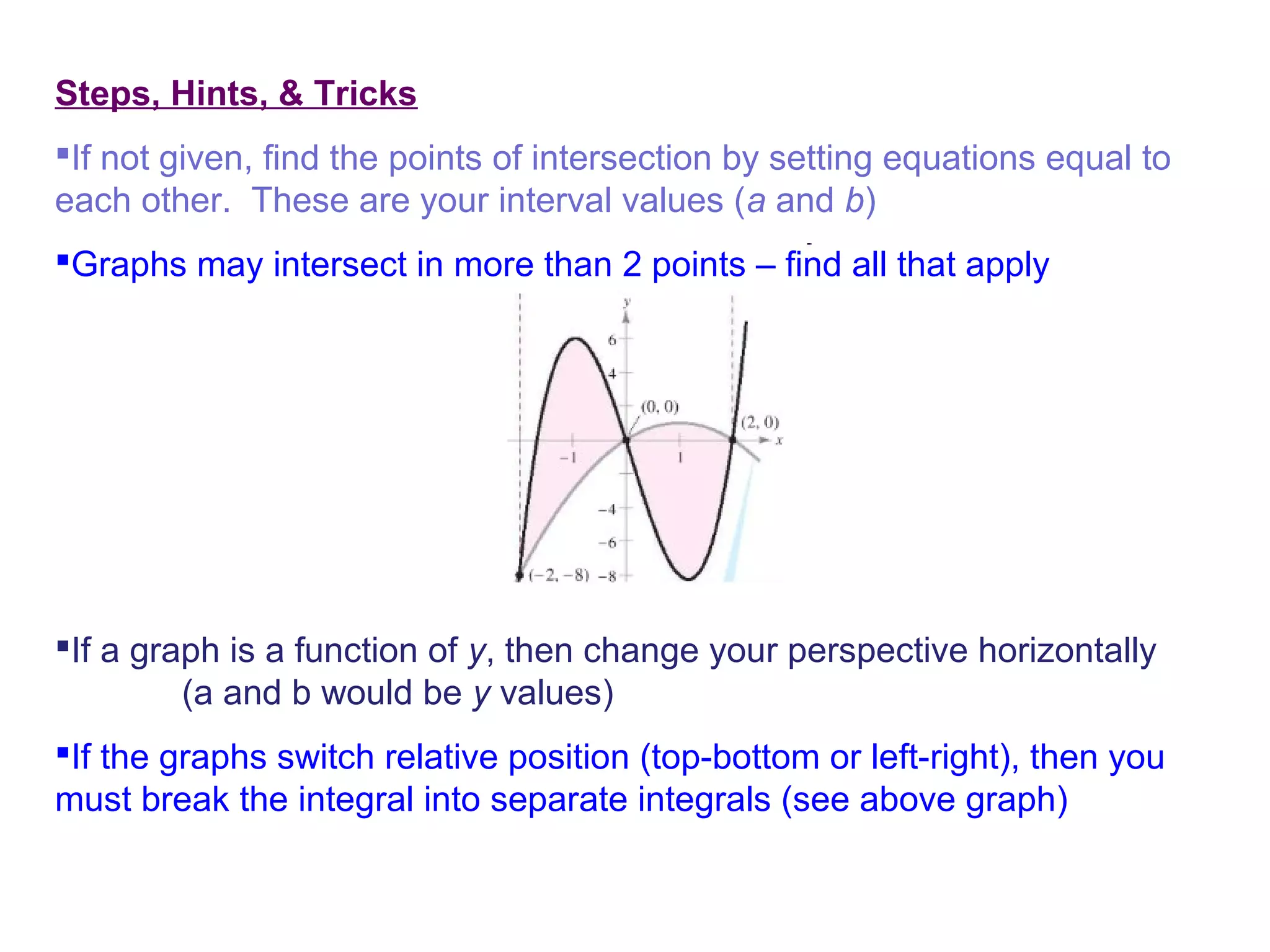
If not given, find the points of intersection by setting equations equal to
each other. These are your interval values (a and b)
Graphs may intersect in more than 2 points – find all that apply

If a graph is a function of y, then change your perspective horizontally
(a and b would be y values)
If the graphs switch relative position (top-bottom or left-right), then you
must break the integral into separate integrals (see above graph)
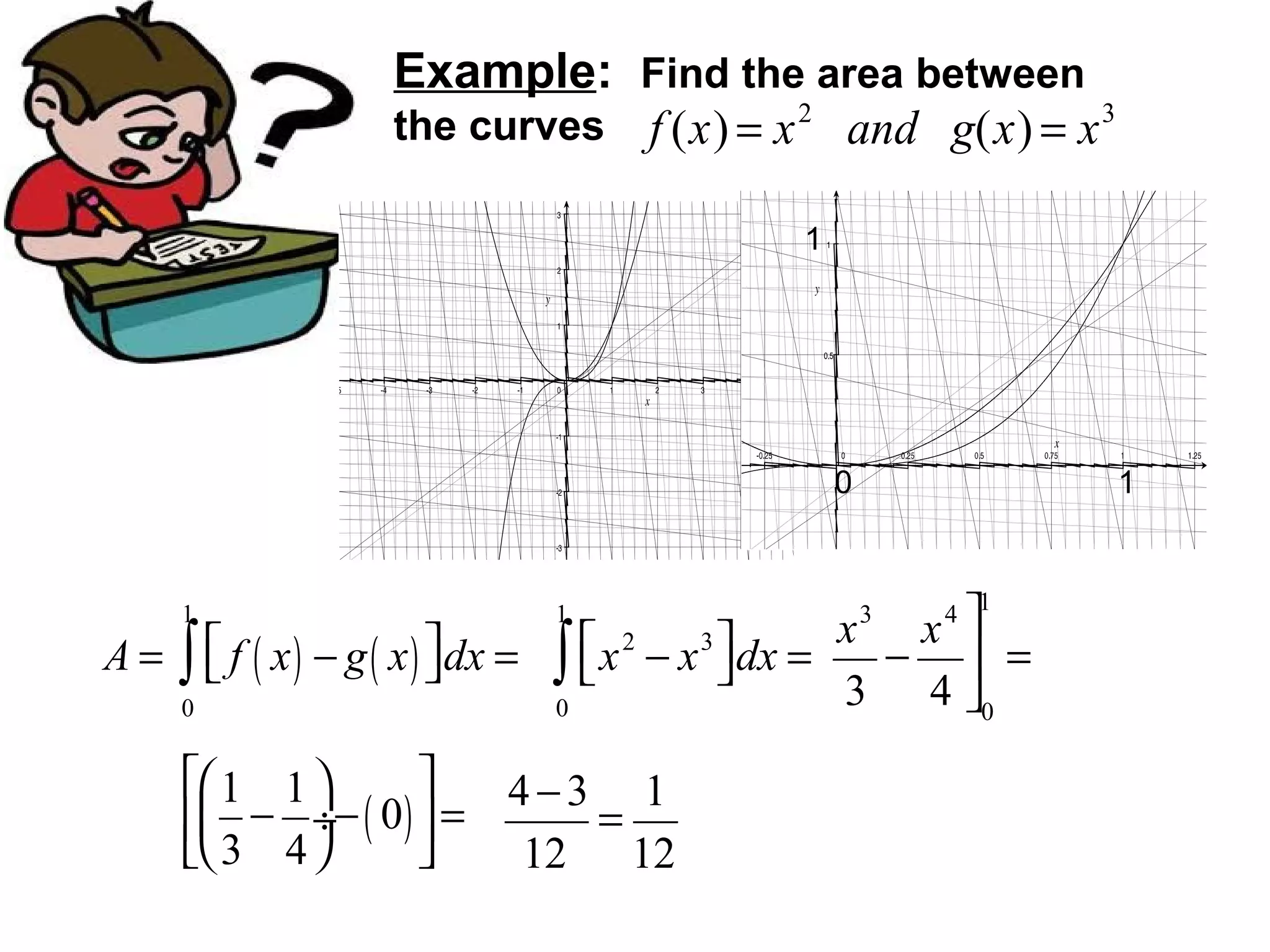
Example: Find the area between
the curves f (x) = x 2 and g(x) = x 3
1

0

1

4 1

x x 
−  =
A = ∫  f ( x ) − g ( x )  dx = ∫  x − x  dx =




3 4 0
0
0
1

1

2

 1 1 

4−3 1
− ÷− ( 0)  =
=

 3 4 

12 12

3

3
Example: Find the area between the curves y1 =

3

0

1

−1

x and y2 = x

0

A = ∫  x − 3 x  dx + ∫  3 x − x dx =




4 0
3

1



2
x 3x  3x
x 
−
 + 4 − 2 =
2
4
−1
0


2

4
3

  1 3   3 1 
= 0 −  − ÷ +  − − 0 =
  2 4   4 2 

−4 + 6 + 6 − 4 4 1
= =
8
8 2
Area Between Curves

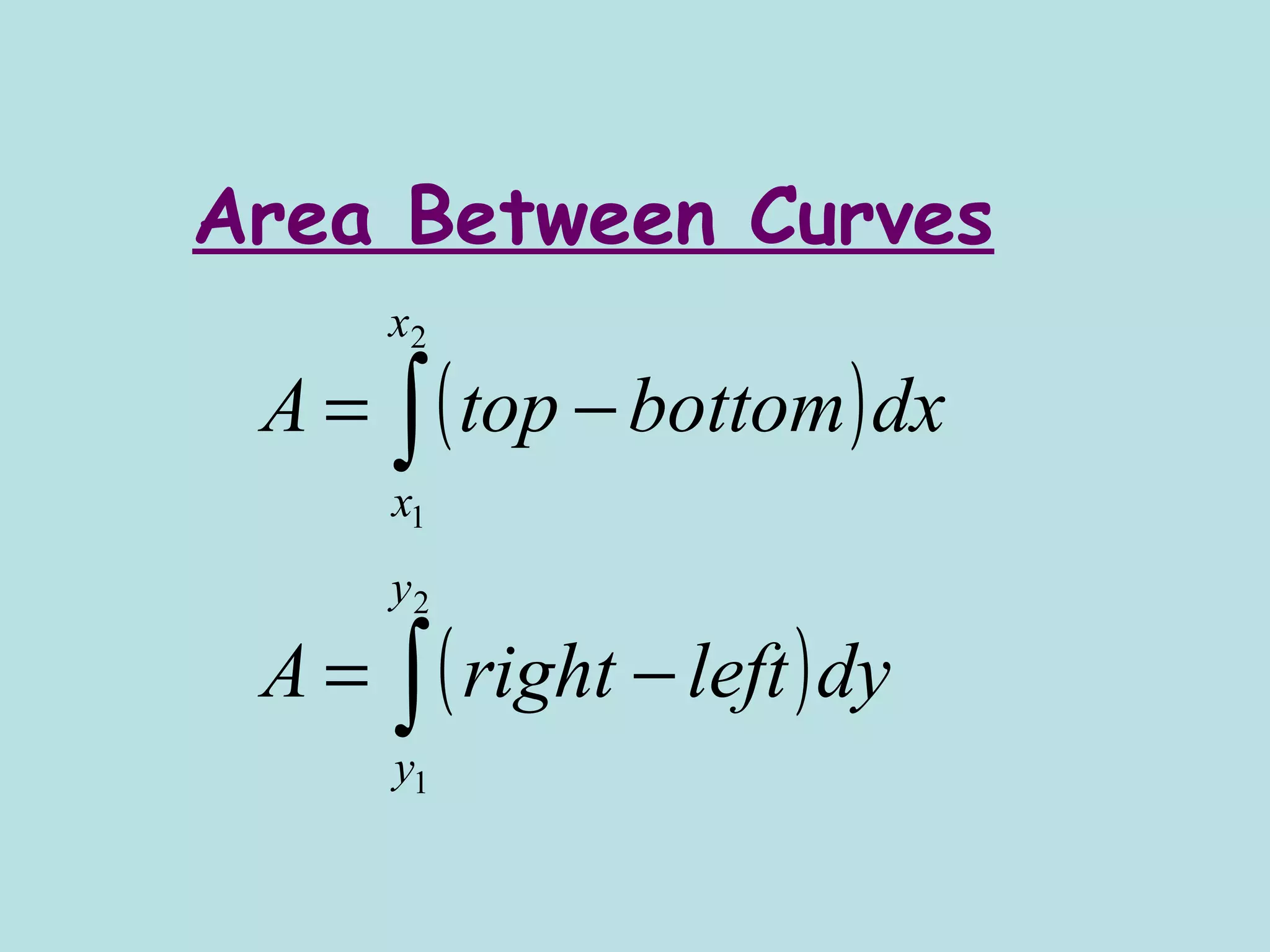
A=

x2

( top − bottom ) dx
∫

x1

A=

y2

( right − left ) dy
∫

y1
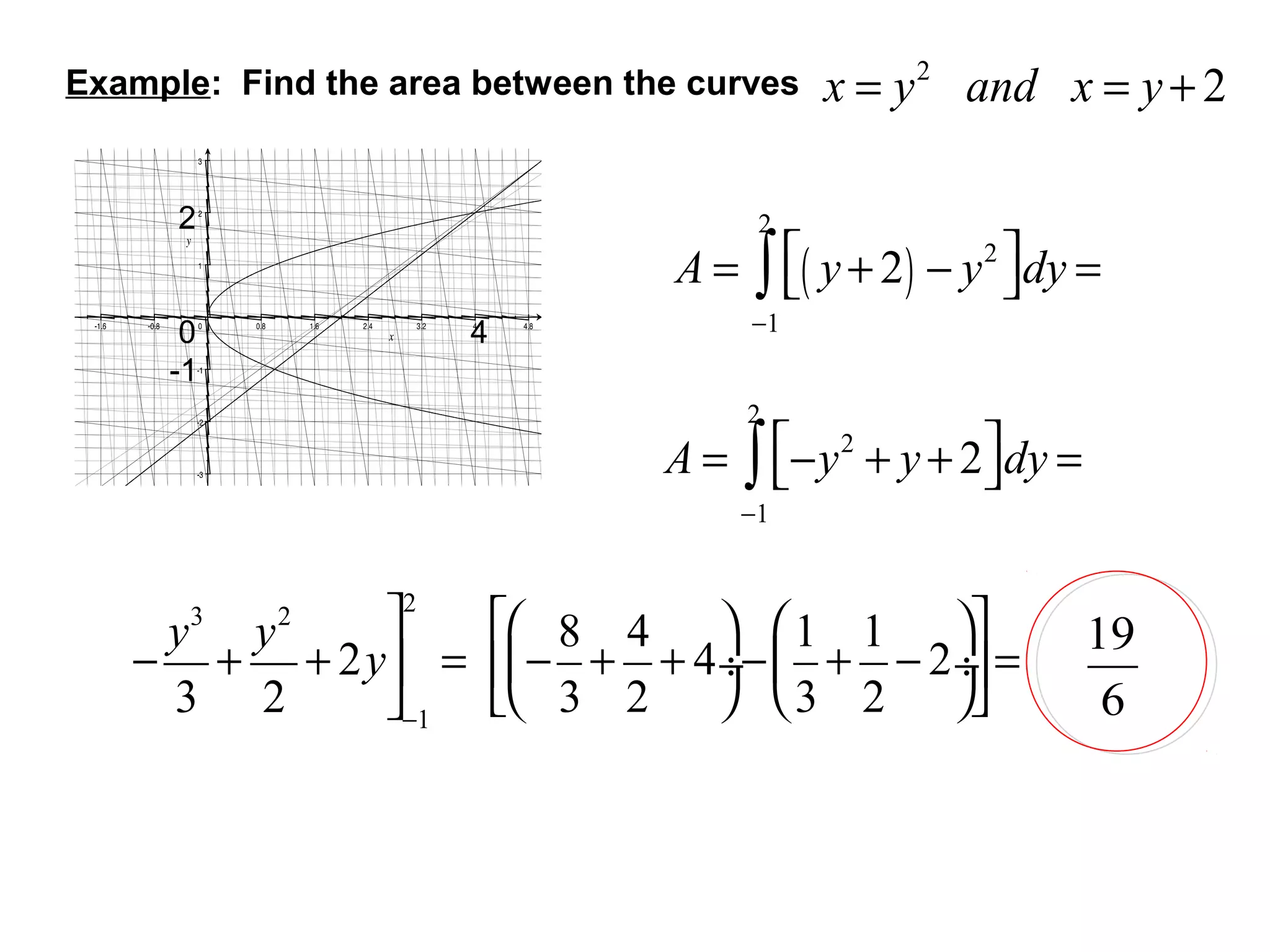
Example: Find the area between the curves

2

x = y 2 and x = y + 2

2

A = ∫ ( y + 2 ) − y 2  dy =



0
-1

4

−1

2

A = ∫ −y 2 + y + 2 dy =


−1

2


y y
− + + 2y =
3 2
−1
3

2

 8 4   1 1 
 − + + 4 ÷−  + − 2 ÷ =
 3 2   3 2 

19
6

7.1 area between curves

  • 1.
  • 2.
  • 3.
    “Proof” Find the limitof the area of rectangles given by a representative rectangle: The area would be the limit of the sum of the areas of infinite representative rectangles with infinitely small intervals (n → ∞): n lim ∑ [ f ( xi ) − g ( xi ) ] ∆x n →∞ i −1 This is the integral: b ∫ [ f ( x ) − g ( x ) ] dx a
  • 4.
    Steps, Hints, &Tricks If not given, find the points of intersection by setting equations equal to each other. These are your interval values (a and b) Graphs may intersect in more than 2 points – find all that apply If a graph is a function of y, then change your perspective horizontally (a and b would be y values) If the graphs switch relative position (top-bottom or left-right), then you must break the integral into separate integrals (see above graph)
  • 5.
    Example: Find thearea between the curves f (x) = x 2 and g(x) = x 3 1 0 1 4 1 x x  −  = A = ∫  f ( x ) − g ( x )  dx = ∫  x − x  dx =     3 4 0 0 0 1 1 2  1 1   4−3 1 − ÷− ( 0)  = =   3 4   12 12 3 3
  • 6.
    Example: Find thearea between the curves y1 = 3 0 1 −1 x and y2 = x 0 A = ∫  x − 3 x  dx + ∫  3 x − x dx =     4 0 3 1   2 x 3x  3x x  −  + 4 − 2 = 2 4 −1 0   2 4 3   1 3   3 1  = 0 −  − ÷ +  − − 0 =   2 4   4 2  −4 + 6 + 6 − 4 4 1 = = 8 8 2
  • 7.
    Area Between Curves A= x2 (top − bottom ) dx ∫ x1 A= y2 ( right − left ) dy ∫ y1
  • 8.
    Example: Find thearea between the curves 2 x = y 2 and x = y + 2 2 A = ∫ ( y + 2 ) − y 2  dy =   0 -1 4 −1 2 A = ∫ −y 2 + y + 2 dy =   −1 2  y y − + + 2y = 3 2 −1 3 2  8 4   1 1   − + + 4 ÷−  + − 2 ÷ =  3 2   3 2  19 6