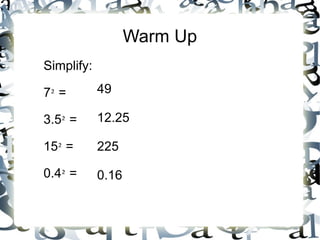
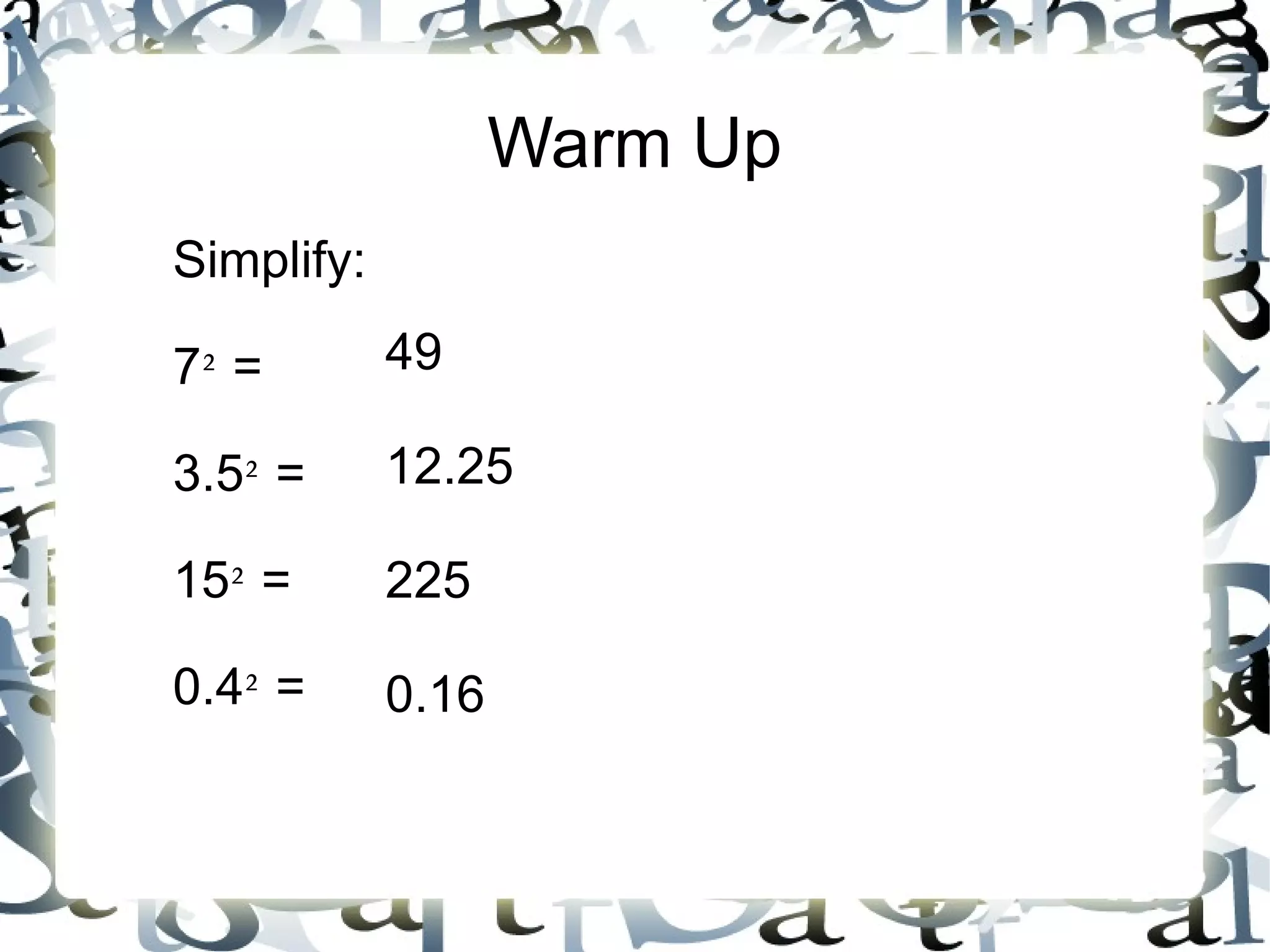
Warm Up Simplify: 7 ²  = 3.5 ²  = 15 ²  = 0.4 ²  = 49 12.25 225 0.16
Chapter 11, Section 1 Square Roots and Irrational Numbers By Ms. Dewey-Hoffman
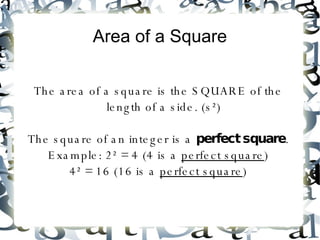
Area of a Square The area of a square is the SQUARE of the length of a side. (s²) The square of an integer is a  perfect square . Example: 2² = 4 (4 is a  perfect square ) 4² = 16 (16 is a  perfect square )
Everything in Math has an Opposite The opposite of a  SQUARE  is a  SQUARE ROOT . The symbol:  √  indicates a NONNEGATIVE Square Root of a number. Square Root = Radical Same thing!!!
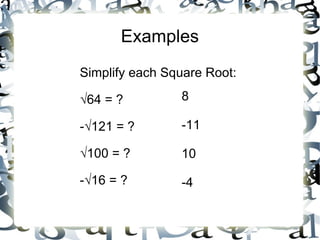
Examples Simplify each Square Root: √ 64 = ? -√121 = ? √ 100 = ? -√16 = ? 8 -11 10 -4
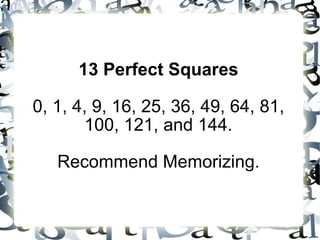
13 Perfect Squares 0, 1, 4, 9, 16, 25, 36, 49, 64, 81, 100, 121, and 144. Recommend Memorizing.
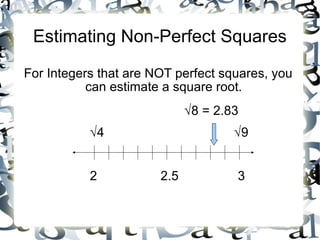
Estimating Non-Perfect Squares For Integers that are NOT perfect squares, you can estimate a square root. √ 4 √ 9 2 2.5 3 √ 8 = 2.83
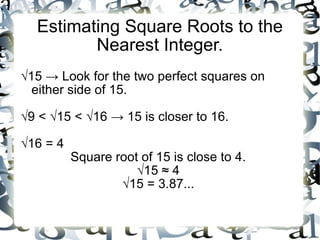
Estimating Square Roots to the Nearest Integer. √ 15 -> Look for the two perfect squares on either side of 15. √ 9 < √15 < √16 -> 15 is closer to 16. √ 16 = 4 Square root of 15 is close to 4. √ 15 ≈ 4 √ 15 = 3.87...
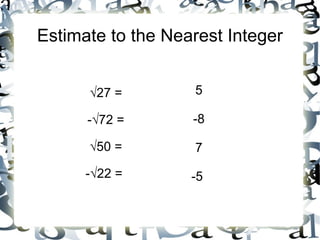
Estimate to the Nearest Integer √ 27 = -√72 = √ 50 = -√22 =  5 -8 7 -5
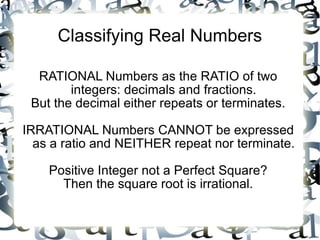
Classifying Real Numbers RATIONAL Numbers as the RATIO of two integers: decimals and fractions. But the decimal either repeats or terminates. IRRATIONAL Numbers CANNOT be expressed as a ratio and NEITHER repeat nor terminate. Positive Integer not a Perfect Square? Then the square root is irrational.
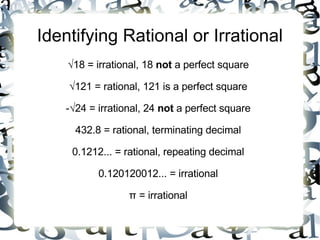
Identifying Rational or Irrational √ 18 = irrational, 18  not  a perfect square √ 121 = rational, 121 is a perfect square -√24 = irrational, 24  not  a perfect square 432.8 = rational, terminating decimal 0.1212... = rational, repeating decimal 0.120120012... = irrational π = irrational
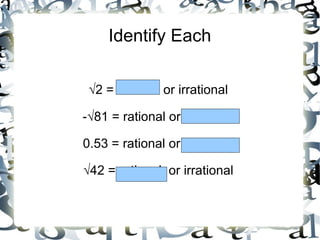
Identify Each √ 2 = rational or irrational -√81 = rational or irrational 0.53 = rational or irrational √ 42 = rational  or irrational
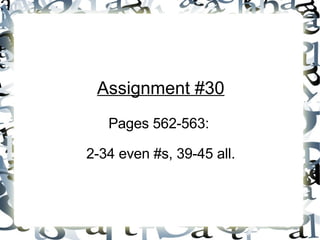
Assignment #30 Pages 562-563:  2-34 even #s, 39-45 all.

11.1 Square Root Irrational

  • 1.
    Warm Up Simplify:7 ² = 3.5 ² = 15 ² = 0.4 ² = 49 12.25 225 0.16
  • 2.
    Chapter 11, Section1 Square Roots and Irrational Numbers By Ms. Dewey-Hoffman
  • 3.
    Area of aSquare The area of a square is the SQUARE of the length of a side. (s²) The square of an integer is a perfect square . Example: 2² = 4 (4 is a perfect square ) 4² = 16 (16 is a perfect square )
  • 4.
    Everything in Mathhas an Opposite The opposite of a SQUARE is a SQUARE ROOT . The symbol: √ indicates a NONNEGATIVE Square Root of a number. Square Root = Radical Same thing!!!
  • 5.
    Examples Simplify eachSquare Root: √ 64 = ? -√121 = ? √ 100 = ? -√16 = ? 8 -11 10 -4
  • 6.
    13 Perfect Squares0, 1, 4, 9, 16, 25, 36, 49, 64, 81, 100, 121, and 144. Recommend Memorizing.
  • 7.
    Estimating Non-Perfect SquaresFor Integers that are NOT perfect squares, you can estimate a square root. √ 4 √ 9 2 2.5 3 √ 8 = 2.83
  • 8.
    Estimating Square Rootsto the Nearest Integer. √ 15 -> Look for the two perfect squares on either side of 15. √ 9 < √15 < √16 -> 15 is closer to 16. √ 16 = 4 Square root of 15 is close to 4. √ 15 ≈ 4 √ 15 = 3.87...
  • 9.
    Estimate to theNearest Integer √ 27 = -√72 = √ 50 = -√22 = 5 -8 7 -5
  • 10.
    Classifying Real NumbersRATIONAL Numbers as the RATIO of two integers: decimals and fractions. But the decimal either repeats or terminates. IRRATIONAL Numbers CANNOT be expressed as a ratio and NEITHER repeat nor terminate. Positive Integer not a Perfect Square? Then the square root is irrational.
  • 11.
    Identifying Rational orIrrational √ 18 = irrational, 18 not a perfect square √ 121 = rational, 121 is a perfect square -√24 = irrational, 24 not a perfect square 432.8 = rational, terminating decimal 0.1212... = rational, repeating decimal 0.120120012... = irrational π = irrational
  • 12.
    Identify Each √2 = rational or irrational -√81 = rational or irrational 0.53 = rational or irrational √ 42 = rational or irrational
  • 13.
    Assignment #30 Pages562-563: 2-34 even #s, 39-45 all.