Seven C’s are the life blood of communication between
sender & receiver. The Sender’s message is said to be
effective when the receiver understands the same
meaning that the sender was intended to Persuade his
receiver.
For any communication in business, in order to be
effective, it must have seven qualities. These seven
attributes are called Seven C’s of effective
communication.
What is 7 C’s?
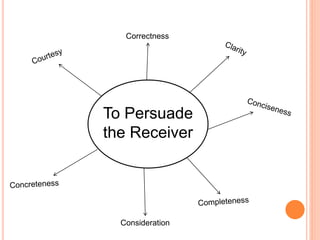
To Persuade
the Receiver
Correctness
Consideration
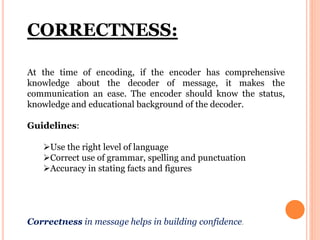
CORRECTNESS:
At the time of encoding, if the encoder has comprehensive
knowledge about the decoder of message, it makes the
communication an ease. The encoder should know the status,
knowledge and educational background of the decoder.
Guidelines:
Use the right level of language
Correct use of grammar, spelling and punctuation
Accuracy in stating facts and figures
Correctness in message helps in building confidence.
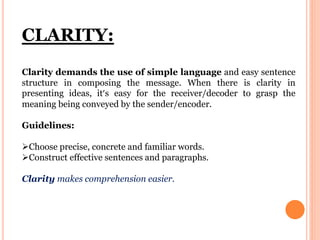
CLARITY:
Clarity demands the use of simple language and easy sentence
structure in composing the message. When there is clarity in
presenting ideas, it’s easy for the receiver/decoder to grasp the
meaning being conveyed by the sender/encoder.
Guidelines:
Choose precise, concrete and familiar words.
Construct effective sentences and paragraphs.
Clarity makes comprehension easier.
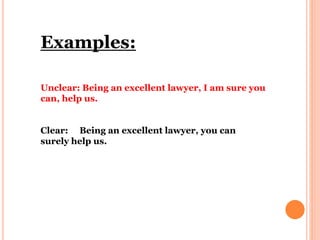
Examples:
Unclear: Being an excellent lawyer, I am sure you
can, help us.
Clear: Being an excellent lawyer, you can
surely help us.
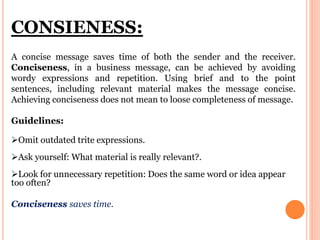
CONSIENESS:
A concise message saves time of both the sender and the receiver.
Conciseness, in a business message, can be achieved by avoiding
wordy expressions and repetition. Using brief and to the point
sentences, including relevant material makes the message concise.
Achieving conciseness does not mean to loose completeness of message.
Guidelines:
Omit outdated trite expressions.
Ask yourself: What material is really relevant?.
Look for unnecessary repetition: Does the same word or idea appear
too often?
Conciseness saves time.
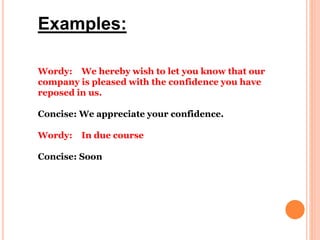
Examples:
Wordy: We hereby wish to let you know that our
company is pleased with the confidence you have
reposed in us.
Concise: We appreciate your confidence.
Wordy: In due course
Concise: Soon
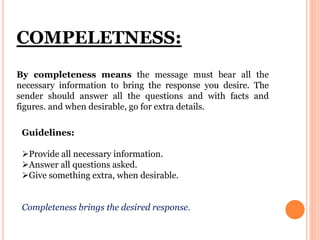
COMPELETNESS:
By completeness means the message must bear all the
necessary information to bring the response you desire. The
sender should answer all the questions and with facts and
figures. and when desirable, go for extra details.
Guidelines:
Provide all necessary information.
Answer all questions asked.
Give something extra, when desirable.
Completeness brings the desired response.
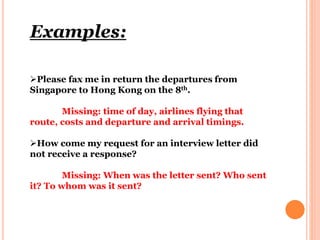
Examples:
Please fax me in return the departures from
Singapore to Hong Kong on the 8th.
Missing: time of day, airlines flying that
route, costs and departure and arrival timings.
How come my request for an interview letter did
not receive a response?
Missing: When was the letter sent? Who sent
it? To whom was it sent?
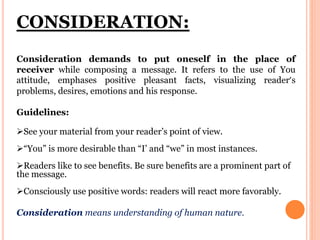
CONSIDERATION:
Consideration demands to put oneself in the place of
receiver while composing a message. It refers to the use of You
attitude, emphases positive pleasant facts, visualizing reader’s
problems, desires, emotions and his response.
Guidelines:
See your material from your reader’s point of view.
“You” is more desirable than “I’ and “we” in most instances.
Readers like to see benefits. Be sure benefits are a prominent part of
the message.
Consciously use positive words: readers will react more favorably.
Consideration means understanding of human nature.
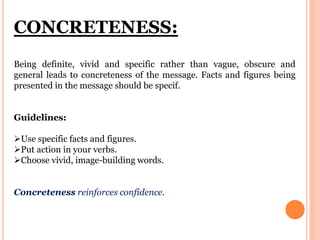
CONCRETENESS:
Being definite, vivid and specific rather than vague, obscure and
general leads to concreteness of the message. Facts and figures being
presented in the message should be specif.
Guidelines:
Use specific facts and figures.
Put action in your verbs.
Choose vivid, image-building words.
Concreteness reinforces confidence.
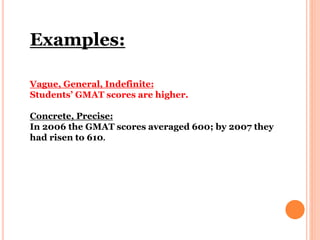
Examples:
Vague, General, Indefinite:
Students’ GMAT scores are higher.
Concrete, Precise:
In 2006 the GMAT scores averaged 600; by 2007 they
had risen to 610.
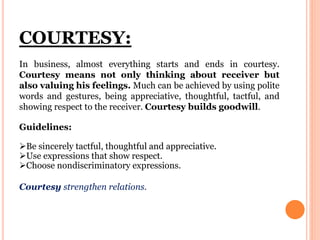
COURTESY:
In business, almost everything starts and ends in courtesy.
Courtesy means not only thinking about receiver but
also valuing his feelings. Much can be achieved by using polite
words and gestures, being appreciative, thoughtful, tactful, and
showing respect to the receiver. Courtesy builds goodwill.
Guidelines:
Be sincerely tactful, thoughtful and appreciative.
Use expressions that show respect.
Choose nondiscriminatory expressions.
Courtesy strengthen relations.
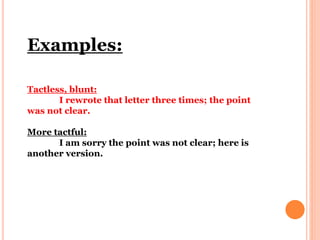
Examples:
Tactless, blunt:
I rewrote that letter three times; the point
was not clear.
More tactful:
I am sorry the point was not clear; here is
another version.

Documents.mx 7cs of-communication-presentation

  • 2.
    Seven C’s arethe life blood of communication between sender & receiver. The Sender’s message is said to be effective when the receiver understands the same meaning that the sender was intended to Persuade his receiver. For any communication in business, in order to be effective, it must have seven qualities. These seven attributes are called Seven C’s of effective communication. What is 7 C’s?
  • 3.
  • 4.
    CORRECTNESS: At the timeof encoding, if the encoder has comprehensive knowledge about the decoder of message, it makes the communication an ease. The encoder should know the status, knowledge and educational background of the decoder. Guidelines: Use the right level of language Correct use of grammar, spelling and punctuation Accuracy in stating facts and figures Correctness in message helps in building confidence.
  • 5.
    CLARITY: Clarity demands theuse of simple language and easy sentence structure in composing the message. When there is clarity in presenting ideas, it’s easy for the receiver/decoder to grasp the meaning being conveyed by the sender/encoder. Guidelines: Choose precise, concrete and familiar words. Construct effective sentences and paragraphs. Clarity makes comprehension easier.
  • 6.
    Examples: Unclear: Being anexcellent lawyer, I am sure you can, help us. Clear: Being an excellent lawyer, you can surely help us.
  • 7.
    CONSIENESS: A concise messagesaves time of both the sender and the receiver. Conciseness, in a business message, can be achieved by avoiding wordy expressions and repetition. Using brief and to the point sentences, including relevant material makes the message concise. Achieving conciseness does not mean to loose completeness of message. Guidelines: Omit outdated trite expressions. Ask yourself: What material is really relevant?. Look for unnecessary repetition: Does the same word or idea appear too often? Conciseness saves time.
  • 8.
    Examples: Wordy: We herebywish to let you know that our company is pleased with the confidence you have reposed in us. Concise: We appreciate your confidence. Wordy: In due course Concise: Soon
  • 9.
    COMPELETNESS: By completeness meansthe message must bear all the necessary information to bring the response you desire. The sender should answer all the questions and with facts and figures. and when desirable, go for extra details. Guidelines: Provide all necessary information. Answer all questions asked. Give something extra, when desirable. Completeness brings the desired response.
  • 10.
    Examples: Please fax mein return the departures from Singapore to Hong Kong on the 8th. Missing: time of day, airlines flying that route, costs and departure and arrival timings. How come my request for an interview letter did not receive a response? Missing: When was the letter sent? Who sent it? To whom was it sent?
  • 11.
    CONSIDERATION: Consideration demands toput oneself in the place of receiver while composing a message. It refers to the use of You attitude, emphases positive pleasant facts, visualizing reader’s problems, desires, emotions and his response. Guidelines: See your material from your reader’s point of view. “You” is more desirable than “I’ and “we” in most instances. Readers like to see benefits. Be sure benefits are a prominent part of the message. Consciously use positive words: readers will react more favorably. Consideration means understanding of human nature.
  • 12.
    CONCRETENESS: Being definite, vividand specific rather than vague, obscure and general leads to concreteness of the message. Facts and figures being presented in the message should be specif. Guidelines: Use specific facts and figures. Put action in your verbs. Choose vivid, image-building words. Concreteness reinforces confidence.
  • 13.
    Examples: Vague, General, Indefinite: Students’GMAT scores are higher. Concrete, Precise: In 2006 the GMAT scores averaged 600; by 2007 they had risen to 610.
  • 14.
    COURTESY: In business, almosteverything starts and ends in courtesy. Courtesy means not only thinking about receiver but also valuing his feelings. Much can be achieved by using polite words and gestures, being appreciative, thoughtful, tactful, and showing respect to the receiver. Courtesy builds goodwill. Guidelines: Be sincerely tactful, thoughtful and appreciative. Use expressions that show respect. Choose nondiscriminatory expressions. Courtesy strengthen relations.
  • 15.
    Examples: Tactless, blunt: I rewrotethat letter three times; the point was not clear. More tactful: I am sorry the point was not clear; here is another version.