BY:
KHUSHBU GUPTA
Effective communication
 Effective communication takes place only when
the listener clearly understands the message that
the speaker intended to send.
 A speaker’s message must be delivered clearly.
 A listener must be an active listener.
 Applicable to both written and verbal
communication
Benefits of effective
communication
⚫Quicker problem solving
⚫Better decision making
⚫Steady work flow
⚫Strong business relations
⚫Better professional image
The 7 C’s
 Completeness
Conciseness
Consideration
Concreteness
Clarity
Courtesy
Correctness
Completeness
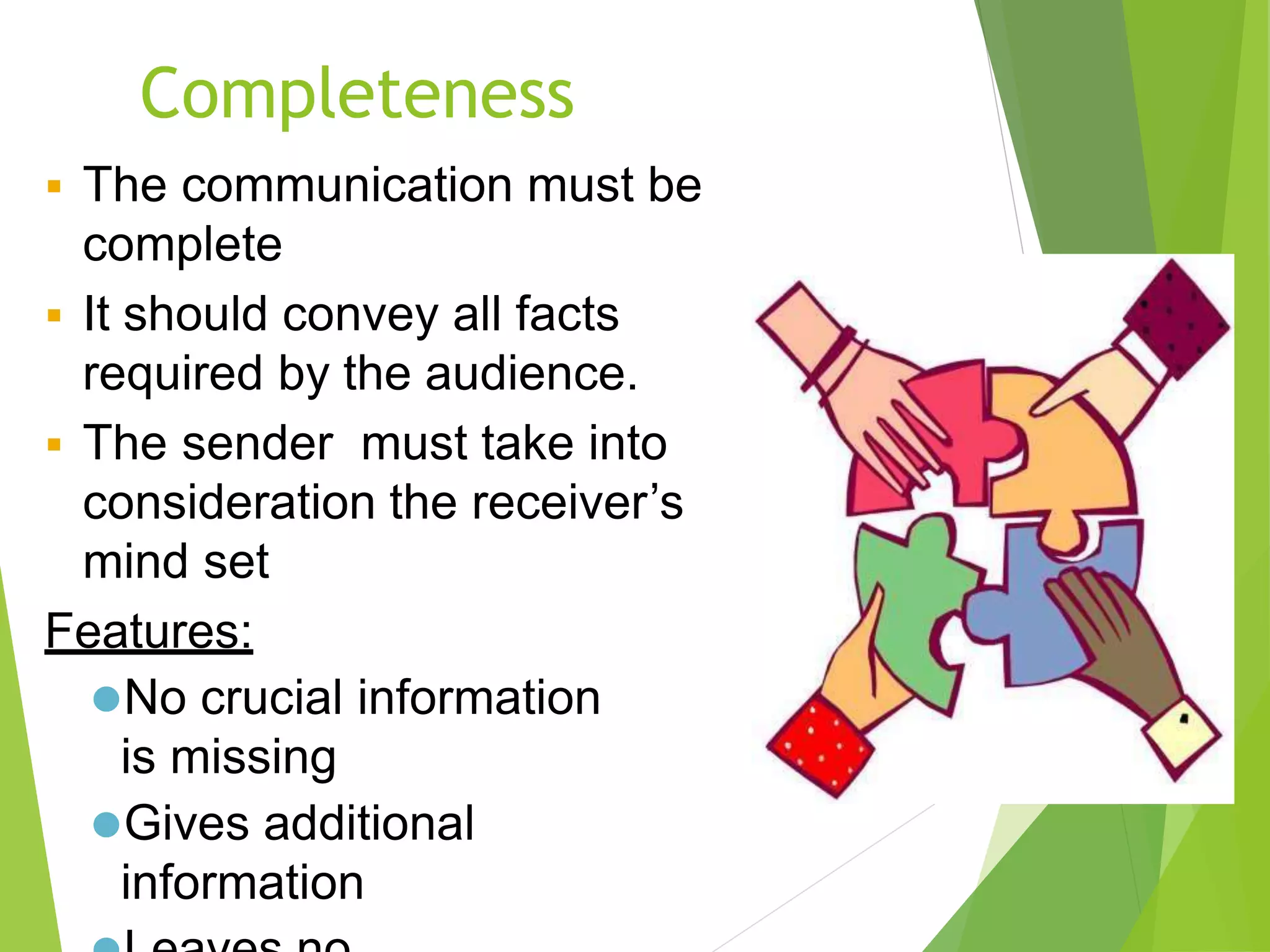
 The communication must be
complete
 It should convey all facts
required by the audience.
 The sender must take into
consideration the receiver’s
mind set
Features:
⚫No crucial information
is missing
⚫Gives additional
information
•Check for five Ws & one H for
completeness
–Who
–What
–When
–Where
–Why and
–How
Conciseness
 It means wordiness - communicating
what you want to convey in least
possible words.
Features:
⚫Highlights the main message
⚫Avoids using excessive and needless
words.
⚫Provides short and essential message
in limited word.
⚫Message becomes appealing
and comprehensible to the
audience.
Eliminate Wordy Expressions
⚫Use single words in place of phrases. Even
Winston Churchill made extensive use of
simple, one syllable words
Example
⚫Wordy:
⚫Concise
:
At this time
Now
⚫Wordy:
⚫Concise
:
Due to the fact that
Because
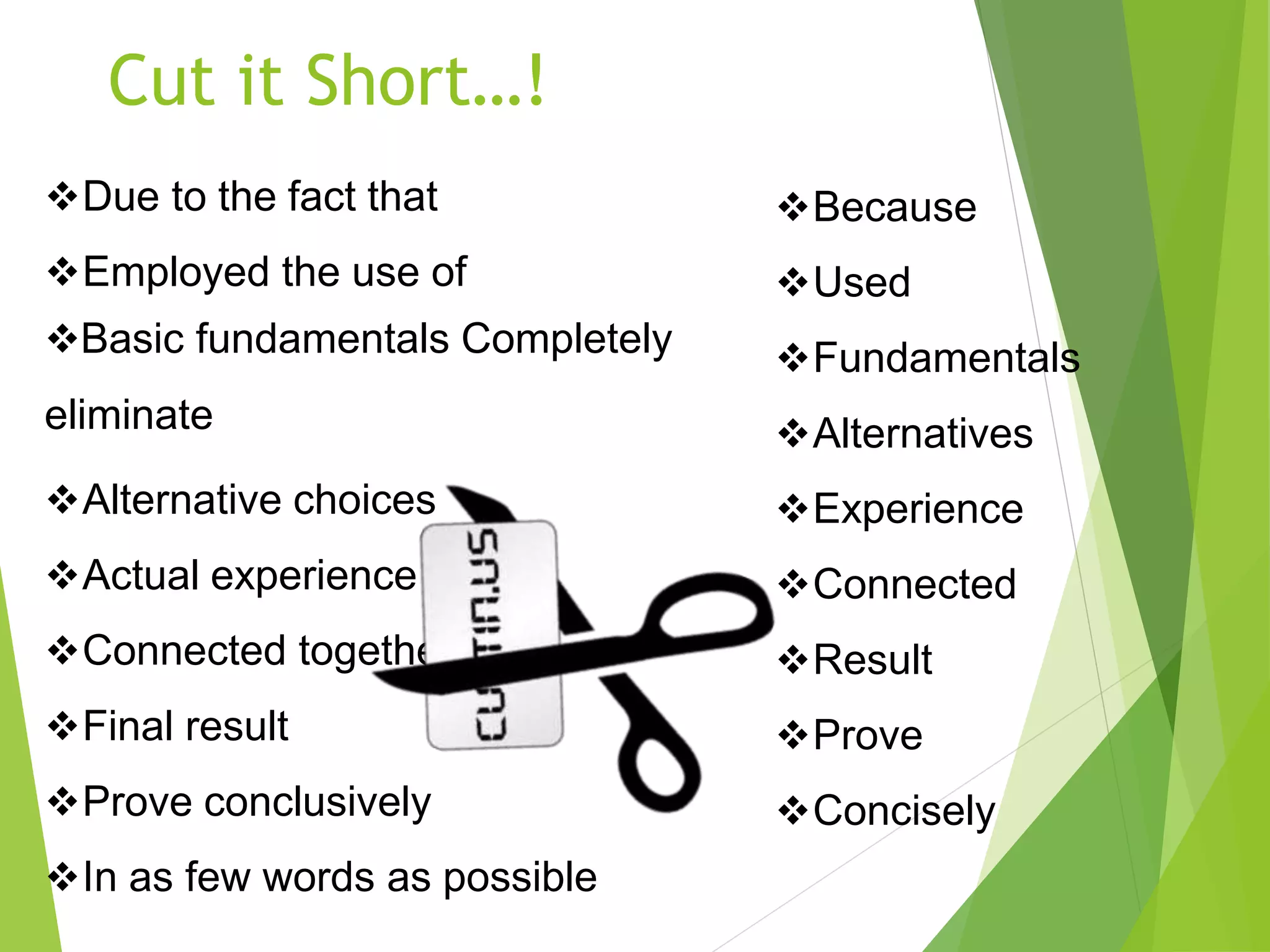
Due to the fact that
Employed the use of
Basic fundamentals Completely
eliminate
Alternative choices
Actual experience
Connected together
Final result
Prove conclusively
In as few words as possible
Because
Used
Fundamentals
Alternatives
Experience
Connected
Result
Prove
Concisely
Cut it Short…!
Consideration
⚫Implies “stepping into the shoes of
others”.
⚫Take note of audience’s view points, background,
mind-set, education level, etc.
⚫ Envisage your audience, their requirements,
emotions and problems.
⚫Do not hurt self-respect and emotions of
audience .
⚫Modify your words to suit the audience’s needs
Features :
⚫Emphasize on “you” approach.
Show optimism towards your
audience.
⚫Empathize and exhibit interest in
Concreteness
 Be particular and clear rather
than fuzzy and general.
 It strengthens the confidence.
 Concrete messages are not
misinterpreted.
Features:
⚫It is supported with specific
facts and figures.
⚫Make use of words that are
clear and that build the
reputation.
Example
Concrete, Precise
• In 1996, the GMAT scores averaged
600; by 1997 they had risen to
610.
Vague, General,
Indefinite
⚫Student GMAT
scores are
higher.
Clarity
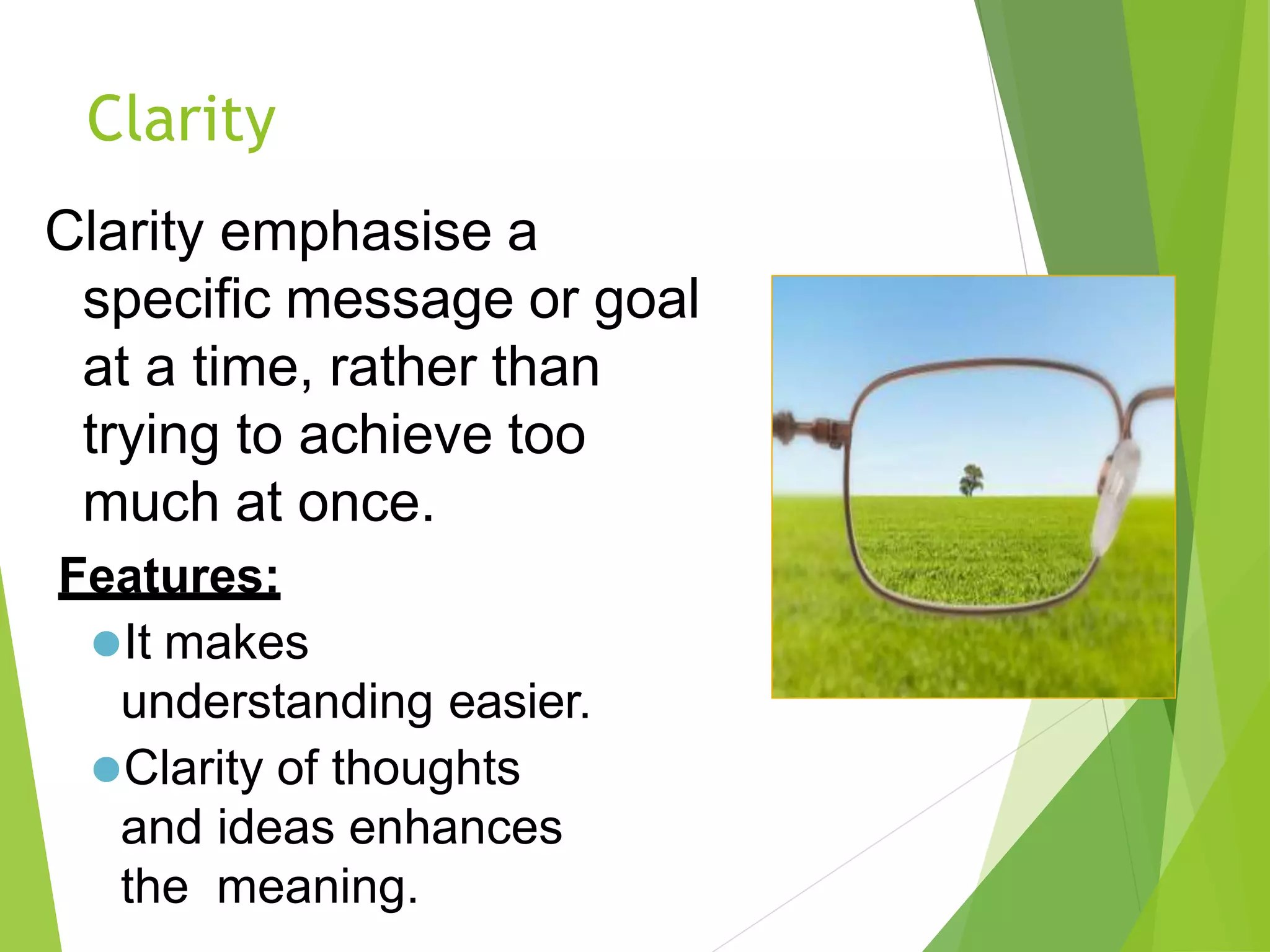
Clarity emphasise a
specific message or goal
at a time, rather than
trying to achieve too
much at once.
Features:
⚫It makes
understanding easier.
⚫Clarity of thoughts
and ideas enhances
the meaning.
Eg : Use simple words
later
agree
try
replace
• Subsequent
• Accede
• Endeavour
• Supersede
• Disclose show
Courtesy
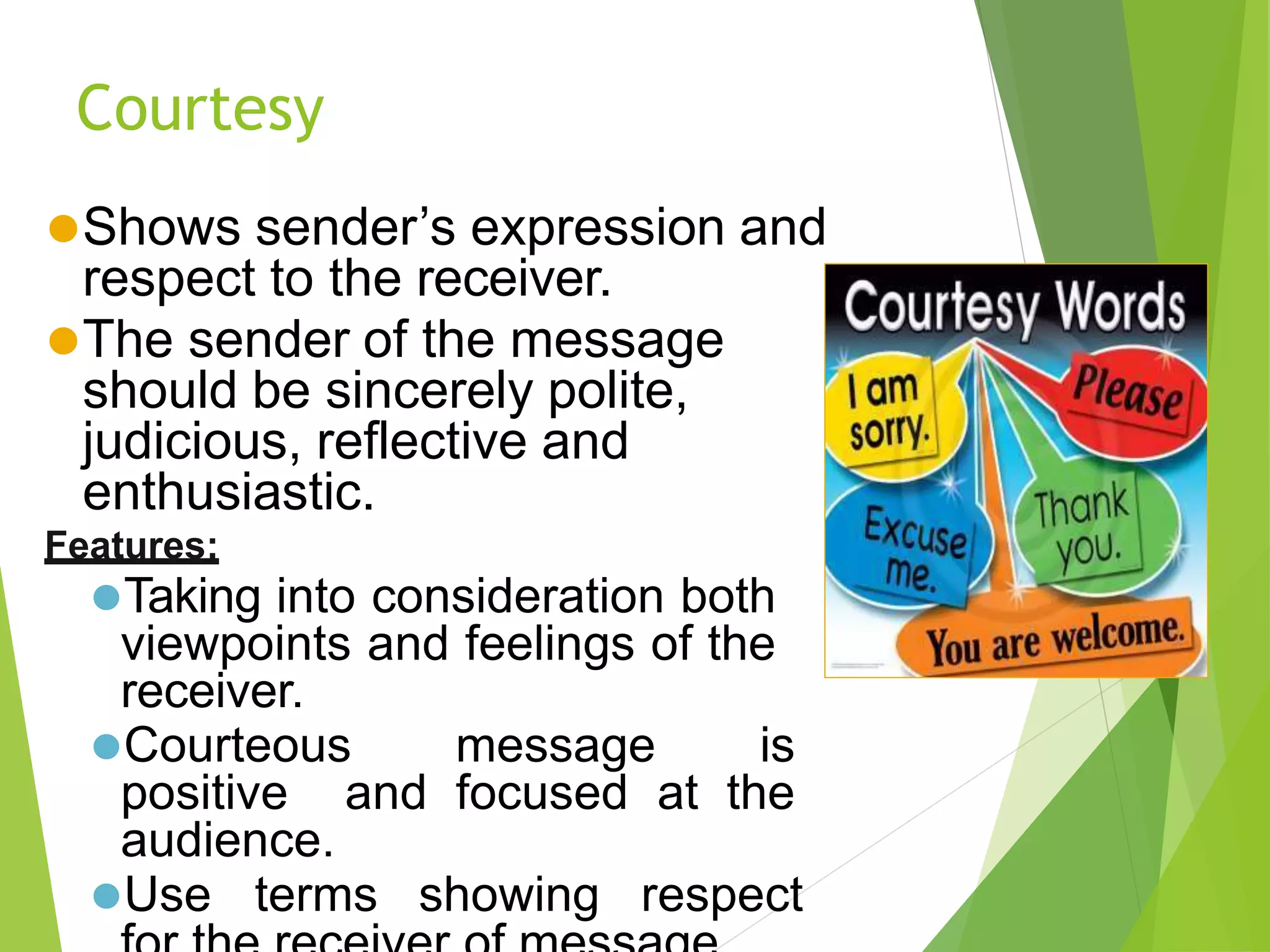
⚫Shows sender’s expression and
respect to the receiver.
⚫The sender of the message
should be sincerely polite,
judicious, reflective and
enthusiastic.
Features:
⚫Taking into consideration both
viewpoints and feelings of the
receiver.
⚫Courteous message is
positive and focused at the
audience.
⚫Use terms showing respect
Correctness
Implies there are no
grammatical errors in
communication.
Features:
⚫The message is exact,
correct and well-timed.
⚫ Correct communication,
boosts the confidence level.
⚫Correct message has impact
on the audience/readers.
⚫ Precision and accurateness
of facts and figures given
importance
⚫Use appropriate and correct
17
The right form of language,
accuracy and acceptable
words
 Select the right level of language
for your communication either formal or
informal.
 Realize that formal language is most often used in
business communication.
 Check for correct figures, facts, and words.
 Apply the principles of communication
to your writing.
7 C's of Communication.pptx

7 C's of Communication.pptx

  • 1.
  • 2.
    Effective communication  Effectivecommunication takes place only when the listener clearly understands the message that the speaker intended to send.  A speaker’s message must be delivered clearly.  A listener must be an active listener.  Applicable to both written and verbal communication
  • 3.
    Benefits of effective communication ⚫Quickerproblem solving ⚫Better decision making ⚫Steady work flow ⚫Strong business relations ⚫Better professional image
  • 4.
    The 7 C’s Completeness Conciseness Consideration Concreteness Clarity Courtesy Correctness
  • 5.
    Completeness  The communicationmust be complete  It should convey all facts required by the audience.  The sender must take into consideration the receiver’s mind set Features: ⚫No crucial information is missing ⚫Gives additional information
  • 6.
    •Check for fiveWs & one H for completeness –Who –What –When –Where –Why and –How
  • 7.
    Conciseness  It meanswordiness - communicating what you want to convey in least possible words. Features: ⚫Highlights the main message ⚫Avoids using excessive and needless words. ⚫Provides short and essential message in limited word. ⚫Message becomes appealing and comprehensible to the audience.
  • 8.
    Eliminate Wordy Expressions ⚫Usesingle words in place of phrases. Even Winston Churchill made extensive use of simple, one syllable words Example ⚫Wordy: ⚫Concise : At this time Now ⚫Wordy: ⚫Concise : Due to the fact that Because
  • 9.
    Due to thefact that Employed the use of Basic fundamentals Completely eliminate Alternative choices Actual experience Connected together Final result Prove conclusively In as few words as possible Because Used Fundamentals Alternatives Experience Connected Result Prove Concisely Cut it Short…!
  • 10.
    Consideration ⚫Implies “stepping intothe shoes of others”. ⚫Take note of audience’s view points, background, mind-set, education level, etc. ⚫ Envisage your audience, their requirements, emotions and problems. ⚫Do not hurt self-respect and emotions of audience . ⚫Modify your words to suit the audience’s needs Features : ⚫Emphasize on “you” approach. Show optimism towards your audience. ⚫Empathize and exhibit interest in
  • 11.
    Concreteness  Be particularand clear rather than fuzzy and general.  It strengthens the confidence.  Concrete messages are not misinterpreted. Features: ⚫It is supported with specific facts and figures. ⚫Make use of words that are clear and that build the reputation.
  • 12.
    Example Concrete, Precise • In1996, the GMAT scores averaged 600; by 1997 they had risen to 610. Vague, General, Indefinite ⚫Student GMAT scores are higher.
  • 13.
    Clarity Clarity emphasise a specificmessage or goal at a time, rather than trying to achieve too much at once. Features: ⚫It makes understanding easier. ⚫Clarity of thoughts and ideas enhances the meaning.
  • 14.
    Eg : Usesimple words later agree try replace • Subsequent • Accede • Endeavour • Supersede • Disclose show
  • 15.
    Courtesy ⚫Shows sender’s expressionand respect to the receiver. ⚫The sender of the message should be sincerely polite, judicious, reflective and enthusiastic. Features: ⚫Taking into consideration both viewpoints and feelings of the receiver. ⚫Courteous message is positive and focused at the audience. ⚫Use terms showing respect
  • 16.
    Correctness Implies there areno grammatical errors in communication. Features: ⚫The message is exact, correct and well-timed. ⚫ Correct communication, boosts the confidence level. ⚫Correct message has impact on the audience/readers. ⚫ Precision and accurateness of facts and figures given importance ⚫Use appropriate and correct
  • 17.
    17 The right formof language, accuracy and acceptable words  Select the right level of language for your communication either formal or informal.  Realize that formal language is most often used in business communication.  Check for correct figures, facts, and words.  Apply the principles of communication to your writing.