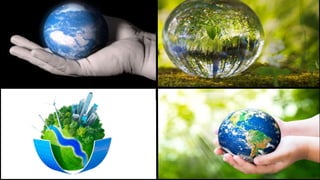
What Is Environment ?
 Environment is everything that is around us, which can be
living or nonliving things.
 It includes physical, chemical and other natural forces.
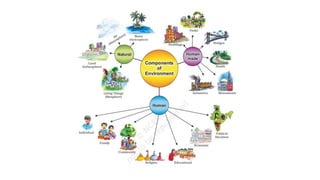
 Natural Environment comprises land, water, air, plants and
animals.
 Human beings interact with the environment and modify it
according to their needs.
 Environment is our basic life support system.
Definition of Environment ?
The place, people, things and nature that surround any living
organism is called environment. It is a combination of natural
and human made phenomena. While the natural environment
refers to both biotic and abiotic conditions existing on the earth.
Abiotic : - The world of non-living elements. e.g. land
Biotic : - The world of Living organisms. e.g. plants and animals
Word Origin
The word “Environment is originated from a French word
Environer / Environner which means surroundings or
neighborhood.
What does Environment Provide ?
It provides the air we breath, the water we drink,
the food we eat and the land where we live.
About Environment
 The Earth is the only planet in the solar system that
supports life.
 The Physical and Biological conditions in which an
organisms lives makes up its environment.
 On 5 June every year the World Environment Day is
celebrated.
How do human beings modify this
natural environment?
 The car fumes pollute the air, water is collected in a pot, food
is served in vessels and land is used to build factories.
 Human beings make cars, mills, factories and manufacture
Containers.
 Humans have modified the physical environment by clearing
land for agriculture or damming streams to store and divert
water.
Components of environment
1. Natural Environment : -
Land, Water, Air, Plants And Animals Comprise The Natural
Environment.
Components of environment
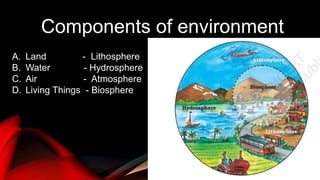
A. Land - Lithosphere
B. Water - Hydrosphere
C. Air - Atmosphere
D. Living Things - Biosphere
Components of environment
2. Human Environment / Human Made : -
The environment created by humans. It includes permanent
human settlements like buildings, parks, bridges, roads,
industries, monuments, villages, towns, cities, transport,
communication facilities etc.
1. Natural Environment : -
A. Land - Lithosphere
 A Lithosphere is the solid crust or the hard top layer of the earth.
 It is made up of rocks and minerals and covered by a thin layer of soil.
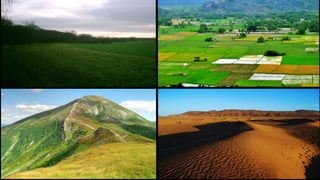
 Various landforms such as mountains, plateaus, plains, valleys, etc
over the continents and also on the ocean floors.
Provides us forests, grasslands for grazing, land for agriculture and
human settlements.
It is also a source of mineral wealth.
1. Natural Environment : -
B. Water - Hydrosphere
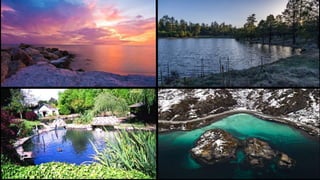
 It comprises various sources of water and different types of water
bodies like rivers, lakes, seas, oceans, etc.
 It is essential for all living organisms.
1. Natural Environment : -
C. Air - Atmosphere
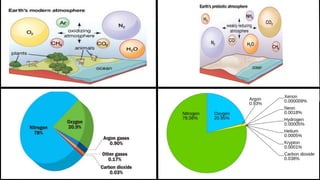
 The atmosphere is the thin layer of air that surrounds the earth.
 The gravitational force of the earth holds the atmosphere around it.
 It protects us from the harmful rays and scorching heat of the sun.
 It consists of a number of gases, dust and water vapour.
 The changes in the atmosphere produce changes in the weather
and climate.
the harmful rays and scorching heat of the sun.
It consists of a number of gases, dust and water vapour
1. Natural Environment : -
D. Living Things - Biosphere
 Plant and animal kingdom together make biosphere or the living
world.
 It is a narrow zone of the earth where land, water and air interact
with each other to support life.
the harmful rays and scorching heat of the sun.
It consists of a number of gases, dust and water vapour
Components of environment
2. Human Environment / Human Made : -
 Human beings interact with the environment and modify it according to
their need.
 New ways to use and change environment like grow crops,
domesticate animals, lead a settled life. The wheel was invented,
surplus food was produced, barter system emerged, trade started and
commerce developed. Industrial revolution enabled large scale
production. Transportation became faster. Information revolution made
communication easier and speedy across the world.
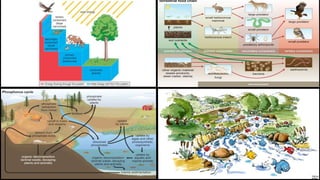
What Is Ecosystem ?
 It is a system formed by the interaction of all living organisms
with each other and with the physical and chemical factors of the
environment in which they live, all linked by transfer of energy
and material.
 All plants, animals and human beings depend on their immediate
surroundings and form an ecosystem. There could be an
ecosystem of large rain forest, grassland, desert, mountains,
lake, river, ocean and even a small pond.
the harmful rays and scorching heat of the sun.
It consists of a number of gases, dust and water vapour
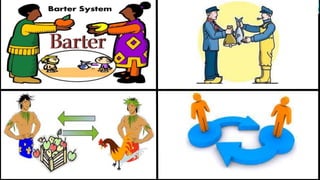
What Is Barter System ?
 Barter system is a trade in which goods are exchanged without
the use of money.
 It is a system of exchange in which participants in a
transaction directly exchange goods or services for other
goods or services without using a medium of exchange,
such as money.
the harmful rays and scorching heat of the sun.
It consists of a number of gases, dust and water vapour
Our environment Class - 7

Our environment Class - 7

  • 3.
    What Is Environment?  Environment is everything that is around us, which can be living or nonliving things.  It includes physical, chemical and other natural forces.  Natural Environment comprises land, water, air, plants and animals.  Human beings interact with the environment and modify it according to their needs.  Environment is our basic life support system.
  • 4.
    Definition of Environment? The place, people, things and nature that surround any living organism is called environment. It is a combination of natural and human made phenomena. While the natural environment refers to both biotic and abiotic conditions existing on the earth. Abiotic : - The world of non-living elements. e.g. land Biotic : - The world of Living organisms. e.g. plants and animals
  • 5.
    Word Origin The word“Environment is originated from a French word Environer / Environner which means surroundings or neighborhood.
  • 6.
    What does EnvironmentProvide ? It provides the air we breath, the water we drink, the food we eat and the land where we live.
  • 7.
    About Environment  TheEarth is the only planet in the solar system that supports life.  The Physical and Biological conditions in which an organisms lives makes up its environment.  On 5 June every year the World Environment Day is celebrated.
  • 8.
    How do humanbeings modify this natural environment?  The car fumes pollute the air, water is collected in a pot, food is served in vessels and land is used to build factories.  Human beings make cars, mills, factories and manufacture Containers.  Humans have modified the physical environment by clearing land for agriculture or damming streams to store and divert water.
  • 10.
    Components of environment 1.Natural Environment : - Land, Water, Air, Plants And Animals Comprise The Natural Environment.
  • 11.
    Components of environment A.Land - Lithosphere B. Water - Hydrosphere C. Air - Atmosphere D. Living Things - Biosphere
  • 12.
    Components of environment 2.Human Environment / Human Made : - The environment created by humans. It includes permanent human settlements like buildings, parks, bridges, roads, industries, monuments, villages, towns, cities, transport, communication facilities etc.
  • 13.
    1. Natural Environment: - A. Land - Lithosphere  A Lithosphere is the solid crust or the hard top layer of the earth.  It is made up of rocks and minerals and covered by a thin layer of soil.  Various landforms such as mountains, plateaus, plains, valleys, etc over the continents and also on the ocean floors. Provides us forests, grasslands for grazing, land for agriculture and human settlements. It is also a source of mineral wealth.
  • 15.
    1. Natural Environment: - B. Water - Hydrosphere  It comprises various sources of water and different types of water bodies like rivers, lakes, seas, oceans, etc.  It is essential for all living organisms.
  • 17.
    1. Natural Environment: - C. Air - Atmosphere  The atmosphere is the thin layer of air that surrounds the earth.  The gravitational force of the earth holds the atmosphere around it.  It protects us from the harmful rays and scorching heat of the sun.  It consists of a number of gases, dust and water vapour.  The changes in the atmosphere produce changes in the weather and climate.
  • 18.
    the harmful raysand scorching heat of the sun. It consists of a number of gases, dust and water vapour
  • 19.
    1. Natural Environment: - D. Living Things - Biosphere  Plant and animal kingdom together make biosphere or the living world.  It is a narrow zone of the earth where land, water and air interact with each other to support life.
  • 20.
    the harmful raysand scorching heat of the sun. It consists of a number of gases, dust and water vapour
  • 21.
    Components of environment 2.Human Environment / Human Made : -  Human beings interact with the environment and modify it according to their need.  New ways to use and change environment like grow crops, domesticate animals, lead a settled life. The wheel was invented, surplus food was produced, barter system emerged, trade started and commerce developed. Industrial revolution enabled large scale production. Transportation became faster. Information revolution made communication easier and speedy across the world.
  • 22.
    What Is Ecosystem?  It is a system formed by the interaction of all living organisms with each other and with the physical and chemical factors of the environment in which they live, all linked by transfer of energy and material.  All plants, animals and human beings depend on their immediate surroundings and form an ecosystem. There could be an ecosystem of large rain forest, grassland, desert, mountains, lake, river, ocean and even a small pond.
  • 23.
    the harmful raysand scorching heat of the sun. It consists of a number of gases, dust and water vapour
  • 24.
    What Is BarterSystem ?  Barter system is a trade in which goods are exchanged without the use of money.  It is a system of exchange in which participants in a transaction directly exchange goods or services for other goods or services without using a medium of exchange, such as money.
  • 25.
    the harmful raysand scorching heat of the sun. It consists of a number of gases, dust and water vapour