Grade – 6 Civics
6. Rural Administration
By: Navya Rai
Introduction
 The local government of the village takes care
of its needs and requirements.
 There are various issues, such as
implementing reforms, maintenance of law
and order, keeping records, etc.
 We will discuss some agents of rural
administration.
Local Police
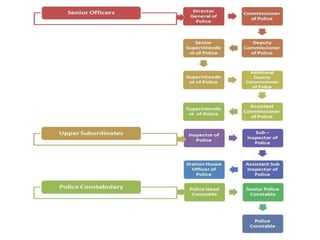
• Each state in India has a police force,
responsible for maintaining law and order in
the state.
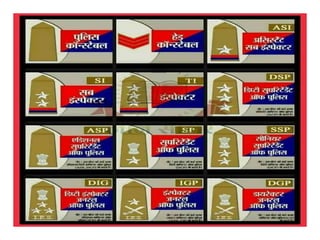
• The state police is headed by the Director
General of Police (DGP).
• The states are divided into districts and each
districts police administration is headed by
the Superintendent of Police (SP).
Conti…
• The District is sub-divided into five or six circles.
• Each circle is headed by a Deputy
Superintendent of Police (DSP). Each circle has
about 10 local police stations called Thanas.
• Each police station or Thana, is supervised by
the Station House Officer (SHO) who is an
inspector.
• Under him work Sub- Inspectors, head
Constables, who carry out the instructions of the
SHO.
Land Records
• An important function of rural
administrations to maintain records of the
selling and buying of lands and the collection
of revenue from them.
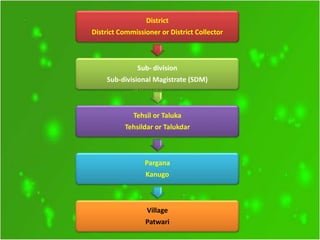
• The district is supervised by the District
Commissioner, or the District Collector.
• It is divided into sub divisions.
District
District Commissioner or District Collector
Sub- division
Sub-divisional Magistrate (SDM)
Tehsil or Taluka
Tehsildar or Talukdar
Pargana
Kanugo
Village
Patwari
Conti….
• All disputes related to land are handled
by the sarpanch along with the patwari.
• In many villages, the patwari is also
known as a lekhpal or karamchari.
The main duties of the Patwari are
1. To maintain a record of which piece of land has
produced which crop and what quantity.
2. To maintain a record of ownership of each plot
of land- who is selling, to who its sold, who will
inherit, etc.
3. To keep an up-to-date measurement of last and
ensure that revenue equivalent to the size of the
land is generated.
4. To add in revenue collection.
5. To report any foreseen calamity or problem
regarding land or the animals working on the
lands.
6. To maintain all the records in hand copy in forms
of maps, reports etc.
New Inheritance of Law
• Till some years ago inheritance of agricultural
property was male- oriented.
• The daughters had no claim in inherited
property.
• The Hindu succession Act was passed in 2005
to remove discrimination.
• The Act gave equal rights to daughters.
6. Rural administration- Grade 6 - Civics

6. Rural administration- Grade 6 - Civics

  • 1.
    Grade – 6Civics 6. Rural Administration By: Navya Rai
  • 2.
    Introduction  The localgovernment of the village takes care of its needs and requirements.  There are various issues, such as implementing reforms, maintenance of law and order, keeping records, etc.  We will discuss some agents of rural administration.
  • 3.
    Local Police • Eachstate in India has a police force, responsible for maintaining law and order in the state. • The state police is headed by the Director General of Police (DGP). • The states are divided into districts and each districts police administration is headed by the Superintendent of Police (SP).
  • 4.
    Conti… • The Districtis sub-divided into five or six circles. • Each circle is headed by a Deputy Superintendent of Police (DSP). Each circle has about 10 local police stations called Thanas. • Each police station or Thana, is supervised by the Station House Officer (SHO) who is an inspector. • Under him work Sub- Inspectors, head Constables, who carry out the instructions of the SHO.
  • 8.
    Land Records • Animportant function of rural administrations to maintain records of the selling and buying of lands and the collection of revenue from them. • The district is supervised by the District Commissioner, or the District Collector. • It is divided into sub divisions.
  • 9.
    District District Commissioner orDistrict Collector Sub- division Sub-divisional Magistrate (SDM) Tehsil or Taluka Tehsildar or Talukdar Pargana Kanugo Village Patwari
  • 10.
    Conti…. • All disputesrelated to land are handled by the sarpanch along with the patwari. • In many villages, the patwari is also known as a lekhpal or karamchari.
  • 11.
    The main dutiesof the Patwari are 1. To maintain a record of which piece of land has produced which crop and what quantity. 2. To maintain a record of ownership of each plot of land- who is selling, to who its sold, who will inherit, etc. 3. To keep an up-to-date measurement of last and ensure that revenue equivalent to the size of the land is generated. 4. To add in revenue collection. 5. To report any foreseen calamity or problem regarding land or the animals working on the lands. 6. To maintain all the records in hand copy in forms of maps, reports etc.
  • 12.
    New Inheritance ofLaw • Till some years ago inheritance of agricultural property was male- oriented. • The daughters had no claim in inherited property. • The Hindu succession Act was passed in 2005 to remove discrimination. • The Act gave equal rights to daughters.