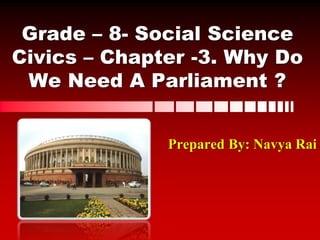




Grade – 8- Social Science
Civics – Chapter -3. Why Do
We Need A Parliament ?
Prepared By: Navya Rai
Navya Rai
Why Should People Decide?
• The decision of people matters in a democratic
country because:
Navya Rai
1. A democratic government is run by the consent,
approval, and participation of the people or citizens.
2. The people in a democracy are the citizens and
they are an integral part of any democracy.
3. The people elect a few candidates who represent
their collective voices in the Parliament.
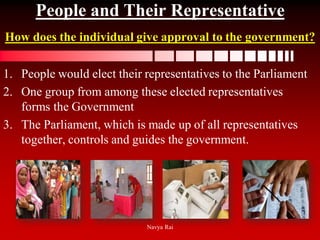
People and Their Representative
How does the individual give approval to the government?
1. People would elect their representatives to the Parliament
2. One group from among these elected representatives
forms the Government
3. The Parliament, which is made up of all representatives
together, controls and guides the government.
Navya Rai
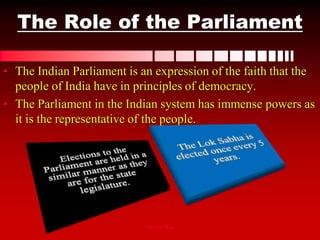
The Role of the Parliament
• The Indian Parliament is an expression of the faith that the
people of India have in principles of democracy.
• The Parliament in the Indian system has immense powers as
it is the representative of the people.
Navya Rai
Functions of Parliament
• India has numerous constituencies. Each of these
constituencies elects one person to the Parliament.
• The candidates who contest elections usually belong
to different political parties.
• These candidates become Members of Parliament
or MPs. Once elections to the Parliament have taken
place, the Parliament needs to perform the following
functions:
Navya Rai
Parliament Needs to Perform the
following Functions
Navya Rai
1) To Select the
National
Government
2) To Control,
Guide and Inform
the Government
3) Law-Making
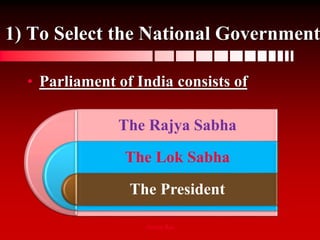
1) To Select the National Government
• Parliament of India consists of
Navya Rai
The Rajya Sabha
The Lok Sabha
The President
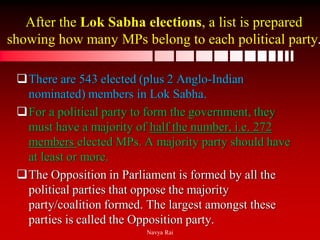
After the Lok Sabha elections, a list is prepared
showing how many MPs belong to each political party.
There are 543 elected (plus 2 Anglo-Indian
nominated) members in Lok Sabha.
For a political party to form the government, they
must have a majority of half the number, i.e. 272
members elected MPs. A majority party should have
at least or more.
The Opposition in Parliament is formed by all the
political parties that oppose the majority
party/coalition formed. The largest amongst these
parties is called the Opposition party.
Navya Rai
Functions Of Rajyasabha
• The Rajya Sabha functions primarily as the
representative of the states of India in the
Parliament.
1. The Rajya Sabha can also initiate
legislation.
2. A bill is required to pass through the Rajya
Sabha in order to become a law.
Navya Rai
Conti…
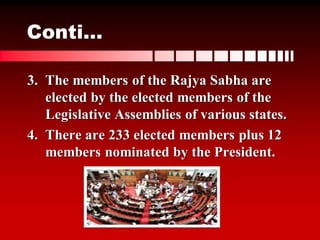
3. The members of the Rajya Sabha are
elected by the elected members of the
Legislative Assemblies of various states.
4. There are 233 elected members plus 12
members nominated by the President.
Navya Rai
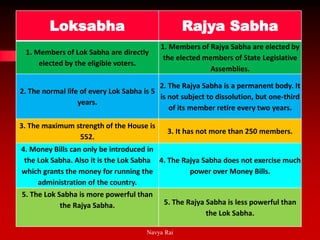
Loksabha Rajya Sabha
1. Members of Lok Sabha are directly
elected by the eligible voters.
1. Members of Rajya Sabha are elected by
the elected members of State Legislative
Assemblies.
2. The normal life of every Lok Sabha is 5
years.
2. The Rajya Sabha is a permanent body. It
is not subject to dissolution, but one-third
of its member retire every two years.
3. The maximum strength of the House is
552.
3. It has not more than 250 members.
4. Money Bills can only be introduced in
the Lok Sabha. Also it is the Lok Sabha
which grants the money for running the
administration of the country.
4. The Rajya Sabha does not exercise much
power over Money Bills.
5. The Lok Sabha is more powerful than
the Rajya Sabha. 5. The Rajya Sabha is less powerful than
the Lok Sabha.
Navya Rai
2) To Control, Guide And
Inform the Government
• The Parliament begins with a question
hour. The question hour is an important
mechanism through which MPs can elicit
information about the working of the
government.
• By asking questions the government is
alerted to its shortcomings.
Navya Rai
Cont.…..
• The government also comes
to know the opinion of the
people through their
representatives in the
Parliament (the MPs).
• In all matters dealing with
finances, the Parliament’s
approval is crucial for the
government. Navya Rai
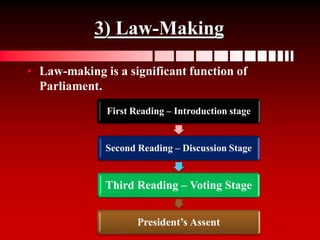
3) Law-Making
• Law-making is a significant function of
Parliament.
Navya Rai
First Reading – Introduction stage
Second Reading – Discussion Stage
Third Reading – Voting Stage
President’s Assent
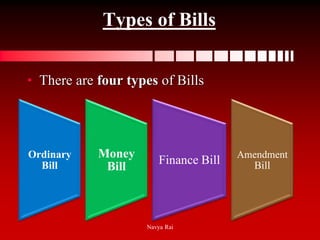
Types of Bills
• There are four types of Bills
Navya Rai
Ordinary
Bill
Money
Bill
Finance Bill Amendment
Bill
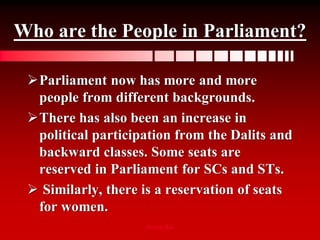
Who are the People in Parliament?
Parliament now has more and more
people from different backgrounds.
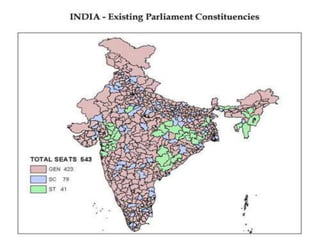
There has also been an increase in
political participation from the Dalits and
backward classes. Some seats are
reserved in Parliament for SCs and STs.
 Similarly, there is a reservation of seats
for women.
Navya Rai
Navya Rai
Navya Rai