2.5 Cartesian Vectors
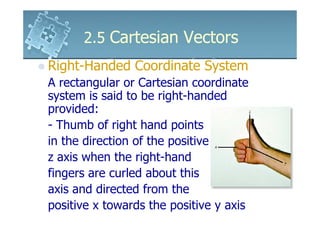
Right-Handed Coordinate System
A rectangular or Cartesian coordinate
system is said to be right-handed
provided:
- Thumb of right hand points
in the direction of the positive
z axis when the right-hand
fingers are curled about this
axis and directed from the
positive x towards the positive y axis
2.5 Cartesian Vectors
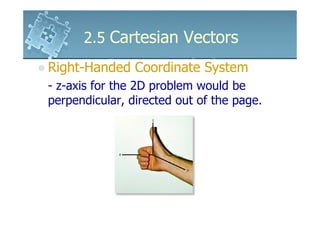
Right-Handed Coordinate System
- z-axis for the 2D problem would be
perpendicular, directed out of the page.
2.5 Cartesian Vectors
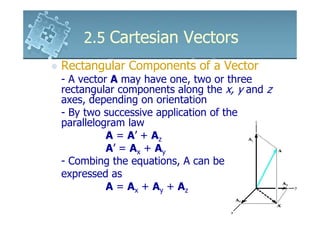
Rectangular Components of a Vector
- A vector A may have one, two or three
rectangular components along the x, y and z
axes, depending on orientation
- By two successive application of the
parallelogram law
          A = A’ + Az
          A’ = Ax + Ay
- Combing the equations, A can be
expressed as
          A = Ax + Ay + Az
2.5 Cartesian Vectors
  Unit Vector
  - Direction of A can be specified using a unit
  vector
  - Unit vector has a magnitude of 1
  - If A is a vector having a magnitude of A ≠ 0,
  unit vector having the same direction as A is
  expressed by
             uA = A / A
So that
             A = A uA
2.5 Cartesian Vectors

Unit Vector
- Since A is of a certain type, like force
vector, a proper set of units are used for the
description
- Magnitude A has the same sets of units,
hence unit vector is dimensionless
- A ( a positive scalar)
defines magnitude of A
- uA defines the direction
and sense of A
2.5 Cartesian Vectors

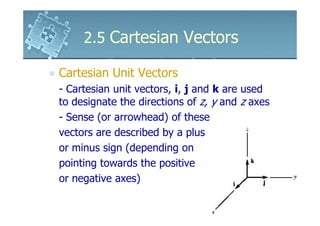
Cartesian Unit Vectors
- Cartesian unit vectors, i, j and k are used
to designate the directions of z, y and z axes
- Sense (or arrowhead) of these
vectors are described by a plus
or minus sign (depending on
pointing towards the positive
or negative axes)
2.5 Cartesian Vectors

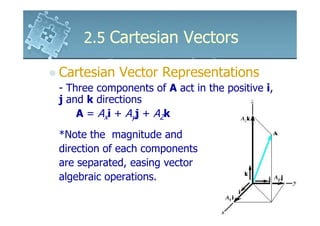
Cartesian Vector Representations
- Three components of A act in the positive i,
j and k directions
    A = Axi + Ayj + AZk
*Note the magnitude and
direction of each components
are separated, easing vector
algebraic operations.
2.5 Cartesian Vectors

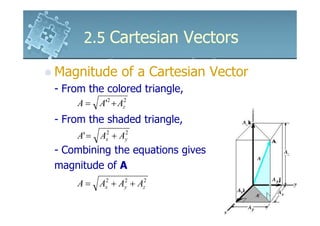
Magnitude of a Cartesian Vector
- From the colored triangle,
     A = A'2 + Az2
- From the shaded triangle,
     A' = Ax2 + Ay
                 2


- Combining the equations gives
magnitude of A
     A = Ax2 + Ay + Az2
                2
2.5 Cartesian Vectors
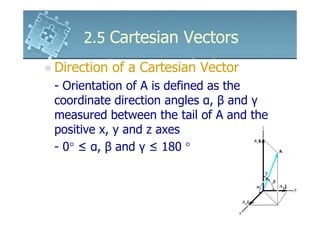
Direction of a Cartesian Vector
- Orientation of A is defined as the
coordinate direction angles α, β and γ
measured between the tail of A and the
positive x, y and z axes
- 0° ≤ α, β and γ ≤ 180 °
2.5 Cartesian Vectors

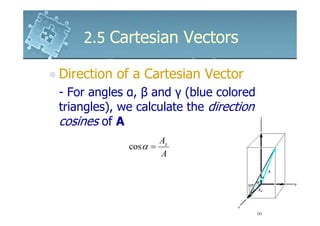
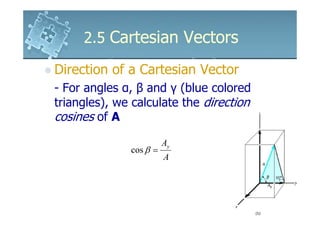
Direction of a Cartesian Vector
- For angles α, β and γ (blue colored
triangles), we calculate the direction
cosines of A
                     Ax
             cos α =
                     A
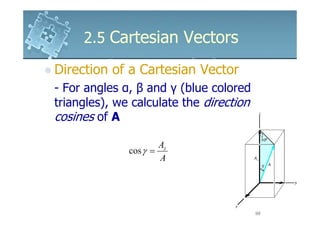
2.5 Cartesian Vectors

Direction of a Cartesian Vector
- For angles α, β and γ (blue colored
triangles), we calculate the direction
cosines of A
                        Ay
              cos β =
                        A
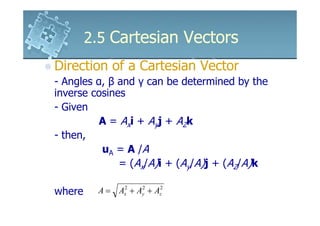
2.5 Cartesian Vectors

Direction of a Cartesian Vector
- For angles α, β and γ (blue colored
triangles), we calculate the direction
cosines of A

                      Az
              cos γ =
                      A
2.5 Cartesian Vectors
Direction of a Cartesian Vector
- Angles α, β and γ can be determined by the
inverse cosines
- Given
          A = Axi + Ayj + AZk
- then,
          uA = A /A
              = (Ax/A)i + (Ay/A)j + (AZ/A)k

where    A = Ax2 + Ay + Az2
                    2
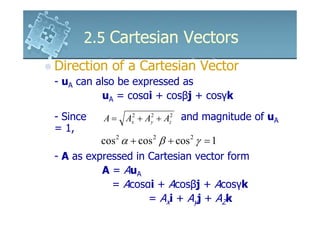
2.5 Cartesian Vectors
Direction of a Cartesian Vector
- uA can also be expressed as
          uA = cosαi + cosβj + cosγk
- Since   A = Ax + Ay + Az2 and magnitude of uA
               2    2

= 1,
          cos 2 α + cos 2 β + cos 2 γ = 1
- A as expressed in Cartesian vector form
          A = AuA
            = Acosαi + Acosβj + Acosγk
                      = Axi + Ayj + AZk

6161103 2.5 cartesian vectors

  • 1.
    2.5 Cartesian Vectors Right-HandedCoordinate System A rectangular or Cartesian coordinate system is said to be right-handed provided: - Thumb of right hand points in the direction of the positive z axis when the right-hand fingers are curled about this axis and directed from the positive x towards the positive y axis
  • 2.
    2.5 Cartesian Vectors Right-HandedCoordinate System - z-axis for the 2D problem would be perpendicular, directed out of the page.
  • 3.
    2.5 Cartesian Vectors RectangularComponents of a Vector - A vector A may have one, two or three rectangular components along the x, y and z axes, depending on orientation - By two successive application of the parallelogram law A = A’ + Az A’ = Ax + Ay - Combing the equations, A can be expressed as A = Ax + Ay + Az
  • 4.
    2.5 Cartesian Vectors Unit Vector - Direction of A can be specified using a unit vector - Unit vector has a magnitude of 1 - If A is a vector having a magnitude of A ≠ 0, unit vector having the same direction as A is expressed by uA = A / A So that A = A uA
  • 5.
    2.5 Cartesian Vectors UnitVector - Since A is of a certain type, like force vector, a proper set of units are used for the description - Magnitude A has the same sets of units, hence unit vector is dimensionless - A ( a positive scalar) defines magnitude of A - uA defines the direction and sense of A
  • 6.
    2.5 Cartesian Vectors CartesianUnit Vectors - Cartesian unit vectors, i, j and k are used to designate the directions of z, y and z axes - Sense (or arrowhead) of these vectors are described by a plus or minus sign (depending on pointing towards the positive or negative axes)
  • 7.
    2.5 Cartesian Vectors CartesianVector Representations - Three components of A act in the positive i, j and k directions A = Axi + Ayj + AZk *Note the magnitude and direction of each components are separated, easing vector algebraic operations.
  • 8.
    2.5 Cartesian Vectors Magnitudeof a Cartesian Vector - From the colored triangle, A = A'2 + Az2 - From the shaded triangle, A' = Ax2 + Ay 2 - Combining the equations gives magnitude of A A = Ax2 + Ay + Az2 2
  • 9.
    2.5 Cartesian Vectors Directionof a Cartesian Vector - Orientation of A is defined as the coordinate direction angles α, β and γ measured between the tail of A and the positive x, y and z axes - 0° ≤ α, β and γ ≤ 180 °
  • 10.
    2.5 Cartesian Vectors Directionof a Cartesian Vector - For angles α, β and γ (blue colored triangles), we calculate the direction cosines of A Ax cos α = A
  • 11.
    2.5 Cartesian Vectors Directionof a Cartesian Vector - For angles α, β and γ (blue colored triangles), we calculate the direction cosines of A Ay cos β = A
  • 12.
    2.5 Cartesian Vectors Directionof a Cartesian Vector - For angles α, β and γ (blue colored triangles), we calculate the direction cosines of A Az cos γ = A
  • 13.
    2.5 Cartesian Vectors Directionof a Cartesian Vector - Angles α, β and γ can be determined by the inverse cosines - Given A = Axi + Ayj + AZk - then, uA = A /A = (Ax/A)i + (Ay/A)j + (AZ/A)k where A = Ax2 + Ay + Az2 2
  • 14.
    2.5 Cartesian Vectors Directionof a Cartesian Vector - uA can also be expressed as uA = cosαi + cosβj + cosγk - Since A = Ax + Ay + Az2 and magnitude of uA 2 2 = 1, cos 2 α + cos 2 β + cos 2 γ = 1 - A as expressed in Cartesian vector form A = AuA = Acosαi + Acosβj + Acosγk = Axi + Ayj + AZk