7.3 Relations between Distributed
         Load, Shear and Moment
Distributed Load
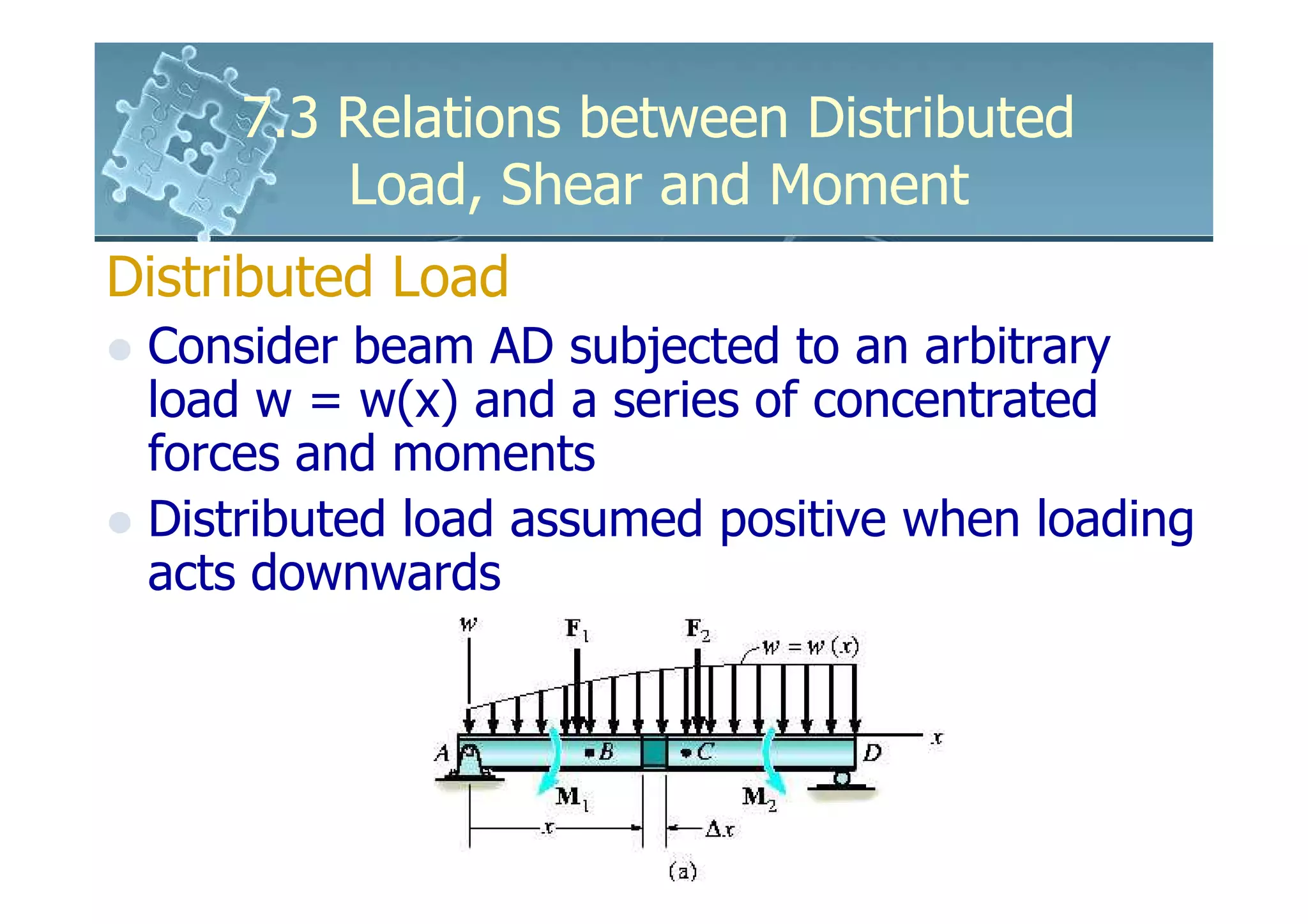
 Consider beam AD subjected to an arbitrary
 load w = w(x) and a series of concentrated
 forces and moments
 Distributed load assumed positive when loading
 acts downwards
7.3 Relations between Distributed
     Load, Shear and Moment
Distributed Load
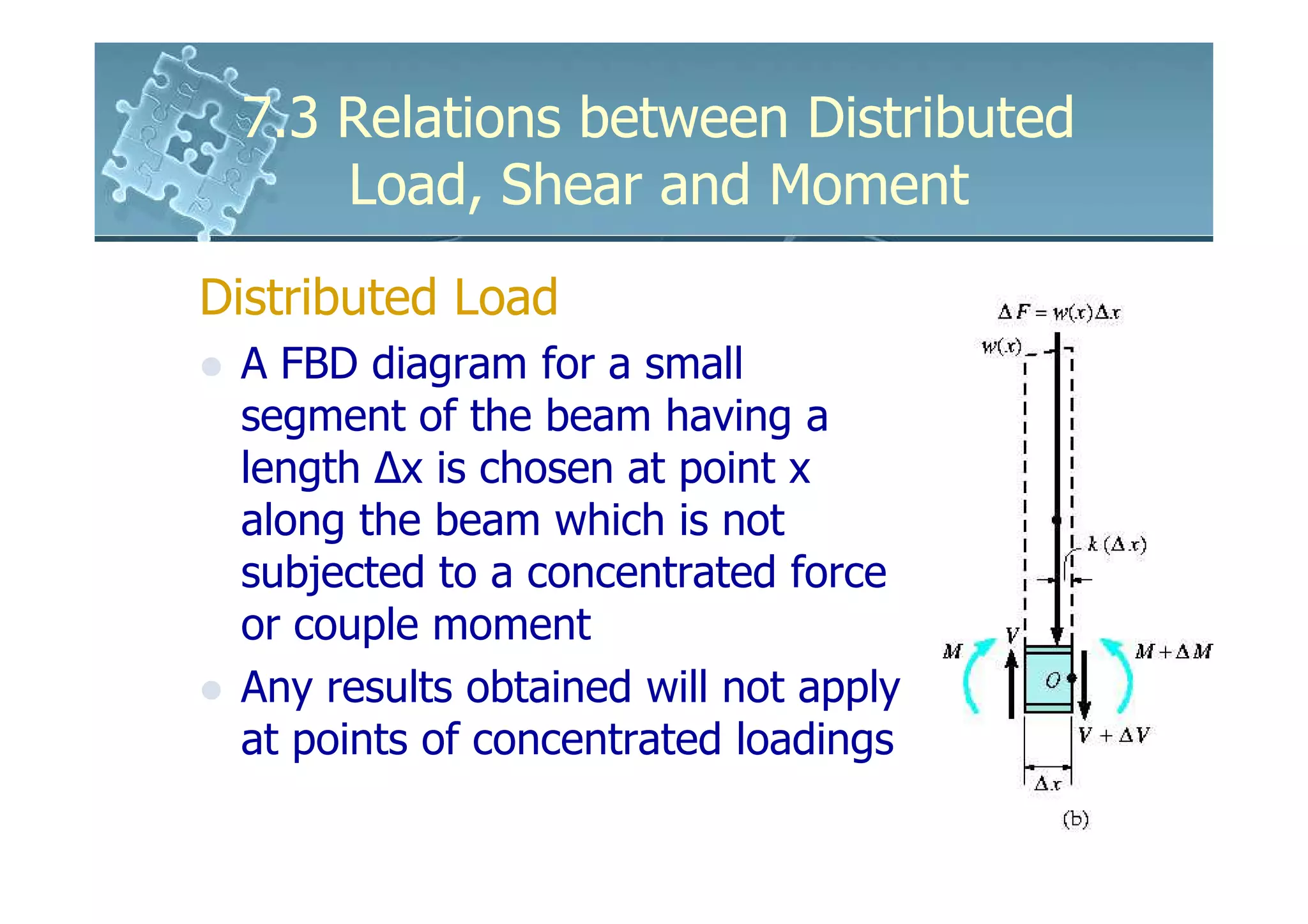
 A FBD diagram for a small
 segment of the beam having a
 length ∆x is chosen at point x
 along the beam which is not
 subjected to a concentrated force
 or couple moment
 Any results obtained will not apply
 at points of concentrated loadings
7.3 Relations between Distributed
      Load, Shear and Moment
Distributed Load
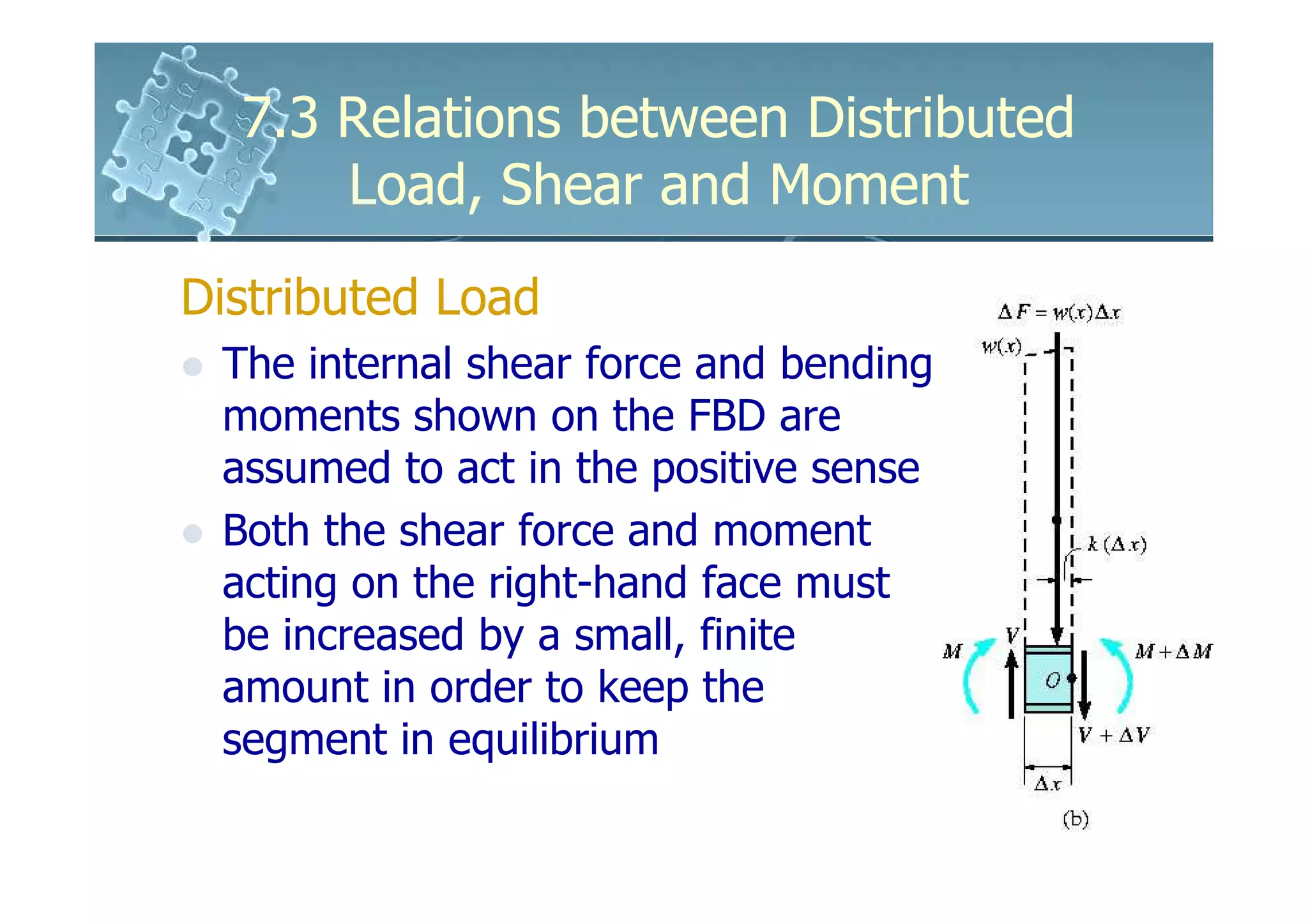
 The internal shear force and bending
 moments shown on the FBD are
 assumed to act in the positive sense
 Both the shear force and moment
 acting on the right-hand face must
 be increased by a small, finite
 amount in order to keep the
 segment in equilibrium
7.3 Relations between Distributed
       Load, Shear and Moment
Distributed Load
  The distributed loading has been replaced by a
  resultant force ∆F = w(x) ∆x that acts at a
  fractional distance k (∆x) from the right end,
  where 0 < k <1
+ ↑ ∑ Fy = 0;V − w( x)∆x − (V + ∆V ) = 0
∆V = − w( x)∆x
∑ M = 0;−V∆x − M + w( x)∆x[k (∆x )] + ( M + ∆M ) = 0
∆M = V∆x − w( x)k (∆x)   2
7.3 Relations between Distributed
          Load, Shear and Moment
Distributed Load
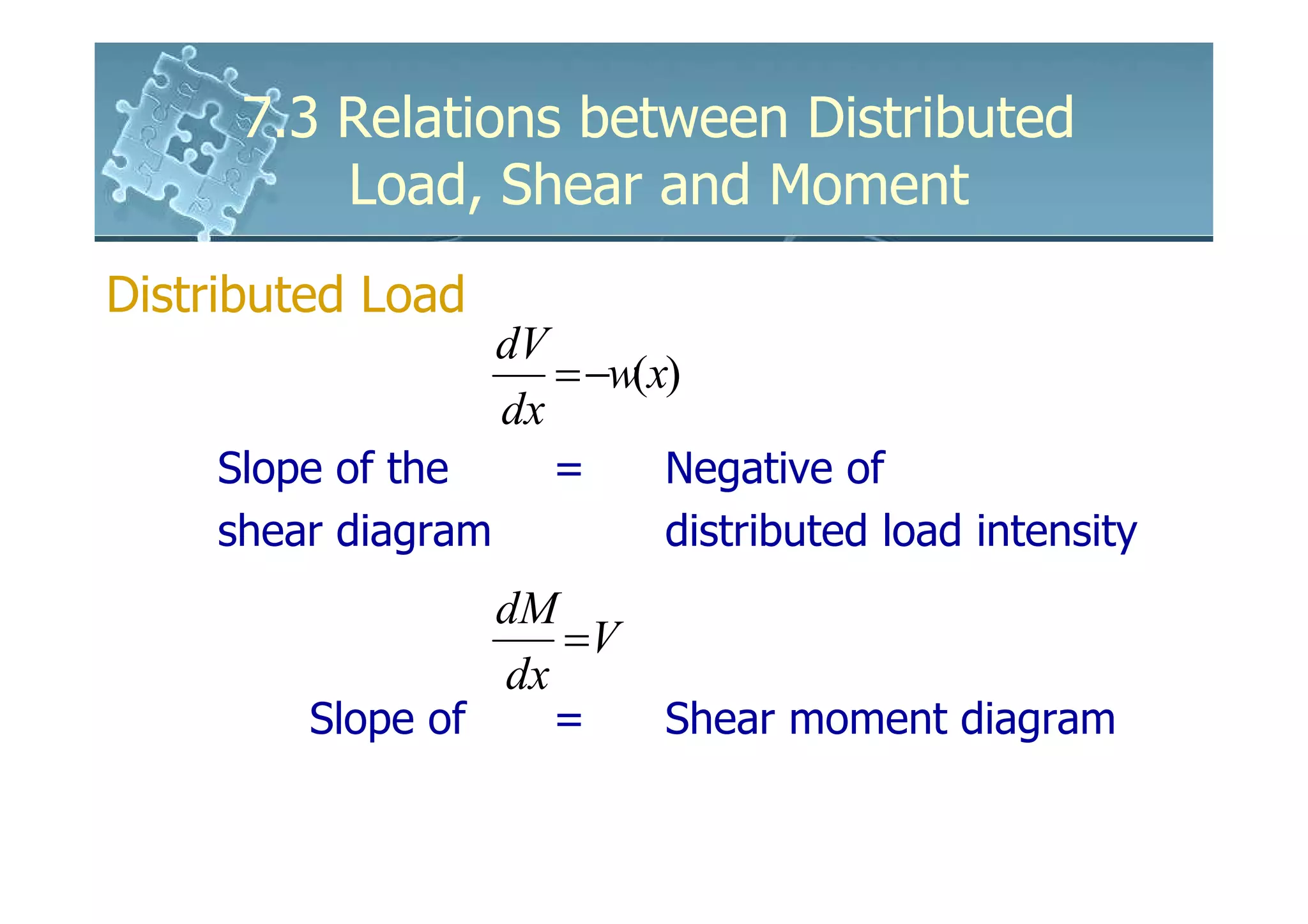
                    dV
                       = −w(x)
                    dx
    Slope of the       =     Negative of
    shear diagram            distributed load intensity
                    dM
                       =V
                    dx
         Slope of      =     Shear moment diagram
7.3 Relations between Distributed
      Load, Shear and Moment
Distributed Load
 At a specified point in a beam, the slope of the
 shear diagram is equal to the intensity of the
 distributed load
 Slope of the moment diagram = shear
 If the shear is equal to zero, dM/dx = 0, a point
 of zero shear corresponds to a point of maximum
 (or possibly minimum) moment
 w (x) dx and V dx represent differential area
 under the distributed loading and shear diagrams
7.3 Relations between Distributed
          Load, Shear and Moment
Distributed Load
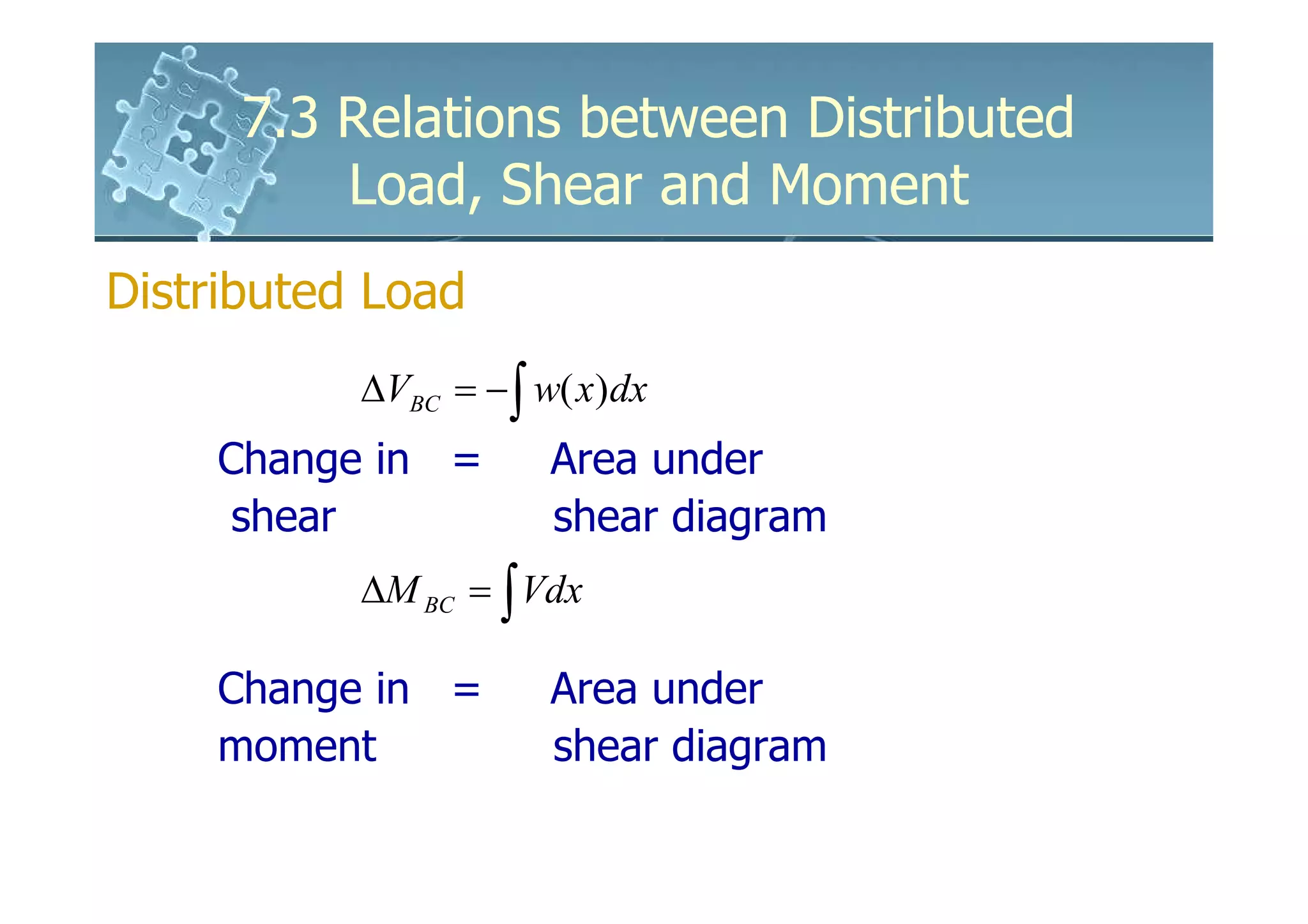
           ∆VBC = − ∫ w( x)dx
    Change in =       Area under
     shear            shear diagram
           ∆M BC = ∫ Vdx

    Change in =       Area under
    moment            shear diagram
7.3 Relations between Distributed
     Load, Shear and Moment
Distributed Load
 Change in shear between points B and C is
 equal to the negative of the area under the
 distributed-loading curve between these
 points
 Change in moment between B and C is equal
 to the area under the shear diagram within
 region BC
 The equations so not apply at points where
 concentrated force or couple moment acts
7.3 Relations between Distributed
     Load, Shear and Moment
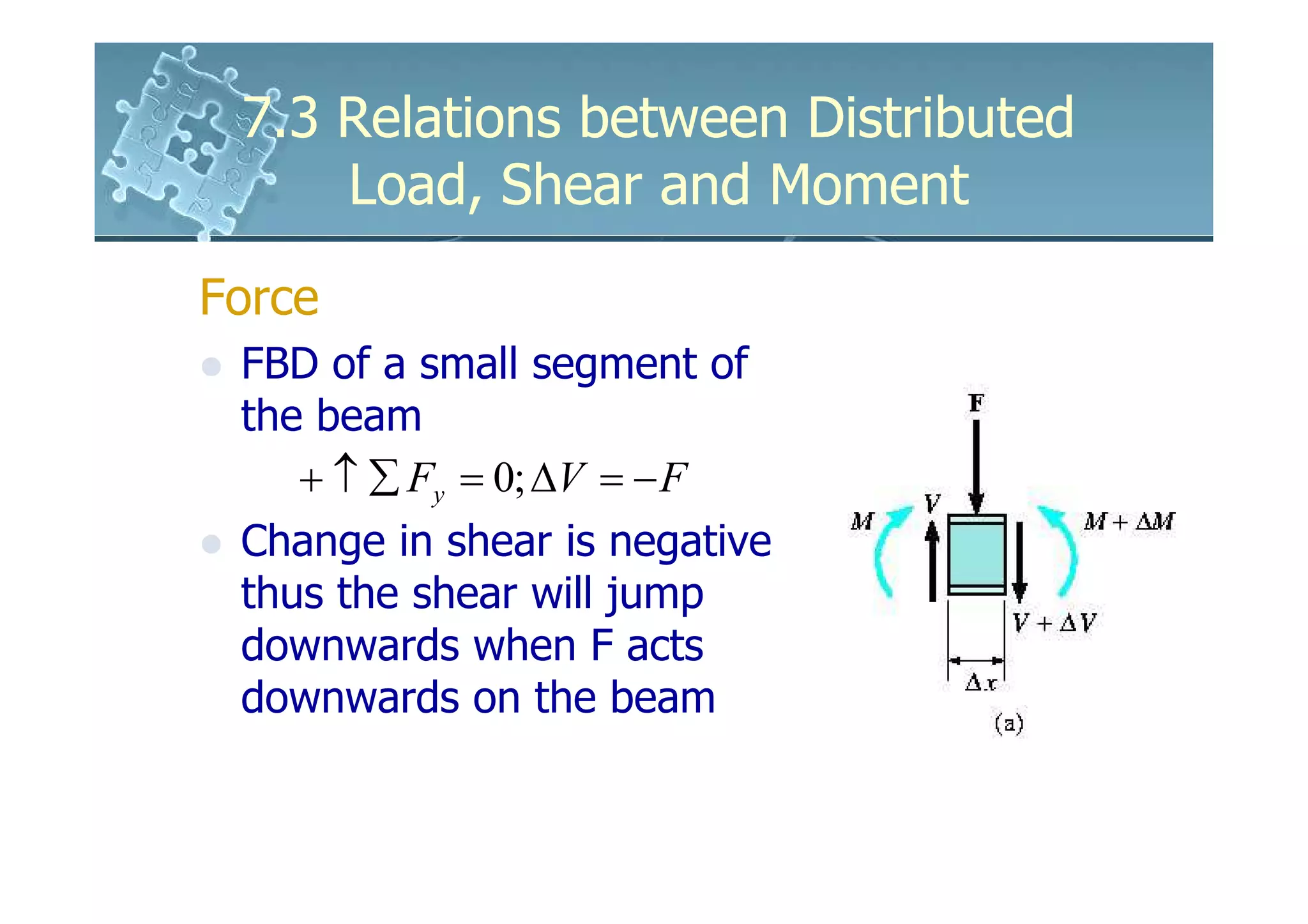
Force
 FBD of a small segment of
 the beam
    + ↑ ∑ Fy = 0; ∆V = − F
 Change in shear is negative
 thus the shear will jump
 downwards when F acts
 downwards on the beam
7.3 Relations between Distributed
     Load, Shear and Moment
Force
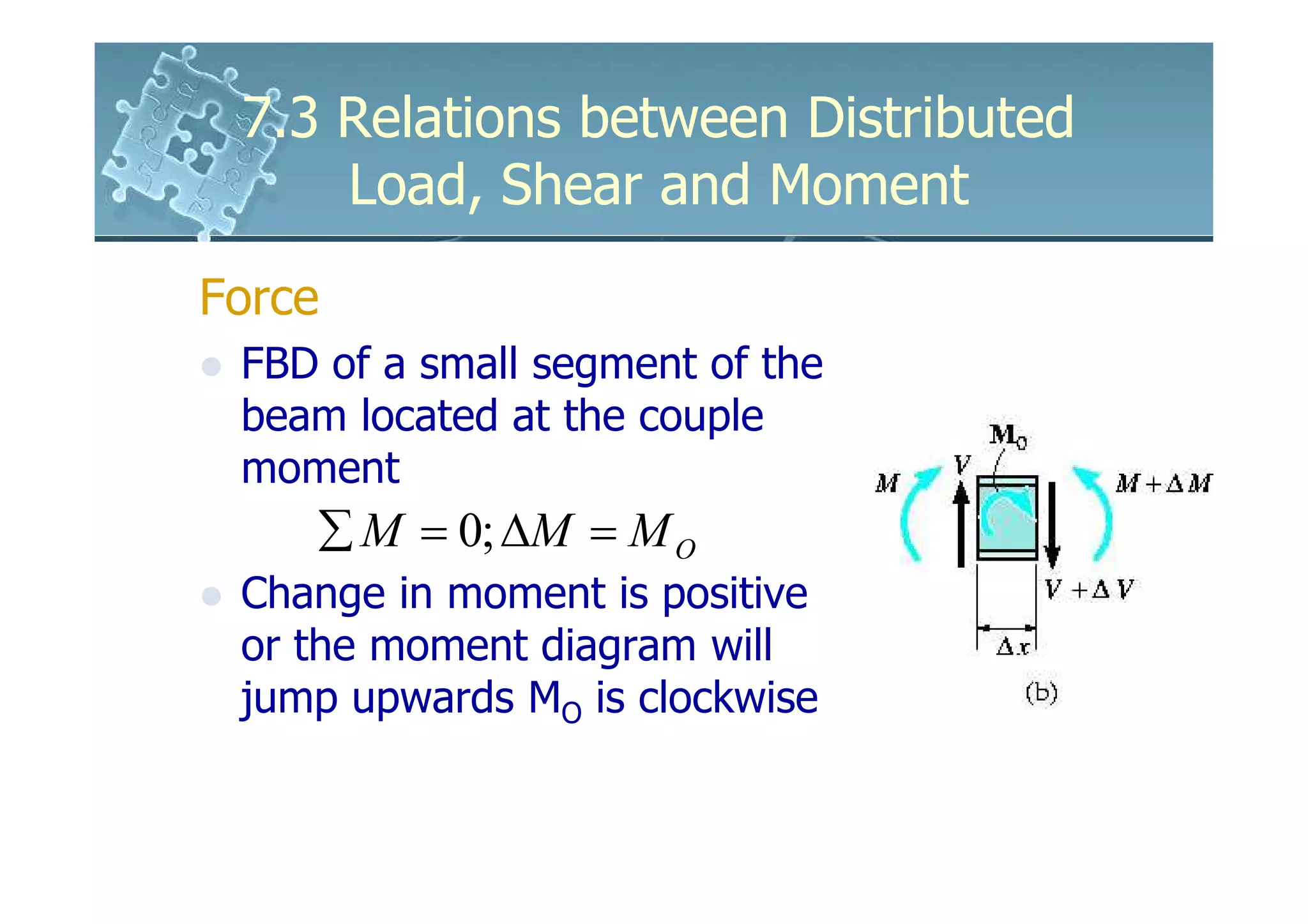
 FBD of a small segment of the
 beam located at the couple
 moment
    ∑ M = 0; ∆M = M O
 Change in moment is positive
 or the moment diagram will
 jump upwards MO is clockwise
7.3 Relations between Distributed
         Load, Shear and Moment
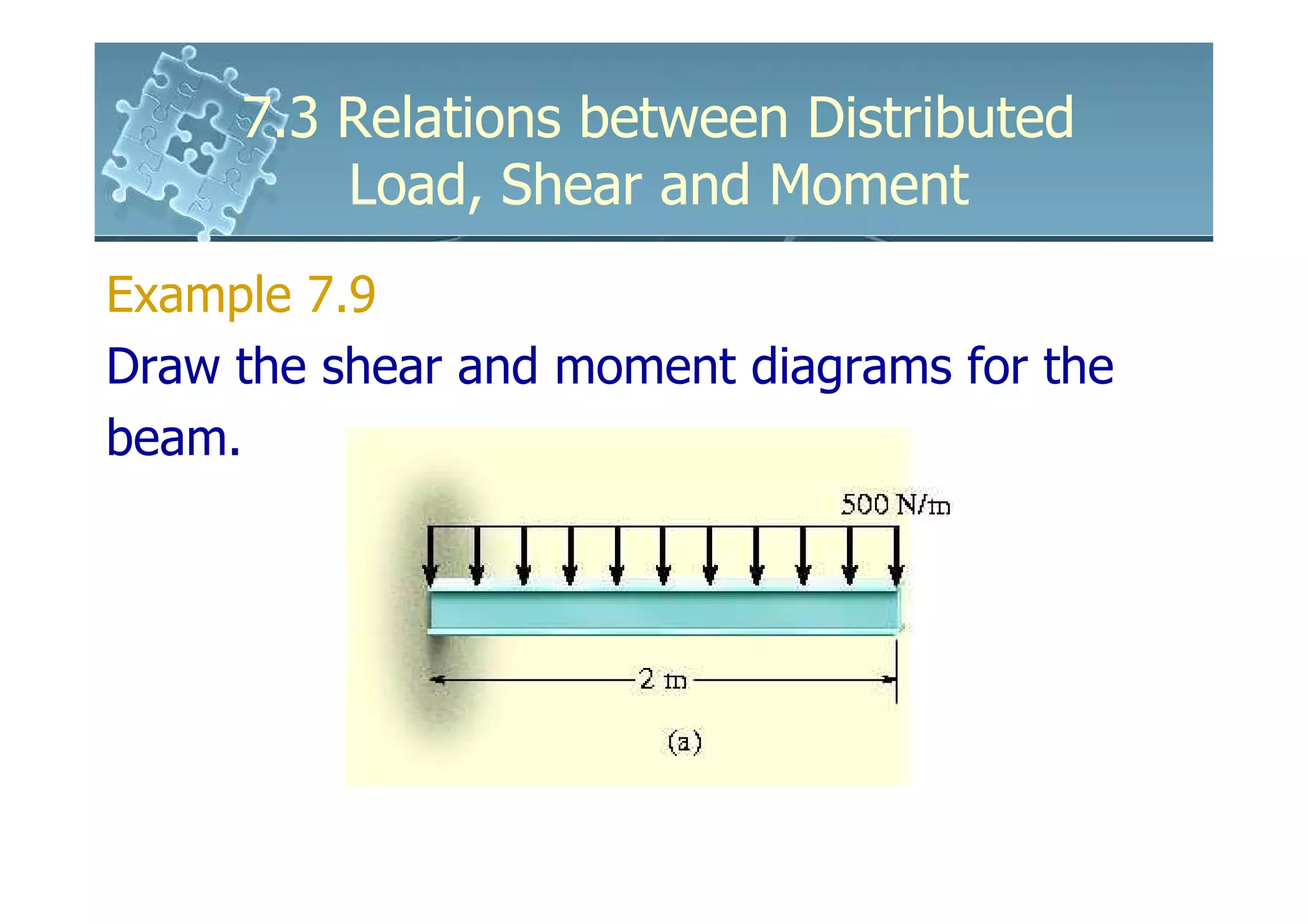
Example 7.9
Draw the shear and moment diagrams for the
beam.
7.3 Relations between Distributed
      Load, Shear and Moment
Solution
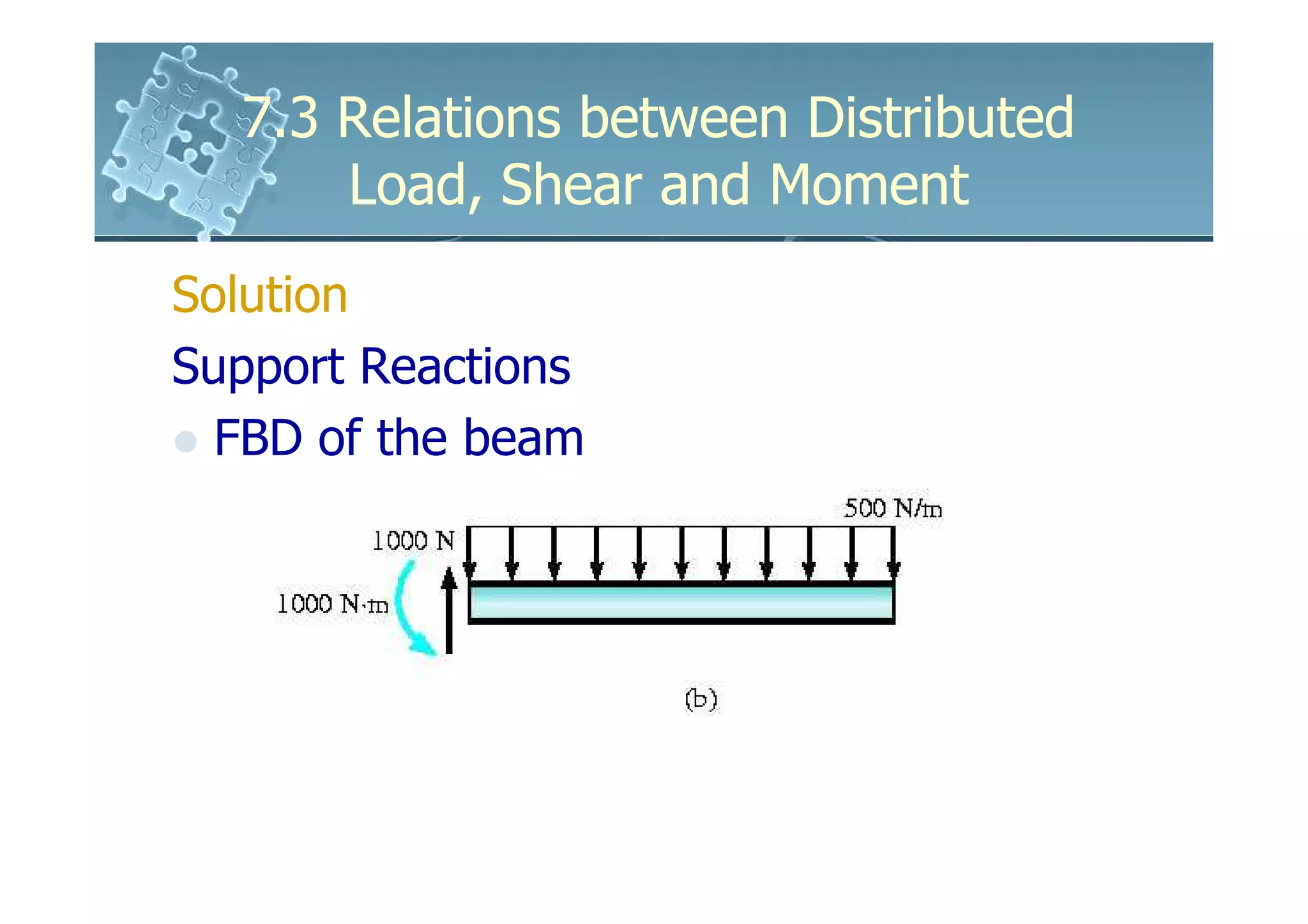
Support Reactions
  FBD of the beam
7.3 Relations between Distributed
          Load, Shear and Moment
Solution
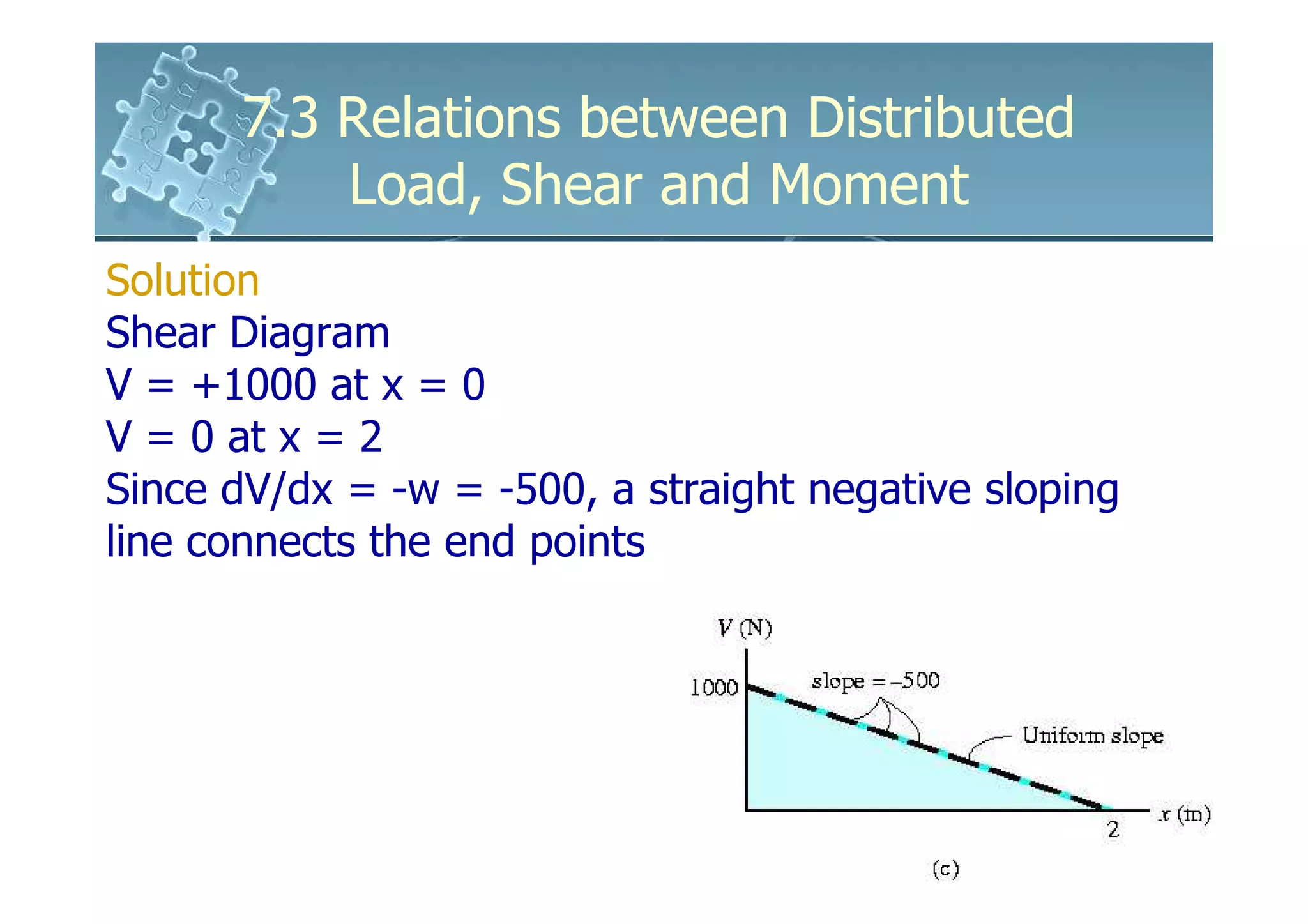
Shear Diagram
V = +1000 at x = 0
V = 0 at x = 2
Since dV/dx = -w = -500, a straight negative sloping
line connects the end points
7.3 Relations between Distributed
          Load, Shear and Moment
Solution
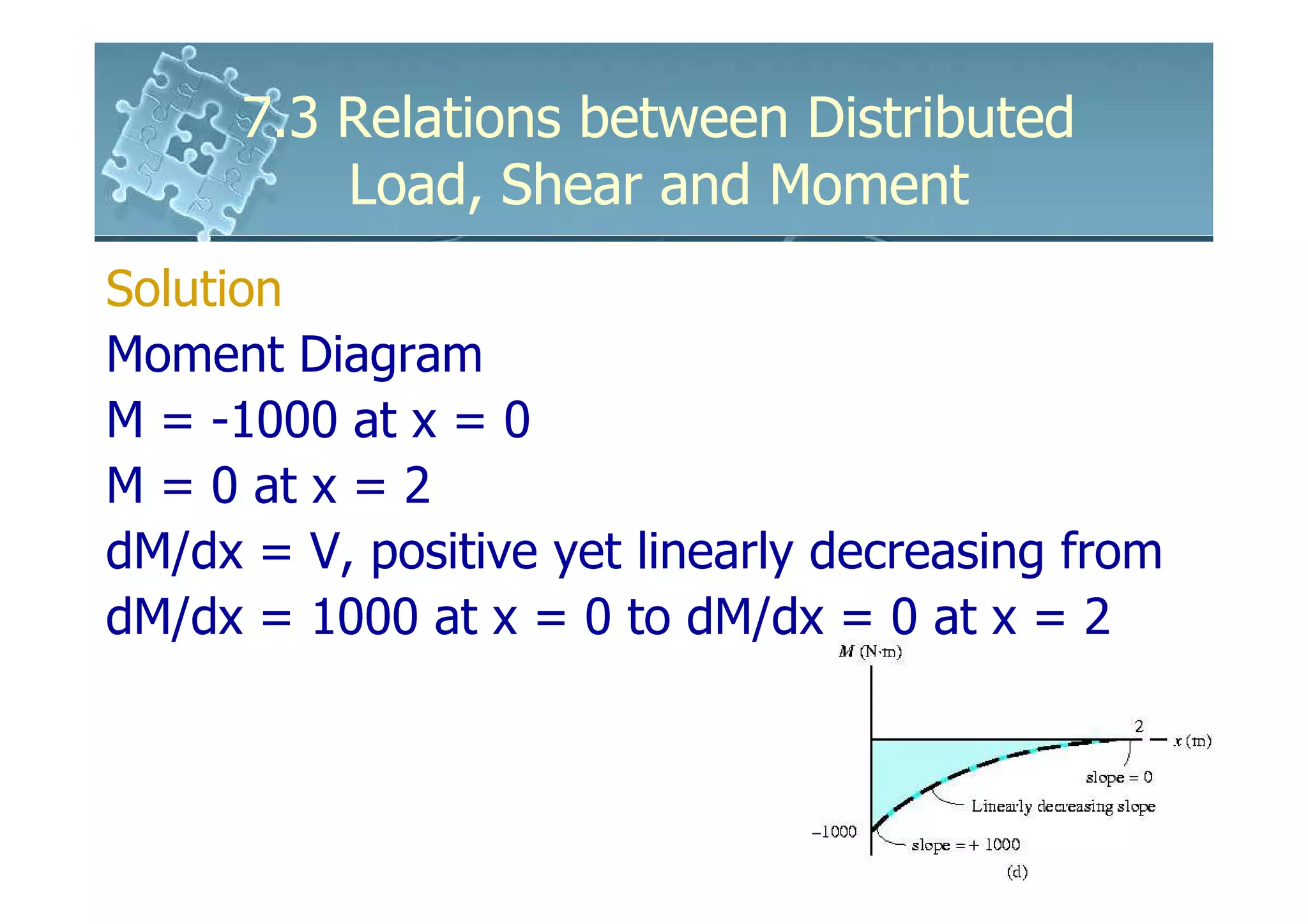
Moment Diagram
M = -1000 at x = 0
M = 0 at x = 2
dM/dx = V, positive yet linearly decreasing from
dM/dx = 1000 at x = 0 to dM/dx = 0 at x = 2
7.3 Relations between Distributed
         Load, Shear and Moment
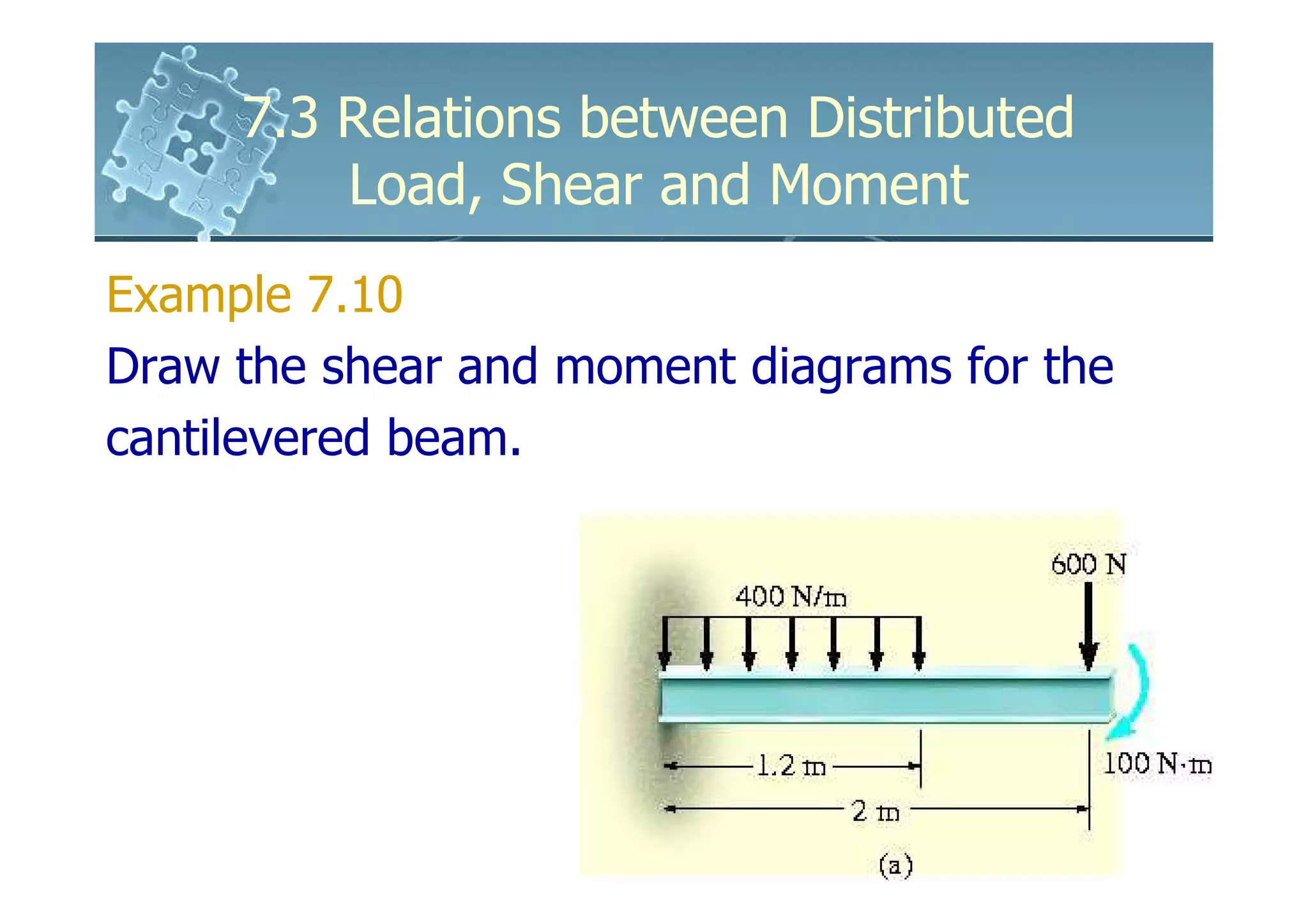
Example 7.10
Draw the shear and moment diagrams for the
cantilevered beam.
7.3 Relations between Distributed
      Load, Shear and Moment
Solution
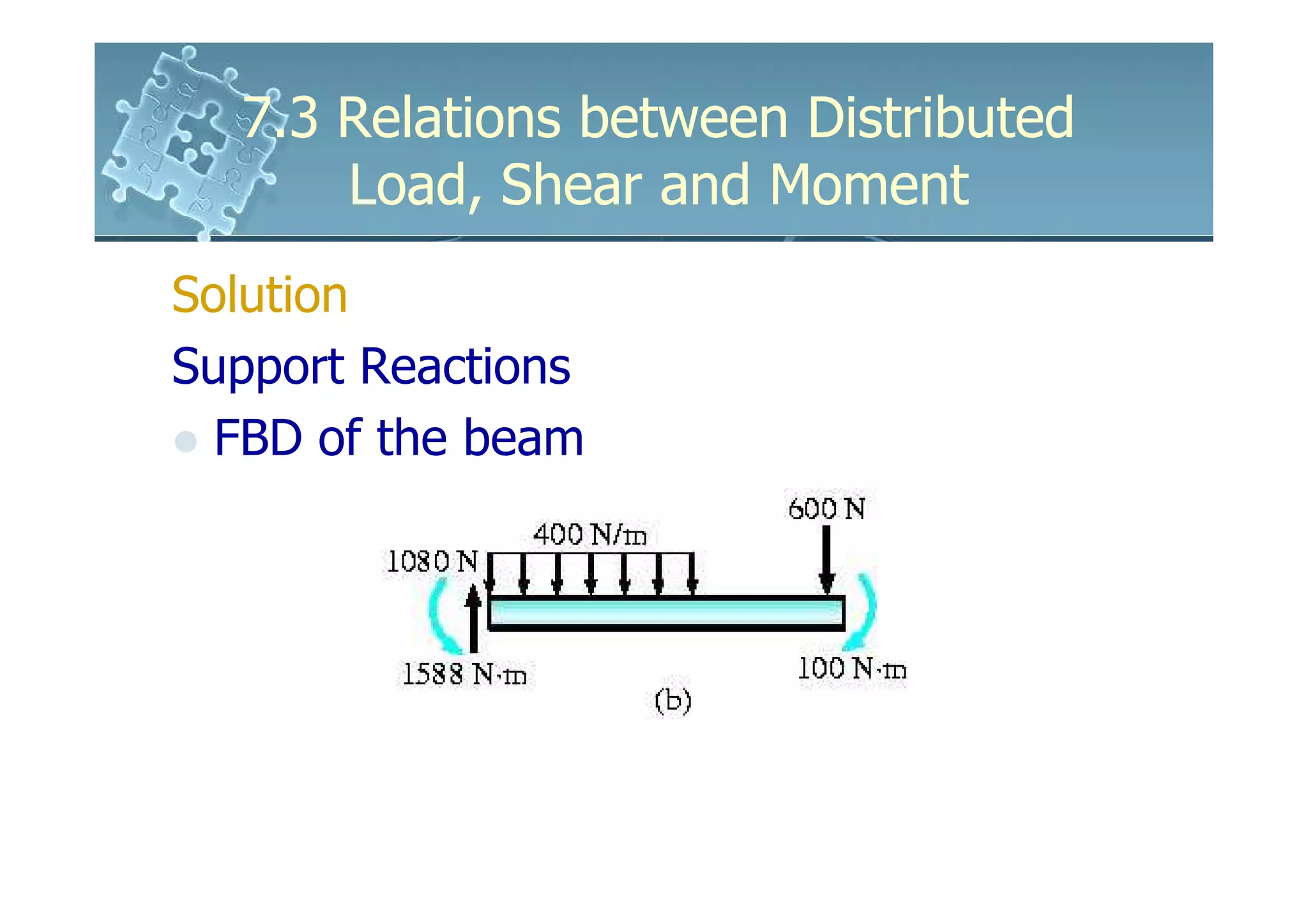
Support Reactions
  FBD of the beam
7.3 Relations between Distributed
       Load, Shear and Moment
Solution
  At the ends of the beams,
  when x = 0, V = +1080
  when x = 2, V = +600
  Uniform load is downwards and slope of
  the shear diagram is constant
  dV/dx = -w = - 400     for 0 ≤ x ≤ 1.2
  The above represents a change in shear
7.3 Relations between Distributed
      Load, Shear and Moment
Solution
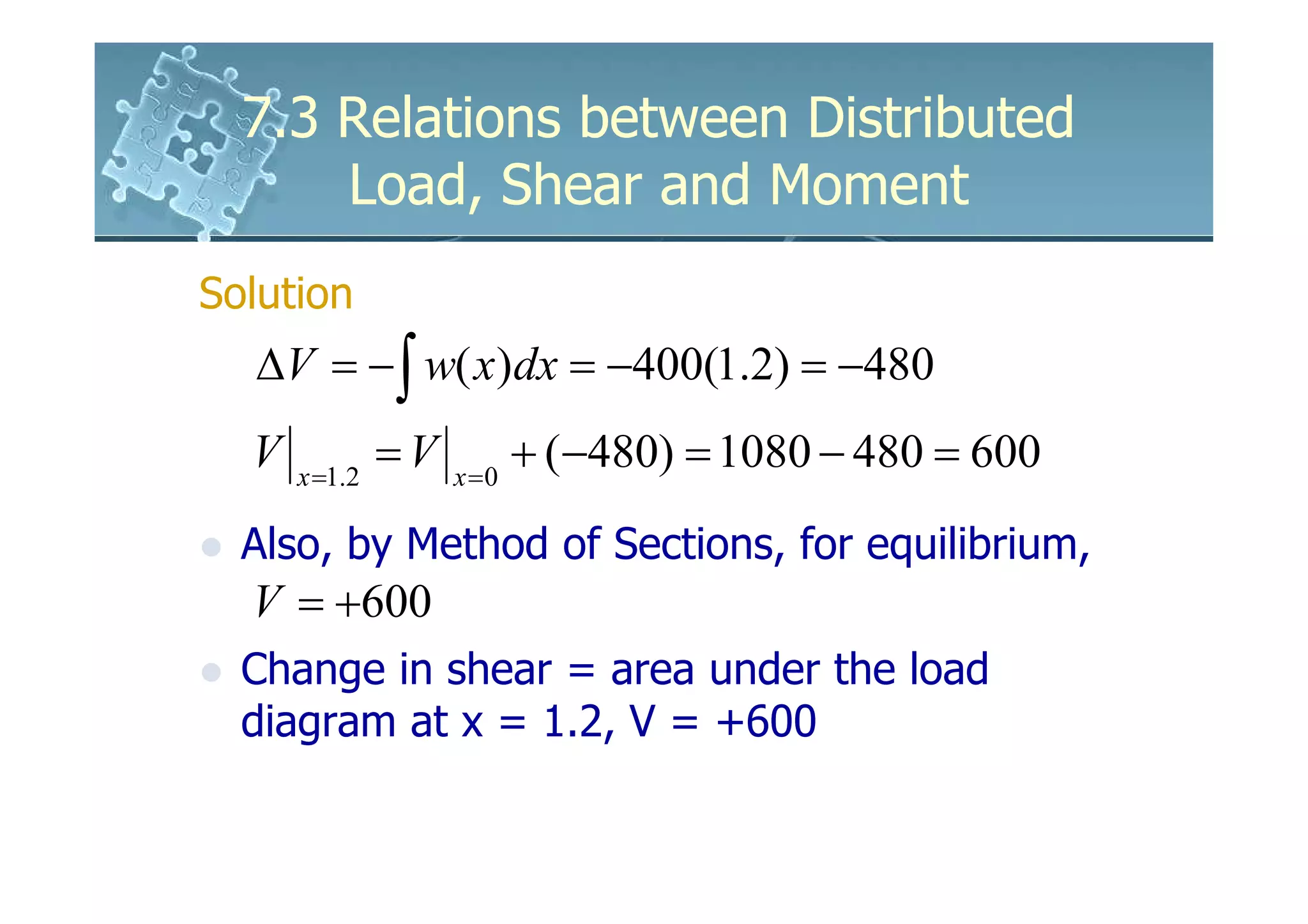
  ∆V = − ∫ w( x)dx = −400(1.2) = −480
  V   x =1.2
               =V   x =0
                           + (−480) = 1080 − 480 = 600
  Also, by Method of Sections, for equilibrium,
  V = +600
  Change in shear = area under the load
  diagram at x = 1.2, V = +600
7.3 Relations between Distributed
       Load, Shear and Moment
Solution
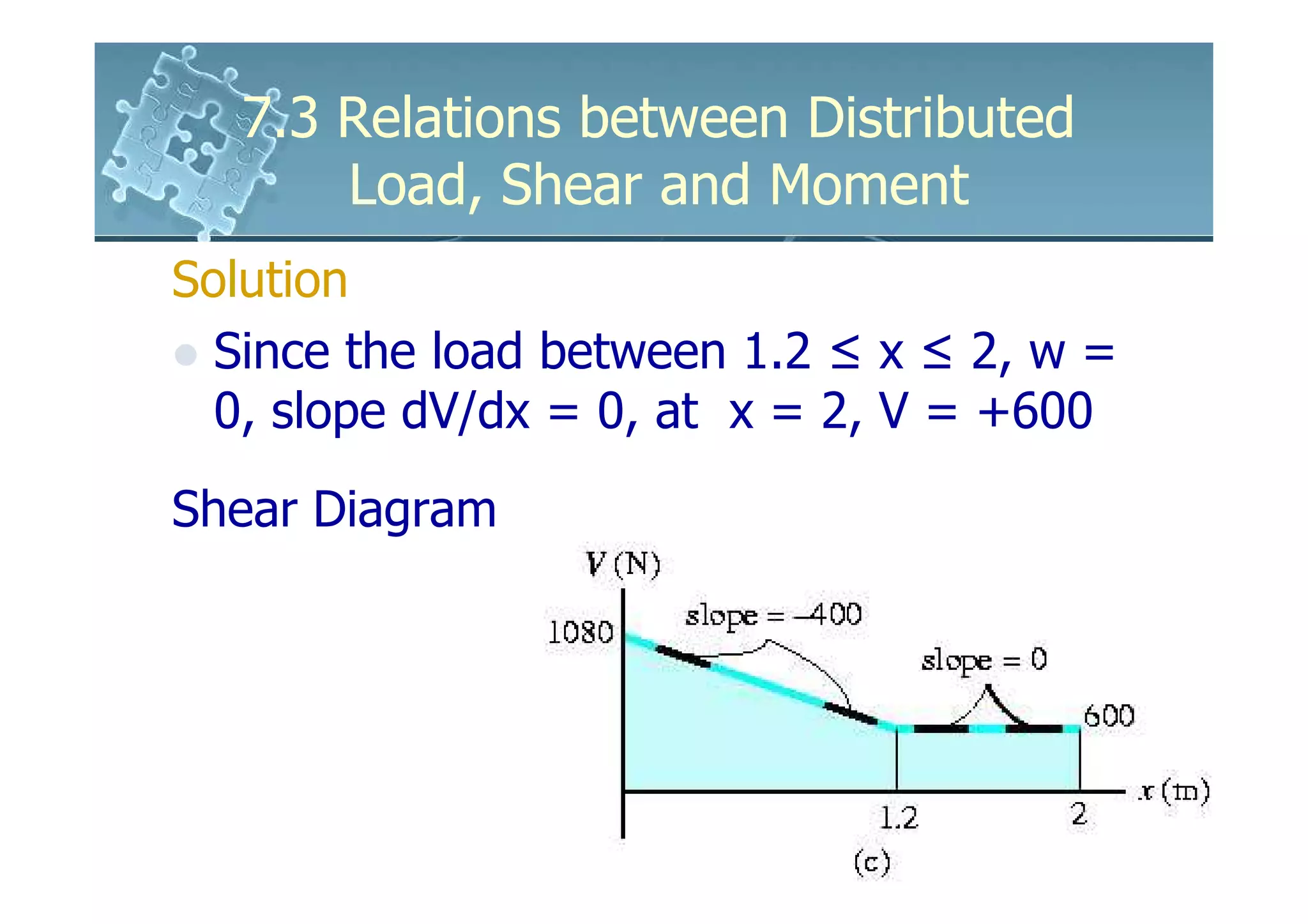
  Since the load between 1.2 ≤ x ≤ 2, w =
  0, slope dV/dx = 0, at x = 2, V = +600
Shear Diagram
7.3 Relations between Distributed
       Load, Shear and Moment
Solution
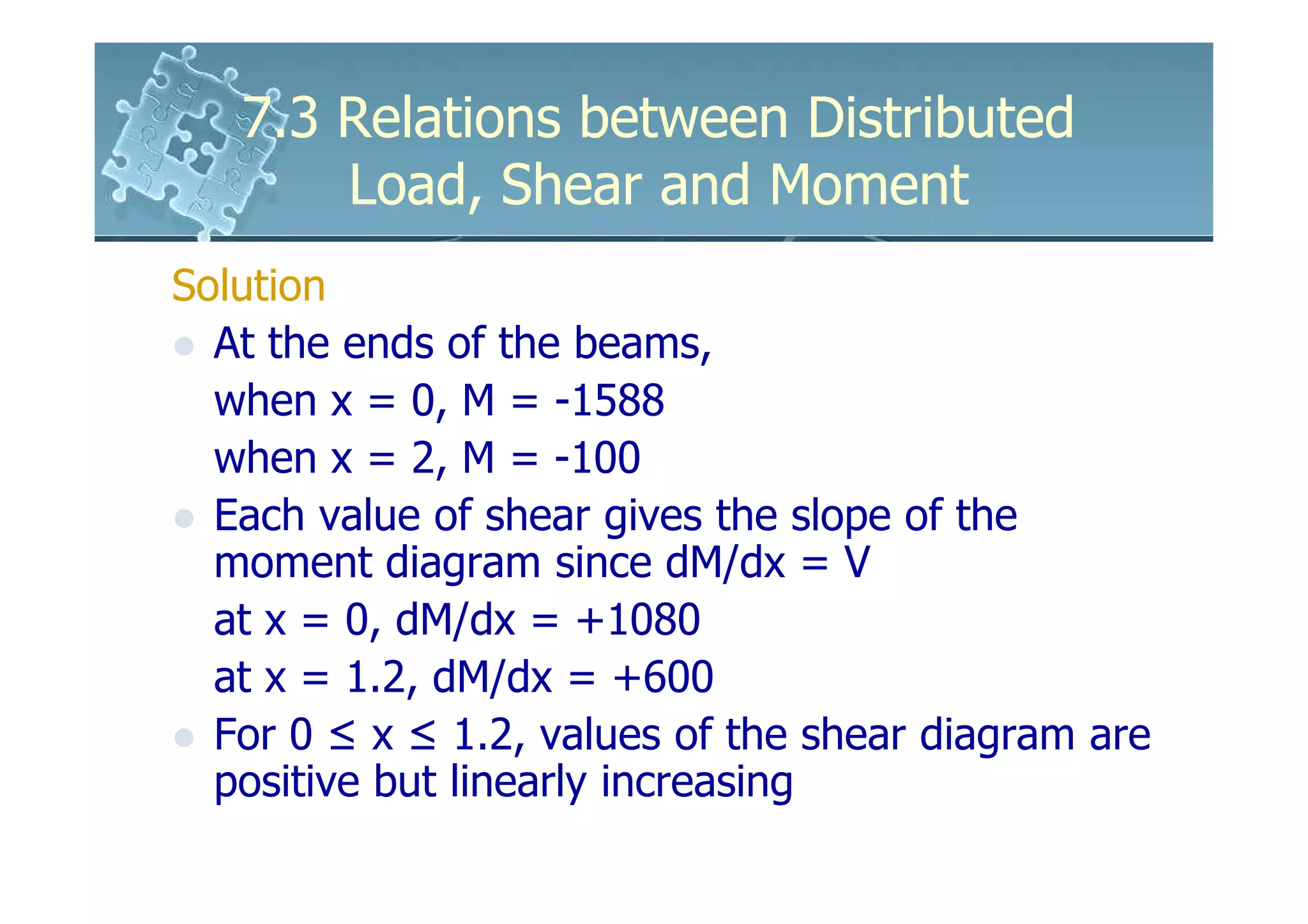
  At the ends of the beams,
  when x = 0, M = -1588
  when x = 2, M = -100
  Each value of shear gives the slope of the
  moment diagram since dM/dx = V
  at x = 0, dM/dx = +1080
  at x = 1.2, dM/dx = +600
  For 0 ≤ x ≤ 1.2, values of the shear diagram are
  positive but linearly increasing
7.3 Relations between Distributed
       Load, Shear and Moment
Solution
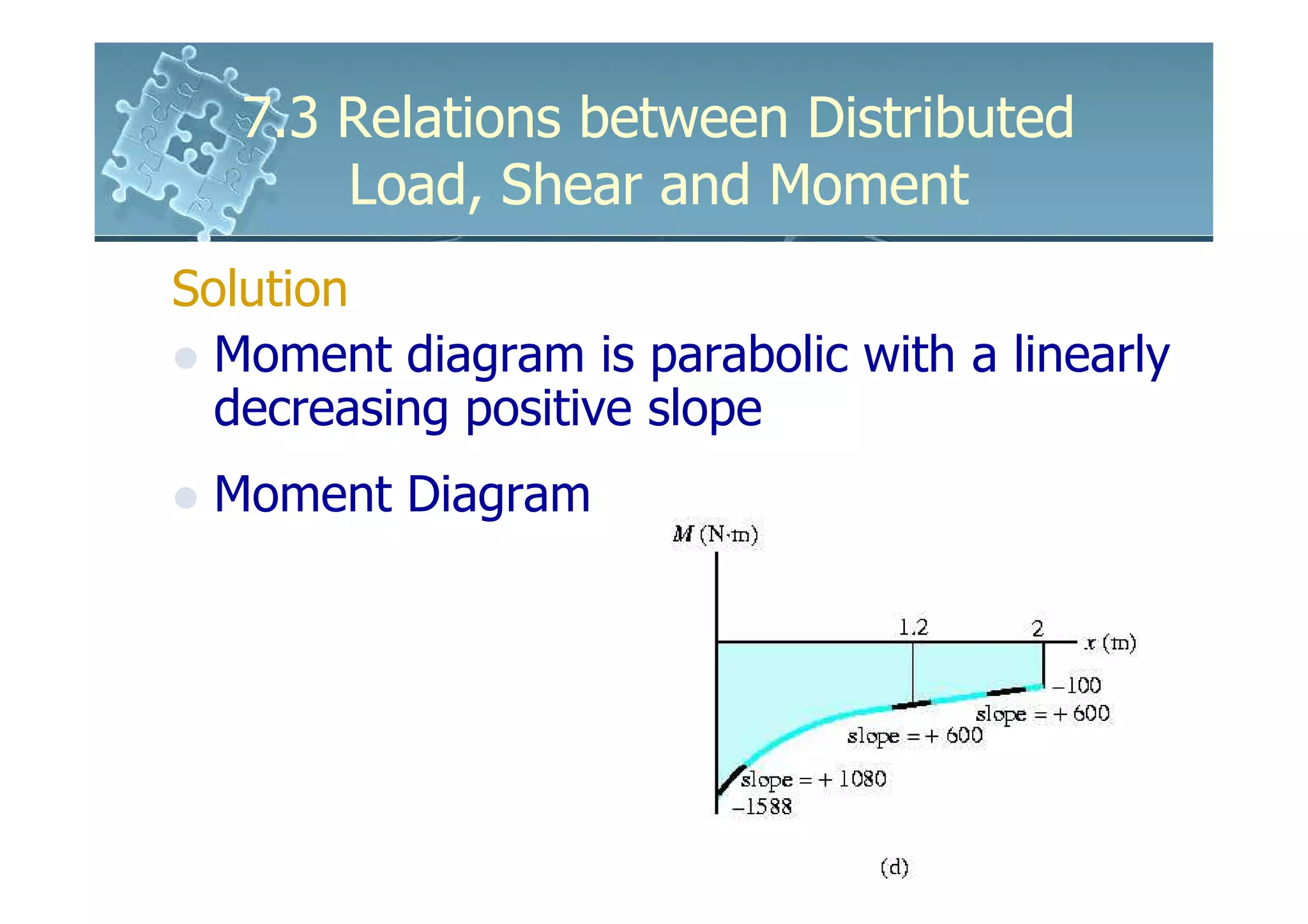
  Moment diagram is parabolic with a linearly
  decreasing positive slope
 Moment Diagram
7.3 Relations between Distributed
      Load, Shear and Moment
Solution
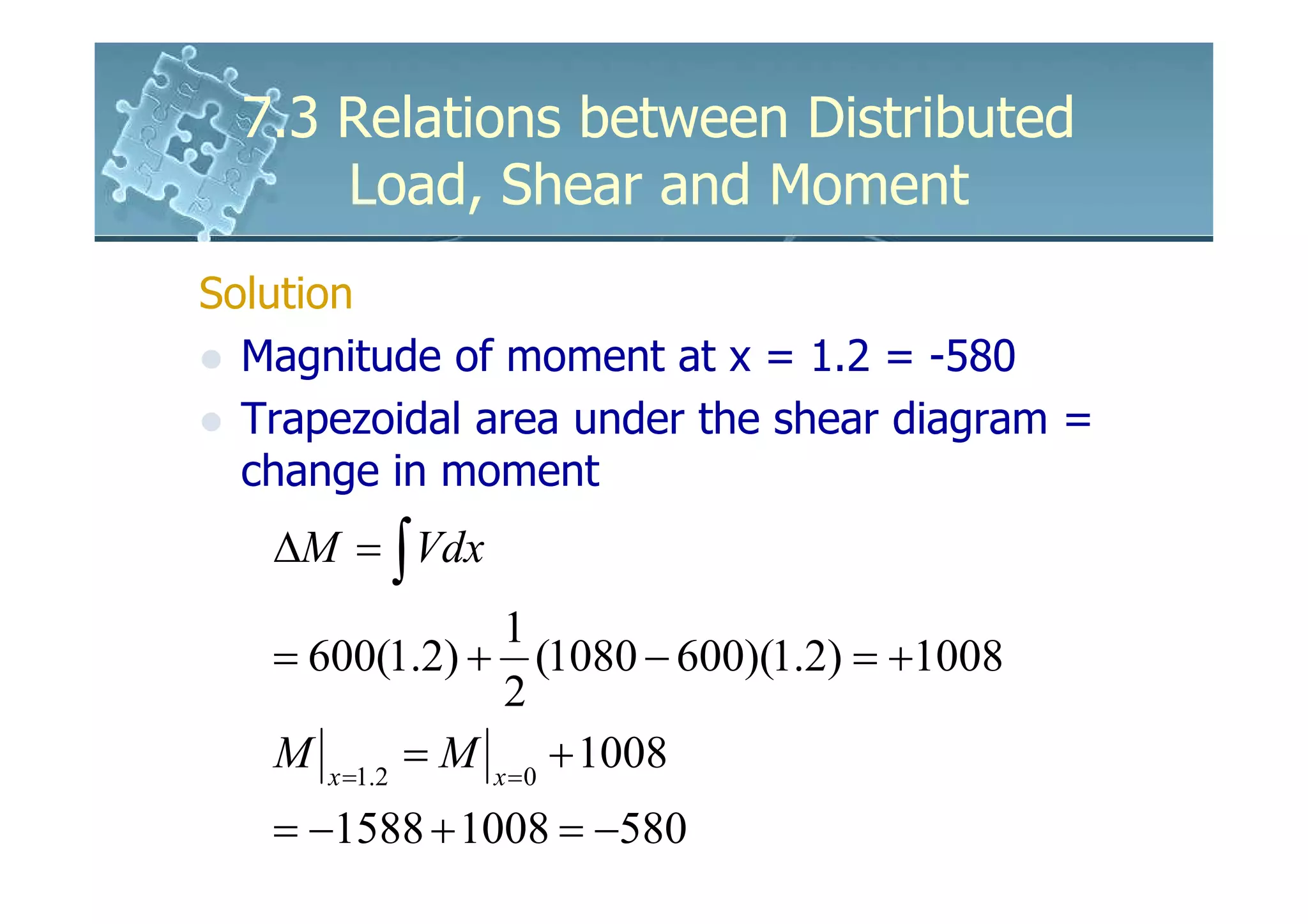
  Magnitude of moment at x = 1.2 = -580
  Trapezoidal area under the shear diagram =
  change in moment
   ∆M = ∫ Vdx
                 1
   = 600(1.2) + (1080 − 600)(1.2) = +1008
                 2
   M x =1.2 = M x =0 + 1008
   = −1588 + 1008 = −580
7.3 Relations between Distributed
       Load, Shear and Moment
Solution
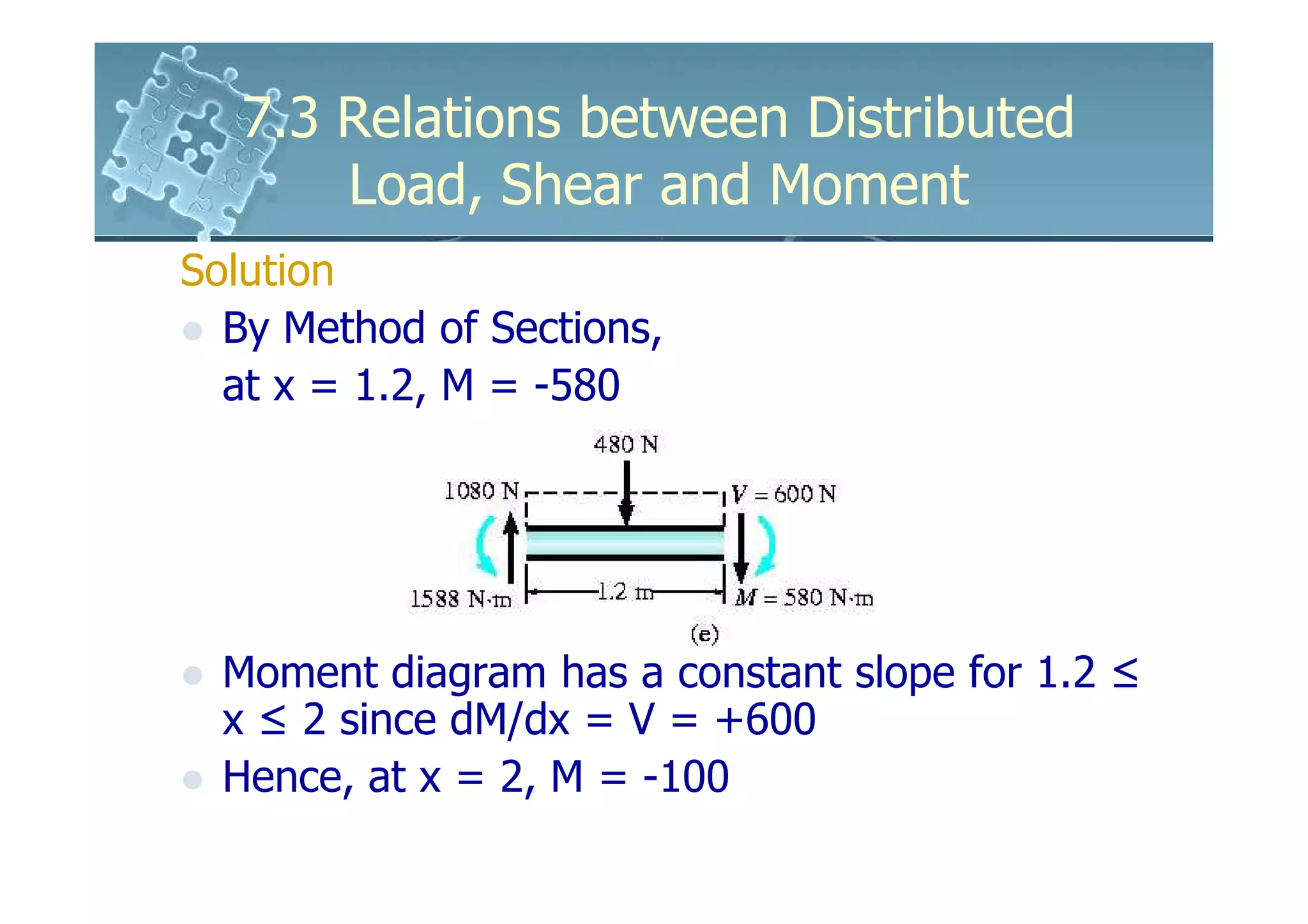
  By Method of Sections,
  at x = 1.2, M = -580


  Moment diagram has a constant slope for 1.2 ≤
  x ≤ 2 since dM/dx = V = +600
  Hence, at x = 2, M = -100
7.3 Relations between Distributed
         Load, Shear and Moment
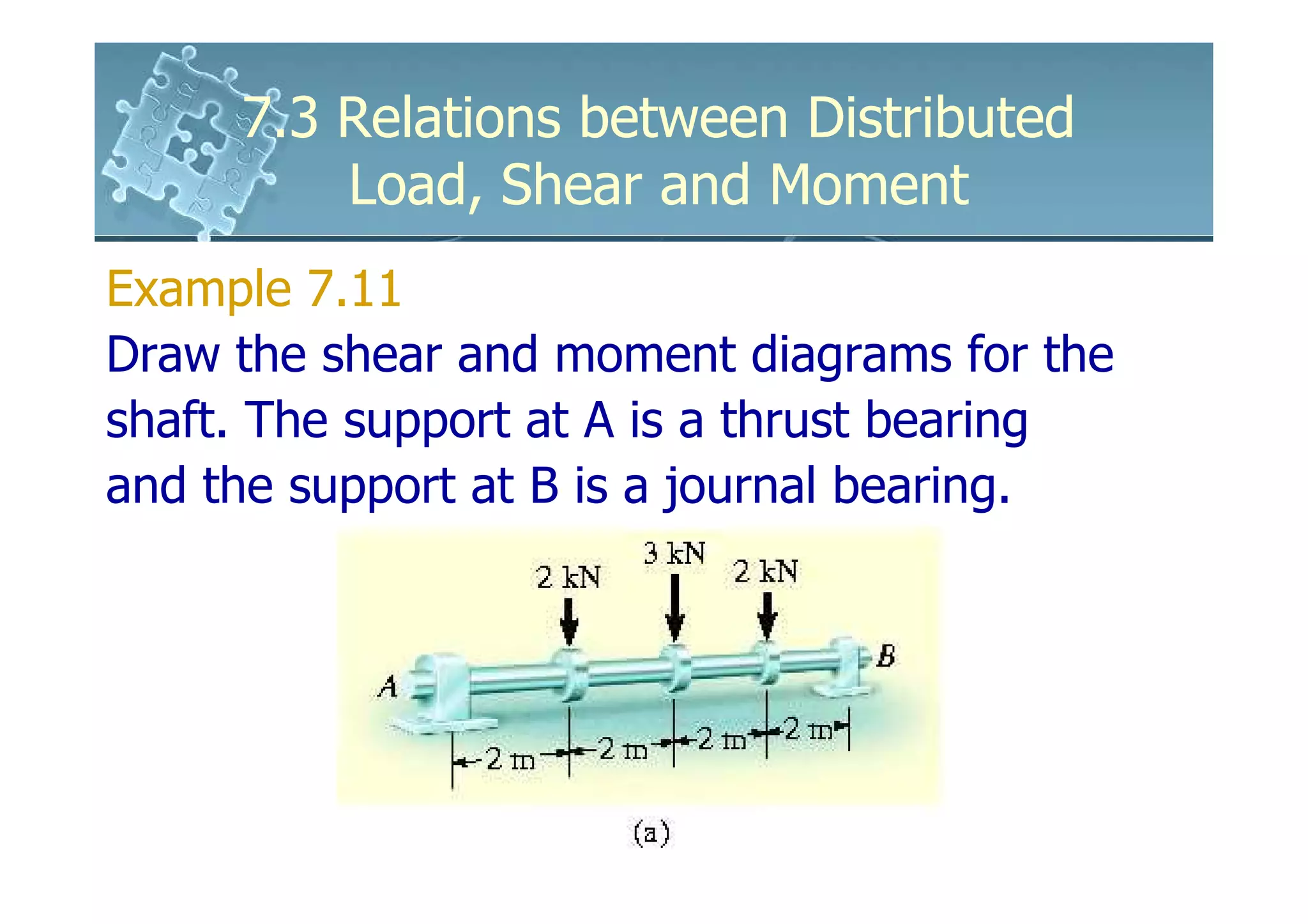
Example 7.11
Draw the shear and moment diagrams for the
shaft. The support at A is a thrust bearing
and the support at B is a journal bearing.
7.3 Relations between Distributed
       Load, Shear and Moment
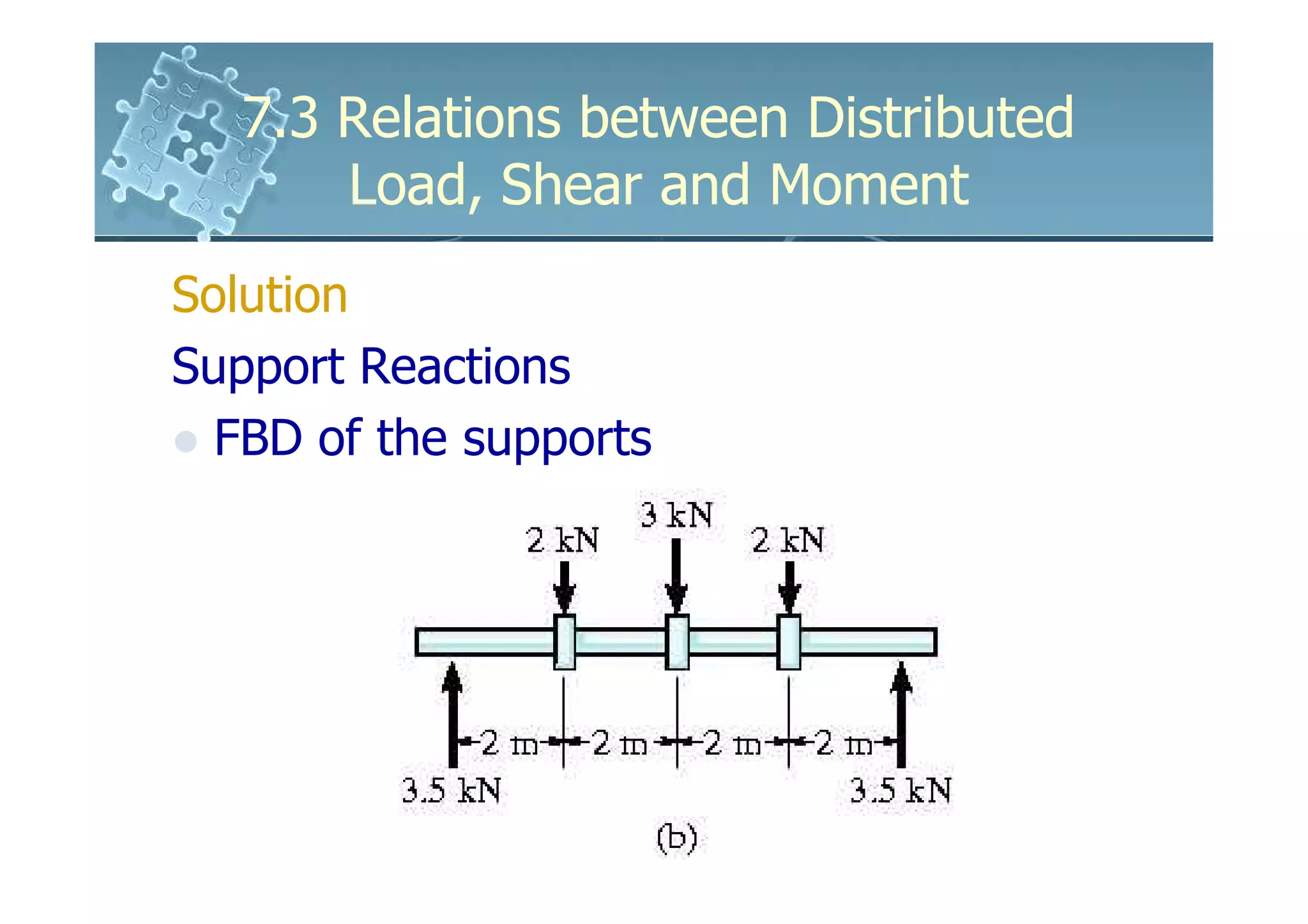
Solution
Support Reactions
  FBD of the supports
7.3 Relations between Distributed
       Load, Shear and Moment
Solution
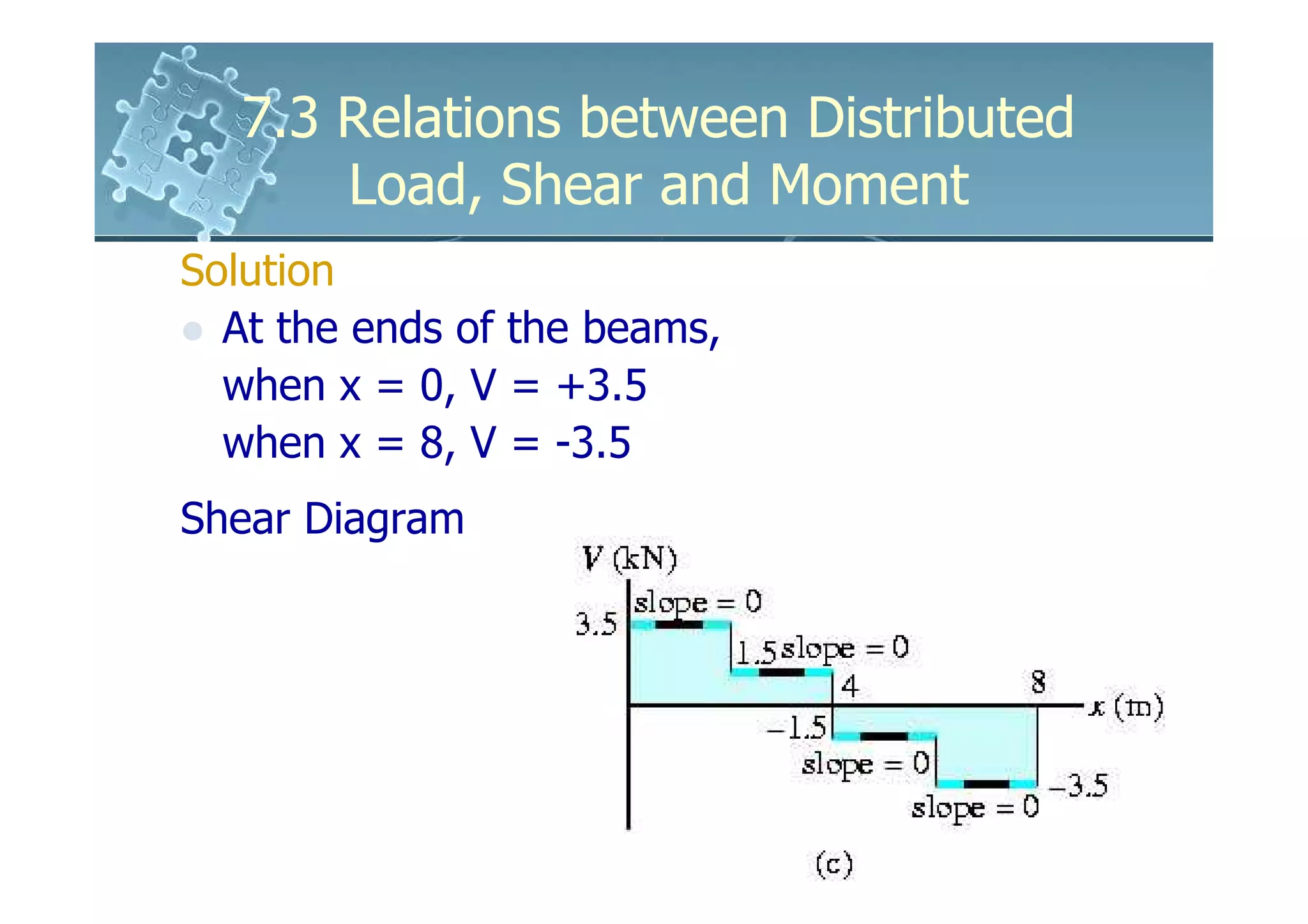
  At the ends of the beams,
  when x = 0, V = +3.5
  when x = 8, V = -3.5
Shear Diagram
7.3 Relations between Distributed
       Load, Shear and Moment
Solution
  No distributed load on the shaft, slope dV/dx = -
  w=0
  Discontinuity or “jump” of the shear diagram at
  each concentrated force
  Change in shear negative when the force acts
  downwards and positive when the force acts
  upwards
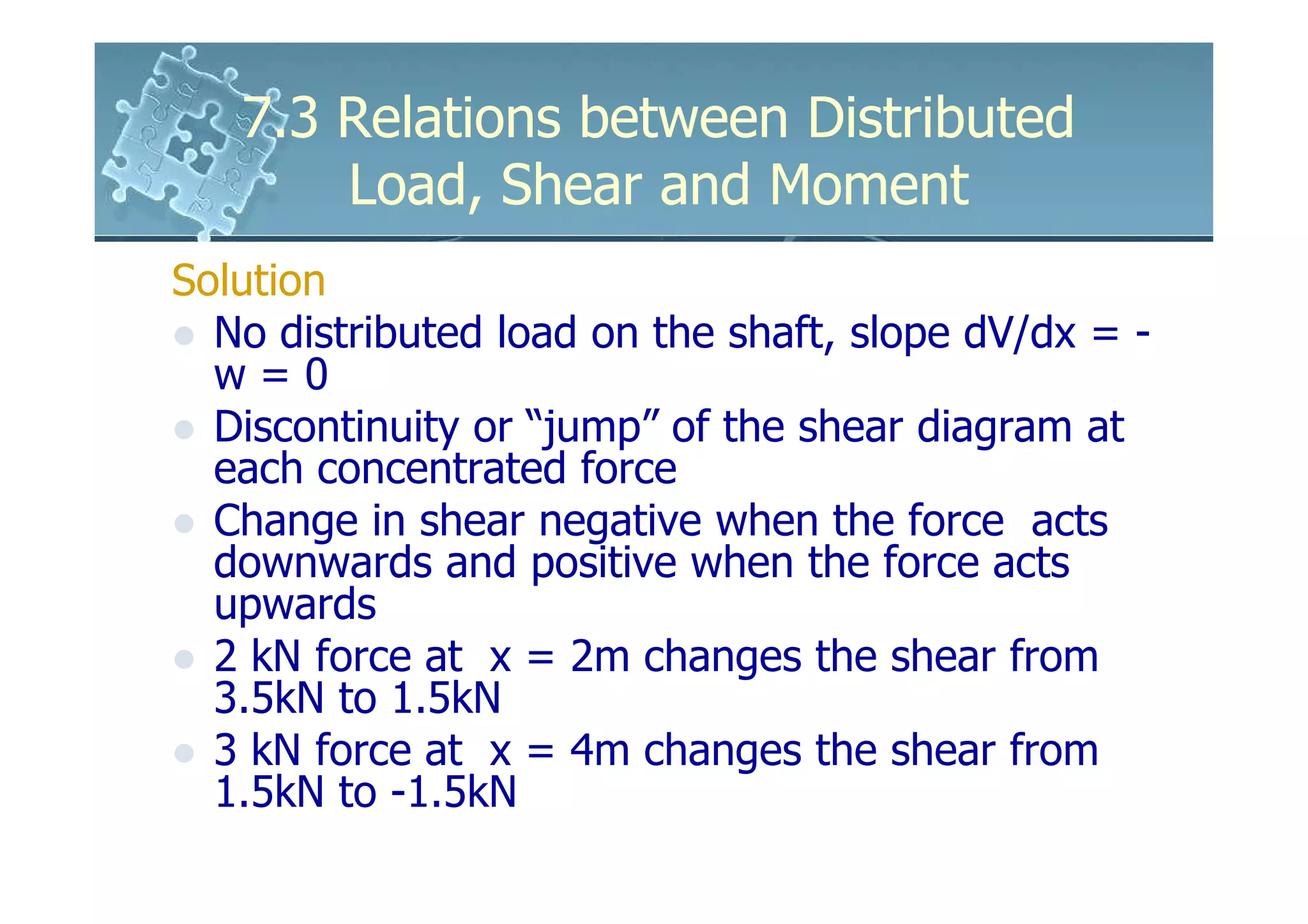
  2 kN force at x = 2m changes the shear from
  3.5kN to 1.5kN
  3 kN force at x = 4m changes the shear from
  1.5kN to -1.5kN
7.3 Relations between Distributed
      Load, Shear and Moment
Solution
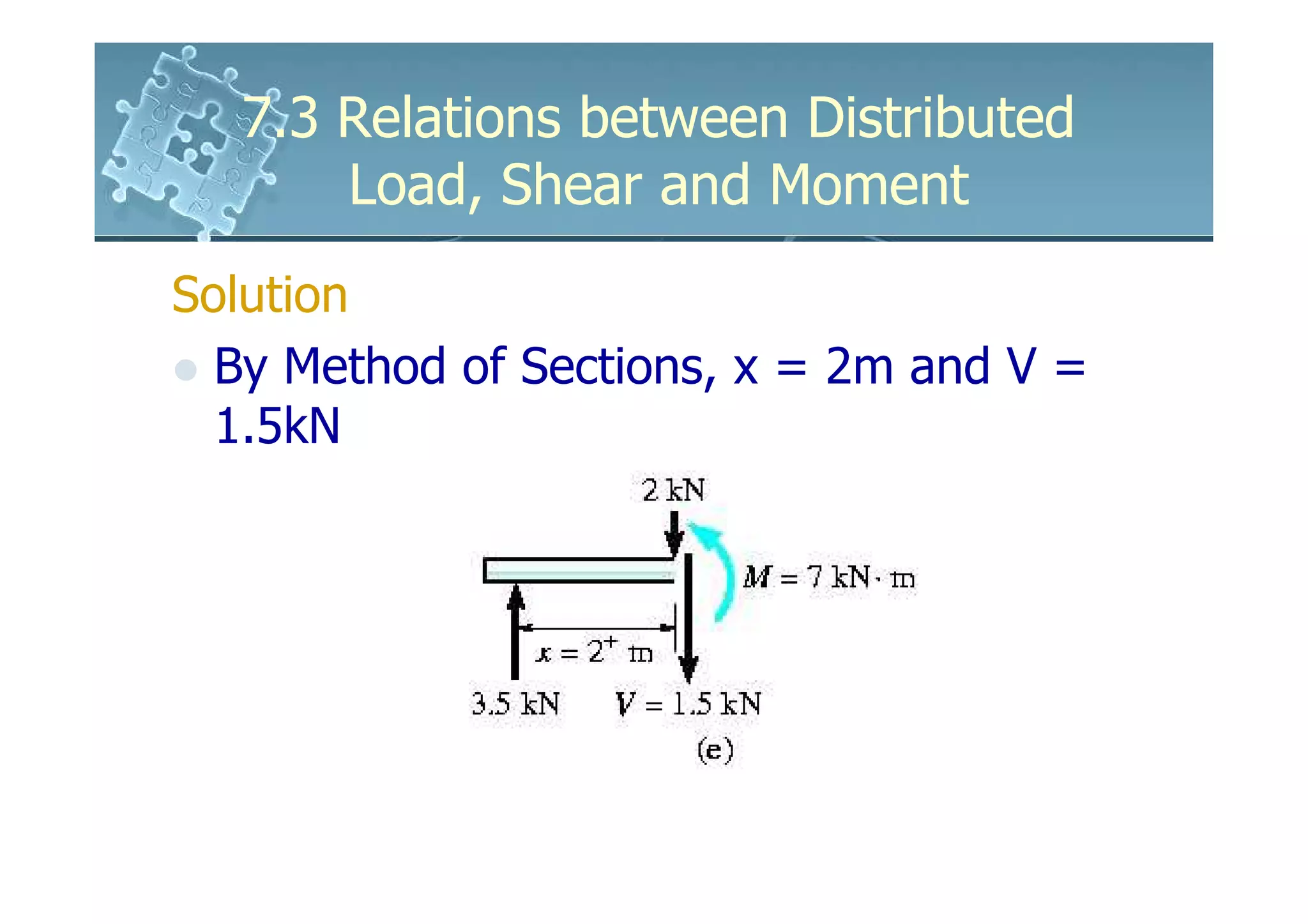
  By Method of Sections, x = 2m and V =
  1.5kN
7.3 Relations between Distributed
         Load, Shear and Moment
Solution
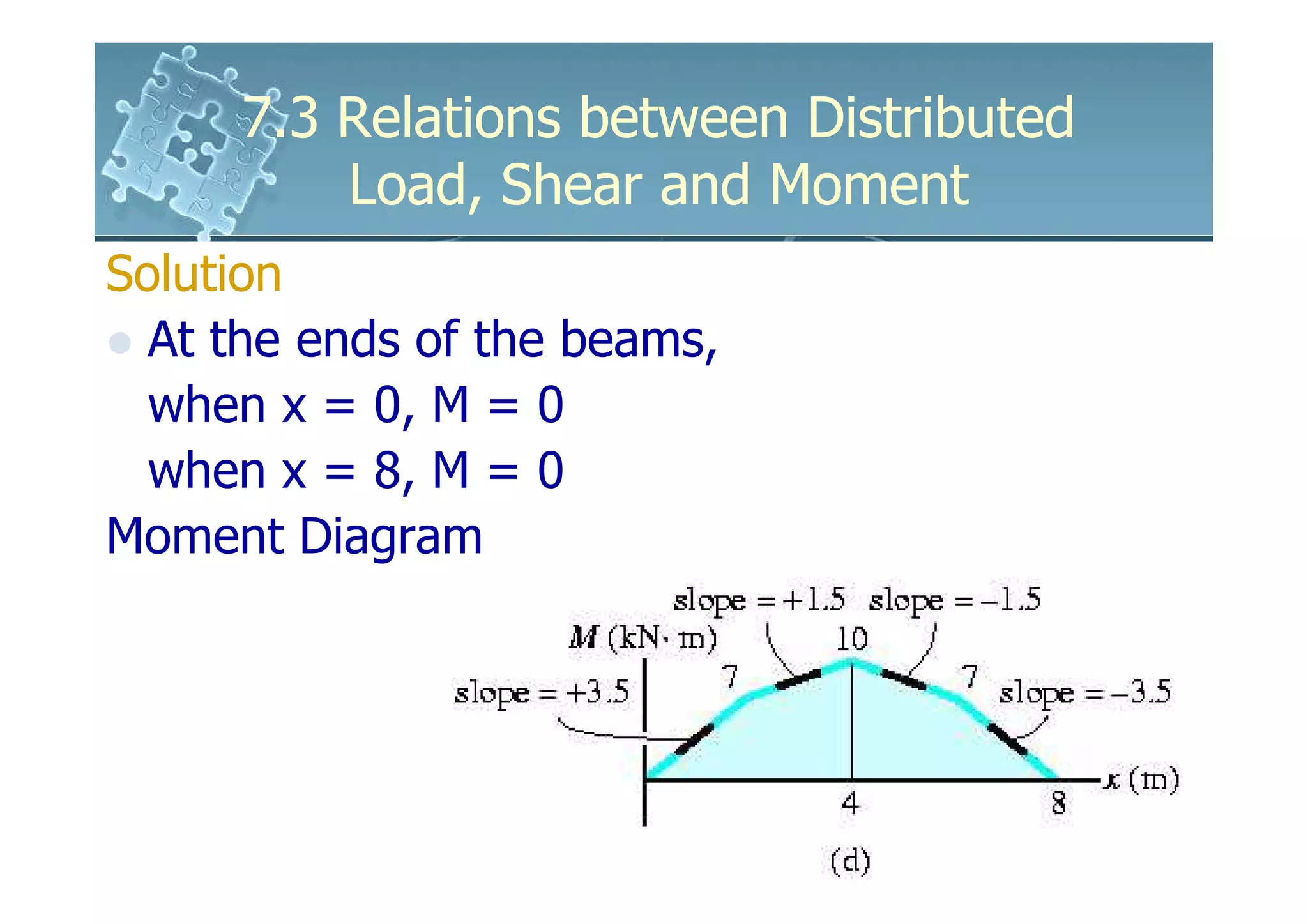
  At the ends of the beams,
  when x = 0, M = 0
  when x = 8, M = 0
Moment Diagram
7.3 Relations between Distributed
      Load, Shear and Moment
Solution
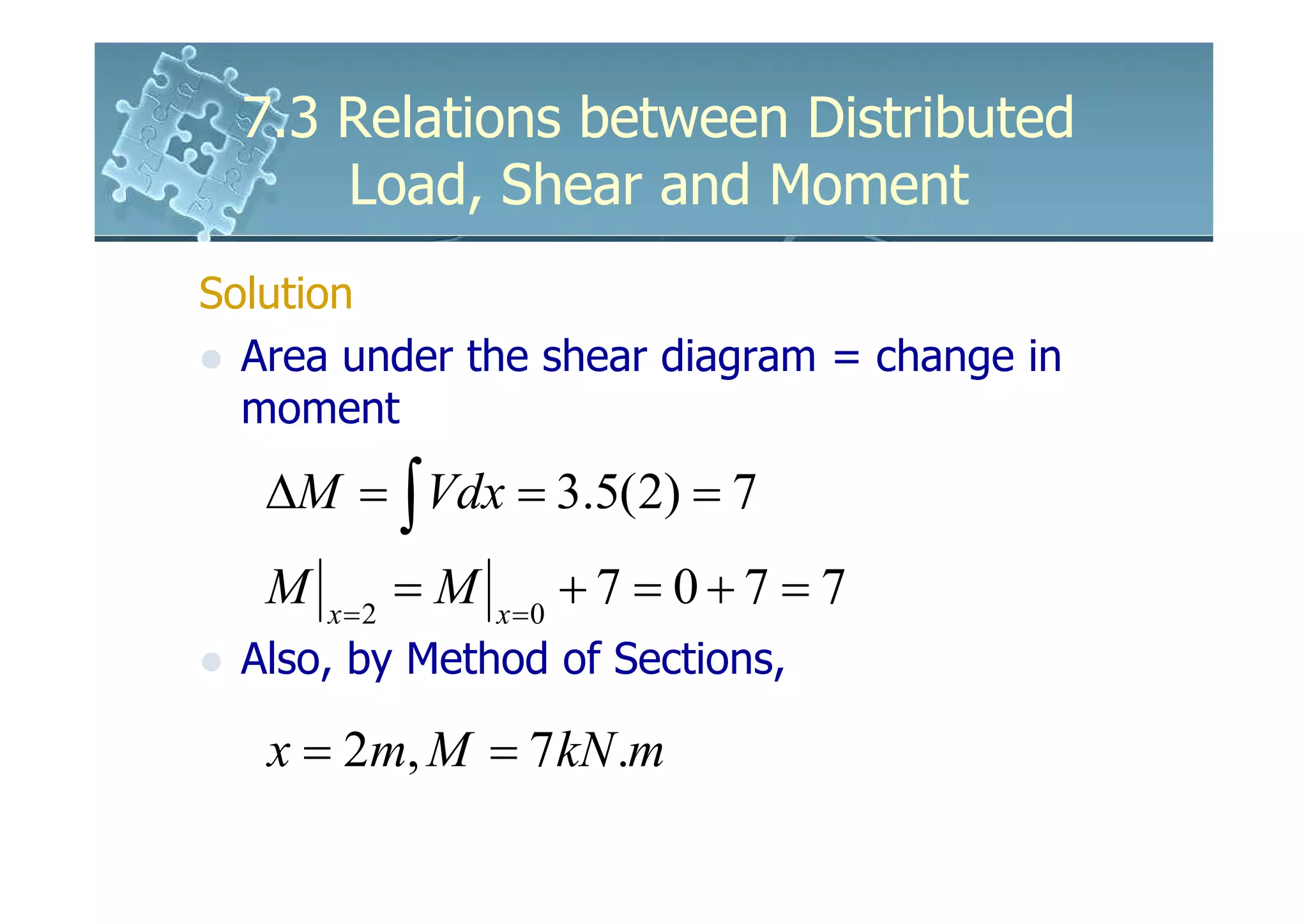
  Area under the shear diagram = change in
  moment
   ∆M = ∫ Vdx = 3.5(2) = 7
   M   x=2
             =M   x =0
                         +7 = 0+7 = 7
  Also, by Method of Sections,

   x = 2m, M = 7 kN .m
7.3 Relations between Distributed
         Load, Shear and Moment
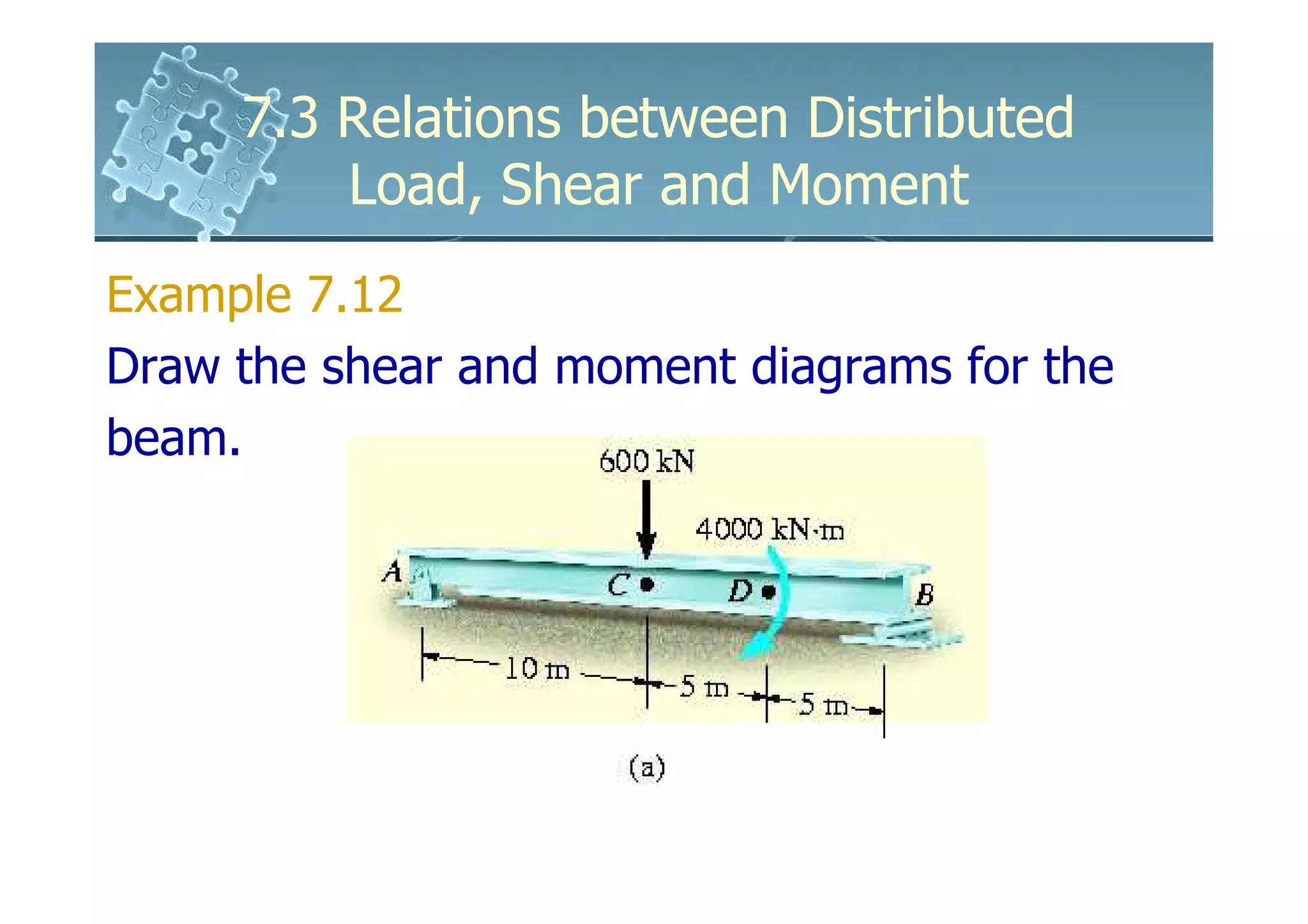
Example 7.12
Draw the shear and moment diagrams for the
beam.
7.3 Relations between Distributed
      Load, Shear and Moment
Solution
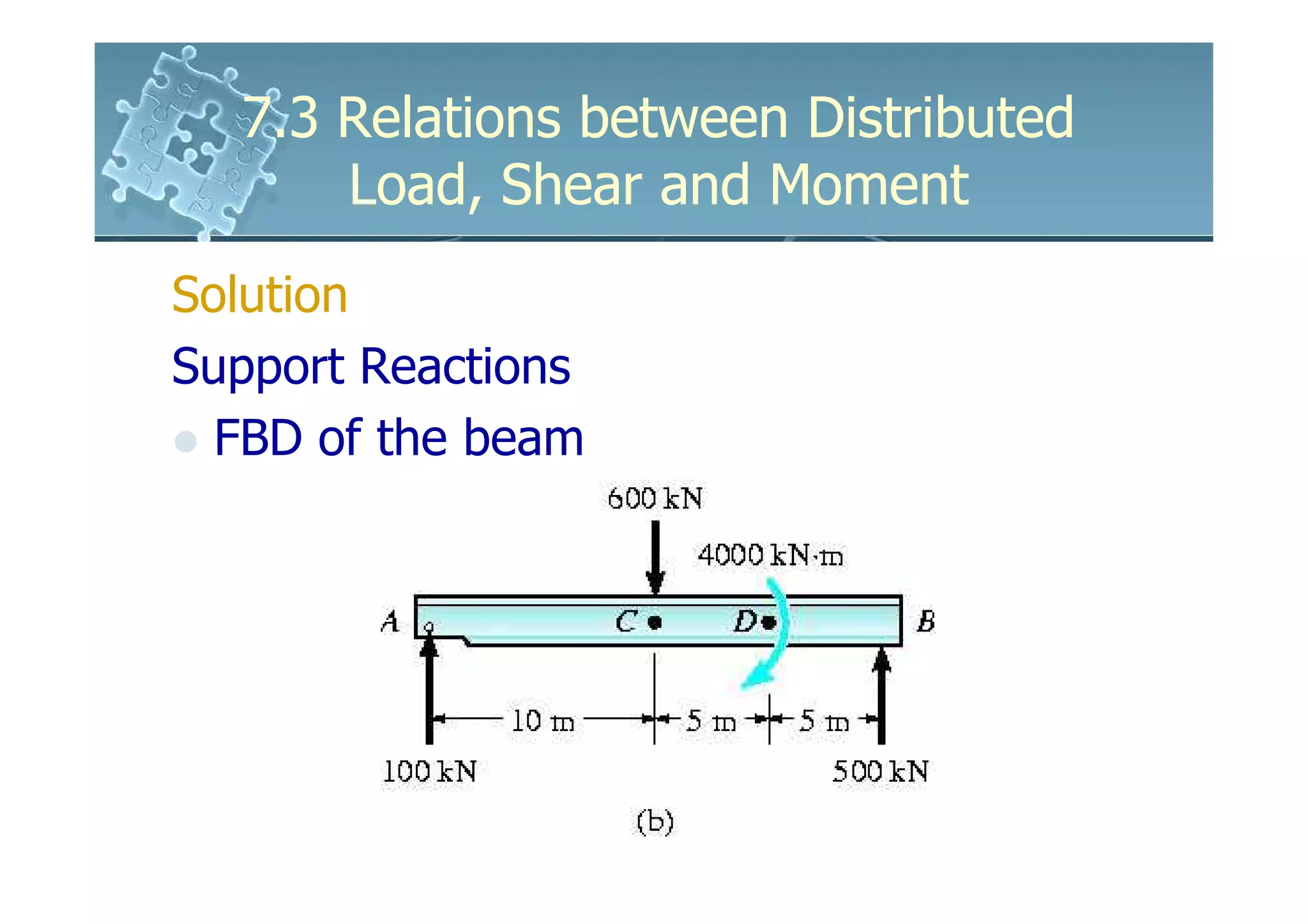
Support Reactions
  FBD of the beam
7.3 Relations between Distributed
       Load, Shear and Moment
Solution
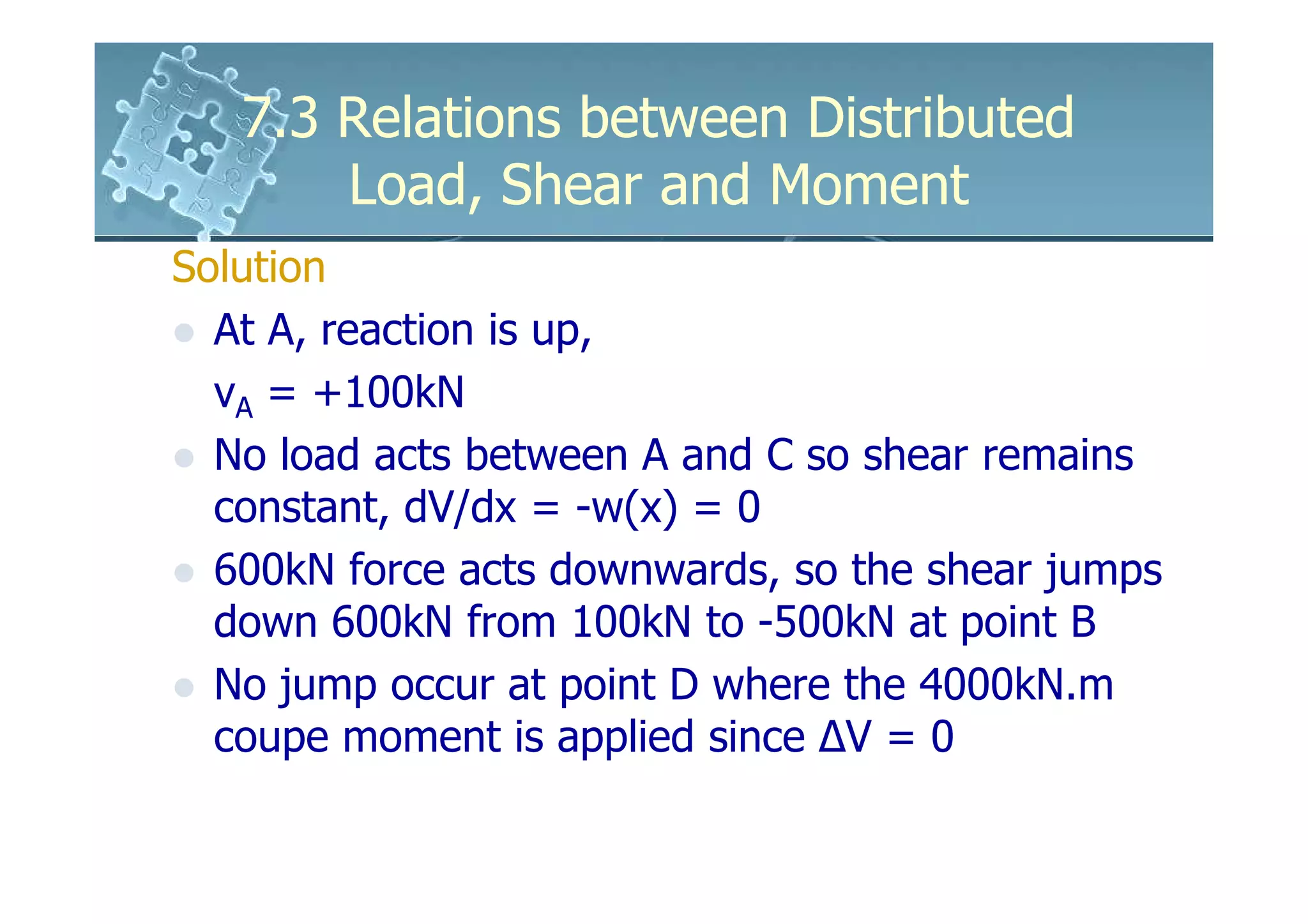
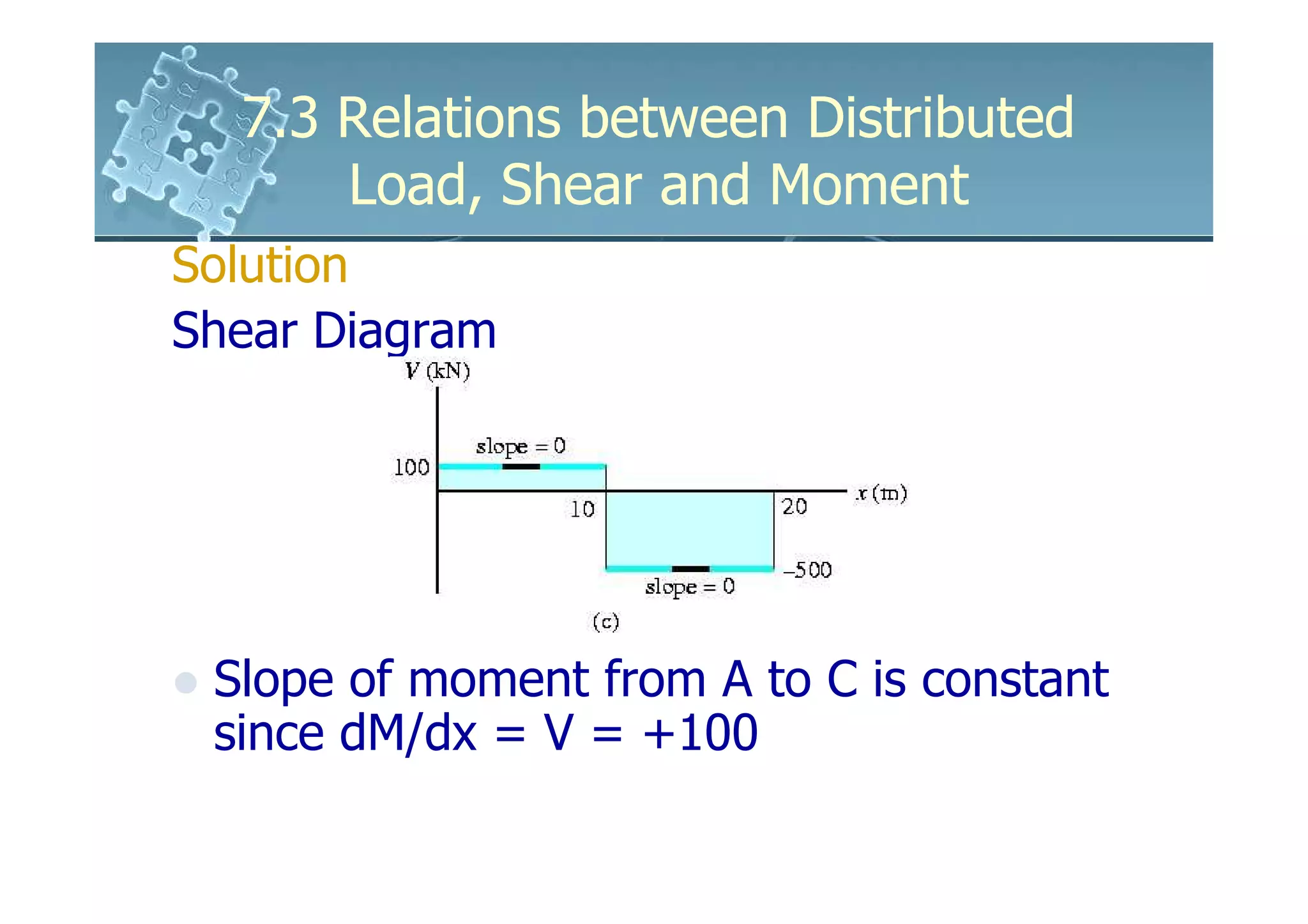
  At A, reaction is up,
  vA = +100kN
  No load acts between A and C so shear remains
  constant, dV/dx = -w(x) = 0
  600kN force acts downwards, so the shear jumps
  down 600kN from 100kN to -500kN at point B
  No jump occur at point D where the 4000kN.m
  coupe moment is applied since ∆V = 0
7.3 Relations between Distributed
      Load, Shear and Moment
Solution
Shear Diagram


 Slope of moment from A to C is constant
 since dM/dx = V = +100
7.3 Relations between Distributed
      Load, Shear and Moment
Solution
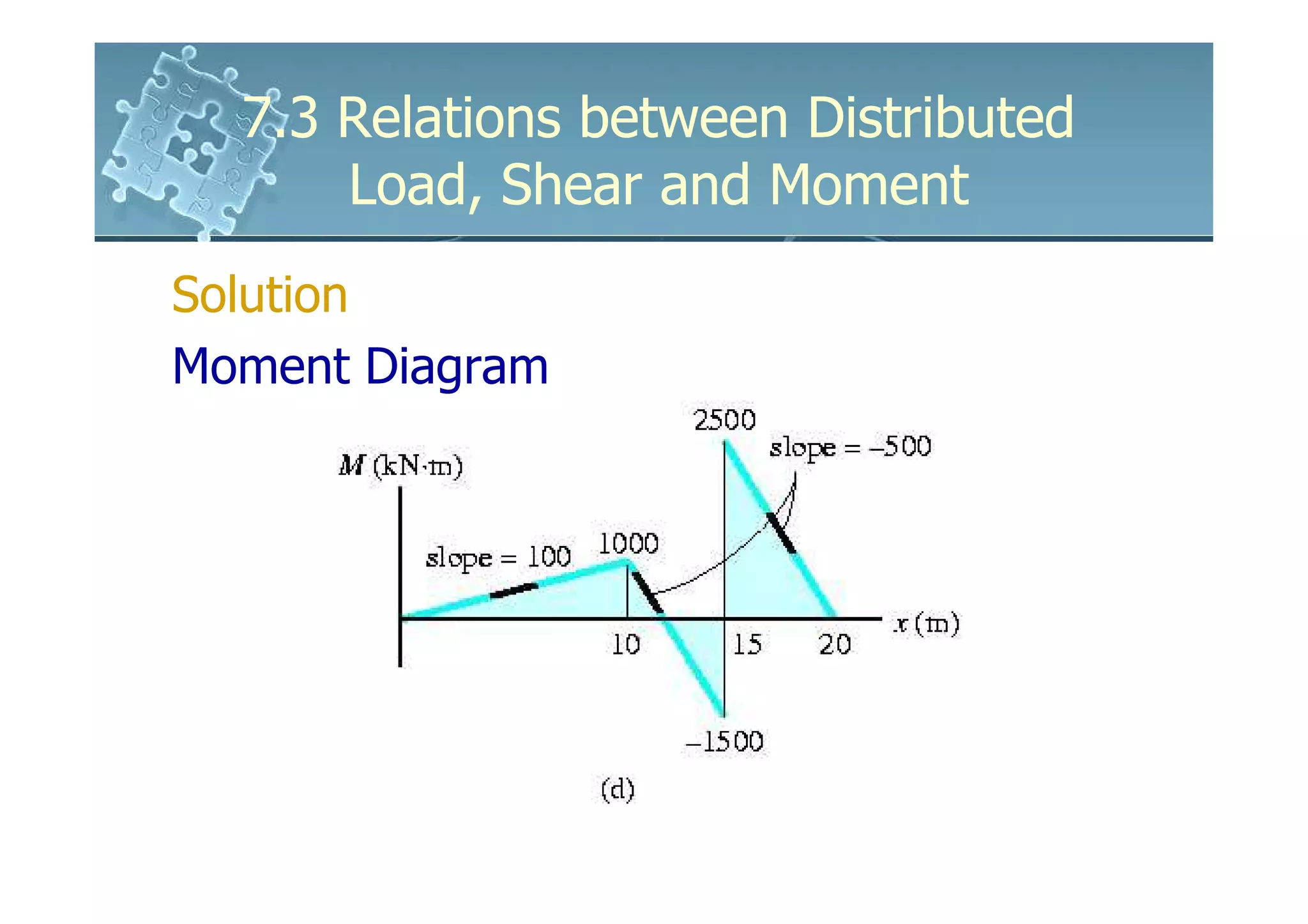
Moment Diagram
7.3 Relations between Distributed
       Load, Shear and Moment
Solution
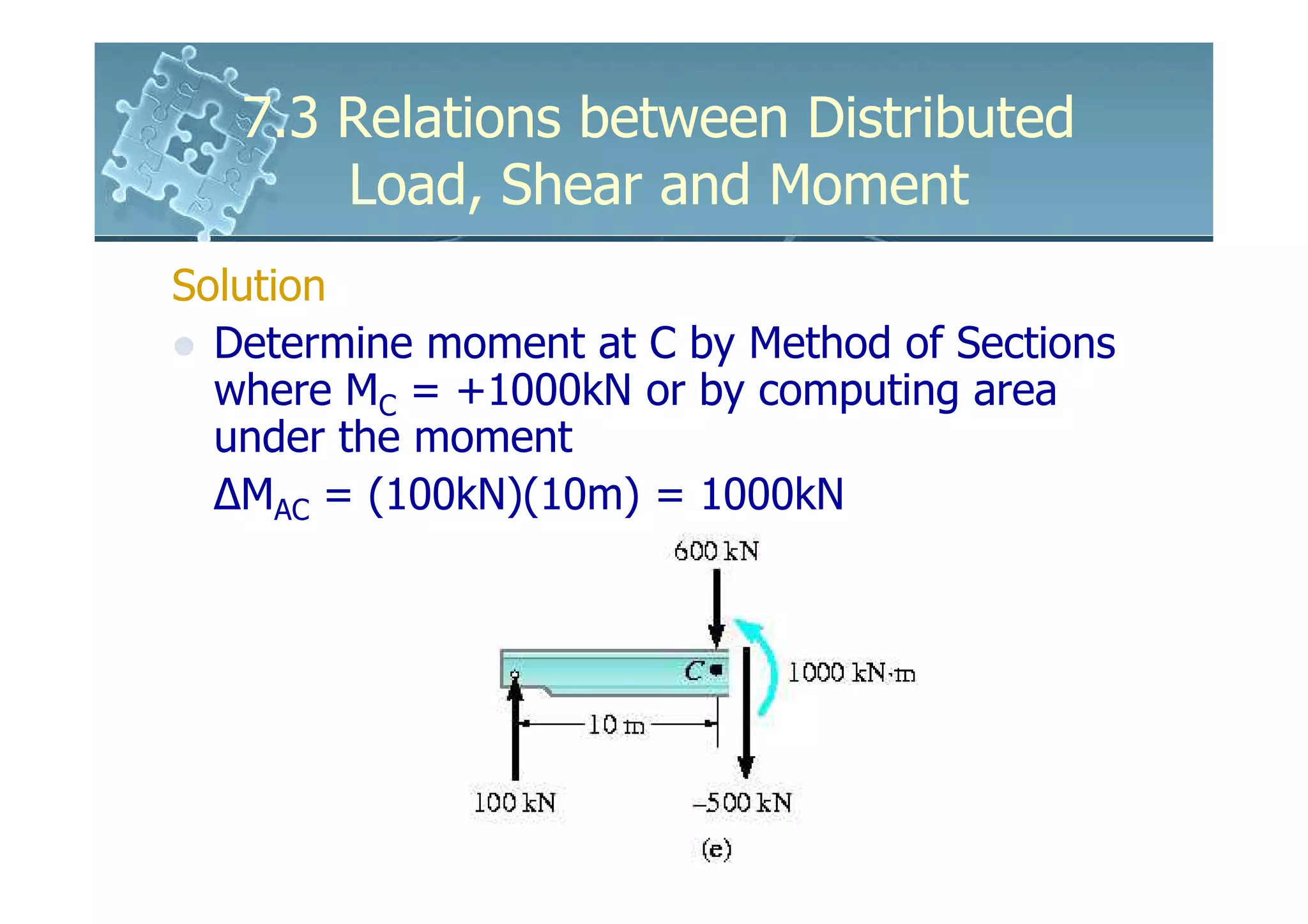
  Determine moment at C by Method of Sections
  where MC = +1000kN or by computing area
  under the moment
  ∆MAC = (100kN)(10m) = 1000kN
7.3 Relations between Distributed
       Load, Shear and Moment

Solution
  Since MA = 0, MC = 0 + 1000kN.m = 1000kN.m
  From C to D, slope, dM/dx = V = -500
  For area under the shear diagram between C and
  D, ∆MCD = (-500kN)(5m) = -2500kN, so that MD
  = MC + ∆MCD = 1000 – 2500 = -1500kN.m
  Jump at point D caused by concentrated couple
  moment of 4000kN.m
  Positive jump for clockwise couple moment
7.3 Relations between Distributed
         Load, Shear and Moment
Solution
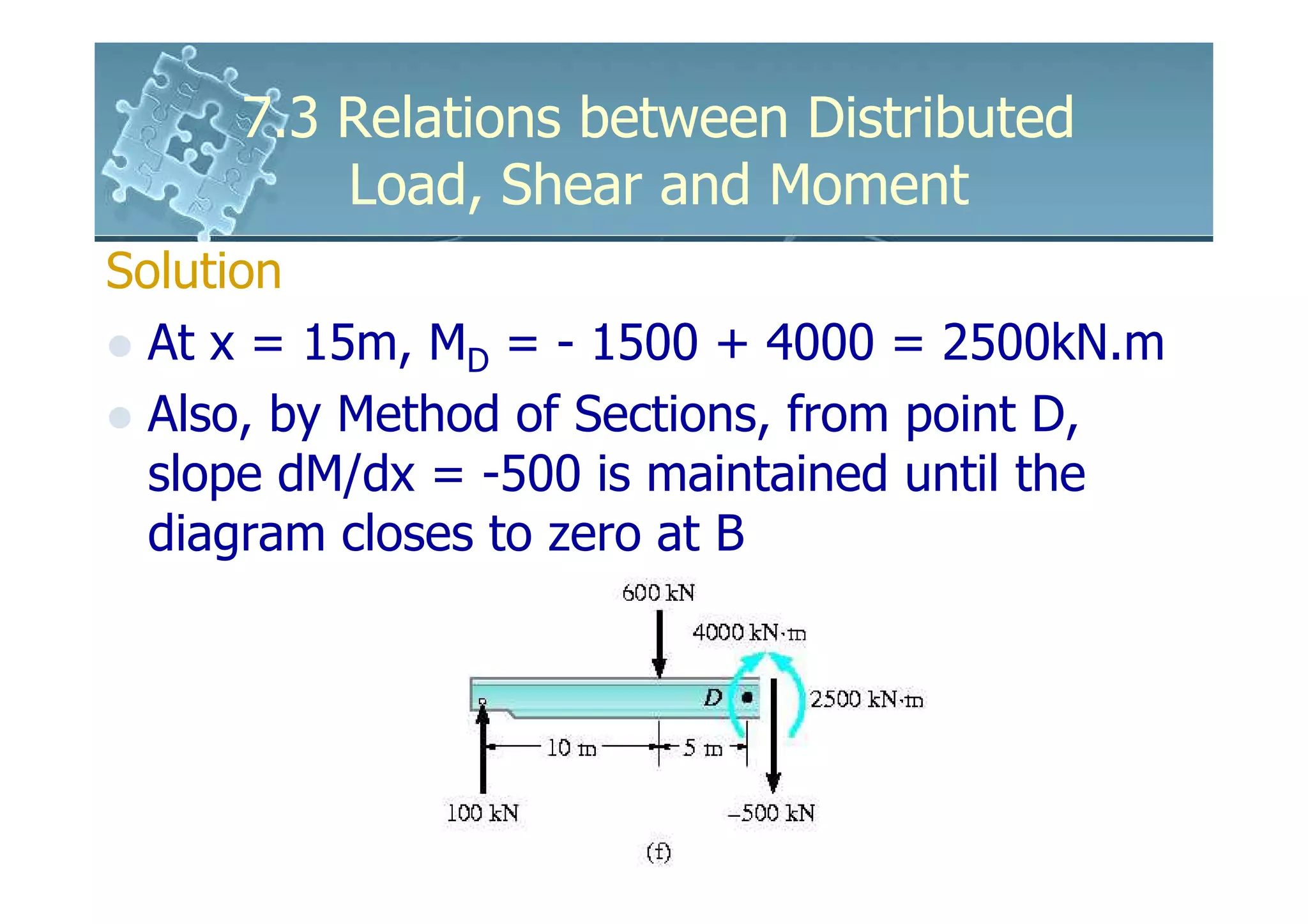
  At x = 15m, MD = - 1500 + 4000 = 2500kN.m
  Also, by Method of Sections, from point D,
  slope dM/dx = -500 is maintained until the
  diagram closes to zero at B

6161103 7.3 relations between distributed load, shear and moment

  • 1.
    7.3 Relations betweenDistributed Load, Shear and Moment Distributed Load Consider beam AD subjected to an arbitrary load w = w(x) and a series of concentrated forces and moments Distributed load assumed positive when loading acts downwards
  • 2.
    7.3 Relations betweenDistributed Load, Shear and Moment Distributed Load A FBD diagram for a small segment of the beam having a length ∆x is chosen at point x along the beam which is not subjected to a concentrated force or couple moment Any results obtained will not apply at points of concentrated loadings
  • 3.
    7.3 Relations betweenDistributed Load, Shear and Moment Distributed Load The internal shear force and bending moments shown on the FBD are assumed to act in the positive sense Both the shear force and moment acting on the right-hand face must be increased by a small, finite amount in order to keep the segment in equilibrium
  • 4.
    7.3 Relations betweenDistributed Load, Shear and Moment Distributed Load The distributed loading has been replaced by a resultant force ∆F = w(x) ∆x that acts at a fractional distance k (∆x) from the right end, where 0 < k <1 + ↑ ∑ Fy = 0;V − w( x)∆x − (V + ∆V ) = 0 ∆V = − w( x)∆x ∑ M = 0;−V∆x − M + w( x)∆x[k (∆x )] + ( M + ∆M ) = 0 ∆M = V∆x − w( x)k (∆x) 2
  • 5.
    7.3 Relations betweenDistributed Load, Shear and Moment Distributed Load dV = −w(x) dx Slope of the = Negative of shear diagram distributed load intensity dM =V dx Slope of = Shear moment diagram
  • 6.
    7.3 Relations betweenDistributed Load, Shear and Moment Distributed Load At a specified point in a beam, the slope of the shear diagram is equal to the intensity of the distributed load Slope of the moment diagram = shear If the shear is equal to zero, dM/dx = 0, a point of zero shear corresponds to a point of maximum (or possibly minimum) moment w (x) dx and V dx represent differential area under the distributed loading and shear diagrams
  • 7.
    7.3 Relations betweenDistributed Load, Shear and Moment Distributed Load ∆VBC = − ∫ w( x)dx Change in = Area under shear shear diagram ∆M BC = ∫ Vdx Change in = Area under moment shear diagram
  • 8.
    7.3 Relations betweenDistributed Load, Shear and Moment Distributed Load Change in shear between points B and C is equal to the negative of the area under the distributed-loading curve between these points Change in moment between B and C is equal to the area under the shear diagram within region BC The equations so not apply at points where concentrated force or couple moment acts
  • 9.
    7.3 Relations betweenDistributed Load, Shear and Moment Force FBD of a small segment of the beam + ↑ ∑ Fy = 0; ∆V = − F Change in shear is negative thus the shear will jump downwards when F acts downwards on the beam
  • 10.
    7.3 Relations betweenDistributed Load, Shear and Moment Force FBD of a small segment of the beam located at the couple moment ∑ M = 0; ∆M = M O Change in moment is positive or the moment diagram will jump upwards MO is clockwise
  • 11.
    7.3 Relations betweenDistributed Load, Shear and Moment Example 7.9 Draw the shear and moment diagrams for the beam.
  • 12.
    7.3 Relations betweenDistributed Load, Shear and Moment Solution Support Reactions FBD of the beam
  • 13.
    7.3 Relations betweenDistributed Load, Shear and Moment Solution Shear Diagram V = +1000 at x = 0 V = 0 at x = 2 Since dV/dx = -w = -500, a straight negative sloping line connects the end points
  • 14.
    7.3 Relations betweenDistributed Load, Shear and Moment Solution Moment Diagram M = -1000 at x = 0 M = 0 at x = 2 dM/dx = V, positive yet linearly decreasing from dM/dx = 1000 at x = 0 to dM/dx = 0 at x = 2
  • 15.
    7.3 Relations betweenDistributed Load, Shear and Moment Example 7.10 Draw the shear and moment diagrams for the cantilevered beam.
  • 16.
    7.3 Relations betweenDistributed Load, Shear and Moment Solution Support Reactions FBD of the beam
  • 17.
    7.3 Relations betweenDistributed Load, Shear and Moment Solution At the ends of the beams, when x = 0, V = +1080 when x = 2, V = +600 Uniform load is downwards and slope of the shear diagram is constant dV/dx = -w = - 400 for 0 ≤ x ≤ 1.2 The above represents a change in shear
  • 18.
    7.3 Relations betweenDistributed Load, Shear and Moment Solution ∆V = − ∫ w( x)dx = −400(1.2) = −480 V x =1.2 =V x =0 + (−480) = 1080 − 480 = 600 Also, by Method of Sections, for equilibrium, V = +600 Change in shear = area under the load diagram at x = 1.2, V = +600
  • 19.
    7.3 Relations betweenDistributed Load, Shear and Moment Solution Since the load between 1.2 ≤ x ≤ 2, w = 0, slope dV/dx = 0, at x = 2, V = +600 Shear Diagram
  • 20.
    7.3 Relations betweenDistributed Load, Shear and Moment Solution At the ends of the beams, when x = 0, M = -1588 when x = 2, M = -100 Each value of shear gives the slope of the moment diagram since dM/dx = V at x = 0, dM/dx = +1080 at x = 1.2, dM/dx = +600 For 0 ≤ x ≤ 1.2, values of the shear diagram are positive but linearly increasing
  • 21.
    7.3 Relations betweenDistributed Load, Shear and Moment Solution Moment diagram is parabolic with a linearly decreasing positive slope Moment Diagram
  • 22.
    7.3 Relations betweenDistributed Load, Shear and Moment Solution Magnitude of moment at x = 1.2 = -580 Trapezoidal area under the shear diagram = change in moment ∆M = ∫ Vdx 1 = 600(1.2) + (1080 − 600)(1.2) = +1008 2 M x =1.2 = M x =0 + 1008 = −1588 + 1008 = −580
  • 23.
    7.3 Relations betweenDistributed Load, Shear and Moment Solution By Method of Sections, at x = 1.2, M = -580 Moment diagram has a constant slope for 1.2 ≤ x ≤ 2 since dM/dx = V = +600 Hence, at x = 2, M = -100
  • 24.
    7.3 Relations betweenDistributed Load, Shear and Moment Example 7.11 Draw the shear and moment diagrams for the shaft. The support at A is a thrust bearing and the support at B is a journal bearing.
  • 25.
    7.3 Relations betweenDistributed Load, Shear and Moment Solution Support Reactions FBD of the supports
  • 26.
    7.3 Relations betweenDistributed Load, Shear and Moment Solution At the ends of the beams, when x = 0, V = +3.5 when x = 8, V = -3.5 Shear Diagram
  • 27.
    7.3 Relations betweenDistributed Load, Shear and Moment Solution No distributed load on the shaft, slope dV/dx = - w=0 Discontinuity or “jump” of the shear diagram at each concentrated force Change in shear negative when the force acts downwards and positive when the force acts upwards 2 kN force at x = 2m changes the shear from 3.5kN to 1.5kN 3 kN force at x = 4m changes the shear from 1.5kN to -1.5kN
  • 28.
    7.3 Relations betweenDistributed Load, Shear and Moment Solution By Method of Sections, x = 2m and V = 1.5kN
  • 29.
    7.3 Relations betweenDistributed Load, Shear and Moment Solution At the ends of the beams, when x = 0, M = 0 when x = 8, M = 0 Moment Diagram
  • 30.
    7.3 Relations betweenDistributed Load, Shear and Moment Solution Area under the shear diagram = change in moment ∆M = ∫ Vdx = 3.5(2) = 7 M x=2 =M x =0 +7 = 0+7 = 7 Also, by Method of Sections, x = 2m, M = 7 kN .m
  • 31.
    7.3 Relations betweenDistributed Load, Shear and Moment Example 7.12 Draw the shear and moment diagrams for the beam.
  • 32.
    7.3 Relations betweenDistributed Load, Shear and Moment Solution Support Reactions FBD of the beam
  • 33.
    7.3 Relations betweenDistributed Load, Shear and Moment Solution At A, reaction is up, vA = +100kN No load acts between A and C so shear remains constant, dV/dx = -w(x) = 0 600kN force acts downwards, so the shear jumps down 600kN from 100kN to -500kN at point B No jump occur at point D where the 4000kN.m coupe moment is applied since ∆V = 0
  • 34.
    7.3 Relations betweenDistributed Load, Shear and Moment Solution Shear Diagram Slope of moment from A to C is constant since dM/dx = V = +100
  • 35.
    7.3 Relations betweenDistributed Load, Shear and Moment Solution Moment Diagram
  • 36.
    7.3 Relations betweenDistributed Load, Shear and Moment Solution Determine moment at C by Method of Sections where MC = +1000kN or by computing area under the moment ∆MAC = (100kN)(10m) = 1000kN
  • 37.
    7.3 Relations betweenDistributed Load, Shear and Moment Solution Since MA = 0, MC = 0 + 1000kN.m = 1000kN.m From C to D, slope, dM/dx = V = -500 For area under the shear diagram between C and D, ∆MCD = (-500kN)(5m) = -2500kN, so that MD = MC + ∆MCD = 1000 – 2500 = -1500kN.m Jump at point D caused by concentrated couple moment of 4000kN.m Positive jump for clockwise couple moment
  • 38.
    7.3 Relations betweenDistributed Load, Shear and Moment Solution At x = 15m, MD = - 1500 + 4000 = 2500kN.m Also, by Method of Sections, from point D, slope dM/dx = -500 is maintained until the diagram closes to zero at B