2.6 Addition and Subtraction
                     of Cartesian Vectors
Example
Given: A = Axi + Ayj + AZk
and B = Bxi + Byj + BZk
Vector Addition
Resultant R = A + B
      = (Ax + Bx)i + (Ay + By )j + (AZ + BZ) k
Vector Substraction
Resultant R = A - B
      = (Ax - Bx)i + (Ay - By )j + (AZ - BZ) k
2.6 Addition and Subtraction
                  of Cartesian Vectors
 Concurrent Force Systems
 - Force resultant is the vector sum of all
 the forces in the system

     FR = ∑F = ∑Fxi + ∑Fyj + ∑Fzk

where ∑Fx , ∑Fy and ∑Fz represent the
 algebraic sums of the x, y and z or i, j or k
 components of each force in the system
2.6 Addition and Subtraction
               of Cartesian Vectors


Force, F that the tie down rope exerts on the
ground support at O is directed along the rope
Angles α, β and γ can be solved with axes x, y
and z
2.6 Addition and Subtraction
               of Cartesian Vectors


Cosines of their values forms a unit vector u that
acts in the direction of the rope
Force F has a magnitude of F
    F = Fu = Fcosαi + Fcosβj + Fcosγk
2.6 Addition and Subtraction
                of Cartesian Vectors
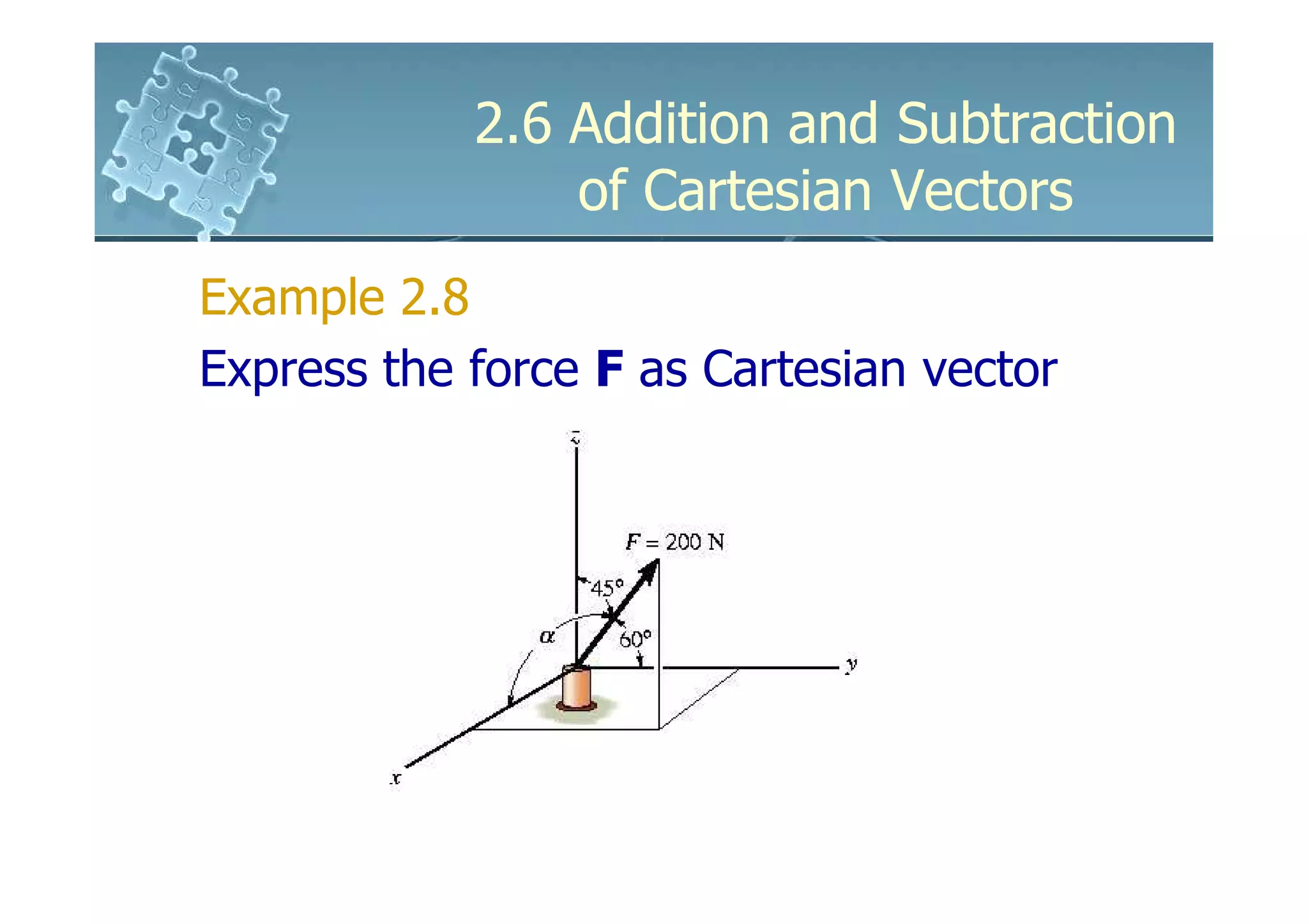
Example 2.8
Express the force F as Cartesian vector
2.6 Addition and Subtraction
                        of Cartesian Vectors
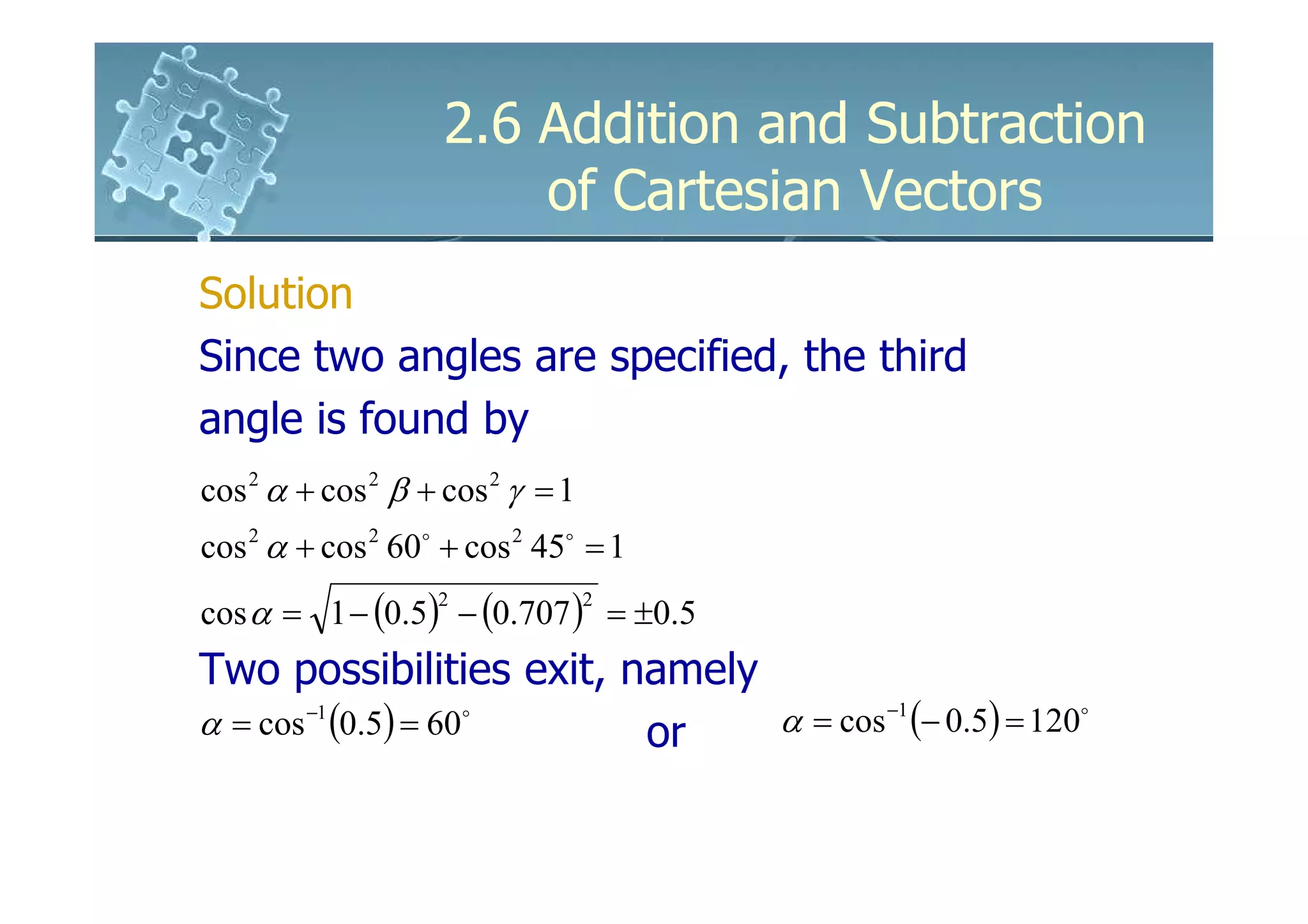
Solution
Since two angles are specified, the third
angle is found by
cos 2 α + cos 2 β + cos 2 γ = 1
cos 2 α + cos 2 60o + cos 2 45o = 1
cos α = 1 − (0.5) − (0.707 ) = ±0.5
                   2              2


Two possibilities exit, namely
α = cos −1 (0.5) = 60o   or    α = cos −1 (− 0.5) = 120o
2.6 Addition and Subtraction
                   of Cartesian Vectors
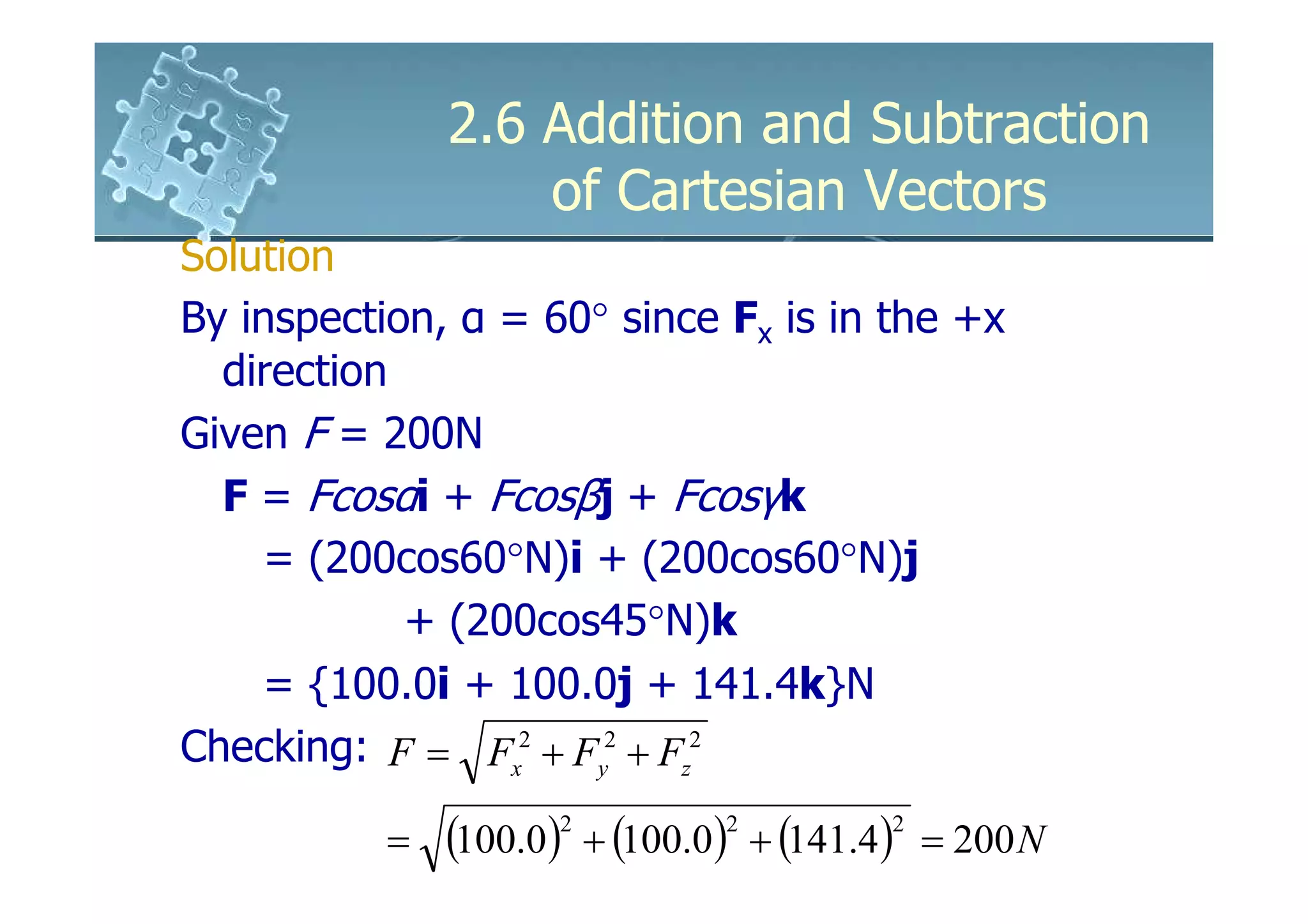
Solution
By inspection, α = 60° since Fx is in the +x
  direction
Given F = 200N
  F = Fcosαi + Fcosβj + Fcosγk
    = (200cos60°N)i + (200cos60°N)j
            + (200cos45°N)k
    = {100.0i + 100.0j + 141.4k}N
Checking: F = Fx2 + Fy2 + Fz2

           =   (100.0) + (100.0) + (141.4)
                     2         2         2
                                             = 200 N
2.6 Addition and Subtraction of
                  Cartesian Vectors
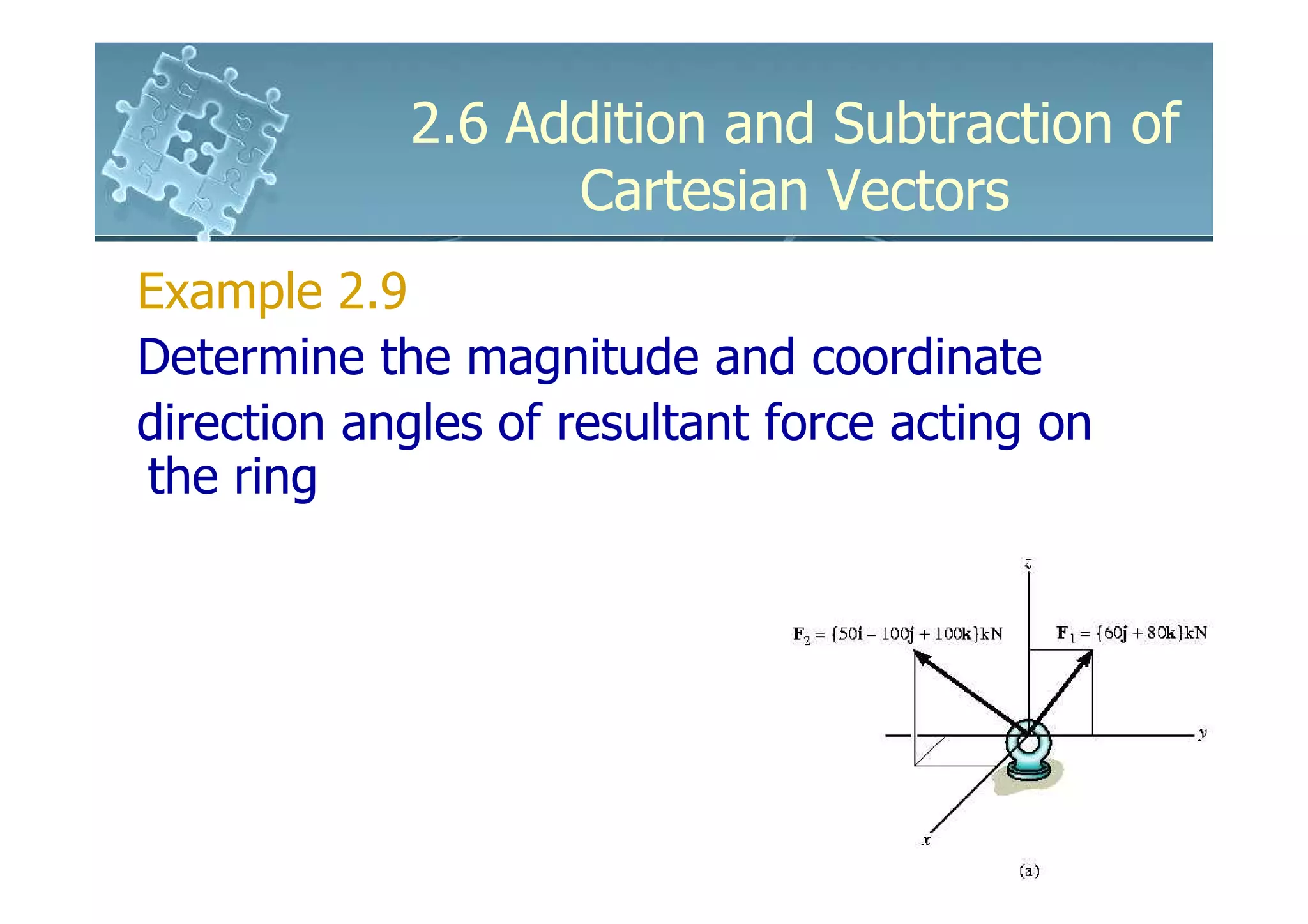
Example 2.9
Determine the magnitude and coordinate
direction angles of resultant force acting on
the ring
2.6 Addition and Subtraction
                        of Cartesian Vectors
Solution
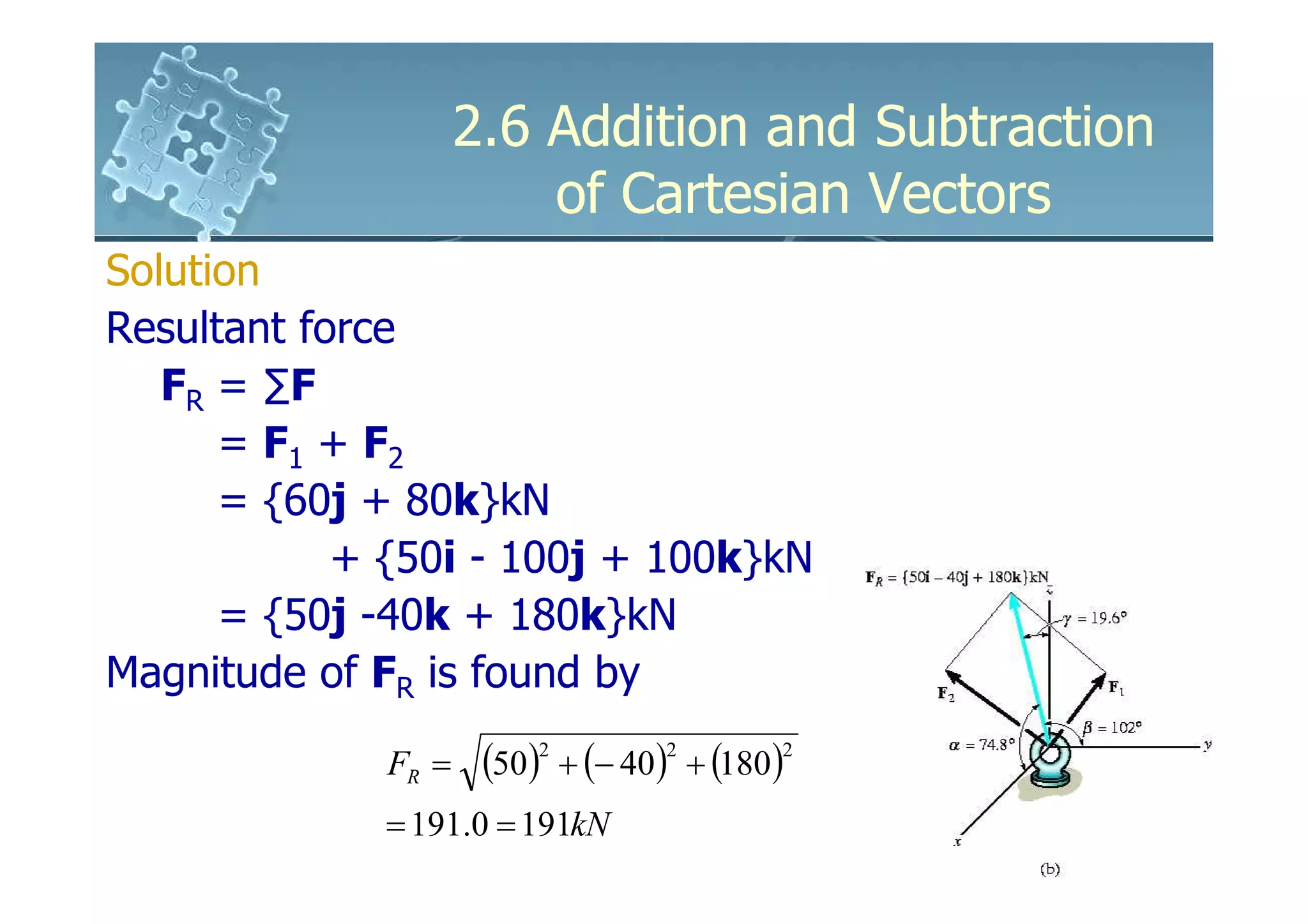
Resultant force
   FR = ∑F
      = F1 + F2
      = {60j + 80k}kN
            + {50i - 100j + 100k}kN
      = {50j -40k + 180k}kN
Magnitude of FR is found by

             FR =    (50)2 + (− 40)2 + (180)2
             = 191.0 = 191kN
2.6 Addition and Subtraction
                  of Cartesian Vectors
Solution
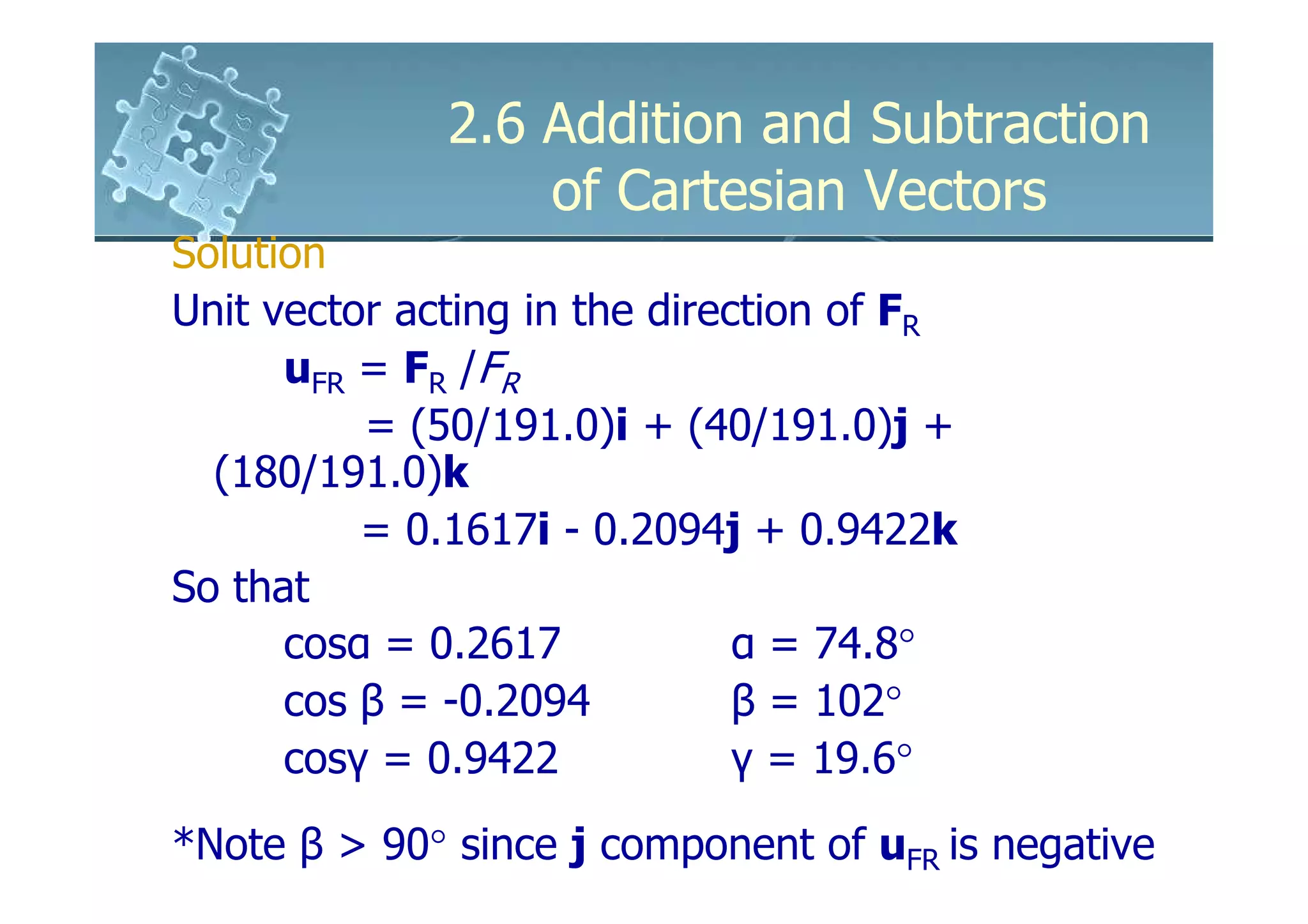
Unit vector acting in the direction of FR
      uFR = FR /FR
          = (50/191.0)i + (40/191.0)j +
  (180/191.0)k
          = 0.1617i - 0.2094j + 0.9422k
So that
      cosα = 0.2617            α = 74.8°
      cos β = -0.2094          β = 102°
      cosγ = 0.9422            γ = 19.6°
*Note β > 90° since j component of uFR is negative
2.6 Addition and Subtraction
                   of Cartesian Vectors
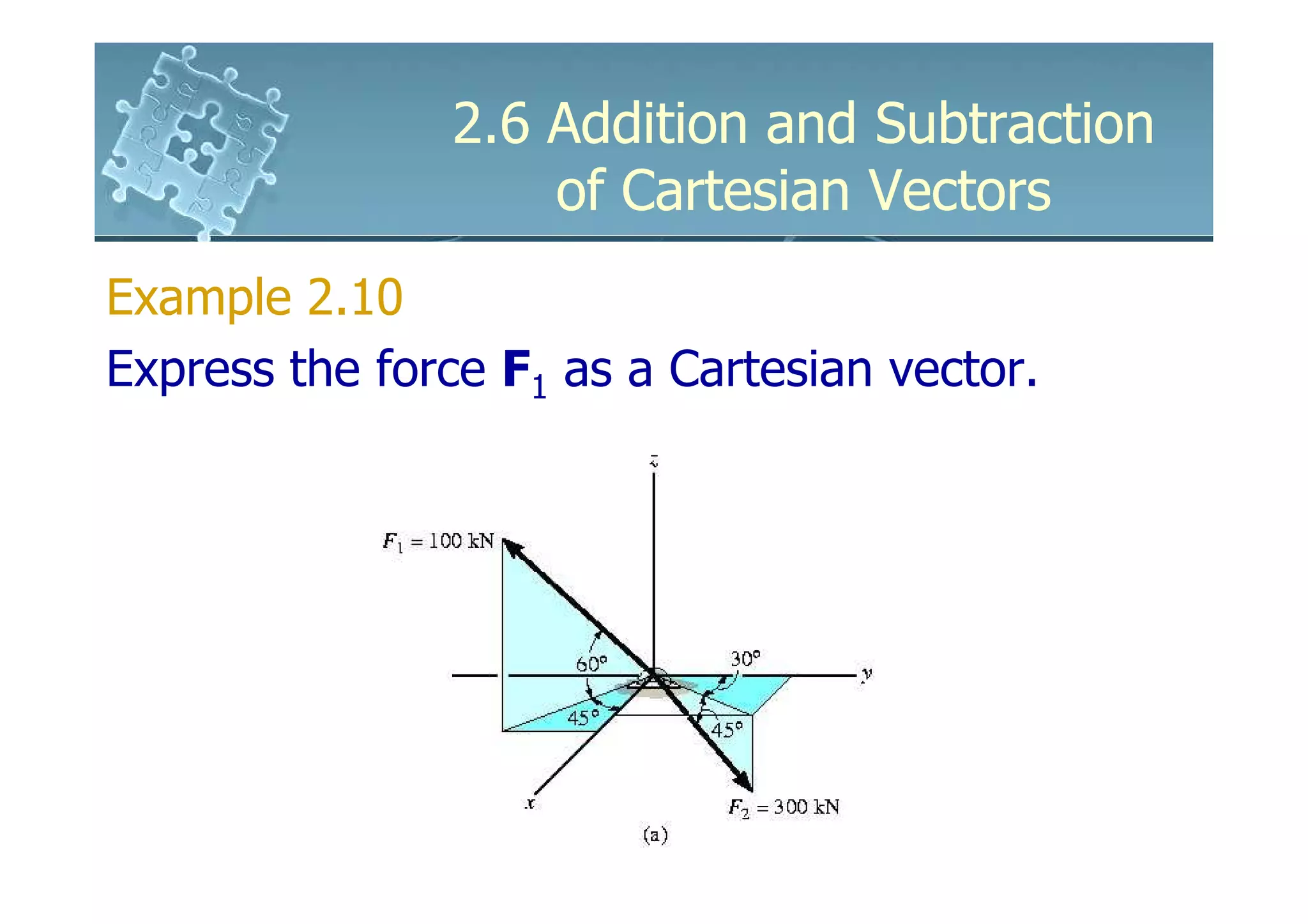
Example 2.10
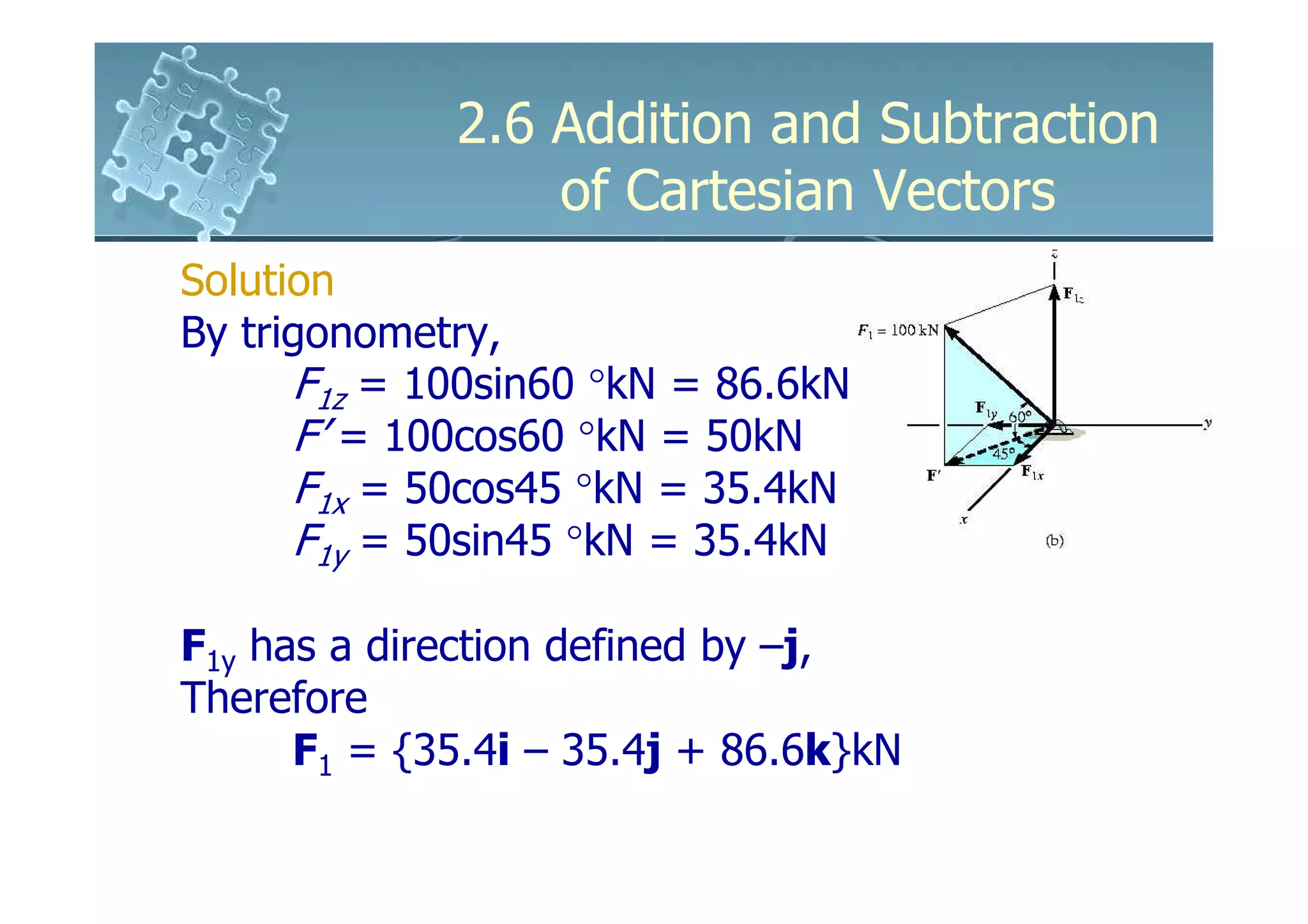
Express the force F1 as a Cartesian vector.
2.6 Addition and Subtraction
                 of Cartesian Vectors
Solution
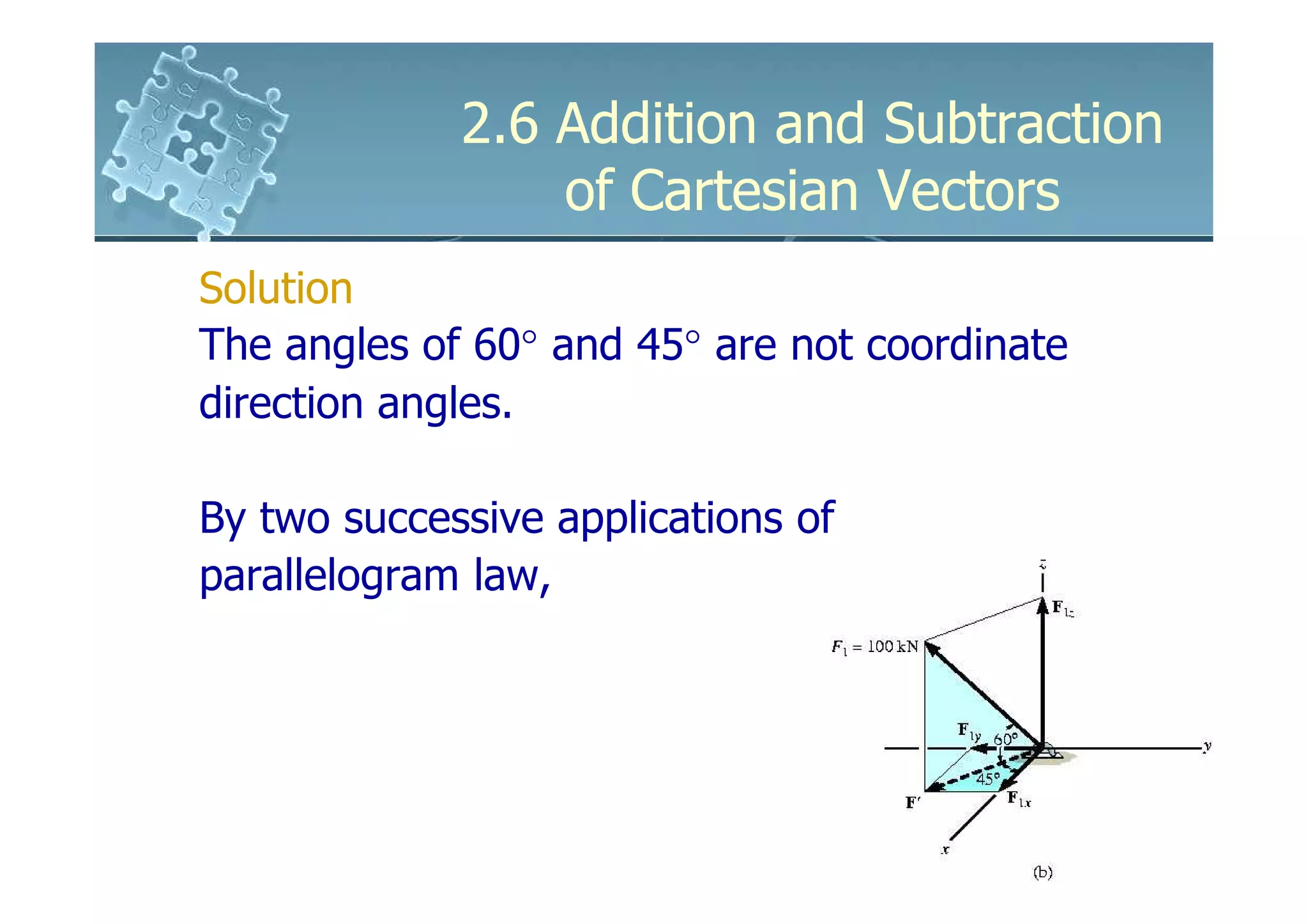
The angles of 60° and 45° are not coordinate
direction angles.

By two successive applications of
parallelogram law,
2.6 Addition and Subtraction
                 of Cartesian Vectors
Solution
By trigonometry,
      F1z = 100sin60 °kN = 86.6kN
      F’ = 100cos60 °kN = 50kN
      F1x = 50cos45 °kN = 35.4kN
                     kN
      F1y = 50sin45 °kN = 35.4kN

F1y has a direction defined by –j,
Therefore
      F1 = {35.4i – 35.4j + 86.6k}kN
2.6 Addition and Subtraction
                         of Cartesian Vectors
Solution
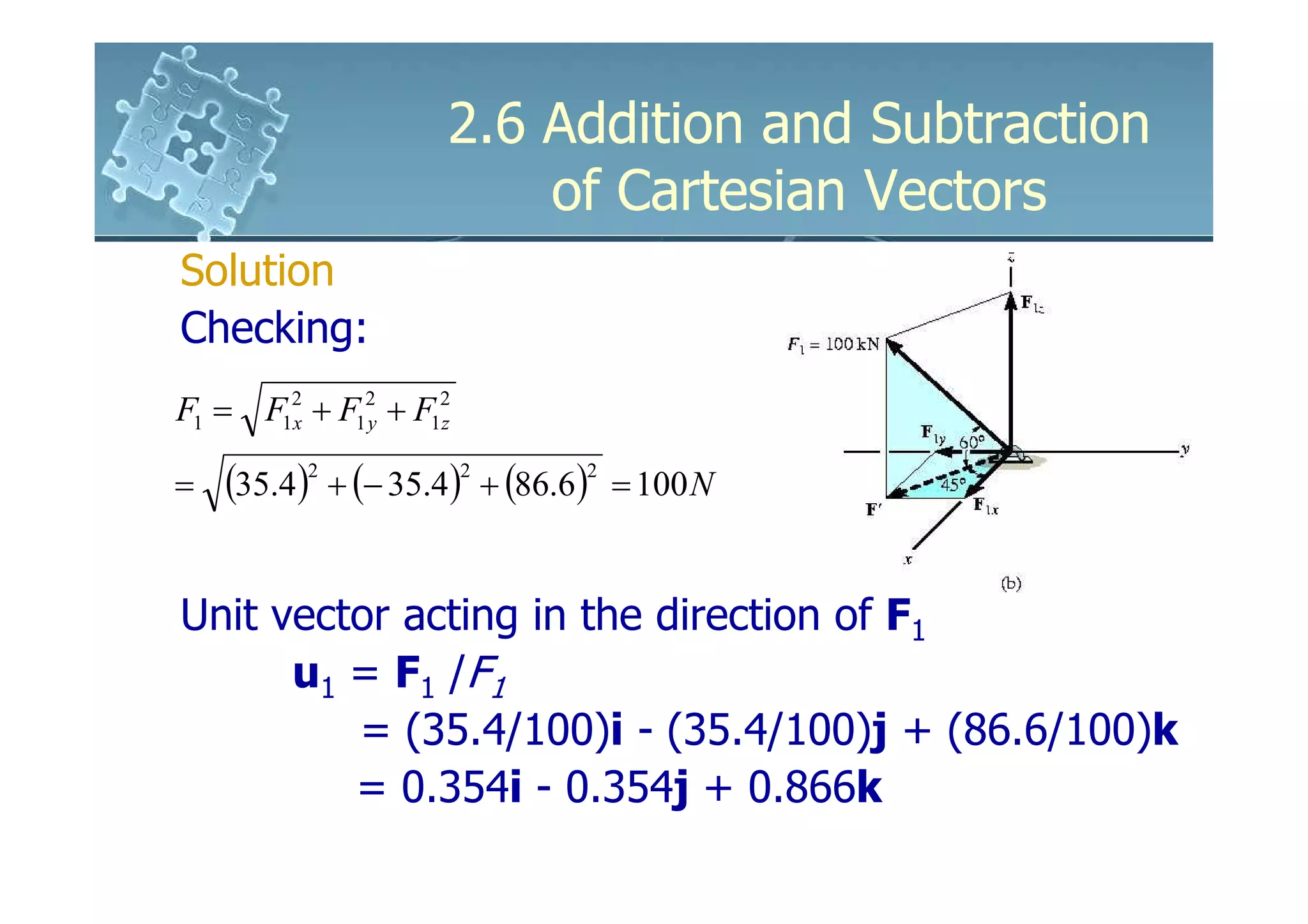
Checking:
F1 = F12 + F12 + F12
       x     y     z


=   (35.4)2 + (− 35.4)2 + (86.6)2   = 100 N


Unit vector acting in the direction of F1
      u1 = F1 /F1
         = (35.4/100)i - (35.4/100)j + (86.6/100)k
         = 0.354i - 0.354j + 0.866k
2.6 Addition and Subtraction
                 of Cartesian Vectors
Solution
      α1 = cos-1(0.354) = 69.3°
      β1 = cos-1(-0.354) = 111°
      γ1 = cos-1(0.866) = 30.0°

Using the same method,
      F2 = {106i + 184j - 212k}kN
2.6 Addition and Subtraction
                    of Cartesian Vectors
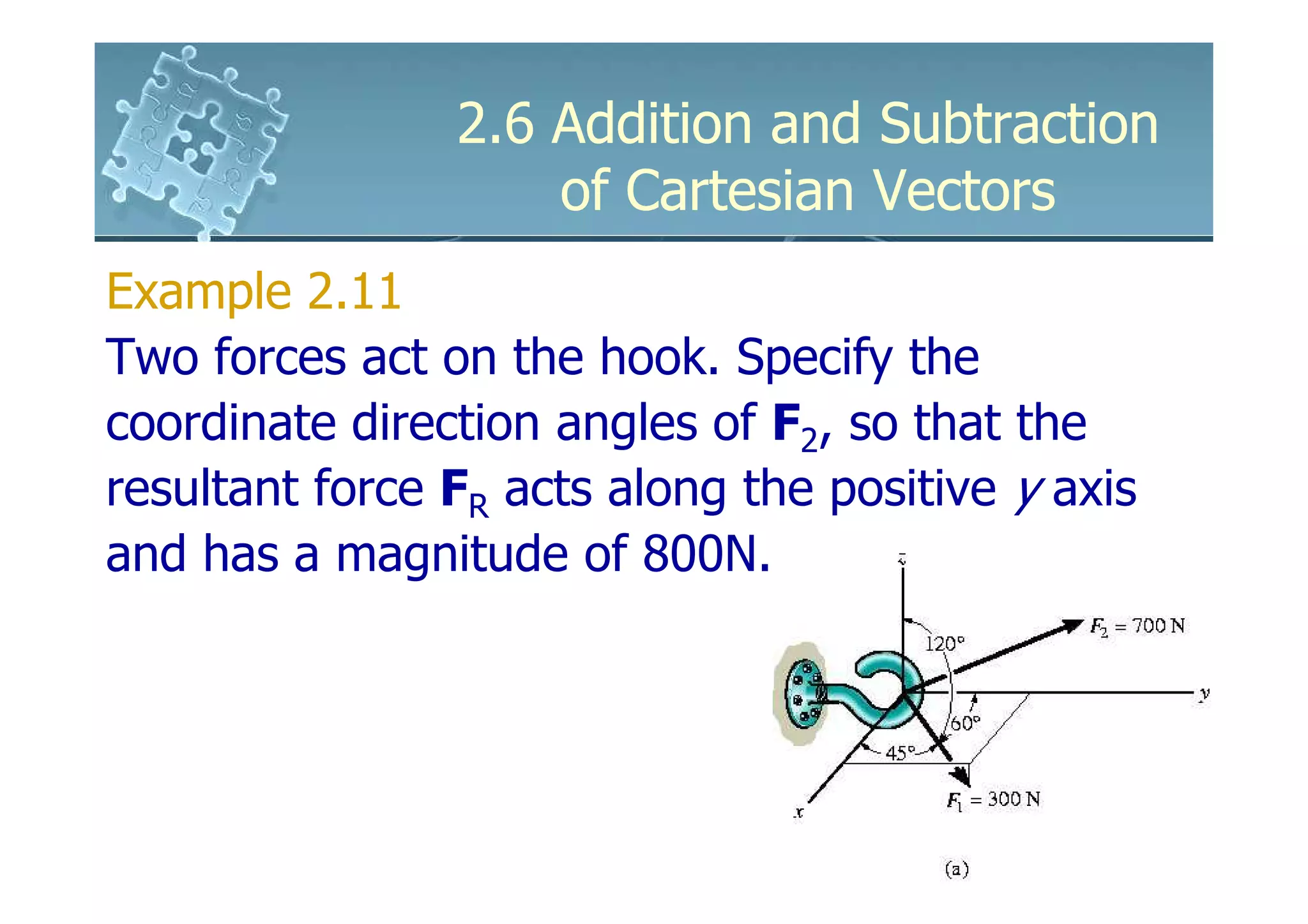
Example 2.11
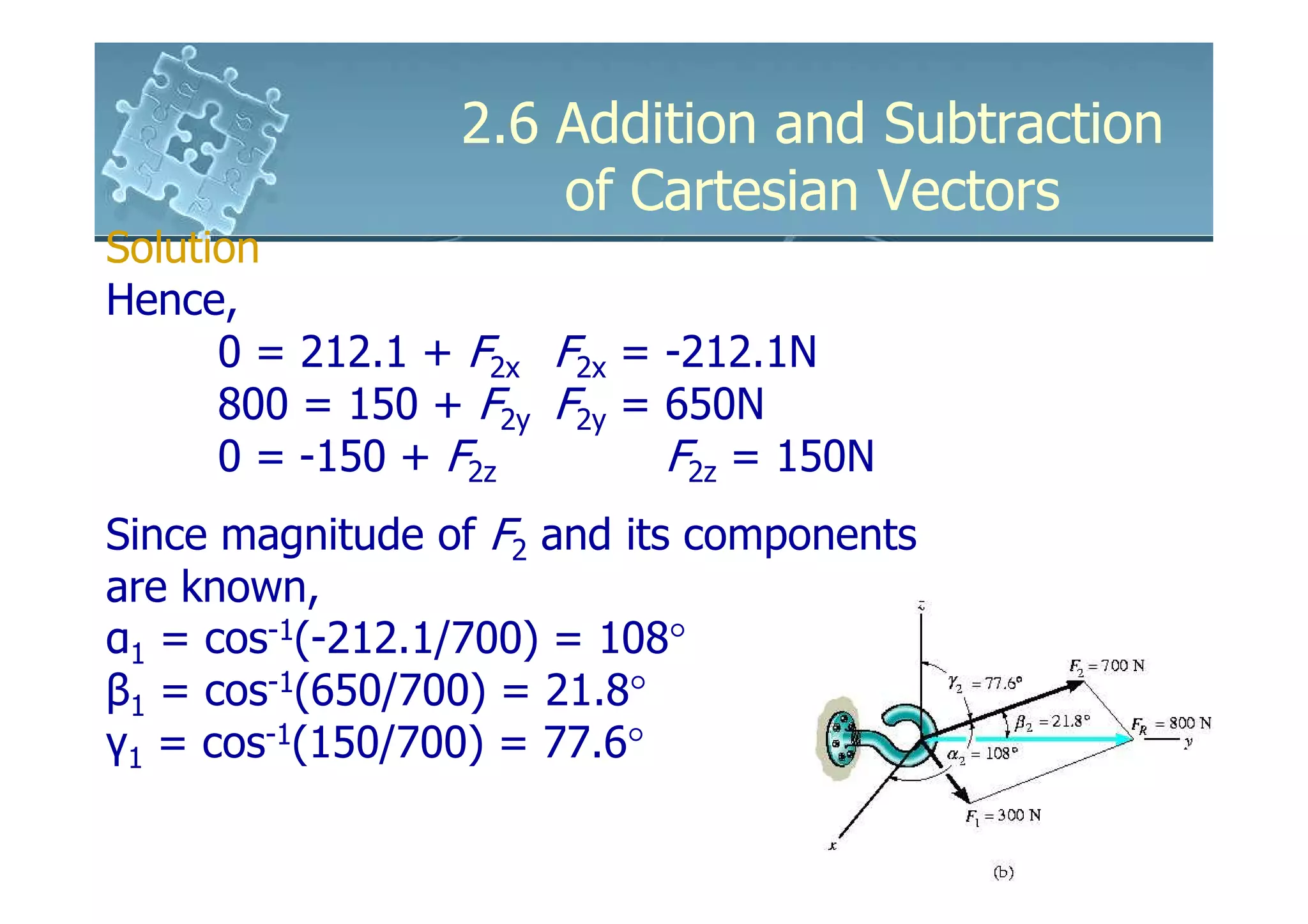
Two forces act on the hook. Specify the
coordinate direction angles of F2, so that the
resultant force FR acts along the positive y axis
and has a magnitude of 800N.
2.6 Addition and Subtraction
                of Cartesian Vectors
Solution
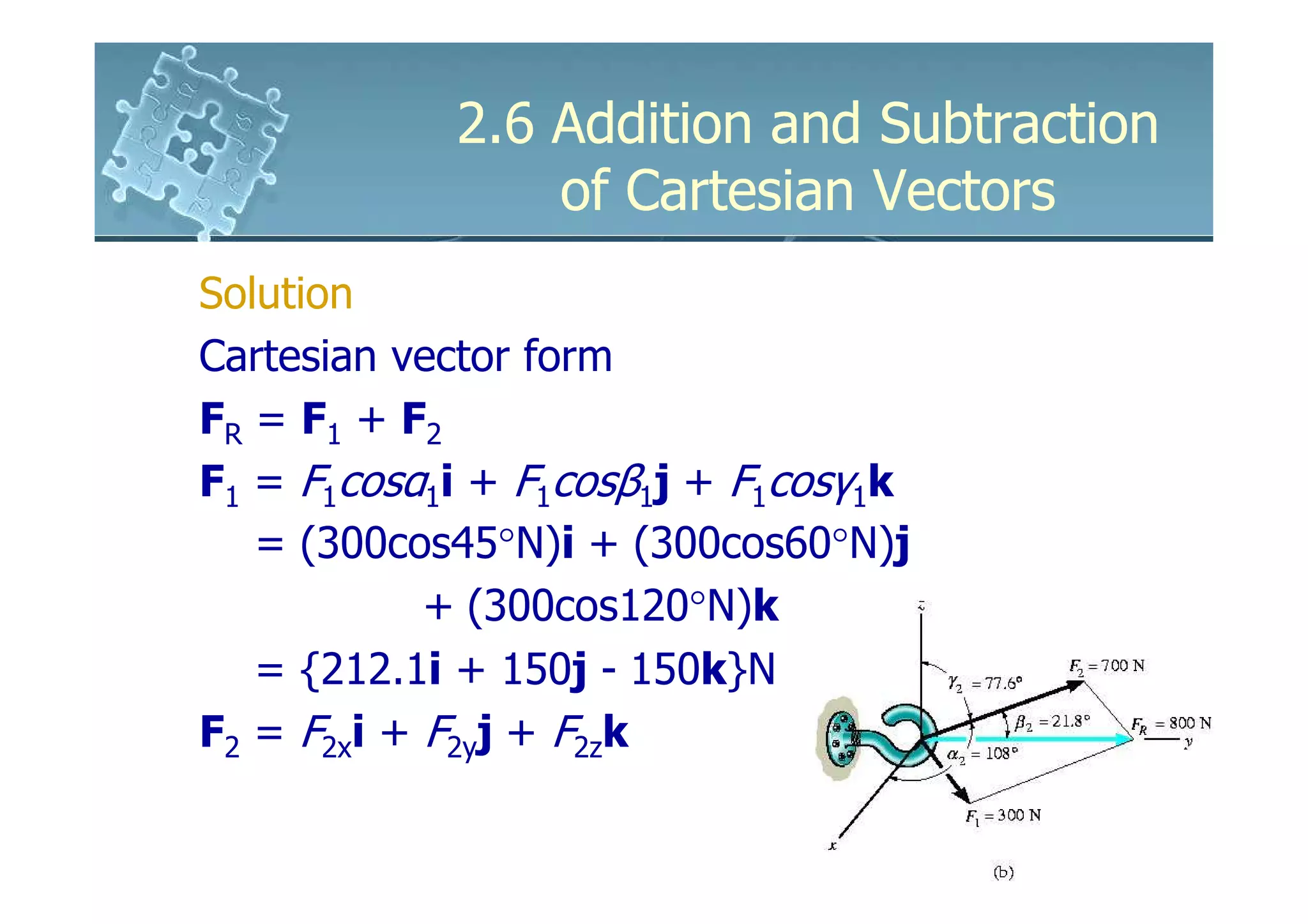
Cartesian vector form
FR = F1 + F2
F1 = F1cosα1i + F1cosβ1j + F1cosγ1k
   = (300cos45°N)i + (300cos60°N)j
            + (300cos120°N)k
   = {212.1i + 150j - 150k}N
F2 = F2xi + F2yj + F2zk
2.6 Addition and Subtraction
                      of Cartesian Vectors
Solution
Since FR has a magnitude of 800N and acts
in the +j direction
FR = F1 + F2
800j = 212.1i + 150j - 150k + F2xi + F2yj + F2zk
800j = (212.1 + F2x)i + (150 + F2y)j + (- 50 + F2z)k
To satisfy the equation, the corresponding
components on left and right sides must be equal
2.6 Addition and Subtraction
                     of Cartesian Vectors
Solution
Hence,
      0 = 212.1 + F2x F2x = -212.1N
      800 = 150 + F2y F2y = 650N
      0 = -150 + F2z        F2z = 150N
Since magnitude of F2 and its components
are known,
α1 = cos-1(-212.1/700) = 108°
β1 = cos-1(650/700) = 21.8°
γ1 = cos-1(150/700) = 77.6°
2.7 Position Vectors
x,y,z Coordinates
- Right-handed coordinate system
- Positive z axis points upwards, measuring
the height of an object or the altitude of a
point
- Points are measured relative to the
origin, O.
2.7 Position Vectors
x,y,z Coordinates
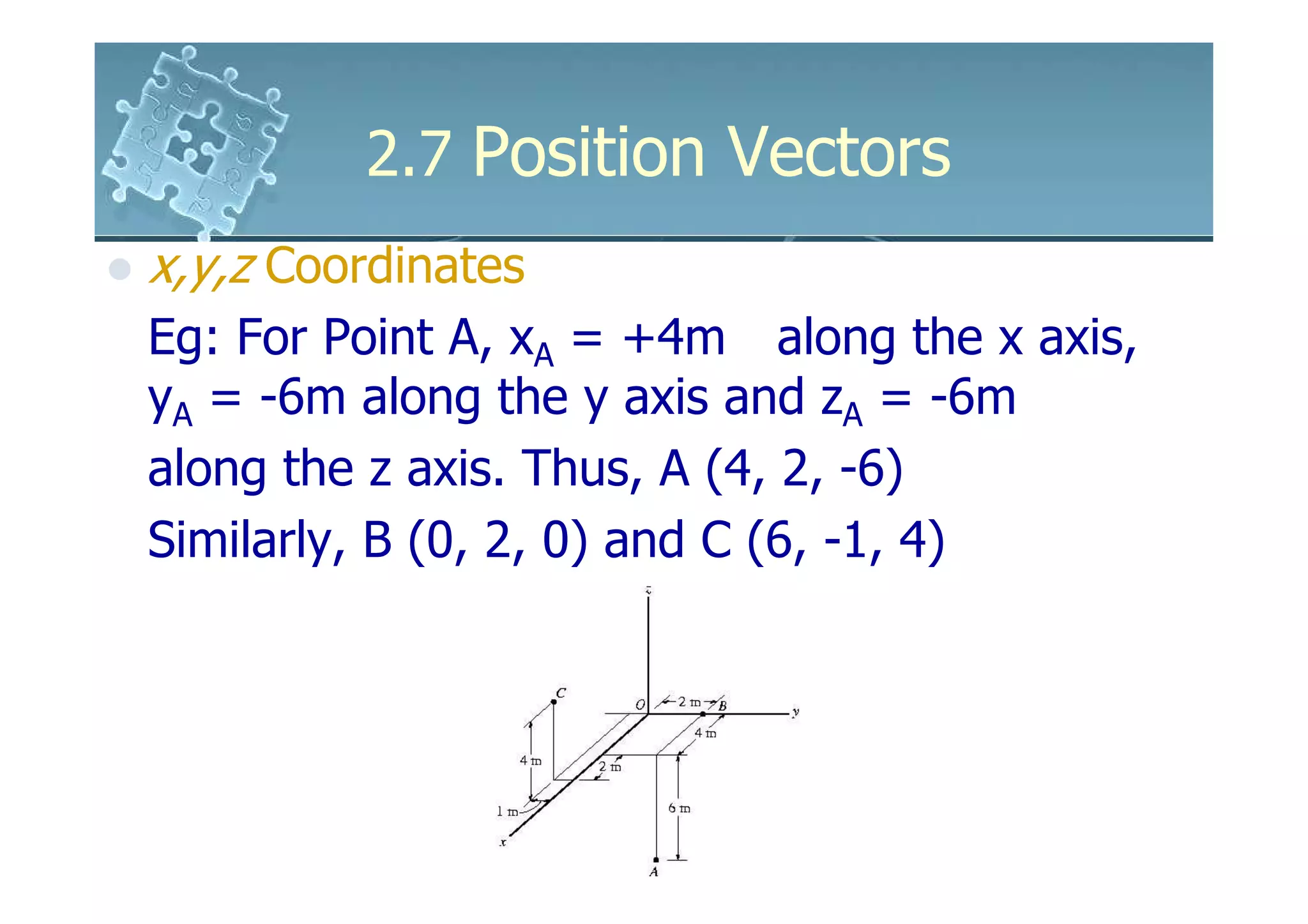
Eg: For Point A, xA = +4m along the x axis,
yA = -6m along the y axis and zA = -6m
along the z axis. Thus, A (4, 2, -6)
Similarly, B (0, 2, 0) and C (6, -1, 4)
2.7 Position Vectors
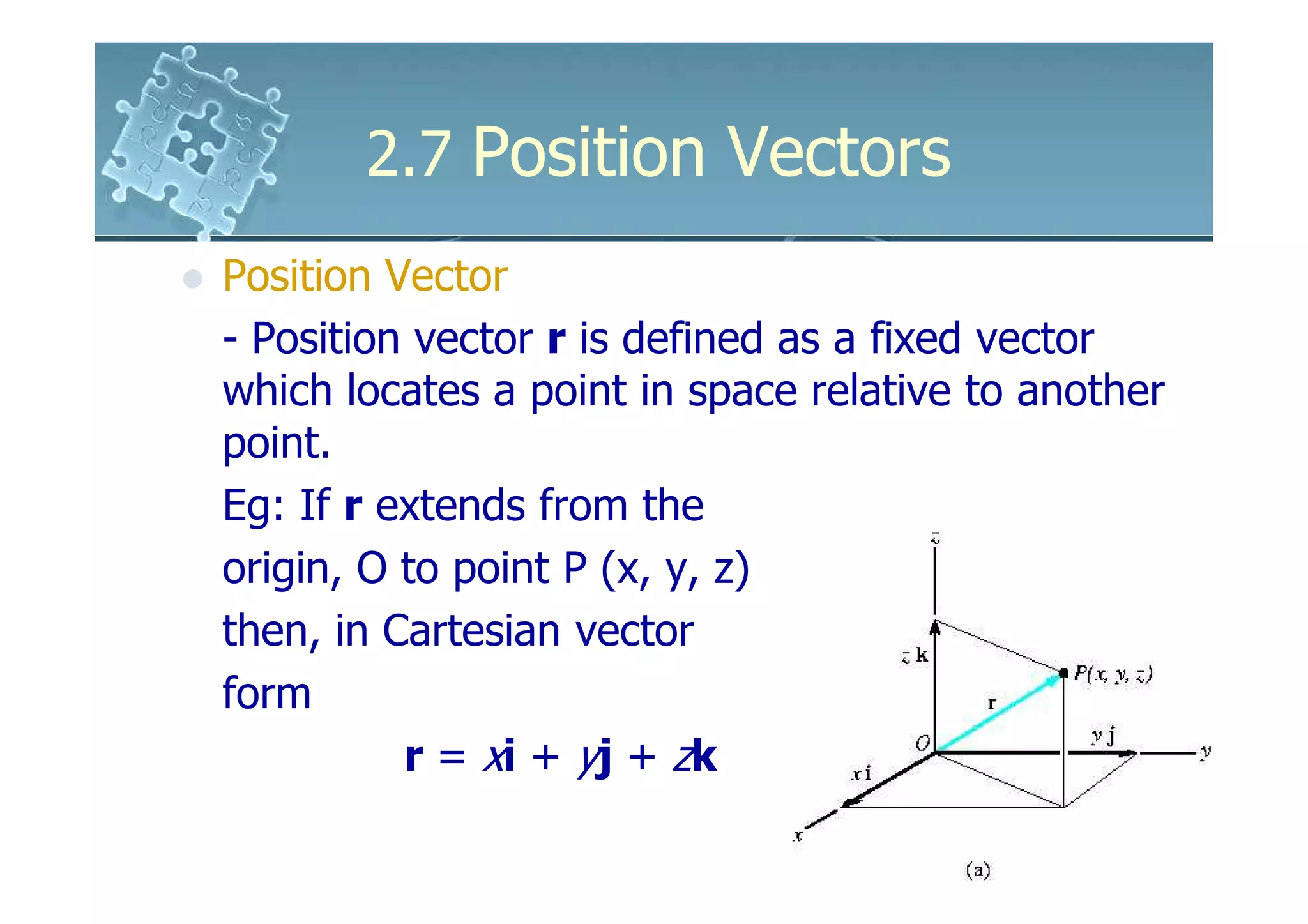
Position Vector
- Position vector r is defined as a fixed vector
which locates a point in space relative to another
point.
Eg: If r extends from the
origin, O to point P (x, y, z)
then, in Cartesian vector
form
          r = xi + yj + zk
2.7 Position Vectors
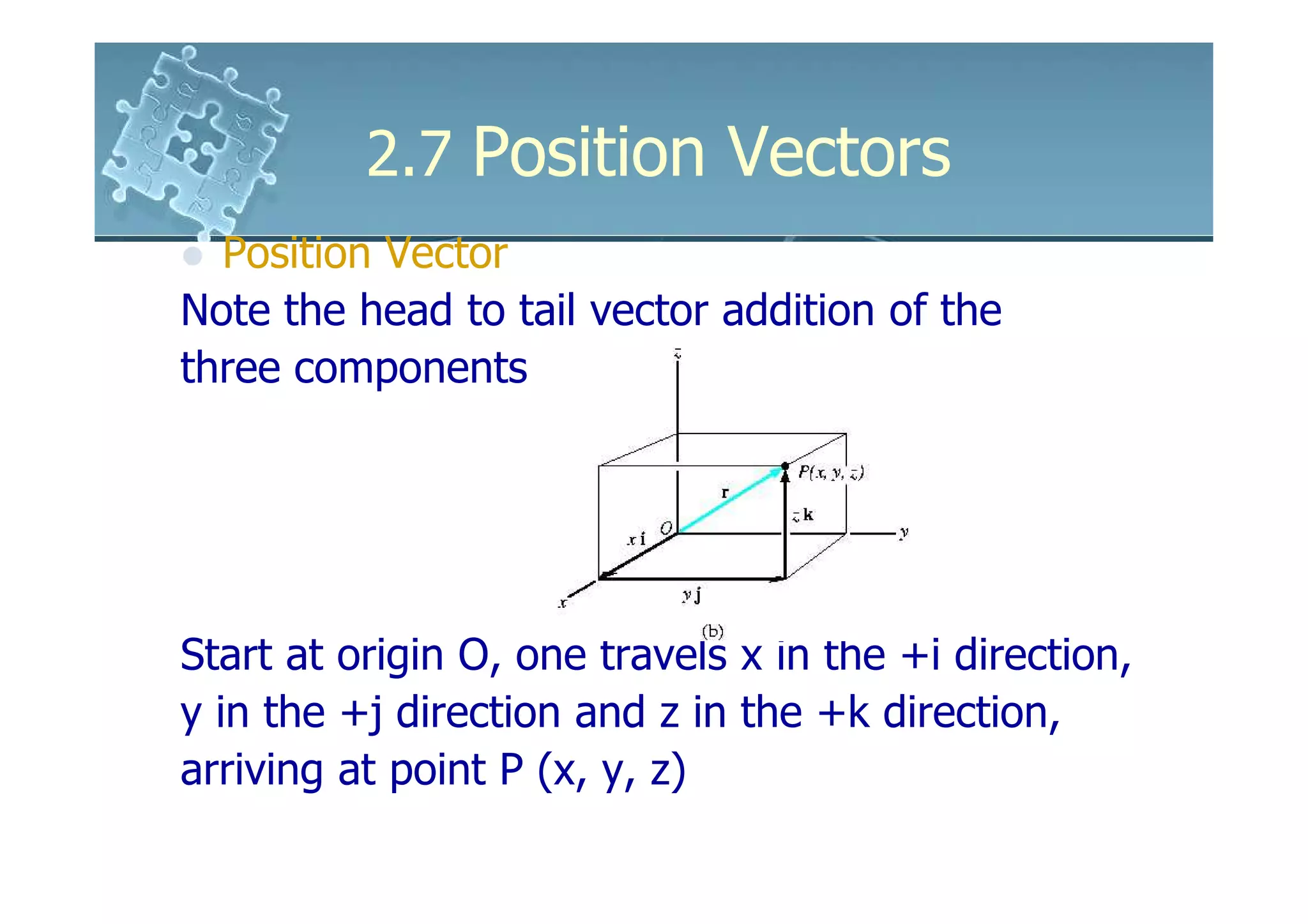
  Position Vector
Note the head to tail vector addition of the
three components


Start at origin O, one travels x in the +i direction,
y in the +j direction and z in the +k direction,
arriving at point P (x, y, z)
2.7 Position Vectors
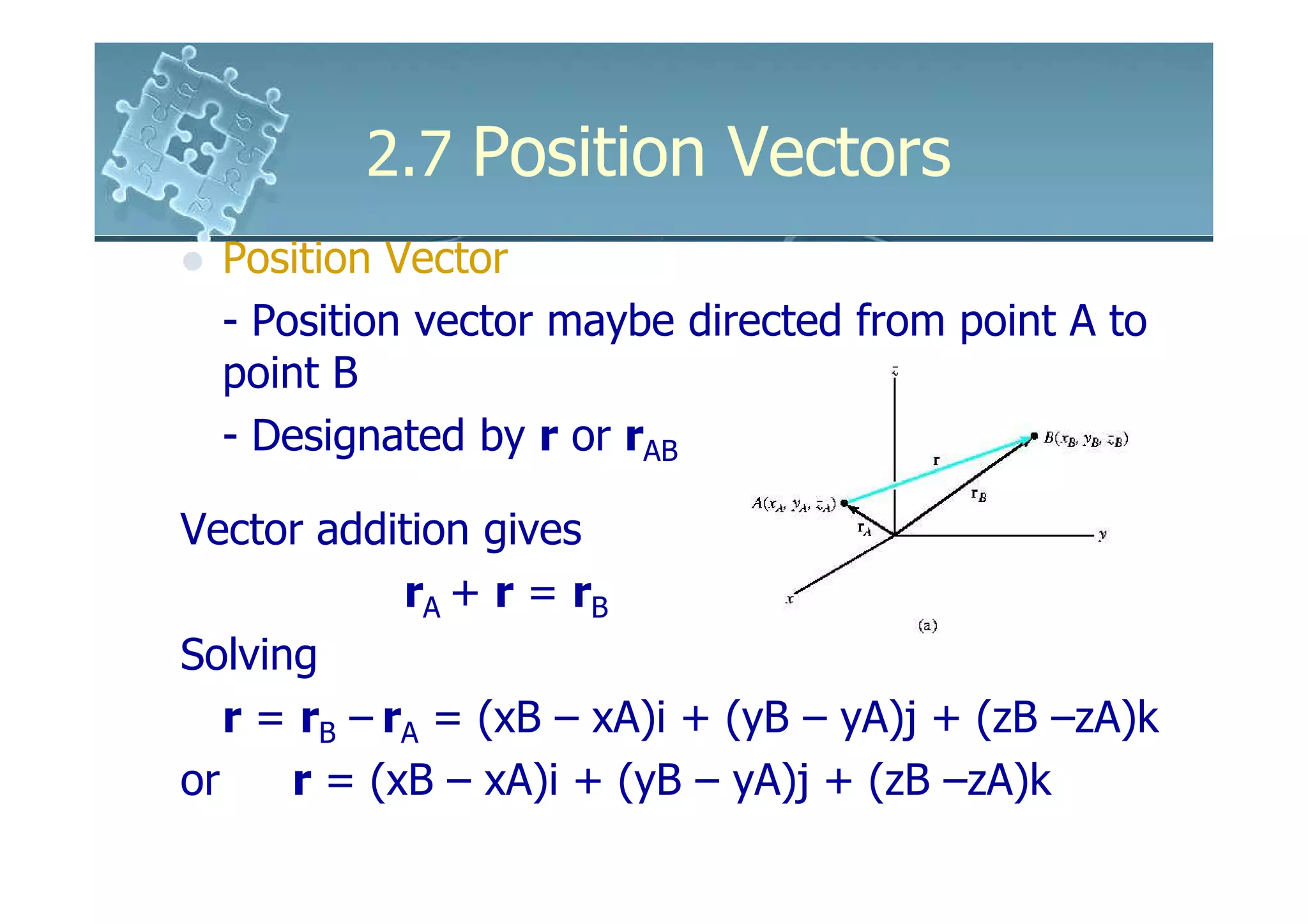
  Position Vector
  - Position vector maybe directed from point A to
  point B
  - Designated by r or rAB

Vector addition gives
             rA + r = rB
Solving
   r = rB – rA = (xB – xA)i + (yB – yA)j + (zB –zA)k
or    r = (xB – xA)i + (yB – yA)j + (zB –zA)k
2.7 Position Vectors
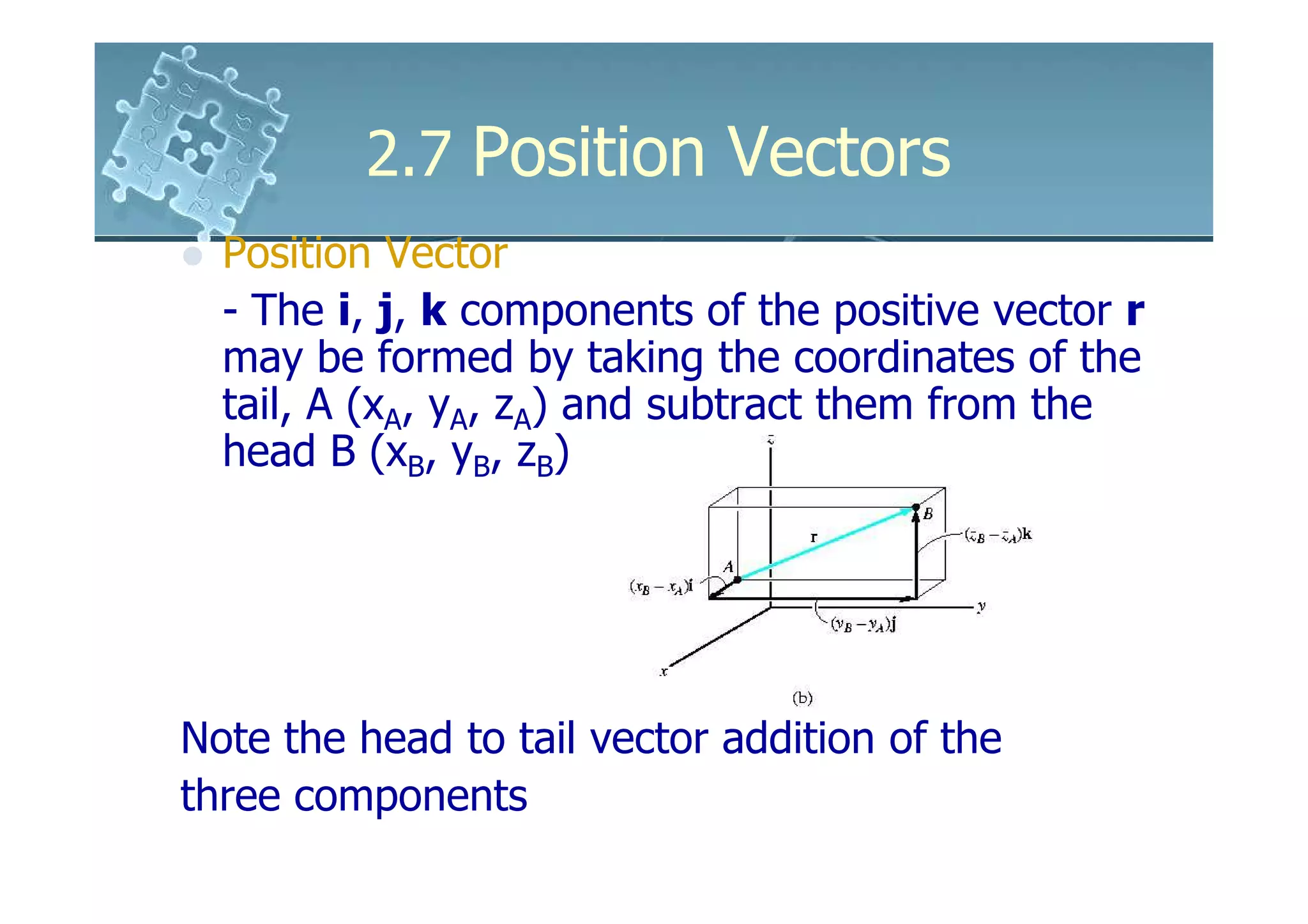
  Position Vector
  - The i, j, k components of the positive vector r
  may be formed by taking the coordinates of the
  tail, A (xA, yA, zA) and subtract them from the
  head B (xB, yB, zB)


Note the head to tail vector addition of the
three components
2.7 Position Vectors

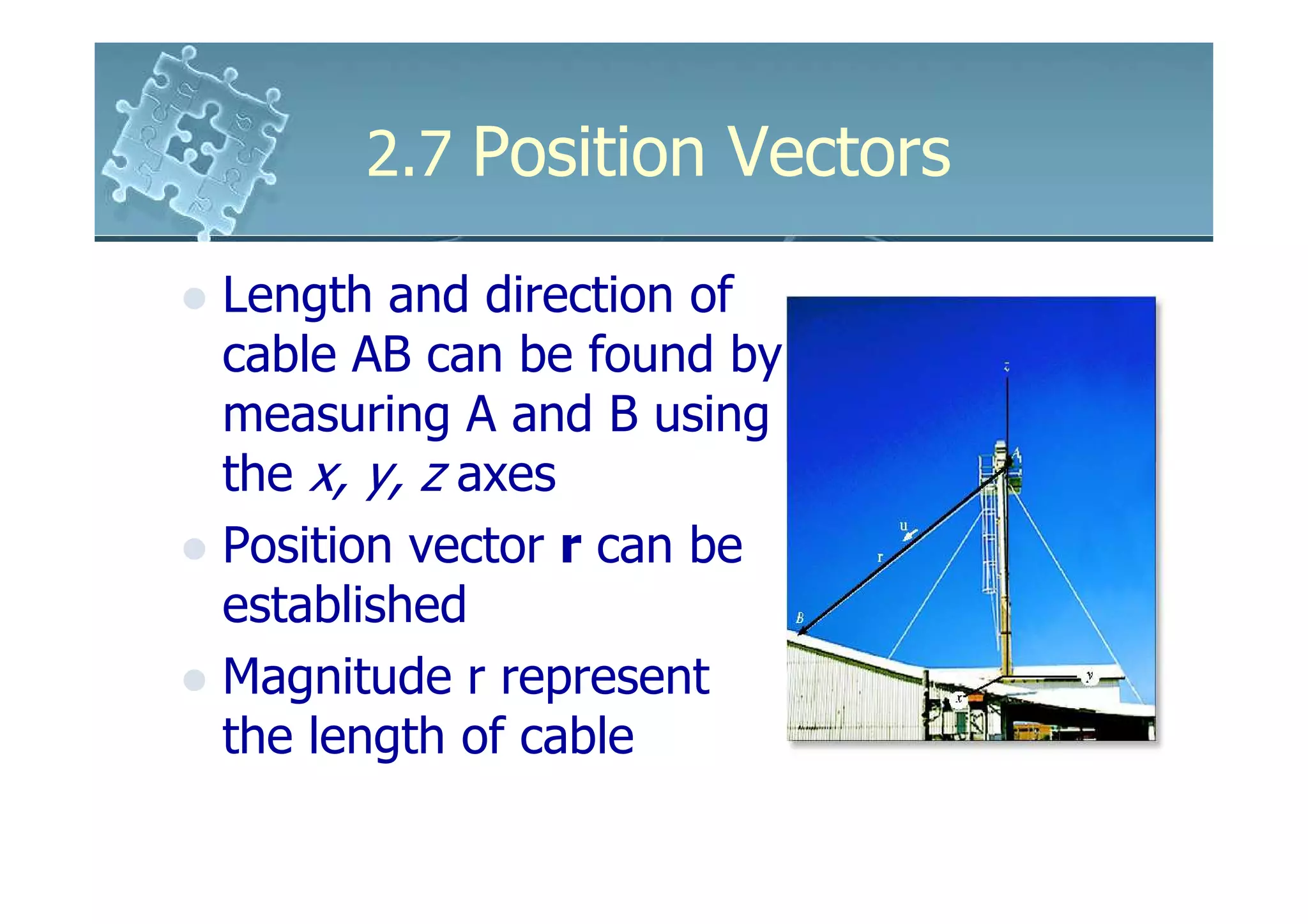
Length and direction of
cable AB can be found by
measuring A and B using
the x, y, z axes
Position vector r can be
established
Magnitude r represent
the length of cable
2.7 Position Vectors


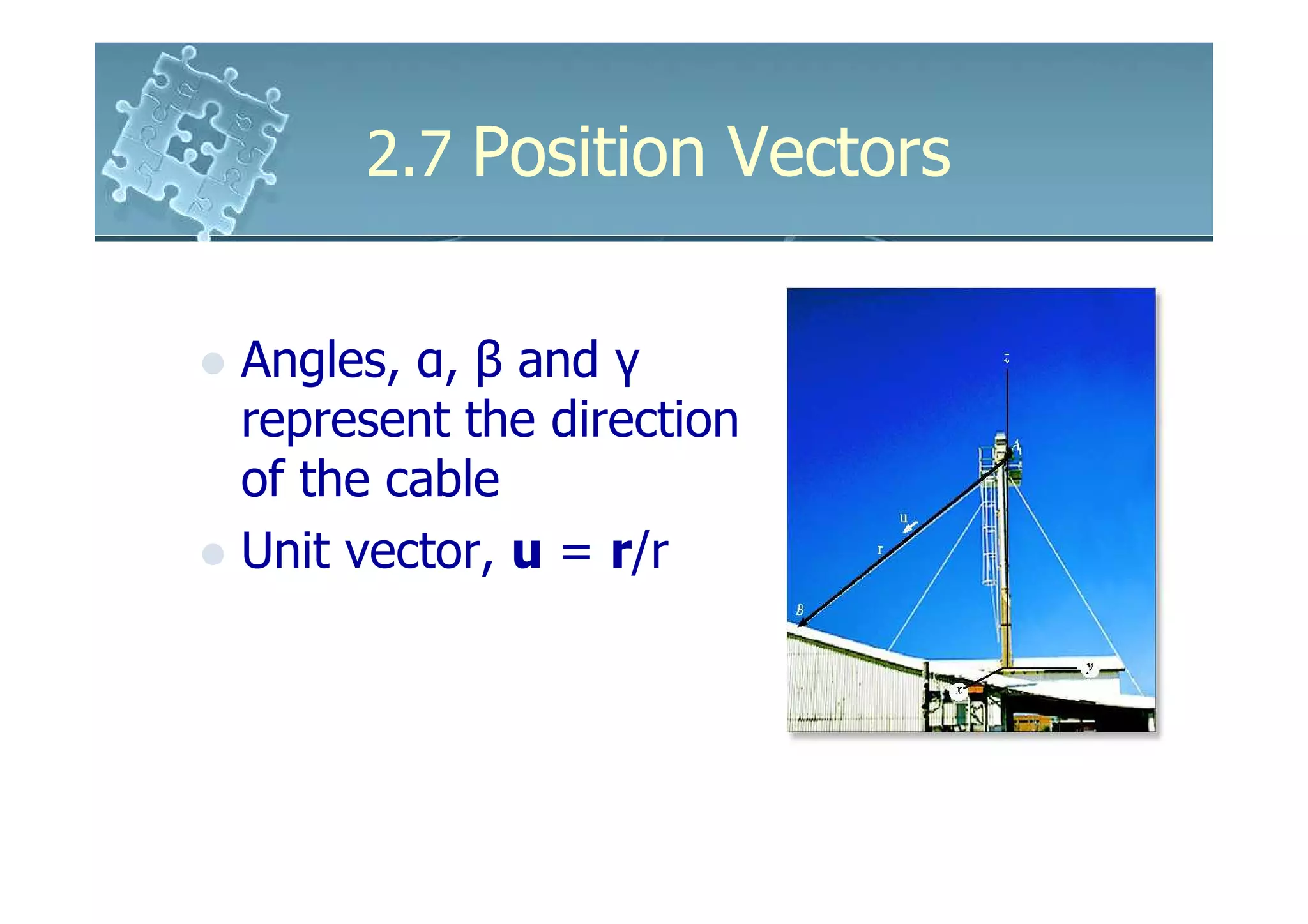
Angles, α, β and γ
represent the direction
of the cable
Unit vector, u = r/r
2.7 Position Vectors

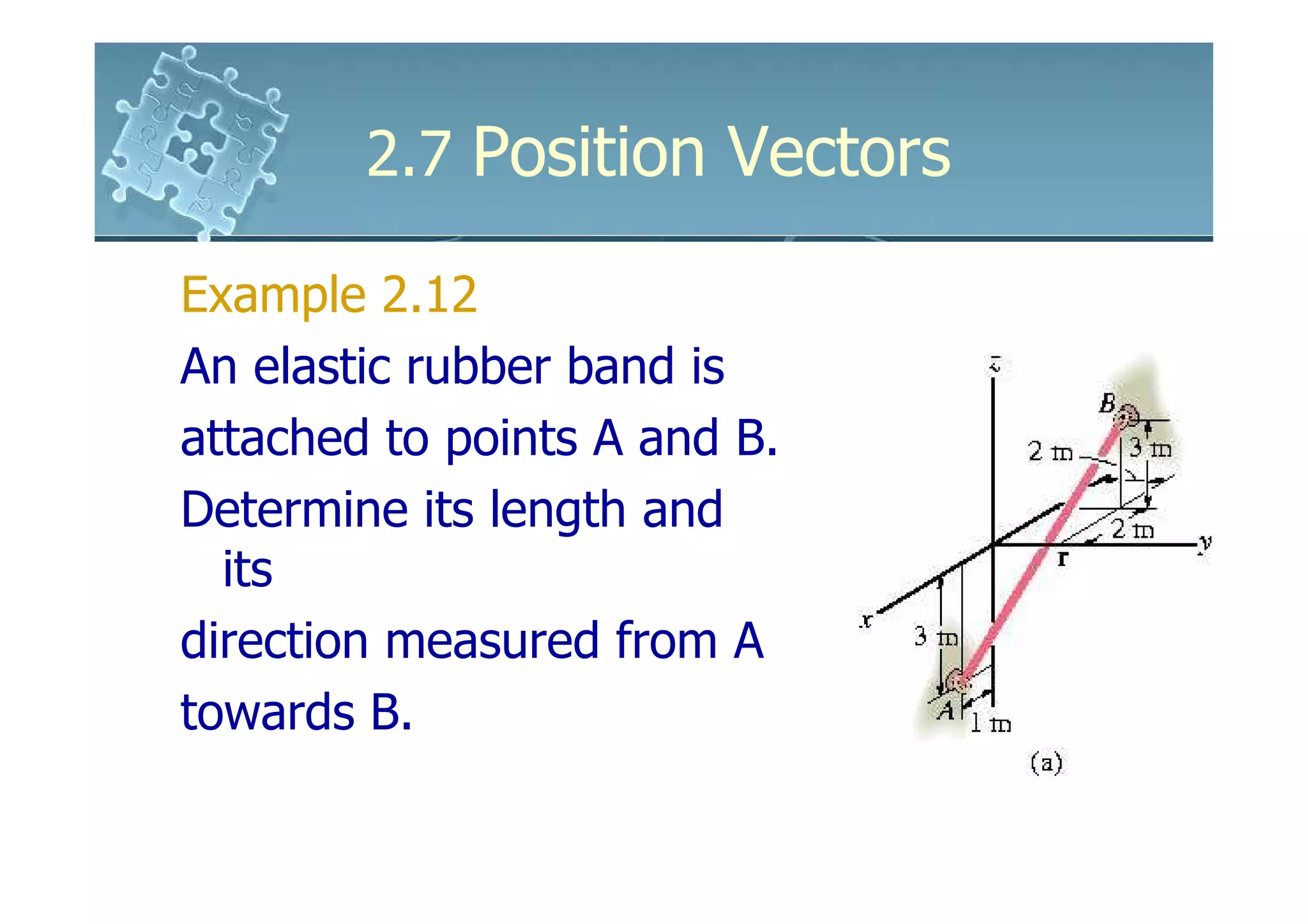
Example 2.12
An elastic rubber band is
attached to points A and B.
Determine its length and
  its
direction measured from A
towards B.
2.7 Position Vectors
Solution
Position vector
  r = [-2m – 1m]i + [2m – 0]j + [3m – (-3m)]k
    = {-3i + 2j + 6k}m
Magnitude = length of the rubber band
        r=   (− 3)2 + (2)2 + (6)2   = 7m
Unit vector in the director of r
  u = r /r
    = -3/7i + 2/7j + 6/7k
2.7 Position Vectors
Solution
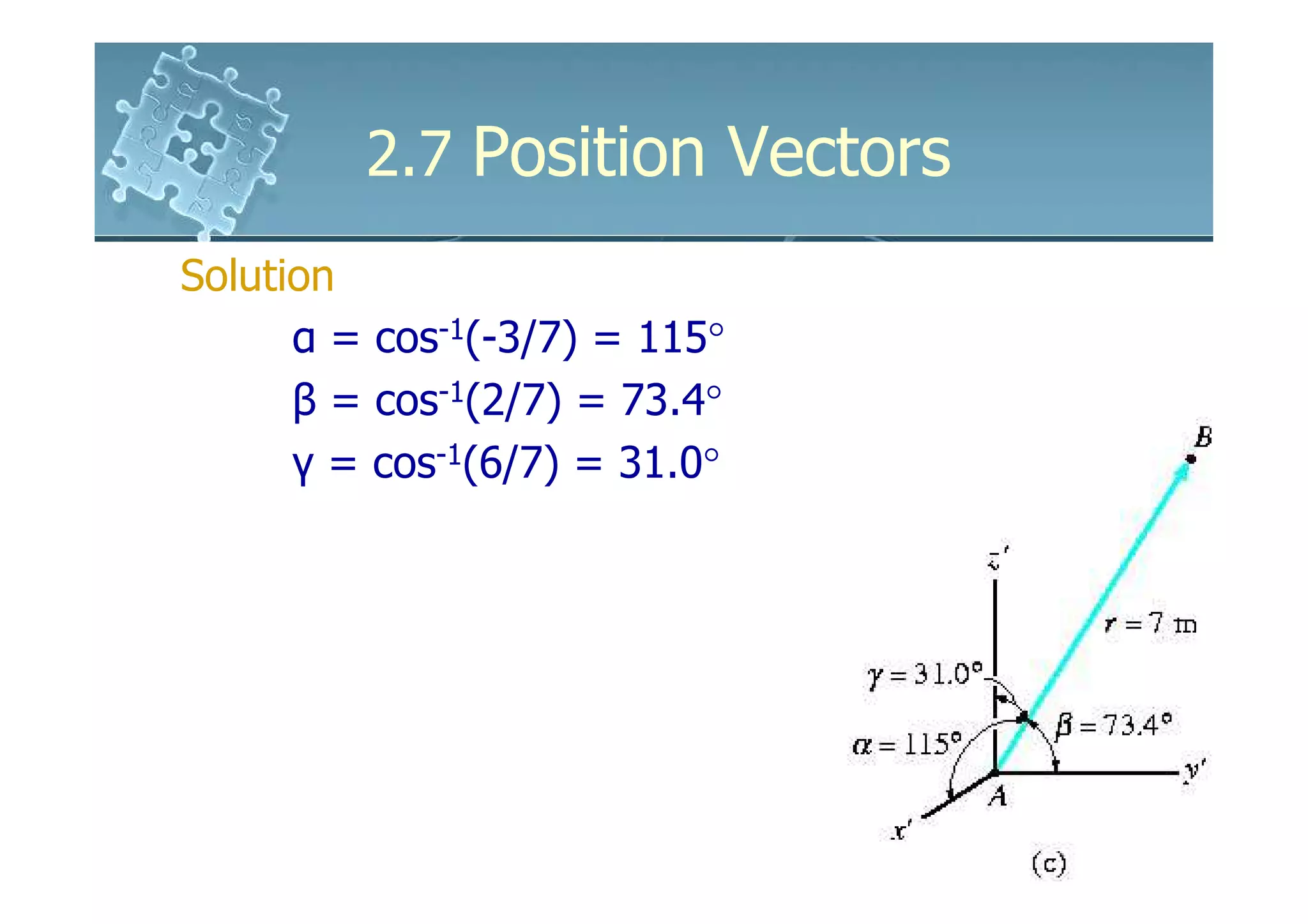
      α = cos-1(-3/7) = 115°
      β = cos-1(2/7) = 73.4°
      γ = cos-1(6/7) = 31.0°
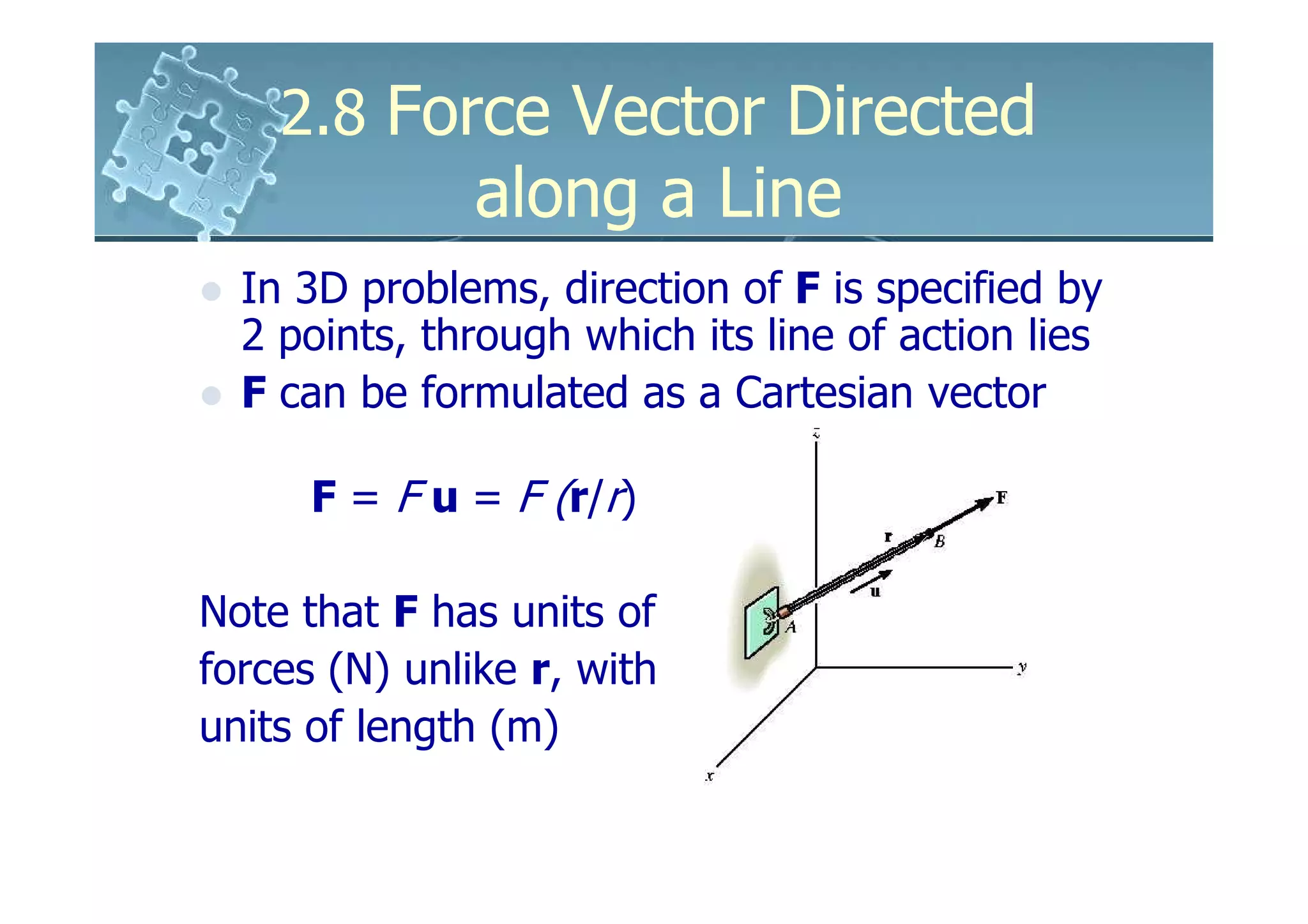
2.8 Force Vector Directed
               along a Line
  In 3D problems, direction of F is specified by
  2 points, through which its line of action lies
  F can be formulated as a Cartesian vector

      F = F u = F (r/r)

Note that F has units of
forces (N) unlike r, with
units of length (m)
2.8 Force Vector Directed
            along a Line


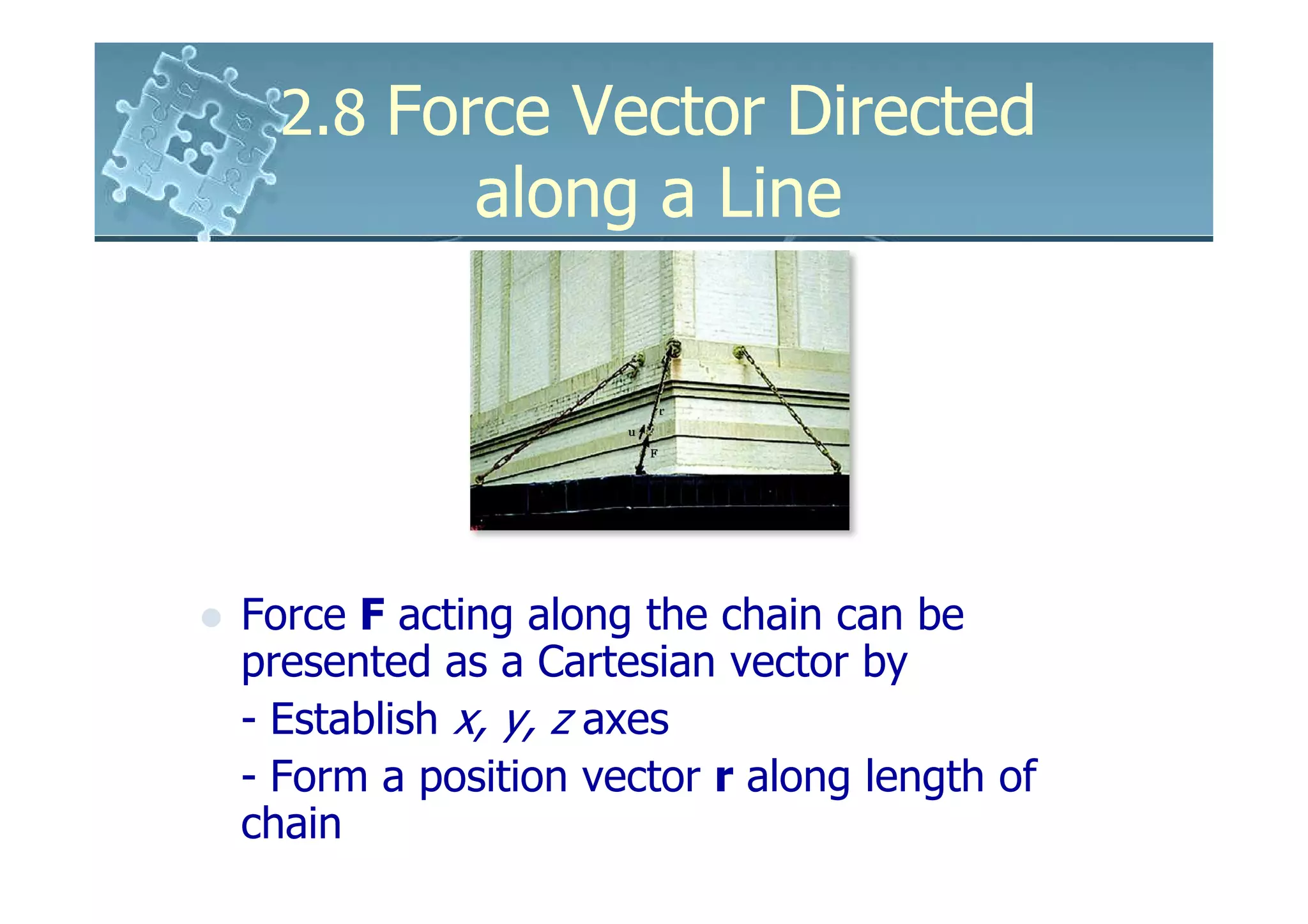
Force F acting along the chain can be
presented as a Cartesian vector by
- Establish x, y, z axes
- Form a position vector r along length of
chain
2.8 Force Vector Directed
            along a Line


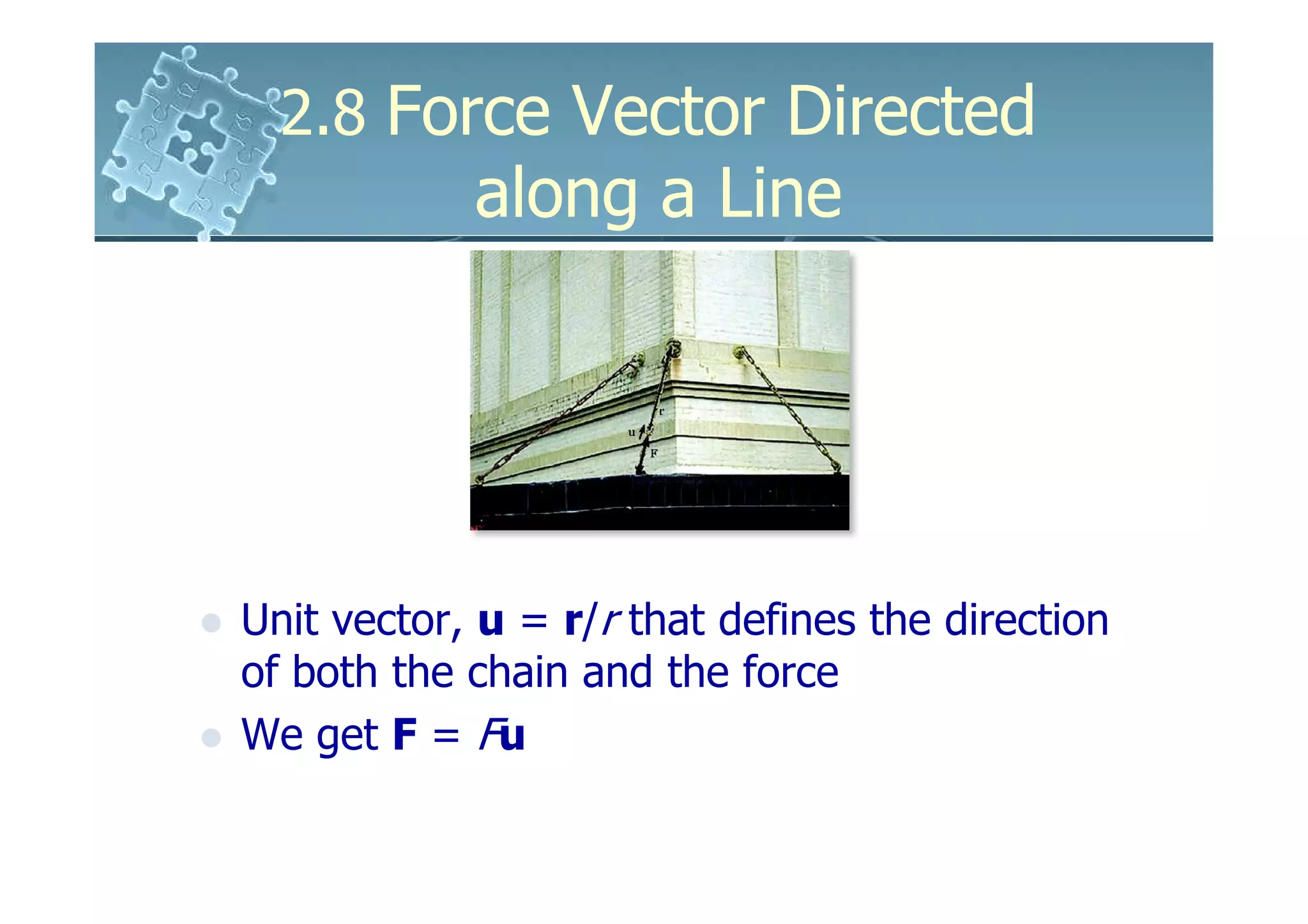
Unit vector, u = r/r that defines the direction
of both the chain and the force
We get F = Fu
2.8 Force Vector Directed
             along a Line
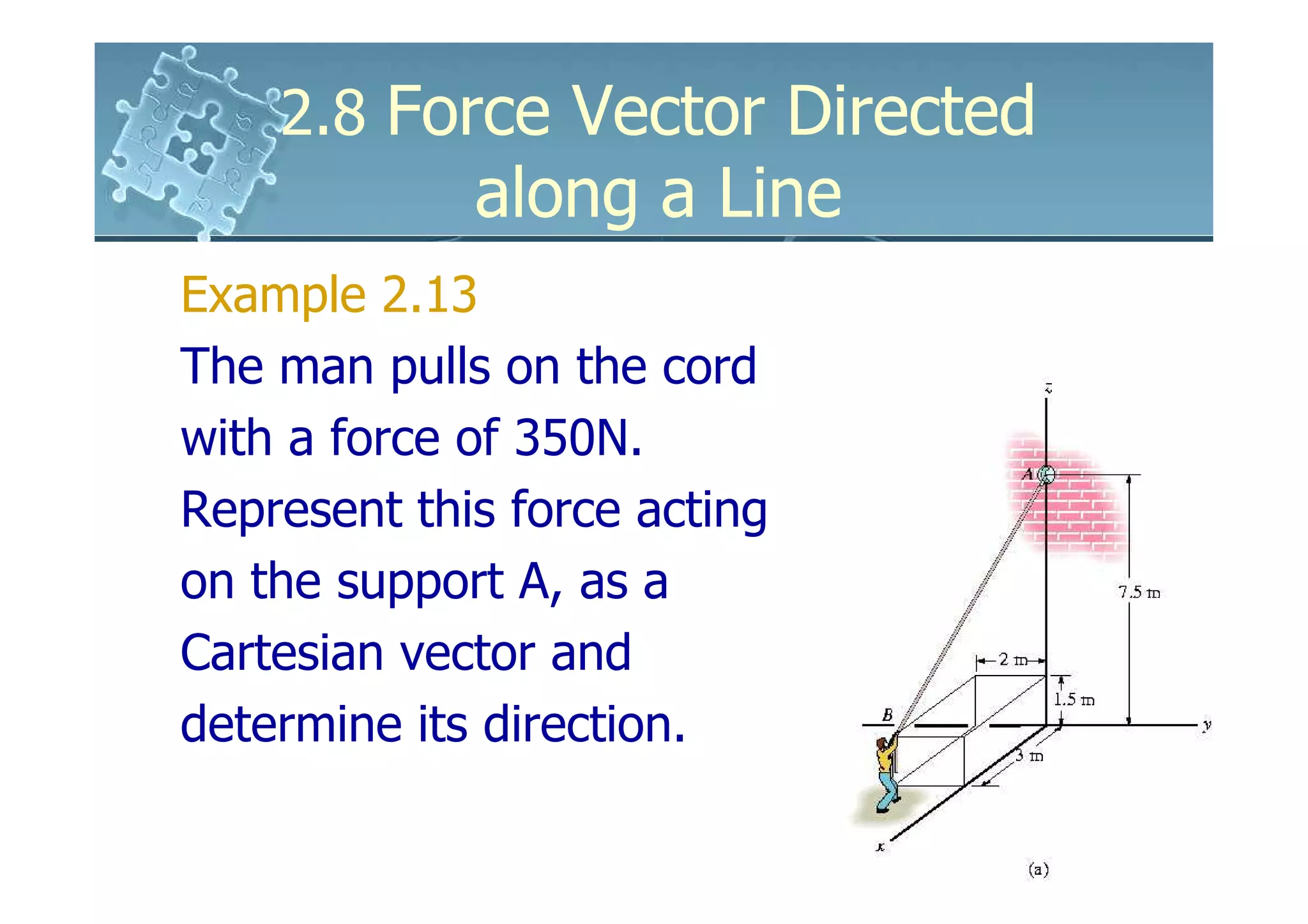
Example 2.13
The man pulls on the cord
with a force of 350N.
Represent this force acting
on the support A, as a
Cartesian vector and
determine its direction.
2.8 Force Vector Directed
             along a Line
Solution
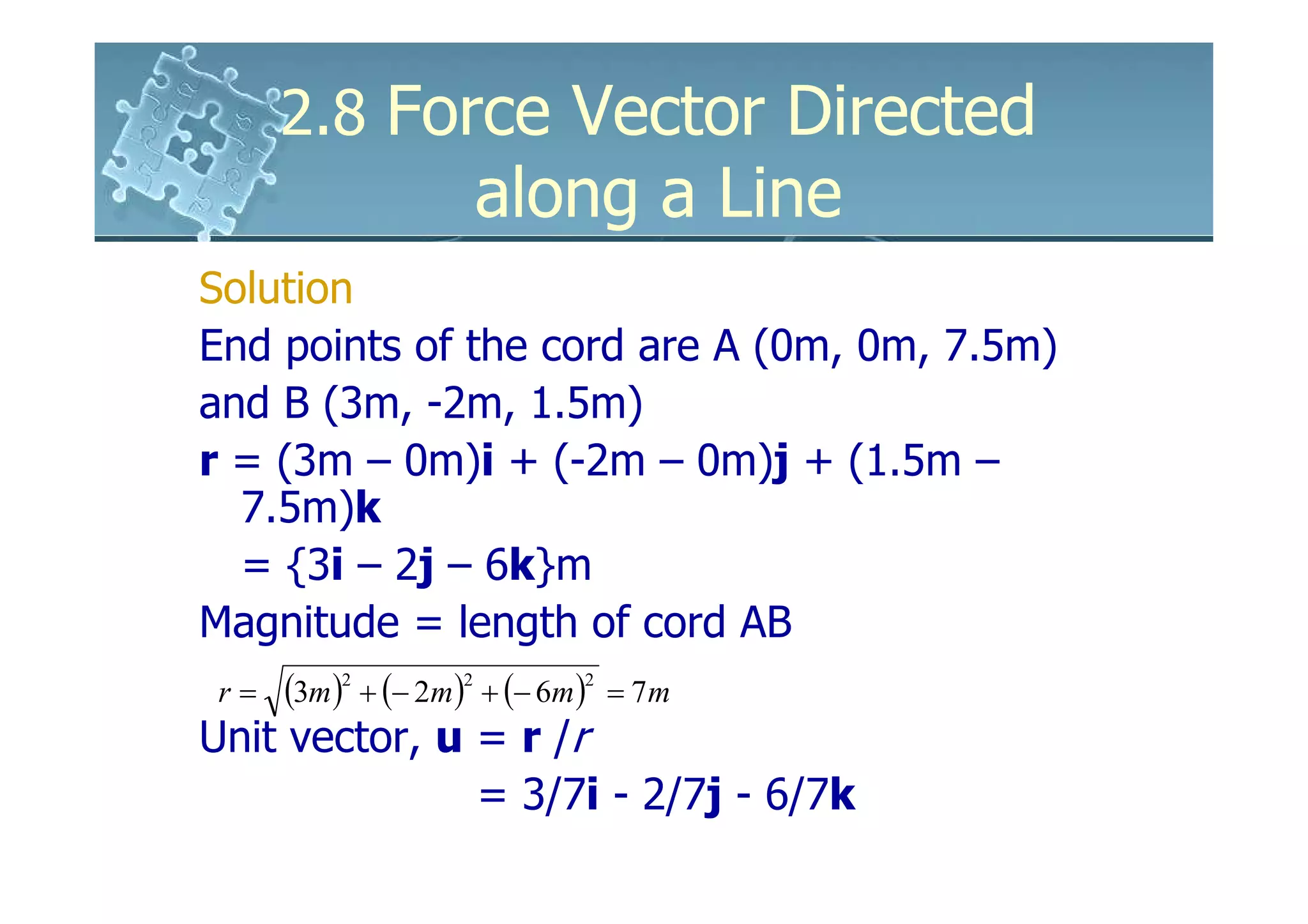
End points of the cord are A (0m, 0m, 7.5m)
and B (3m, -2m, 1.5m)
r = (3m – 0m)i + (-2m – 0m)j + (1.5m –
   7.5m)k
   = {3i – 2j – 6k}m
Magnitude = length of cord AB
 r = (3m ) + (− 2m ) + (− 6m ) = 7m
          2         2         2


Unit vector, u = r /r
                      = 3/7i - 2/7j - 6/7k
2.8 Force Vector Directed
              along a Line
Solution
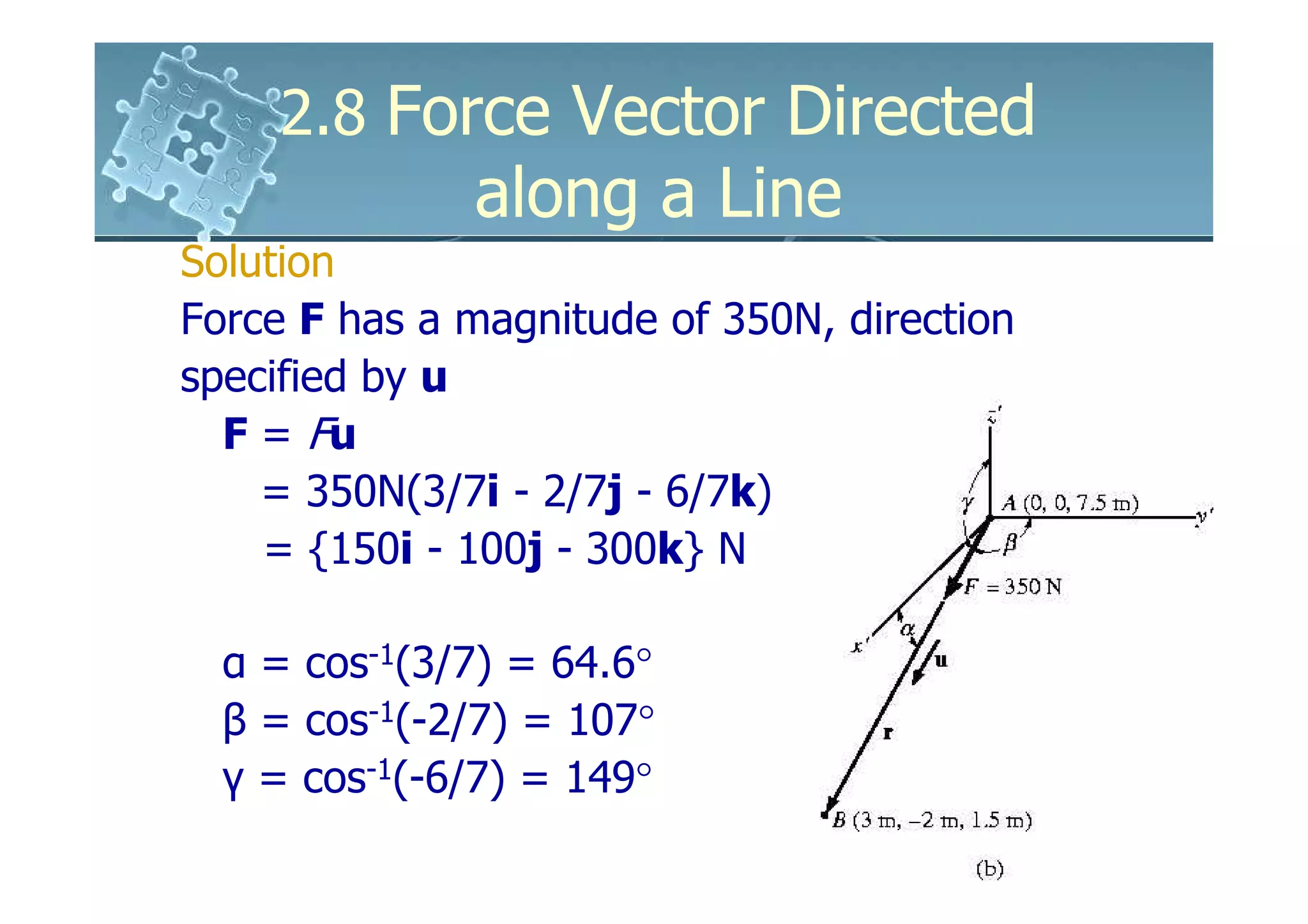
Force F has a magnitude of 350N, direction
specified by u
  F = Fu
    = 350N(3/7i - 2/7j - 6/7k)
    = {150i - 100j - 300k} N

  α = cos-1(3/7) = 64.6°
  β = cos-1(-2/7) = 107°
  γ = cos-1(-6/7) = 149°
2.8 Force Vector Directed
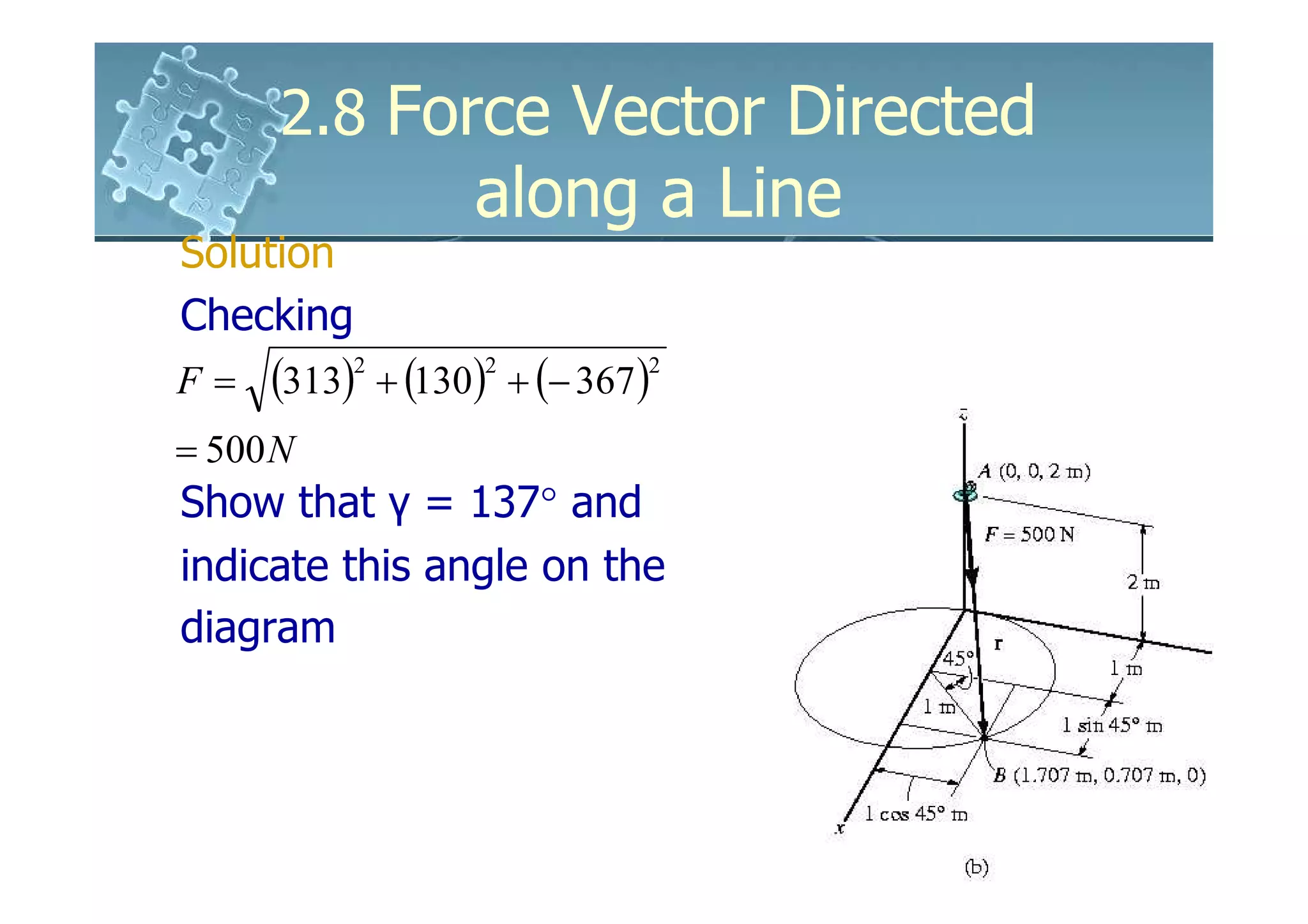
            along a Line
Example 2.14
The circular plate is
partially supported by
the cable AB. If the
force of the cable on
  the
hook at A is F = 500N,
express F as a
Cartesian vector.
2.8 Force Vector Directed
                         along a Line
Solution
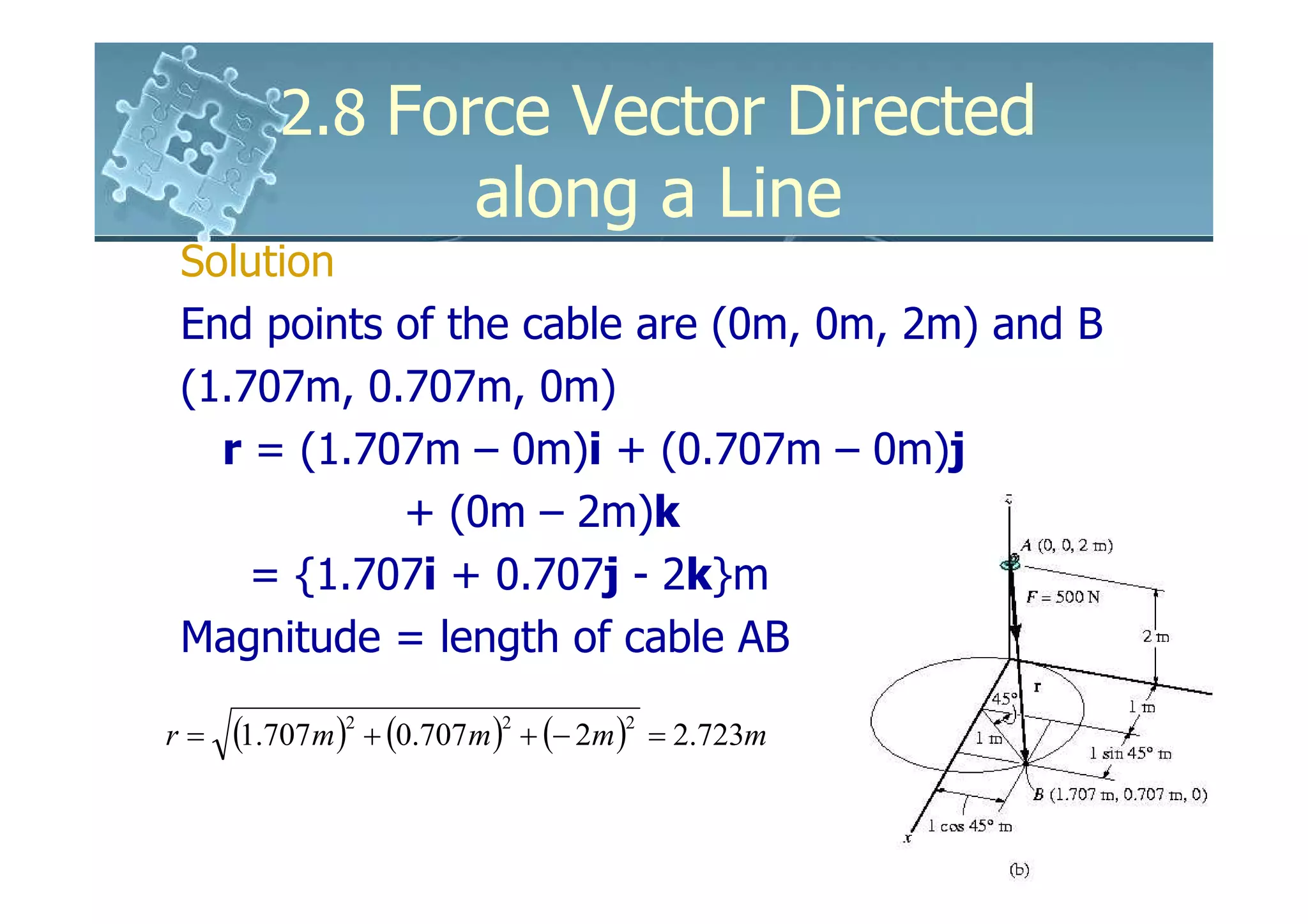
End points of the cable are (0m, 0m, 2m) and B
(1.707m, 0.707m, 0m)
  r = (1.707m – 0m)i + (0.707m – 0m)j
           + (0m – 2m)k
    = {1.707i + 0.707j - 2k}m
Magnitude = length of cable AB

r=   (1.707m )2 + (0.707m )2 + (− 2m )2   = 2.723m
2.8 Force Vector Directed
                  along a Line
Solution
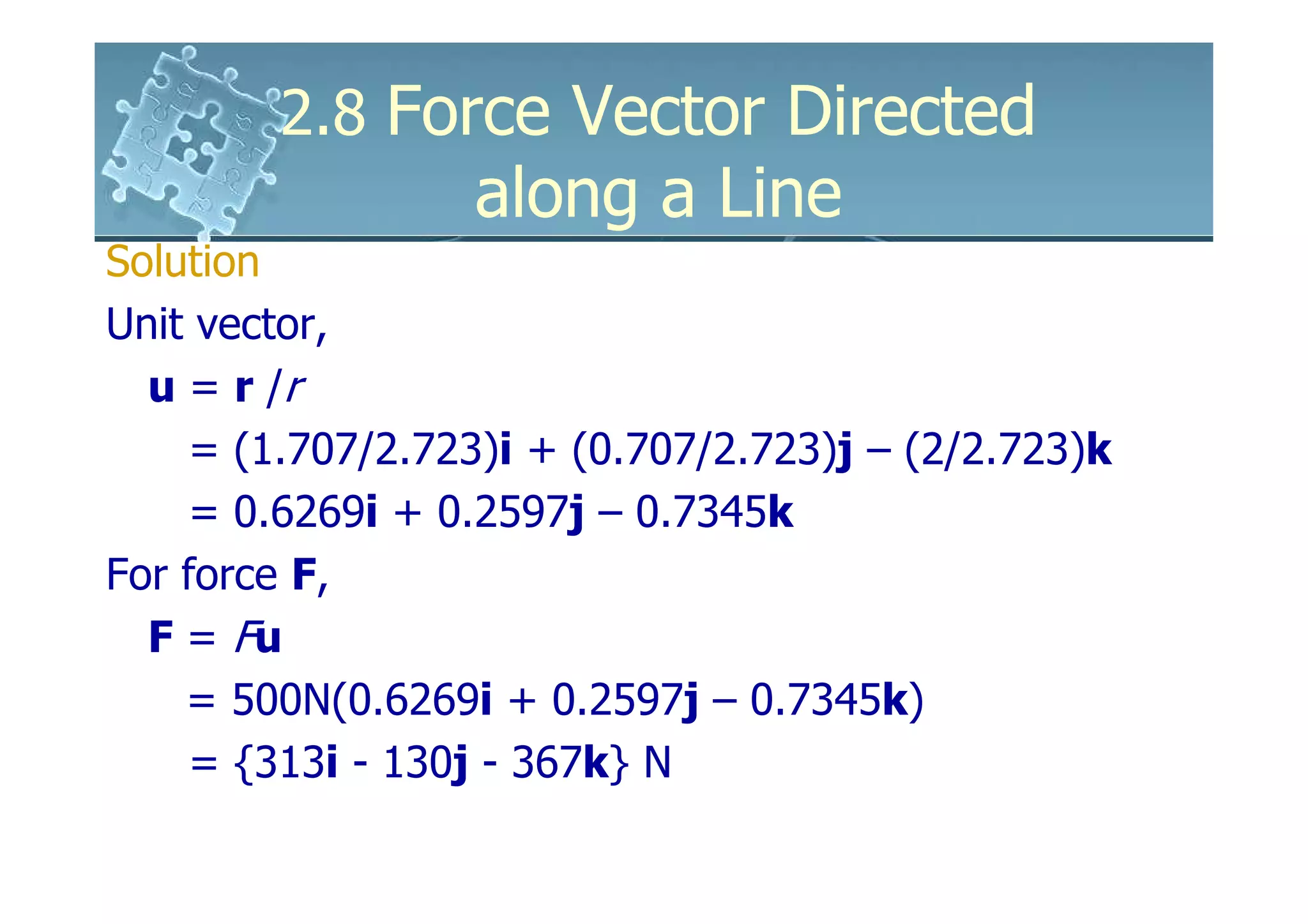
Unit vector,
  u = r /r
     = (1.707/2.723)i + (0.707/2.723)j – (2/2.723)k
     = 0.6269i + 0.2597j – 0.7345k
For force F,
  F = Fu
    = 500N(0.6269i + 0.2597j – 0.7345k)
     = {313i - 130j - 367k} N
2.8 Force Vector Directed
                 along a Line
Solution
Checking
F=   (313) + (130) + (− 367 )
           2      2         2


= 500 N
Show that γ = 137° and
indicate this angle on the
diagram
2.8 Force Vector Directed
              along a Line
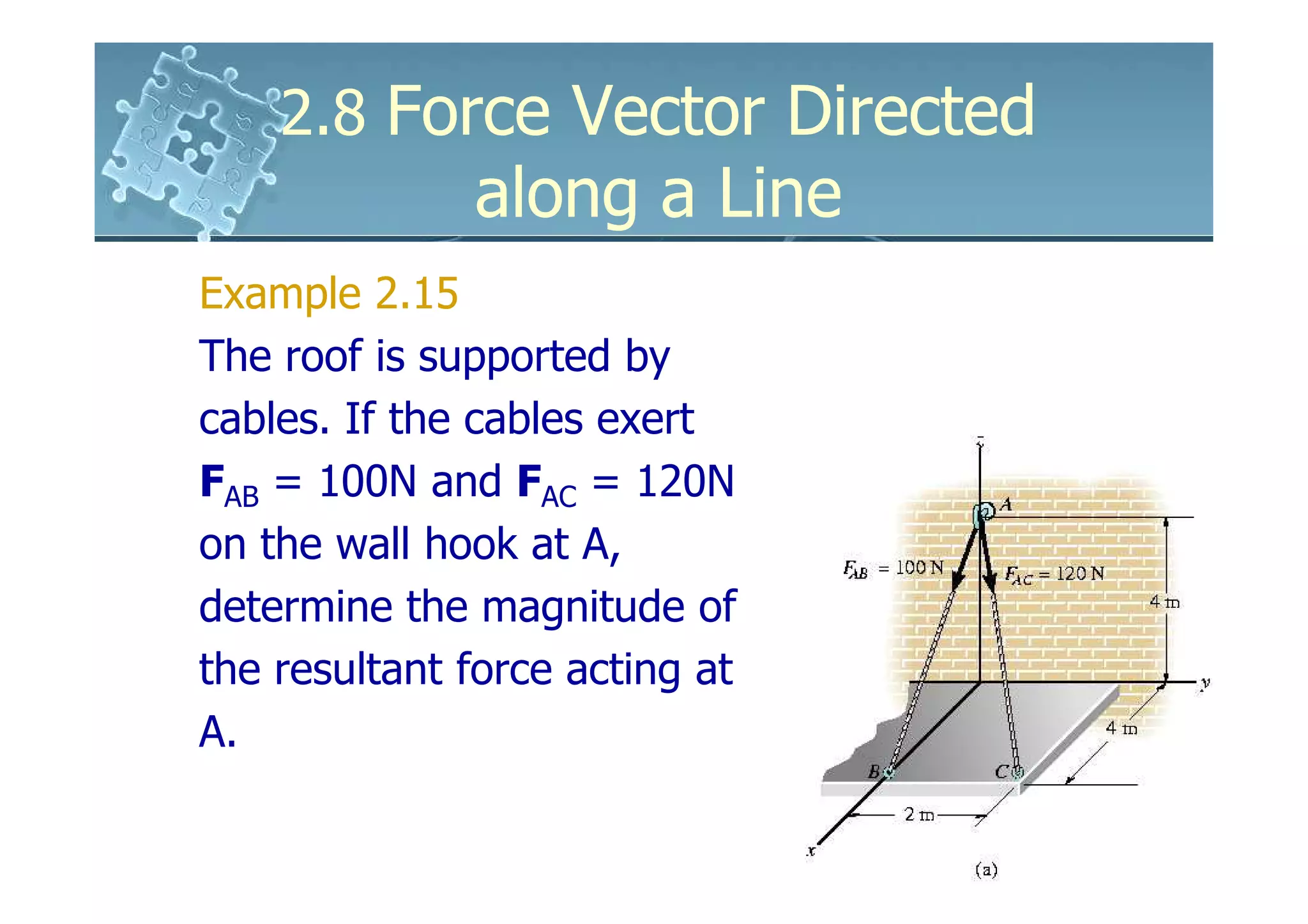
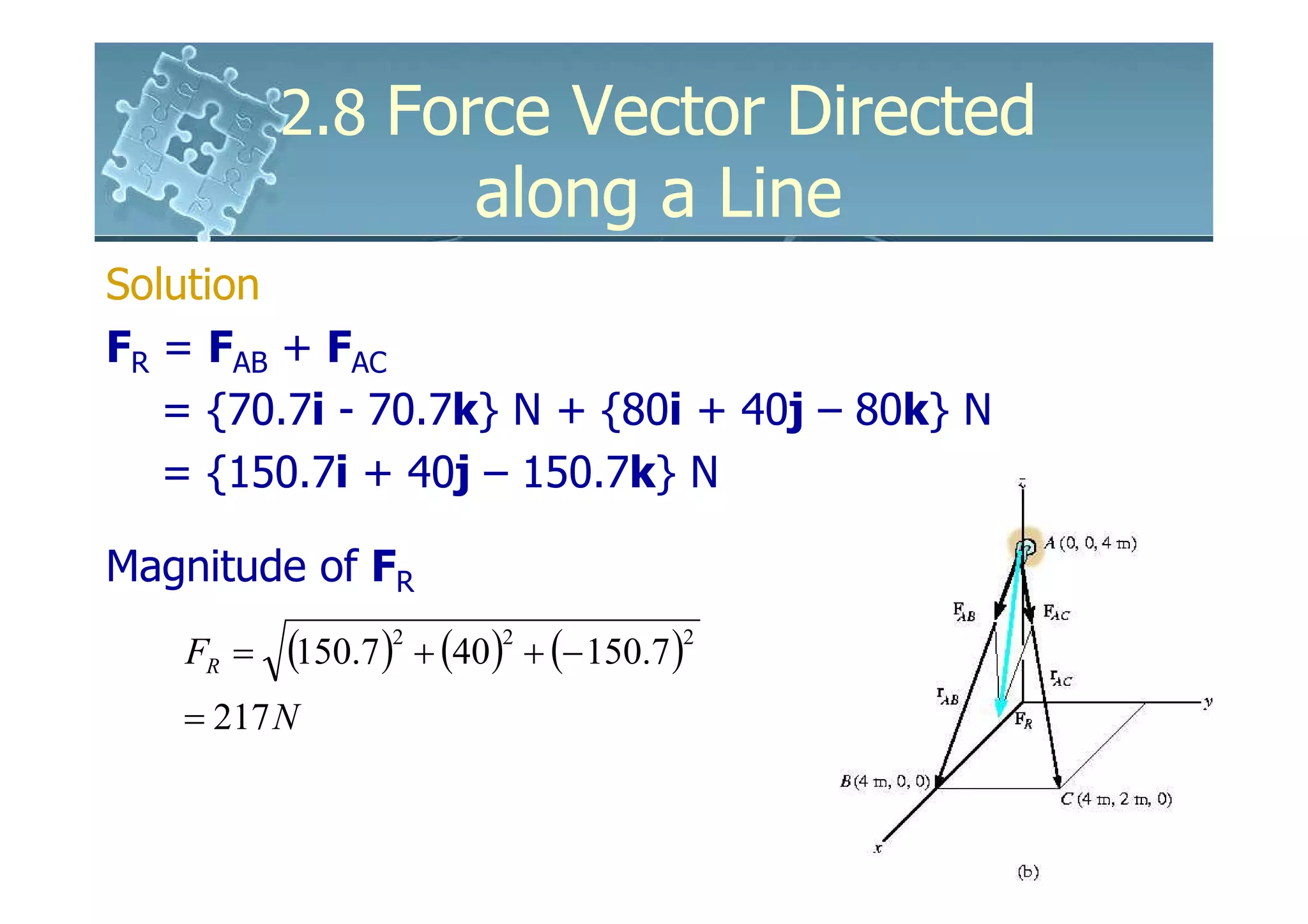
Example 2.15
The roof is supported by
cables. If the cables exert
FAB = 100N and FAC = 120N
on the wall hook at A,
determine the magnitude of
the resultant force acting at
A.
2.8 Force Vector Directed
                     along a Line
Solution
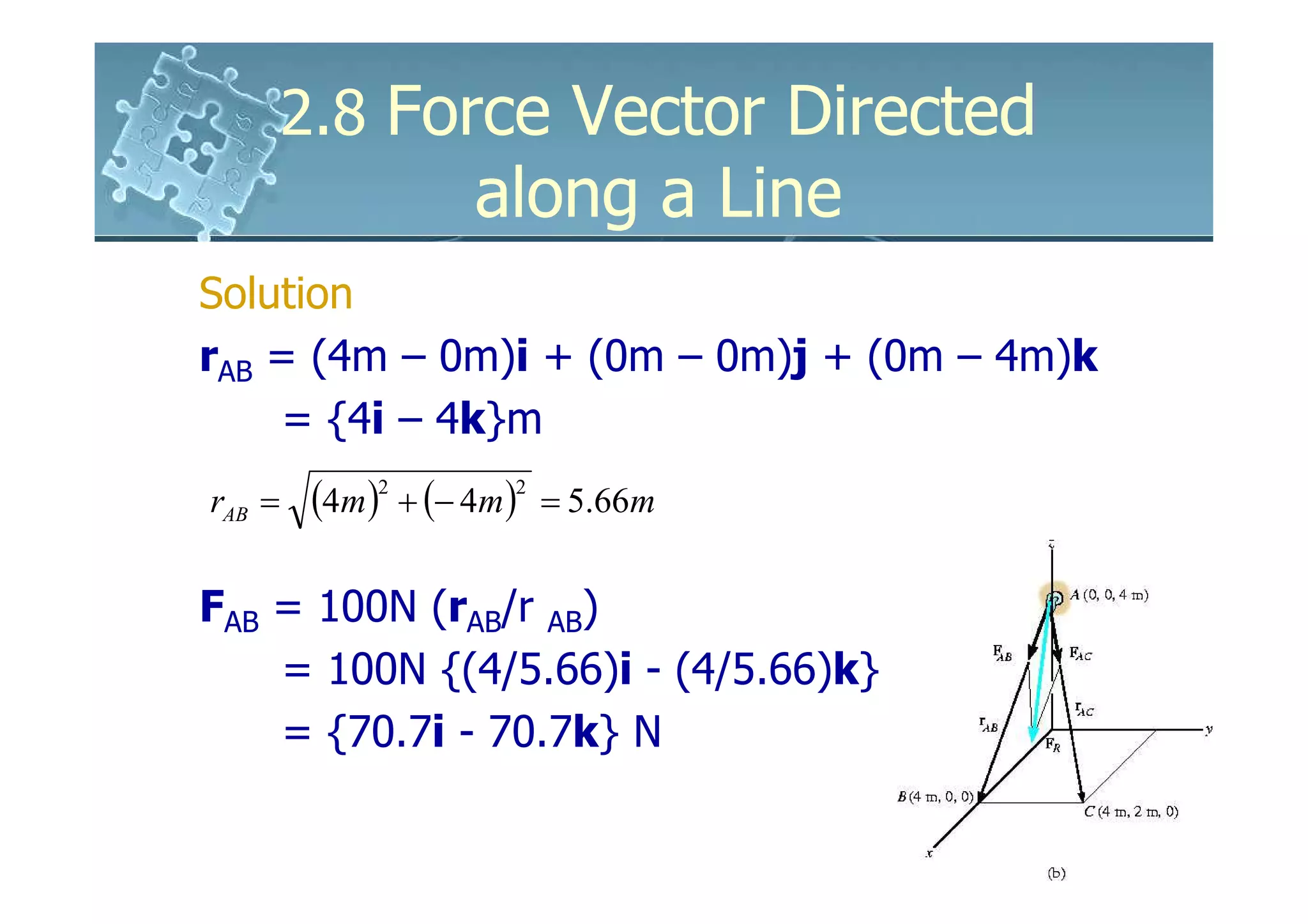
rAB = (4m – 0m)i + (0m – 0m)j + (0m – 4m)k
     = {4i – 4k}m
rAB =    (4m )2 + (− 4m )2   = 5.66m


FAB = 100N (rAB/r AB)
    = 100N {(4/5.66)i - (4/5.66)k}
    = {70.7i - 70.7k} N
2.8 Force Vector Directed
                         along a Line
Solution
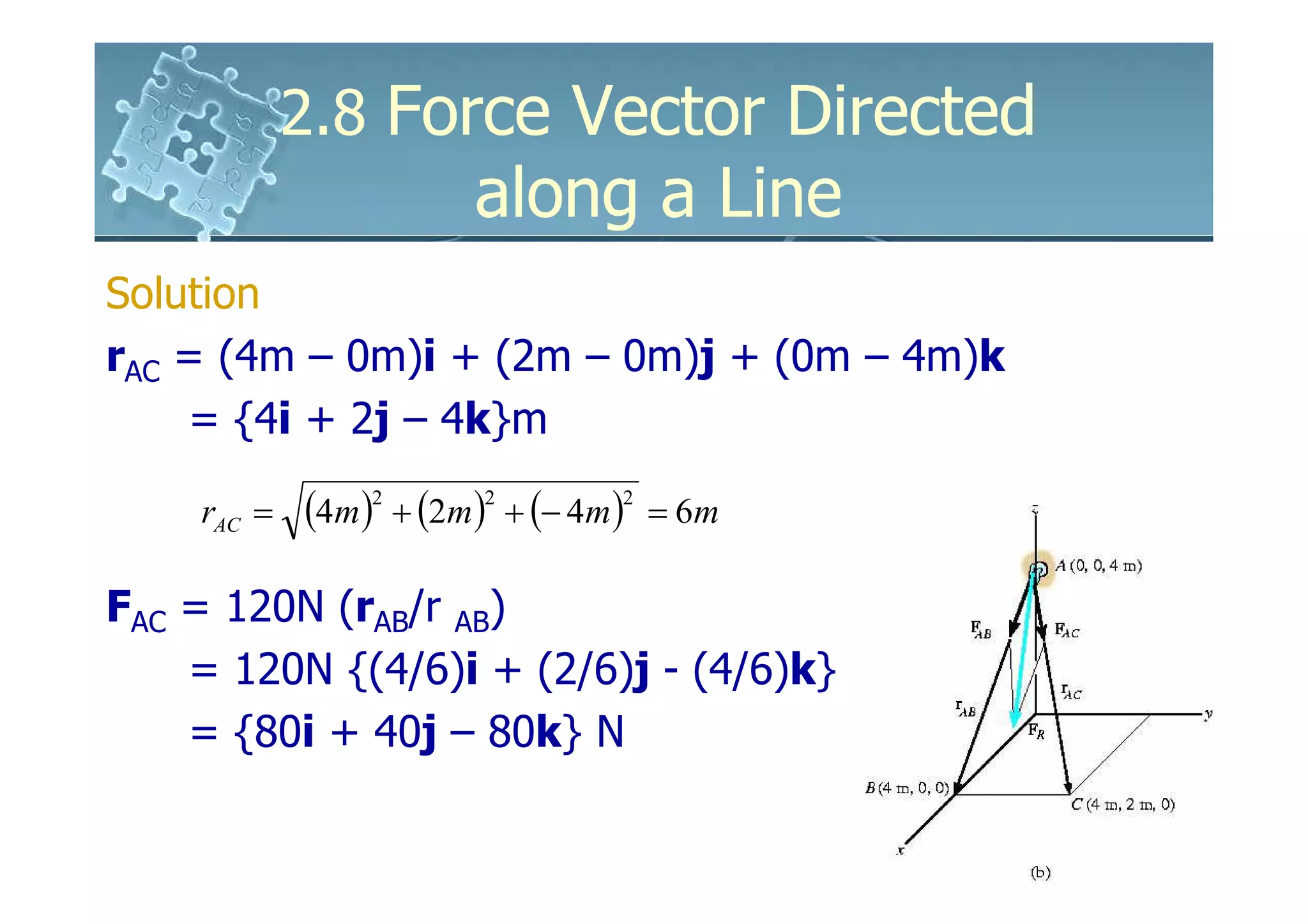
rAC = (4m – 0m)i + (2m – 0m)j + (0m – 4m)k
    = {4i + 2j – 4k}m

    rAC =   (4m )2 + (2m )2 + (− 4m )2   = 6m

FAC = 120N (rAB/r AB)
    = 120N {(4/6)i + (2/6)j - (4/6)k}
    = {80i + 40j – 80k} N
2.8 Force Vector Directed
                        along a Line
Solution
FR = FAB + FAC
   = {70.7i - 70.7k} N + {80i + 40j – 80k} N
   = {150.7i + 40j – 150.7k} N

Magnitude of FR
   FR =   (150.7 )2 + (40)2 + (− 150.7 )2
   = 217 N
2.9 Dot Product
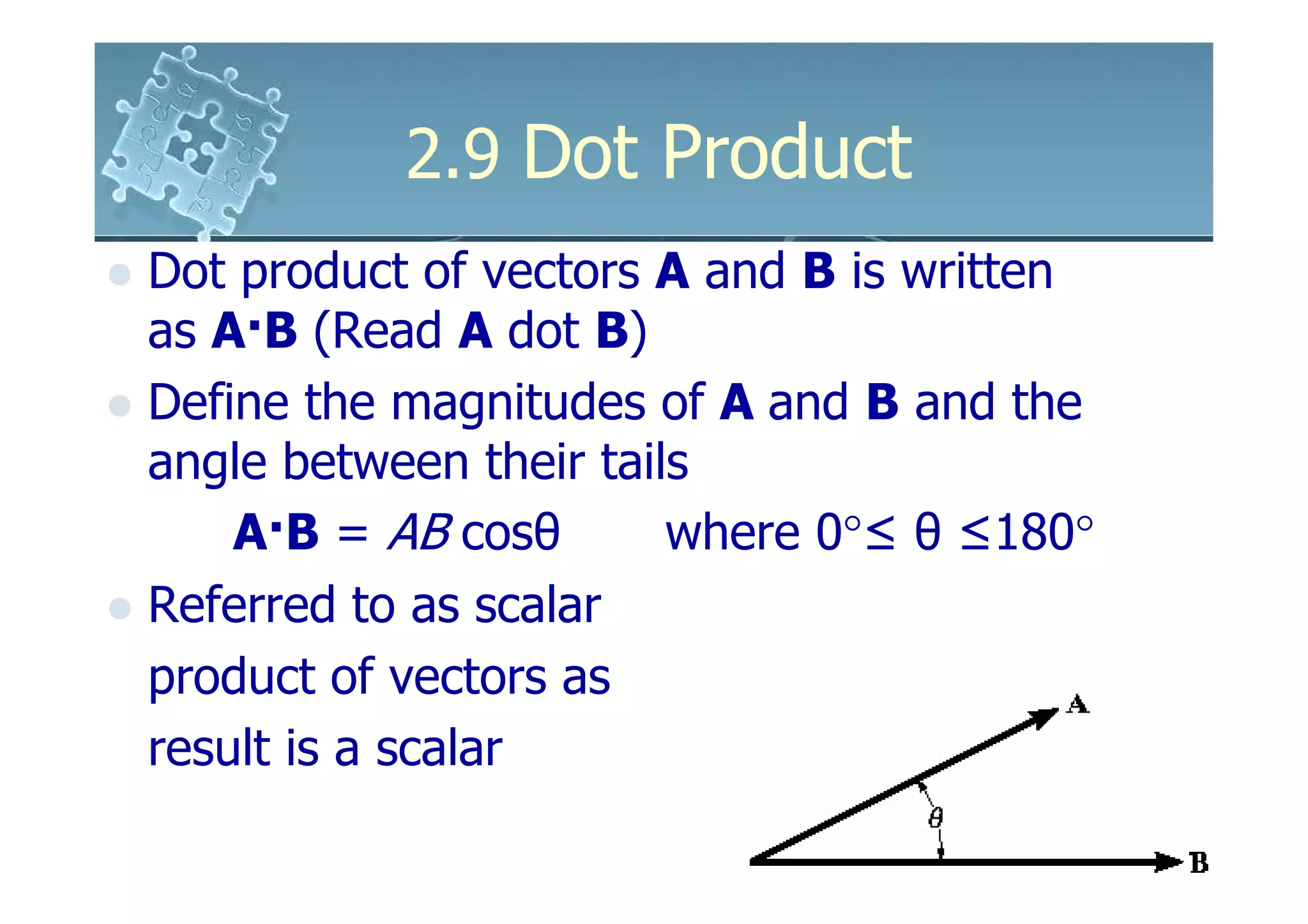
Dot product of vectors A and B is written
as A·B (Read A dot B)
Define the magnitudes of A and B and the
angle between their tails
    A·B = AB cosθ       where 0°≤ θ ≤180°
Referred to as scalar
product of vectors as
result is a scalar
2.9 Dot Product

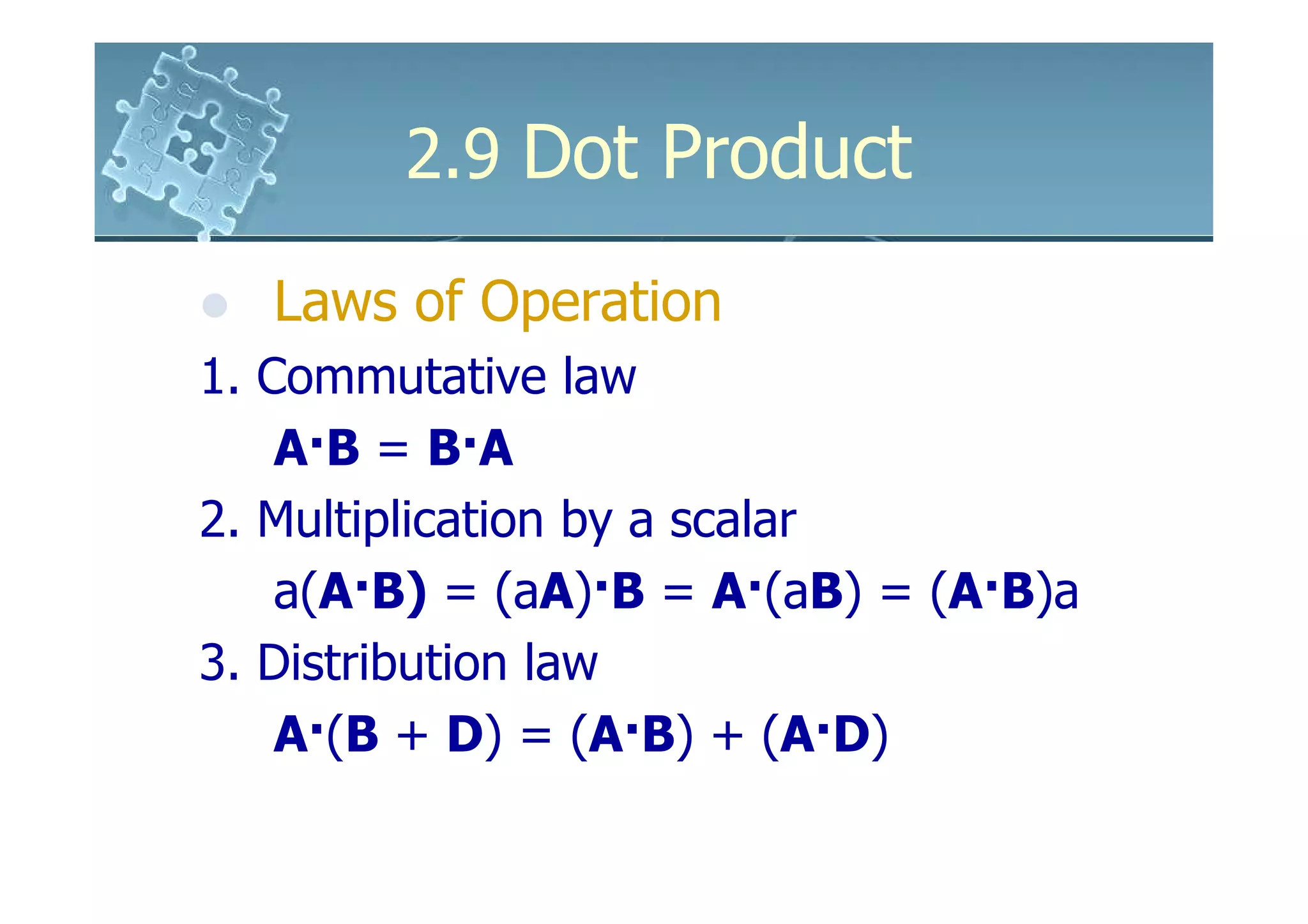
   Laws of Operation
1. Commutative law
    A·B = B·A
2. Multiplication by a scalar
    a(A·B) = (aA)·B = A·(aB) = (A·B)a
3. Distribution law
    A·(B + D) = (A·B) + (A·D)
2.9 Dot Product

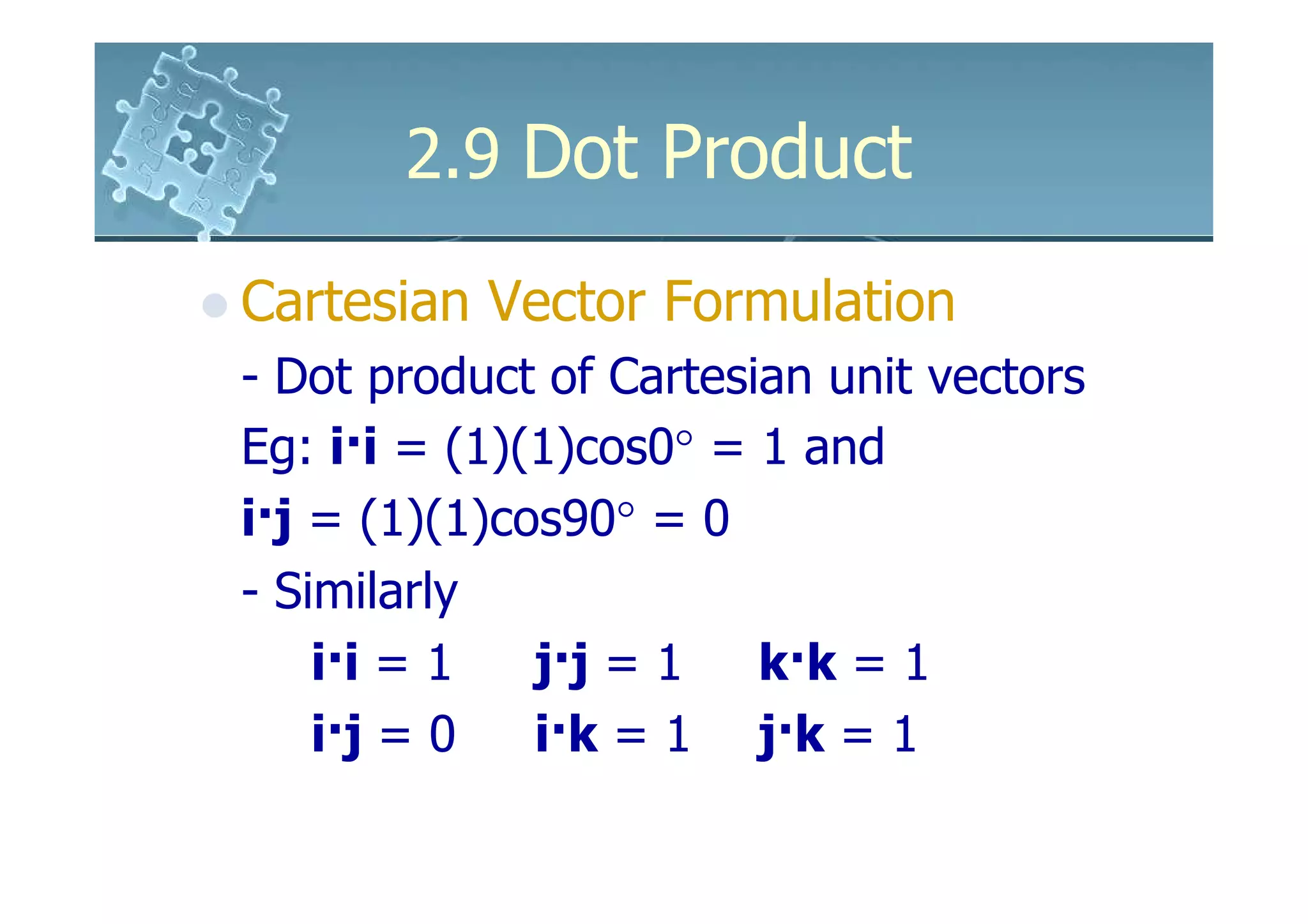
Cartesian Vector Formulation
- Dot product of Cartesian unit vectors
Eg: i·i = (1)(1)cos0° = 1 and
i·j = (1)(1)cos90° = 0
- Similarly
    i·i = 1   j·j = 1   k·k = 1
    i·j = 0   i·k = 1 j·k = 1
2.9 Dot Product
  Cartesian Vector Formulation
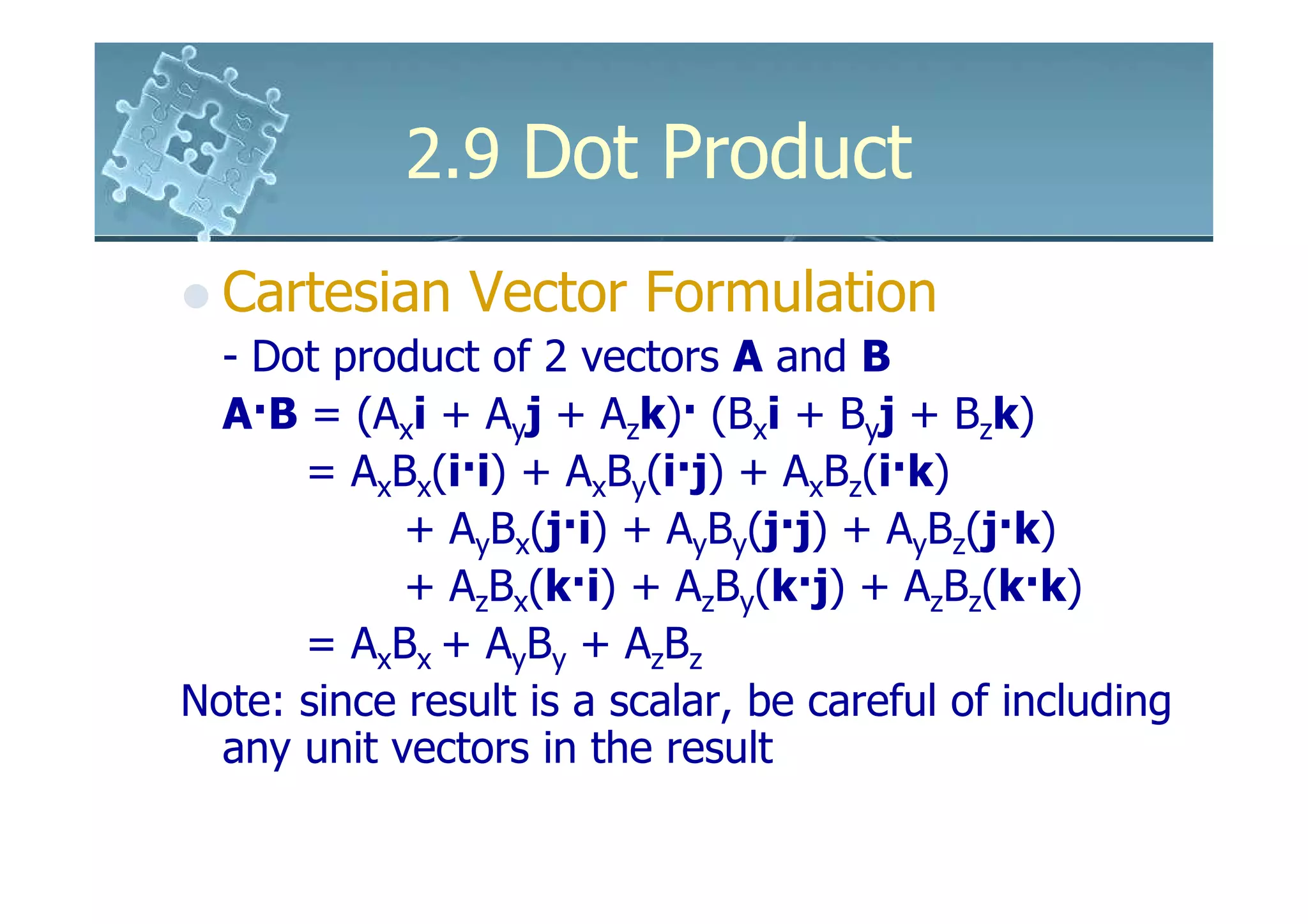
  - Dot product of 2 vectors A and B
  A·B = (Axi + Ayj + Azk)· (Bxi + Byj + Bzk)
      = AxBx(i·i) + AxBy(i·j) + AxBz(i·k)
            + AyBx(j·i) + AyBy(j·j) + AyBz(j·k)
            + AzBx(k·i) + AzBy(k·j) + AzBz(k·k)
      = AxBx + AyBy + AzBz
Note: since result is a scalar, be careful of including
  any unit vectors in the result
2.9 Dot Product

 Applications
  - The angle formed between two vectors or
  intersecting lines
      θ = cos-1 [(A·B)/(AB)]   0°≤ θ ≤180°
Note: if A·B = 0, cos-10= 90°, A is
perpendicular to B
2.9 Dot Product
Applications
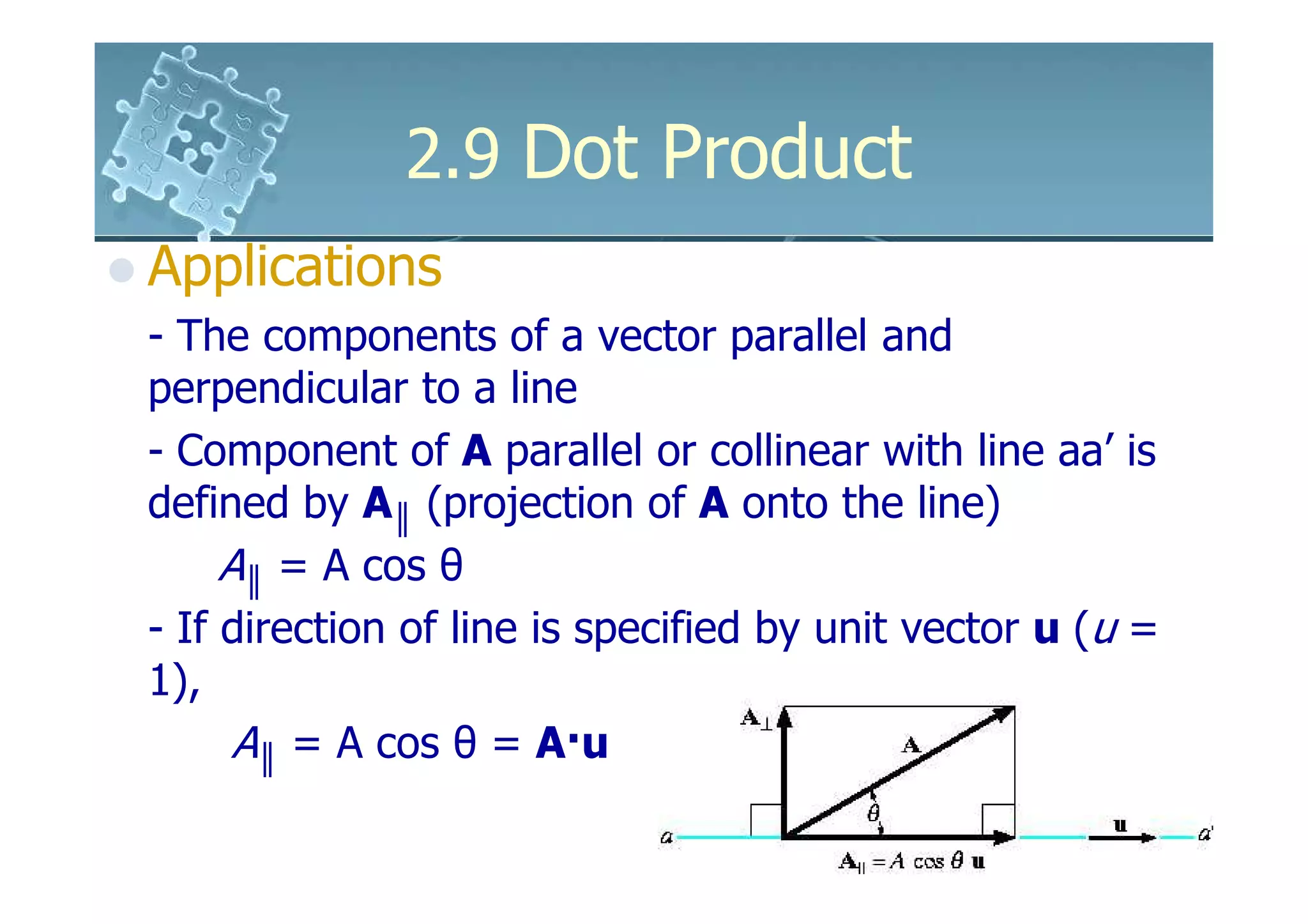
- The components of a vector parallel and
perpendicular to a line
- Component of A parallel or collinear with line aa’ is
defined by A║ (projection of A onto the line)
     A║ = A cos θ
- If direction of line is specified by unit vector u (u =
1),
      A║ = A cos θ = A·u
2.9 Dot Product

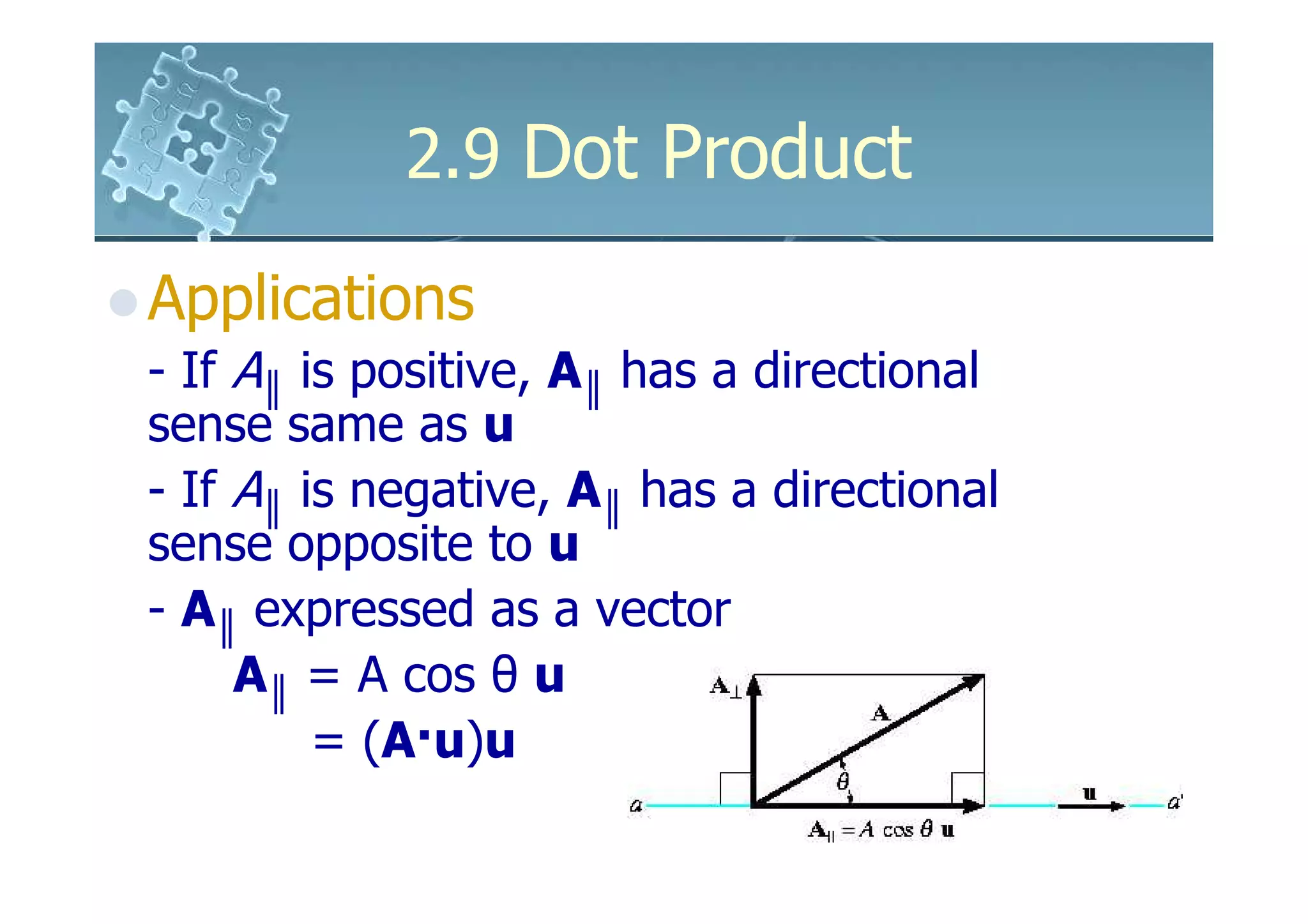
Applications
- If A║ is positive, A║ has a directional
sense same as u
- If A║ is negative, A║ has a directional
sense opposite to u
- A║ expressed as a vector
     A║ = A cos θ u
         = (A·u)u
2.9 Dot Product
Applications
For component of A perpendicular to line aa’
1. Since A = A║ + A┴,
    then A┴ = A - A║
2. θ = cos-1 [(A·u)/(A)]
    then A┴ = Asinθ
3. If A║ is known, by Pythagorean Theorem
     A⊥ = A2 + A||2
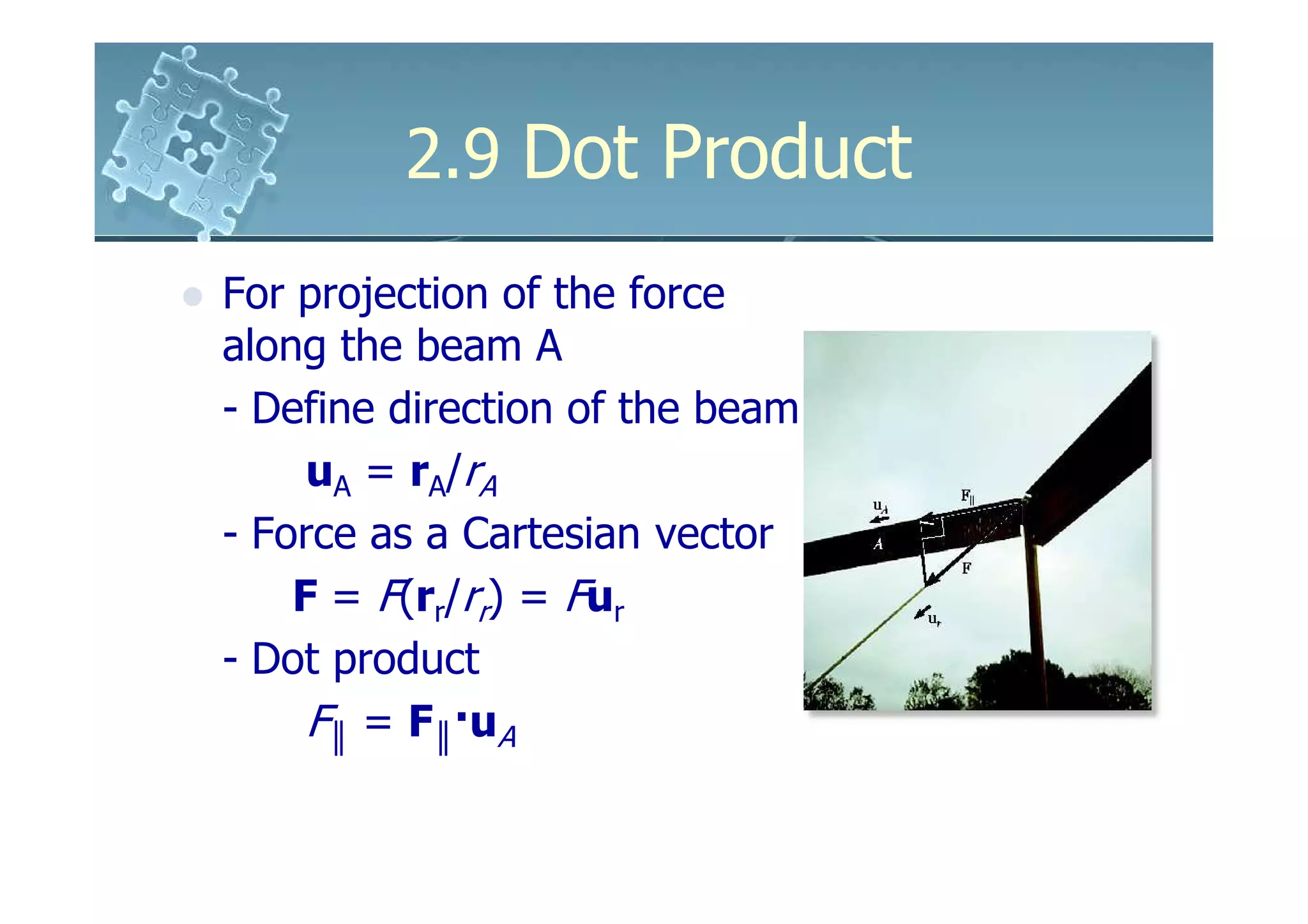
2.9 Dot Product
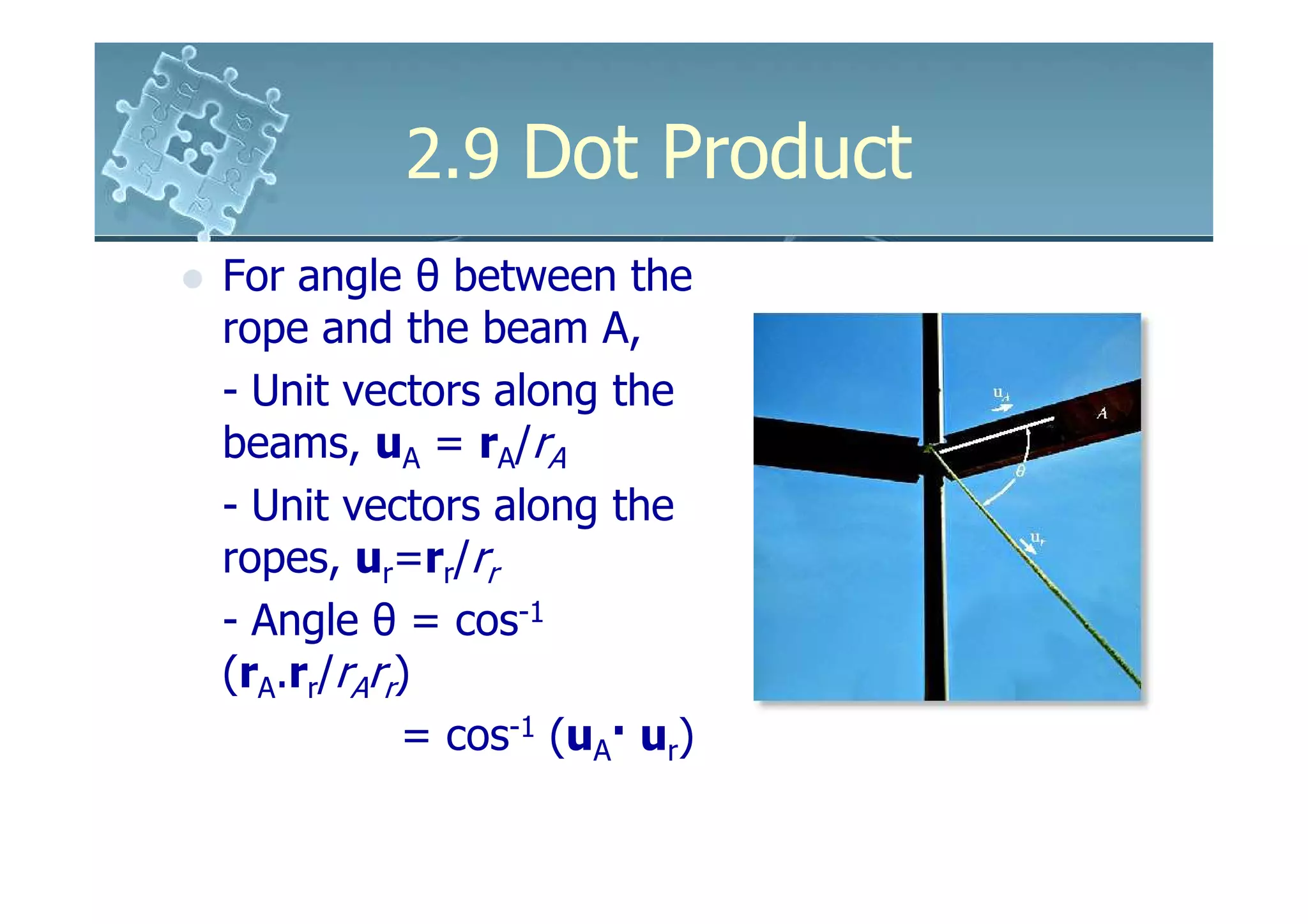
For angle θ between the
rope and the beam A,
- Unit vectors along the
beams, uA = rA/rA
- Unit vectors along the
ropes, ur=rr/rr
- Angle θ = cos-1
(rA.rr/rArr)
           = cos-1 (uA· ur)
2.9 Dot Product
For projection of the force
along the beam A
- Define direction of the beam
     uA = rA/rA
- Force as a Cartesian vector
    F = F(rr/rr) = Fur
- Dot product
     F║ = F║·uA
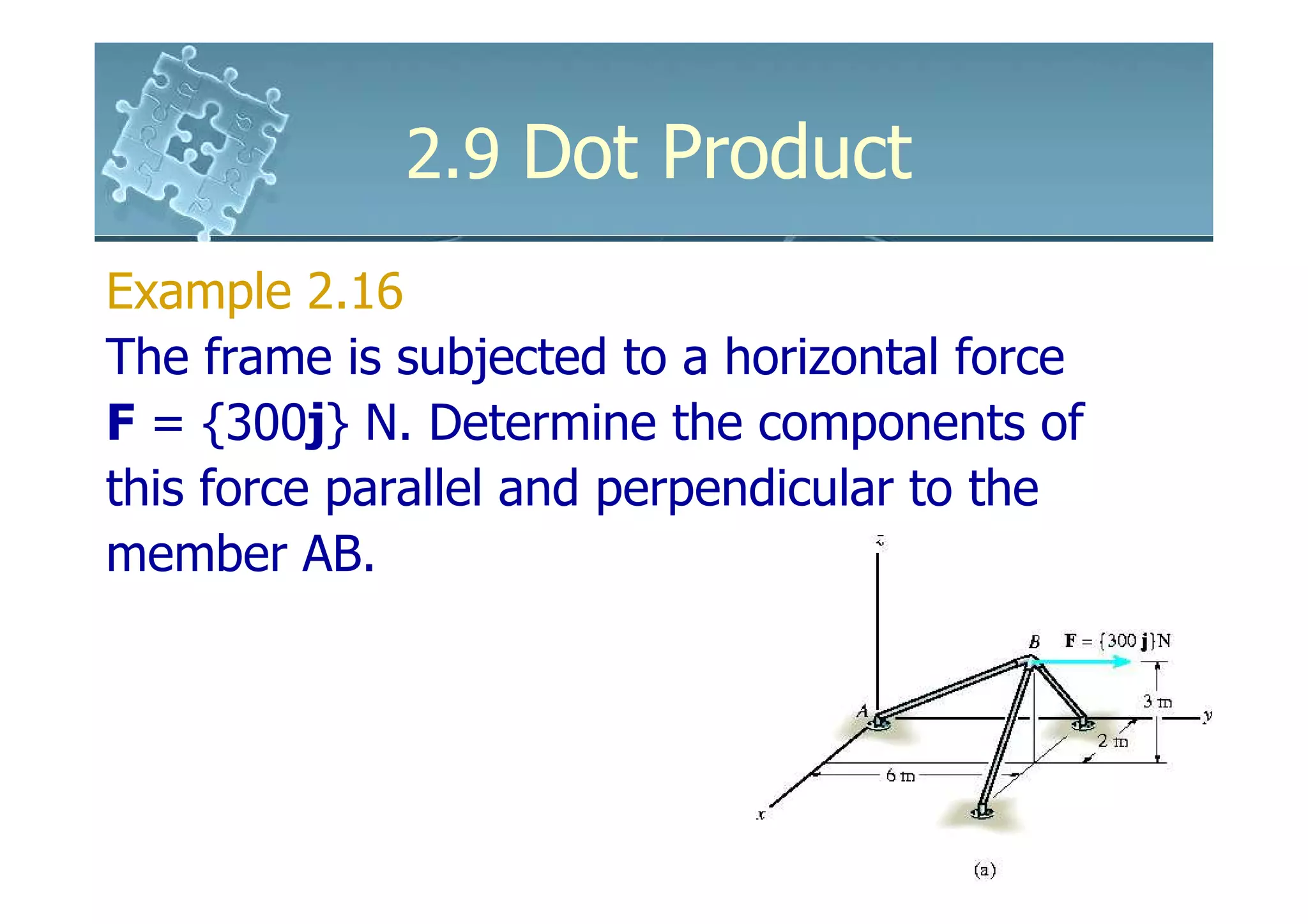
2.9 Dot Product
Example 2.16
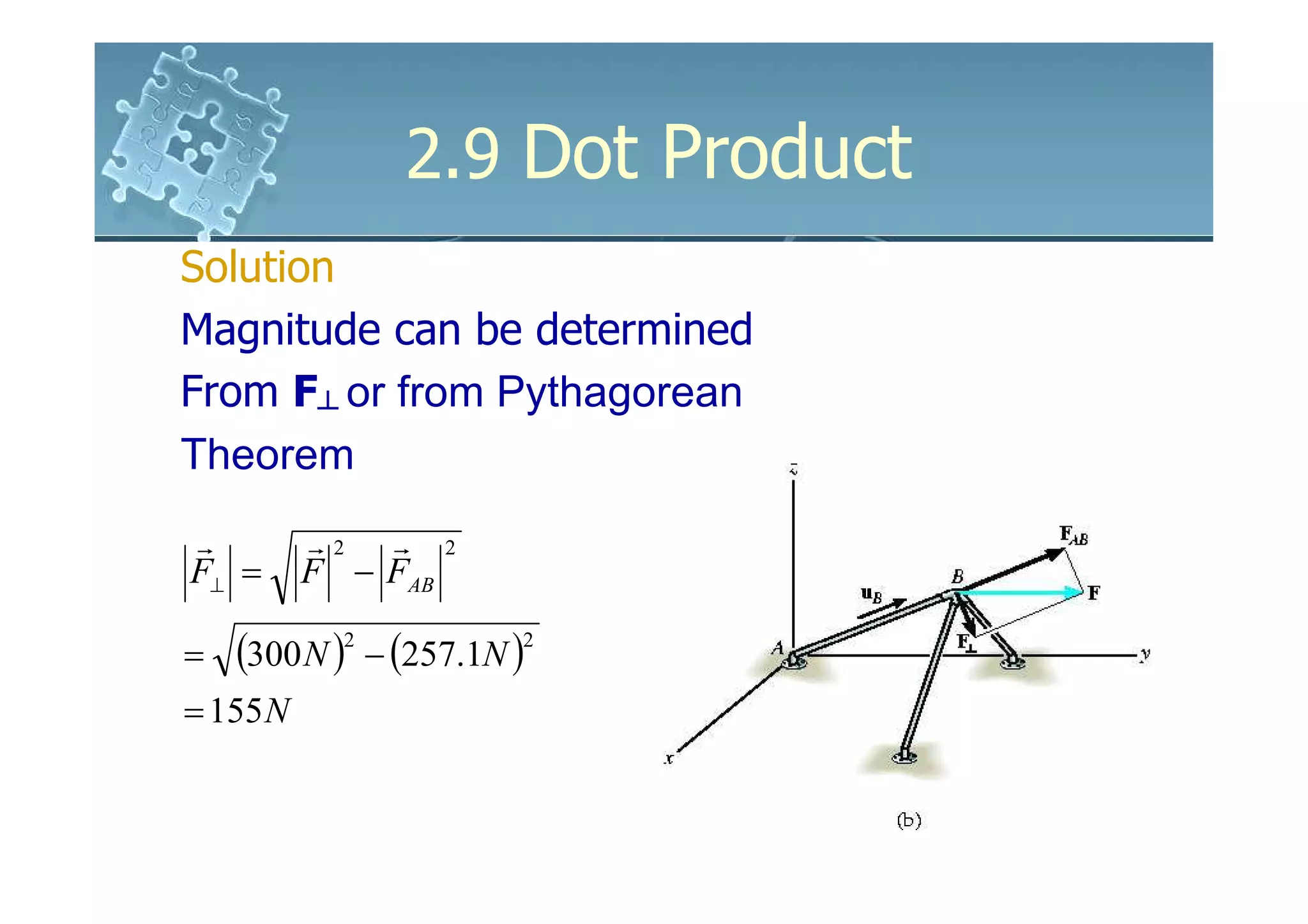
The frame is subjected to a horizontal force
F = {300j} N. Determine the components of
this force parallel and perpendicular to the
member AB.
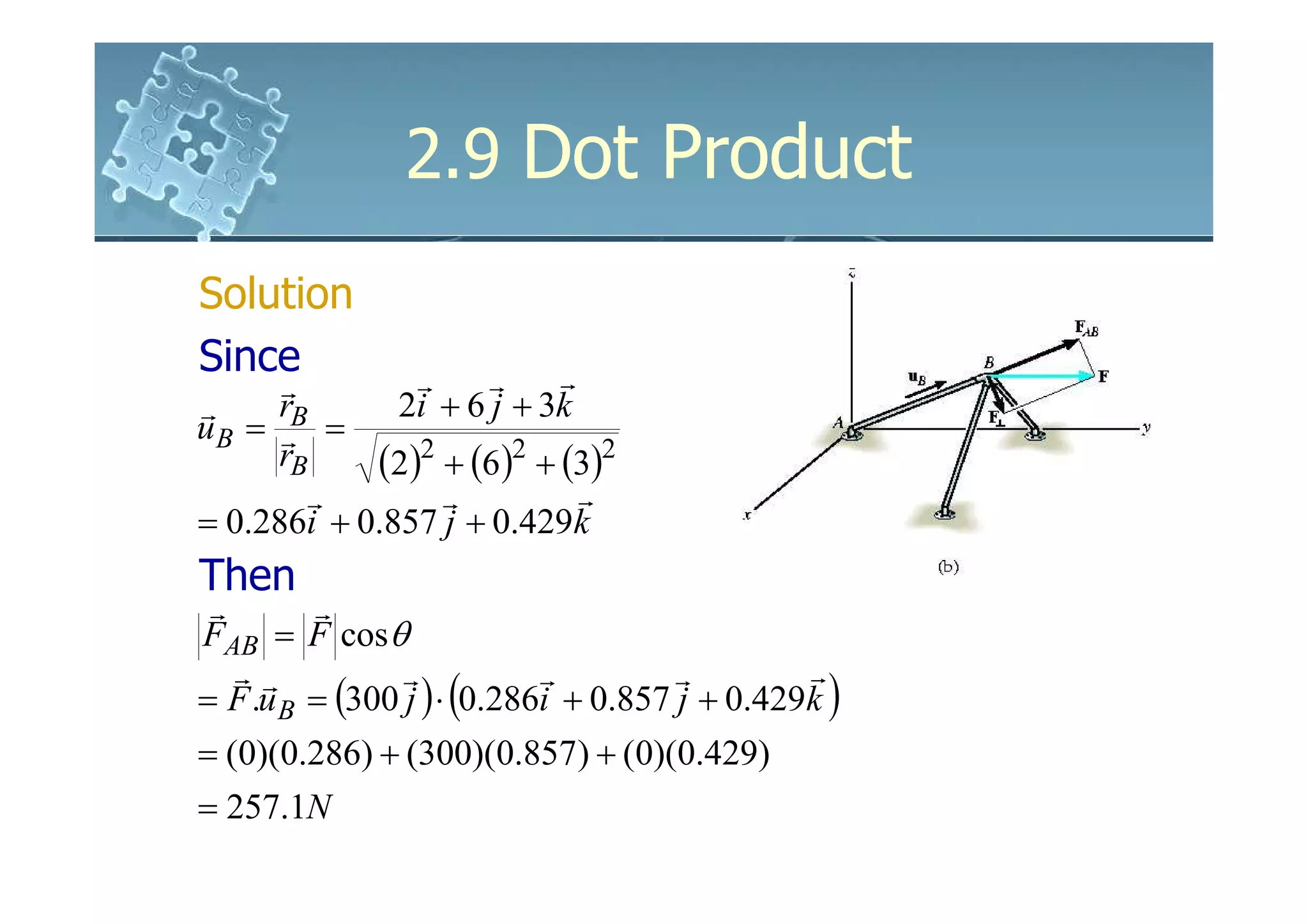
2.9 Dot Product
Solution
Since          r     r    r
      r
r     r       2i + 6 j + 3k
u B = rB =
      rB    (2)2 + (6)2 + (3)2
        r        r          r
= 0.286i + 0.857 j + 0.429k
Then
 r       r
FAB = F cosθ
   rr           r           r         r        r
= F .u B = (300 j ) ⋅ (0.286i + 0.857 j + 0.429k )
= (0)(0.286) + (300)(0.857) + (0)(0.429)
= 257.1N
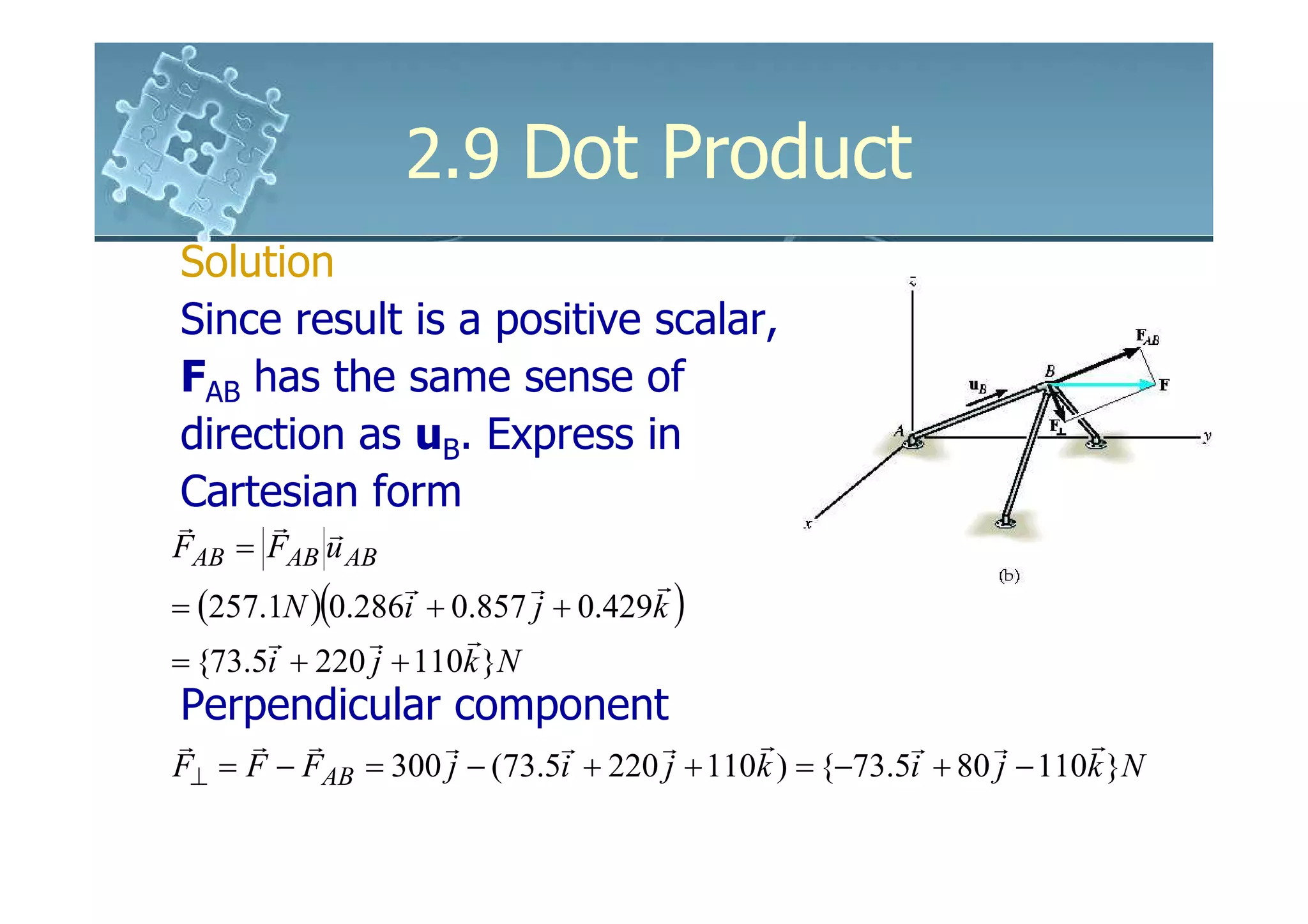
2.9 Dot Product
Solution
Since result is a positive scalar,
FAB has the same sense of
direction as uB. Express in
Cartesian form
r     r r
FAB = FAB u AB
                  r        r        r
= (257.1N )(0.286i + 0.857 j + 0.429k )
       r       r      r
= {73.5i + 220 j + 110k }N
Perpendicular component
r    r r           r        r       r      r           r      r      r
F⊥ = F − FAB = 300 j − (73.5i + 220 j + 110k ) = {−73.5i + 80 j − 110k }N
2.9 Dot Product
Solution
Magnitude can be determined
From F┴ or from Pythagorean
Theorem
r         r2 r      2
F⊥ =      F − FAB

=   (300 N )2 − (257.1N )2
= 155 N
2.9 Dot Product
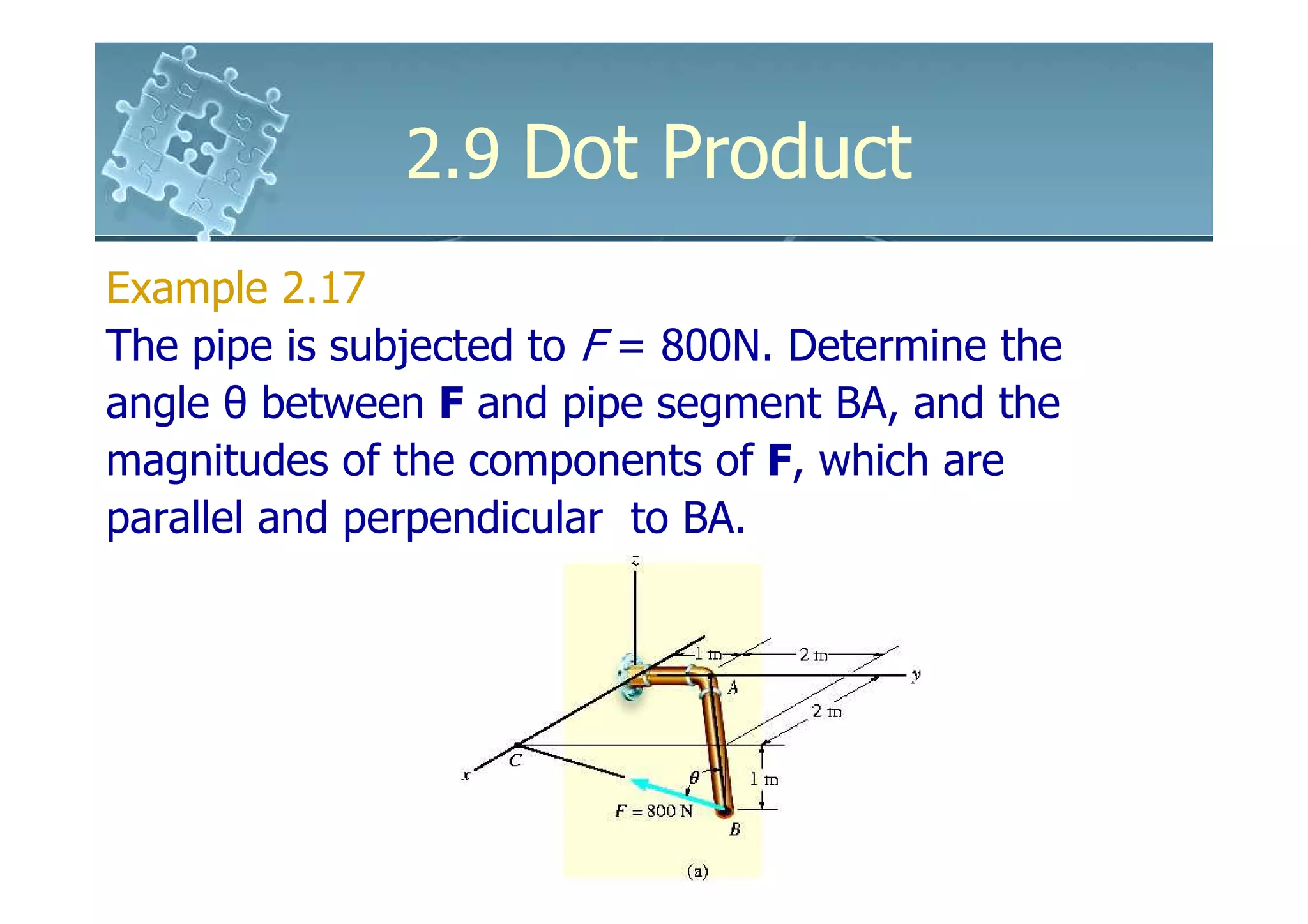
Example 2.17
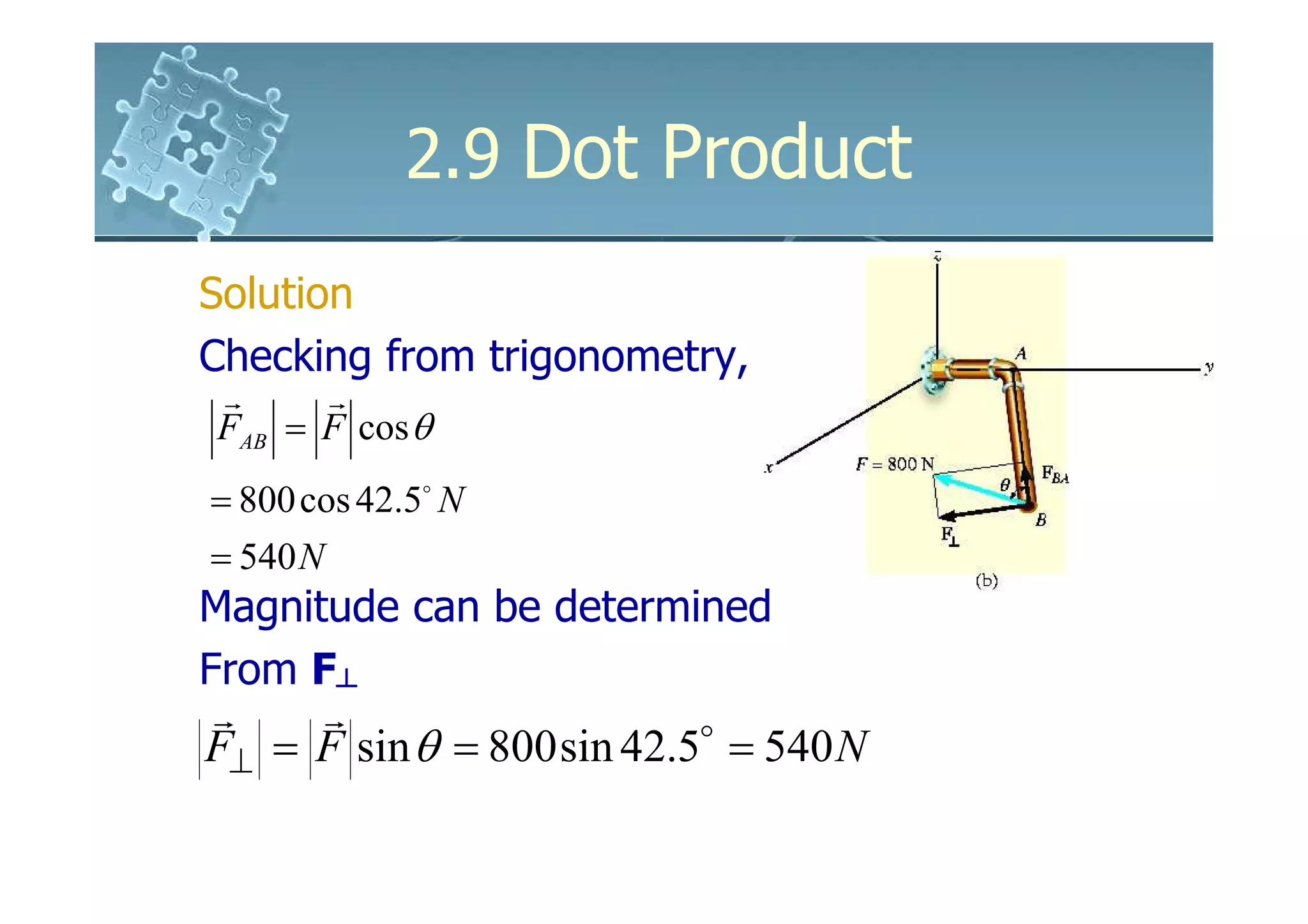
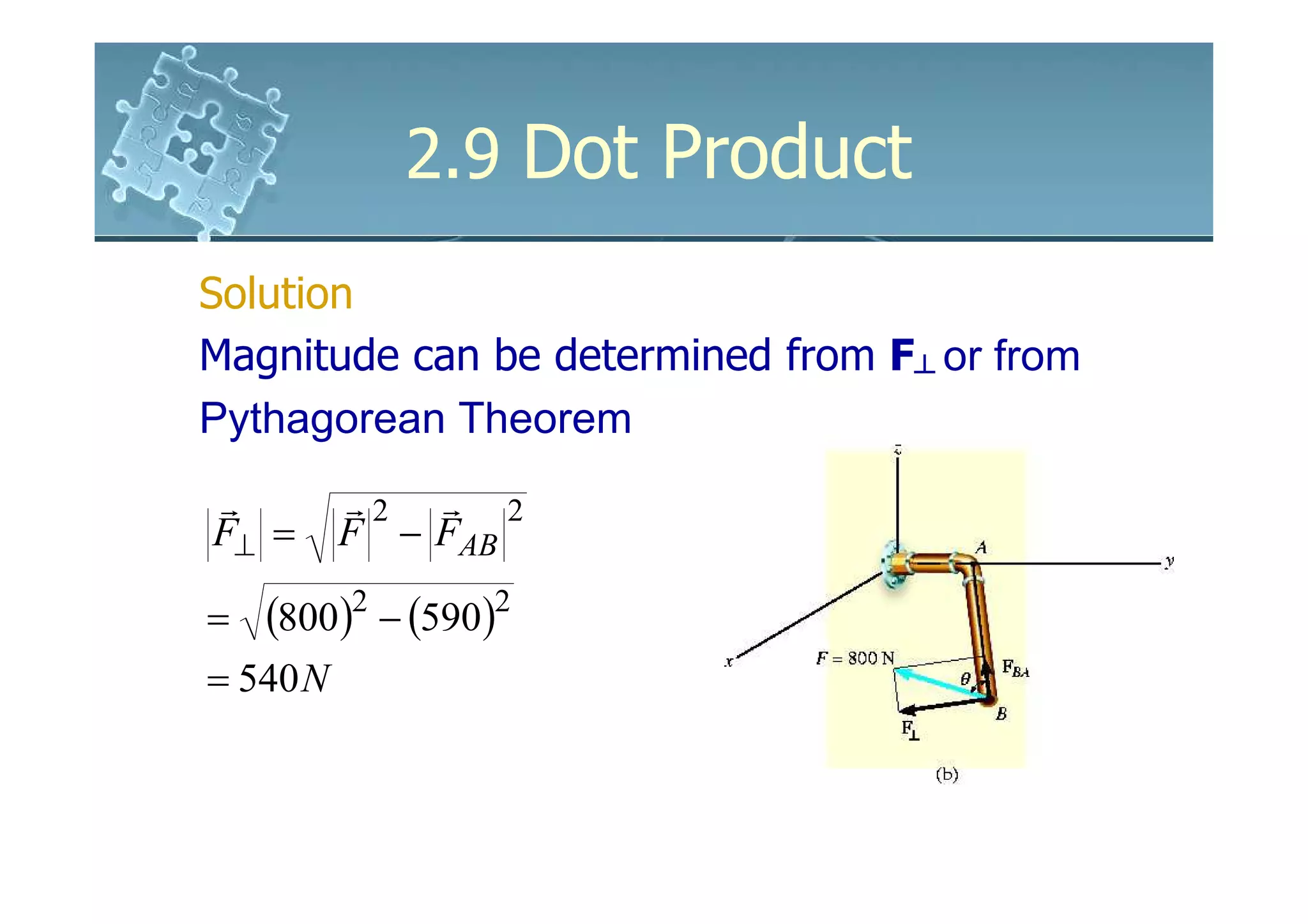
The pipe is subjected to F = 800N. Determine the
angle θ between F and pipe segment BA, and the
magnitudes of the components of F, which are
parallel and perpendicular to BA.
2.9 Dot Product
Solution
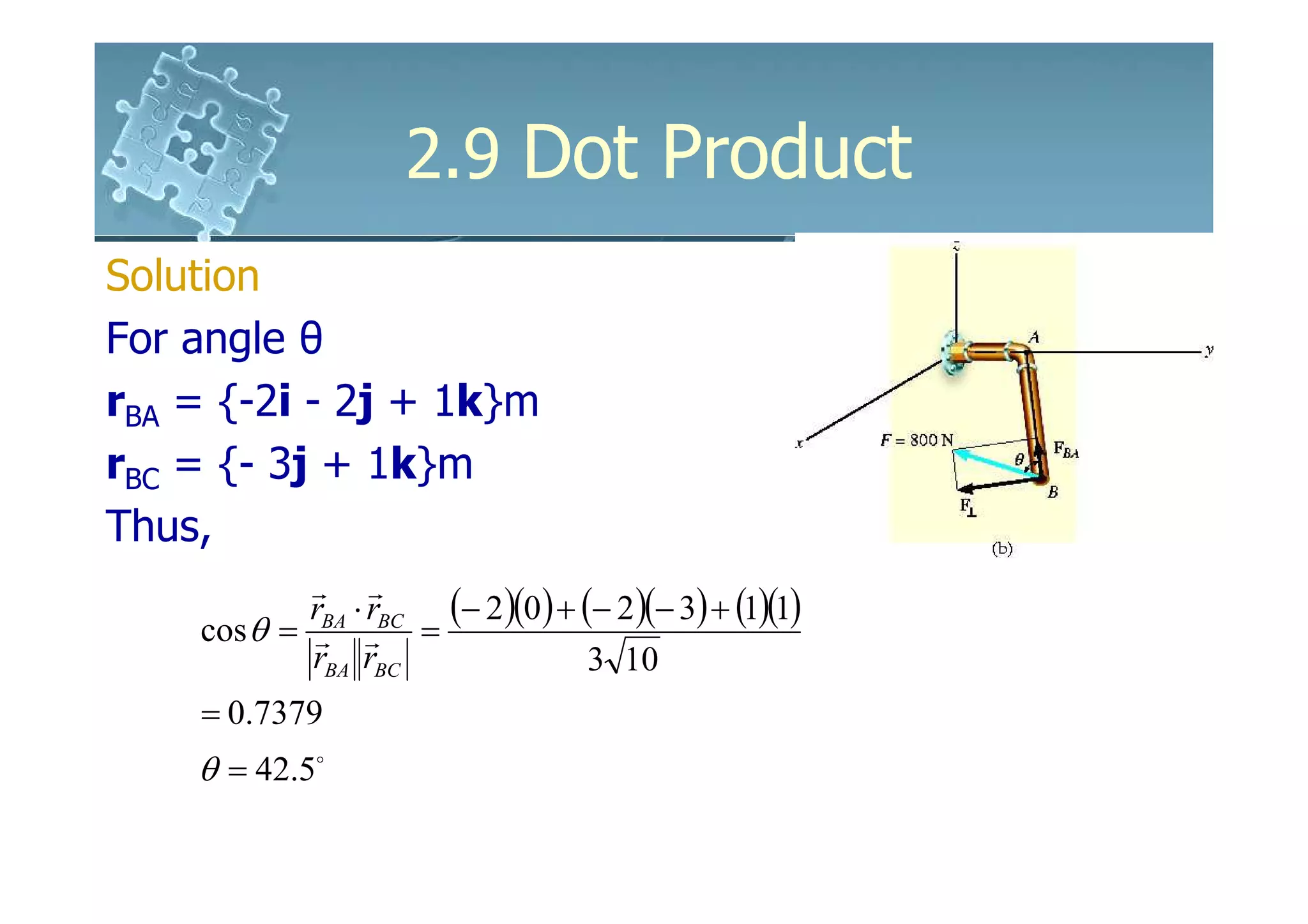
For angle θ
rBA = {-2i - 2j + 1k}m
rBC = {- 3j + 1k}m
Thus,
            r r
            rBA ⋅ rBC (− 2 )(0 ) + (− 2 )(− 3) + (1)(1)
    cos θ = r r =
            rBA rBC                 3 10
    = 0.7379
    θ = 42.5o
2.9 Dot Product
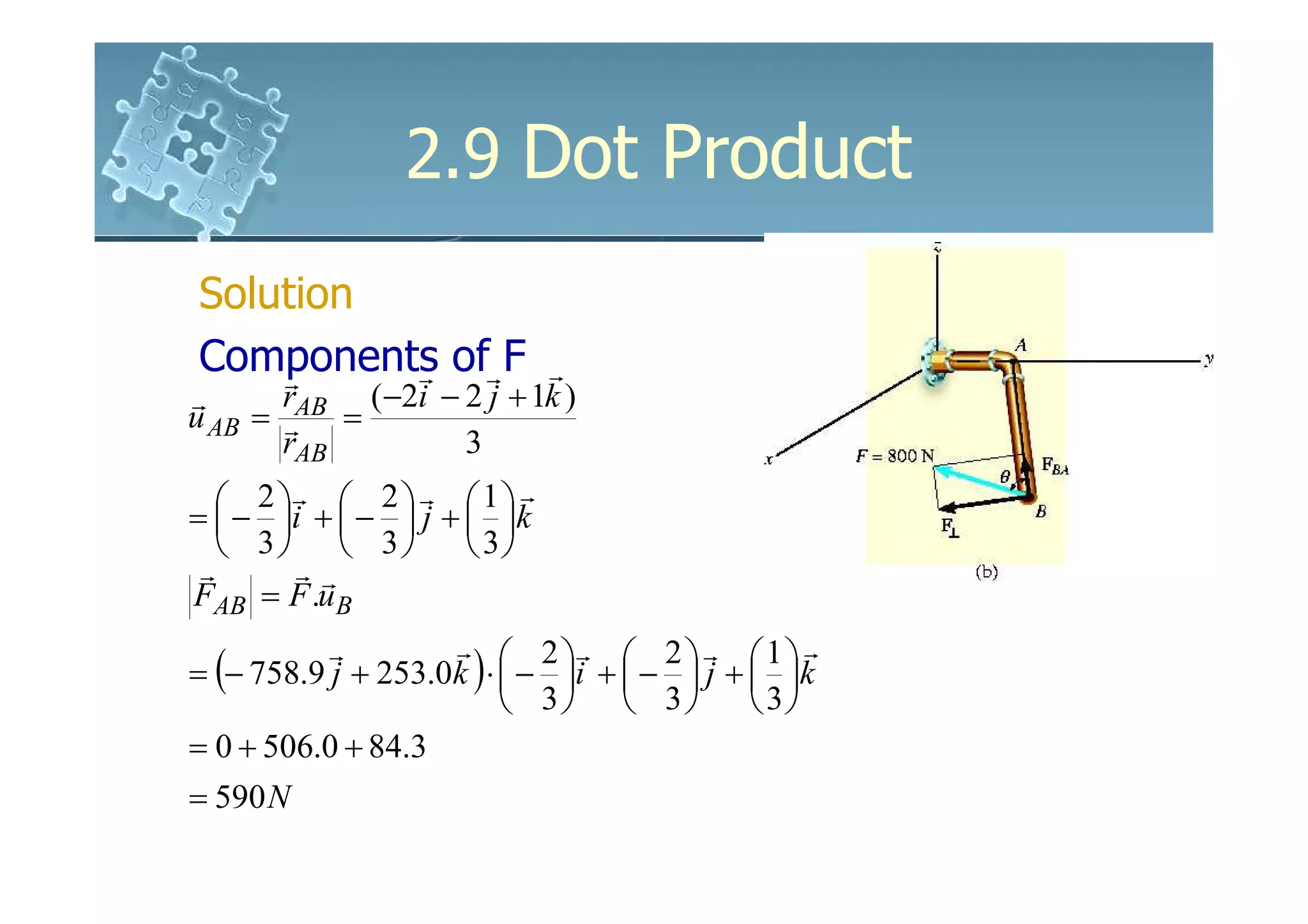
Solution
Components ofr F
    r    r                        r
r        r       (−2i − 2 j + 1k )
u AB = rAB =
         rAB              3
                                r
    − 2 i +  − 2  r +  1  k
          r
=                j  
    3   3   3
 r         rr
FAB = F .u B
             r           r  2 r  2  r  1  r
= (− 758.9 j + 253.0k ) ⋅  − i +  −  j +  k
                              3   3   3
= 0 + 506.0 + 84.3
= 590 N
2.9 Dot Product
Solution
Checking from trigonometry,
r     r
FAB = F cos θ
= 800 cos 42.5o N
= 540 N
Magnitude can be determined
From F┴
r    r
F⊥ = F sin θ = 800 sin 42.5o = 540 N
2.9 Dot Product
Solution
Magnitude can be determined from F┴ or from
Pythagorean Theorem
r         r2 r 2
F⊥ =      F − FAB

=   (800)2 − (590)2
= 540 N
Chapter Summary

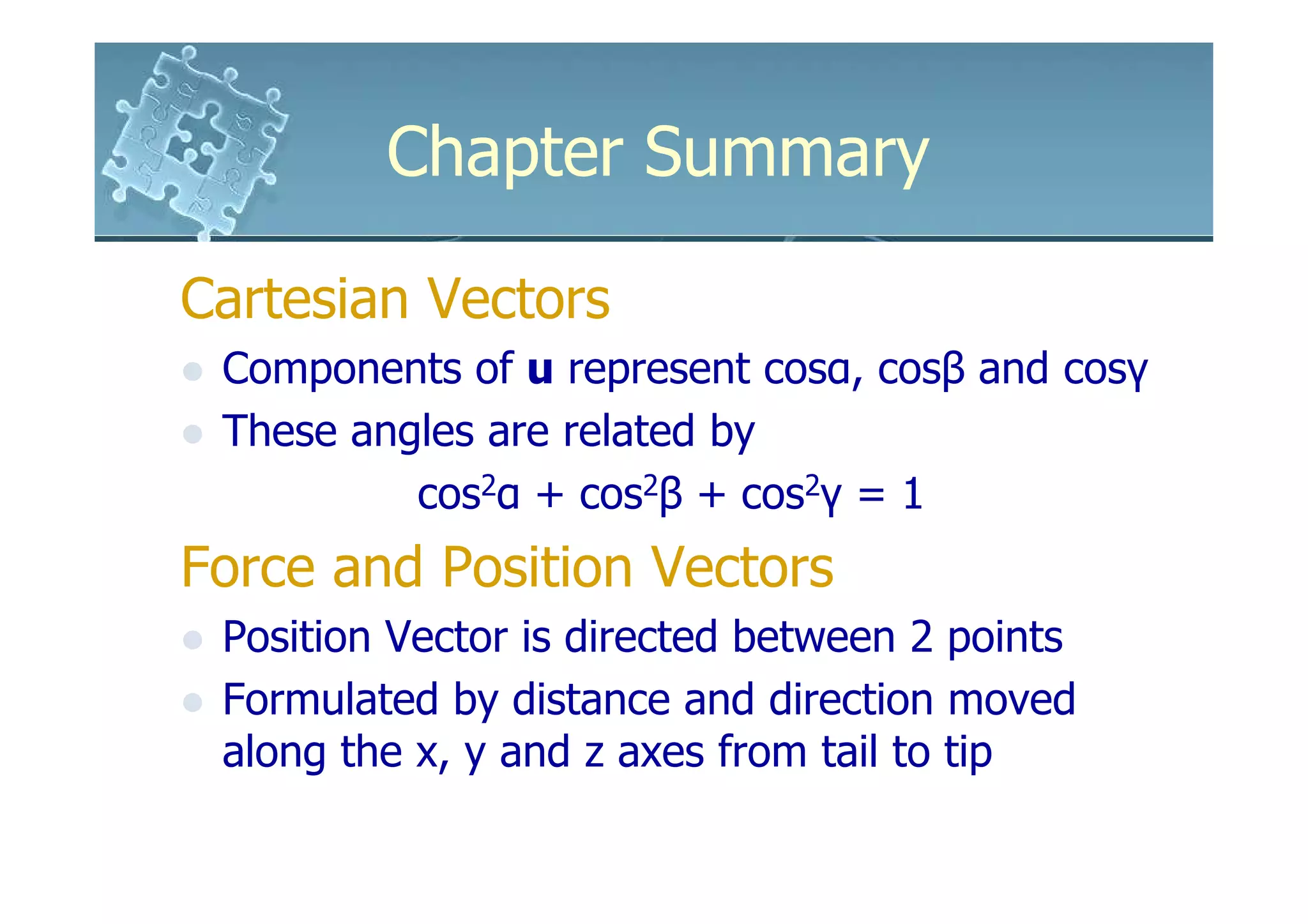
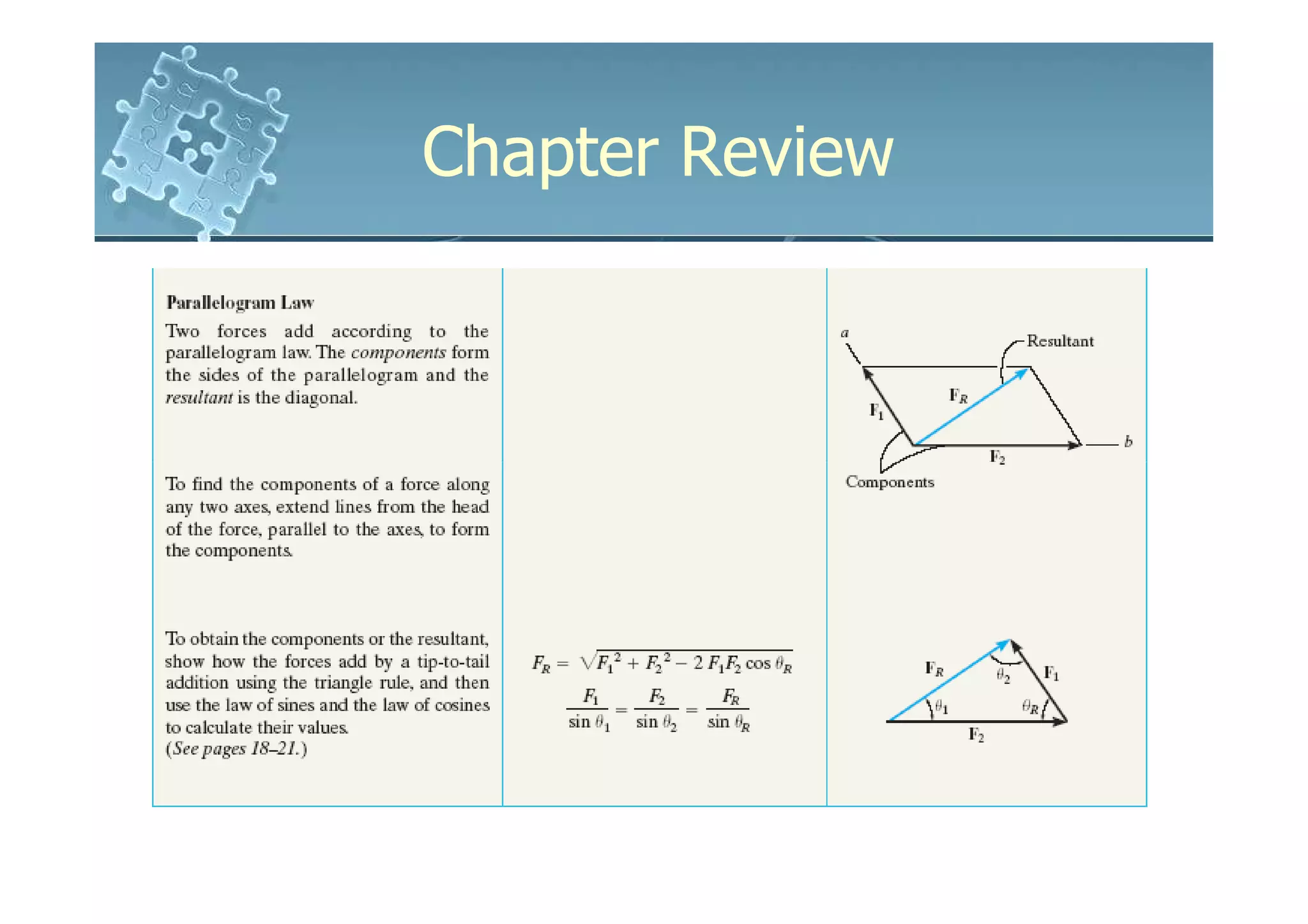
Parallelogram Law
 Addition of two vectors
 Components form the side and resultant
 form the diagonal of the parallelogram
 To obtain resultant, use tip to tail addition
 by triangle rule
 To obtain magnitudes and directions, use
 Law of Cosines and Law of Sines
Chapter Summary

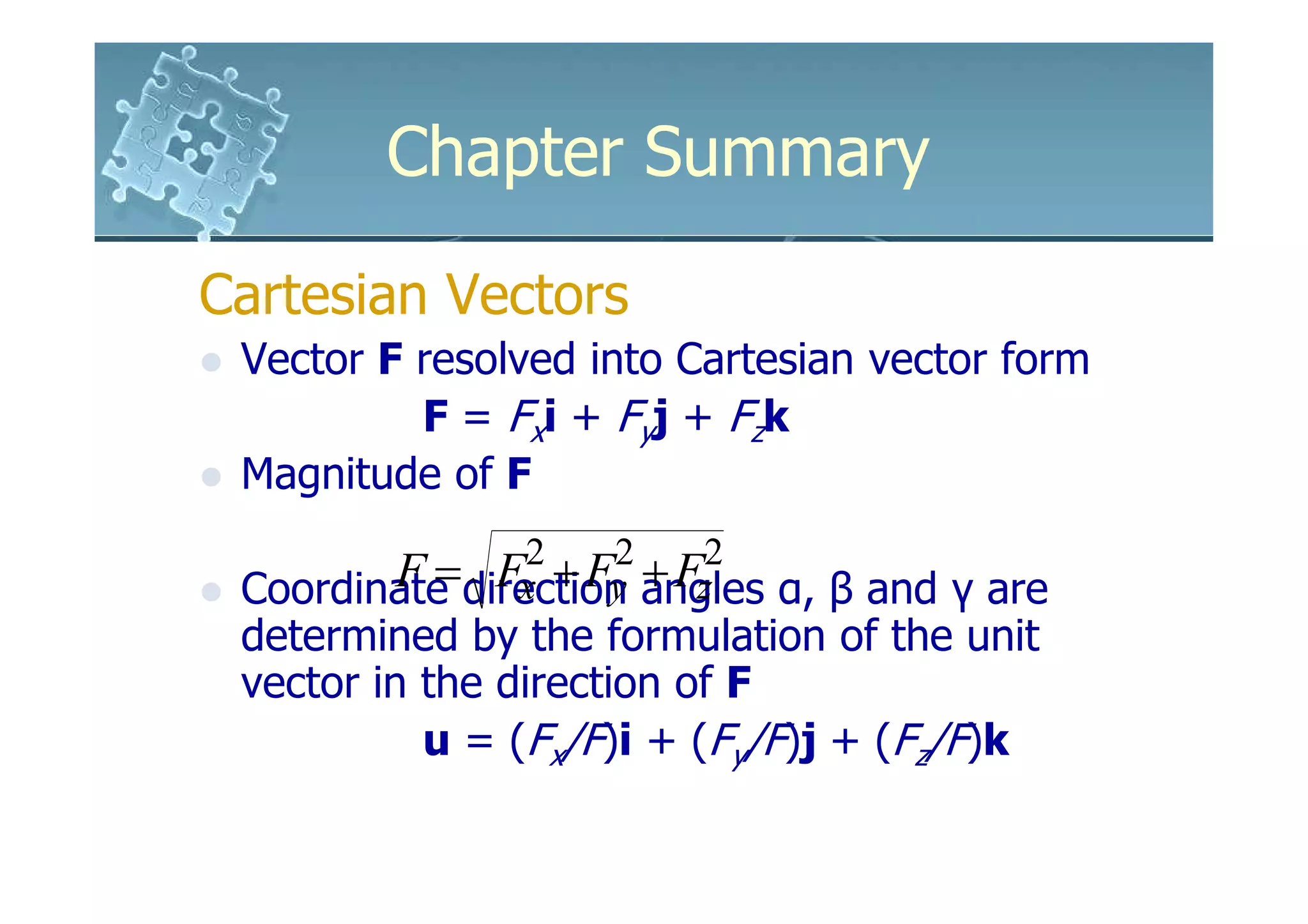
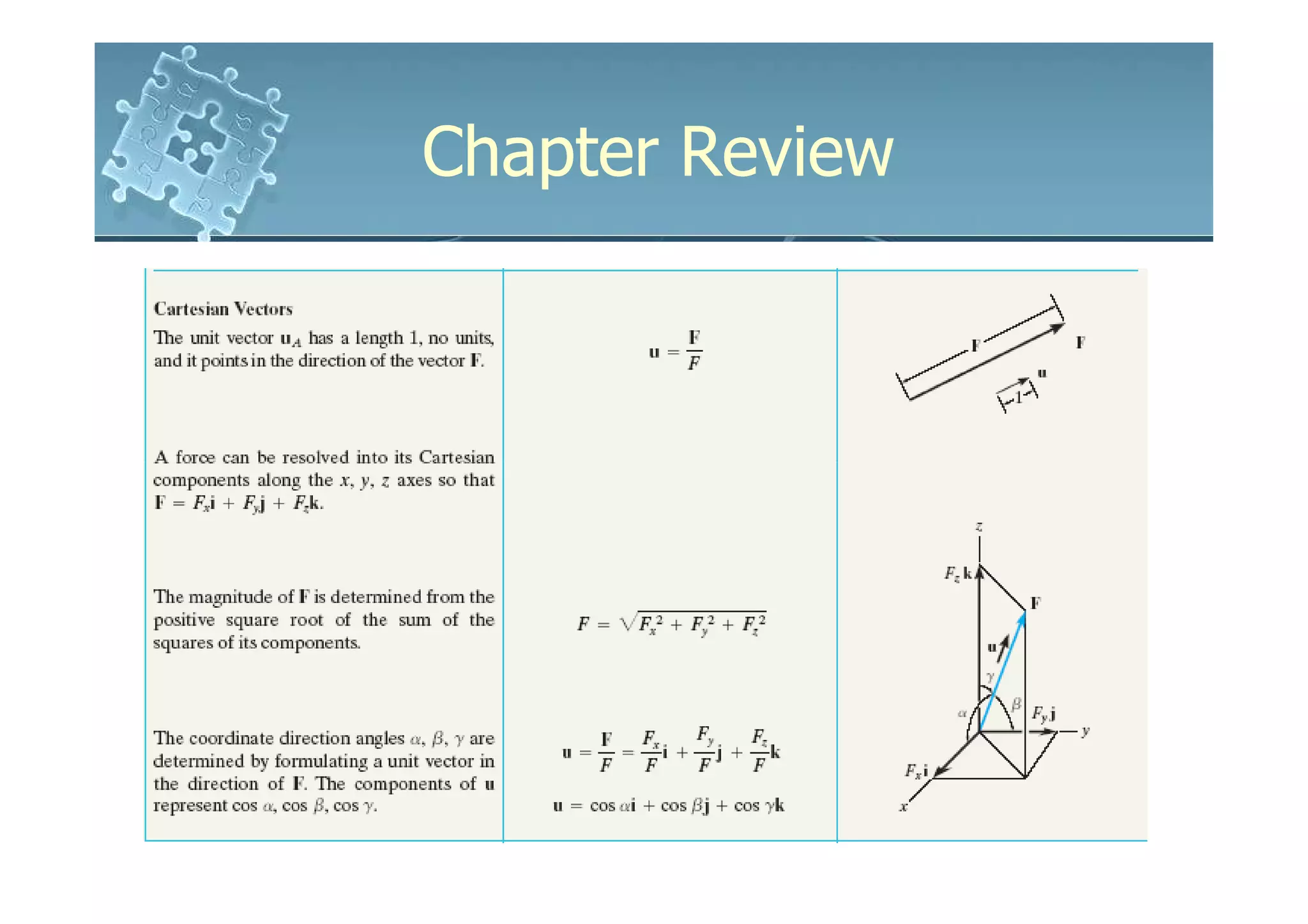
Cartesian Vectors
 Vector F resolved into Cartesian vector form
          F = Fxi + Fyj + Fzk
 Magnitude of F
                2   2    2
        F = Fx + Fy + Fz
 Coordinate direction angles α, β and γ are
 determined by the formulation of the unit
 vector in the direction of F
           u = (Fx/F)i + (Fy/F)j + (Fz/F)k
Chapter Summary

Cartesian Vectors
 Components of u represent cosα, cosβ and cosγ
 These angles are related by
          cos2α + cos2β + cos2γ = 1
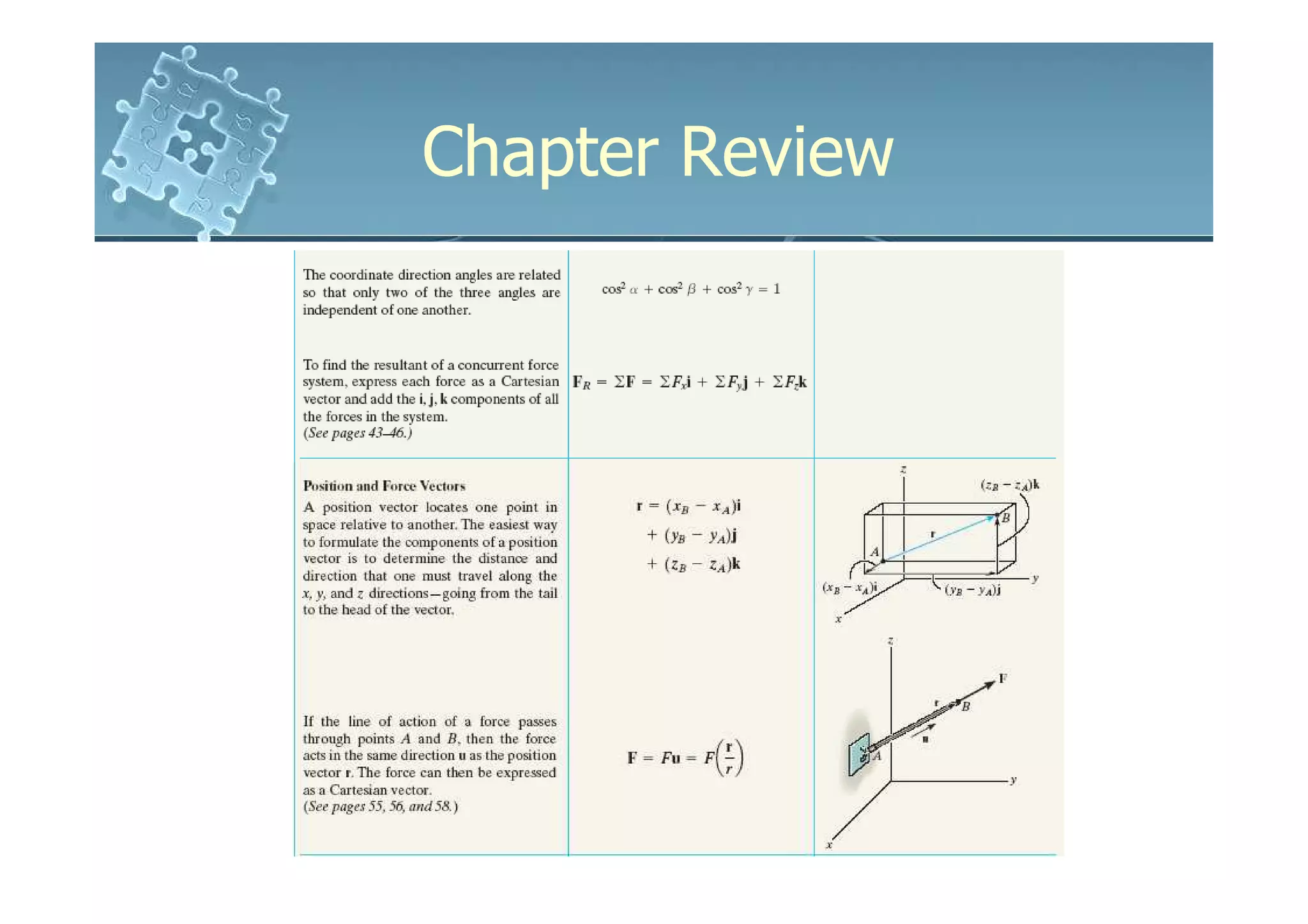
Force and Position Vectors
 Position Vector is directed between 2 points
 Formulated by distance and direction moved
 along the x, y and z axes from tail to tip
Chapter Summary

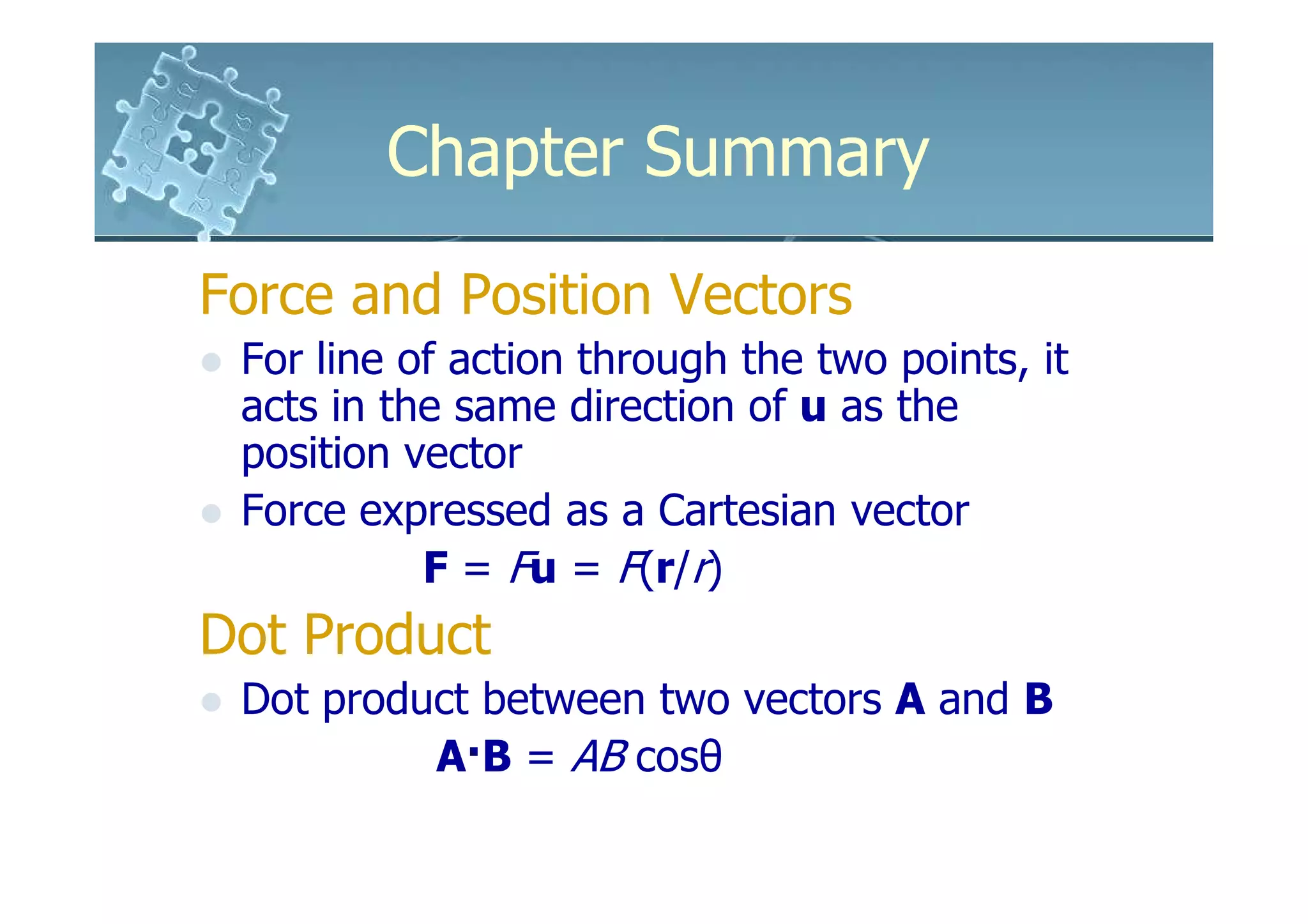
Force and Position Vectors
 For line of action through the two points, it
 acts in the same direction of u as the
 position vector
 Force expressed as a Cartesian vector
           F = Fu = F(r/r)
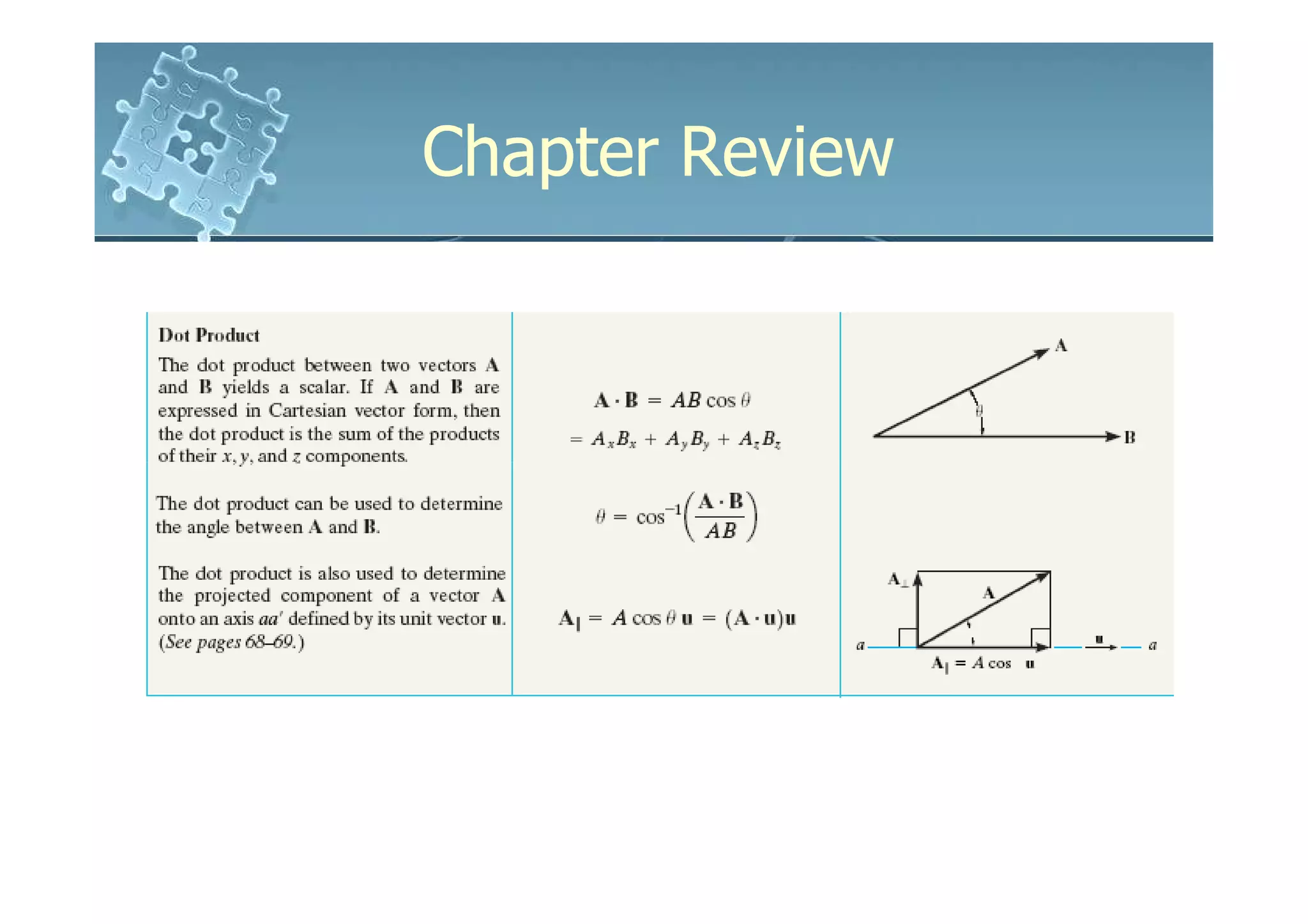
Dot Product
 Dot product between two vectors A and B
          A·B = AB cosθ
Chapter Summary
Dot Product
 Dot product between two vectors A and B
 (vectors expressed as Cartesian form)
     A·B = AxBx + AyBy + AzBz
 For angle between the tails of two vectors
      θ = cos-1 [(A·B)/(AB)]
 For projected component of A onto an axis
 defined by its unit vector u
      A = A cos θ = A·u
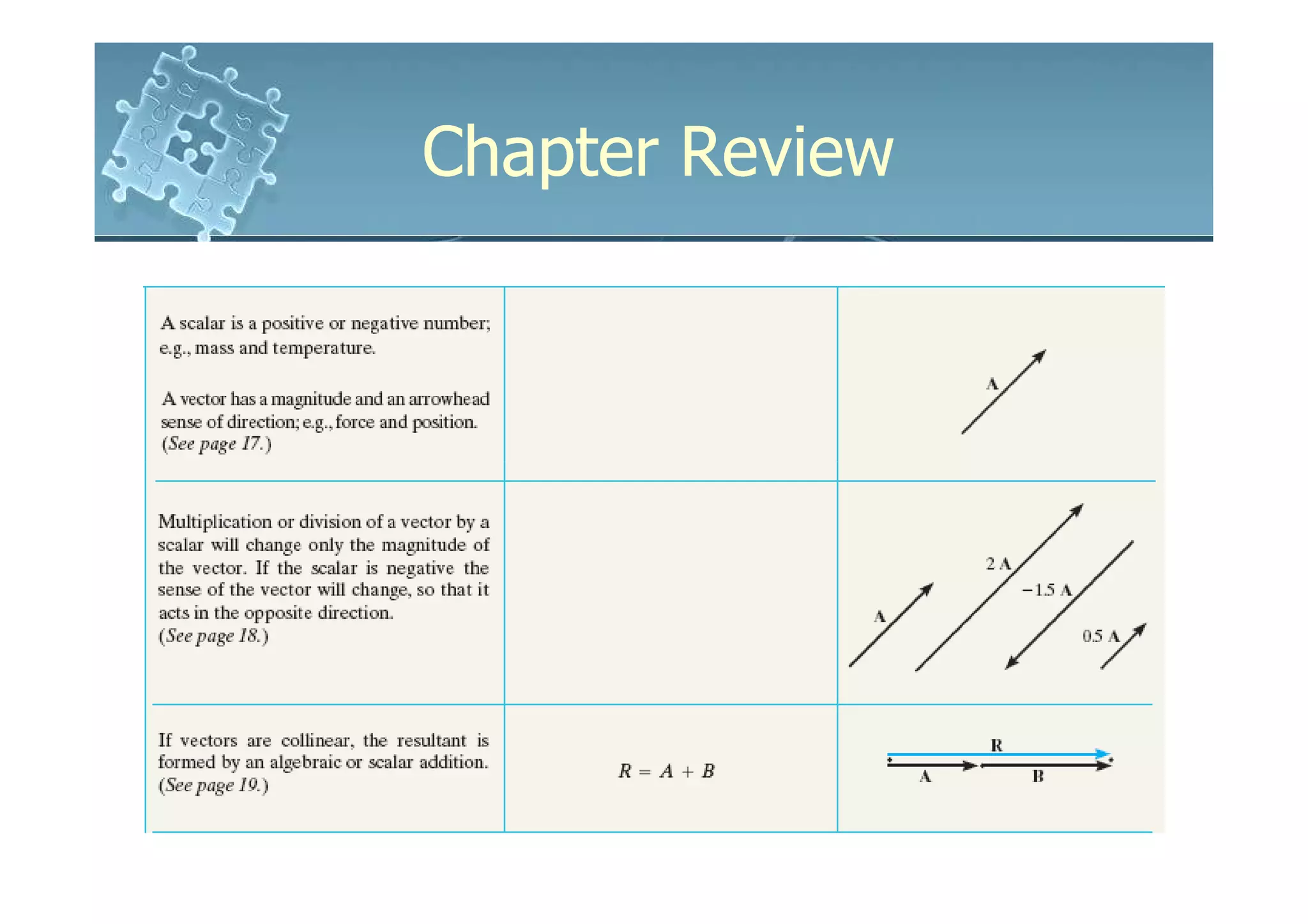
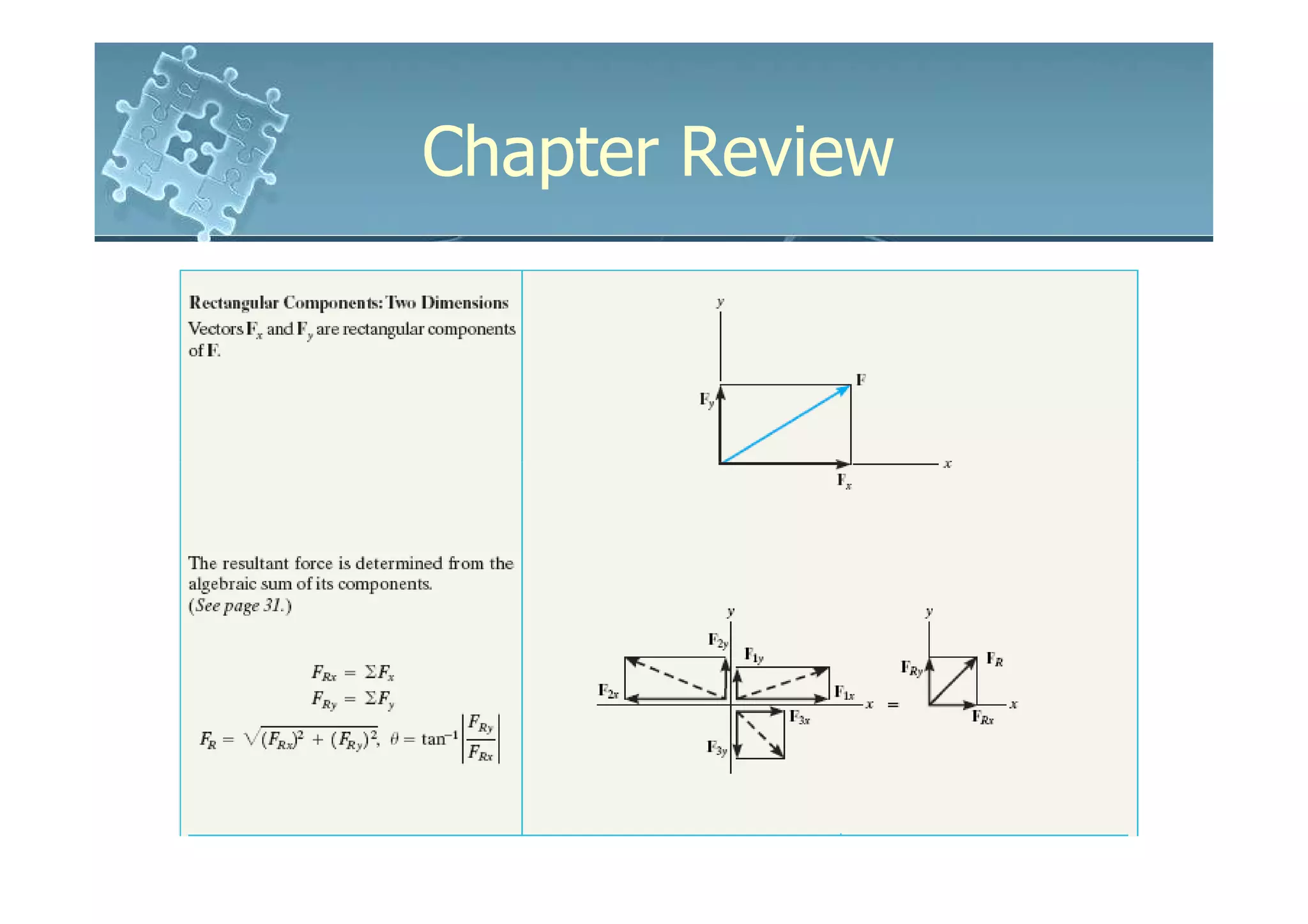
Chapter Review
Chapter Review
Chapter Review
Chapter Review
Chapter Review
Chapter Review

6161103 Ch02b

  • 1.
    2.6 Addition andSubtraction of Cartesian Vectors Example Given: A = Axi + Ayj + AZk and B = Bxi + Byj + BZk Vector Addition Resultant R = A + B = (Ax + Bx)i + (Ay + By )j + (AZ + BZ) k Vector Substraction Resultant R = A - B = (Ax - Bx)i + (Ay - By )j + (AZ - BZ) k
  • 2.
    2.6 Addition andSubtraction of Cartesian Vectors Concurrent Force Systems - Force resultant is the vector sum of all the forces in the system FR = ∑F = ∑Fxi + ∑Fyj + ∑Fzk where ∑Fx , ∑Fy and ∑Fz represent the algebraic sums of the x, y and z or i, j or k components of each force in the system
  • 3.
    2.6 Addition andSubtraction of Cartesian Vectors Force, F that the tie down rope exerts on the ground support at O is directed along the rope Angles α, β and γ can be solved with axes x, y and z
  • 4.
    2.6 Addition andSubtraction of Cartesian Vectors Cosines of their values forms a unit vector u that acts in the direction of the rope Force F has a magnitude of F F = Fu = Fcosαi + Fcosβj + Fcosγk
  • 5.
    2.6 Addition andSubtraction of Cartesian Vectors Example 2.8 Express the force F as Cartesian vector
  • 6.
    2.6 Addition andSubtraction of Cartesian Vectors Solution Since two angles are specified, the third angle is found by cos 2 α + cos 2 β + cos 2 γ = 1 cos 2 α + cos 2 60o + cos 2 45o = 1 cos α = 1 − (0.5) − (0.707 ) = ±0.5 2 2 Two possibilities exit, namely α = cos −1 (0.5) = 60o or α = cos −1 (− 0.5) = 120o
  • 7.
    2.6 Addition andSubtraction of Cartesian Vectors Solution By inspection, α = 60° since Fx is in the +x direction Given F = 200N F = Fcosαi + Fcosβj + Fcosγk = (200cos60°N)i + (200cos60°N)j + (200cos45°N)k = {100.0i + 100.0j + 141.4k}N Checking: F = Fx2 + Fy2 + Fz2 = (100.0) + (100.0) + (141.4) 2 2 2 = 200 N
  • 8.
    2.6 Addition andSubtraction of Cartesian Vectors Example 2.9 Determine the magnitude and coordinate direction angles of resultant force acting on the ring
  • 9.
    2.6 Addition andSubtraction of Cartesian Vectors Solution Resultant force FR = ∑F = F1 + F2 = {60j + 80k}kN + {50i - 100j + 100k}kN = {50j -40k + 180k}kN Magnitude of FR is found by FR = (50)2 + (− 40)2 + (180)2 = 191.0 = 191kN
  • 10.
    2.6 Addition andSubtraction of Cartesian Vectors Solution Unit vector acting in the direction of FR uFR = FR /FR = (50/191.0)i + (40/191.0)j + (180/191.0)k = 0.1617i - 0.2094j + 0.9422k So that cosα = 0.2617 α = 74.8° cos β = -0.2094 β = 102° cosγ = 0.9422 γ = 19.6° *Note β > 90° since j component of uFR is negative
  • 11.
    2.6 Addition andSubtraction of Cartesian Vectors Example 2.10 Express the force F1 as a Cartesian vector.
  • 12.
    2.6 Addition andSubtraction of Cartesian Vectors Solution The angles of 60° and 45° are not coordinate direction angles. By two successive applications of parallelogram law,
  • 13.
    2.6 Addition andSubtraction of Cartesian Vectors Solution By trigonometry, F1z = 100sin60 °kN = 86.6kN F’ = 100cos60 °kN = 50kN F1x = 50cos45 °kN = 35.4kN kN F1y = 50sin45 °kN = 35.4kN F1y has a direction defined by –j, Therefore F1 = {35.4i – 35.4j + 86.6k}kN
  • 14.
    2.6 Addition andSubtraction of Cartesian Vectors Solution Checking: F1 = F12 + F12 + F12 x y z = (35.4)2 + (− 35.4)2 + (86.6)2 = 100 N Unit vector acting in the direction of F1 u1 = F1 /F1 = (35.4/100)i - (35.4/100)j + (86.6/100)k = 0.354i - 0.354j + 0.866k
  • 15.
    2.6 Addition andSubtraction of Cartesian Vectors Solution α1 = cos-1(0.354) = 69.3° β1 = cos-1(-0.354) = 111° γ1 = cos-1(0.866) = 30.0° Using the same method, F2 = {106i + 184j - 212k}kN
  • 16.
    2.6 Addition andSubtraction of Cartesian Vectors Example 2.11 Two forces act on the hook. Specify the coordinate direction angles of F2, so that the resultant force FR acts along the positive y axis and has a magnitude of 800N.
  • 17.
    2.6 Addition andSubtraction of Cartesian Vectors Solution Cartesian vector form FR = F1 + F2 F1 = F1cosα1i + F1cosβ1j + F1cosγ1k = (300cos45°N)i + (300cos60°N)j + (300cos120°N)k = {212.1i + 150j - 150k}N F2 = F2xi + F2yj + F2zk
  • 18.
    2.6 Addition andSubtraction of Cartesian Vectors Solution Since FR has a magnitude of 800N and acts in the +j direction FR = F1 + F2 800j = 212.1i + 150j - 150k + F2xi + F2yj + F2zk 800j = (212.1 + F2x)i + (150 + F2y)j + (- 50 + F2z)k To satisfy the equation, the corresponding components on left and right sides must be equal
  • 19.
    2.6 Addition andSubtraction of Cartesian Vectors Solution Hence, 0 = 212.1 + F2x F2x = -212.1N 800 = 150 + F2y F2y = 650N 0 = -150 + F2z F2z = 150N Since magnitude of F2 and its components are known, α1 = cos-1(-212.1/700) = 108° β1 = cos-1(650/700) = 21.8° γ1 = cos-1(150/700) = 77.6°
  • 20.
    2.7 Position Vectors x,y,zCoordinates - Right-handed coordinate system - Positive z axis points upwards, measuring the height of an object or the altitude of a point - Points are measured relative to the origin, O.
  • 21.
    2.7 Position Vectors x,y,zCoordinates Eg: For Point A, xA = +4m along the x axis, yA = -6m along the y axis and zA = -6m along the z axis. Thus, A (4, 2, -6) Similarly, B (0, 2, 0) and C (6, -1, 4)
  • 22.
    2.7 Position Vectors PositionVector - Position vector r is defined as a fixed vector which locates a point in space relative to another point. Eg: If r extends from the origin, O to point P (x, y, z) then, in Cartesian vector form r = xi + yj + zk
  • 23.
    2.7 Position Vectors Position Vector Note the head to tail vector addition of the three components Start at origin O, one travels x in the +i direction, y in the +j direction and z in the +k direction, arriving at point P (x, y, z)
  • 24.
    2.7 Position Vectors Position Vector - Position vector maybe directed from point A to point B - Designated by r or rAB Vector addition gives rA + r = rB Solving r = rB – rA = (xB – xA)i + (yB – yA)j + (zB –zA)k or r = (xB – xA)i + (yB – yA)j + (zB –zA)k
  • 25.
    2.7 Position Vectors Position Vector - The i, j, k components of the positive vector r may be formed by taking the coordinates of the tail, A (xA, yA, zA) and subtract them from the head B (xB, yB, zB) Note the head to tail vector addition of the three components
  • 26.
    2.7 Position Vectors Lengthand direction of cable AB can be found by measuring A and B using the x, y, z axes Position vector r can be established Magnitude r represent the length of cable
  • 27.
    2.7 Position Vectors Angles,α, β and γ represent the direction of the cable Unit vector, u = r/r
  • 28.
    2.7 Position Vectors Example2.12 An elastic rubber band is attached to points A and B. Determine its length and its direction measured from A towards B.
  • 29.
    2.7 Position Vectors Solution Positionvector r = [-2m – 1m]i + [2m – 0]j + [3m – (-3m)]k = {-3i + 2j + 6k}m Magnitude = length of the rubber band r= (− 3)2 + (2)2 + (6)2 = 7m Unit vector in the director of r u = r /r = -3/7i + 2/7j + 6/7k
  • 30.
    2.7 Position Vectors Solution α = cos-1(-3/7) = 115° β = cos-1(2/7) = 73.4° γ = cos-1(6/7) = 31.0°
  • 31.
    2.8 Force VectorDirected along a Line In 3D problems, direction of F is specified by 2 points, through which its line of action lies F can be formulated as a Cartesian vector F = F u = F (r/r) Note that F has units of forces (N) unlike r, with units of length (m)
  • 32.
    2.8 Force VectorDirected along a Line Force F acting along the chain can be presented as a Cartesian vector by - Establish x, y, z axes - Form a position vector r along length of chain
  • 33.
    2.8 Force VectorDirected along a Line Unit vector, u = r/r that defines the direction of both the chain and the force We get F = Fu
  • 34.
    2.8 Force VectorDirected along a Line Example 2.13 The man pulls on the cord with a force of 350N. Represent this force acting on the support A, as a Cartesian vector and determine its direction.
  • 35.
    2.8 Force VectorDirected along a Line Solution End points of the cord are A (0m, 0m, 7.5m) and B (3m, -2m, 1.5m) r = (3m – 0m)i + (-2m – 0m)j + (1.5m – 7.5m)k = {3i – 2j – 6k}m Magnitude = length of cord AB r = (3m ) + (− 2m ) + (− 6m ) = 7m 2 2 2 Unit vector, u = r /r = 3/7i - 2/7j - 6/7k
  • 36.
    2.8 Force VectorDirected along a Line Solution Force F has a magnitude of 350N, direction specified by u F = Fu = 350N(3/7i - 2/7j - 6/7k) = {150i - 100j - 300k} N α = cos-1(3/7) = 64.6° β = cos-1(-2/7) = 107° γ = cos-1(-6/7) = 149°
  • 37.
    2.8 Force VectorDirected along a Line Example 2.14 The circular plate is partially supported by the cable AB. If the force of the cable on the hook at A is F = 500N, express F as a Cartesian vector.
  • 38.
    2.8 Force VectorDirected along a Line Solution End points of the cable are (0m, 0m, 2m) and B (1.707m, 0.707m, 0m) r = (1.707m – 0m)i + (0.707m – 0m)j + (0m – 2m)k = {1.707i + 0.707j - 2k}m Magnitude = length of cable AB r= (1.707m )2 + (0.707m )2 + (− 2m )2 = 2.723m
  • 39.
    2.8 Force VectorDirected along a Line Solution Unit vector, u = r /r = (1.707/2.723)i + (0.707/2.723)j – (2/2.723)k = 0.6269i + 0.2597j – 0.7345k For force F, F = Fu = 500N(0.6269i + 0.2597j – 0.7345k) = {313i - 130j - 367k} N
  • 40.
    2.8 Force VectorDirected along a Line Solution Checking F= (313) + (130) + (− 367 ) 2 2 2 = 500 N Show that γ = 137° and indicate this angle on the diagram
  • 41.
    2.8 Force VectorDirected along a Line Example 2.15 The roof is supported by cables. If the cables exert FAB = 100N and FAC = 120N on the wall hook at A, determine the magnitude of the resultant force acting at A.
  • 42.
    2.8 Force VectorDirected along a Line Solution rAB = (4m – 0m)i + (0m – 0m)j + (0m – 4m)k = {4i – 4k}m rAB = (4m )2 + (− 4m )2 = 5.66m FAB = 100N (rAB/r AB) = 100N {(4/5.66)i - (4/5.66)k} = {70.7i - 70.7k} N
  • 43.
    2.8 Force VectorDirected along a Line Solution rAC = (4m – 0m)i + (2m – 0m)j + (0m – 4m)k = {4i + 2j – 4k}m rAC = (4m )2 + (2m )2 + (− 4m )2 = 6m FAC = 120N (rAB/r AB) = 120N {(4/6)i + (2/6)j - (4/6)k} = {80i + 40j – 80k} N
  • 44.
    2.8 Force VectorDirected along a Line Solution FR = FAB + FAC = {70.7i - 70.7k} N + {80i + 40j – 80k} N = {150.7i + 40j – 150.7k} N Magnitude of FR FR = (150.7 )2 + (40)2 + (− 150.7 )2 = 217 N
  • 45.
    2.9 Dot Product Dotproduct of vectors A and B is written as A·B (Read A dot B) Define the magnitudes of A and B and the angle between their tails A·B = AB cosθ where 0°≤ θ ≤180° Referred to as scalar product of vectors as result is a scalar
  • 46.
    2.9 Dot Product Laws of Operation 1. Commutative law A·B = B·A 2. Multiplication by a scalar a(A·B) = (aA)·B = A·(aB) = (A·B)a 3. Distribution law A·(B + D) = (A·B) + (A·D)
  • 47.
    2.9 Dot Product CartesianVector Formulation - Dot product of Cartesian unit vectors Eg: i·i = (1)(1)cos0° = 1 and i·j = (1)(1)cos90° = 0 - Similarly i·i = 1 j·j = 1 k·k = 1 i·j = 0 i·k = 1 j·k = 1
  • 48.
    2.9 Dot Product Cartesian Vector Formulation - Dot product of 2 vectors A and B A·B = (Axi + Ayj + Azk)· (Bxi + Byj + Bzk) = AxBx(i·i) + AxBy(i·j) + AxBz(i·k) + AyBx(j·i) + AyBy(j·j) + AyBz(j·k) + AzBx(k·i) + AzBy(k·j) + AzBz(k·k) = AxBx + AyBy + AzBz Note: since result is a scalar, be careful of including any unit vectors in the result
  • 49.
    2.9 Dot Product Applications - The angle formed between two vectors or intersecting lines θ = cos-1 [(A·B)/(AB)] 0°≤ θ ≤180° Note: if A·B = 0, cos-10= 90°, A is perpendicular to B
  • 50.
    2.9 Dot Product Applications -The components of a vector parallel and perpendicular to a line - Component of A parallel or collinear with line aa’ is defined by A║ (projection of A onto the line) A║ = A cos θ - If direction of line is specified by unit vector u (u = 1), A║ = A cos θ = A·u
  • 51.
    2.9 Dot Product Applications -If A║ is positive, A║ has a directional sense same as u - If A║ is negative, A║ has a directional sense opposite to u - A║ expressed as a vector A║ = A cos θ u = (A·u)u
  • 52.
    2.9 Dot Product Applications Forcomponent of A perpendicular to line aa’ 1. Since A = A║ + A┴, then A┴ = A - A║ 2. θ = cos-1 [(A·u)/(A)] then A┴ = Asinθ 3. If A║ is known, by Pythagorean Theorem A⊥ = A2 + A||2
  • 53.
    2.9 Dot Product Forangle θ between the rope and the beam A, - Unit vectors along the beams, uA = rA/rA - Unit vectors along the ropes, ur=rr/rr - Angle θ = cos-1 (rA.rr/rArr) = cos-1 (uA· ur)
  • 54.
    2.9 Dot Product Forprojection of the force along the beam A - Define direction of the beam uA = rA/rA - Force as a Cartesian vector F = F(rr/rr) = Fur - Dot product F║ = F║·uA
  • 55.
    2.9 Dot Product Example2.16 The frame is subjected to a horizontal force F = {300j} N. Determine the components of this force parallel and perpendicular to the member AB.
  • 56.
    2.9 Dot Product Solution Since r r r r r r 2i + 6 j + 3k u B = rB = rB (2)2 + (6)2 + (3)2 r r r = 0.286i + 0.857 j + 0.429k Then r r FAB = F cosθ rr r r r r = F .u B = (300 j ) ⋅ (0.286i + 0.857 j + 0.429k ) = (0)(0.286) + (300)(0.857) + (0)(0.429) = 257.1N
  • 57.
    2.9 Dot Product Solution Sinceresult is a positive scalar, FAB has the same sense of direction as uB. Express in Cartesian form r r r FAB = FAB u AB r r r = (257.1N )(0.286i + 0.857 j + 0.429k ) r r r = {73.5i + 220 j + 110k }N Perpendicular component r r r r r r r r r r F⊥ = F − FAB = 300 j − (73.5i + 220 j + 110k ) = {−73.5i + 80 j − 110k }N
  • 58.
    2.9 Dot Product Solution Magnitudecan be determined From F┴ or from Pythagorean Theorem r r2 r 2 F⊥ = F − FAB = (300 N )2 − (257.1N )2 = 155 N
  • 59.
    2.9 Dot Product Example2.17 The pipe is subjected to F = 800N. Determine the angle θ between F and pipe segment BA, and the magnitudes of the components of F, which are parallel and perpendicular to BA.
  • 60.
    2.9 Dot Product Solution Forangle θ rBA = {-2i - 2j + 1k}m rBC = {- 3j + 1k}m Thus, r r rBA ⋅ rBC (− 2 )(0 ) + (− 2 )(− 3) + (1)(1) cos θ = r r = rBA rBC 3 10 = 0.7379 θ = 42.5o
  • 61.
    2.9 Dot Product Solution Componentsofr F r r r r r (−2i − 2 j + 1k ) u AB = rAB = rAB 3 r  − 2 i +  − 2  r +  1  k r =   j    3   3   3 r rr FAB = F .u B r r  2 r  2  r  1  r = (− 758.9 j + 253.0k ) ⋅  − i +  −  j +  k  3   3   3 = 0 + 506.0 + 84.3 = 590 N
  • 62.
    2.9 Dot Product Solution Checkingfrom trigonometry, r r FAB = F cos θ = 800 cos 42.5o N = 540 N Magnitude can be determined From F┴ r r F⊥ = F sin θ = 800 sin 42.5o = 540 N
  • 63.
    2.9 Dot Product Solution Magnitudecan be determined from F┴ or from Pythagorean Theorem r r2 r 2 F⊥ = F − FAB = (800)2 − (590)2 = 540 N
  • 64.
    Chapter Summary Parallelogram Law Addition of two vectors Components form the side and resultant form the diagonal of the parallelogram To obtain resultant, use tip to tail addition by triangle rule To obtain magnitudes and directions, use Law of Cosines and Law of Sines
  • 65.
    Chapter Summary Cartesian Vectors Vector F resolved into Cartesian vector form F = Fxi + Fyj + Fzk Magnitude of F 2 2 2 F = Fx + Fy + Fz Coordinate direction angles α, β and γ are determined by the formulation of the unit vector in the direction of F u = (Fx/F)i + (Fy/F)j + (Fz/F)k
  • 66.
    Chapter Summary Cartesian Vectors Components of u represent cosα, cosβ and cosγ These angles are related by cos2α + cos2β + cos2γ = 1 Force and Position Vectors Position Vector is directed between 2 points Formulated by distance and direction moved along the x, y and z axes from tail to tip
  • 67.
    Chapter Summary Force andPosition Vectors For line of action through the two points, it acts in the same direction of u as the position vector Force expressed as a Cartesian vector F = Fu = F(r/r) Dot Product Dot product between two vectors A and B A·B = AB cosθ
  • 68.
    Chapter Summary Dot Product Dot product between two vectors A and B (vectors expressed as Cartesian form) A·B = AxBx + AyBy + AzBz For angle between the tails of two vectors θ = cos-1 [(A·B)/(AB)] For projected component of A onto an axis defined by its unit vector u A = A cos θ = A·u
  • 69.
  • 70.
  • 71.
  • 72.
  • 73.
  • 74.