Module : Reaction Mechanism
Topic : Synthesis via enolates
Dr. M. T. Bachute
(Associate Professor)
Department of Chemistry
K. B. P. Mahavidyalaya, Pandharpur
Points to be studied :
1. Active methylene group and active methylene
compounds
2. Enols and enolate ions
3. Enolisation
4. Acid catalysed and base catalysed enolisation
5. Keto-enol tautomerism
6. Synthetic reagents
7. Ethyl aceto acetate
8.Synthesis of ethyl aceto acetate : Claisen condensation
9.Synthetic applications of EAA
• Points to be studied :
9. i. Alkylation and further conversions
10. Diethyl malonate
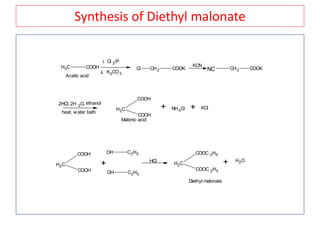
11. Synthesis of Diethyl malonate
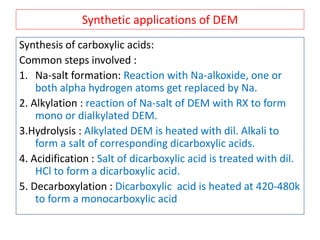
12. Synthetic applications of diethyl malonate
13. i. Alkylation and further conversions
What do you mean by active methylene group?
Give its General Formula.
A methylene (-CH2-) group which is located between
two electron withdrawing groups.
General Formula:
Z CH2 Z’
Z and Z’ are electron withdrawing
same or different groups
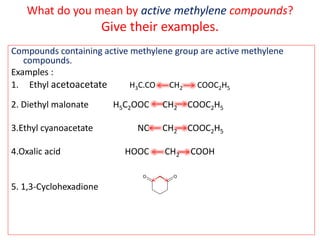
What do you mean by active methylene compounds?
Give their examples.
Compounds containing active methylene group are active methylene
compounds.
Examples :
1. Ethyl acetoacetate H3C.CO CH2 COOC2H5
2. Diethyl malonate H5C2OOC CH2 COOC2H5
3.Ethyl cyanoacetate NC CH2 COOC2H5
4.Oxalic acid HOOC CH2 COOH
5. 1,3-Cyclohexadione
OO
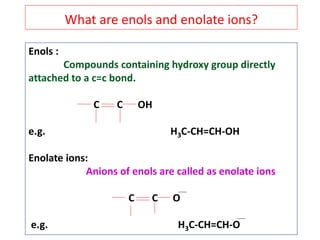
Enols :
Compounds containing hydroxy group directly
attached to a c=c bond.
C C OH
e.g. H3C-CH=CH-OH
Enolate ions:
Anions of enols are called as enolate ions
C C O
e.g. H3C-CH=CH-O
What are enols and enolate ions?
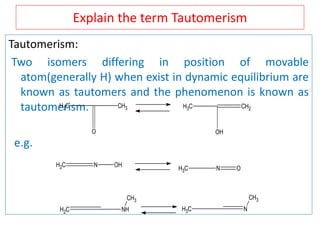
Explain the term Tautomerism
Tautomerism:
Two isomers differing in position of movable
atom(generally H) when exist in dynamic equilibrium are
known as tautomers and the phenomenon is known as
tautomerism.
e.g.
CH3
O
CH3 CH3
OH
CH2
CH2 N OH
CH3 N O
CH2 NH
CH3
CH3 N
CH3
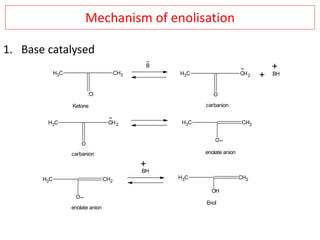
Mechanism of enolisation
1. Base catalysed
CH3
:O:
CH3 CH3
O
CH2
CH3 CH2
O
+
B
..
BH
+_
CH3
O
CH2
_
_
carbanion
enolate anion
CH3 CH2
O_
BH
+
CH3 CH2
OH
Ketone
Enol
enolate anion
carbanion
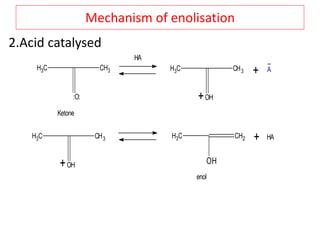
Mechanism of enolisation
2.Acid catalysed
CH3
:O:
CH3 CH3
OH
CH3
CH3 CH2
OH
+
HA
CH3
OH
CH3
enol
Ketone
A
_
+
+
+ HA
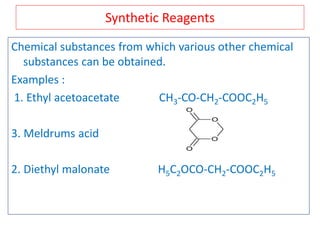
Synthetic Reagents
Chemical substances from which various other chemical
substances can be obtained.
Examples :
1. Ethyl acetoacetate CH3-CO-CH2-COOC2H5
3. Meldrums acid
2. Diethyl malonate H5C2OCO-CH2-COOC2H5
O
O
O
O
Ethyl acetoacetate
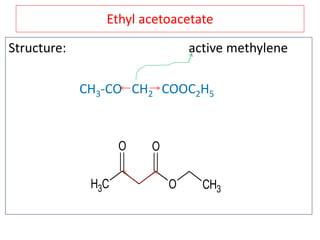
Structure: active methylene
CH3-CO CH2 COOC2H5
CH3 O
O O
CH3
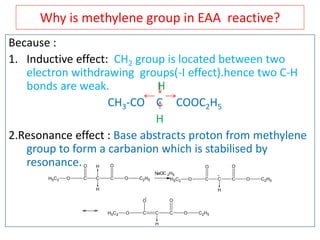
Why is methylene group in EAA reactive?
Because :
1. Inductive effect: CH2 group is located between two
electron withdrawing groups(-I effect).hence two C-H
bonds are weak. H
CH3-CO C COOC2H5
H
2.Resonance effect : Base abstracts proton from methylene
group to form a carbanion which is stabilised by
resonance.
C
O
C
H
H
C
O
O C2H5OH5C2
NaOC 2H5
C
O
C
H
C
O
O C2H5OH5C2
-
C
O
C
H
C
O
O C2H5OH5C2
-
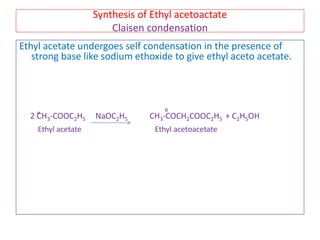
Synthesis of Ethyl acetoactate
Claisen condensation
Ethyl acetate undergoes self condensation in the presence of
strong base like sodium ethoxide to give ethyl aceto acetate.
2 CH3-COOC2H5 NaOC2H5 CH3-COCH2COOC2H5 + C2H5OH
Ethyl acetate Ethyl acetoacetate
 
Synthetic applications of EAA
Syntheses of various carboxylic acids and methyl ketones.
Common steps involved :
1. Na-salt formation: Reaction with Na-alkoxide, one or both
alpha hydrogen atoms get replaced by Na.
2. Alkylation : reaction of Na-salt of EAA with RX to form mono
or dialkylated EAA.
3.Hydrolysis : Depending on nature of product desired one of the
following procedures is used
i) Ketonic hydrolysis :Alkylated EAA is heated with dil. alkali or
acid. Hydrolysis yields ketone as the product.
ii) Acid hydrolysis : Alkylated EAA is heated with con. NaOH
followed by acidification. Hydrolysis yields carboxylic acid as
the product.
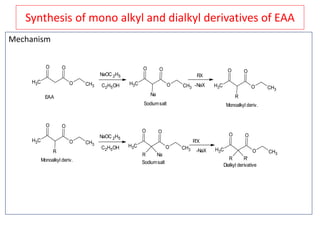
Synthesis of mono alkyl and dialkyl derivatives of EAA
Mechanism
CH3 O CH3
O O
NaOC 2H5
C2H5OH CH3 O CH3
O O
Na
RX
CH3 O CH3
O O
REAA
Sodiumsalt Monoalkyl deriv.
CH3 O CH3
O O
R
Monoalkyl deriv.
NaOC 2H5
C2H5OH CH3 O CH3
O O
R Na
-NaX
-NaX CH3 O CH3
O O
R R'
R'X
Sodiumsalt
Dialkyl derivative
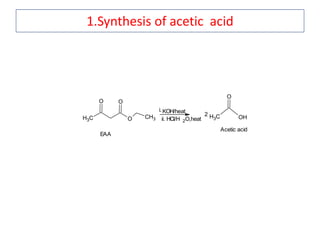
1.Synthesis of acetic acid
CH3 O
O O
CH3
i.KOH/heat
ii. HCl/H 2O,heat
2 CH3 OH
O
EAA
Acetic acid
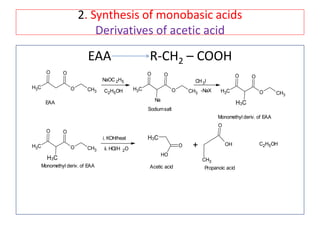
2. Synthesis of monobasic acids
Derivatives of acetic acid
EAA R-CH2 – COOH
CH3 O CH3
O O
NaOC 2H5
C2H5OH CH3 O CH3
O O
Na
CH3 O CH3
O O
H3CEAA
Sodiumsalt
CH3 O CH3
O O
H3C
Monomethyl deriv. of EAA
-NaX
CH3I
i. KOH/heat
ii. HCl/H 2O
OH
O
H3C
+ C2H5OH
Monomethyl deriv. of EAA
Acetic acid
CH3
OH
O
Propanoic acid
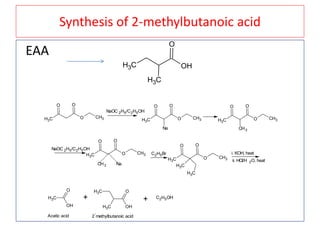
Synthesis of 2-methylbutanoic acid
EAA
CH3 OH
O
CH3
CH3
O
O O
CH3
NaOC 2H5/C2H5OH
CH3
O
O O
CH3
Na
CH3
O
O O
CH3
CH3
NaOC 2H5/C2H5OH
CH3
O
O O
CH3
CH3 Na
C2H5Br
CH3
O
O O
CH3
CH3
CH3
i. KOH, heat
ii. HCl/H 2O, heat
CH3
OH
O
+
CH3
CH3 OH
O
Acetic acid 2
-
methylbutanoic acid
+ C2H5OH
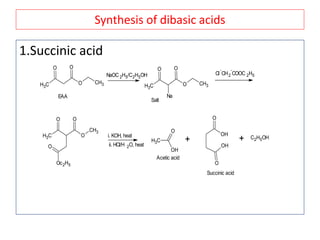
Synthesis of dibasic acids
1.Succinic acid
CH3
O
O O
CH3
NaOC 2H5/C2H5OH
CH3
O
O O
CH3
Na
Cl
-
CH2
-
COOC 2H5
CH3 O
O
CH3
O
Oc2H5
O
i. KOH, heat
ii. HCl/H 2O, heat
CH3
OH
O
+
O
O
OH
OH
+ C2H5OH
Succinic acid
EAA
Salt
Acetic acid
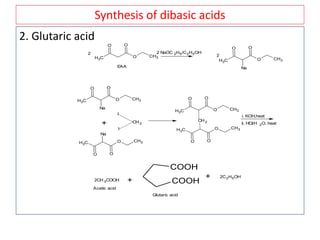
Synthesis of dibasic acids
2. Glutaric acid
CH3
O
O O
CH3
EAA
2 NaOC 2H5/C2H5OH2
CH3
O
O O
CH3
Na
2
CH3
O
O O
CH3
Na
CH3O
O
CH3
O
Na
+
I
I
CH2
CH3
O
O O
CH3
CH3O
O
CH3
O
CH2
i. KOH,heat
ii. HCl/H 2O, heat
2CH 3COOH + COOH
COOH
+ 2C2H5OH
Glutaric acid
Acetic acid
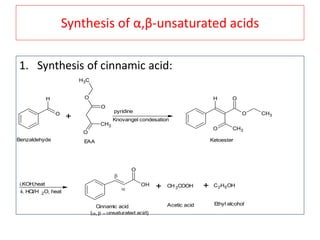
Synthesis of α,β-unsaturated acids
1. Synthesis of cinnamic acid:
O
H
+
O
CH3
O
O
CH3
pyridine
Knovangel condesation
H
O CH3
O
O
CH3
i.KOH,heat
ii. HCl/H 2O, heat
OH
O
+ CH3COOH + C2H5OH
Benzaldehyde EAA Ketoester
Cinnamic acid Acetic acid Ethyl alcohol


(unsaturated acid)
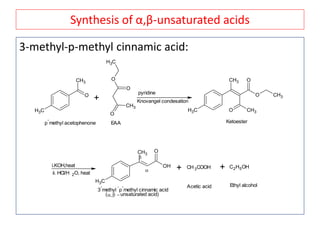
Synthesis of α,β-unsaturated acids
3-methyl-p-methyl cinnamic acid:
O
CH3
CH3
+
O
CH3
O
O
CH3
pyridine
Knovangel condesation
CH3
O CH3
O
O
CH3
CH3
i.KOH,heat
ii. HCl/H 2O, heat
OH
OCH3
CH3
+ CH3COOH + C2H5OH
EAA Ketoester
Acetic acid Ethyl alcohol


(unsaturated acid)
3
-
methyl
-
p
-
methyl cinnamic acid
p
-
methyl acetophenone
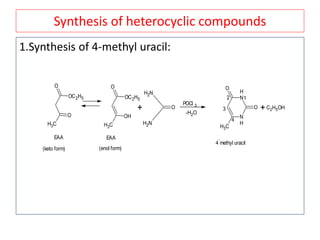
Synthesis of heterocyclic compounds
1.Synthesis of 4-methyl uracil:
CH3
O
O
OC2H5
CH3
O
OH
OC2H5
EAA EAA
(keto form) (enol form)
+
NH2
NH2
O
POCl 3
-H2O
N
H
N
H
O
CH3
O
12
3
4
4
-
methyl uracil
+C2H5OH
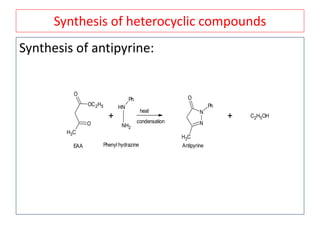
Synthesis of heterocyclic compounds
Synthesis of antipyrine:
CH3
O
O
OC2H5
EAA
+ + C2H5OH
NH
Ph
NH2
heat
condensation
N
N
CH3
O
Ph
Phenyl hydrazine Antipyrine
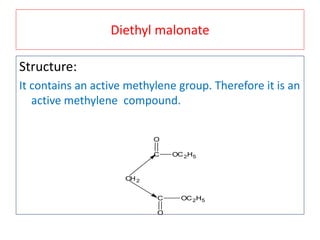
Diethyl malonate
Structure:
It contains an active methylene group. Therefore it is an
active methylene compound.
C
O
OC2H5
C
O
OC2H5
CH2
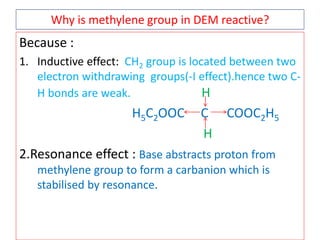
Why is methylene group in DEM reactive?
Because :
1. Inductive effect: CH2 group is located between two
electron withdrawing groups(-I effect).hence two C-
H bonds are weak. H
H5C2OOC C COOC2H5
H
2.Resonance effect : Base abstracts proton from
methylene group to form a carbanion which is
stabilised by resonance.
Synthesis of Diethyl malonate
CH3 COOH
i. Cl 2/P
K2CO3
Cl CH2 COOK
KCN
NC CH2 COOK
ii.
, ethanol
heat, w ater bath
H2C
COOH
COOH
+ NH4Cl + KCl
2HCl, 2H 2O
H2C
COOH
COOH
+
OH C2H5
OH C2H5
HCl
H2C
COOC 2H5
COOC 2H5
+ H2O
Acetic acid
Malonic acid
Diethyl malonate
Synthetic applications of DEM
Synthesis of carboxylic acids:
Common steps involved :
1. Na-salt formation: Reaction with Na-alkoxide, one or
both alpha hydrogen atoms get replaced by Na.
2. Alkylation : reaction of Na-salt of DEM with RX to form
mono or dialkylated DEM.
3.Hydrolysis : Alkylated DEM is heated with dil. Alkali to
form a salt of corresponding dicarboxylic acids.
4. Acidification : Salt of dicarboxylic acid is treated with dil.
HCl to form a dicarboxylic acid.
5. Decarboxylation : Dicarboxylic acid is heated at 420-480k
to form a monocarboxylic acid
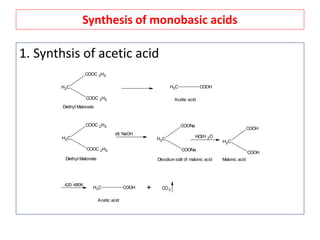
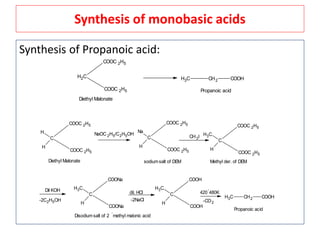
Synthesis of monobasic acids
H2C
COOC 2H5
COOC 2H5
dil. NaOH
H2C
COONa
COONa
HCl/H 2O
H2C
COOH
COOH
420
-
480K
CH3 COOH + CO2
Diethyl Malonate Disodiumsalt of malonic acid Malonic acid
Acetic acid
1. Synthsis of acetic acid
H2C
COOC 2H5
COOC 2H5
Diethyl Malonate
CH3 COOH
Acetic acid
Synthesis of monobasic acids
Synthesis of Propanoic acid:
H2C
COOC 2H5
COOC 2H5
Diethyl Malonate
Propanoic acid
CH3 CH2 COOH
C
COOC 2H5
COOC 2H5
H
H
Diethyl Malonate sodiumsalt of DEM Methyl der. of DEM
C
COOC 2H5
COOC 2H5
H
Na
NaOC 2H5/C2H5OH
CH3I
C
COOC 2H5
COOC 2H5
H
H3C
Dil KOH
C
COONa
COONa
H
H3C
-2C2H5OH
Disodiumsalt of 2
-
methyl malonic acid
dil. HCl C
COOH
COOH
H
H3C
-2NaCl
420
-
480K
CH3 CH2 COOH
Propanoic acid
-CO2

Synthesis via enolates

  • 1.
    Module : ReactionMechanism Topic : Synthesis via enolates Dr. M. T. Bachute (Associate Professor) Department of Chemistry K. B. P. Mahavidyalaya, Pandharpur
  • 2.
    Points to bestudied : 1. Active methylene group and active methylene compounds 2. Enols and enolate ions 3. Enolisation 4. Acid catalysed and base catalysed enolisation 5. Keto-enol tautomerism 6. Synthetic reagents 7. Ethyl aceto acetate 8.Synthesis of ethyl aceto acetate : Claisen condensation 9.Synthetic applications of EAA
  • 3.
    • Points tobe studied : 9. i. Alkylation and further conversions 10. Diethyl malonate 11. Synthesis of Diethyl malonate 12. Synthetic applications of diethyl malonate 13. i. Alkylation and further conversions
  • 4.
    What do youmean by active methylene group? Give its General Formula. A methylene (-CH2-) group which is located between two electron withdrawing groups. General Formula: Z CH2 Z’ Z and Z’ are electron withdrawing same or different groups
  • 5.
    What do youmean by active methylene compounds? Give their examples. Compounds containing active methylene group are active methylene compounds. Examples : 1. Ethyl acetoacetate H3C.CO CH2 COOC2H5 2. Diethyl malonate H5C2OOC CH2 COOC2H5 3.Ethyl cyanoacetate NC CH2 COOC2H5 4.Oxalic acid HOOC CH2 COOH 5. 1,3-Cyclohexadione OO
  • 6.
    Enols : Compounds containinghydroxy group directly attached to a c=c bond. C C OH e.g. H3C-CH=CH-OH Enolate ions: Anions of enols are called as enolate ions C C O e.g. H3C-CH=CH-O What are enols and enolate ions?
  • 7.
    Explain the termTautomerism Tautomerism: Two isomers differing in position of movable atom(generally H) when exist in dynamic equilibrium are known as tautomers and the phenomenon is known as tautomerism. e.g. CH3 O CH3 CH3 OH CH2 CH2 N OH CH3 N O CH2 NH CH3 CH3 N CH3
  • 8.
    Mechanism of enolisation 1.Base catalysed CH3 :O: CH3 CH3 O CH2 CH3 CH2 O + B .. BH +_ CH3 O CH2 _ _ carbanion enolate anion CH3 CH2 O_ BH + CH3 CH2 OH Ketone Enol enolate anion carbanion
  • 9.
    Mechanism of enolisation 2.Acidcatalysed CH3 :O: CH3 CH3 OH CH3 CH3 CH2 OH + HA CH3 OH CH3 enol Ketone A _ + + + HA
  • 10.
    Synthetic Reagents Chemical substancesfrom which various other chemical substances can be obtained. Examples : 1. Ethyl acetoacetate CH3-CO-CH2-COOC2H5 3. Meldrums acid 2. Diethyl malonate H5C2OCO-CH2-COOC2H5 O O O O
  • 11.
    Ethyl acetoacetate Structure: activemethylene CH3-CO CH2 COOC2H5 CH3 O O O CH3
  • 12.
    Why is methylenegroup in EAA reactive? Because : 1. Inductive effect: CH2 group is located between two electron withdrawing groups(-I effect).hence two C-H bonds are weak. H CH3-CO C COOC2H5 H 2.Resonance effect : Base abstracts proton from methylene group to form a carbanion which is stabilised by resonance. C O C H H C O O C2H5OH5C2 NaOC 2H5 C O C H C O O C2H5OH5C2 - C O C H C O O C2H5OH5C2 -
  • 13.
    Synthesis of Ethylacetoactate Claisen condensation Ethyl acetate undergoes self condensation in the presence of strong base like sodium ethoxide to give ethyl aceto acetate. 2 CH3-COOC2H5 NaOC2H5 CH3-COCH2COOC2H5 + C2H5OH Ethyl acetate Ethyl acetoacetate  
  • 14.
    Synthetic applications ofEAA Syntheses of various carboxylic acids and methyl ketones. Common steps involved : 1. Na-salt formation: Reaction with Na-alkoxide, one or both alpha hydrogen atoms get replaced by Na. 2. Alkylation : reaction of Na-salt of EAA with RX to form mono or dialkylated EAA. 3.Hydrolysis : Depending on nature of product desired one of the following procedures is used i) Ketonic hydrolysis :Alkylated EAA is heated with dil. alkali or acid. Hydrolysis yields ketone as the product. ii) Acid hydrolysis : Alkylated EAA is heated with con. NaOH followed by acidification. Hydrolysis yields carboxylic acid as the product.
  • 15.
    Synthesis of monoalkyl and dialkyl derivatives of EAA Mechanism CH3 O CH3 O O NaOC 2H5 C2H5OH CH3 O CH3 O O Na RX CH3 O CH3 O O REAA Sodiumsalt Monoalkyl deriv. CH3 O CH3 O O R Monoalkyl deriv. NaOC 2H5 C2H5OH CH3 O CH3 O O R Na -NaX -NaX CH3 O CH3 O O R R' R'X Sodiumsalt Dialkyl derivative
  • 16.
    1.Synthesis of aceticacid CH3 O O O CH3 i.KOH/heat ii. HCl/H 2O,heat 2 CH3 OH O EAA Acetic acid
  • 17.
    2. Synthesis ofmonobasic acids Derivatives of acetic acid EAA R-CH2 – COOH CH3 O CH3 O O NaOC 2H5 C2H5OH CH3 O CH3 O O Na CH3 O CH3 O O H3CEAA Sodiumsalt CH3 O CH3 O O H3C Monomethyl deriv. of EAA -NaX CH3I i. KOH/heat ii. HCl/H 2O OH O H3C + C2H5OH Monomethyl deriv. of EAA Acetic acid CH3 OH O Propanoic acid
  • 18.
    Synthesis of 2-methylbutanoicacid EAA CH3 OH O CH3 CH3 O O O CH3 NaOC 2H5/C2H5OH CH3 O O O CH3 Na CH3 O O O CH3 CH3 NaOC 2H5/C2H5OH CH3 O O O CH3 CH3 Na C2H5Br CH3 O O O CH3 CH3 CH3 i. KOH, heat ii. HCl/H 2O, heat CH3 OH O + CH3 CH3 OH O Acetic acid 2 - methylbutanoic acid + C2H5OH
  • 19.
    Synthesis of dibasicacids 1.Succinic acid CH3 O O O CH3 NaOC 2H5/C2H5OH CH3 O O O CH3 Na Cl - CH2 - COOC 2H5 CH3 O O CH3 O Oc2H5 O i. KOH, heat ii. HCl/H 2O, heat CH3 OH O + O O OH OH + C2H5OH Succinic acid EAA Salt Acetic acid
  • 20.
    Synthesis of dibasicacids 2. Glutaric acid CH3 O O O CH3 EAA 2 NaOC 2H5/C2H5OH2 CH3 O O O CH3 Na 2 CH3 O O O CH3 Na CH3O O CH3 O Na + I I CH2 CH3 O O O CH3 CH3O O CH3 O CH2 i. KOH,heat ii. HCl/H 2O, heat 2CH 3COOH + COOH COOH + 2C2H5OH Glutaric acid Acetic acid
  • 21.
    Synthesis of α,β-unsaturatedacids 1. Synthesis of cinnamic acid: O H + O CH3 O O CH3 pyridine Knovangel condesation H O CH3 O O CH3 i.KOH,heat ii. HCl/H 2O, heat OH O + CH3COOH + C2H5OH Benzaldehyde EAA Ketoester Cinnamic acid Acetic acid Ethyl alcohol   (unsaturated acid)
  • 22.
    Synthesis of α,β-unsaturatedacids 3-methyl-p-methyl cinnamic acid: O CH3 CH3 + O CH3 O O CH3 pyridine Knovangel condesation CH3 O CH3 O O CH3 CH3 i.KOH,heat ii. HCl/H 2O, heat OH OCH3 CH3 + CH3COOH + C2H5OH EAA Ketoester Acetic acid Ethyl alcohol   (unsaturated acid) 3 - methyl - p - methyl cinnamic acid p - methyl acetophenone
  • 23.
    Synthesis of heterocycliccompounds 1.Synthesis of 4-methyl uracil: CH3 O O OC2H5 CH3 O OH OC2H5 EAA EAA (keto form) (enol form) + NH2 NH2 O POCl 3 -H2O N H N H O CH3 O 12 3 4 4 - methyl uracil +C2H5OH
  • 24.
    Synthesis of heterocycliccompounds Synthesis of antipyrine: CH3 O O OC2H5 EAA + + C2H5OH NH Ph NH2 heat condensation N N CH3 O Ph Phenyl hydrazine Antipyrine
  • 25.
    Diethyl malonate Structure: It containsan active methylene group. Therefore it is an active methylene compound. C O OC2H5 C O OC2H5 CH2
  • 26.
    Why is methylenegroup in DEM reactive? Because : 1. Inductive effect: CH2 group is located between two electron withdrawing groups(-I effect).hence two C- H bonds are weak. H H5C2OOC C COOC2H5 H 2.Resonance effect : Base abstracts proton from methylene group to form a carbanion which is stabilised by resonance.
  • 27.
    Synthesis of Diethylmalonate CH3 COOH i. Cl 2/P K2CO3 Cl CH2 COOK KCN NC CH2 COOK ii. , ethanol heat, w ater bath H2C COOH COOH + NH4Cl + KCl 2HCl, 2H 2O H2C COOH COOH + OH C2H5 OH C2H5 HCl H2C COOC 2H5 COOC 2H5 + H2O Acetic acid Malonic acid Diethyl malonate
  • 28.
    Synthetic applications ofDEM Synthesis of carboxylic acids: Common steps involved : 1. Na-salt formation: Reaction with Na-alkoxide, one or both alpha hydrogen atoms get replaced by Na. 2. Alkylation : reaction of Na-salt of DEM with RX to form mono or dialkylated DEM. 3.Hydrolysis : Alkylated DEM is heated with dil. Alkali to form a salt of corresponding dicarboxylic acids. 4. Acidification : Salt of dicarboxylic acid is treated with dil. HCl to form a dicarboxylic acid. 5. Decarboxylation : Dicarboxylic acid is heated at 420-480k to form a monocarboxylic acid
  • 29.
    Synthesis of monobasicacids H2C COOC 2H5 COOC 2H5 dil. NaOH H2C COONa COONa HCl/H 2O H2C COOH COOH 420 - 480K CH3 COOH + CO2 Diethyl Malonate Disodiumsalt of malonic acid Malonic acid Acetic acid 1. Synthsis of acetic acid H2C COOC 2H5 COOC 2H5 Diethyl Malonate CH3 COOH Acetic acid
  • 30.
    Synthesis of monobasicacids Synthesis of Propanoic acid: H2C COOC 2H5 COOC 2H5 Diethyl Malonate Propanoic acid CH3 CH2 COOH C COOC 2H5 COOC 2H5 H H Diethyl Malonate sodiumsalt of DEM Methyl der. of DEM C COOC 2H5 COOC 2H5 H Na NaOC 2H5/C2H5OH CH3I C COOC 2H5 COOC 2H5 H H3C Dil KOH C COONa COONa H H3C -2C2H5OH Disodiumsalt of 2 - methyl malonic acid dil. HCl C COOH COOH H H3C -2NaCl 420 - 480K CH3 CH2 COOH Propanoic acid -CO2