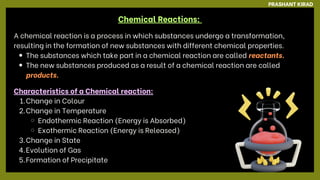
Chemical Reactions:
A chemicalreaction is a process in which substances undergo a transformation,
resulting in the formation of new substances with different chemical properties.
The substances which take part in a chemical reaction are called reactants.
The new substances produced as a result of a chemical reaction are called
products.
PRASHANT KIRAD
Characteristics of a Chemical reaction:
1.Change in Colour
2.Change in Temperature
Endothermic Reaction (Energy is Absorbed)
Exothermic Reaction (Energy is Released)
3.Change in State
4.Evolution of Gas
5.Formation of Precipitate
7.
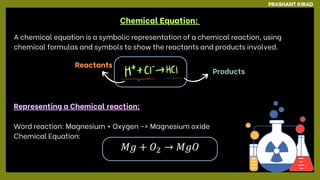
Chemical Equation:
A chemicalequation is a symbolic representation of a chemical reaction, using
chemical formulas and symbols to show the reactants and products involved.
Representing a Chemical reaction:
Word reaction: Magnesium + Oxygen
-> Magnesium oxide
Chemical Equation:
Reactants
Products
PRASHANT KIRAD
8.
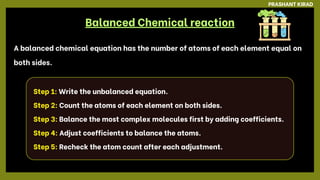
Balanced Chemical reaction
Abalanced chemical equation has the number of atoms of each element equal on
both sides.
Step 1: Write the unbalanced equation.
Step 2: Count the atoms of each element on both sides.
Step 3: Balance the most complex molecules first by adding coefficients.
Step 4: Adjust coefficients to balance the atoms.
Step 5: Recheck the atom count after each adjustment.
PRASHANT KIRAD
9.
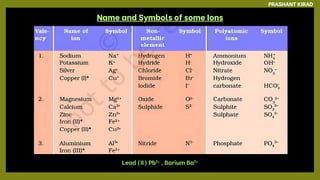
Name and Symbolsof some Ions
PRASHANT KIRAD
Lead (II) Pb²⁺ , Barium Ba²⁺
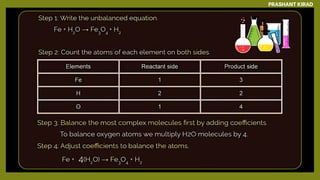
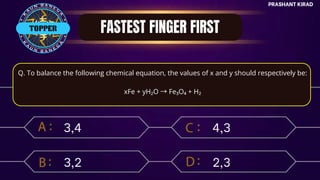
Q. To balancethe following chemical equation, the values of x and y should respectively be:
xFe + yH₂O →Fe₃O₄ + H₂
PRASHANT KIRAD
3,4
3,2
4,3
2,3
TOPPER
16.
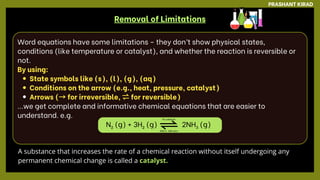
Word equations havesome limitations – they don’t show physical states,
conditions (like temperature or catalyst), and whether the reaction is reversible or
not.
By using:
State symbols like (s), (l), (g), (aq)
Conditions on the arrow (e.g., heat, pressure, catalyst)
Arrows (→for irreversible, ⇌for reversible)
...we get complete and informative chemical equations that are easier to
understand. e.g.
N₂ (g) + 3H₂ (g) 2NH₃ (g)
Removal of Limitations
PRASHANT KIRAD
A substance that increases the rate of a chemical reaction without itself undergoing any
permanent chemical change is called a catalyst.
Fe catalyst
450°C, 200 atm
17.
Combination Reaction andits types:
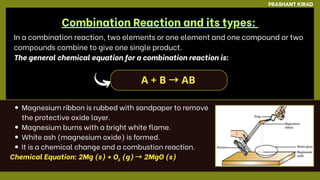
In a combination reaction, two elements or one element and one compound or two
compounds combine to give one single product.
The general chemical equation for a combination reaction is:
A + B →AB
PRASHANT KIRAD
Magnesium ribbon is rubbed with sandpaper to remove
the protective oxide layer.
Magnesium burns with a bright white flame.
White ash (magnesium oxide) is formed.
It is a chemical change and a combustion reaction.
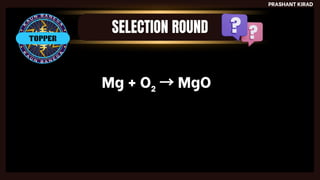
Chemical Equation: 2Mg (s) + O₂ (g) →2MgO (s)
18.
PRASHANT KIRAD
(i) Reactionof Quick Lime with Water
CaO reacts vigorously with water – forms slaked lime
[Ca(OH)₂].
Exothermic reaction – releases heat
Type of reaction: Combination reaction
CaO (s) + H₂O (l) →Ca(OH)₂ (aq) + Heat
Whitewashing and Formation of Calcium Carbonate
Slaked lime is used for whitewashing walls.
It reacts slowly with CO₂ in air:
Ca(OH)₂ (aq) + CO₂ (g) →CaCO₃ (s) + H₂O (l)
CaCO₃ (Calcium carbonate) forms a shiny layer on walls.
Marble also has the formula CaCO₃.
Carbon dioxide Test: The most effective way to test for CO₂ is to bubble the gas
through lime water, which is a diluted solution of calcium hydroxide.
19.
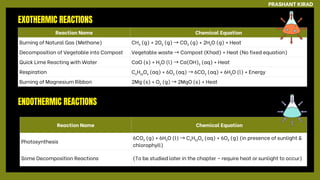
Reaction Name ChemicalEquation
Burning of Natural Gas (Methane) CH₄ (g) + 2O₂ (g) →CO₂ (g) + 2H₂O (g) + Heat
Decomposition of Vegetable into Compost Vegetable waste →Compost (Khad) + Heat (No fixed equation)
Quick Lime Reacting with Water CaO (s) + H₂O (l) →Ca(OH)₂ (aq) + Heat
Respiration C₆H₁₂O₆ (aq) + 6O₂ (aq) →6CO₂ (aq) + 6H₂O (l) + Energy
Burning of Magnesium Ribbon 2Mg (s) + O₂ (g) →2MgO (s) + Heat
Reaction Name Chemical Equation
Photosynthesis
6CO₂ (g) + 6H₂O (l) →C₆H₁₂O₆ (aq) + 6O₂ (g) (in presence of sunlight &
chlorophyll)
Some Decomposition Reactions (To be studied later in the chapter – require heat or sunlight to occur)
PRASHANT KIRAD
EXOTHERMIC REACTIONS
ENDOTHERMIC REACTIONS
20.
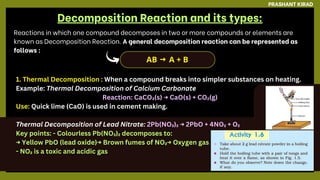
Reactions in whichone compound decomposes in two or more compounds or elements are
known as Decomposition Reaction. A general decomposition reaction can be represented as
follows :
1. Thermal Decomposition : When a compound breaks into simpler substances on heating.
Example: Thermal Decomposition of Calcium Carbonate
Reaction: CaCO₃(s) → CaO(s) + CO₂(g)
Use: Quick lime (CaO) is used in cement making.
Thermal Decomposition of Lead Nitrate: 2Pb(NO₃)₂ → 2PbO + 4NO₂ + O₂
Key points: - Colourless Pb(NO₃)₂ decomposes to:
→ Yellow PbO (lead oxide)→ Brown fumes of NO₂→ Oxygen gas
- NO₂ is a toxic and acidic gas
PRASHANT KIRAD
Decomposition Reaction and its types:
AB A + B
→
21.
PRASHANT KIRAD
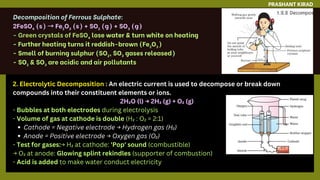
2. ElectrolyticDecomposition : An electric current is used to decompose or break down
compounds into their constituent elements or ions.
2H₂O (l) → 2H₂ (g) + O₂ (g)
- Bubbles at both electrodes during electrolysis
- Volume of gas at cathode is double (H₂ : O₂ = 2:1)
Cathode = Negative electrode → Hydrogen gas (H₂)
Anode = Positive electrode → Oxygen gas (O₂)
- Test for gases:→ H₂ at cathode: 'Pop' sound (combustible)
→ O₂ at anode: Glowing splint rekindles (supporter of combustion)
- Acid is added to make water conduct electricity
22.
PRASHANT KIRAD
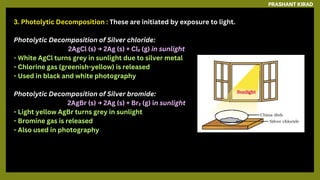
3. PhotolyticDecomposition : These are initiated by exposure to light.
Photolytic Decomposition of Silver chloride:
2AgCl (s) → 2Ag (s) + Cl₂ (g) in sunlight
- White AgCl turns grey in sunlight due to silver metal
- Chlorine gas (greenish-yellow) is released
- Used in black and white photography
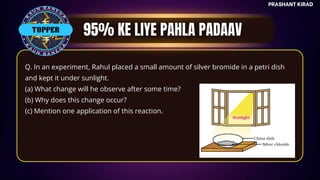
Photolytic Decomposition of Silver bromide:
2AgBr (s) → 2Ag (s) + Br₂ (g) in sunlight
- Light yellow AgBr turns grey in sunlight
- Bromine gas is released
- Also used in photography
23.
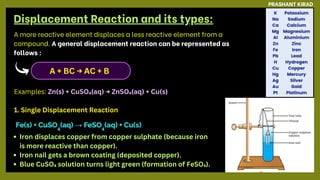
A more reactiveelement displaces a less reactive element from a
compound. A general displacement reaction can be represented as
follows :
PRASHANT KIRAD
Displacement Reaction and its types:
Examples: Zn(s) + CuSO₄(aq) → ZnSO₄(aq) + Cu(s)
1. Single Displacement Reaction
A + BC → AC + B
Iron displaces copper from copper sulphate (because iron
is more reactive than copper).
Iron nail gets a brown coating (deposited copper).
Blue CuSO₄ solution turns light green (formation of FeSO₄).
24.
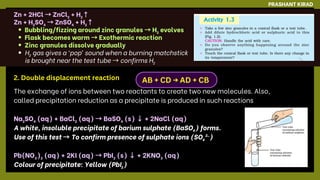
The exchange ofions between two reactants to create two new molecules. Also,
called precipitation reduction as a precipitate is produced in such reactions
Na₂SO₄ (aq) + BaCl₂ (aq) →BaSO₄ (s) ↓+ 2NaCl (aq)
A white, insoluble precipitate of barium sulphate (BaSO₄) forms.
Use of this test →To confirm presence of sulphate ions (SO₄²⁻)
Pb(NO₃)₂ (aq) + 2KI (aq) →PbI₂ (s) ↓+ 2KNO₃ (aq)
Colour of precipitate: Yellow (PbI₂)
PRASHANT KIRAD
AB + CD → AD + CB
2. Double displacement reaction
Zn + 2HCl →ZnCl₂ + H₂↑
Zn + H₂SO₄ →ZnSO₄ + H₂↑
Bubbling/fizzing around zinc granules →H₂ evolves
Flask becomes warm →Exothermic reaction
Zinc granules dissolve gradually
H₂ gas gives a ‘pop’ sound when a burning matchstick
is brought near the test tube →confirms H₂
25.
PRASHANT KIRAD
1.Change inColour : Example: Fe + CuSO₄ →FeSO₄ + Cu
2.Change in Temperature:
a.Endothermic Reaction (Heat absorbed) : Example: CaCO₃ + Heat →CaO + CO₂
b.Exothermic Reaction (Heat released) : Example: CaO + H₂O →Ca(OH)₂ + Heat
3.Change in Stats : Example: 2H₂ + O₂ →2H₂O
4.Evolution of Gas : Example: Zn + H₂SO₄ →ZnSO₄ + H₂
5.Formation of Precipitate : Example: Pb(NO₃)₂ + KI →PbI₂ + KNO₃
CHARACTERISTICS OF A CHEMICAL REACTION:
26.
The reaction inwhich oxidation and reduction both take place simultaneously is called
Redox reaction.
Oxidation is the gain of oxygen or loss of hydrogen by a substance in a chemical reaction.
Reduction is the loss of oxygen or gain of hydrogen by a substance in a chemical reaction.
PRASHANT KIRAD
Redox reaction
2Cu + O₂ →2CuO
Reddish-brown copper powder turns black on heating.
Formation of black CuO (copper oxide) layer
Copper gets oxidized to form CuO.
The reaction is exothermic (releases heat).
Substance getting oxidised is called a Reducing agent
and the substance getting reduced is called an
Oxidising agent.
27.
TOP QUESTIONS
PRASHANT KIRAD
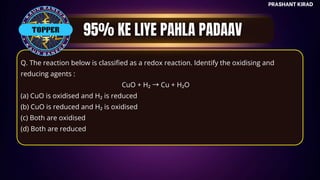
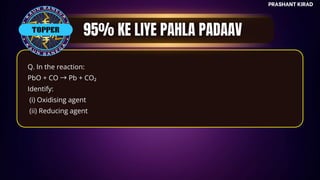
Q.The reaction below is classified as a redox reaction. Identify the oxidising and
reducing agents :
CuO + H₂ →Cu + H₂O
(a) CuO is oxidised and H₂ is reduced
(b) CuO is reduced and H₂ is oxidised
(c) Both are oxidised
(d) Both are reduced
TOPPER
28.
TOP QUESTIONS
PRASHANT KIRAD
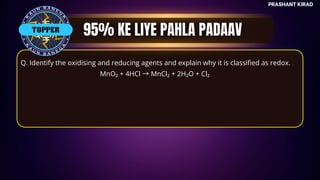
Q.Identify the oxidising and reducing agents and explain why it is classified as redox.
MnO₂ + 4HCl →MnCl₂ + 2H₂O + Cl₂
TOPPER
29.
PRASHANT KIRAD
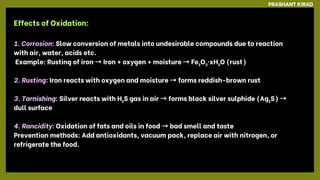
Effects ofOxidation:
1. Corrosion: Slow conversion of metals into undesirable compounds due to reaction
with air, water, acids etc.
Example: Rusting of iron →Iron + oxygen + moisture →Fe₂O₃·xH₂O (rust)
2. Rusting: Iron reacts with oxygen and moisture →forms reddish-brown rust
3. Tarnishing: Silver reacts with H₂S gas in air →forms black silver sulphide (Ag₂S) →
dull surface
4. Rancidity: Oxidation of fats and oils in food →bad smell and taste
Prevention methods: Add antioxidants, vacuum pack, replace air with nitrogen, or
refrigerate the food.
30.
TOP QUESTIONS
PRASHANT KIRAD
Q.Write the balanced chemical equation for the following and identify the type of
reaction:
(i) Calcium carbonate →Calcium oxide + Carbon dioxide
(ii) Barium chloride + Sodium sulphate →Barium sulphate + Sodium chloride
[CBSE 2019, 2022]
TOPPER
31.
TOP QUESTIONS
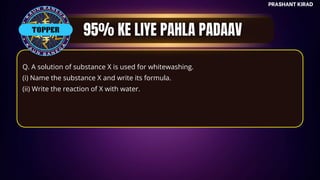
Q. Asolution of substance X is used for whitewashing.
(i) Name the substance X and write its formula.
(ii) Write the reaction of X with water.
PRASHANT KIRAD
TOPPER
32.
TOP QUESTIONS
Q. Ametal X displaces another metal Y from its salt solution. Identify X and Y if X is
more reactive and the salt solution is blue in color.
PRASHANT KIRAD
TOPPER
TOP QUESTIONS
PRASHANT KIRAD
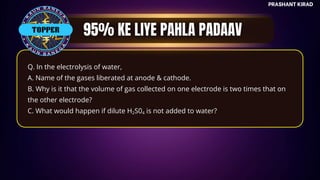
Q.In the electrolysis of water,
A. Name of the gases liberated at anode & cathode.
B. Why is it that the volume of gas collected on one electrode is two times that on
the other electrode?
C. What would happen if dilute H S0 is not added to water?
2 4
TOPPER
35.
TOP QUESTIONS
PRASHANT KIRAD
Q.In an experiment, Rahul placed a small amount of silver bromide in a petri dish
and kept it under sunlight.
(a) What change will he observe after some time?
(b) Why does this change occur?
(c) Mention one application of this reaction.
TOPPER
LIFE PROCESSES: Thevarious basic functions performed by living organisms to maintain their
life on this earth.
PRASHANT KIRAD
Autotrophic Nutrition Heterotrophic Nutrition
Nutrition: process of taking in food and converting it into energy and other vital nutrients required for life.
Organisms that prepare their own food.
e.g., Green plants, blue-green algae, etc.
Organisms that are dependent on other organisms
for food. E.g., Animals, fungi,etc.
Holozoic nutrition: involves organisms ingesting
whole food material, which is then digested and
absorbed inside their bodies.
Examples include: Animals - [Herbivores: Cow,
goat], [Carnivores: Lion, tiger], [Omnivores:
Human beings], Unicellular organisms: Amoeba,
Paramecium
Saprophytic nutrition:
Organisms feed on dead and
decaying matter. Food is
digested externally and then
nutrients are absorbed. e.g.
Bread mold, Mushroom, Yeast.
Parasitic nutrition:
Organisms derive nutrition
from plants or animals
without killing them. They
obtain nutrition by living on or
inside the host. e.g.
Tapeworm, Lice .
38.
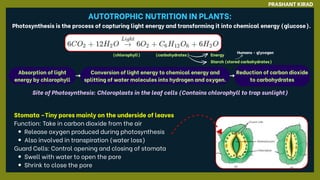
(carbohydrates)
Absorption of light
energyby chlorophyll
Conversion of light energy to chemical energy and
splitting of water molecules into hydrogen and oxygen.
Reduction of carbon dioxide
to carbohydrates
Energy
Starch (stored carbohydrates)
Humans - glycogen
PRASHANT KIRAD
Photosynthesis is the process of capturing light energy and transforming it into chemical energy (glucose).
(chlorophyll)
AUTOTROPHIC NUTRITION IN PLANTS:
Site of Photosynthesis: Chloroplasts in the leaf cells (Contains chlorophyll to trap sunlight)
Stomata –Tiny pores mainly on the underside of leaves
Function: Take in carbon dioxide from the air
Release oxygen produced during photosynthesis
Also involved in transpiration (water loss)
Guard Cells: Control opening and closing of stomata
Swell with water to open the pore
Shrink to close the pore
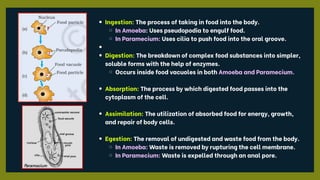
Ingestion: The processof taking in food into the body.
In Amoeba: Uses pseudopodia to engulf food.
In Paramecium: Uses cilia to push food into the oral groove.
Digestion: The breakdown of complex food substances into simpler,
soluble forms with the help of enzymes.
Occurs inside food vacuoles in both Amoeba and Paramecium.
Absorption: The process by which digested food passes into the
cytoplasm of the cell.
Assimilation: The utilization of absorbed food for energy, growth,
and repair of body cells.
Egestion: The removal of undigested and waste food from the body.
In Amoeba: Waste is removed by rupturing the cell membrane.
In Paramecium: Waste is expelled through an anal pore.
41.
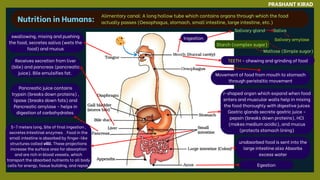
Ingestion
TEETH - chewingand grinding of food
swallowing, mixing and pushing
the food, secretes saliva (wets the
food) and mucus
J-shaped organ which expand when food
enters and muscular walls help in mixing
the food thoroughly with digestive juices
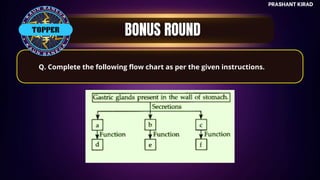
Gastric glands secrete gastric juice -
pepsin (breaks down proteins), HCl
(makes medium acidic), and mucus
(protects stomach lining)
Receives secretion from liver
(bile) and pancreas (pancreatic
juice). Bile emulsifies fat.
unabsorbed food is sent into the
large intestine also Absorbs
excess water
Egestion
Movement of food from mouth to stomach
through peristaltic movement
Salivary gland Saliva
Salivary amylase
Starch (complex sugar)
Maltose (Simple sugar)
Pancreatic juice contains
trypsin (breaks down proteins) ,
lipase (breaks down fats) and
Pancreatic amylase - helps in
digestion of carbohydrates.
5-7 meters long, Site of final ingestion ,
secretes Intestinal enzymes. . Food in the
small intestine is absorbed by finger-like
structures called villi. These projections
increase the surface area for absorption
and are rich in blood vessels, which
transport the absorbed nutrients to all body
cells for energy, tissue building, and repair.
PRASHANT KIRAD
Nutrition in Humans:
Alimentary canal: A long hollow tube which contains organs through which the food
actually passes (Oesophagus, stomach, small intestine, large intestine, etc.)
42.
PRASHANT KIRAD
Villi inHuman Nutrition:
Villi are small, finger-like projections in the inner wall of the small intestine.
They increase the surface area for absorption of digested food.
Each villus has blood vessels that absorb nutrients like glucose, amino acids, and fatty acids
directly into the bloodstream.
This makes absorption faster and more efficient.
43.
TOP QUESTIONS
PRASHANT KIRAD
TOPPER
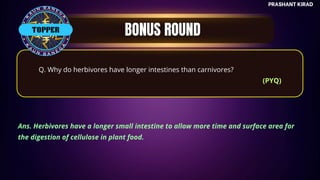
Q.Why do herbivores have longer intestines than carnivores?
(PYQ)
Ans. Herbivores have a longer small intestine to allow more time and surface area for
the digestion of cellulose in plant food.
44.
PRASHANT KIRAD
TOP QUESTIONS
PRASHANTKIRAD
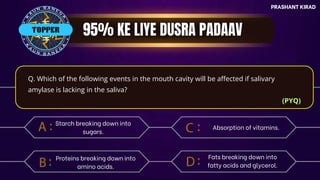
Q. Which of the following events in the mouth cavity will be affected if salivary
amylase is lacking in the saliva?
(PYQ)
Starch breaking down into
sugars.
TOPPER
Proteins breaking down into
amino acids.
Absorption of vitamins.
Fats breaking down into
fatty acids and glycerol.
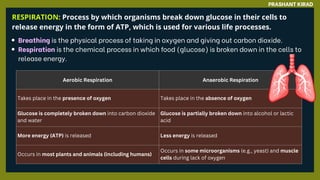
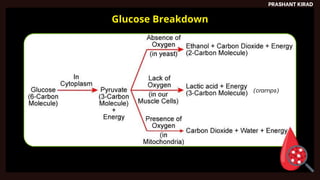
Aerobic Respiration AnaerobicRespiration
Takes place in the presence of oxygen Takes place in the absence of oxygen
Glucose is completely broken down into carbon dioxide
and water
Glucose is partially broken down into alcohol or lactic
acid
More energy (ATP) is released Less energy is released
Occurs in most plants and animals (including humans)
Occurs in some microorganisms (e.g., yeast) and muscle
cells during lack of oxygen
PRASHANT KIRAD
RESPIRATION: Process by which organisms break down glucose in their cells to
release energy in the form of ATP, which is used for various life processes.
Breathing is the physical process of taking in oxygen and giving out carbon dioxide.
Respiration is the chemical process in which food (glucose) is broken down in the cells to
release energy.
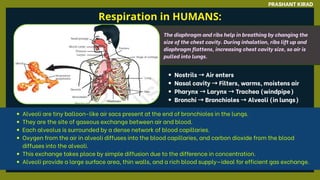
Respiration in HUMANS:
PRASHANTKIRAD
Nostrils →Air enters
Nasal cavity →Filters, warms, moistens air
Pharynx →Larynx →Trachea (windpipe)
Bronchi →Bronchioles →Alveoli (in lungs)
The diaphragm and ribs help in breathing by changing the
size of the chest cavity. During inhalation, ribs lift up and
diaphragm flattens, increasing chest cavity size, so air is
pulled into lungs.
Alveoli are tiny balloon-like air sacs present at the end of bronchioles in the lungs.
They are the site of gaseous exchange between air and blood.
Each alveolus is surrounded by a dense network of blood capillaries.
Oxygen from the air in alveoli diffuses into the blood capillaries, and carbon dioxide from the blood
diffuses into the alveoli.
This exchange takes place by simple diffusion due to the difference in concentration.
Alveoli provide a large surface area, thin walls, and a rich blood supply—ideal for efficient gas exchange.
49.
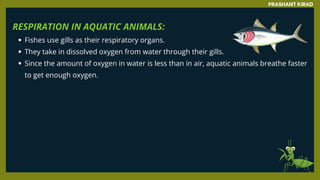
RESPIRATION IN AQUATICANIMALS:
Fishes use gills as their respiratory organs.
They take in dissolved oxygen from water through their gills.
Since the amount of oxygen in water is less than in air, aquatic animals breathe faster
to get enough oxygen.
PRASHANT KIRAD
50.
PRASHANT KIRAD
TOP QUESTIONS
PRASHANTKIRAD
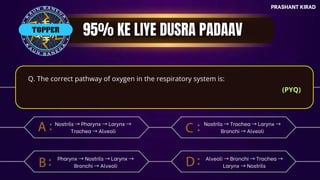
Q. The correct pathway of oxygen in the respiratory system is:
(PYQ)
Nostrils →Pharynx →Larynx →
Trachea →Alveoli
TOPPER
Pharynx →Nostrils →Larynx →
Bronchi →Alveoli
Nostrils →Trachea →Larynx →
Bronchi →Alveoli
Alveoli →Bronchi →Trachea →
Larynx →Nostrils
51.
TOP QUESTIONS
PRASHANT KIRAD
TOPPER
Q.Give reasons for the following:
There is a difference in the rate of breathing between aquatic organisms and
terrestrial organisms
Aquatic organisms like fish breathe dissolved oxygen from water, which contains less
oxygen compared to air. To get enough oxygen, they need to breathe faster.
Terrestrial organisms get oxygen directly from air, which is rich in oxygen, so their
breathing rate is slower.
52.
TOP QUESTIONS
PRASHANT KIRAD
TOPPER
Q.Explain the role of lungs in the exchange of gases. How are alveoli adapted for this
function?
Ans. The lungs help in the exchange of gases during breathing. Oxygen from the inhaled air
enters the alveoli and diffuses into the blood, while carbon dioxide from the blood diffuses
into the alveoli to be exhaled.
Adaptations of Alveoli:
Large surface area for maximum gas exchange
Thin walls for easy diffusion of gases
Rich supply of blood capillaries for quick transport
Moist lining helps dissolve gases for diffusion
53.
PRASHANT KIRAD
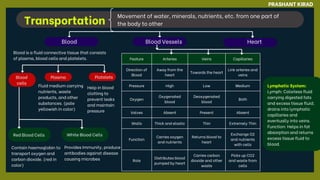
Feature ArteriesVeins Capillaries
Direction of
Blood
Away from the
heart
Towards the heart
Link arteries and
veins
Pressure High Low Medium
Oxygen
Oxygenated
blood
Deoxygenated
blood
Both
Valves Absent Present Absent
Walls Thick and elastic Thin Extremely Thin
Function
Carries oxygen
and nutrients
Returns blood to
heart
Exchange O2
and nutrients
with cells
Role
Distributes blood
pumped by heart
Carries carbon
dioxide and other
waste
Picks up CO2
and waste from
cells
Transportation
Movement of water, minerals, nutrients, etc. from one part of
the body to other
Blood Blood Vessels Heart
Blood is a fluid connective tissue that consists
of plasma, blood cells and platelets.
Plasma
Red Blood Cells
Fluid medium carrying
nutrients, waste
products, and other
substances. (pale
yellowish in color)
Blood
cells
White Blood Cells
Platelets
Help in blood
clotting to
prevent leaks
and maintain
pressure
Contain haemoglobin to
transport oxygen and
carbon dioxide. (red in
color)
Provides Immunity, produce
antibodies against disease
causing microbes
Lymphatic System:
Lymph: Colorless fluid
carrying digested fats
and excess tissue fluid;
drains into lymphatic
capillaries and
eventually into veins.
Function: Helps in fat
absorption and returns
excess tissue fluid to
blood.
54.
PRASHANT KIRAD
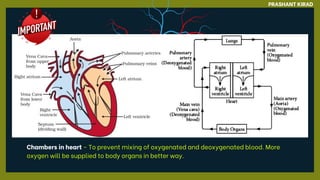
Chambers inheart - To prevent mixing of oxygenated and deoxygenated blood. More
oxygen will be supplied to body organs in better way.
55.
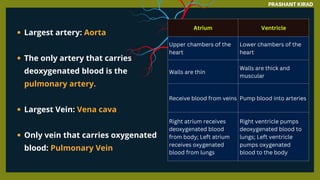
Largest artery: Aorta
Theonly artery that carries
deoxygenated blood is the
pulmonary artery.
Largest Vein: Vena cava
Only vein that carries oxygenated
blood: Pulmonary Vein
Atrium Ventricle
Upper chambers of the
heart
Lower chambers of the
heart
Walls are thin
Walls are thick and
muscular
Receive blood from veins Pump blood into arteries
Right atrium receives
deoxygenated blood
from body; Left atrium
receives oxygenated
blood from lungs
Right ventricle pumps
deoxygenated blood to
lungs; Left ventricle
pumps oxygenated
blood to the body
PRASHANT KIRAD
56.
PRASHANT KIRAD
In humans,blood passes through the heart twice during one
complete circulation of the body. This is called double
circulation.
Two Types of Circulation:
Pulmonary Circulation: Blood flows from the heart to the
lungs and back.
Purpose: To oxygenate the blood (remove CO₂ and take in O₂).
Systemic Circulation: Blood flows from the heart to the rest of
the body and returns.
Purpose: To supply oxygen and nutrients to body tissues and
collect CO₂.
Why is it Important?
Keeps oxygen-rich blood separate from oxygen-poor
blood.
Ensures efficient supply of oxygen to the body.
Maintains high pressure in systemic circulation for proper
distribution.
Double
Circulation
57.
Transport of Waterand Minerals – by Xylem
Xylem tissues transport water and minerals from roots
to leaves. Water enters roots by osmosis and moves
upward through xylem vessels.
Movement is due to:
Root pressure
Transpiration pull (main force)
Transportation in Plants:
PRASHANT KIRAD
Transport of Food – by Phloem
Phloem transports prepared food
(mainly sucrose) from leaves to other
parts of the plant (both upward and
downward). This process is called
translocation.
It requires energy (ATP).
Transpiration: The loss of water in the form of water vapour through stomata.
Helps in: Pulling water upwards (transpiration pull), Cooling the plant and
Maintaining flow of water and minerals
58.
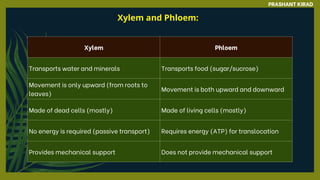
Xylem and Phloem:
PRASHANTKIRAD
Xylem Phloem
Transports water and minerals Transports food (sugar/sucrose)
Movement is only upward (from roots to
leaves)
Movement is both upward and downward
Made of dead cells (mostly) Made of living cells (mostly)
No energy is required (passive transport) Requires energy (ATP) for translocation
Provides mechanical support Does not provide mechanical support
59.
PRASHANT KIRAD
TOP QUESTIONS
PRASHANTKIRAD
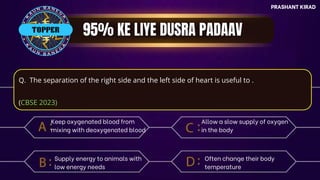
Q. The separation of the right side and the left side of heart is useful to .
(CBSE 2023)
Keep oxygenated blood from
mixing with deoxygenated blood
TOPPER
Supply energy to animals with
low energy needs
Allow a slow supply of oxygen
in the body
Often change their body
temperature
60.
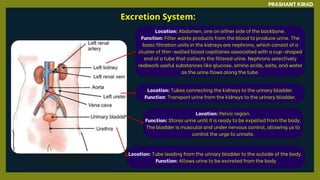
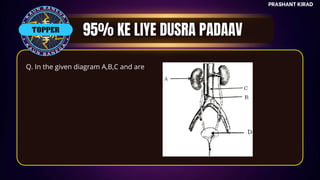
Location: Abdomen, oneon either side of the backbone.
Function: Filter waste products from the blood to produce urine. The
basic filtration units in the kidneys are nephrons, which consist of a
cluster of thin-walled blood capillaries associated with a cup-shaped
end of a tube that collects the filtered urine. Nephrons selectively
reabsorb useful substances like glucose, amino acids, salts, and water
as the urine flows along the tube.
Location: Tubes connecting the kidneys to the urinary bladder.
Function: Transport urine from the kidneys to the urinary bladder.
Location: Pelvic region.
Function: Stores urine until it is ready to be expelled from the body.
The bladder is muscular and under nervous control, allowing us to
control the urge to urinate.
Location: Tube leading from the urinary bladder to the outside of the body.
Function: Allows urine to be excreted from the body
Excretion System:
PRASHANT KIRAD
61.
PRASHANT KIRAD
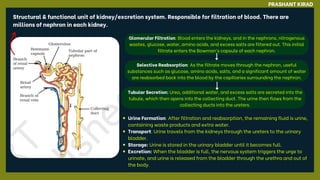
Glomerular Filtration:Blood enters the kidneys, and in the nephrons, nitrogenous
wastes, glucose, water, amino acids, and excess salts are filtered out. This initial
filtrate enters the Bowman’s capsule of each nephron.
Structural & functional unit of kidney/excretion system. Responsible for filtration of blood. There are
millions of nephron in each kidney.
Urine Formation: After filtration and reabsorption, the remaining fluid is urine,
containing waste products and extra water.
Transport: Urine travels from the kidneys through the ureters to the urinary
bladder.
Storage: Urine is stored in the urinary bladder until it becomes full.
Excretion: When the bladder is full, the nervous system triggers the urge to
urinate, and urine is released from the bladder through the urethra and out of
the body.
Selective Reabsorption: As the filtrate moves through the nephron, useful
substances such as glucose, amino acids, salts, and a significant amount of water
are reabsorbed back into the blood by the capillaries surrounding the nephron.
Tubular Secretion: Urea, additional water, and excess salts are secreted into the
tubule, which then opens into the collecting duct. The urine then flows from the
collecting ducts into the ureters.
62.
PRASHANT KIRAD
Hemodialysis
(Artificial Kidney)
Hemodialysisis an artificial process to remove urea,
extra salts, and water from the blood when kidneys
fail.
Blood is passed through a dialyzer (artificial kidney)
where wastes diffuse out into a dialysis fluid.
Clean blood is returned to the body, helping maintain
chemical balance.
63.
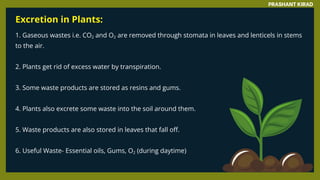
1. Gaseous wastesi.e. CO and O are removed through stomata in leaves and lenticels in stems
to the air.
2 2
2. Plants get rid of excess water by transpiration.
3. Some waste products are stored as resins and gums.
4. Plants also excrete some waste into the soil around them.
5. Waste products are also stored in leaves that fall off.
6. Useful Waste- Essential oils, Gums, O (during daytime)
2
PRASHANT KIRAD
Excretion in Plants:
PRASHANT KIRAD
TOP QUESTIONS
PRASHANTKIRAD
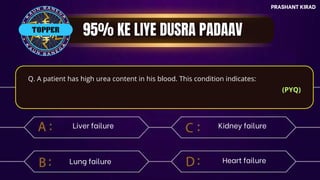
Q. A patient has high urea content in his blood. This condition indicates:
(PYQ)
Liver failure
TOPPER
Kidney failure
Heart failure
Lung failure
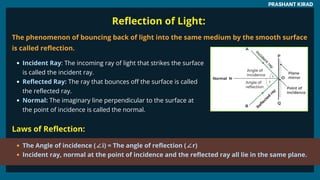
Reflection of Light:
Thephenomenon of bouncing back of light into the same medium by the smooth surface
is called reflection.
Incident Ray: The incoming ray of light that strikes the surface
is called the incident ray.
Reflected Ray: The ray that bounces off the surface is called
the reflected ray.
Normal: The imaginary line perpendicular to the surface at
the point of incidence is called the normal.
PRASHANT KIRAD
Laws of Reflection:
The Angle of incidence (∠i) = The angle of reflection (∠r)
Incident ray, normal at the point of incidence and the reflected ray all lie in the same plane.
70.
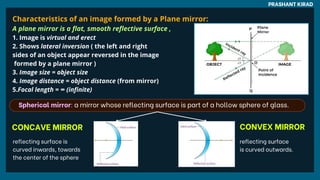
Characteristics of animage formed by a Plane mirror:
A plane mirror is a flat, smooth reflective surface ,
1. Image is virtual and erect
2. Shows lateral inversion ( the left and right
sides of an object appear reversed in the image
formed by a plane mirror )
3. Image size = object size
4. Image distance = object distance (from mirror)
5.Focal length = ∞ (infinite)
PRASHANT KIRAD
Spherical mirror: a mirror whose reflecting surface is part of a hollow sphere of glass.
reflecting surface is
curved inwards, towards
the center of the sphere
reflecting surface
is curved outwards.
CONCAVE MIRROR CONVEX MIRROR
71.
PRASHANT KIRAD
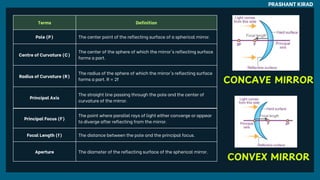
Principal Focus(F)
The point where parallel rays of light either converge or appear
to diverge after reflecting from the mirror.
Focal Length (f) The distance between the pole and the principal focus.
Aperture The diameter of the reflecting surface of the spherical mirror.
CONVEX MIRROR
Terms Definition
Pole (P) The center point of the reflecting surface of a spherical mirror.
Centre of Curvature (C)
The center of the sphere of which the mirror's reflecting surface
forms a part.
Radius of Curvature (R)
The radius of the sphere of which the mirror's reflecting surface
forms a part. R = 2f
Principal Axis
The straight line passing through the pole and the center of
curvature of the mirror.
CONCAVE MIRROR
72.
PRASHANT KIRAD
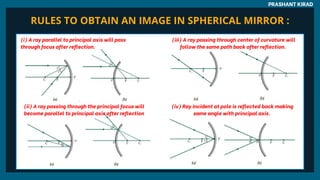
(i) Aray parallel to principal axis will pass
through focus after reflection.
(ii) A ray passing through the principal focus will
become parallel to principal axis after reflection
(iii) A ray passing through center of curvature will
follow the same path back after reflection.
(iv) Ray incident at pole is reflected back making
same angle with principal axis.
RULES TO OBTAIN AN IMAGE IN SPHERICAL MIRROR :
73.
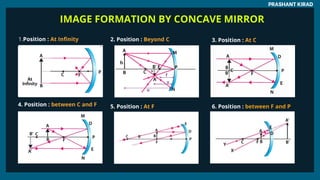
IMAGE FORMATION BYCONCAVE MIRROR
PRASHANT KIRAD
1.Position : At Infinity 2. Position : Beyond C 3. Position : At C
4. Position : between C and F 5. Position : At F 6. Position : between F and P
74.
PRASHANT KIRAD
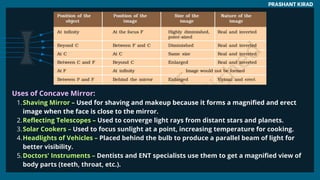
Uses ofConcave Mirror:
1.Shaving Mirror – Used for shaving and makeup because it forms a magnified and erect
image when the face is close to the mirror.
2.Reflecting Telescopes – Used to converge light rays from distant stars and planets.
3.Solar Cookers – Used to focus sunlight at a point, increasing temperature for cooking.
4.Headlights of Vehicles – Placed behind the bulb to produce a parallel beam of light for
better visibility.
5.Doctors' Instruments – Dentists and ENT specialists use them to get a magnified view of
body parts (teeth, throat, etc.).
75.
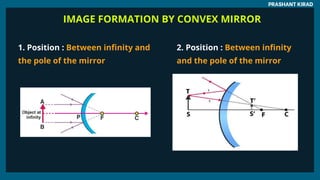
IMAGE FORMATION BYCONVEX MIRROR
PRASHANT KIRAD
1. Position : Between infinity and
the pole of the mirror
2. Position : Between infinity
and the pole of the mirror
76.
PRASHANT KIRAD
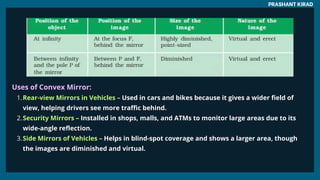
Uses ofConvex Mirror:
1.Rear-view Mirrors in Vehicles – Used in cars and bikes because it gives a wider field of
view, helping drivers see more traffic behind.
2.Security Mirrors – Installed in shops, malls, and ATMs to monitor large areas due to its
wide-angle reflection.
3.Side Mirrors of Vehicles – Helps in blind-spot coverage and shows a larger area, though
the images are diminished and virtual.
77.
PRASHANT KIRAD
TOP QUESTIONS
PRASHANTKIRAD
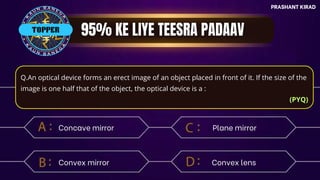
Q.An optical device forms an erect image of an object placed in front of it. If the size of the
image is one half that of the object, the optical device is a :
(PYQ)
Concave mirror
Convex mirror
Plane mirror
Convex lens
TOPPER
78.
PRASHANT KIRAD
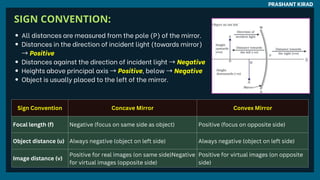
SIGN CONVENTION:
Alldistances are measured from the pole (P) of the mirror.
Distances in the direction of incident light (towards mirror)
→Positive
Distances against the direction of incident light →Negative
Heights above principal axis →Positive, below →Negative
Object is usually placed to the left of the mirror.
Sign Convention Concave Mirror Convex Mirror
Focal length (f) Negative (focus on same side as object) Positive (focus on opposite side)
Object distance (u) Always negative (object on left side) Always negative (object on left side)
Image distance (v)
Positive for real images (on same side)Negative
for virtual images (opposite side)
Positive for virtual images (on opposite
side)
79.
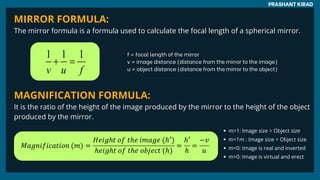
MIRROR FORMULA:
The mirrorformula is a formula used to calculate the focal length of a spherical mirror.
MAGNIFICATION FORMULA:
It is the ratio of the height of the image produced by the mirror to the height of the object
produced by the mirror.
PRASHANT KIRAD
f = focal length of the mirror
v = image distance (distance from the mirror to the image)
u = object distance (distance from the mirror to the object)
m>1: Image size > Object size
m<1m : Image size < Object size
m<0: Image is real and inverted
m>0: Image is virtual and erect
80.
TOP QUESTIONS
PRASHANT KIRAD
TOPPER
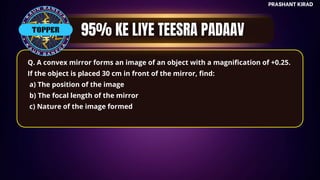
Q.A convex mirror forms an image of an object with a magnification of +0.25.
If the object is placed 30 cm in front of the mirror, find:
a) The position of the image
b) The focal length of the mirror
c) Nature of the image formed
81.
TOP QUESTIONS
PRASHANT KIRAD
TOPPER
Q.A real image of size 5 cm is formed on a screen by a concave mirror placed
30 cm away from the object. The size of the object is 2 cm. Find:
a) The image distance (v)
b) The focal length of the mirror
c) The magnification
d) Is the image erect or inverted?
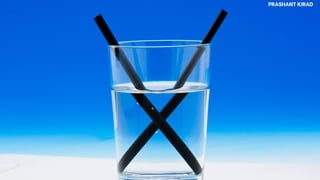
REFRACTION OF LIGHT:
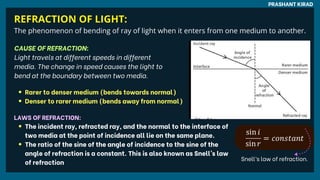
Thephenomenon of bending of ray of light when it enters from one medium to another.
PRASHANT KIRAD
CAUSE OF REFRACTION:
Light travels at different speeds in different
media. The change in speed causes the light to
bend at the boundary between two media.
Rarer to denser medium (bends towards normal)
Denser to rarer medium (bends away from normal)
LAWS OF REFRACTION:
The incident ray, refracted ray, and the normal to the interface of
two media at the point of incidence all lie on the same plane.
The ratio of the sine of the angle of incidence to the sine of the
angle of refraction is a constant. This is also known as Snell’s law
of refraction
Snell’s law of refraction.
84.
PRASHANT KIRAD
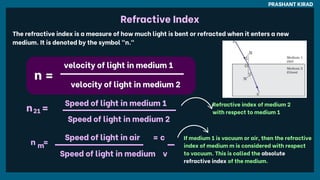
velocity oflight in medium 1
velocity of light in medium 1
The refractive index is a measure of how much light is bent or refracted when it enters a new
medium. It is denoted by the symbol "n."
velocity of light in medium 2
velocity of light in medium 2
n =
n =
Speed of light in medium 1
Speed of light in medium 1
Speed of light in medium 2
Speed of light in medium 2
n
n =
=
21
21
Refractive index of medium 2
with respect to medium 1
Speed of light in air
Speed of light in air = c
= c
Speed of light in medium
Speed of light in medium v
v
n
n =
=
m
m
If medium 1 is vacuum or air, then the refractive
index of medium m is considered with respect
to vacuum. This is called the absolute
refractive index of the medium.
Refractive Index
85.
TOP QUESTIONS
PRASHANT KIRAD
TOPPER
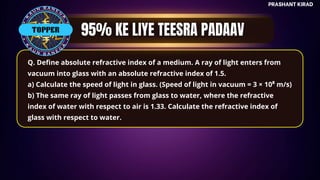
Q.Define absolute refractive index of a medium. A ray of light enters from
vacuum into glass with an absolute refractive index of 1.5.
a) Calculate the speed of light in glass. (Speed of light in vacuum = 3 × 10⁸ m/s)
b) The same ray of light passes from glass to water, where the refractive
index of water with respect to air is 1.33. Calculate the refractive index of
glass with respect to water.
86.
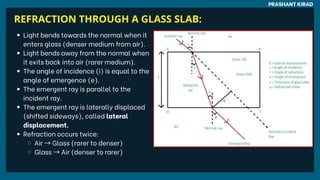
REFRACTION THROUGH AGLASS SLAB:
PRASHANT KIRAD
Light bends towards the normal when it
enters glass (denser medium from air).
Light bends away from the normal when
it exits back into air (rarer medium).
The angle of incidence (i) is equal to the
angle of emergence (e).
The emergent ray is parallel to the
incident ray.
The emergent ray is laterally displaced
(shifted sideways), called lateral
displacement.
Refraction occurs twice:
Air →Glass (rarer to denser)
Glass →Air (denser to rarer)
87.
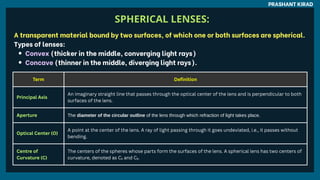
SPHERICAL LENSES:
PRASHANT KIRAD
Atransparent material bound by two surfaces, of which one or both surfaces are spherical.
Types of lenses:
Convex (thicker in the middle, converging light rays)
Concave (thinner in the middle, diverging light rays).
Term Definition
Principal Axis
An imaginary straight line that passes through the optical center of the lens and is perpendicular to both
surfaces of the lens.
Aperture The diameter of the circular outline of the lens through which refraction of light takes place.
Optical Center (O)
A point at the center of the lens. A ray of light passing through it goes undeviated, i.e., it passes without
bending.
Centre of
Curvature (C)
The centers of the spheres whose parts form the surfaces of the lens. A spherical lens has two centers of
curvature, denoted as C₁ and C₂.
88.
PRASHANT KIRAD
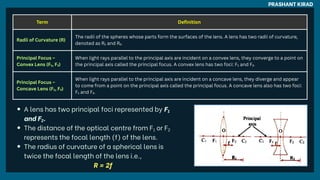
Term Definition
Radiiof Curvature (R)
The radii of the spheres whose parts form the surfaces of the lens. A lens has two radii of curvature,
denoted as R₁ and R₂.
Principal Focus –
Convex Lens (F₁, F₂)
When light rays parallel to the principal axis are incident on a convex lens, they converge to a point on
the principal axis called the principal focus. A convex lens has two foci: F₁ and F₂.
Principal Focus –
Concave Lens (F₁, F₂)
When light rays parallel to the principal axis are incident on a concave lens, they diverge and appear
to come from a point on the principal axis called the principal focus. A concave lens also has two foci:
F₁ and F₂.
A lens has two principal foci represented by F
and F .
1
2
The distance of the optical centre from F or F
represents the focal length (f) of the lens.
1 2
The radius of curvature of a spherical lens is
twice the focal length of the lens i.e.,
R = 2f
89.
PRASHANT KIRAD
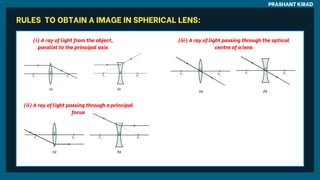
RULES TOOBTAIN A IMAGE IN SPHERICAL LENS:
(i) A ray of light from the object,
parallel to the principal axis
(ii) A ray of light passing through a principal
focus
(iii) A ray of light passing through the optical
centre of a lens
90.
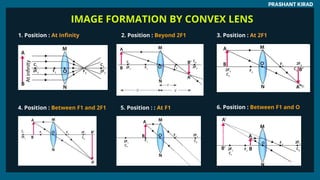
IMAGE FORMATION BYCONVEX LENS
PRASHANT KIRAD
1. Position : At Infinity 2. Position : Beyond 2F1 3. Position : At 2F1
4. Position : Between F1 and 2F1 5. Position : : At F1 6. Position : Between F1 and O
91.
PRASHANT KIRAD
Uses ofConvex Mirror:
1.Magnifying glass – Used to see small objects clearly (forms magnified image).
2.Eyeglasses – Used to correct hypermetropia (farsightedness).
3.Camera lenses – Helps focus light and form sharp images.
4.Microscope & Telescope – Used as objective lenses to magnify distant or tiny objects.
5.Projectors – To form enlarged real images on a screen.
92.
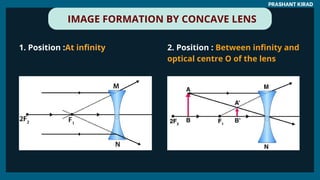
IMAGE FORMATION BYCONCAVE LENS
PRASHANT KIRAD
1. Position :At infinity 2. Position : Between infinity and
optical centre O of the lens
93.
PRASHANT KIRAD
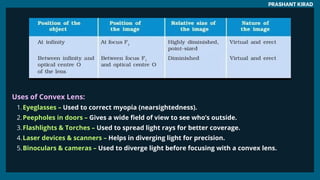
Uses ofConvex Lens:
1.Eyeglasses – Used to correct myopia (nearsightedness).
2.Peepholes in doors – Gives a wide field of view to see who’s outside.
3.Flashlights & Torches – Used to spread light rays for better coverage.
4.Laser devices & scanners – Helps in diverging light for precision.
5.Binoculars & cameras – Used to diverge light before focusing with a convex lens.
94.
PRASHANT KIRAD
TOP QUESTIONS
PRASHANTKIRAD
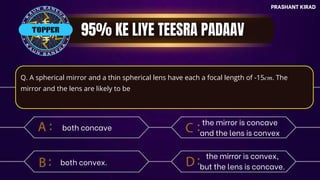
Q. A spherical mirror and a thin spherical lens have each a focal length of -15𝑐𝑚. The
mirror and the lens are likely to be
both concave
both convex.
the mirror is concave
and the lens is convex
the mirror is convex,
but the lens is concave.
TOPPER
95.
PRASHANT KIRAD
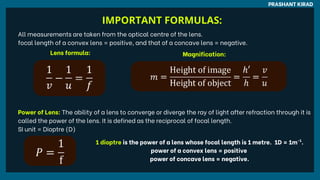
All measurementsare taken from the optical centre of the lens.
focal length of a convex lens = positive, and that of a concave lens = negative.
Lens formula: Magnification:
Power of Lens: The ability of a lens to converge or diverge the ray of light after refraction through it is
called the power of the lens. It is defined as the reciprocal of focal length.
SI unit = Dioptre (D)
1 dioptre is the power of a lens whose focal length is 1 metre. 1D = 1m .
-1
power of a convex lens = positive
power of concave lens = negative.
IMPORTANT FORMULAS:
96.
PRASHANT KIRAD
TOP QUESTIONS
PRASHANTKIRAD
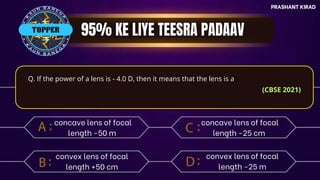
Q. If the power of a lens is - 4.0 D, then it means that the lens is a
(CBSE 2021)
concave lens of focal
length -50 m
convex lens of focal
length +50 cm
concave lens of focal
length -25 cm
convex lens of focal
length -25 m
TOPPER
97.
TOP QUESTIONS
PRASHANT KIRAD
TOPPER
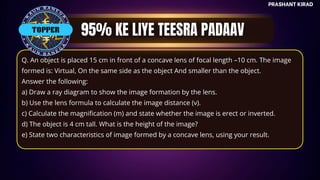
Q.An object is placed 15 cm in front of a concave lens of focal length –10 cm. The image
formed is: Virtual, On the same side as the object And smaller than the object.
Answer the following:
a) Draw a ray diagram to show the image formation by the lens.
b) Use the lens formula to calculate the image distance (v).
c) Calculate the magnification (m) and state whether the image is erect or inverted.
d) The object is 4 cm tall. What is the height of the image?
e) State two characteristics of image formed by a concave lens, using your result.
98.
TOP QUESTIONS
PRASHANT KIRAD
TOPPER
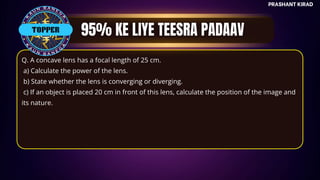
Q.A concave lens has a focal length of 25 cm.
a) Calculate the power of the lens.
b) State whether the lens is converging or diverging.
c) If an object is placed 20 cm in front of this lens, calculate the position of the image and
its nature.





![PRASHANT KIRAD
(i) Reaction of Quick Lime with Water
CaO reacts vigorously with water – forms slaked lime
[Ca(OH)₂].
Exothermic reaction – releases heat
Type of reaction: Combination reaction
CaO (s) + H₂O (l) →Ca(OH)₂ (aq) + Heat
Whitewashing and Formation of Calcium Carbonate
Slaked lime is used for whitewashing walls.
It reacts slowly with CO₂ in air:
Ca(OH)₂ (aq) + CO₂ (g) →CaCO₃ (s) + H₂O (l)
CaCO₃ (Calcium carbonate) forms a shiny layer on walls.
Marble also has the formula CaCO₃.
Carbon dioxide Test: The most effective way to test for CO₂ is to bubble the gas
through lime water, which is a diluted solution of calcium hydroxide.](https://image.slidesharecdn.com/17633042173032153965-251210152053-aa01b04c/85/Prashant-bhaiya-backlog-mairathan-science-notes-for-class-10th-18-320.jpg)


![TOP QUESTIONS
PRASHANT KIRAD
Q. Write the balanced chemical equation for the following and identify the type of
reaction:
(i) Calcium carbonate →Calcium oxide + Carbon dioxide
(ii) Barium chloride + Sodium sulphate →Barium sulphate + Sodium chloride
[CBSE 2019, 2022]
TOPPER](https://image.slidesharecdn.com/17633042173032153965-251210152053-aa01b04c/85/Prashant-bhaiya-backlog-mairathan-science-notes-for-class-10th-30-320.jpg)

![LIFE PROCESSES: The various basic functions performed by living organisms to maintain their
life on this earth.
PRASHANT KIRAD
Autotrophic Nutrition Heterotrophic Nutrition
Nutrition: process of taking in food and converting it into energy and other vital nutrients required for life.
Organisms that prepare their own food.
e.g., Green plants, blue-green algae, etc.
Organisms that are dependent on other organisms
for food. E.g., Animals, fungi,etc.
Holozoic nutrition: involves organisms ingesting
whole food material, which is then digested and
absorbed inside their bodies.
Examples include: Animals - [Herbivores: Cow,
goat], [Carnivores: Lion, tiger], [Omnivores:
Human beings], Unicellular organisms: Amoeba,
Paramecium
Saprophytic nutrition:
Organisms feed on dead and
decaying matter. Food is
digested externally and then
nutrients are absorbed. e.g.
Bread mold, Mushroom, Yeast.
Parasitic nutrition:
Organisms derive nutrition
from plants or animals
without killing them. They
obtain nutrition by living on or
inside the host. e.g.
Tapeworm, Lice .](https://image.slidesharecdn.com/17633042173032153965-251210152053-aa01b04c/85/Prashant-bhaiya-backlog-mairathan-science-notes-for-class-10th-37-320.jpg)