Putting 5S to Work.
5S Housekeeping
Presentation 1995
Putting 5S to Work.
• 5S is a set of techniques that provides a standard approach to
housekeeping
• Commonsense and good practice for all businesses
• Proven to positively effect productivity, quality & safety
• It equally applies to office and shop floor environments
• Everyone has experience of working better and feeling better in
a tidy room
• It’s a mindset thing - changing attitudes from “I work in a dirty
factory” to “I work in a manufacturing laboratory”
Putting 5S to Work.
Seri Sort - Clearing Up
Seiton Simplify - Organising
Seiso Sweep - Cleaning
Seiketsu Standardising
Shitsuke Self-discipline & Training
Putting 5S to Work.
5s
Goal:
- Do We Have Organised Tidy Office Space ?
- Examples? - Problems?
Putting 5S to Work.
Preparation:
Recording the Present Situation
Take Photos From The Same Position
Before After
Putting 5S to Work.
Pillar 1: Eliminating unnecessary items (Sort)
1.1 Use cross-functional teams
- Managers / Team Leaders from other Departments
1.2 Can you think of any unnecessary items?
Tools, Gauges, Machinery, WIP etc
1.3 Classify items by frequency of use
- Daily, is the quantity correct, is there a standard
- Weekly, can it be stored and brought out weekly
- Monthly, should it be located elsewhere
- Never or in doubt, dispose or red tag
1.4 The red tag tactic: visual clearing Up
Putting 5S to Work.
Red tag anything that’s not needed or in doubt
This means checking stock, machines,
equipment, particular locations such as
shelves, etc
Red Tags are meant to stand out
Attaching Red Tags requires a second point
Of view
The next step is to clarify WHY Red Tags
have been attached and take appropriate
action
Place in Red Tag holding area
Red Tagging
5s Housekeeping – Red Tag
Classification
1. Raw Material
2. Work In Progress
3. Component Part
4. Finished Part
5. Machine / Equipment
6. Tool / Fitting
7. Jig / Fixture
8. Other
Name of Item
Order Number
Reason
1. Unnecessary
2. Defective
3. Non-Urgent
4. Leftover Material
5. Unknown
6. Other
Section
Responsible ____________________ Dept. ________________ Work Centre
Action
Required
1. Dispose of
2. Return to Supplier
3. Move to Red Tag Storage
4. Store Separately
5. Other
Completed
Yes / No
Date Tag Attached Action Taken
Putting 5S to Work.
Pillar 2: Fixing storage places (Simplify)
2.1 A place for everything, everything in its place
2.2 Shadowboards, inventory footprints,tool and die trolley's,
2.3 Adding colour to the workplace
2.4 Begin with dividing lines
2.5 Implementing a signboard and labelling strategy
2.6 The 3 keys To organising (where, what, how many?)
2.7 Jigs and Tools: changing from a closed to an open storage system
2.8 Jigs and Tools: functional organisation
A good example is:
The Dental Surgery
Putting 5S to Work.
3 Keys - fixing position
Where?
Fix position (indication Of place)
What?
Fix items (identification)
How many?
Fix quantity (indication Of amount)
A
1
2
3
4
1234
Block Label
Street Numbers
HouseNumbers
Labelling Of Fixed Positions
Address Of Bin:
A42 = Block A,
Street 4, House 2
Putting 5S to Work.
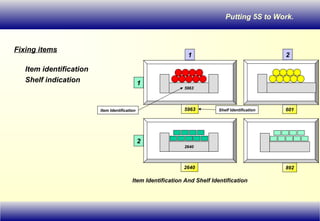
Fixing items
Item identification
Shelf indication
1
1
2
5963
2640
Shelf IdentificationItem Identification
Item Identification And Shelf Identification
5963
2640
892
2
601
Putting 5S to Work.
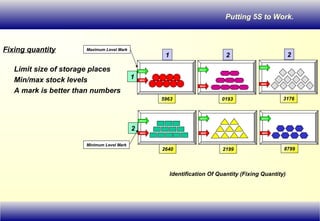
Fixing quantity
Limit size of storage places
Min/max stock levels
A mark is better than numbers
1
1
2
5963
2640
Maximum Level Mark
Identification Of Quantity (Fixing Quantity)
2
0193
2199
2
3176
8799
MAX
MIN
MAX
MIN
MAX
MIN
MAX
MIN
MAX
MIN
MAX
MIN
Minimum Level Mark
Putting 5S to Work.
Pillar 3: Consolidating daily cleaning procedures (Sweep)
3.1 Order / rota of cleaning
3.2 Cleaning targets
3.3 Cleaning responsibilities
3.4 Fixing cleaning methods / routines
3.5 Preparation of cleaning tools
3.6 Implementation of revised cleaning routines
3.7 Encourage “visual cleaning” operators routinely
on the lookout for anything out of place
Putting 5S to Work.
Pillar 4: Maintaining a spotless workplace (Standardising)
4.1 Standardisation of the first three elements
4.2 A tidy workplace at all times!
4.3 Check unnecessary items first
4.4 Checking storage
4.5 Checking for dust and dirt
4.6 Establish routine audits (internal & external auditors)
Everybody's responsible
Encourage awareness & participation
Putting 5S to Work.
Evaluating The effectiveness of The 5S with Audit Check Lists
Marks: graded 0-4
0 = very bad
1 = bad
2 = average
3 = good
4 = very good
0 1 2 3 4
1 Lockers
2 Gamgways
No excess pieces of equipment or
materials
3 Visual Control
Irrelevant items or documents can be
identified at a glance
4 Standards For Disposal
Standards are fixed for disposal of
documents and equipment
5 Exhibits
Displays are up to date, tidy and well
balanced
6 Storage Labels
Labelling of lockers and equipment allows
immediate identification
7 Everthing is locally identified
8 Ease Of Use Storage is designed for ease of use
9 Orderly Storage Everthing is stored in an indexed place
10 Aisles And Display Areas
All dividing lines and bulletin boards are
clearly indicated
11 Floor The Floor is clean
12 Dust And Dirt
Windows, windowsills and shelves are
clean
13 Cleaning Responsibilities
There is a rotation or shift system for
cleaning
14 Waste Baskets
There is a system for getting rid of dirt and
waste paper
15 Habitual Cleaning
Sweeping and dusting are regarded as
habitual activities
Marks
ClearingUp-Sort
Organising-
Simplify
Cleaning-Sweep
5S's No. Checking Item Evaluation Criteria
Putting 5S to Work.
0 1 2 3 4
1 Lockers / Pigeonholes Tidy / uncluttered
2 Gangways / Aisles
No excess pieces of equipment or
materials
3 Visual Control
Irrelevant items or documents can be
identified at a glance
4 Standards For Disposal
Standards are fixed for disposal of
documents and equipment
5 Exhibits
Displays are up to date, tidy and well
balanced
6 Storage Labels
Labelling of lockers and equipment allows
immediate identification
7 Documents & Equipment Everthing is locally identified
8 Ease Of Use Storage is designed for ease of use
9 Orderly Storage Everthing is stored in an indexed place
10 Aisles And Display Areas
All dividing lines and bulletin boards are
clearly indicated
11 Floor The Floor is clean
12 Dust And Dirt
Windows, windowsills and shelves are
clean
13 Cleaning Responsibilities
There is a rotation or shift system for
cleaning
14 Waste Baskets
There is a system for getting rid of dirt and
waste paper
15 Habitual Cleaning
Sweeping and dusting are regarded as
habitual activities
Marks
No. Checking Item Evaluation Criteria
Putting 5S to Work.
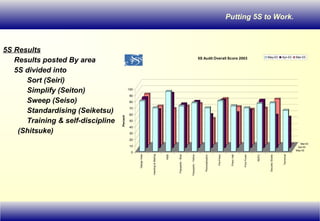
5S Results
Results posted By area
5S divided into
Sort (Seiri)
Simplify (Seiton)
Sweep (Seiso)
Standardising (Seiketsu)
Training & self-discipline
(Shitsuke)
0
10
20
30
40
50
60
70
80
90
100
Percent
DesignArea
Inserting&Mailing
NSB
Passports-Blue
Passports-Yellow
Personalisation
Pre-Press
PressHall
PrintFinish
RDPC
SecuresStores
Technical
May-03
Apr-03
Mar-03
5S Audit Overall Score 2003 May-03 Apr-03 Mar-03
Putting 5S to Work.
Pillar 5: Ongoing Commitment (Self-discipline & Training)
 It is the set of approaches used to win hearts and minds
 To make people want to keep applying best practice in shop organisation
and housekeeping.
 How this is done depends on the organisation, but the Key Points are
 Communication
 Education
 Rewards & Recognition
 Time
Ongoing Improvement:
Not just clearing up the oil, but
questioning why its there in
the first place
Putting 5S to Work.
Step I:
Firstly put things in order (Active 5S)
Step II:
Making a habit Of 5S (Effective 5S)
Step III:
Taking 5S to a higher level (Preventive 5S)
Putting 5S to Work.
Step I: Firstly clear up (Active 5S)
Preparation: Recording the present situation
Process 1: Eliminating unnecessary items (clearing up)
Process 2: Fixing storage places (organising)
Process 3: Consolidating daily cleaning procedures (cleaning)
Process 4: Maintaining a spotless workplace (standardising)
Process 5: Visual control in the workplace (training & discipline)
Can you visualise the improvements?
Putting 5S to Work.
Step II: Making a habit of 5S (Effective 5S)
Preparation: Photograph the new look workplace
Process 1: Controlling of stock levels (clearing up)
Process 2: Make it easy to use and return things (organising)
Process 3: Making cleaning and checking habitual (cleaning)
Process 4: Maintaining a spotless workplace (standardising)
Process 5: Maintaining standards throughout the company
(training & discipline)
Has 5S become a habit?
Putting 5S to Work.
Step III: Taking 5S to a higher level (Preventive 5S)
Preparation: Evaluating the factory, where 5S has become habitual
Process 1: Avoiding unnecessary items (preventive clearing up)
Process 2: Avoiding disorganisation (preventive organising)
Process 3: Cleaning without getting dirty again (cleaning)
Process 4: Preventing degradation of the environment
Process 5: Systematising training (preventive training & discipline)

5s's housekeeping 1995

  • 1.
    Putting 5S toWork. 5S Housekeeping Presentation 1995
  • 2.
    Putting 5S toWork. • 5S is a set of techniques that provides a standard approach to housekeeping • Commonsense and good practice for all businesses • Proven to positively effect productivity, quality & safety • It equally applies to office and shop floor environments • Everyone has experience of working better and feeling better in a tidy room • It’s a mindset thing - changing attitudes from “I work in a dirty factory” to “I work in a manufacturing laboratory”
  • 3.
    Putting 5S toWork. Seri Sort - Clearing Up Seiton Simplify - Organising Seiso Sweep - Cleaning Seiketsu Standardising Shitsuke Self-discipline & Training
  • 4.
    Putting 5S toWork. 5s Goal: - Do We Have Organised Tidy Office Space ? - Examples? - Problems?
  • 5.
    Putting 5S toWork. Preparation: Recording the Present Situation Take Photos From The Same Position Before After
  • 6.
    Putting 5S toWork. Pillar 1: Eliminating unnecessary items (Sort) 1.1 Use cross-functional teams - Managers / Team Leaders from other Departments 1.2 Can you think of any unnecessary items? Tools, Gauges, Machinery, WIP etc 1.3 Classify items by frequency of use - Daily, is the quantity correct, is there a standard - Weekly, can it be stored and brought out weekly - Monthly, should it be located elsewhere - Never or in doubt, dispose or red tag 1.4 The red tag tactic: visual clearing Up
  • 7.
    Putting 5S toWork. Red tag anything that’s not needed or in doubt This means checking stock, machines, equipment, particular locations such as shelves, etc Red Tags are meant to stand out Attaching Red Tags requires a second point Of view The next step is to clarify WHY Red Tags have been attached and take appropriate action Place in Red Tag holding area Red Tagging 5s Housekeeping – Red Tag Classification 1. Raw Material 2. Work In Progress 3. Component Part 4. Finished Part 5. Machine / Equipment 6. Tool / Fitting 7. Jig / Fixture 8. Other Name of Item Order Number Reason 1. Unnecessary 2. Defective 3. Non-Urgent 4. Leftover Material 5. Unknown 6. Other Section Responsible ____________________ Dept. ________________ Work Centre Action Required 1. Dispose of 2. Return to Supplier 3. Move to Red Tag Storage 4. Store Separately 5. Other Completed Yes / No Date Tag Attached Action Taken
  • 8.
    Putting 5S toWork. Pillar 2: Fixing storage places (Simplify) 2.1 A place for everything, everything in its place 2.2 Shadowboards, inventory footprints,tool and die trolley's, 2.3 Adding colour to the workplace 2.4 Begin with dividing lines 2.5 Implementing a signboard and labelling strategy 2.6 The 3 keys To organising (where, what, how many?) 2.7 Jigs and Tools: changing from a closed to an open storage system 2.8 Jigs and Tools: functional organisation A good example is: The Dental Surgery
  • 9.
    Putting 5S toWork. 3 Keys - fixing position Where? Fix position (indication Of place) What? Fix items (identification) How many? Fix quantity (indication Of amount) A 1 2 3 4 1234 Block Label Street Numbers HouseNumbers Labelling Of Fixed Positions Address Of Bin: A42 = Block A, Street 4, House 2
  • 10.
    Putting 5S toWork. Fixing items Item identification Shelf indication 1 1 2 5963 2640 Shelf IdentificationItem Identification Item Identification And Shelf Identification 5963 2640 892 2 601
  • 11.
    Putting 5S toWork. Fixing quantity Limit size of storage places Min/max stock levels A mark is better than numbers 1 1 2 5963 2640 Maximum Level Mark Identification Of Quantity (Fixing Quantity) 2 0193 2199 2 3176 8799 MAX MIN MAX MIN MAX MIN MAX MIN MAX MIN MAX MIN Minimum Level Mark
  • 12.
    Putting 5S toWork. Pillar 3: Consolidating daily cleaning procedures (Sweep) 3.1 Order / rota of cleaning 3.2 Cleaning targets 3.3 Cleaning responsibilities 3.4 Fixing cleaning methods / routines 3.5 Preparation of cleaning tools 3.6 Implementation of revised cleaning routines 3.7 Encourage “visual cleaning” operators routinely on the lookout for anything out of place
  • 13.
    Putting 5S toWork. Pillar 4: Maintaining a spotless workplace (Standardising) 4.1 Standardisation of the first three elements 4.2 A tidy workplace at all times! 4.3 Check unnecessary items first 4.4 Checking storage 4.5 Checking for dust and dirt 4.6 Establish routine audits (internal & external auditors) Everybody's responsible Encourage awareness & participation
  • 14.
    Putting 5S toWork. Evaluating The effectiveness of The 5S with Audit Check Lists Marks: graded 0-4 0 = very bad 1 = bad 2 = average 3 = good 4 = very good 0 1 2 3 4 1 Lockers 2 Gamgways No excess pieces of equipment or materials 3 Visual Control Irrelevant items or documents can be identified at a glance 4 Standards For Disposal Standards are fixed for disposal of documents and equipment 5 Exhibits Displays are up to date, tidy and well balanced 6 Storage Labels Labelling of lockers and equipment allows immediate identification 7 Everthing is locally identified 8 Ease Of Use Storage is designed for ease of use 9 Orderly Storage Everthing is stored in an indexed place 10 Aisles And Display Areas All dividing lines and bulletin boards are clearly indicated 11 Floor The Floor is clean 12 Dust And Dirt Windows, windowsills and shelves are clean 13 Cleaning Responsibilities There is a rotation or shift system for cleaning 14 Waste Baskets There is a system for getting rid of dirt and waste paper 15 Habitual Cleaning Sweeping and dusting are regarded as habitual activities Marks ClearingUp-Sort Organising- Simplify Cleaning-Sweep 5S's No. Checking Item Evaluation Criteria
  • 15.
    Putting 5S toWork. 0 1 2 3 4 1 Lockers / Pigeonholes Tidy / uncluttered 2 Gangways / Aisles No excess pieces of equipment or materials 3 Visual Control Irrelevant items or documents can be identified at a glance 4 Standards For Disposal Standards are fixed for disposal of documents and equipment 5 Exhibits Displays are up to date, tidy and well balanced 6 Storage Labels Labelling of lockers and equipment allows immediate identification 7 Documents & Equipment Everthing is locally identified 8 Ease Of Use Storage is designed for ease of use 9 Orderly Storage Everthing is stored in an indexed place 10 Aisles And Display Areas All dividing lines and bulletin boards are clearly indicated 11 Floor The Floor is clean 12 Dust And Dirt Windows, windowsills and shelves are clean 13 Cleaning Responsibilities There is a rotation or shift system for cleaning 14 Waste Baskets There is a system for getting rid of dirt and waste paper 15 Habitual Cleaning Sweeping and dusting are regarded as habitual activities Marks No. Checking Item Evaluation Criteria
  • 16.
    Putting 5S toWork. 5S Results Results posted By area 5S divided into Sort (Seiri) Simplify (Seiton) Sweep (Seiso) Standardising (Seiketsu) Training & self-discipline (Shitsuke) 0 10 20 30 40 50 60 70 80 90 100 Percent DesignArea Inserting&Mailing NSB Passports-Blue Passports-Yellow Personalisation Pre-Press PressHall PrintFinish RDPC SecuresStores Technical May-03 Apr-03 Mar-03 5S Audit Overall Score 2003 May-03 Apr-03 Mar-03
  • 17.
    Putting 5S toWork. Pillar 5: Ongoing Commitment (Self-discipline & Training)  It is the set of approaches used to win hearts and minds  To make people want to keep applying best practice in shop organisation and housekeeping.  How this is done depends on the organisation, but the Key Points are  Communication  Education  Rewards & Recognition  Time Ongoing Improvement: Not just clearing up the oil, but questioning why its there in the first place
  • 18.
    Putting 5S toWork. Step I: Firstly put things in order (Active 5S) Step II: Making a habit Of 5S (Effective 5S) Step III: Taking 5S to a higher level (Preventive 5S)
  • 19.
    Putting 5S toWork. Step I: Firstly clear up (Active 5S) Preparation: Recording the present situation Process 1: Eliminating unnecessary items (clearing up) Process 2: Fixing storage places (organising) Process 3: Consolidating daily cleaning procedures (cleaning) Process 4: Maintaining a spotless workplace (standardising) Process 5: Visual control in the workplace (training & discipline) Can you visualise the improvements?
  • 20.
    Putting 5S toWork. Step II: Making a habit of 5S (Effective 5S) Preparation: Photograph the new look workplace Process 1: Controlling of stock levels (clearing up) Process 2: Make it easy to use and return things (organising) Process 3: Making cleaning and checking habitual (cleaning) Process 4: Maintaining a spotless workplace (standardising) Process 5: Maintaining standards throughout the company (training & discipline) Has 5S become a habit?
  • 21.
    Putting 5S toWork. Step III: Taking 5S to a higher level (Preventive 5S) Preparation: Evaluating the factory, where 5S has become habitual Process 1: Avoiding unnecessary items (preventive clearing up) Process 2: Avoiding disorganisation (preventive organising) Process 3: Cleaning without getting dirty again (cleaning) Process 4: Preventing degradation of the environment Process 5: Systematising training (preventive training & discipline)

Editor's Notes

  • #2 Company has an embarked on a Lean Thinking Programme A Philosophy not a technique or System Its about simplicity, improved flow, visibility, value, reducing variation - reducing waste - Increasing throughput - Produce at Customers rate of demand 5S Housekeeping is a Cornerstone, a building block of Lean Thinking Implementation Along with flow management setting standards & set-up reduction Have here 20 slides that will introduce 5S, over the coming weeks the team will be working with you to Implement 5s in each department
  • #3 Read Slide Untidy, cluttered work areas are not productive People inclined to care more, work harder in an area they are proud to work in
  • #4 5S was developed by the Japanese within Toyota All 5S words are therefore Japanese They have been anglicised in into English though The items within 5S are known as pillars Read one-by-one Go into the detail of each pillar later in the Slide Show
  • #5 Do we have a first class factory relating to Housekeeping Examples? Unnecessary items Clutter WIP Lack of ownership of cleaning routines Get some examples of the problems poor housekeeping gives us - Lack of Space - Quality Issues - Lose Items - Productivity
  • #6 Good idea Take photographs before and after Put them up in the areas Get all the team involved
  • #7 SORT -Seiri Seiri is the identification of the best physical Organisation of the workplace. It is the series of steps by which we identify things which are being held in the workplace when they shouldn't, or are being held in the wrong area of the workplace. Refer to other notes Using Cross Functional team brings fresh pairs of eyes
  • #8 Hand out copy of Red Tag Go through details Get feedback and buy-in Explain we will facilitate and assist (Ideas etc) but it is you and your people who must do it and maintain it Must have a questioning mindset, don’t accept If it from another department get them to think Unnecessary items lead to excess costs, H&S issues, Quality problems and lost time
  • #9 Seiton is the series of steps by which the optimum organisation identified in the first pillar are put into place. English Translation is Orderliness Sort will hopefully create visible space in which items can be organised and stored more effectively On the slide are some examples but there are many more ideas that you will have that are more suitable to your areas Dental Surgery
  • #10 Example of ORGANISING Where What How many Labelling for quick identification Location stock holding
  • #11 Item & Shelf Identification Use of colour to identify
  • #12 Fix the quantity allowed by location Visual means rather than numbers
  • #13 Seiso Anglicised as Cleanliness but again the initial S can be retained in Shine, or Sweeping. The principle here is that people are happier and hence more productive in clean, bright environments. Cleaning Routines 7 Schedules The implementation of Seiso revolves around two main elements. The first is the assignment map which identifies who is responsible for which areas.The second is the schedule which says who does what at which times and on which days. Ensure that cleaning materials are always available and at hand
  • #14 5s has to become routine Not to be seen as a fad The fourth pillar is the introduction of a formal, rigorous review programme to ensure that the benefits of the approach are maintained. Ongoing cross functional audits
  • #15 Example of Audit Should be tailored to individual area
  • #16 5S audit This is example I’ve used elsewhere Audit to cover the first three pillars
  • #17 Method of scoring & Displaying the audit
  • #18 5th Pillar Ongoing Improvement Communication. We need people to be aware of what we are trying to achieve, and why. Education. They need to understand the concepts and the individual techniques. Rewards and Recognition. People need to feel that their efforts are recognised. Whether the reward is a senior manager walking past and saying "that's very good, well done” Time. If we want people to spend five minutes every four hours removing swarf from the floor around their machine we have to make sure that we allow them this time. We cannot give this as an instruction yet at the same time push for more time spent achieving productivity targets. Structure. We need to identify what is to be done, by whom, and ensure that schedules are updated and clearly visible.
  • #19 Finally 5S can be used to take the company further down its improvement journey 3 Steps of 5S Active We are about to embark on step 1 Stage 2 Effective 5S and stage 3 Preventative 5S Will come as 5S in the company becomes second nature and evolves
  • #20 Active 5S The first step doing it
  • #21 Effective 5S 5S becoming second nature Rules & Disciplines are in place Visually operatives know what goes where how much
  • #22 Preventative 5S Highest levels of 5S Pride in the work place Preventative measures to ensure area remains perfect