







Reflections on a shared
journey.
What lessons have we
learned along the way?
Alan Masson
Head of Blackboard International
Customer Success team
2
About me
Integrated... Interoperable... Institutional... Implementation...
Institutional VLE - Library Integration
at University of Ulster
Re lections on a shared
journey.
What lessons have we
learned along the way?
Alan Masson
Head of Blackboard Interna onal
Customer Success team
2003 2016always
3
Blackboard – a long term partnership with our customers
Copyright © 2004 Blackboard Inc.
Some UK/Irish Customers (2004)
ü University of Bradford
ü Cardiff University
ü University of Durham
ü University College Galway
ü University of Leicester
ü University of Liverpool
ü Liverpool John Moores
ü University of Newcastle
ü Northumbria University
ü University of Reading
ü University of Salford
ü University of Aberdeen
ü Abertay University
ü UCLAN
ü Edgehill University
ü University of Edinburgh
ü Imperial College
ü Leeds Beckett University
ü University of Manchester
ü Queen Margaret University
ü Trinity College Dublin
ü University of Sheffield
ü University of Stirling
ü Ulster University
4
Shared Journey – shared perspectives (some UK based Bb staff)
Industry Management
• Demetra Katsifli (Kingston University)
Solutions Engineers
• Dominic Gore (University College Birmingham)
• Ashley Wright (Newcastle University)
• Nathan Cobb (East Riding College)
Customer Success
• Alan Masson (University of Ulster)
• Gillian Fielding (Salford University)
Sales
• Richard Burrows (Abertay University)
• Paul Grist (University of Reading)
Consulting
• Louise Thorpe (Sheffield Hallam University)
• Adrian Powell (University of Sheffield)
• Stephen Clarke (University of Birmingham)
• Andy Ramsden (Bristol, Bath & Suffolk)
• Mike Highfield (University of Exeter )
5
Consistent company focus along the journey
From 2004
6
Let’s examine our
shared journey to
date
7
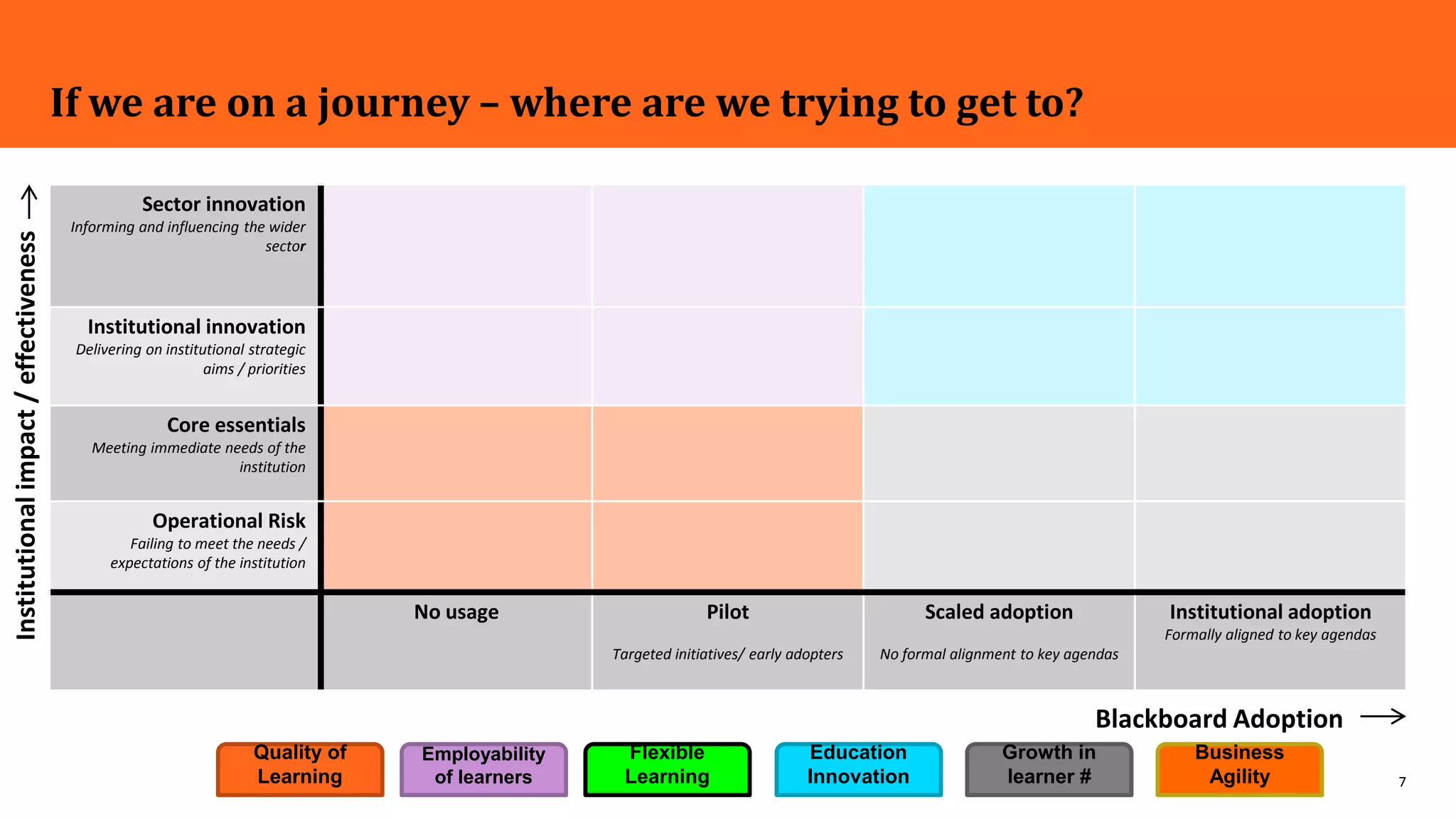
If we are on a journey – where are we trying to get to?
Sector innovation
Informing and influencing the wider
sector
Institutional innovation
Delivering on institutional strategic
aims / priorities
Core essentials
Meeting immediate needs of the
institution
Operational Risk
Failing to meet the needs /
expectations of the institution
No usage Pilot
Targeted initiatives/ early adopters
Scaled adoption
No formal alignment to key agendas
Institutional adoption
Formally aligned to key agendas
Institutionalimpact/effectiveness
Quality of
Learning
Flexible
Learning
Business
Agility
Education
Innovation
Growth in
learner #
Employability
of learners
Blackboard Adoption
8
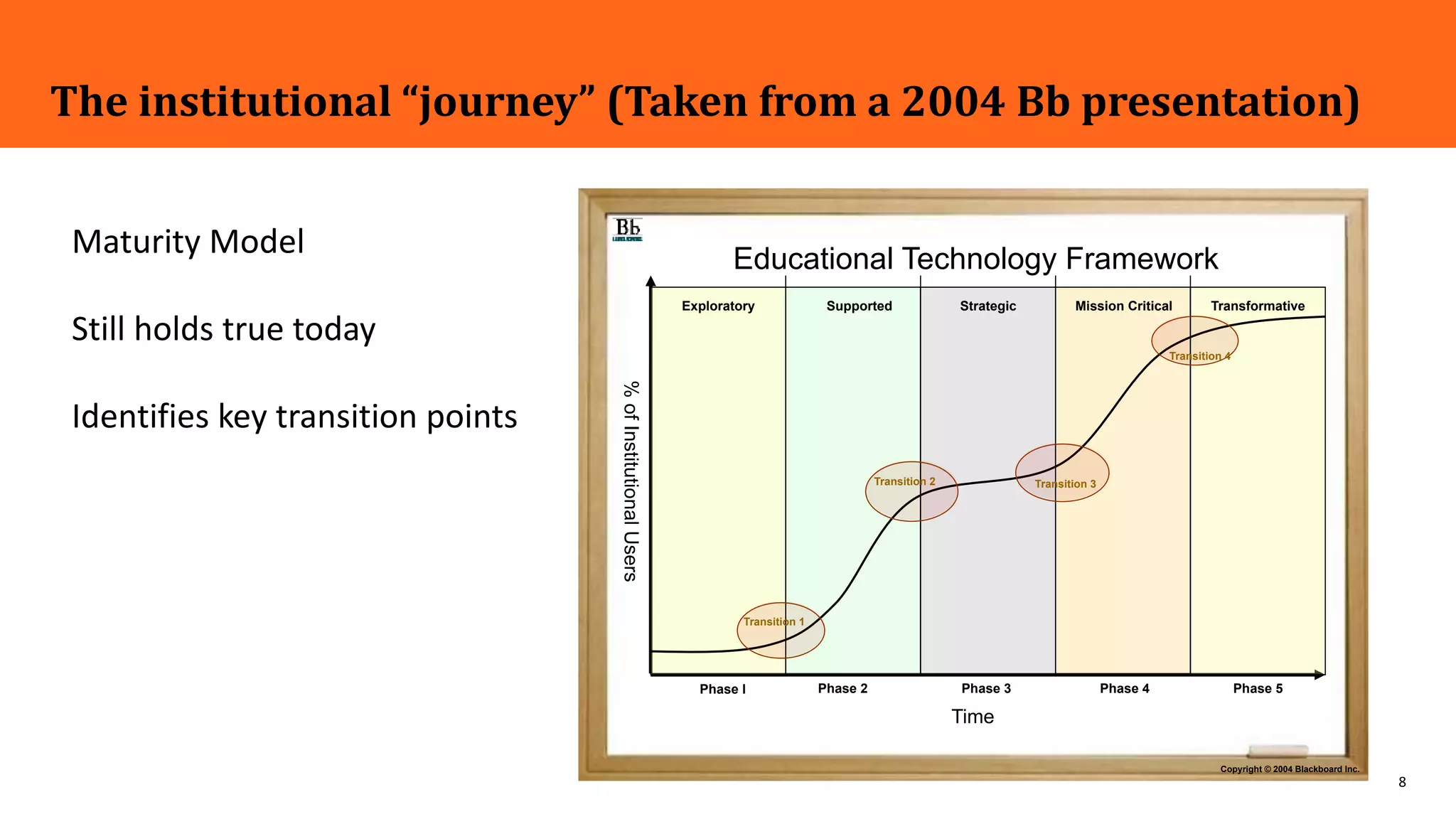
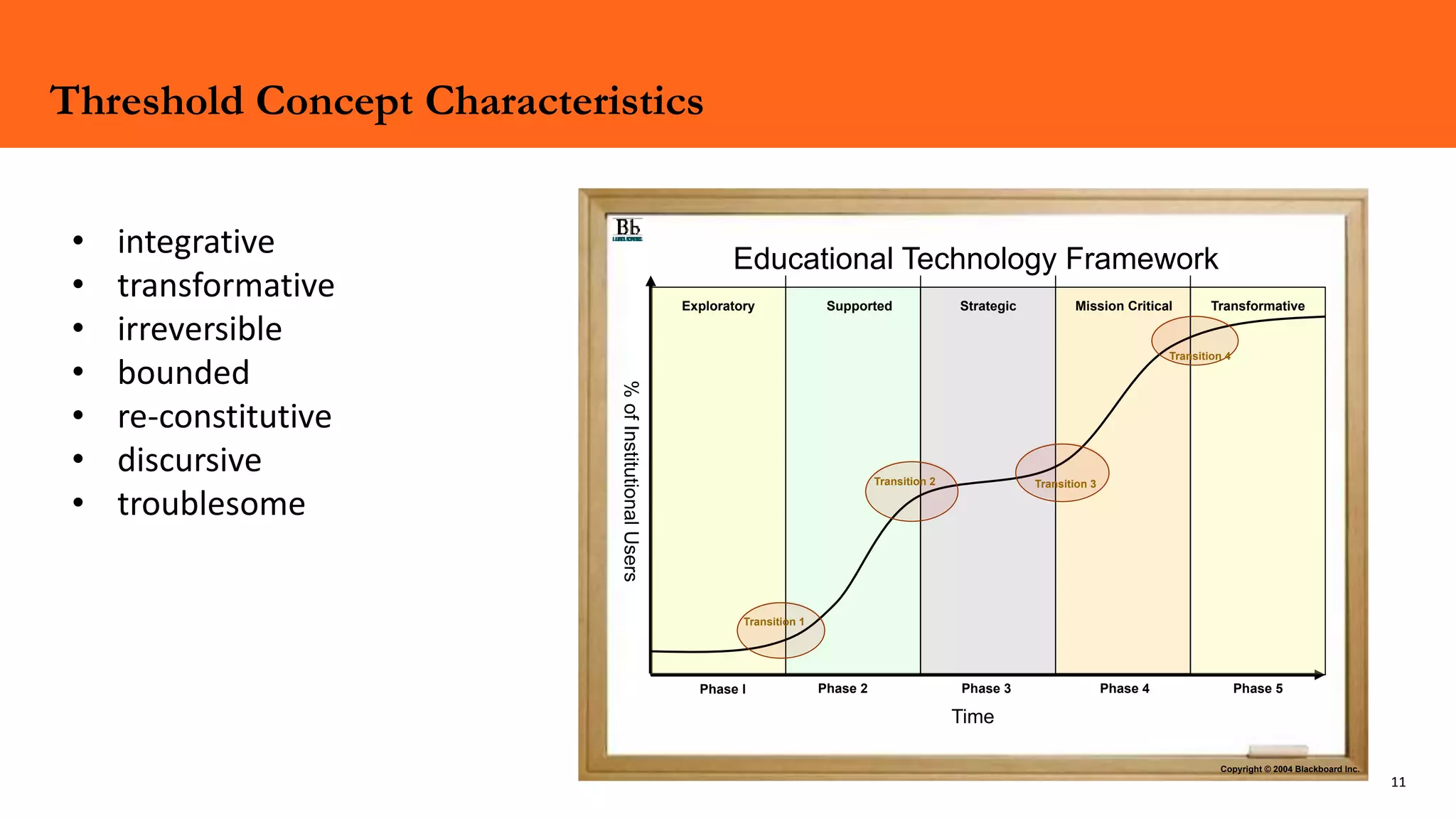
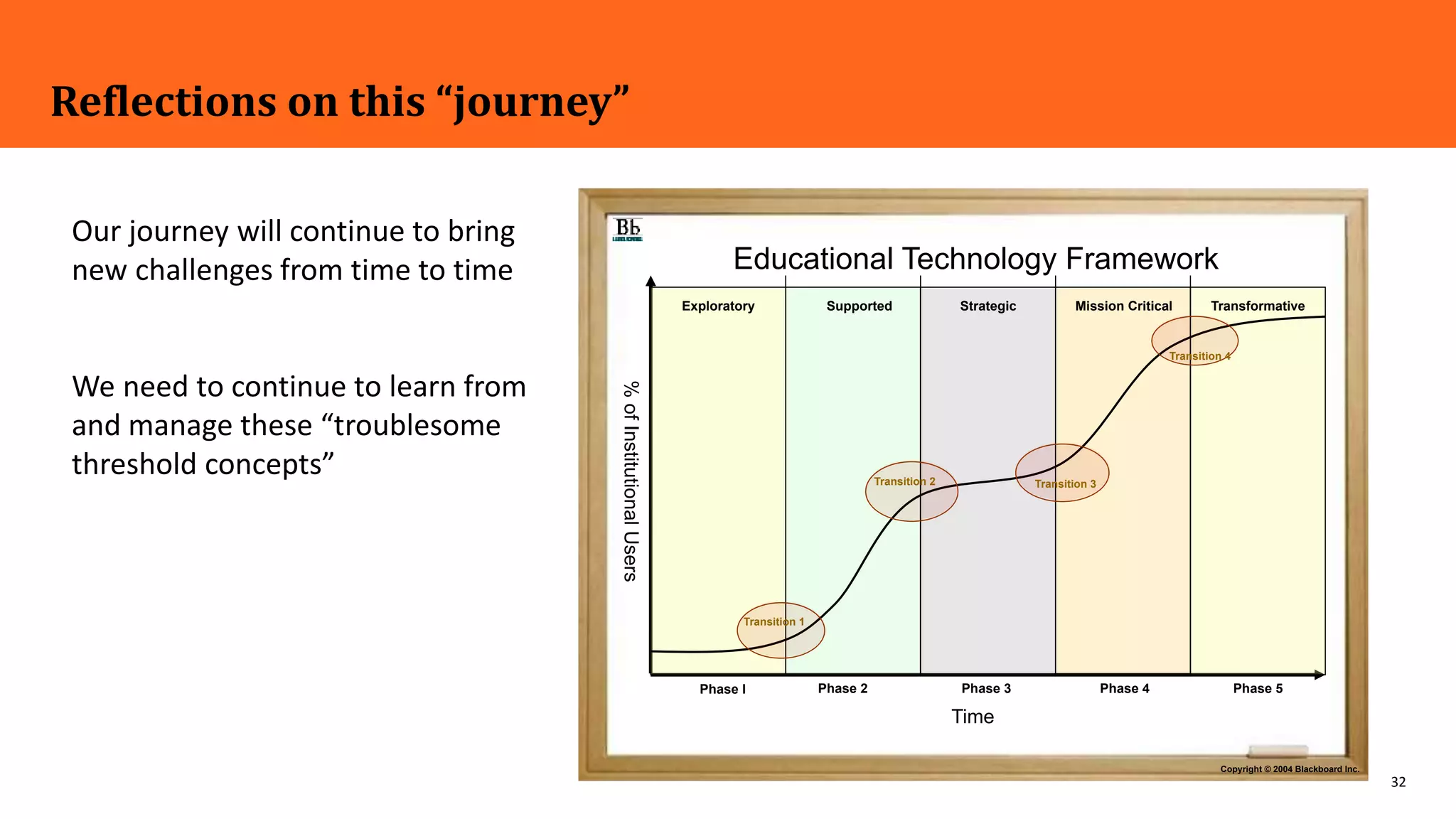
The institutional “journey” (Taken from a 2004 Bb presentation)
Copyright © 2004 Blackboard Inc.
Exploratory
Time
Educational Technology Framework
Supported Strategic TransformativeMission Critical
Transition 1
Phase I Phase 2 Phase 3 Phase 4 Phase 5
Transition 2 Transition 3
Transition 4
%ofInstitutionalUsers
Maturity Model
Still holds true today
Identifies key transition points
9
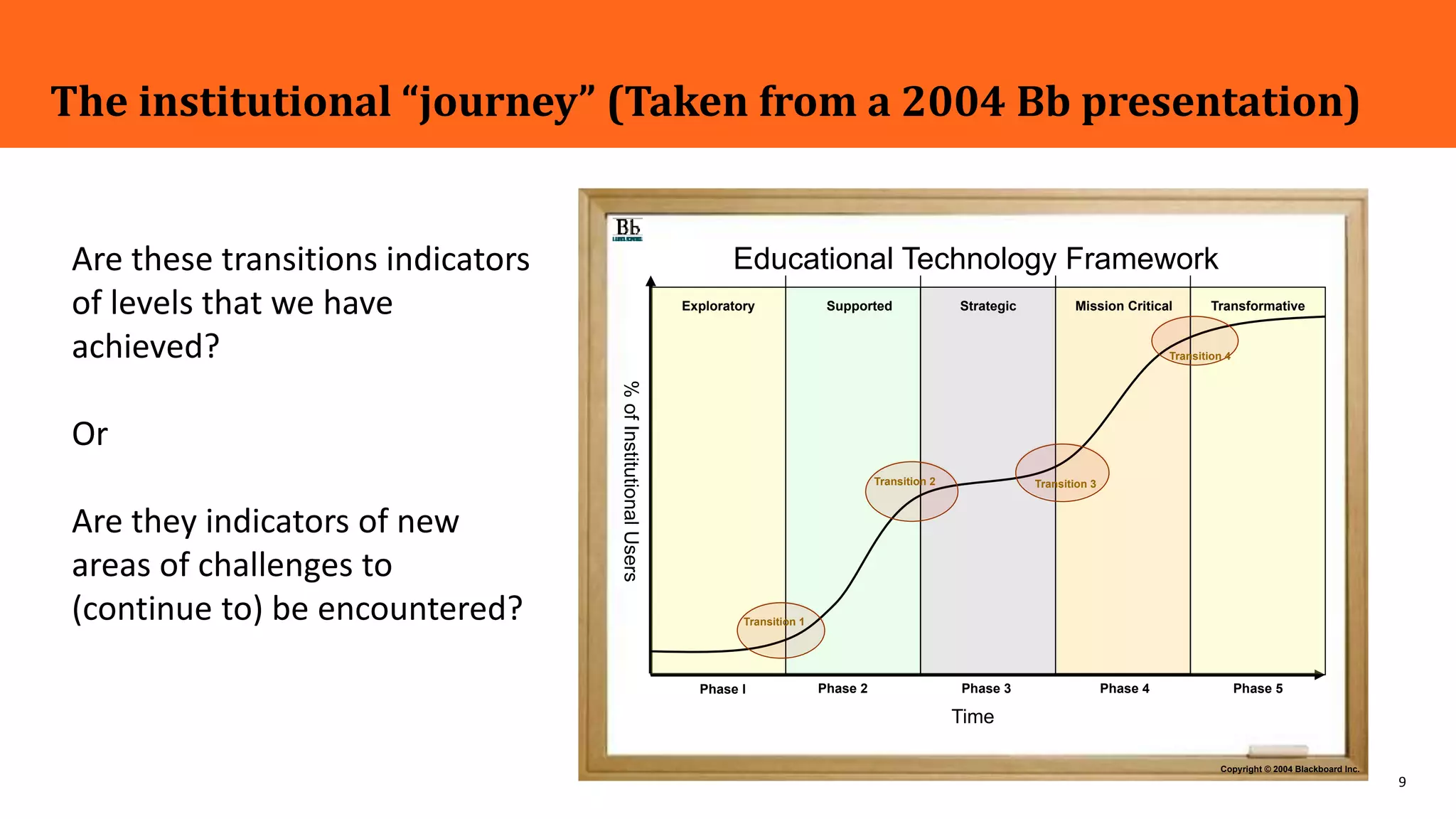
The institutional “journey” (Taken from a 2004 Bb presentation)
Copyright © 2004 Blackboard Inc.
Exploratory
Time
Educational Technology Framework
Supported Strategic TransformativeMission Critical
Transition 1
Phase I Phase 2 Phase 3 Phase 4 Phase 5
Transition 2 Transition 3
Transition 4
%ofInstitutionalUsers
Are these transitions indicators
of levels that we have
achieved?
Or
Are they indicators of new
areas of challenges to
(continue to) be encountered?
10
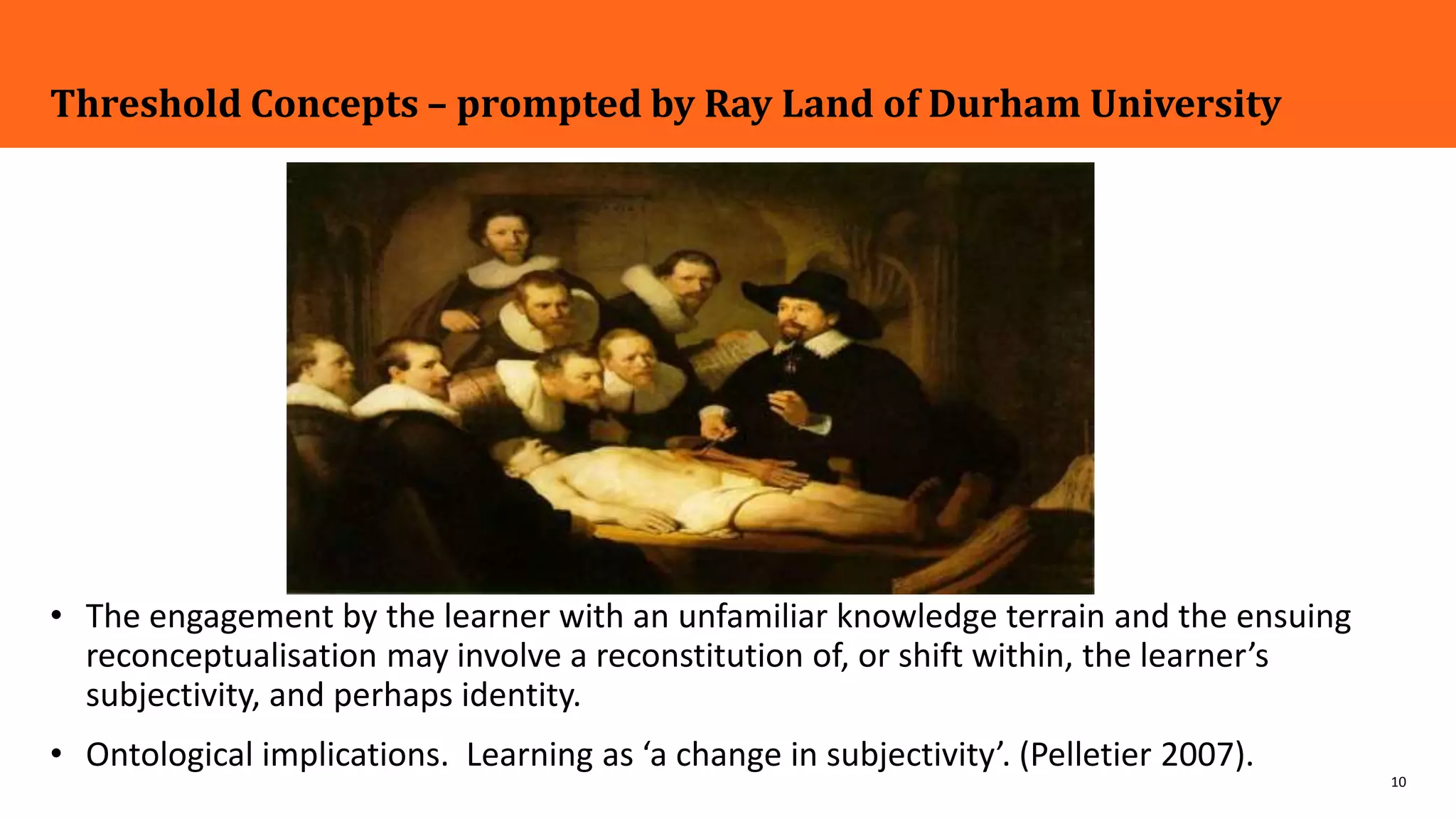
Threshold Concepts – prompted by Ray Land of Durham University
• The engagement by the learner with an unfamiliar knowledge terrain and the ensuing
reconceptualisation may involve a reconstitution of, or shift within, the learner’s
subjectivity, and perhaps identity.
• Ontological implications. Learning as ‘a change in subjectivity’. (Pelletier 2007).
11
Threshold Concept Characteristics
Copyright © 2004 Blackboard Inc.
Exploratory
Time
Educational Technology Framework
Supported Strategic TransformativeMission Critical
Transition 1
Phase I Phase 2 Phase 3 Phase 4 Phase 5
Transition 2 Transition 3
Transition 4
%ofInstitutionalUsers
• integrative
• transformative
• irreversible
• bounded
• re-constitutive
• discursive
• troublesome
12
Let’s explore these
adoption thresholds
in more detail
13
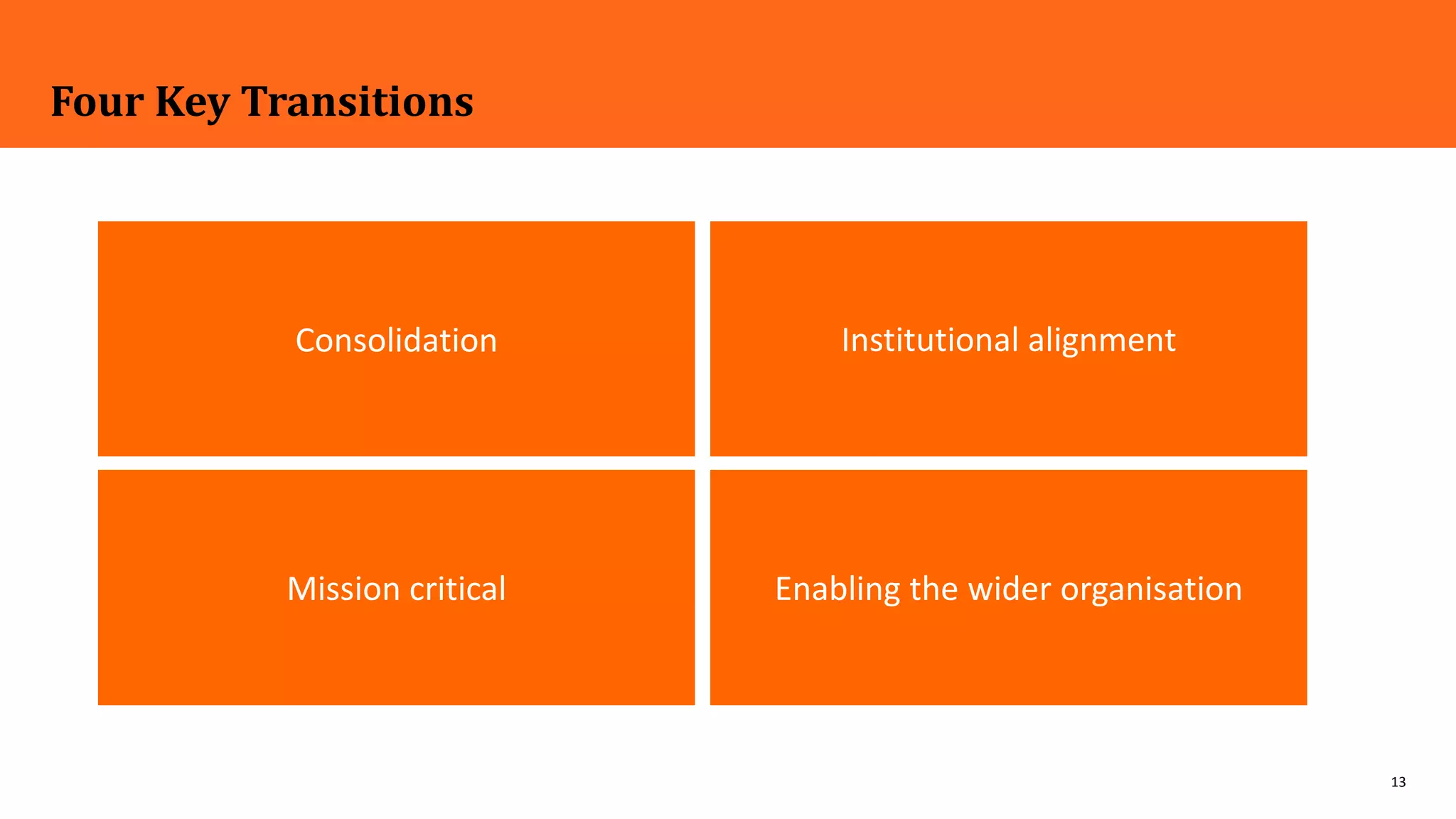
Four Key Transitions
Consolidation
Mission critical Enabling the wider organisation
Institutional alignment
14
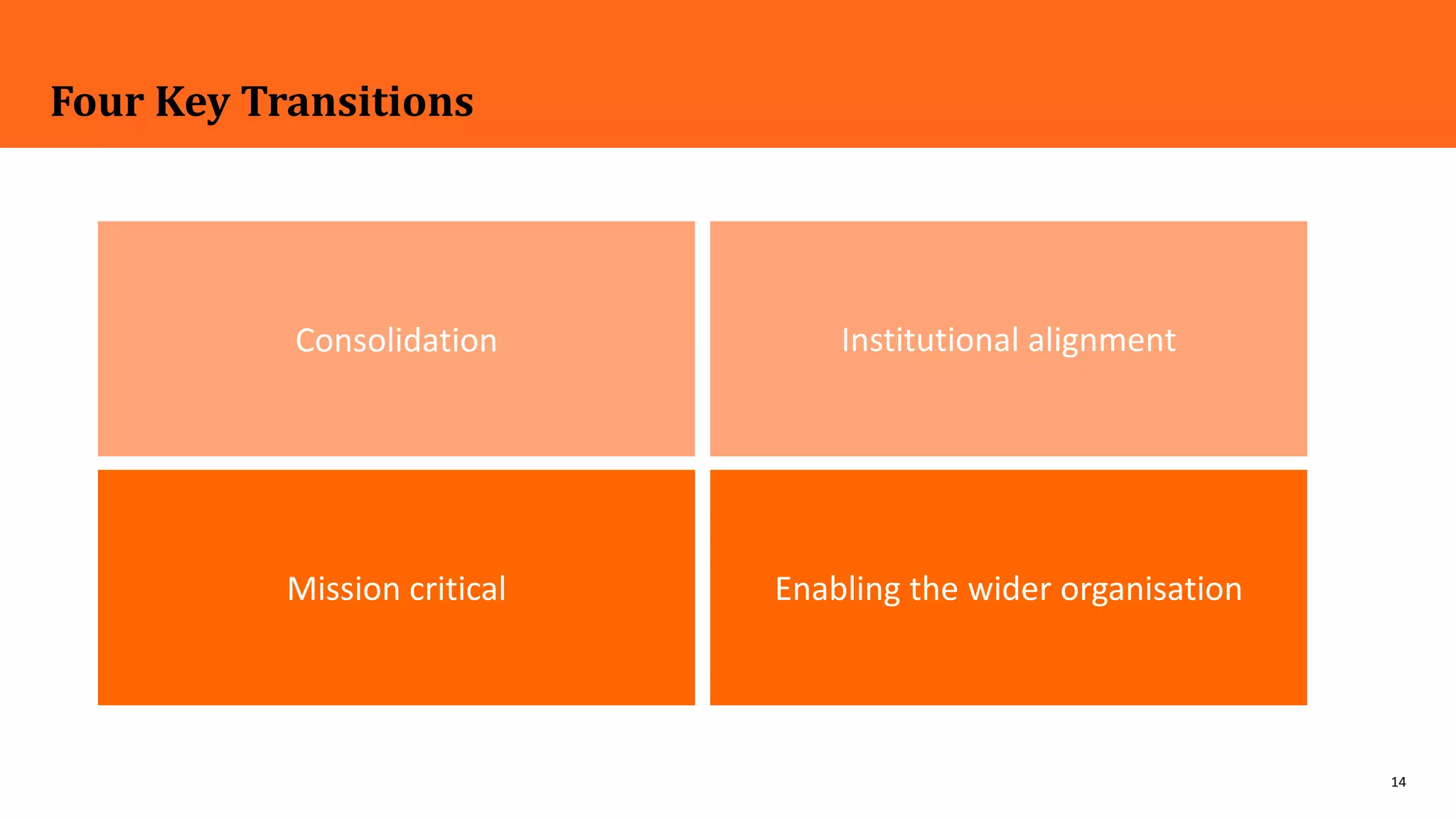
Four Key Transitions
Consolidation
Mission critical Enabling the wider organisation
Institutional alignment
15
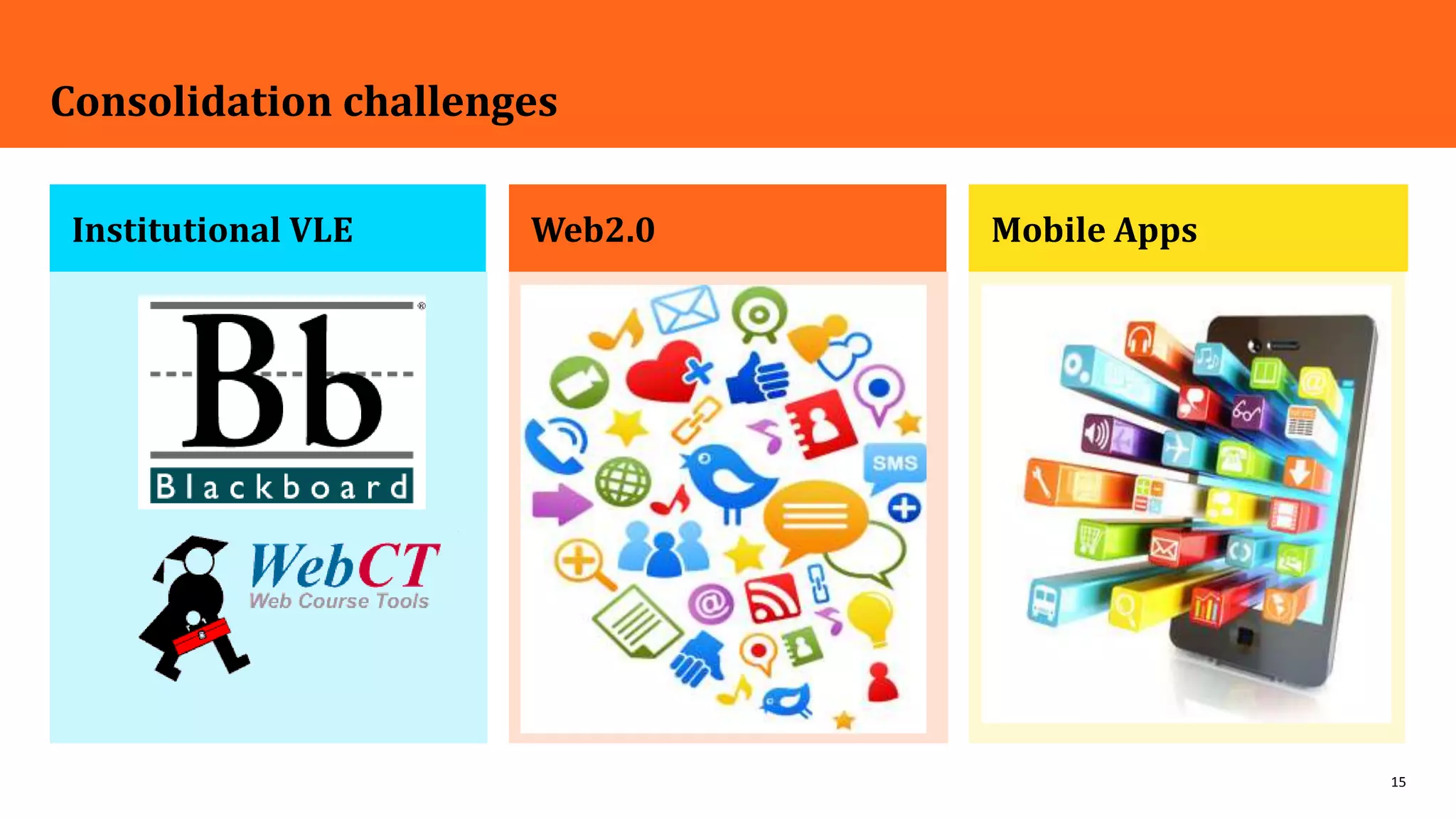
Institutional VLE
Consolidation challenges
Web2.0 Mobile Apps
16
We must continue to innovate and consolidate……..
17
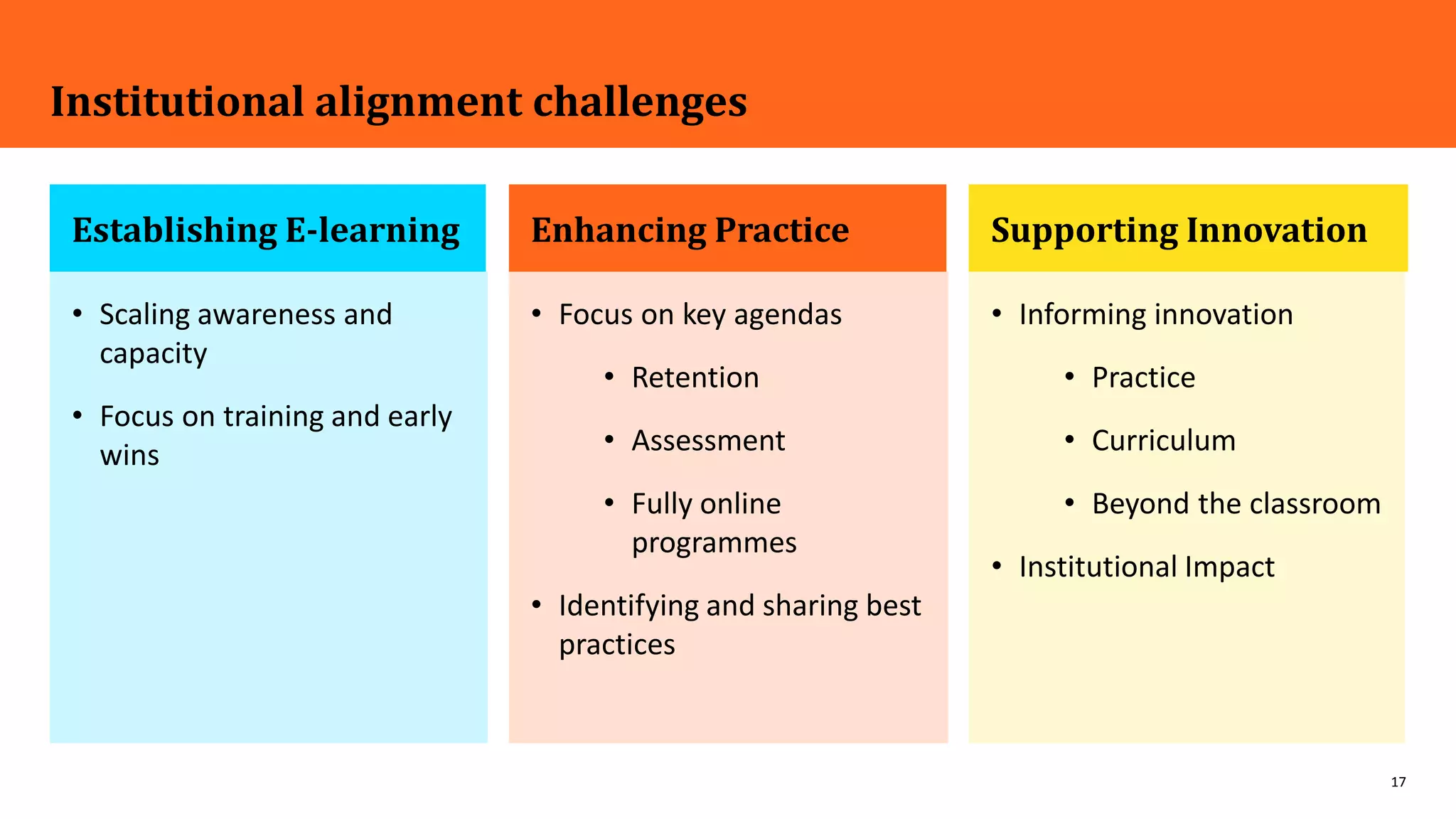
Establishing E-learning
• Informing innovation
• Practice
• Curriculum
• Beyond the classroom
• Institutional Impact
Institutional alignment challenges
Enhancing Practice
• Scaling awareness and
capacity
• Focus on training and early
wins
Supporting Innovation
• Focus on key agendas
• Retention
• Assessment
• Fully online
programmes
• Identifying and sharing best
practices
18
What are the key
transition trends we
are currently seeing?
19
“Mission Critical”
Robust and Reliable Infrastructure
20
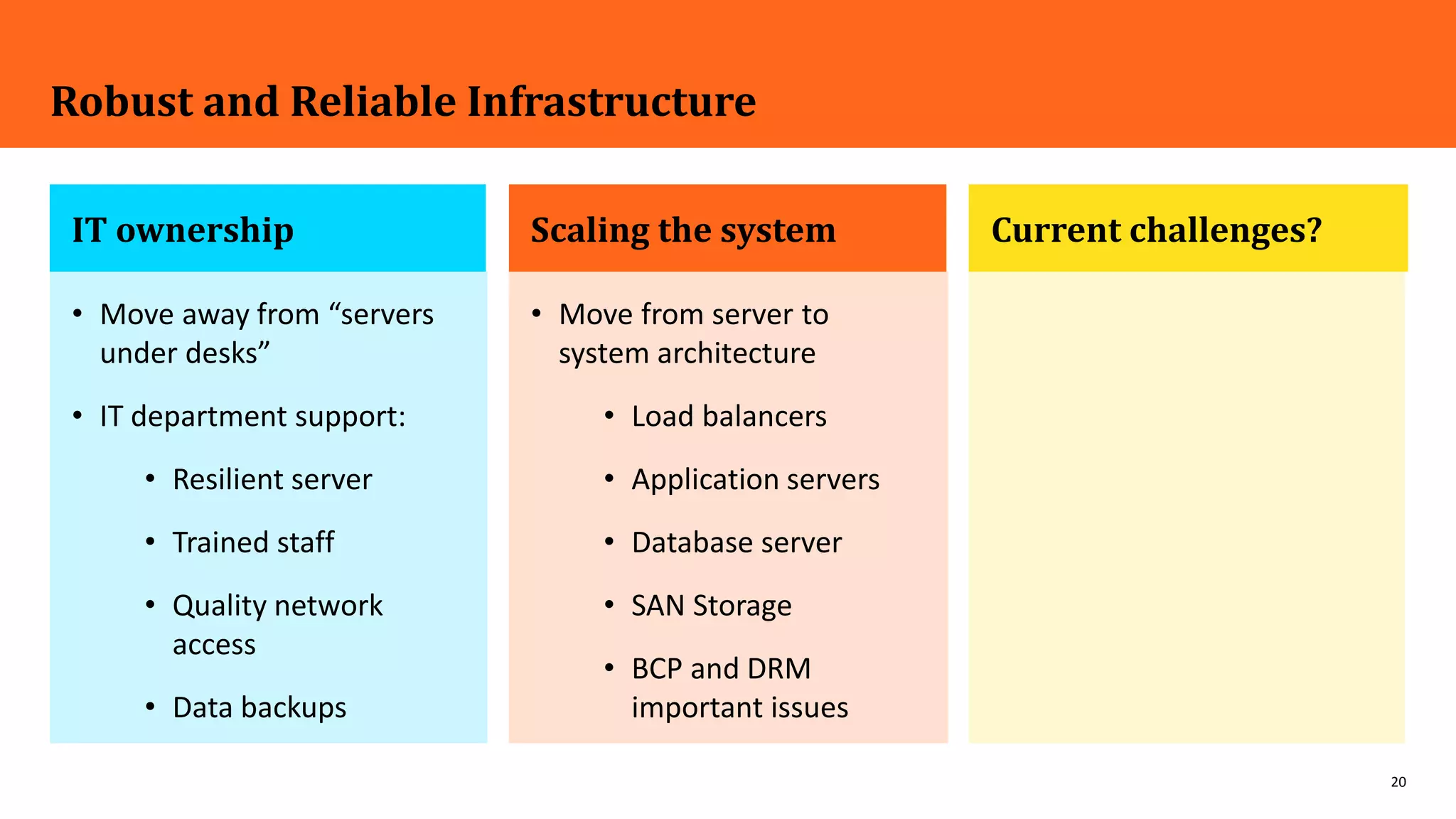
IT ownership
Robust and Reliable Infrastructure
Scaling the system
• Move away from “servers
under desks”
• IT department support:
• Resilient server
• Trained staff
• Quality network
access
• Data backups
Current challenges?
• Move from server to
system architecture
• Load balancers
• Application servers
• Database server
• SAN Storage
• BCP and DRM
important issues
21
Robust and Reliable Infrastructure – Customer Demands
“The level of complexity increased with each migration; technical
people had to spend significant amounts of time building up
knowledge that would be rendered useless after the actual
migration was complete.”
“Our IT department was stretched thin, and we knew that we
needed help if we were going to provide the level of support that
our increasing user community would require ”
“..to manage the increasing number of users more easily and to
maintain the top quality student-facing services our university is
renowned for, we needed a scalable, high-performing IT
environment that could easily increase the amount of processing
power available at critical times such as during assessments.”
22
Robust and Reliable Infrastructure – Customer Benefits
University of Groningen
“Now that we don’t have to worry about the performance and up-
time of our Blackboard platform, we can focus our efforts on other
things,”
University of Reading:
“True 24x7x365: support, monitoring and problem resolution (3 x
8hr shifts) x 365 by a large team with a high level of expertise and
experience”
University of Brighton:
“Spent lunchtime advocating Bb Managed Hosting, we haven't
looked back! I sleep much better these days ” (tweet)
MH hosting image here
Blackboard Managed Hosting
23
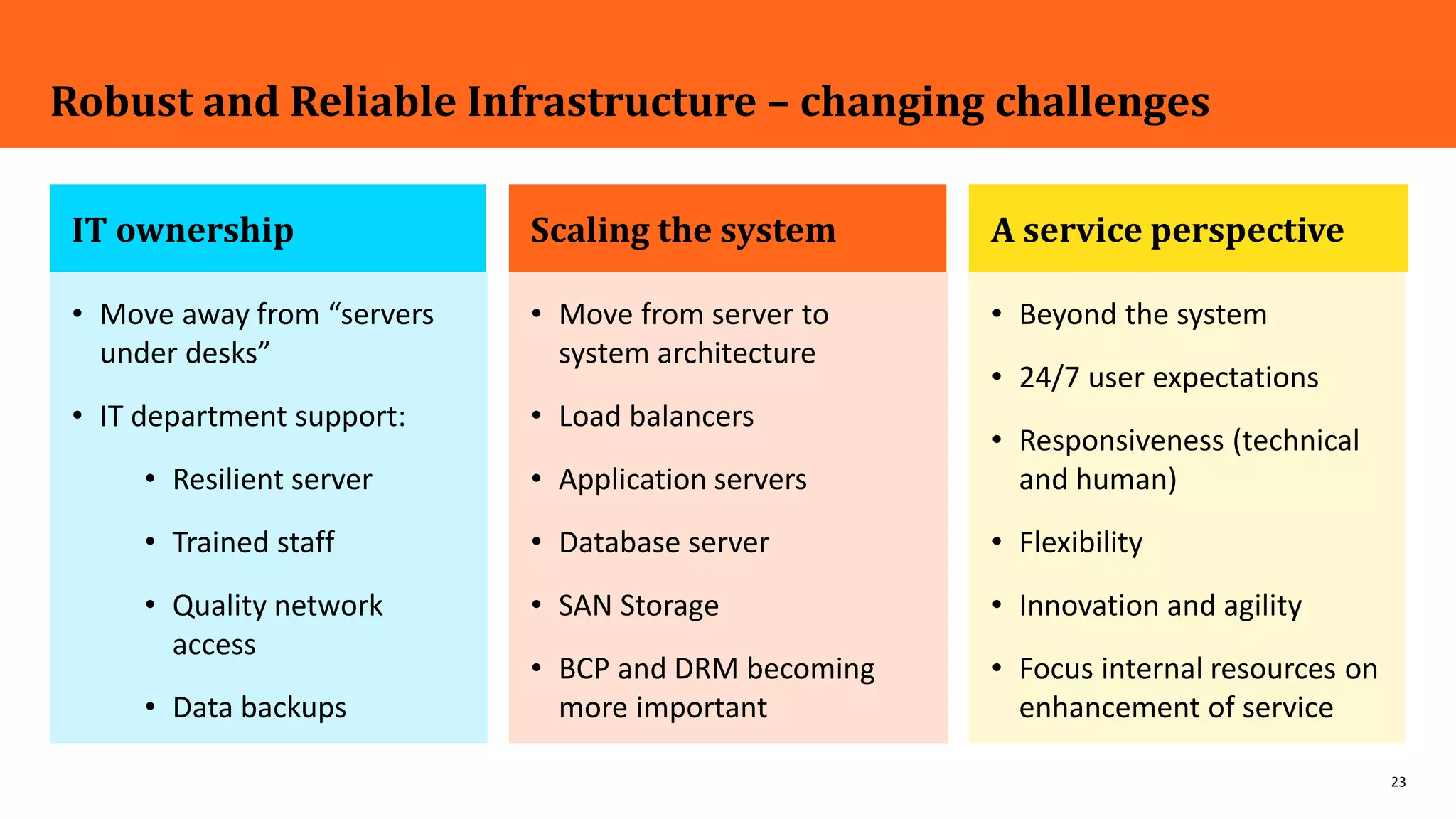
IT ownership
• Beyond the system
• 24/7 user expectations
• Responsiveness (technical
and human)
• Flexibility
• Innovation and agility
• Focus internal resources on
enhancement of service
Robust and Reliable Infrastructure – changing challenges
Scaling the system
• Move away from “servers
under desks”
• IT department support:
• Resilient server
• Trained staff
• Quality network
access
• Data backups
A service perspective
• Move from server to
system architecture
• Load balancers
• Application servers
• Database server
• SAN Storage
• BCP and DRM becoming
more important
24
Supporting the wider organisation
25
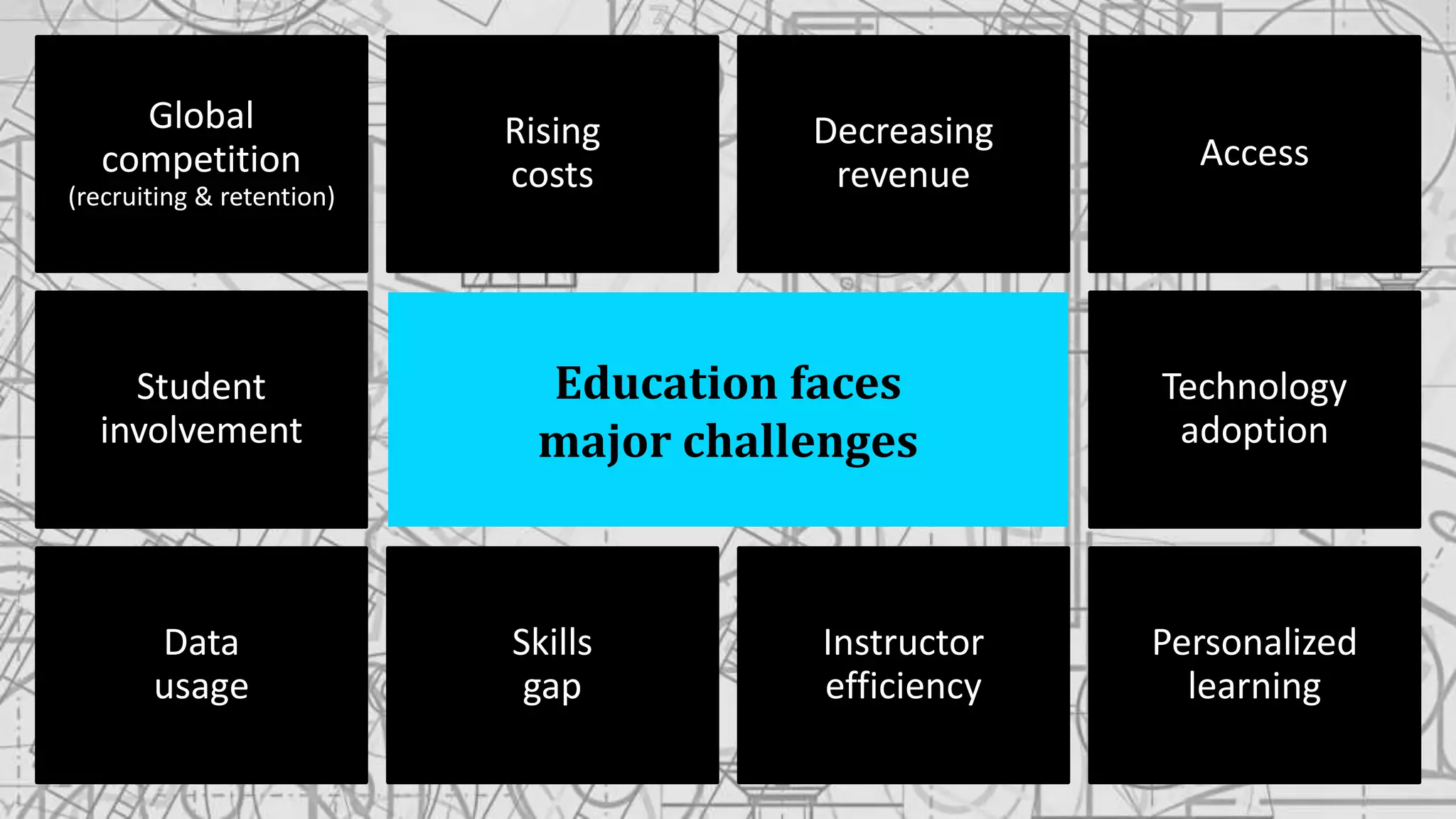
Global
competition
(recruiting & retention)
Rising
costs
Decreasing
revenue
Access
Data
usage
Skills
gap
Instructor
efficiency
Personalized
learning
Student
involvement
Technology
adoption
Education faces
major challenges
Global
competition
(recruiting & retention)
Access
Skills
gap
26
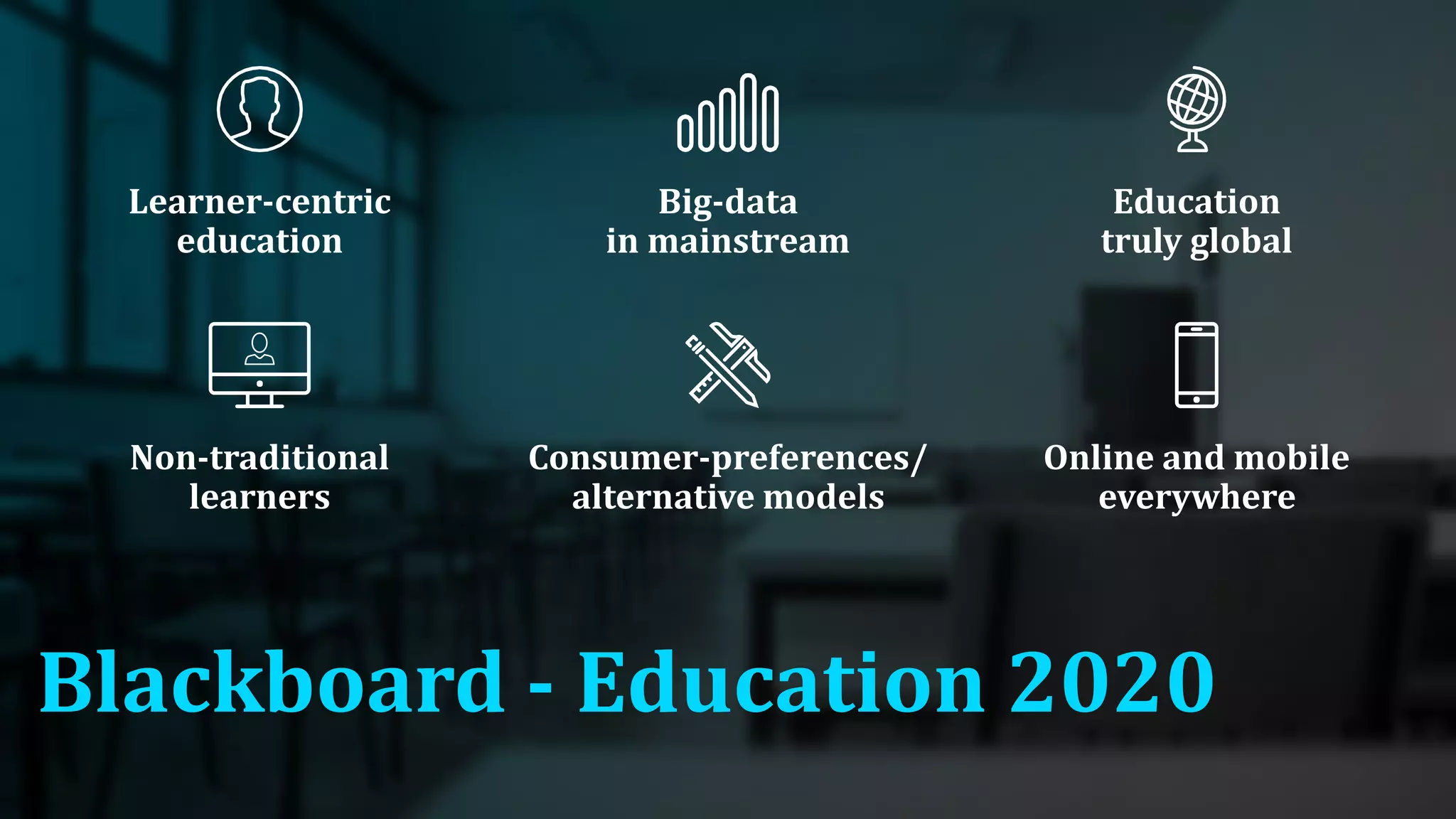
Blackboard - Education 2020
Learner-centric
education
Non-traditional
learners
Big-data
in mainstream
Consumer-preferences/
alternative models
Education
truly global
Online and mobile
everywhere
27
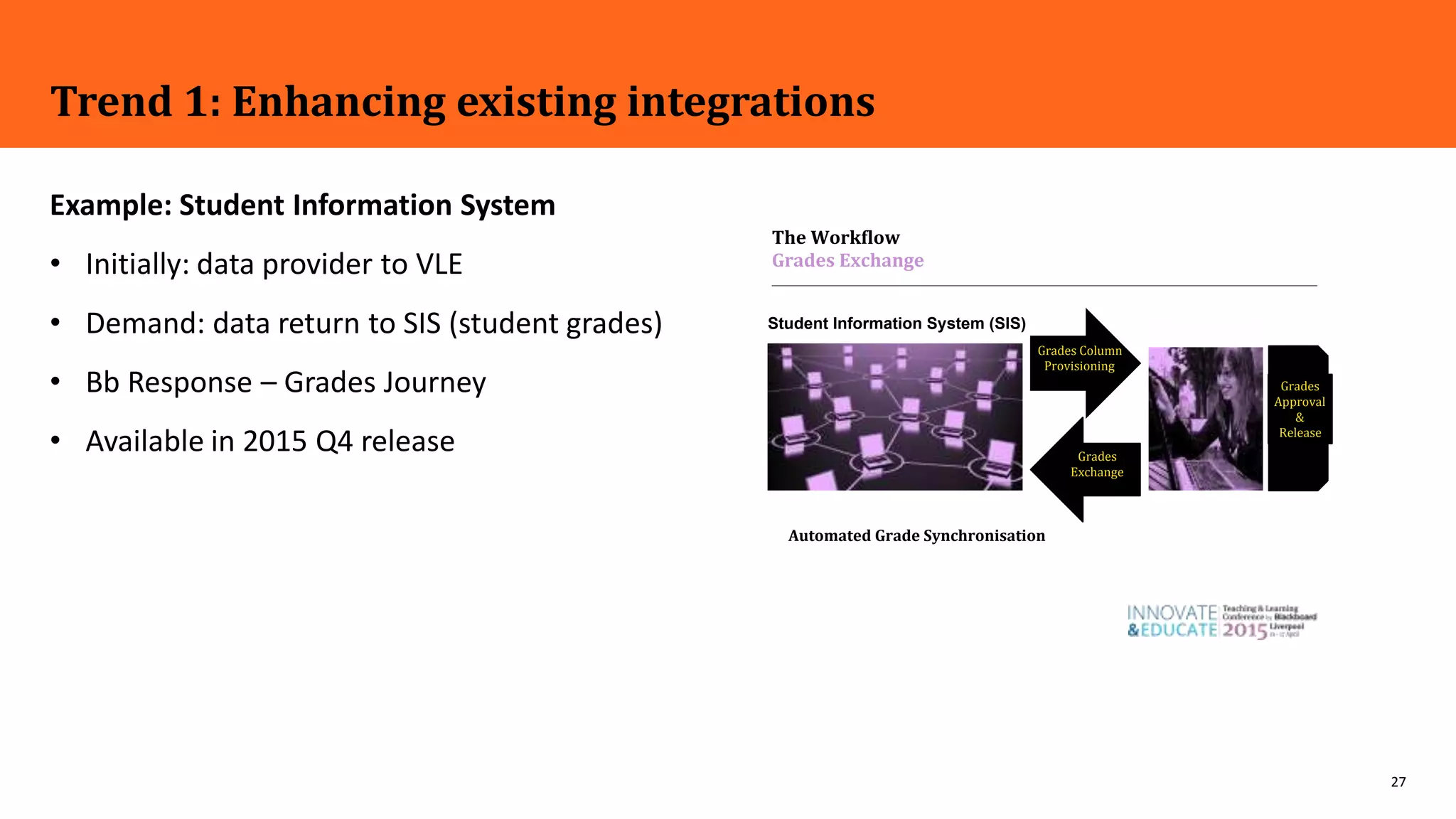
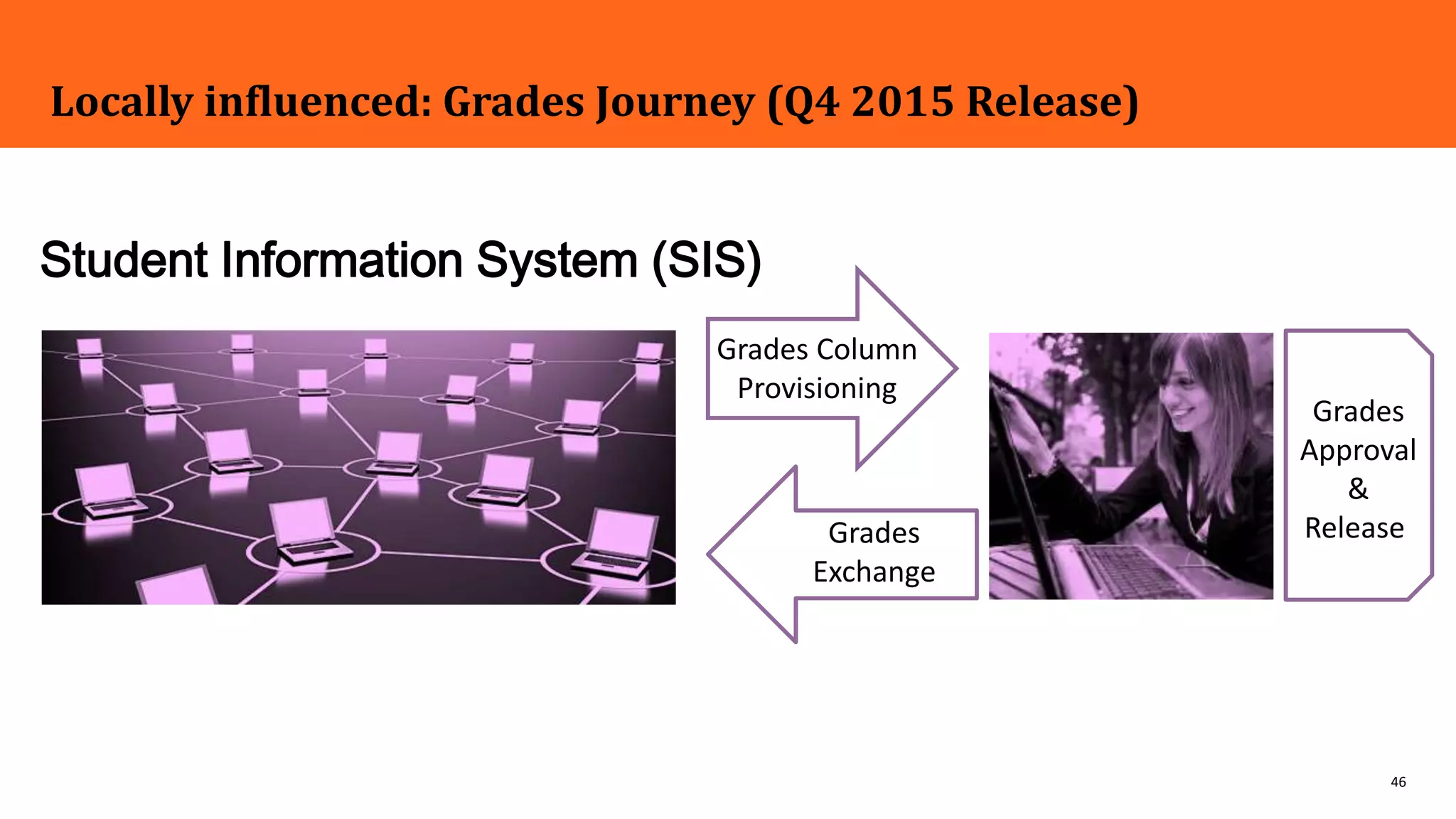
Trend 1: Enhancing existing integrations
Example: Student Information System
• Initially: data provider to VLE
• Demand: data return to SIS (student grades)
• Bb Response – Grades Journey
• Available in 2015 Q4 release
Grades Column
Provisioning
The Work low
Grades Exchange
Student Information System (SIS)
Grades
Approval
&
Release
Grades
Exchange
Automated Grade Synchronisation
28
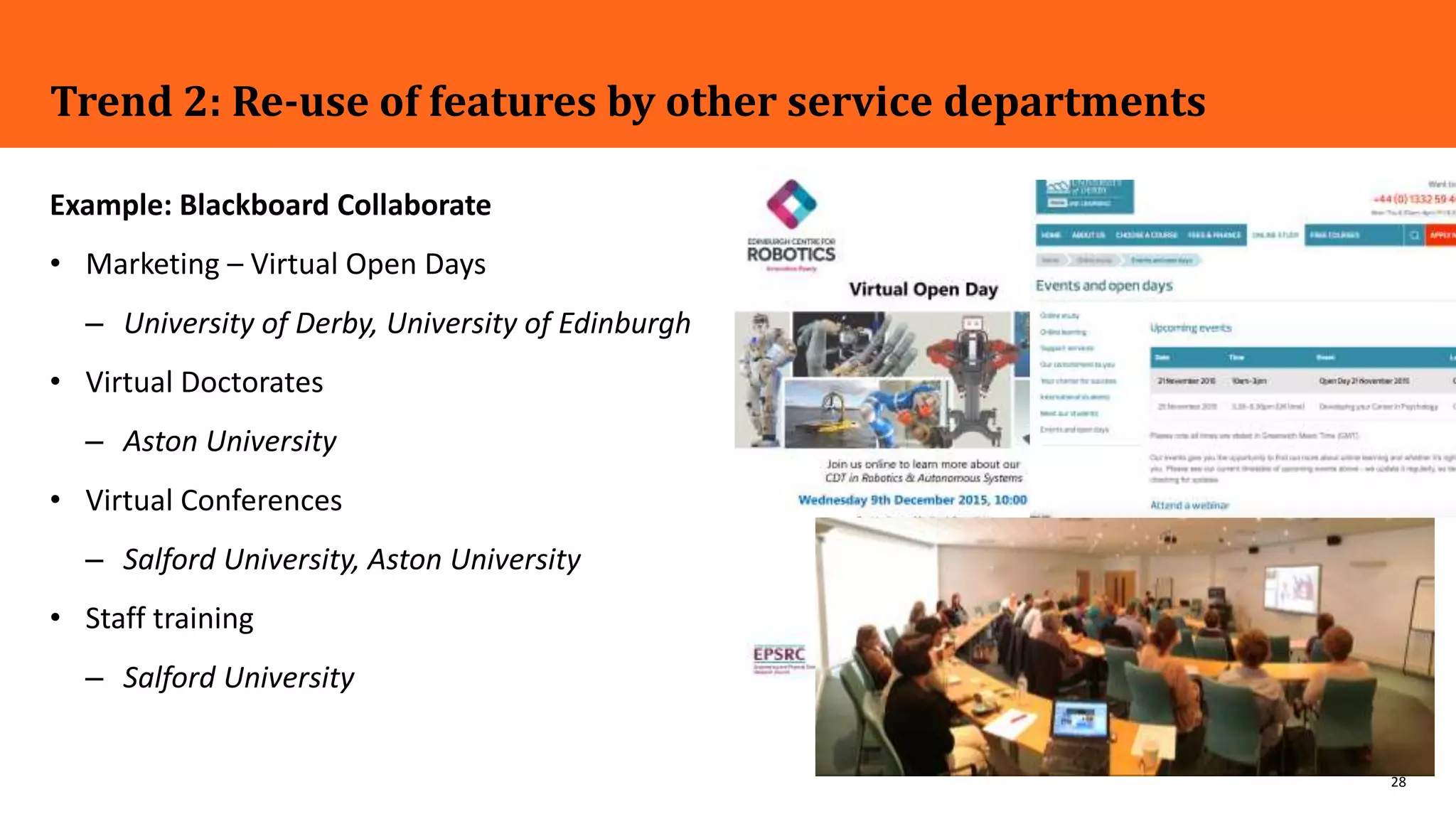
Trend 2: Re-use of features by other service departments
Example: Blackboard Collaborate
• Marketing – Virtual Open Days
– University of Derby, University of Edinburgh
• Virtual Doctorates
– Aston University
• Virtual Conferences
– Salford University, Aston University
• Staff training
– Salford University
29
Trend 3: Enhanced learner access to other services / resources
Example: Blackboard Community System
• Key learner information, tools and resources
– Personalised Bb home page: Sheffield Hallam,
Leeds Beckett, Groningen, Durham
• Student services: Careers / Library / Student
Support / IT support
– Personalised Bb tabs: Groningen, Sheffield
Hallam, Leeds Beckett, Durham
Also thru use of Content System and Enterprise
Surveys
• Quality Office (and University Committees)
– Keele, Leeds (Liverpool John Moores, Reading,
Salford)
30
Trend 4: Inform innovation & realise organisational efficiency gains
Example: Blackboard Consulting
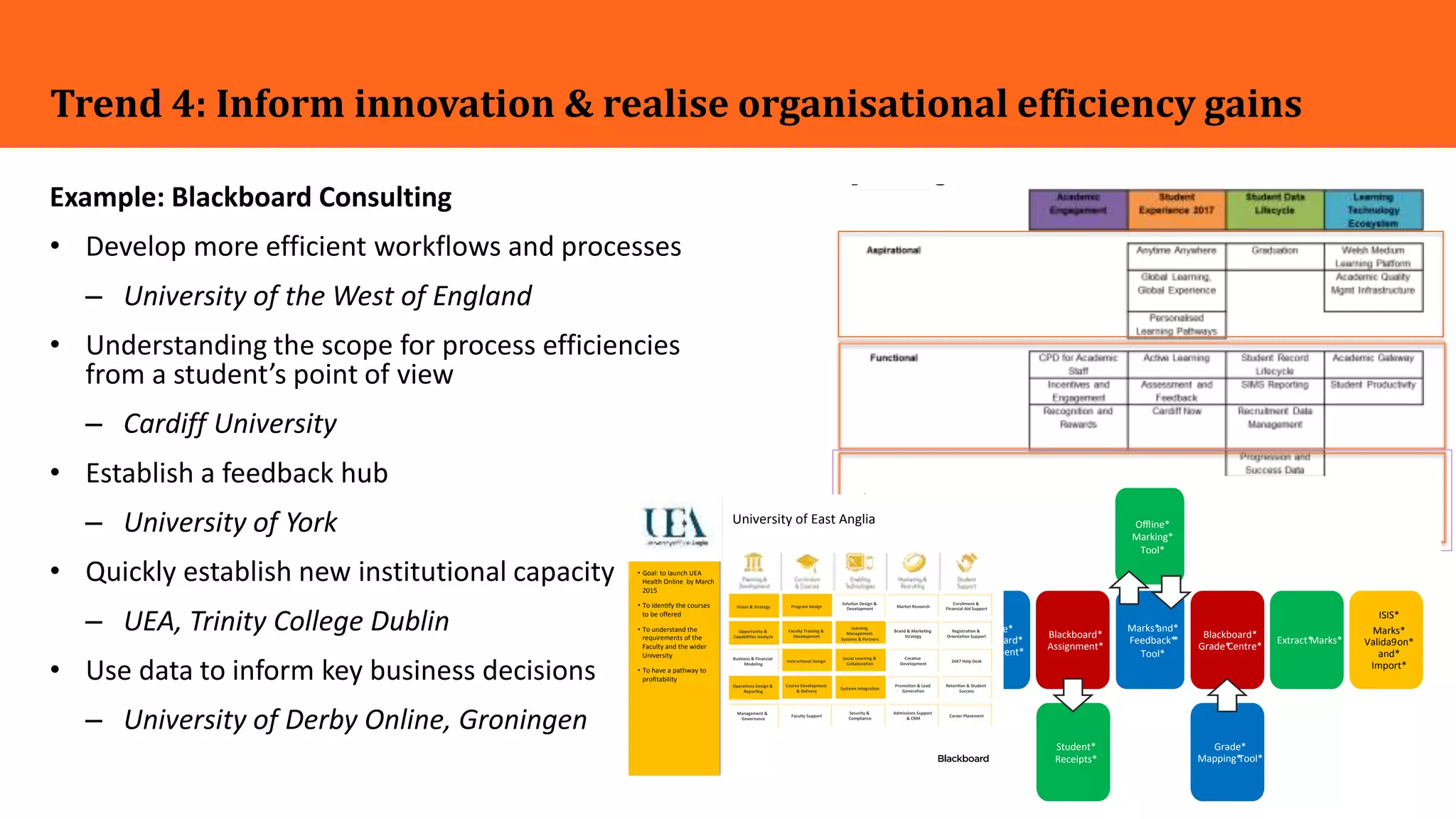
• Develop more efficient workflows and processes
– University of the West of England
• Understanding the scope for process efficiencies
from a student’s point of view
– Cardiff University
• Establish a feedback hub
– University of York
• Quickly establish new institutional capacity
– UEA, Trinity College Dublin
• Use data to inform key business decisions
– University of Derby Online, Groningen
programme of transformation within the institution
• “consistently be among the top 100 universities in
the world and the top 20 in the UK’
• driving international and postgraduate recruitment
• increasing international opportunities and
• improving overall student satisfaction
6
United Kingdom
Founded 1884
#182 - THE World
Ranking 2015-16
28,500 students
Blackboard*
Assignment*
Blackboard*
Grade*Centre*
ISIS*
Marks*
Valida9on*
and*
Import*
Marks*and*
Feedback**
Tool*
Student*
Receipts*
Offline*
Marking*
Tool*
Grade*
Mapping*Tool*
Get*the*
marks*into*
ISIS*??*
ISIS*
Work*Item*
Data**
Extract*
Create*
Blackboard*
Assignment*
Extract*Marks*
• Goal: to launch UEA
Health Online by March
2015
• To iden fy the courses
to be offered
• To understand the
requirements of the
Faculty and the wider
University
• To have a pathway to
profitability
University of East Anglia
Vision & Strategy
Opportunity &
Capabili es Analysis
Business & Financial
Modeling
Opera ons Design &
Repor ng
Management &
Governance
Program Design
Faculty Training &
Development
Instruc onal Design
Course Development
& Delivery
Faculty Support
Solu on Design &
Development
Learning
Management
Systems & Partners
Social Learning &
Collabora on
Systems Integra on
Security &
Compliance
Market Research
Brand & Marke ng
Strategy
Crea ve
Development
Promo on & Lead
Genera on
Admissions Support
& CRM
Enrollment &
Financial Aid Support
Registra on &
Orienta on Support
24X7 Help Desk
Reten on & Student
Success
Career Placement
31
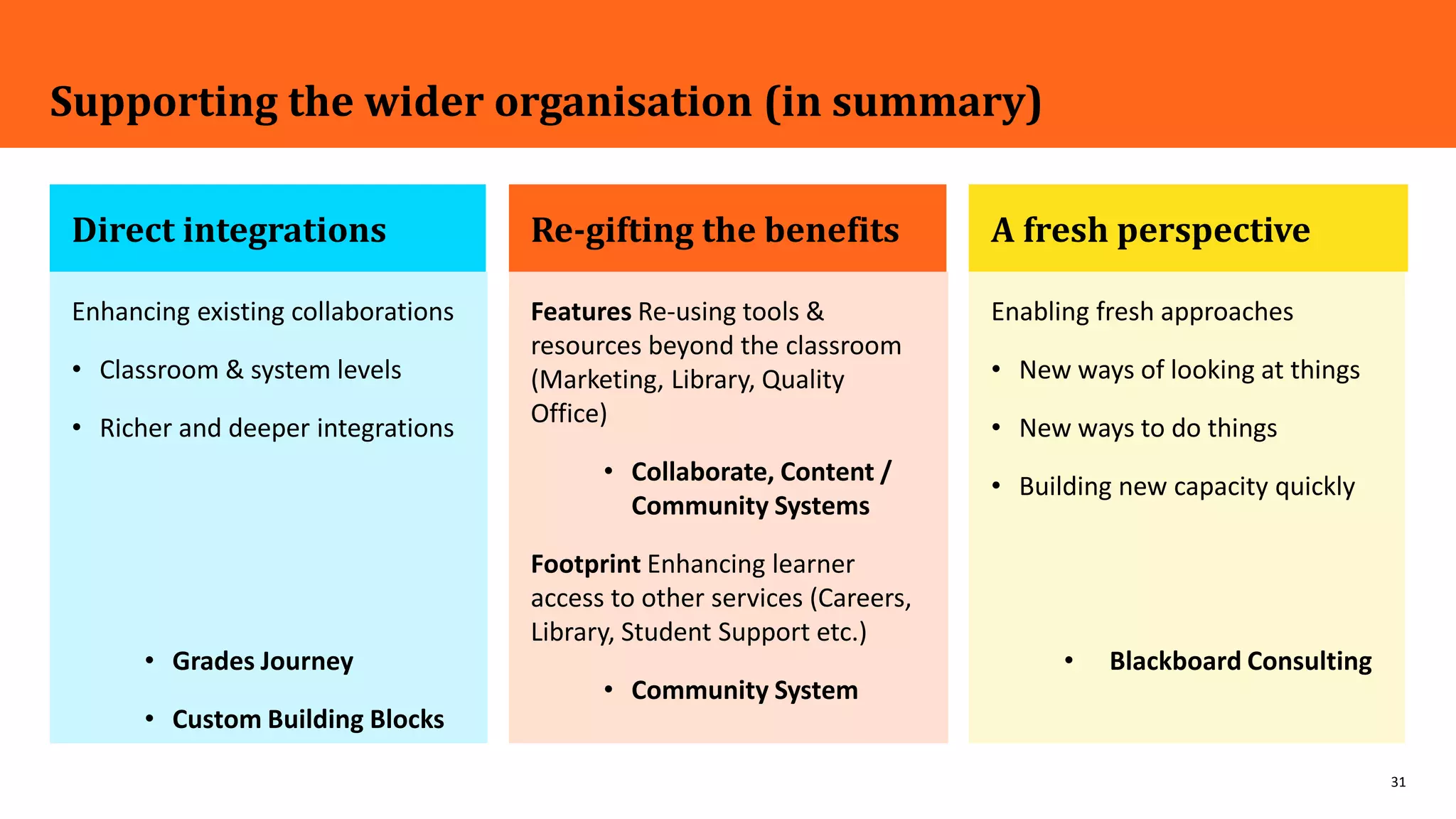
Direct integrations
Enabling fresh approaches
• New ways of looking at things
• New ways to do things
• Building new capacity quickly
• Blackboard Consulting
Supporting the wider organisation (in summary)
Re-gifting the benefits
Enhancing existing collaborations
• Classroom & system levels
• Richer and deeper integrations
• Grades Journey
• Custom Building Blocks
A fresh perspective
Features Re-using tools &
resources beyond the classroom
(Marketing, Library, Quality
Office)
• Collaborate, Content /
Community Systems
Footprint Enhancing learner
access to other services (Careers,
Library, Student Support etc.)
• Community System
32
Reflections on this “journey”
Copyright © 2004 Blackboard Inc.
Exploratory
Time
Educational Technology Framework
Supported Strategic TransformativeMission Critical
Transition 1
Phase I Phase 2 Phase 3 Phase 4 Phase 5
Transition 2 Transition 3
Transition 4
%ofInstitutionalUsers
Our journey will continue to bring
new challenges from time to time
We need to continue to learn from
and manage these “troublesome
threshold concepts”
33
Looking back - what
lessons have we learnt
so far?
34
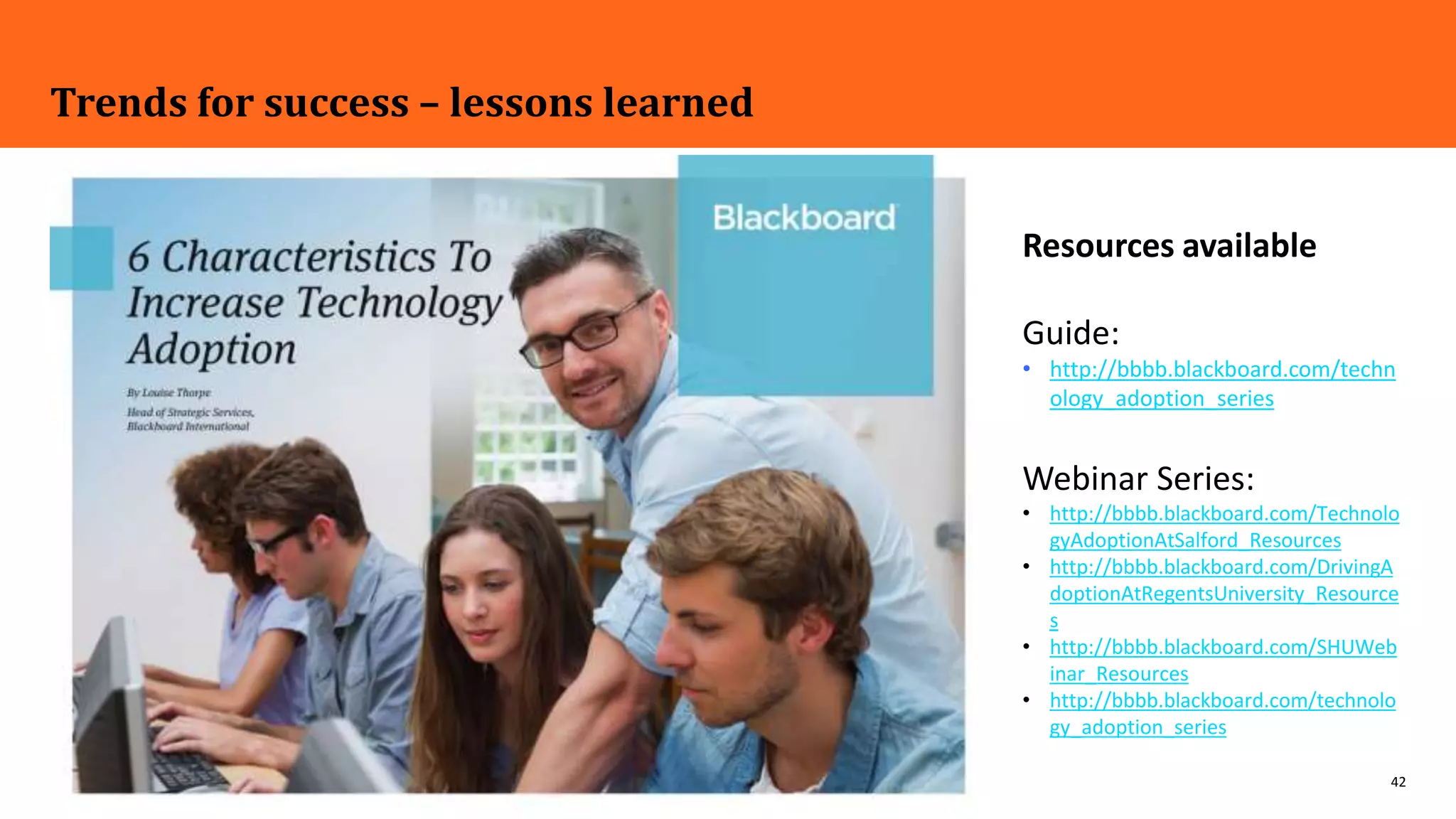
Trends for success – lessons learned
35
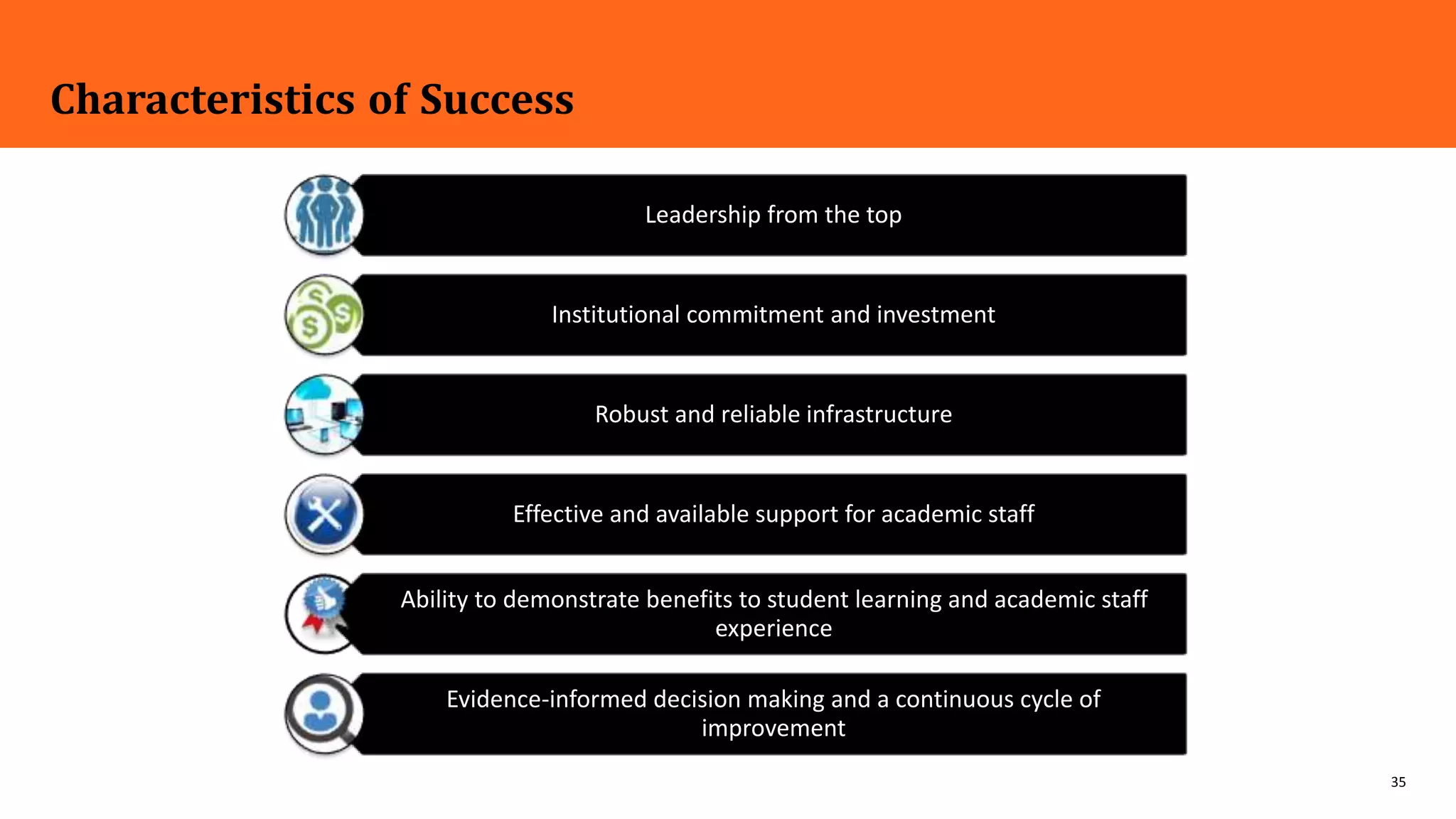
Characteristics of Success
Leadership from the top
Institutional commitment and investment
Robust and reliable infrastructure
Effective and available support for academic staff
Ability to demonstrate benefits to student learning and academic staff
experience
Evidence-informed decision making and a continuous cycle of
improvement
36
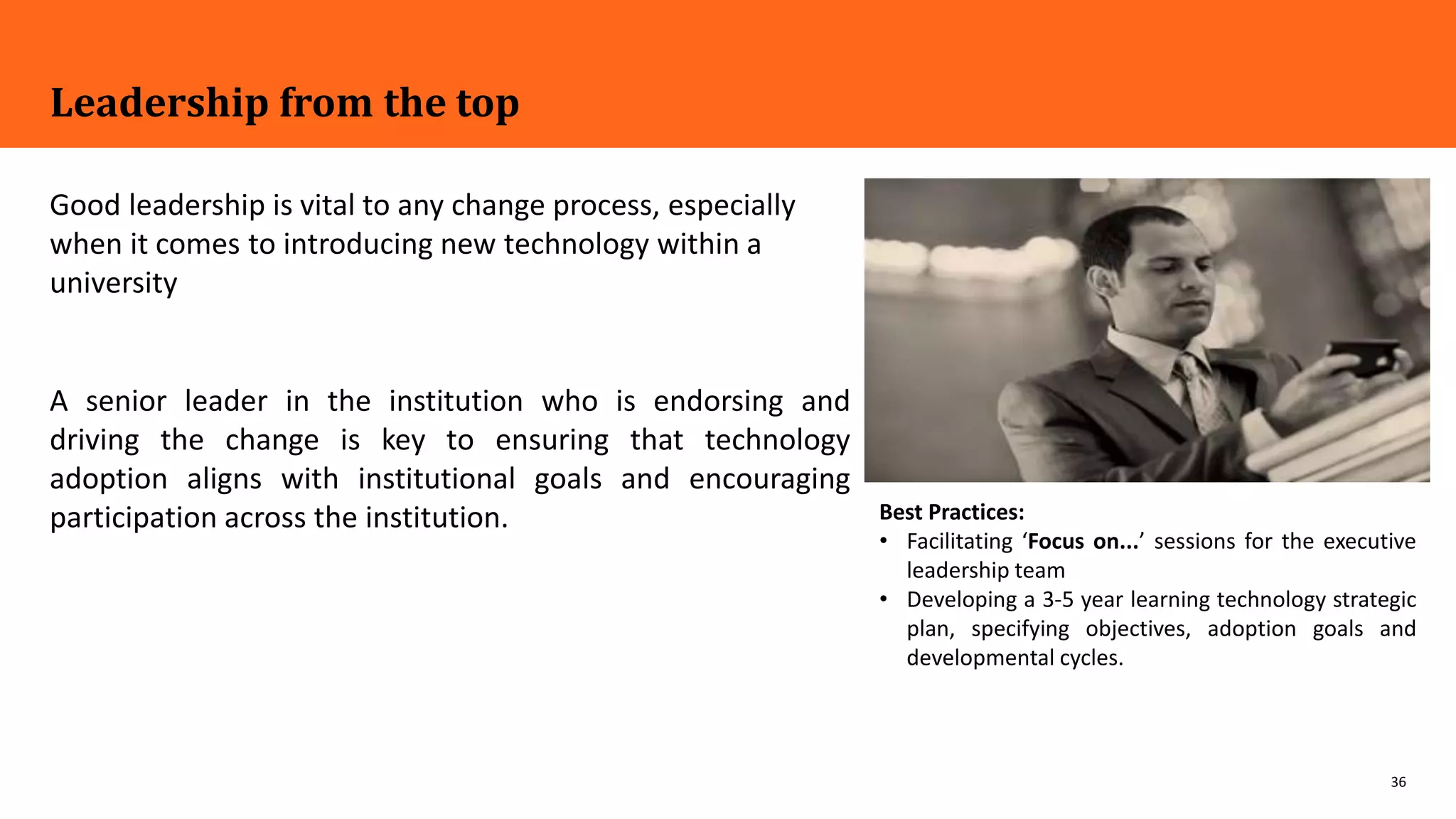
Leadership from the top
Good leadership is vital to any change process, especially
when it comes to introducing new technology within a
university
A senior leader in the institution who is endorsing and
driving the change is key to ensuring that technology
adoption aligns with institutional goals and encouraging
participation across the institution. Best Practices:
• Facilitating ‘Focus on...’ sessions for the executive
leadership team
• Developing a 3-5 year learning technology strategic
plan, specifying objectives, adoption goals and
developmental cycles.
37
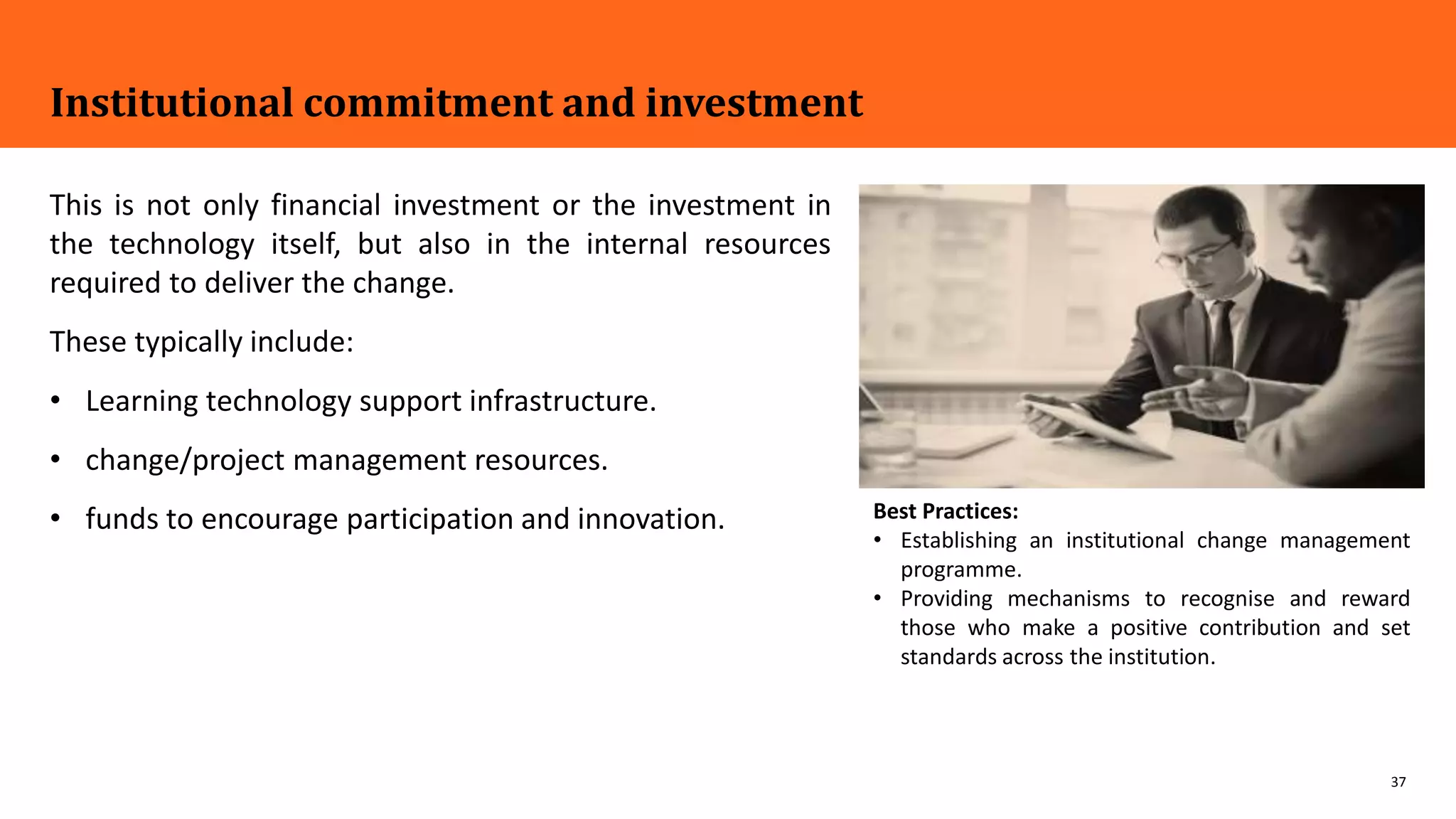
Institutional commitment and investment
This is not only financial investment or the investment in
the technology itself, but also in the internal resources
required to deliver the change.
These typically include:
• Learning technology support infrastructure.
• change/project management resources.
• funds to encourage participation and innovation. Best Practices:
• Establishing an institutional change management
programme.
• Providing mechanisms to recognise and reward
those who make a positive contribution and set
standards across the institution.
38
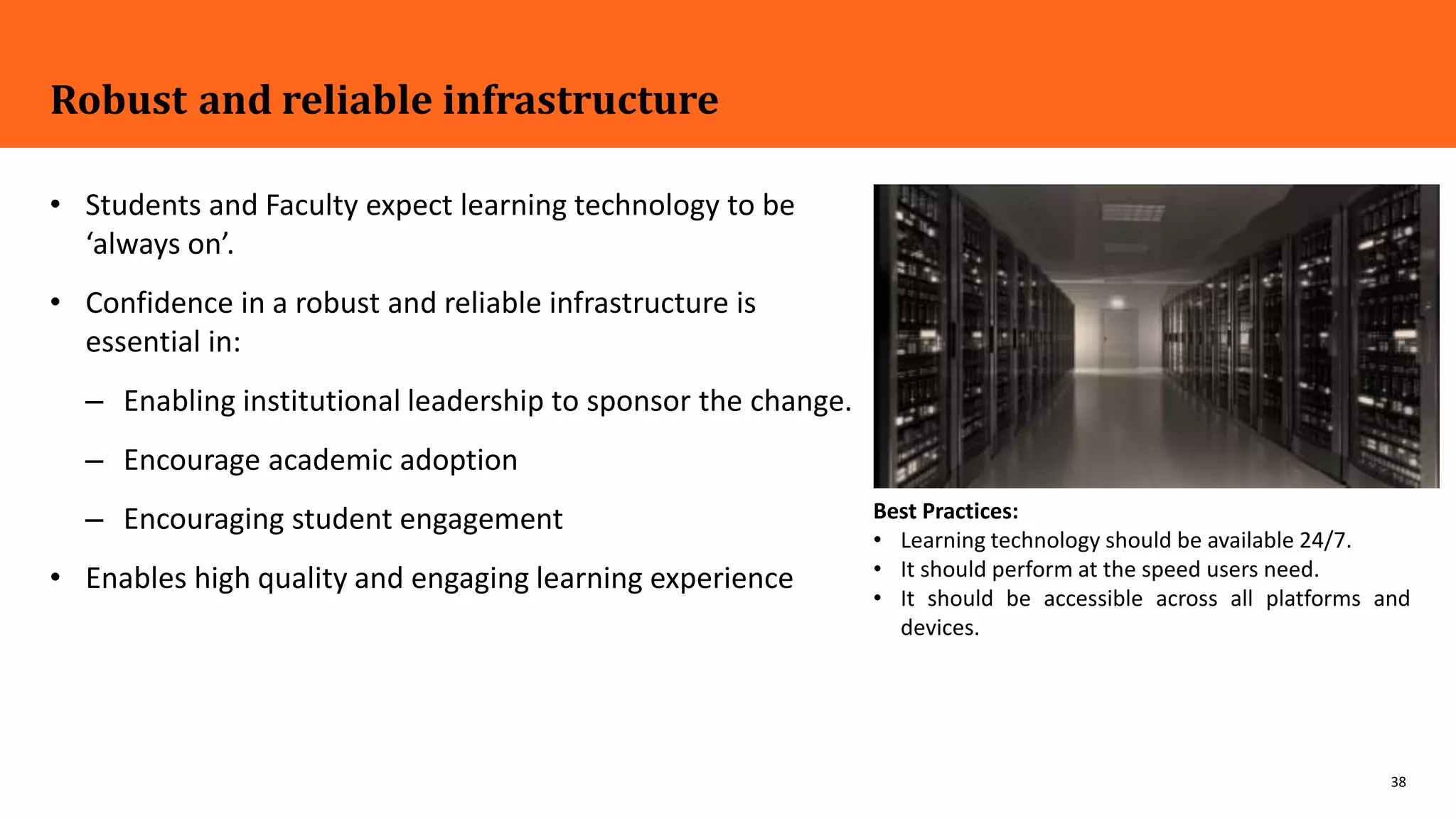
Robust and reliable infrastructure
• Students and Faculty expect learning technology to be
‘always on’.
• Confidence in a robust and reliable infrastructure is
essential in:
– Enabling institutional leadership to sponsor the change.
– Encourage academic adoption
– Encouraging student engagement
• Enables high quality and engaging learning experience
Best Practices:
• Learning technology should be available 24/7.
• It should perform at the speed users need.
• It should be accessible across all platforms and
devices.
39
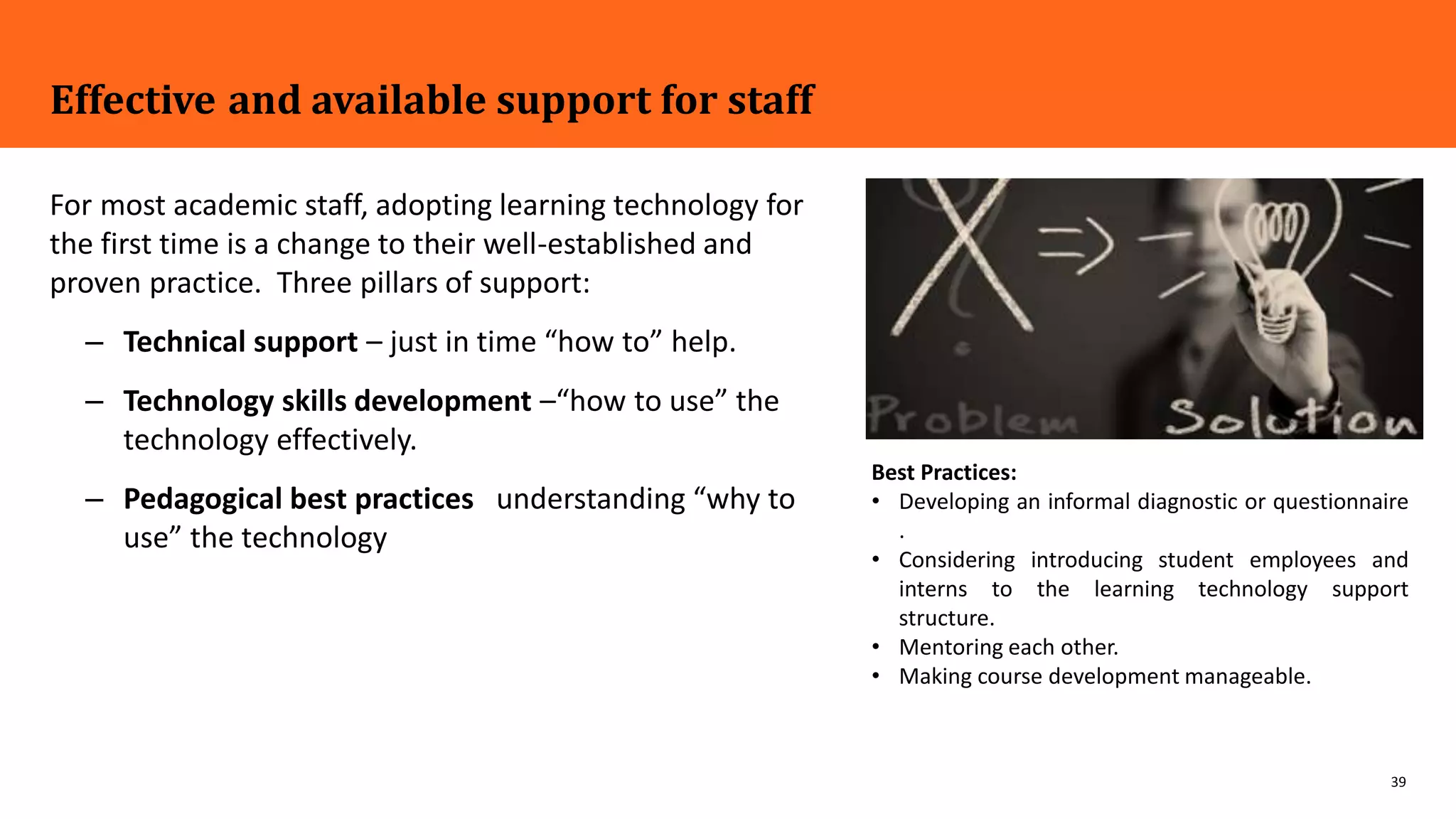
Effective and available support for staff
For most academic staff, adopting learning technology for
the first time is a change to their well-established and
proven practice. Three pillars of support:
– Technical support – just in time “how to” help.
– Technology skills development –“how to use” the
technology effectively.
– Pedagogical best practices understanding “why to
use” the technology
Best Practices:
• Developing an informal diagnostic or questionnaire
.
• Considering introducing student employees and
interns to the learning technology support
structure.
• Mentoring each other.
• Making course development manageable.
40
Ability to demonstrate benefits to student learning and staff
experience
• It is vital that the impact and benefits to the
learner are considered as well as that of the
staff when adopting new technology.
• Perceive better than current practice:
– what’s in it for my students
– what’s in it for me
Best Practices:
• Collating and publishing “one paragraph” case
studies – In Video Format.
• Looking for quick wins that positively impact
the learner experience.
• Recognising them.
41
Evidence-based decision-making and a continuous cycle of
improvement
• Address weaknesses, achieve goals, extend
success.
• Resulting evidence can help:
– Celebrate successes
– Address weaknesses
– Identify effective approaches
– Secure continued funding or additional
resources
• Creating a cycle of continuous
improvement
Best Practices:
• Using learning analytics to measure the impact of
technology adoption .
• Gain insight into learner and staff performance .
42
Trends for success – lessons learned
Resources available
Guide:
• http://bbbb.blackboard.com/techn
ology_adoption_series
Webinar Series:
• http://bbbb.blackboard.com/Technolo
gyAdoptionAtSalford_Resources
• http://bbbb.blackboard.com/DrivingA
doptionAtRegentsUniversity_Resource
s
• http://bbbb.blackboard.com/SHUWeb
inar_Resources
• http://bbbb.blackboard.com/technolo
gy_adoption_series
43
Looking ahead – Next
Steps
44
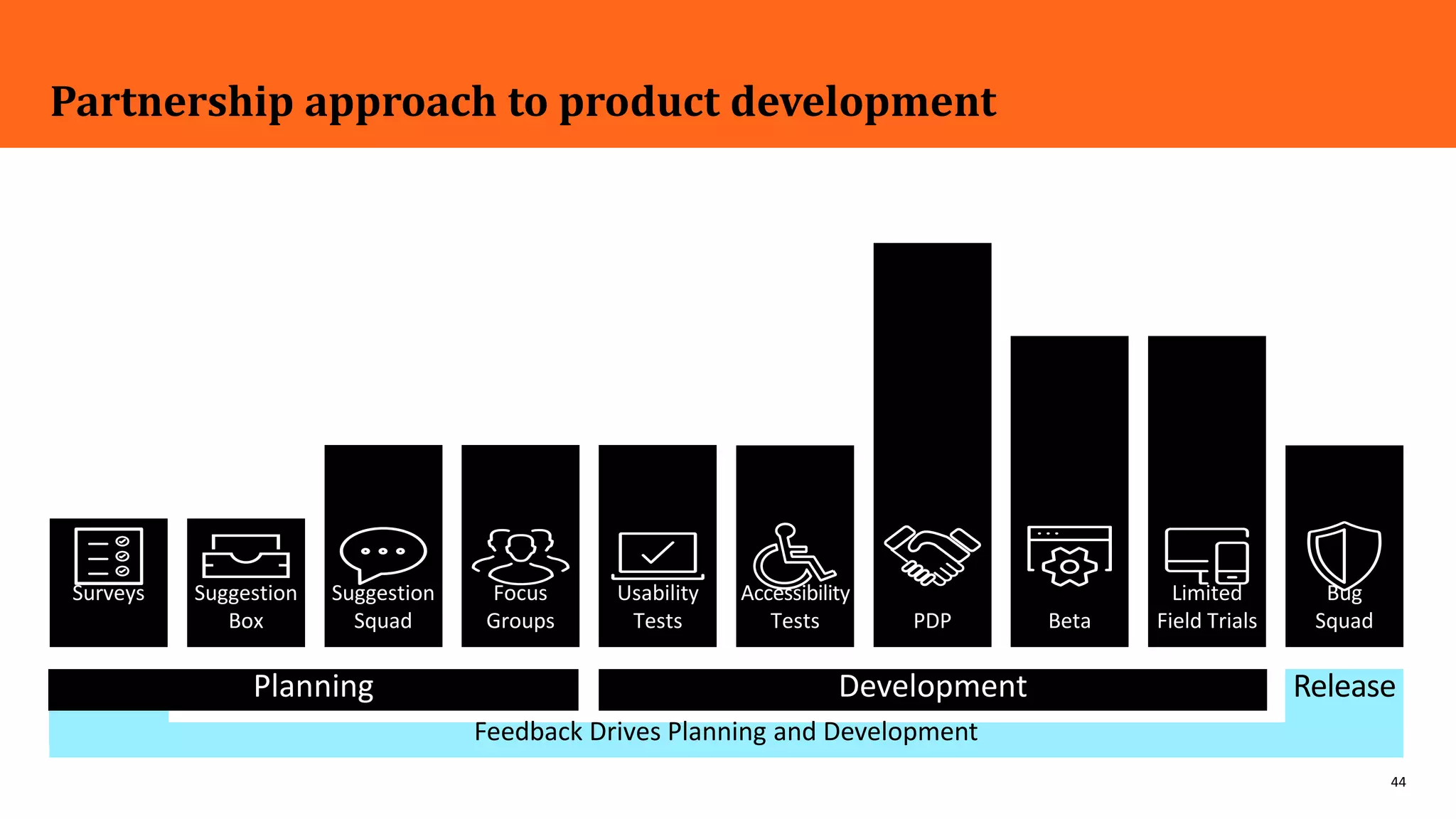
Feedback Drives Planning and Development
Release
BetaPDP
Usability
Tests
Limited
Field Trials
Accessibility
Tests
Focus
Groups
Suggestion
Squad
Suggestion
Box
Surveys Bug
Squad
Planning Development
Commitment&Impact
Partnership approach to product development
45
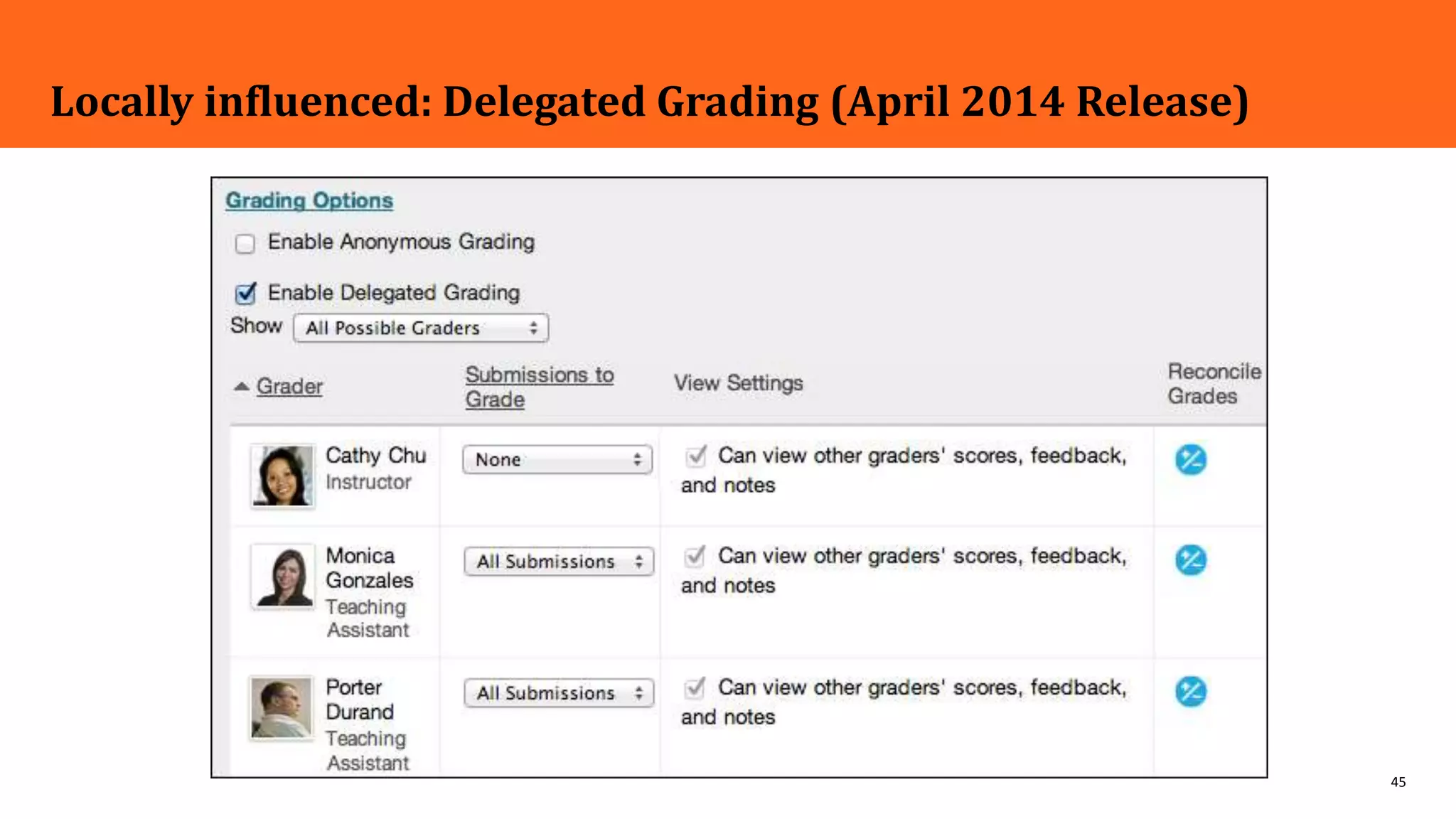
Locally influenced: Delegated Grading (April 2014 Release)
46
Grades Column
Provisioning
Locally influenced: Grades Journey (Q4 2015 Release)
Student Information System (SIS)
Grades
Exchange
Grades
Approval
&
Release
47
Shared Journey: Shared conversations - sharing stories
Learning about emerging challenges
48
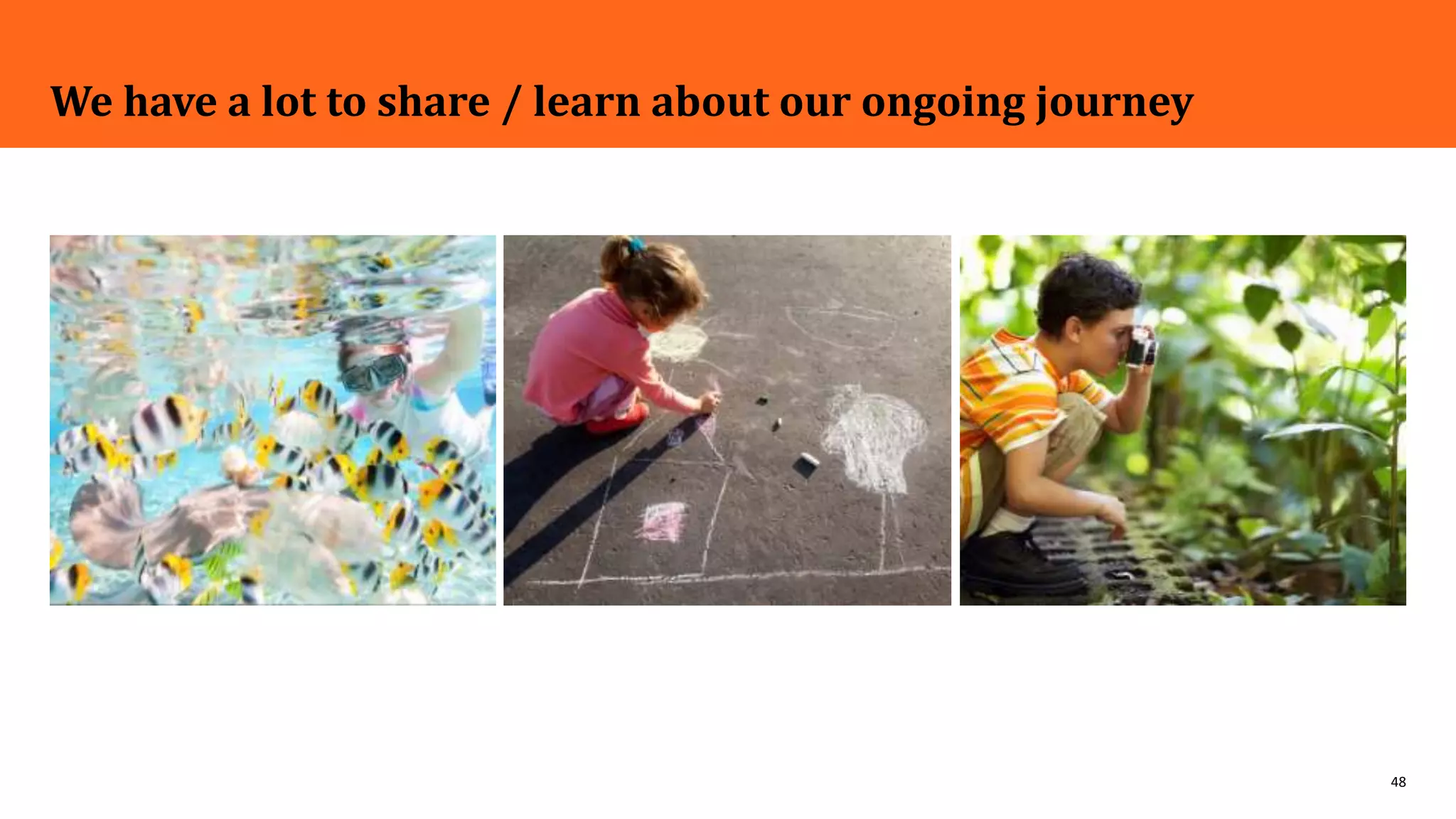
We have a lot to share / learn about our ongoing journey
49
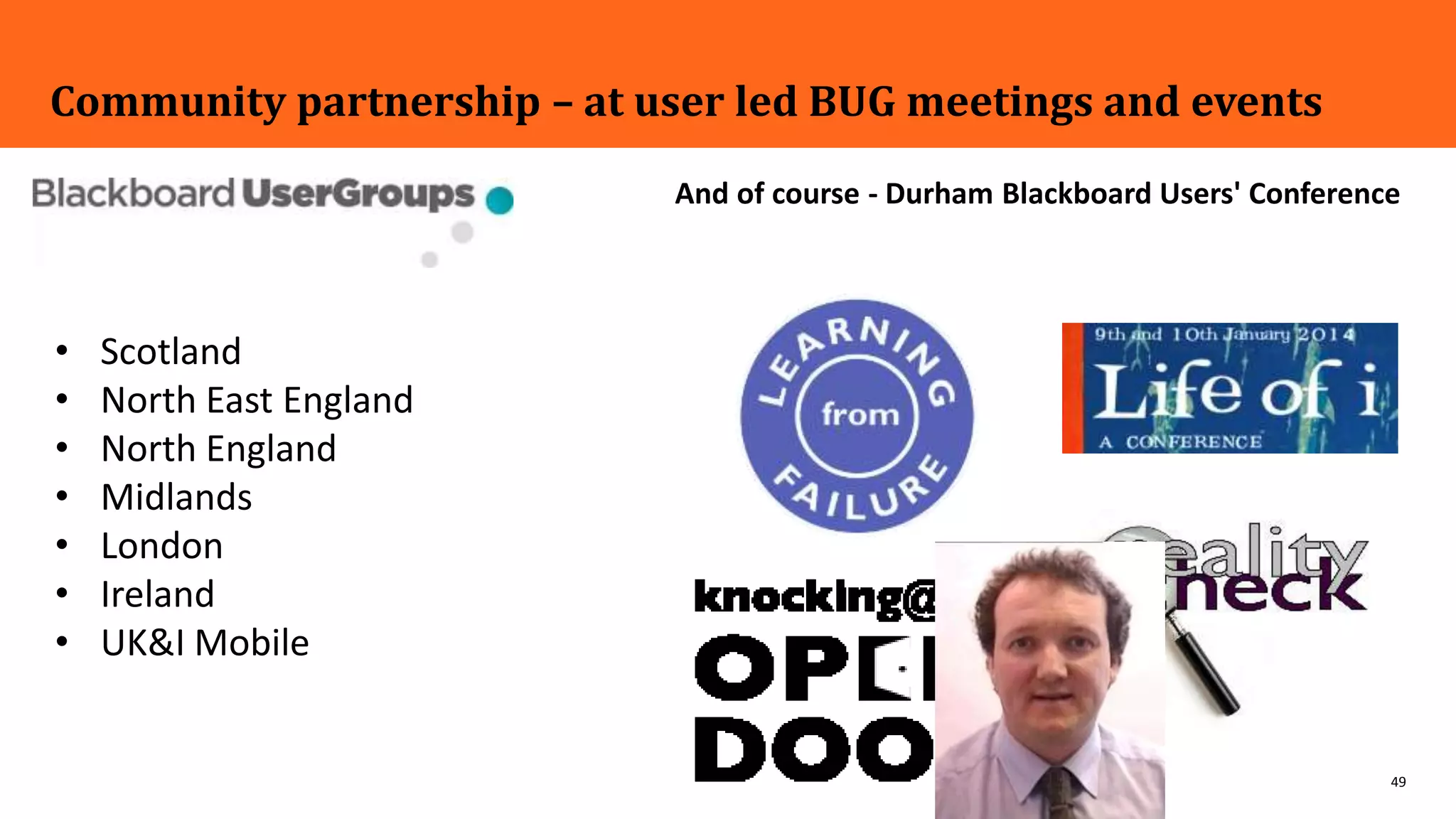
Community partnership – at user led BUG meetings and events
Draft Conference Progra
e-Learning: A Reality C
Conference Programme
• Scotland
• North East England
• North England
• Midlands
• London
• Ireland
• UK&I Mobile
And of course - Durham Blackboard Users' Conference
50
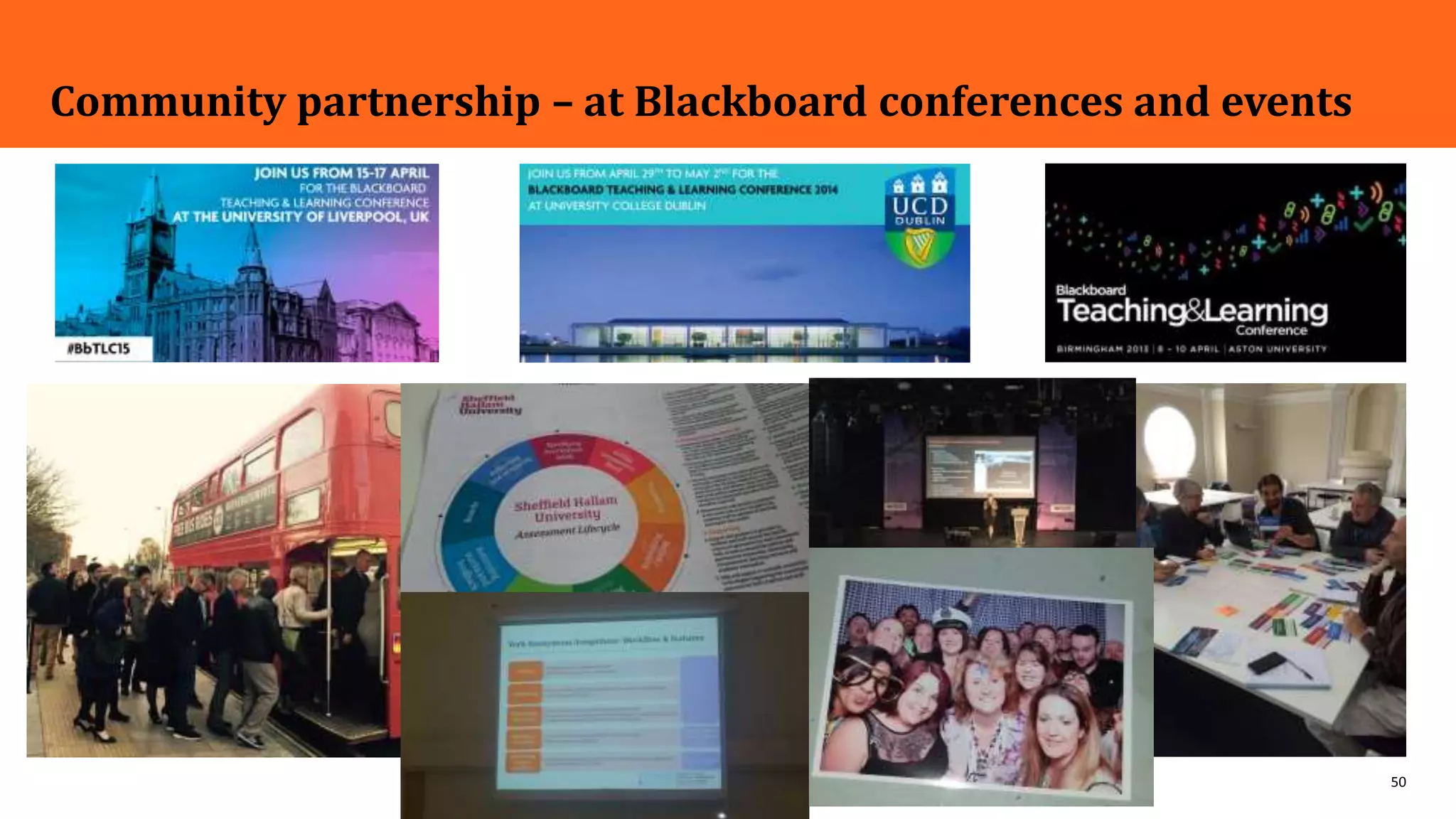
Community partnership – at Blackboard conferences and events
51
Deadline Extended: Submit your paper by Friday 15 January 2016
Visit: experience.blackboard.com/Groningen2016
52
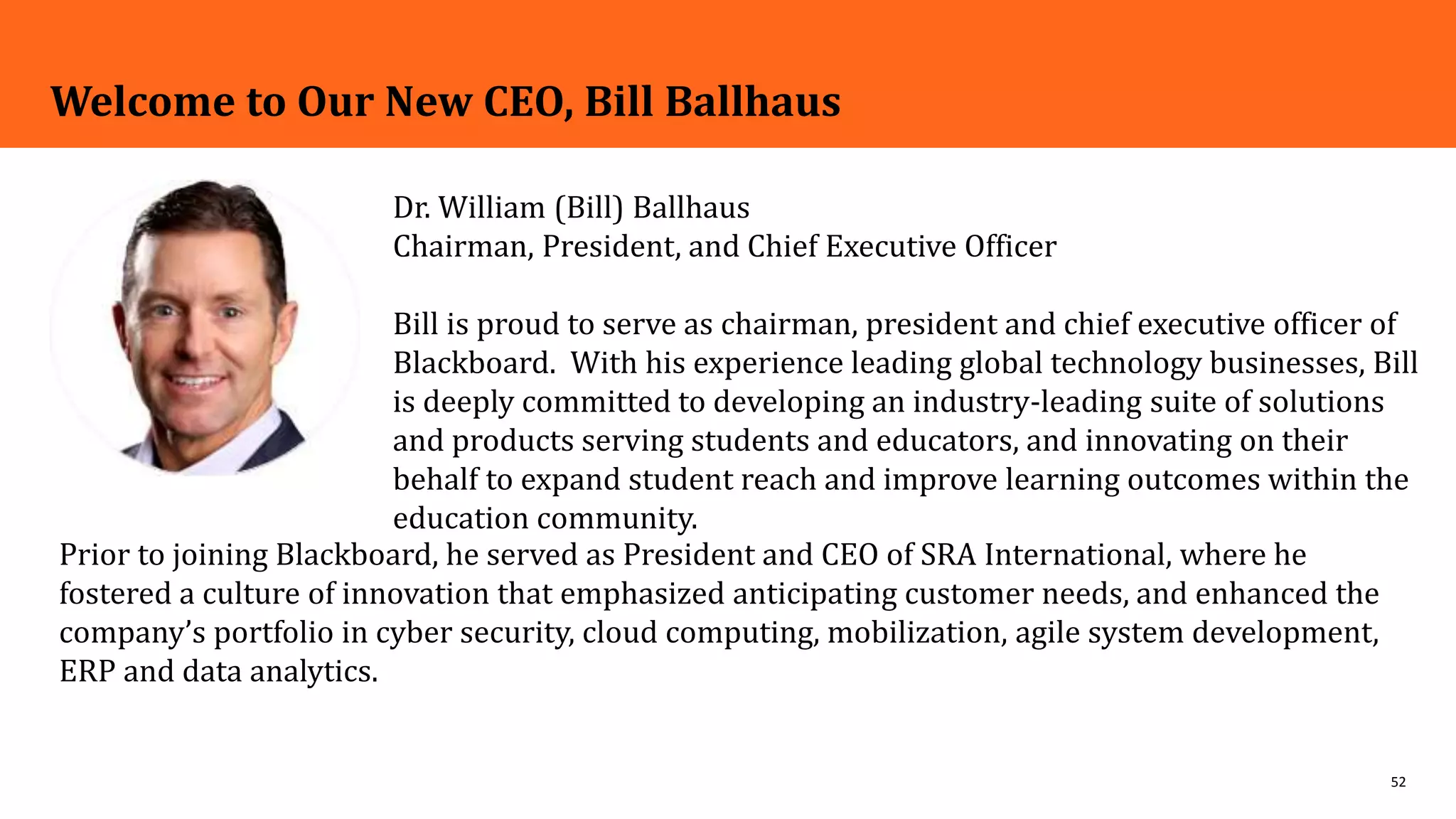
Welcome to Our New CEO, Bill Ballhaus
Dr. William (Bill) Ballhaus
Chairman, President, and Chief Executive Officer
Bill is proud to serve as chairman, president and chief executive officer of
Blackboard. With his experience leading global technology businesses, Bill
is deeply committed to developing an industry-leading suite of solutions
and products serving students and educators, and innovating on their
behalf to expand student reach and improve learning outcomes within the
education community.
Prior to joining Blackboard, he served as President and CEO of SRA International, where he
fostered a culture of innovation that emphasized anticipating customer needs, and enhanced the
company’s portfolio in cyber security, cloud computing, mobilization, agile system development,
ERP and data analytics.
 Learning from failure: The Blackboard Perspective

Learning from failure: The Blackboard Perspective

  • 1.
    Reflections on ashared journey. What lessons have we learned along the way? Alan Masson Head of Blackboard International Customer Success team
  • 2.
    2 About me Integrated... Interoperable...Institutional... Implementation... Institutional VLE - Library Integration at University of Ulster Re lections on a shared journey. What lessons have we learned along the way? Alan Masson Head of Blackboard Interna onal Customer Success team 2003 2016always
  • 3.
    3 Blackboard – along term partnership with our customers Copyright © 2004 Blackboard Inc. Some UK/Irish Customers (2004) ü University of Bradford ü Cardiff University ü University of Durham ü University College Galway ü University of Leicester ü University of Liverpool ü Liverpool John Moores ü University of Newcastle ü Northumbria University ü University of Reading ü University of Salford ü University of Aberdeen ü Abertay University ü UCLAN ü Edgehill University ü University of Edinburgh ü Imperial College ü Leeds Beckett University ü University of Manchester ü Queen Margaret University ü Trinity College Dublin ü University of Sheffield ü University of Stirling ü Ulster University
  • 4.
    4 Shared Journey –shared perspectives (some UK based Bb staff) Industry Management • Demetra Katsifli (Kingston University) Solutions Engineers • Dominic Gore (University College Birmingham) • Ashley Wright (Newcastle University) • Nathan Cobb (East Riding College) Customer Success • Alan Masson (University of Ulster) • Gillian Fielding (Salford University) Sales • Richard Burrows (Abertay University) • Paul Grist (University of Reading) Consulting • Louise Thorpe (Sheffield Hallam University) • Adrian Powell (University of Sheffield) • Stephen Clarke (University of Birmingham) • Andy Ramsden (Bristol, Bath & Suffolk) • Mike Highfield (University of Exeter )
  • 5.
    5 Consistent company focusalong the journey From 2004
  • 6.
  • 7.
    7 If we areon a journey – where are we trying to get to? Sector innovation Informing and influencing the wider sector Institutional innovation Delivering on institutional strategic aims / priorities Core essentials Meeting immediate needs of the institution Operational Risk Failing to meet the needs / expectations of the institution No usage Pilot Targeted initiatives/ early adopters Scaled adoption No formal alignment to key agendas Institutional adoption Formally aligned to key agendas Institutionalimpact/effectiveness Quality of Learning Flexible Learning Business Agility Education Innovation Growth in learner # Employability of learners Blackboard Adoption
  • 8.
    8 The institutional “journey”(Taken from a 2004 Bb presentation) Copyright © 2004 Blackboard Inc. Exploratory Time Educational Technology Framework Supported Strategic TransformativeMission Critical Transition 1 Phase I Phase 2 Phase 3 Phase 4 Phase 5 Transition 2 Transition 3 Transition 4 %ofInstitutionalUsers Maturity Model Still holds true today Identifies key transition points
  • 9.
    9 The institutional “journey”(Taken from a 2004 Bb presentation) Copyright © 2004 Blackboard Inc. Exploratory Time Educational Technology Framework Supported Strategic TransformativeMission Critical Transition 1 Phase I Phase 2 Phase 3 Phase 4 Phase 5 Transition 2 Transition 3 Transition 4 %ofInstitutionalUsers Are these transitions indicators of levels that we have achieved? Or Are they indicators of new areas of challenges to (continue to) be encountered?
  • 10.
    10 Threshold Concepts –prompted by Ray Land of Durham University • The engagement by the learner with an unfamiliar knowledge terrain and the ensuing reconceptualisation may involve a reconstitution of, or shift within, the learner’s subjectivity, and perhaps identity. • Ontological implications. Learning as ‘a change in subjectivity’. (Pelletier 2007).
  • 11.
    11 Threshold Concept Characteristics Copyright© 2004 Blackboard Inc. Exploratory Time Educational Technology Framework Supported Strategic TransformativeMission Critical Transition 1 Phase I Phase 2 Phase 3 Phase 4 Phase 5 Transition 2 Transition 3 Transition 4 %ofInstitutionalUsers • integrative • transformative • irreversible • bounded • re-constitutive • discursive • troublesome
  • 12.
    12 Let’s explore these adoptionthresholds in more detail
  • 13.
    13 Four Key Transitions Consolidation Missioncritical Enabling the wider organisation Institutional alignment
  • 14.
    14 Four Key Transitions Consolidation Missioncritical Enabling the wider organisation Institutional alignment
  • 15.
  • 16.
    16 We must continueto innovate and consolidate……..
  • 17.
    17 Establishing E-learning • Informinginnovation • Practice • Curriculum • Beyond the classroom • Institutional Impact Institutional alignment challenges Enhancing Practice • Scaling awareness and capacity • Focus on training and early wins Supporting Innovation • Focus on key agendas • Retention • Assessment • Fully online programmes • Identifying and sharing best practices
  • 18.
    18 What are thekey transition trends we are currently seeing?
  • 19.
    19 “Mission Critical” Robust andReliable Infrastructure
  • 20.
    20 IT ownership Robust andReliable Infrastructure Scaling the system • Move away from “servers under desks” • IT department support: • Resilient server • Trained staff • Quality network access • Data backups Current challenges? • Move from server to system architecture • Load balancers • Application servers • Database server • SAN Storage • BCP and DRM important issues
  • 21.
    21 Robust and ReliableInfrastructure – Customer Demands “The level of complexity increased with each migration; technical people had to spend significant amounts of time building up knowledge that would be rendered useless after the actual migration was complete.” “Our IT department was stretched thin, and we knew that we needed help if we were going to provide the level of support that our increasing user community would require ” “..to manage the increasing number of users more easily and to maintain the top quality student-facing services our university is renowned for, we needed a scalable, high-performing IT environment that could easily increase the amount of processing power available at critical times such as during assessments.”
  • 22.
    22 Robust and ReliableInfrastructure – Customer Benefits University of Groningen “Now that we don’t have to worry about the performance and up- time of our Blackboard platform, we can focus our efforts on other things,” University of Reading: “True 24x7x365: support, monitoring and problem resolution (3 x 8hr shifts) x 365 by a large team with a high level of expertise and experience” University of Brighton: “Spent lunchtime advocating Bb Managed Hosting, we haven't looked back! I sleep much better these days ” (tweet) MH hosting image here Blackboard Managed Hosting
  • 23.
    23 IT ownership • Beyondthe system • 24/7 user expectations • Responsiveness (technical and human) • Flexibility • Innovation and agility • Focus internal resources on enhancement of service Robust and Reliable Infrastructure – changing challenges Scaling the system • Move away from “servers under desks” • IT department support: • Resilient server • Trained staff • Quality network access • Data backups A service perspective • Move from server to system architecture • Load balancers • Application servers • Database server • SAN Storage • BCP and DRM becoming more important
  • 24.
  • 25.
  • 26.
    26 Blackboard - Education2020 Learner-centric education Non-traditional learners Big-data in mainstream Consumer-preferences/ alternative models Education truly global Online and mobile everywhere
  • 27.
    27 Trend 1: Enhancingexisting integrations Example: Student Information System • Initially: data provider to VLE • Demand: data return to SIS (student grades) • Bb Response – Grades Journey • Available in 2015 Q4 release Grades Column Provisioning The Work low Grades Exchange Student Information System (SIS) Grades Approval & Release Grades Exchange Automated Grade Synchronisation
  • 28.
    28 Trend 2: Re-useof features by other service departments Example: Blackboard Collaborate • Marketing – Virtual Open Days – University of Derby, University of Edinburgh • Virtual Doctorates – Aston University • Virtual Conferences – Salford University, Aston University • Staff training – Salford University
  • 29.
    29 Trend 3: Enhancedlearner access to other services / resources Example: Blackboard Community System • Key learner information, tools and resources – Personalised Bb home page: Sheffield Hallam, Leeds Beckett, Groningen, Durham • Student services: Careers / Library / Student Support / IT support – Personalised Bb tabs: Groningen, Sheffield Hallam, Leeds Beckett, Durham Also thru use of Content System and Enterprise Surveys • Quality Office (and University Committees) – Keele, Leeds (Liverpool John Moores, Reading, Salford)
  • 30.
    30 Trend 4: Informinnovation & realise organisational efficiency gains Example: Blackboard Consulting • Develop more efficient workflows and processes – University of the West of England • Understanding the scope for process efficiencies from a student’s point of view – Cardiff University • Establish a feedback hub – University of York • Quickly establish new institutional capacity – UEA, Trinity College Dublin • Use data to inform key business decisions – University of Derby Online, Groningen programme of transformation within the institution • “consistently be among the top 100 universities in the world and the top 20 in the UK’ • driving international and postgraduate recruitment • increasing international opportunities and • improving overall student satisfaction 6 United Kingdom Founded 1884 #182 - THE World Ranking 2015-16 28,500 students Blackboard* Assignment* Blackboard* Grade*Centre* ISIS* Marks* Valida9on* and* Import* Marks*and* Feedback** Tool* Student* Receipts* Offline* Marking* Tool* Grade* Mapping*Tool* Get*the* marks*into* ISIS*??* ISIS* Work*Item* Data** Extract* Create* Blackboard* Assignment* Extract*Marks* • Goal: to launch UEA Health Online by March 2015 • To iden fy the courses to be offered • To understand the requirements of the Faculty and the wider University • To have a pathway to profitability University of East Anglia Vision & Strategy Opportunity & Capabili es Analysis Business & Financial Modeling Opera ons Design & Repor ng Management & Governance Program Design Faculty Training & Development Instruc onal Design Course Development & Delivery Faculty Support Solu on Design & Development Learning Management Systems & Partners Social Learning & Collabora on Systems Integra on Security & Compliance Market Research Brand & Marke ng Strategy Crea ve Development Promo on & Lead Genera on Admissions Support & CRM Enrollment & Financial Aid Support Registra on & Orienta on Support 24X7 Help Desk Reten on & Student Success Career Placement
  • 31.
    31 Direct integrations Enabling freshapproaches • New ways of looking at things • New ways to do things • Building new capacity quickly • Blackboard Consulting Supporting the wider organisation (in summary) Re-gifting the benefits Enhancing existing collaborations • Classroom & system levels • Richer and deeper integrations • Grades Journey • Custom Building Blocks A fresh perspective Features Re-using tools & resources beyond the classroom (Marketing, Library, Quality Office) • Collaborate, Content / Community Systems Footprint Enhancing learner access to other services (Careers, Library, Student Support etc.) • Community System
  • 32.
    32 Reflections on this“journey” Copyright © 2004 Blackboard Inc. Exploratory Time Educational Technology Framework Supported Strategic TransformativeMission Critical Transition 1 Phase I Phase 2 Phase 3 Phase 4 Phase 5 Transition 2 Transition 3 Transition 4 %ofInstitutionalUsers Our journey will continue to bring new challenges from time to time We need to continue to learn from and manage these “troublesome threshold concepts”
  • 33.
    33 Looking back -what lessons have we learnt so far?
  • 34.
    34 Trends for success– lessons learned
  • 35.
    35 Characteristics of Success Leadershipfrom the top Institutional commitment and investment Robust and reliable infrastructure Effective and available support for academic staff Ability to demonstrate benefits to student learning and academic staff experience Evidence-informed decision making and a continuous cycle of improvement
  • 36.
    36 Leadership from thetop Good leadership is vital to any change process, especially when it comes to introducing new technology within a university A senior leader in the institution who is endorsing and driving the change is key to ensuring that technology adoption aligns with institutional goals and encouraging participation across the institution. Best Practices: • Facilitating ‘Focus on...’ sessions for the executive leadership team • Developing a 3-5 year learning technology strategic plan, specifying objectives, adoption goals and developmental cycles.
  • 37.
    37 Institutional commitment andinvestment This is not only financial investment or the investment in the technology itself, but also in the internal resources required to deliver the change. These typically include: • Learning technology support infrastructure. • change/project management resources. • funds to encourage participation and innovation. Best Practices: • Establishing an institutional change management programme. • Providing mechanisms to recognise and reward those who make a positive contribution and set standards across the institution.
  • 38.
    38 Robust and reliableinfrastructure • Students and Faculty expect learning technology to be ‘always on’. • Confidence in a robust and reliable infrastructure is essential in: – Enabling institutional leadership to sponsor the change. – Encourage academic adoption – Encouraging student engagement • Enables high quality and engaging learning experience Best Practices: • Learning technology should be available 24/7. • It should perform at the speed users need. • It should be accessible across all platforms and devices.
  • 39.
    39 Effective and availablesupport for staff For most academic staff, adopting learning technology for the first time is a change to their well-established and proven practice. Three pillars of support: – Technical support – just in time “how to” help. – Technology skills development –“how to use” the technology effectively. – Pedagogical best practices understanding “why to use” the technology Best Practices: • Developing an informal diagnostic or questionnaire . • Considering introducing student employees and interns to the learning technology support structure. • Mentoring each other. • Making course development manageable.
  • 40.
    40 Ability to demonstratebenefits to student learning and staff experience • It is vital that the impact and benefits to the learner are considered as well as that of the staff when adopting new technology. • Perceive better than current practice: – what’s in it for my students – what’s in it for me Best Practices: • Collating and publishing “one paragraph” case studies – In Video Format. • Looking for quick wins that positively impact the learner experience. • Recognising them.
  • 41.
    41 Evidence-based decision-making anda continuous cycle of improvement • Address weaknesses, achieve goals, extend success. • Resulting evidence can help: – Celebrate successes – Address weaknesses – Identify effective approaches – Secure continued funding or additional resources • Creating a cycle of continuous improvement Best Practices: • Using learning analytics to measure the impact of technology adoption . • Gain insight into learner and staff performance .
  • 42.
    42 Trends for success– lessons learned Resources available Guide: • http://bbbb.blackboard.com/techn ology_adoption_series Webinar Series: • http://bbbb.blackboard.com/Technolo gyAdoptionAtSalford_Resources • http://bbbb.blackboard.com/DrivingA doptionAtRegentsUniversity_Resource s • http://bbbb.blackboard.com/SHUWeb inar_Resources • http://bbbb.blackboard.com/technolo gy_adoption_series
  • 43.
  • 44.
    44 Feedback Drives Planningand Development Release BetaPDP Usability Tests Limited Field Trials Accessibility Tests Focus Groups Suggestion Squad Suggestion Box Surveys Bug Squad Planning Development Commitment&Impact Partnership approach to product development
  • 45.
    45 Locally influenced: DelegatedGrading (April 2014 Release)
  • 46.
    46 Grades Column Provisioning Locally influenced:Grades Journey (Q4 2015 Release) Student Information System (SIS) Grades Exchange Grades Approval & Release
  • 47.
    47 Shared Journey: Sharedconversations - sharing stories Learning about emerging challenges
  • 48.
    48 We have alot to share / learn about our ongoing journey
  • 49.
    49 Community partnership –at user led BUG meetings and events Draft Conference Progra e-Learning: A Reality C Conference Programme • Scotland • North East England • North England • Midlands • London • Ireland • UK&I Mobile And of course - Durham Blackboard Users' Conference
  • 50.
    50 Community partnership –at Blackboard conferences and events
  • 51.
    51 Deadline Extended: Submityour paper by Friday 15 January 2016 Visit: experience.blackboard.com/Groningen2016
  • 52.
    52 Welcome to OurNew CEO, Bill Ballhaus Dr. William (Bill) Ballhaus Chairman, President, and Chief Executive Officer Bill is proud to serve as chairman, president and chief executive officer of Blackboard. With his experience leading global technology businesses, Bill is deeply committed to developing an industry-leading suite of solutions and products serving students and educators, and innovating on their behalf to expand student reach and improve learning outcomes within the education community. Prior to joining Blackboard, he served as President and CEO of SRA International, where he fostered a culture of innovation that emphasized anticipating customer needs, and enhanced the company’s portfolio in cyber security, cloud computing, mobilization, agile system development, ERP and data analytics.

Editor's Notes

  • #4 WebCT customers: Manchester Sheffield Ulster Abertay GCU? Aberdeen Edinburgh QMU Imperial Edgehill Ulclan Uel Leeds beckett
  • #36 This is the overview of the characteristics of success – quick one/two sentence definitions Strong Executive sponsorship – a senior leader in the institution who is endorsing and driving the change – typically an academic leader with responsibility for education and/or students learning Institutional commitment – both in terms of financial investment and allocation of resources and, importantly, acknowledgement that work to develop e-learning is valid activities for teachers and is recognised in work planning and status For staff and students, increasing online activity carries with it an element of risk – the technology needs to be available 24/7 and performing effectively, so ensuring that there is a robust and reliable infrastructure is important to minimise that risk For most teachers technology is a change to their practice and asks them to step away from the comfort of the familiar. For effective adoption by teachers, it is essential that there is effective and available teacher support in the form of training, ad hoc support and self-help resources. When adopting technology, teachers need to feel that the change is purposeful and not just a change for change sake – successful institutions understand the value of technology to support student learning and the benefits to the teachers themselves – these institutions draw on models and best practices from across the globe and from within their own experiences. Successful institutions understand why they are making changes - they gather evidence to inform future decisions - user experiences, performance metrics, process improvements and they understand that change is a cycle where there is always scope for further improvement
  • #37 Techniques institutions employ Facilitating ‘Focus on...’ sessions for the executive leadership team. These are effective forums for exploring and clarifying the benefits of new technology among senior managers. Developing a 3-5 year learning technology strategic plan, specifying objectives, adoption goals and developmental cycles.
  • #38 Establishing an institutional change management programme led by a senior executive that supports the academic community through the transition. Providing mechanisms to recognise and reward those who make a positive contribution and set standards across the institution.
  • #39 Students and staff expect learning technology to be ‘always on’, providing access to the resources and activities they need when they need them.
  • #40 For most academic staff, adopting learning technology is to step away from well-established and proven practice.   Another key trend is the increase in focus on understanding the support needs and baseline digital skills of academic staff. This is a really helpful way of being able to tailor support to key needs and to ensure that it is pitched at the right level.   Blackboard Recommends >   Developing an informal diagnostic or quick questionnaire - to help understand the need of academic staff at your institution. Considering introducing student employees and interns to your learning technology support structure – they are a great way of supporting staff and have excellent insights into what works well. Mentoring each other - recruit early adopters as mentors to academics who are just starting out. Administrators and department chairs can use the technology themselves and serve as role models. Visiting our YouTube channel - it is full of resources and training material to help you get more from your Blackboard environment. Assisting quickly - provide links to your campus help desk, open office hours, and to Blackboard Help and Videos. Make sure that academics have a channel to report and resolve technical difficulties quickly. Training online - academics can enjoy the flexibility of online learning and experience what students experience. If you don't have time to develop your own online training from scratch, Blackboard offers training solutions that include ready-made online and face-to-face training bundles that you can customise and deliver on your campus. Making course development manageable - Create a reasonable timeline for development and support academics continuously during the process. Provide release time for course development, allow academics to start with a hybrid course before going fully online, and provide course designers who build courses for instructors. Learn from others by attending events - spend some time thinking through what topics, techniques, and tools are important to the teaching and learning process. This can include your own perspectives, things you have learnt at conferences, Blackboard user groups or the Blackboard Teaching and Learning Conference.   This is a long list – and I like everything in it – but I worry that it makes it look like we didn’t have enough ideas in the other sections when we’ve kept them to 2 or 3 – perhaps we could stick t to 2 or 3 and have a catch all at the end of the whole ebook regarding our engagement potential. I’d suggest keeping 1, 2, 3 and 7 – and add into did you know – the youtube, bb videos, training and events
  • #41 Collating and publishing “one paragraph” case studies - in video format that capture real world examples from within your institution showing how the application of learning technology has impacted on student learning and/or the staff experience. Looking for quick wins that positively impact the learner experience – identify how the technology directly affects students and show academics how it helps students succeed and improves workflow. Use data to prove the case. Recruiting champions and convert the laggards - empower the technology champions to sway their peers, but also find a academics or staff who are the primary voice of resistance and meet with them. Discuss how greater adoption of technology can aid in student success and help meet student expectations to help convert them to advocates. Recognising them - acknowledge academics who are doing exemplary work through awards, articles, tweets, and other channels available at your institution. Point out the positives - when teaching online, they can enjoy a new teaching paradigm with more flexibility, more student contact, and more data to base course improvement decisions on. This can be part of your marketing communications plan, and you can include some stories about academics who are innovating and benefiting from it.
  • #42 Build capacity and skills to enhance evidence-based decision-making, budget planning, and resource allocation
  • #52 Topics: The content of your submission should relate to the use of Blackboard technologies to solve challenges on and off campus. Looking for ideas? Here are some suggestions: Blended Learning Create more flexibility and increase interaction to keep students engaged. The Evolving Education Ecosystem Highlight your thoughts and examples of how education can be more agile, scalable, and engaging. Online assessment & feedback Share how your institution has implemented its assessment journey to enhance the education experience and improve institutional effectiveness. Delivering a personalised learning experience Share examples of where you have personalised aspects of your online provision, so students experience an engaging ‘one stop’ environment to meet all their needs. Data and Analytics Share your ideas on using data for education. Capturing, analyzing, and using relevant data can determine the value of education better than ever. What are your ideas? Academic Adoption For most academic staff, adopting learning technology for the first time is a change to their well-established and proven practice. Share strategies about how you have got academics to step away from the comfort of the familiar and try something new. How did you provide them with effective and available support? Share your stories. The format of your session can be a 45-minute presentation or panel discussion, a 90-minute workshop, or a virtual poster session.