Litigation: {Data, Theory, Process, & Practice}
Michigan State University College of Law
Using Decision Trees and Settlement Evaluations to
Manage Litigation, Counsel Clients, and Improve Outcomes
Daniel W. Linna Jr.
@DanLinna
February 2014
This presentation provides general information only and does not constitute legal advice for any particular situation.
Learning Goals
 Decision Trees
 Strategic Settlement
 Client Counseling
2
Syllabus: Reading
• Jeffrey M. Senger, Analyzing Risk in The Negotiator’s Fieldbook: A Deskbook for the Experienced
Negotiator, Chapter 51 (2006)
• Marc B. Victor, Craig B. Glidden, Clyde W. Lea & J. Bryan Whitworth, Evaluating Legal Risk and
Cost with Decision Tree Analysis
• Marcellus A. McRae and Kahn A. Scolnick, Case Assessment and Evaluation, Practical Law
Company Practice Note (2013)
Optional reading:
• Lefki Giannopoulou & Gavin Lawrence, Making Better Litigation Decisions Through the Use of
Decision and Risk Analysis (2002)
• Craig W. Kirkwood, Decision Tree Primer (2002)
• Marc Victor, Interpreting a Decision Tree Analysis of a Lawsuit (2001)
• Robert B. Calihan & John R. Dent, The Role of Risk Analysis in Dispute and Litigation Management,
American Bar Association, Forum on Franchising (2004)
• Alexander I Poltorak & Paul J Lerner, Introducing Litigation Risk Analysis, Managing Intellectual
Property (May 2001)
3
Why use a Decision Tree?
 Identify legal issues
 Identify evidence
 Determine client values and objectives
 Forecast fees and (all) costs
 Allocate resources
 Formulate a settlement strategy (early)
 Communication – “Level Set”
 Better serve clients
4
Dollar Hypothetical*
 Your client, Dollar Cup o’ Coffee, is an
aggressive franchisor
 Franchise agreements provide for
mandatory arbitration
 Dollar contracted with the Smith Firm
for Smith to litigate all arbitrations with
franchisees
*This hypothetical is not based on any pending or completed case and is introduced for educational purposes only. Nothing
in this presentation constitutes legal advice for any particular situation.
5
Dollar-Smith Contract
 Smith will handle all arbitrations between Dollar
and its franchisees for a flat fee of $100,000 per
arbitration (payable upon completion of the
arbitration) for 5 years beginning January 1, 2010.
 Dollar may terminate this contract before the
expiration of its term if Dollar determines, in its
sole discretion, that Smith’s performance of legal
services has been unsatisfactory.
6
The January 2011 Class Action
 Ten franchisees filed a class-action lawsuit against
Dollar for fraudulent inducement.
 The franchise agreement is unclear whether the
parties agreed to class-action arbitrations.
 Dollar (acting on Smith’s advice) successfully moved
to dismiss the class action on the grounds that the
franchise agreement required a class-action
arbitration.
 Smith, after about 200 hours of work, got the class-
action arbitration claims dismissed as a matter of law
(failure to state a claim for fraudulent inducement).
7
Smith’s Demand
 In December 2011, Smith invoiced Dollar
$1,000,000 for the class-action arbitration.
 Dollar rejected the invoice, and offered Smith
$100,000 for handling the arbitration.
 Discussions broke down.
 On December 31, 2011, Dollar terminated Smith
for unsatisfactory performance of legal services.
8
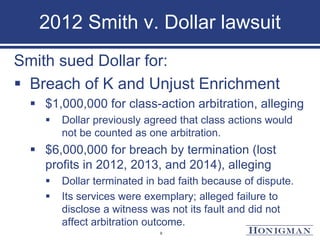
2012 Smith v. Dollar lawsuit
Smith sued Dollar for:
 Breach of K and Unjust Enrichment
 $1,000,000 for class-action arbitration, alleging
 Dollar previously agreed that class actions would
not be counted as one arbitration.
 $6,000,000 for breach by termination (lost
profits in 2012, 2013, and 2014), alleging
 Dollar terminated in bad faith because of dispute.
 Its services were exemplary; alleged failure to
disclose a witness was not its fault and did not
affect arbitration outcome.
9
Dependency Diagrams
 Use dependency diagrams to capture
the relationship between the issues.
 What are the issues?
10
Class Action
 Will the judge grant SJ that, under the
“unambiguous” agreement, a class-
action arbitration = one arbitration?
 If not, what factors will influence a
jury?
11
Termination
 Will the judge grant SJ that Dollar
appropriately exercised its discretion
when it terminated its contract with
Smith?
 If not, what facts will influence the
jury?
12
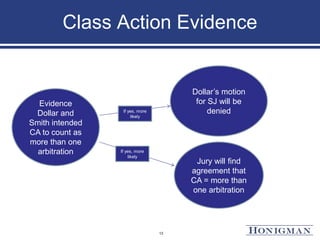
Class Action Evidence
13
Evidence
Dollar and
Smith intended
CA to count as
more than one
arbitration
Dollar’s motion
for SJ will be
denied
Jury will find
agreement that
CA = more than
one arbitration
If yes, more
likely
If yes, more
likely
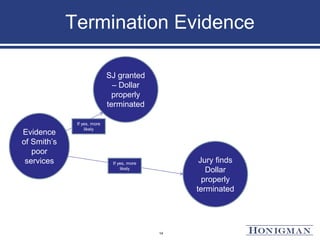
Termination Evidence
14
Evidence
of Smith’s
poor
services
SJ granted
– Dollar
properly
terminated
Jury finds
Dollar
properly
terminated
If yes, more
likely
If yes, more
likely
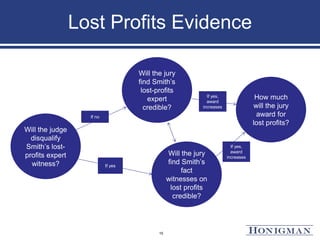
Lost Profits Evidence
15
Will the judge
disqualify
Smith’s lost-
profits expert
witness?
Will the jury
find Smith’s
lost-profits
expert
credible?
Will the jury
find Smith’s
fact
witnesses on
lost profits
credible?
How much
will the jury
award for
lost profits?
If no
If yes
If yes,
award
increases
If yes,
award
increases
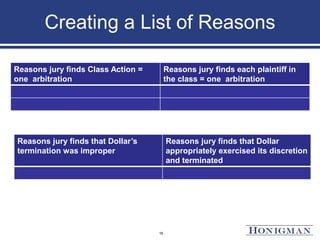
Creating a List of Reasons
Reasons jury finds Class Action =
one arbitration
Reasons jury finds each plaintiff in
the class = one arbitration
16
Reasons jury finds that Dollar’s
termination was improper
Reasons jury finds that Dollar
appropriately exercised its discretion
and terminated
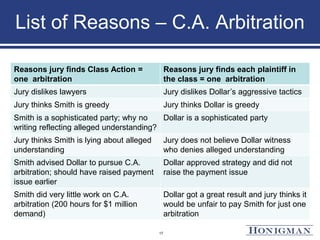
List of Reasons – C.A. Arbitration
Reasons jury finds Class Action =
one arbitration
Reasons jury finds each plaintiff in
the class = one arbitration
Jury dislikes lawyers Jury dislikes Dollar’s aggressive tactics
Jury thinks Smith is greedy Jury thinks Dollar is greedy
Smith is a sophisticated party; why no
writing reflecting alleged understanding?
Dollar is a sophisticated party
Jury thinks Smith is lying about alleged
understanding
Jury does not believe Dollar witness
who denies alleged understanding
Smith advised Dollar to pursue C.A.
arbitration; should have raised payment
issue earlier
Dollar approved strategy and did not
raise the payment issue
Smith did very little work on C.A.
arbitration (200 hours for $1 million
demand)
Dollar got a great result and jury thinks it
would be unfair to pay Smith for just one
arbitration
17
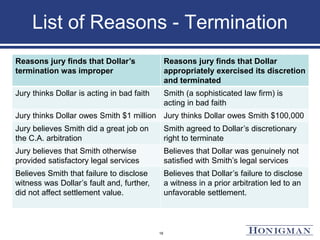
List of Reasons - Termination
18
Reasons jury finds that Dollar’s
termination was improper
Reasons jury finds that Dollar
appropriately exercised its discretion
and terminated
Jury thinks Dollar is acting in bad faith Smith (a sophisticated law firm) is
acting in bad faith
Jury thinks Dollar owes Smith $1 million Jury thinks Dollar owes Smith $100,000
Jury believes Smith did a great job on
the C.A. arbitration
Smith agreed to Dollar’s discretionary
right to terminate
Jury believes that Smith otherwise
provided satisfactory legal services
Believes that Dollar was genuinely not
satisfied with Smith’s legal services
Believes Smith that failure to disclose
witness was Dollar’s fault and, further,
did not affect settlement value.
Believes that Dollar’s failure to disclose
a witness in a prior arbitration led to an
unfavorable settlement.
Probabilities
 What other factors influence
probabilities?
19
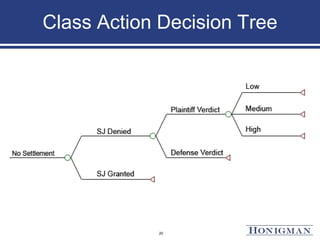
Class Action Decision Tree
20
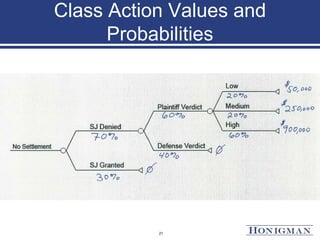
Class Action Values and
Probabilities
21
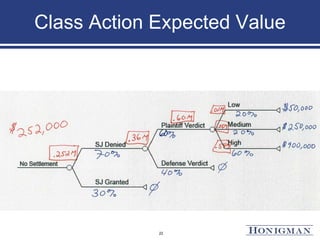
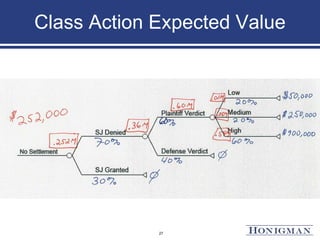
Class Action Expected Value
22
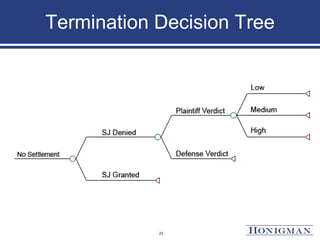
Termination Decision Tree
23
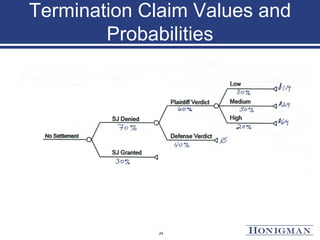
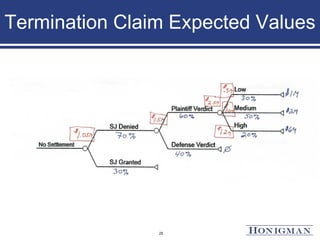
Termination Claim Values and
Probabilities
24
Termination Claim Expected Values
25
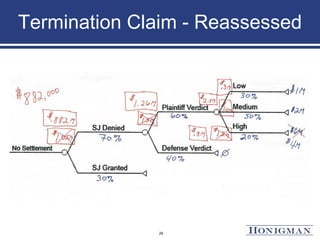
Reassess Values and Probabilities
 Verdict Ranges:
 High – best guess for 90th percentile
 Middle – best guess for 50th percentile
 Low – best guess for 10th percentile
For a normal distribution, the mean of the top quartile is very
close to the 90th percentile; the mean of the bottom quartile is
very close to the 10th percentile.
26
Class Action Expected Value
27
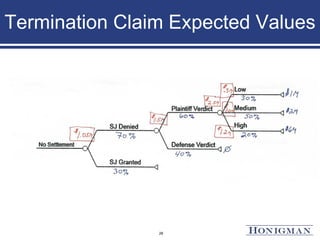
Termination Claim Expected Values
28
Termination Claim - Reassessed
29
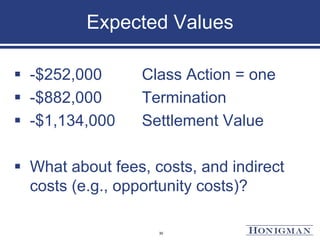
Expected Values
 -$252,000 Class Action = one
 -$882,000 Termination
 -$1,134,000 Settlement Value
 What about fees, costs, and indirect
costs (e.g., opportunity costs)?
30
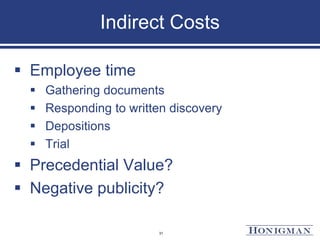
Indirect Costs
 Employee time
 Gathering documents
 Responding to written discovery
 Depositions
 Trial
 Precedential Value?
 Negative publicity?
31
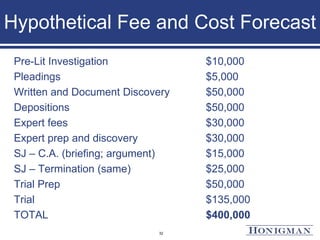
Hypothetical Fee and Cost Forecast
Pre-Lit Investigation $10,000
Pleadings $5,000
Written and Document Discovery $50,000
Depositions $50,000
Expert fees $30,000
Expert prep and discovery $30,000
SJ – C.A. (briefing; argument) $15,000
SJ – Termination (same) $25,000
Trial Prep $50,000
Trial $135,000
TOTAL $400,000
32
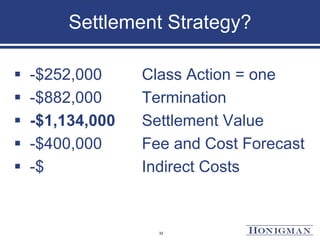
Settlement Strategy?
 -$252,000 Class Action = one
 -$882,000 Termination
 -$1,134,000 Settlement Value
 -$400,000 Fee and Cost Forecast
 -$ Indirect Costs
33
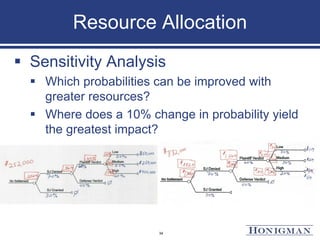
Resource Allocation
 Sensitivity Analysis
 Which probabilities can be improved with
greater resources?
 Where does a 10% change in probability yield
the greatest impact?
34
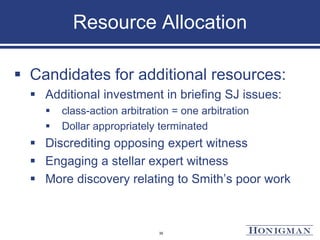
Resource Allocation
 Candidates for additional resources:
 Additional investment in briefing SJ issues:
 class-action arbitration = one arbitration
 Dollar appropriately terminated
 Discrediting opposing expert witness
 Engaging a stellar expert witness
 More discovery relating to Smith’s poor work
35
As Case Progresses
 Update probabilities and expected values
 Remember: you are assessing the likelihood of a range
of potential outcomes; not predicting a particular
outcome
 Continue to reassess litigation strategy and
resource allocation to improve outcomes
 Update fee and cost forecasts
 Continue to communicate with your client about
the impact various events will have on the case’s
settlement value
36
Questions
Quantitative Methods for Lawyers
Michigan State University College of Law
Using Decision Trees and Settlement Evaluations to Manage
Litigation, Counsel Clients, and Improve Outcomes
Daniel W. Linna Jr.
@DanLinna
February 2014
37

Using Decision Trees and Settlement Evaluations to Manage Litigation, Counsel Clients, and Improve Outcomes – Professor Daniel W. Linna Jr. - Litigation: {Data, Theory, Process, & Practice} – ReInvent Law Michigan State University College of Law

  • 1.
    Litigation: {Data, Theory,Process, & Practice} Michigan State University College of Law Using Decision Trees and Settlement Evaluations to Manage Litigation, Counsel Clients, and Improve Outcomes Daniel W. Linna Jr. @DanLinna February 2014 This presentation provides general information only and does not constitute legal advice for any particular situation.
  • 2.
    Learning Goals  DecisionTrees  Strategic Settlement  Client Counseling 2
  • 3.
    Syllabus: Reading • JeffreyM. Senger, Analyzing Risk in The Negotiator’s Fieldbook: A Deskbook for the Experienced Negotiator, Chapter 51 (2006) • Marc B. Victor, Craig B. Glidden, Clyde W. Lea & J. Bryan Whitworth, Evaluating Legal Risk and Cost with Decision Tree Analysis • Marcellus A. McRae and Kahn A. Scolnick, Case Assessment and Evaluation, Practical Law Company Practice Note (2013) Optional reading: • Lefki Giannopoulou & Gavin Lawrence, Making Better Litigation Decisions Through the Use of Decision and Risk Analysis (2002) • Craig W. Kirkwood, Decision Tree Primer (2002) • Marc Victor, Interpreting a Decision Tree Analysis of a Lawsuit (2001) • Robert B. Calihan & John R. Dent, The Role of Risk Analysis in Dispute and Litigation Management, American Bar Association, Forum on Franchising (2004) • Alexander I Poltorak & Paul J Lerner, Introducing Litigation Risk Analysis, Managing Intellectual Property (May 2001) 3
  • 4.
    Why use aDecision Tree?  Identify legal issues  Identify evidence  Determine client values and objectives  Forecast fees and (all) costs  Allocate resources  Formulate a settlement strategy (early)  Communication – “Level Set”  Better serve clients 4
  • 5.
    Dollar Hypothetical*  Yourclient, Dollar Cup o’ Coffee, is an aggressive franchisor  Franchise agreements provide for mandatory arbitration  Dollar contracted with the Smith Firm for Smith to litigate all arbitrations with franchisees *This hypothetical is not based on any pending or completed case and is introduced for educational purposes only. Nothing in this presentation constitutes legal advice for any particular situation. 5
  • 6.
    Dollar-Smith Contract  Smithwill handle all arbitrations between Dollar and its franchisees for a flat fee of $100,000 per arbitration (payable upon completion of the arbitration) for 5 years beginning January 1, 2010.  Dollar may terminate this contract before the expiration of its term if Dollar determines, in its sole discretion, that Smith’s performance of legal services has been unsatisfactory. 6
  • 7.
    The January 2011Class Action  Ten franchisees filed a class-action lawsuit against Dollar for fraudulent inducement.  The franchise agreement is unclear whether the parties agreed to class-action arbitrations.  Dollar (acting on Smith’s advice) successfully moved to dismiss the class action on the grounds that the franchise agreement required a class-action arbitration.  Smith, after about 200 hours of work, got the class- action arbitration claims dismissed as a matter of law (failure to state a claim for fraudulent inducement). 7
  • 8.
    Smith’s Demand  InDecember 2011, Smith invoiced Dollar $1,000,000 for the class-action arbitration.  Dollar rejected the invoice, and offered Smith $100,000 for handling the arbitration.  Discussions broke down.  On December 31, 2011, Dollar terminated Smith for unsatisfactory performance of legal services. 8
  • 9.
    2012 Smith v.Dollar lawsuit Smith sued Dollar for:  Breach of K and Unjust Enrichment  $1,000,000 for class-action arbitration, alleging  Dollar previously agreed that class actions would not be counted as one arbitration.  $6,000,000 for breach by termination (lost profits in 2012, 2013, and 2014), alleging  Dollar terminated in bad faith because of dispute.  Its services were exemplary; alleged failure to disclose a witness was not its fault and did not affect arbitration outcome. 9
  • 10.
    Dependency Diagrams  Usedependency diagrams to capture the relationship between the issues.  What are the issues? 10
  • 11.
    Class Action  Willthe judge grant SJ that, under the “unambiguous” agreement, a class- action arbitration = one arbitration?  If not, what factors will influence a jury? 11
  • 12.
    Termination  Will thejudge grant SJ that Dollar appropriately exercised its discretion when it terminated its contract with Smith?  If not, what facts will influence the jury? 12
  • 13.
    Class Action Evidence 13 Evidence Dollarand Smith intended CA to count as more than one arbitration Dollar’s motion for SJ will be denied Jury will find agreement that CA = more than one arbitration If yes, more likely If yes, more likely
  • 14.
    Termination Evidence 14 Evidence of Smith’s poor services SJgranted – Dollar properly terminated Jury finds Dollar properly terminated If yes, more likely If yes, more likely
  • 15.
    Lost Profits Evidence 15 Willthe judge disqualify Smith’s lost- profits expert witness? Will the jury find Smith’s lost-profits expert credible? Will the jury find Smith’s fact witnesses on lost profits credible? How much will the jury award for lost profits? If no If yes If yes, award increases If yes, award increases
  • 16.
    Creating a Listof Reasons Reasons jury finds Class Action = one arbitration Reasons jury finds each plaintiff in the class = one arbitration 16 Reasons jury finds that Dollar’s termination was improper Reasons jury finds that Dollar appropriately exercised its discretion and terminated
  • 17.
    List of Reasons– C.A. Arbitration Reasons jury finds Class Action = one arbitration Reasons jury finds each plaintiff in the class = one arbitration Jury dislikes lawyers Jury dislikes Dollar’s aggressive tactics Jury thinks Smith is greedy Jury thinks Dollar is greedy Smith is a sophisticated party; why no writing reflecting alleged understanding? Dollar is a sophisticated party Jury thinks Smith is lying about alleged understanding Jury does not believe Dollar witness who denies alleged understanding Smith advised Dollar to pursue C.A. arbitration; should have raised payment issue earlier Dollar approved strategy and did not raise the payment issue Smith did very little work on C.A. arbitration (200 hours for $1 million demand) Dollar got a great result and jury thinks it would be unfair to pay Smith for just one arbitration 17
  • 18.
    List of Reasons- Termination 18 Reasons jury finds that Dollar’s termination was improper Reasons jury finds that Dollar appropriately exercised its discretion and terminated Jury thinks Dollar is acting in bad faith Smith (a sophisticated law firm) is acting in bad faith Jury thinks Dollar owes Smith $1 million Jury thinks Dollar owes Smith $100,000 Jury believes Smith did a great job on the C.A. arbitration Smith agreed to Dollar’s discretionary right to terminate Jury believes that Smith otherwise provided satisfactory legal services Believes that Dollar was genuinely not satisfied with Smith’s legal services Believes Smith that failure to disclose witness was Dollar’s fault and, further, did not affect settlement value. Believes that Dollar’s failure to disclose a witness in a prior arbitration led to an unfavorable settlement.
  • 19.
    Probabilities  What otherfactors influence probabilities? 19
  • 20.
  • 21.
    Class Action Valuesand Probabilities 21
  • 22.
  • 23.
  • 24.
    Termination Claim Valuesand Probabilities 24
  • 25.
  • 26.
    Reassess Values andProbabilities  Verdict Ranges:  High – best guess for 90th percentile  Middle – best guess for 50th percentile  Low – best guess for 10th percentile For a normal distribution, the mean of the top quartile is very close to the 90th percentile; the mean of the bottom quartile is very close to the 10th percentile. 26
  • 27.
  • 28.
  • 29.
    Termination Claim -Reassessed 29
  • 30.
    Expected Values  -$252,000Class Action = one  -$882,000 Termination  -$1,134,000 Settlement Value  What about fees, costs, and indirect costs (e.g., opportunity costs)? 30
  • 31.
    Indirect Costs  Employeetime  Gathering documents  Responding to written discovery  Depositions  Trial  Precedential Value?  Negative publicity? 31
  • 32.
    Hypothetical Fee andCost Forecast Pre-Lit Investigation $10,000 Pleadings $5,000 Written and Document Discovery $50,000 Depositions $50,000 Expert fees $30,000 Expert prep and discovery $30,000 SJ – C.A. (briefing; argument) $15,000 SJ – Termination (same) $25,000 Trial Prep $50,000 Trial $135,000 TOTAL $400,000 32
  • 33.
    Settlement Strategy?  -$252,000Class Action = one  -$882,000 Termination  -$1,134,000 Settlement Value  -$400,000 Fee and Cost Forecast  -$ Indirect Costs 33
  • 34.
    Resource Allocation  SensitivityAnalysis  Which probabilities can be improved with greater resources?  Where does a 10% change in probability yield the greatest impact? 34
  • 35.
    Resource Allocation  Candidatesfor additional resources:  Additional investment in briefing SJ issues:  class-action arbitration = one arbitration  Dollar appropriately terminated  Discrediting opposing expert witness  Engaging a stellar expert witness  More discovery relating to Smith’s poor work 35
  • 36.
    As Case Progresses Update probabilities and expected values  Remember: you are assessing the likelihood of a range of potential outcomes; not predicting a particular outcome  Continue to reassess litigation strategy and resource allocation to improve outcomes  Update fee and cost forecasts  Continue to communicate with your client about the impact various events will have on the case’s settlement value 36
  • 37.
    Questions Quantitative Methods forLawyers Michigan State University College of Law Using Decision Trees and Settlement Evaluations to Manage Litigation, Counsel Clients, and Improve Outcomes Daniel W. Linna Jr. @DanLinna February 2014 37