Changes in Matter
• Matter can undergo three types of changes.
– Physical Change – change in appearance but not
identity.
– Chemical Change – production of new substances
with different properties – same elements just
rearranged – usually involves valence electrons.
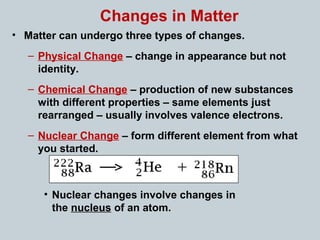
– Nuclear Change – form different element from what
you started.
• Nuclear changes involve changes in
the nucleus of an atom.
Radioactivity
• Radioactivity – spontaneous emission of rays or
particles from certain elements. (like uranium)
– also known as radioactive decay
– rays and particles emitted from a radioactive source are
called nuclear radiation
• Radioactivity is an example of a nuclear reaction.
– Purpose of radioactive decay is for an unstable nucleus to
become stable.
– Nuclear reactions begin with unstable isotopes
known as radioisotopes.
– Atoms become stable when changes occur
in the nuclei.
– These changes are always accompanied by the
emission of large amounts of energy.
– Unlike chemical reactions, nuclear reactions are
not affected by changes in temperature, pressure,
or the presence of catalysts.
– Nuclear reactions of given radioisotope cannot be
slowed down, speeded up, or stopped.
– Radioactive decay is a spontaneous process.
– If the product of a nuclear reaction is unstable, it
will decay again.
– The process continues until unstable isotopes of one
element are changed, or transformed, into stable
isotopes of a different element.
– These stable isotopes are not radioactive.
– Nuclear radiation is emitted during radioactive decay.
– There are three main types of nuclear radiation:
alpha radiation, beta radiation, and gamma radiation.
Types of Radiation
Alpha Radiation
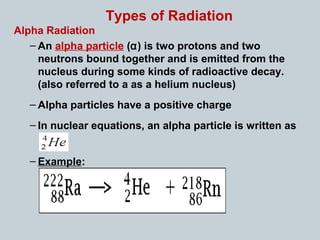
– An alpha particle (α) is two protons and two
neutrons bound together and is emitted from the
nucleus during some kinds of radioactive decay.
(also referred to a as a helium nucleus)
– Alpha particles have a positive charge
– In nuclear equations, an alpha particle is written as
– Example:
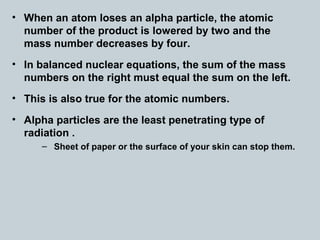
• When an atom loses an alpha particle, the atomic
number of the product is lowered by two and the
mass number decreases by four.
• In balanced nuclear equations, the sum of the mass
numbers on the right must equal the sum on the left.
• This is also true for the atomic numbers.
• Alpha particles are the least penetrating type of
radiation .
– Sheet of paper or the surface of your skin can stop them.
Beta Radiation
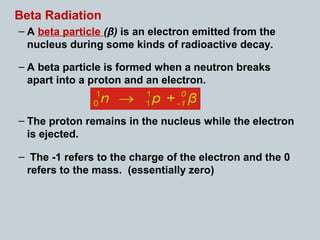
– A beta particle (β) is an electron emitted from the
nucleus during some kinds of radioactive decay.
– A beta particle is formed when a neutron breaks
apart into a proton and an electron.
– The proton remains in the nucleus while the electron
is ejected.
– The -1 refers to the charge of the electron and the 0
refers to the mass. (essentially zero)
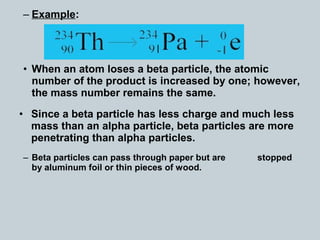
– Example:
• When an atom loses a beta particle, the atomic
number of the product is increased by one; however,
the mass number remains the same.
• Since a beta particle has less charge and much less
mass than an alpha particle, beta particles are more
penetrating than alpha particles.
– Beta particles can pass through paper but are stopped
by aluminum foil or thin pieces of wood.
Gamma Radiation
– Gamma rays (γ) are high-energy waves emitted
from a nucleus as it decays.
– Gamma rays have no mass and no electrical
charge. Therefore, gamma radiation does not
alter the atomic number or mass number of an
atom.
– Nuclei often emit gamma rays along with alpha or
beta particles.
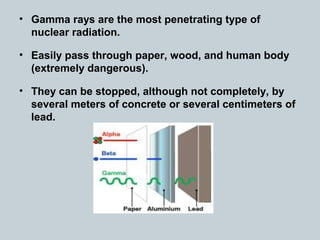
• Gamma rays are the most penetrating type of
nuclear radiation.
• Easily pass through paper, wood, and human body
(extremely dangerous).
• They can be stopped, although not completely, by
several meters of concrete or several centimeters of
lead.
Nuclear Equations and Radioactive Decay
• Radium-226 is a radioactive isotope that decays by
releasing an alpha particle. Write a nuclear equation
for the radioactive decay of radium-226.
• Potassium-40 decays by releasing a beta particle.
Write a nuclear equation that represents the
radioactive decay of potassium-40.
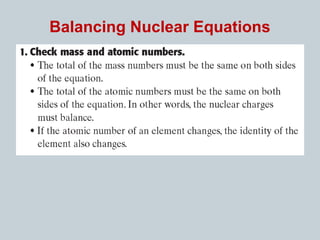
Balancing Nuclear Equations
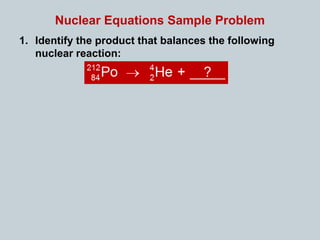
Nuclear Equations Sample Problem
1. Identify the product that balances the following
nuclear reaction:
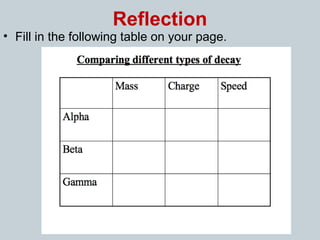
Reflection
• Fill in the following table on your page.

5.7 Nuclear Radiation

  • 1.
    Changes in Matter •Matter can undergo three types of changes. – Physical Change – change in appearance but not identity. – Chemical Change – production of new substances with different properties – same elements just rearranged – usually involves valence electrons. – Nuclear Change – form different element from what you started. • Nuclear changes involve changes in the nucleus of an atom.
  • 2.
    Radioactivity • Radioactivity –spontaneous emission of rays or particles from certain elements. (like uranium) – also known as radioactive decay – rays and particles emitted from a radioactive source are called nuclear radiation • Radioactivity is an example of a nuclear reaction. – Purpose of radioactive decay is for an unstable nucleus to become stable. – Nuclear reactions begin with unstable isotopes known as radioisotopes. – Atoms become stable when changes occur in the nuclei.
  • 3.
    – These changesare always accompanied by the emission of large amounts of energy. – Unlike chemical reactions, nuclear reactions are not affected by changes in temperature, pressure, or the presence of catalysts. – Nuclear reactions of given radioisotope cannot be slowed down, speeded up, or stopped. – Radioactive decay is a spontaneous process. – If the product of a nuclear reaction is unstable, it will decay again.
  • 4.
    – The processcontinues until unstable isotopes of one element are changed, or transformed, into stable isotopes of a different element. – These stable isotopes are not radioactive. – Nuclear radiation is emitted during radioactive decay. – There are three main types of nuclear radiation: alpha radiation, beta radiation, and gamma radiation.
  • 5.
    Types of Radiation AlphaRadiation – An alpha particle (α) is two protons and two neutrons bound together and is emitted from the nucleus during some kinds of radioactive decay. (also referred to a as a helium nucleus) – Alpha particles have a positive charge – In nuclear equations, an alpha particle is written as – Example:
  • 6.
    • When anatom loses an alpha particle, the atomic number of the product is lowered by two and the mass number decreases by four. • In balanced nuclear equations, the sum of the mass numbers on the right must equal the sum on the left. • This is also true for the atomic numbers. • Alpha particles are the least penetrating type of radiation . – Sheet of paper or the surface of your skin can stop them.
  • 7.
    Beta Radiation – Abeta particle (β) is an electron emitted from the nucleus during some kinds of radioactive decay. – A beta particle is formed when a neutron breaks apart into a proton and an electron. – The proton remains in the nucleus while the electron is ejected. – The -1 refers to the charge of the electron and the 0 refers to the mass. (essentially zero)
  • 8.
    – Example: • Whenan atom loses a beta particle, the atomic number of the product is increased by one; however, the mass number remains the same. • Since a beta particle has less charge and much less mass than an alpha particle, beta particles are more penetrating than alpha particles. – Beta particles can pass through paper but are stopped by aluminum foil or thin pieces of wood.
  • 9.
    Gamma Radiation – Gammarays (γ) are high-energy waves emitted from a nucleus as it decays. – Gamma rays have no mass and no electrical charge. Therefore, gamma radiation does not alter the atomic number or mass number of an atom. – Nuclei often emit gamma rays along with alpha or beta particles.
  • 10.
    • Gamma raysare the most penetrating type of nuclear radiation. • Easily pass through paper, wood, and human body (extremely dangerous). • They can be stopped, although not completely, by several meters of concrete or several centimeters of lead.
  • 11.
    Nuclear Equations andRadioactive Decay • Radium-226 is a radioactive isotope that decays by releasing an alpha particle. Write a nuclear equation for the radioactive decay of radium-226. • Potassium-40 decays by releasing a beta particle. Write a nuclear equation that represents the radioactive decay of potassium-40.
  • 12.
  • 13.
    Nuclear Equations SampleProblem 1. Identify the product that balances the following nuclear reaction:
  • 14.
    Reflection • Fill inthe following table on your page.