Radioactivity and particles
b)Radioactivity
describe the structure of an atom in terms of protons, neutrons and
electrons and use symbols such as 14
6C to describe particular nuclei
understand the terms atomic (proton) number, mass (nucleon)
number and isotope
understand that alpha and beta particles and gamma rays are ionising
radiations emitted from unstable nuclei in a random process
describe the nature of alpha and beta particles and gamma rays and
recall that they may be distinguished in terms of penetrating power
describe the effects on the atomic and mass numbers of a nucleus of
the emission of each of the three main types of radiation
understand how to complete balanced nuclear equations
3.
Atomic structure
An atomconsists of a small
central nucleus composed
of protons and neutrons
surrounded by electrons.
An atom will always have
the same number of
electrons as protons.
A Lithium atom
protons
neutrons
electrons
4.
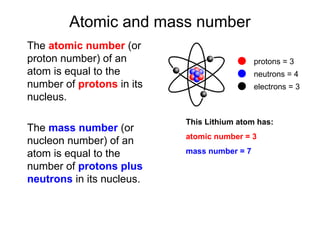
Atomic and massnumber
The atomic number (or
proton number) of an
atom is equal to the
number of protons in its
nucleus.
The mass number (or
nucleon number) of an
atom is equal to the
number of protons plus
neutrons in its nucleus.
This Lithium atom has:
atomic number = 3
mass number = 7
protons = 3
neutrons = 4
electrons = 3
5.
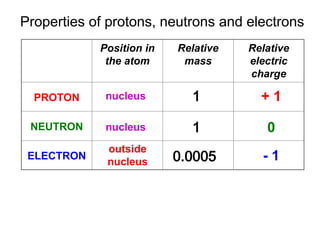
Properties of protons,neutrons and electrons
Position in
the atom
Relative
mass
Relative
electric
charge
PROTON
NEUTRON
ELECTRON
nucleus
nucleus
outside
nucleus
1
1
0.0005
+ 1
- 1
0
6.
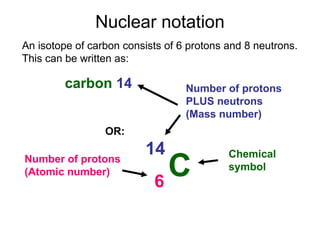
Nuclear notation
C
14
6
Number ofprotons
(Atomic number)
Chemical
symbol
An isotope of carbon consists of 6 protons and 8 neutrons.
This can be written as:
OR:
carbon 14 Number of protons
PLUS neutrons
(Mass number)
7.
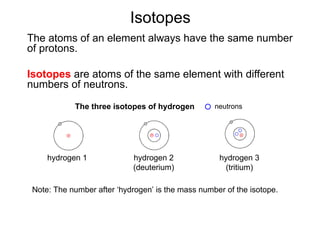
Isotopes
The atoms ofan element always have the same number
of protons.
Isotopes are atoms of the same element with different
numbers of neutrons.
The three isotopes of hydrogen neutrons
hydrogen 1 hydrogen 3
(tritium)
hydrogen 2
(deuterium)
Note: The number after ‘hydrogen’ is the mass number of the isotope.
8.
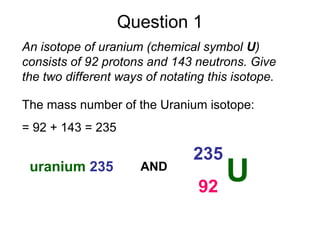
Question 1
U
235
92
An isotopeof uranium (chemical symbol U)
consists of 92 protons and 143 neutrons. Give
the two different ways of notating this isotope.
uranium 235
The mass number of the Uranium isotope:
= 92 + 143 = 235
AND
9.
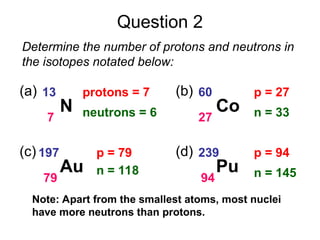
Question 2
Determine thenumber of protons and neutrons in
the isotopes notated below:
N
13
7
(a) protons = 7
neutrons = 6 Co
60
27
(b) p = 27
n = 33
Au
197
79
(c) p = 79
n = 118 Pu
239
94
(d) p = 94
n = 145
Note: Apart from the smallest atoms, most nuclei
have more neutrons than protons.
10.
Ionisation
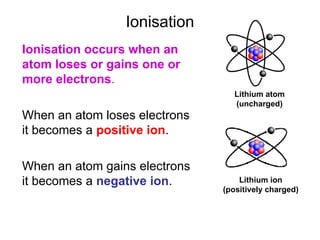
Ionisation occurs whenan
atom loses or gains one or
more electrons.
When an atom loses electrons
it becomes a positive ion.
When an atom gains electrons
it becomes a negative ion.
Lithium atom
(uncharged)
Lithium ion
(positively charged)
11.
Radioactivity and IonisingRadiation
The nuclei of some isotopes
are unstable and when they
decay they give of radiation
that causes ionisation.
This phenomena is called
radioactivity and the
radiation produced is called
ionising radiation
Radioactivity is a random
process. When a particular
nucleus decays cannot be
predicted.
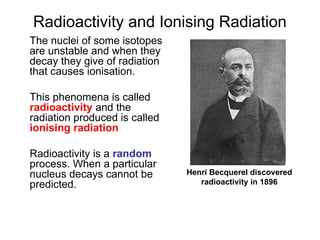
Henri Becquerel discovered
radioactivity in 1896
12.
Alpha, beta andgamma radiation
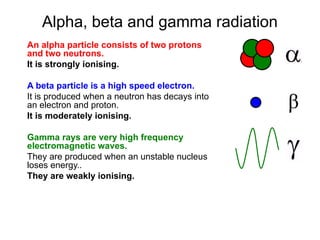
An alpha particle consists of two protons
and two neutrons.
It is strongly ionising.
A beta particle is a high speed electron.
It is produced when a neutron has decays into
an electron and proton.
It is moderately ionising.
Gamma rays are very high frequency
electromagnetic waves.
They are produced when an unstable nucleus
loses energy..
They are weakly ionising.
13.
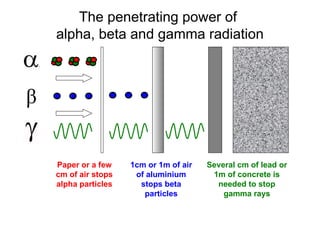
The penetrating powerof
alpha, beta and gamma radiation
Paper or a few
cm of air stops
alpha particles
1cm or 1m of air
of aluminium
stops beta
particles
Several cm of lead or
1m of concrete is
needed to stop
gamma rays
14.
S
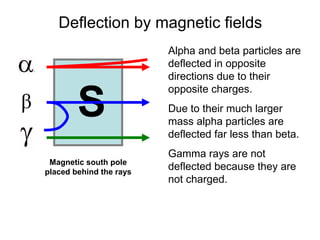
Deflection by magneticfields
Alpha and beta particles are
deflected in opposite
directions due to their
opposite charges.
Due to their much larger
mass alpha particles are
deflected far less than beta.
Gamma rays are not
deflected because they are
not charged.
Magnetic south pole
placed behind the rays
15.
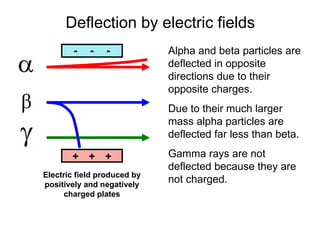
Deflection by electricfields
Alpha and beta particles are
deflected in opposite
directions due to their
opposite charges.
Due to their much larger
mass alpha particles are
deflected far less than beta.
Gamma rays are not
deflected because they are
not charged.
Electric field produced by
positively and negatively
charged plates
+ + +
- - -
16.
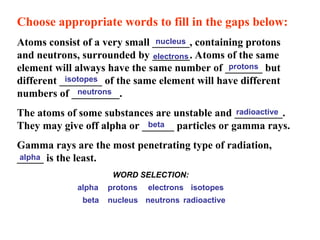
Choose appropriate wordsto fill in the gaps below:
Atoms consist of a very small _______, containing protons
and neutrons, surrounded by _______. Atoms of the same
element will always have the same number of _______ but
different ________ of the same element will have different
numbers of _________.
The atoms of some substances are unstable and _________.
They may give off alpha or ______ particles or gamma rays.
Gamma rays are the most penetrating type of radiation,
_____ is the least.
isotopes
radioactive
nucleus
protons electrons
alpha
neutrons
WORD SELECTION:
beta
isotopes
radioactive
nucleus
protons
electrons
alpha
neutrons
beta
17.
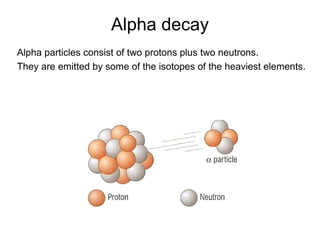
Alpha decay
Alpha particlesconsist of two protons plus two neutrons.
They are emitted by some of the isotopes of the heaviest elements.
18.
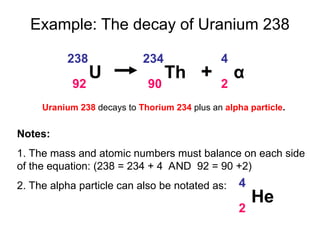
Example: The decayof Uranium 238
U
238
92
Th
234
90
α
4
2
+
Uranium 238 decays to Thorium 234 plus an alpha particle.
Notes:
1. The mass and atomic numbers must balance on each side
of the equation: (238 = 234 + 4 AND 92 = 90 +2)
2. The alpha particle can also be notated as:
He
4
2
19.
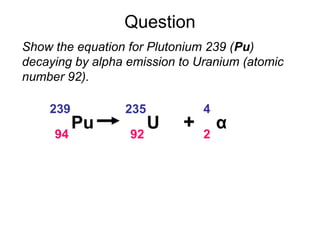
Question
Show the equationfor Plutonium 239 (Pu)
decaying by alpha emission to Uranium (atomic
number 92).
Pu
239
94
U
235
92
α
4
2
+
20.
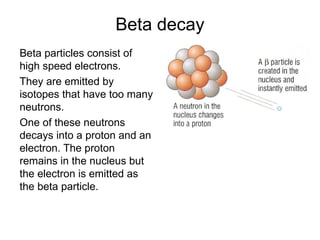
Beta decay
Beta particlesconsist of
high speed electrons.
They are emitted by
isotopes that have too many
neutrons.
One of these neutrons
decays into a proton and an
electron. The proton
remains in the nucleus but
the electron is emitted as
the beta particle.
21.
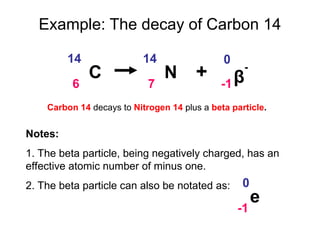
Example: The decayof Carbon 14
C
14
6
N
14
7 β
-
0
-1
+
Carbon 14 decays to Nitrogen 14 plus a beta particle.
Notes:
1. The beta particle, being negatively charged, has an
effective atomic number of minus one.
2. The beta particle can also be notated as:
e
0
-1
22.
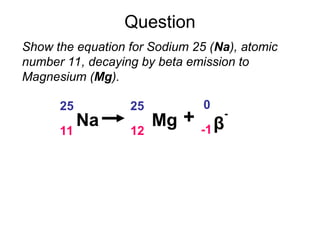
Question
Show the equationfor Sodium 25 (Na), atomic
number 11, decaying by beta emission to
Magnesium (Mg).
Na
25
11
Mg
25
12 β
-
0
-1
+
23.
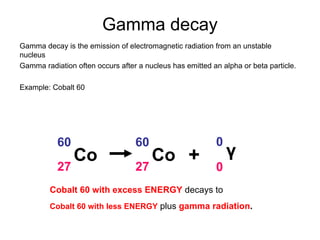
Gamma decay
Gamma decayis the emission of electromagnetic radiation from an unstable
nucleus
Gamma radiation often occurs after a nucleus has emitted an alpha or beta particle.
Example: Cobalt 60
Co
60
27
γ
0
0
+
Co
60
27
Cobalt 60 with excess ENERGY decays to
Cobalt 60 with less ENERGY plus gamma radiation.
24.
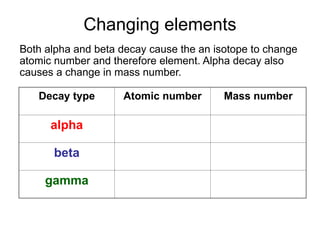
Changing elements
Both alphaand beta decay cause the an isotope to change
atomic number and therefore element. Alpha decay also
causes a change in mass number.
Decay type Atomic number Mass number
alpha DOWN by 2 DOWN by 4
beta UP by 1 NO CHANGE
gamma NO CHANGE NO CHANGE
25.
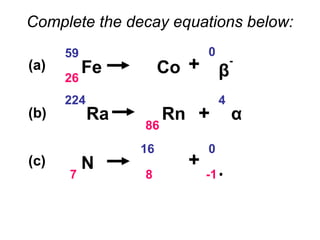
Complete the decayequations below:
Fe
59
26
Co
59
27 β
-
0
-1
+
Ra
224
88
Rn
220
86
α
4
2
+
N
16
7
O
16
8
β
-
0
-1
+
(a)
(c)
(b)
26.
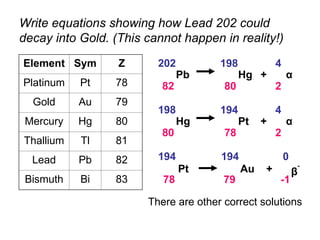
Write equations showinghow Lead 202 could
decay into Gold. (This cannot happen in reality!)
Pb
202
82
Hg
198
80
α
4
2
+
Pt
194
78
Au
194
79
β
-
0
-1
+
Element Sym Z
Platinum Pt 78
Gold Au 79
Mercury Hg 80
Thallium Tl 81
Lead Pb 82
Bismuth Bi 83
Hg
198
80
Pt
194
78
α
4
2
+
There are other correct solutions
27.
Choose appropriate wordsto fill in the gaps below:
When an unstable nucleus emits an alpha particle its atomic
number falls by _______ and its mass number by ______.
Beta particles are emitted by nuclei with too many ________.
In this case the atomic number increases by ______ while the
________ number remains unchanged.
Gamma rays consist of ______________ radiation that is
emitted from a nucleus when it loses ________, often after
undergoing alpha or beta decay.
electromagnetic
energy mass
two
four one
WORD SELECTION:
neutrons
electromagnetic
energy
mass
two four
one
neutrons
28.
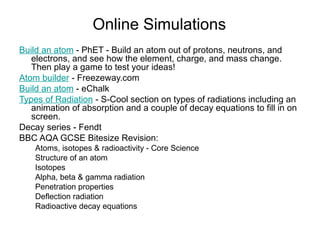
Online Simulations
Build anatom - PhET - Build an atom out of protons, neutrons, and
electrons, and see how the element, charge, and mass change.
Then play a game to test your ideas!
Atom builder - Freezeway.com
Build an atom - eChalk
Types of Radiation - S-Cool section on types of radiations including an
animation of absorption and a couple of decay equations to fill in on
screen.
Decay series - Fendt
BBC AQA GCSE Bitesize Revision:
Atoms, isotopes & radioactivity - Core Science
Structure of an atom
Isotopes
Alpha, beta & gamma radiation
Penetration properties
Deflection radiation
Radioactive decay equations
29.
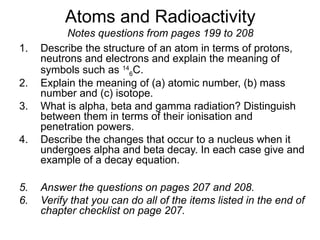
Atoms and Radioactivity
Notesquestions from pages 199 to 208
1. Describe the structure of an atom in terms of protons,
neutrons and electrons and explain the meaning of
symbols such as 14
6C.
2. Explain the meaning of (a) atomic number, (b) mass
number and (c) isotope.
3. What is alpha, beta and gamma radiation? Distinguish
between them in terms of their ionisation and
penetration powers.
4. Describe the changes that occur to a nucleus when it
undergoes alpha and beta decay. In each case give and
example of a decay equation.
5. Answer the questions on pages 207 and 208.
6. Verify that you can do all of the items listed in the end of
chapter checklist on page 207.