Nuclear Stability and Decay
• More than 1500 different isotopes are known. Of
those, only 264 are stable and do not decay over time.
• One factor that affects the stability of nucleus is the
ratio of neutrons to protons.
• Too many or too few neutrons relative to the number
of protons makes the nucleus unstable.
• A neutron vs proton plot of stable nuclei form a
pattern called the band of stability.
Band of Stability
• For elements with atomic numbers 20 or less, this
ratio is about 1:1. Above atomic number 20, stable
nuclei have more neutrons than protons.
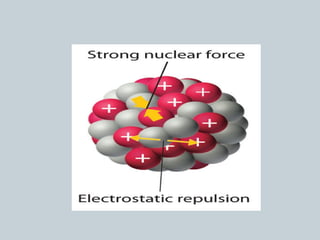
• The band of stability can be explained by the
relationship between the nuclear force and the
electrostatic forces between protons.
– As the number of protons in a nucleus increases, the
repulsive electrostatic force between protons increases
faster than the nuclear force.
– More neutrons are required to increase the nuclear force
and stabilize the nucleus.
– Beyond the atomic number 83, bismuth, the
repulsive force of the protons is so great that
no stable isotopes exists.
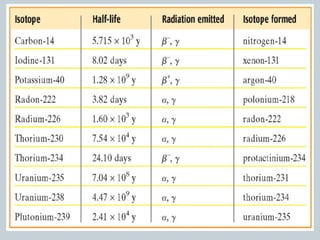
Half-Life
– Every radioisotope has a characteristic rate of
decay, which is measured by its half-life.
– Half-life is the time required for one-half of the nuclei
in a radioisotope sample to decay.
– During each half-life, half of the remaining
radioactive atoms decay into atoms of a new
element.
– Each radioactive nuclide has its own half-life. Half-
lives can be a short as a fraction of a second or as
long as billions of years.
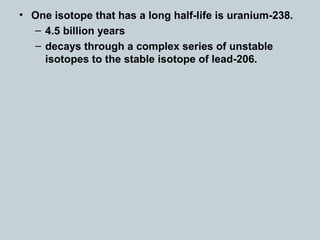
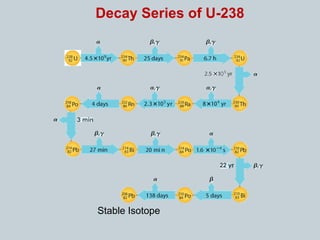
• One isotope that has a long half-life is uranium-238.
– 4.5 billion years
– decays through a complex series of unstable
isotopes to the stable isotope of lead-206.
Decay Series of U-238
Stable Isotope
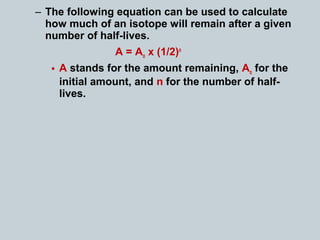
– The following equation can be used to calculate
how much of an isotope will remain after a given
number of half-lives.
A = Ao x (1/2)n
• A stands for the amount remaining, Ao for the
initial amount, and n for the number of half-
lives.
Half-Life Sample Problem
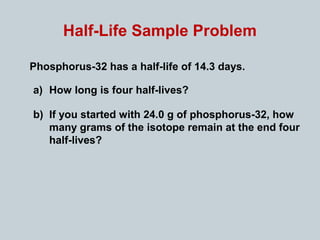
Phosphorus-32 has a half-life of 14.3 days.
a) How long is four half-lives?
b) If you started with 24.0 g of phosphorus-32, how
many grams of the isotope remain at the end four
half-lives?
Outcome Sentences
• After reflecting on
today’s lesson,
complete three of the
sentence starters.
• Sentence Starters
– I’ve learned…
– I was surprised…
– I’m beginning to wonder…
– I would conclude…
– I now realize that…

5.8 Nuclear Stability and Half-Life

  • 1.
    Nuclear Stability andDecay • More than 1500 different isotopes are known. Of those, only 264 are stable and do not decay over time. • One factor that affects the stability of nucleus is the ratio of neutrons to protons. • Too many or too few neutrons relative to the number of protons makes the nucleus unstable. • A neutron vs proton plot of stable nuclei form a pattern called the band of stability.
  • 2.
  • 3.
    • For elementswith atomic numbers 20 or less, this ratio is about 1:1. Above atomic number 20, stable nuclei have more neutrons than protons. • The band of stability can be explained by the relationship between the nuclear force and the electrostatic forces between protons. – As the number of protons in a nucleus increases, the repulsive electrostatic force between protons increases faster than the nuclear force. – More neutrons are required to increase the nuclear force and stabilize the nucleus. – Beyond the atomic number 83, bismuth, the repulsive force of the protons is so great that no stable isotopes exists.
  • 5.
    Half-Life – Every radioisotopehas a characteristic rate of decay, which is measured by its half-life. – Half-life is the time required for one-half of the nuclei in a radioisotope sample to decay. – During each half-life, half of the remaining radioactive atoms decay into atoms of a new element. – Each radioactive nuclide has its own half-life. Half- lives can be a short as a fraction of a second or as long as billions of years.
  • 7.
    • One isotopethat has a long half-life is uranium-238. – 4.5 billion years – decays through a complex series of unstable isotopes to the stable isotope of lead-206.
  • 8.
    Decay Series ofU-238 Stable Isotope
  • 9.
    – The followingequation can be used to calculate how much of an isotope will remain after a given number of half-lives. A = Ao x (1/2)n • A stands for the amount remaining, Ao for the initial amount, and n for the number of half- lives.
  • 10.
    Half-Life Sample Problem Phosphorus-32has a half-life of 14.3 days. a) How long is four half-lives? b) If you started with 24.0 g of phosphorus-32, how many grams of the isotope remain at the end four half-lives?
  • 11.
    Outcome Sentences • Afterreflecting on today’s lesson, complete three of the sentence starters. • Sentence Starters – I’ve learned… – I was surprised… – I’m beginning to wonder… – I would conclude… – I now realize that…

Editor's Notes

  • #9 Uranium-238 decays through a complex series of radioactive intermediates, including radon (Rn) gas. Interpreting Diagrams What is the stable end product of this series?