OBSTRUCTIVE UROPATHY & Benign prostatic hyperplasia  (BPH) Urology Department Under-graduate courses By Moh.Ibrahim, MBBcH Revised by M.A.Wadood , MD, MRCS
DEFINITION Obstructive uropathy is structural or functional hindrance of normal urine flow, sometimes leading to renal dysfunction (obstructive nephropathy). TYPES acute or chronic. partial or complete. unilateral or bilateral. ©  OBSTRUCTIVE UROPATHY By Mohammed Ibrahim, MBBcH Revised by M.A.Wadood , MD, MRCS By Moh.Ibrahim, MBBcH Revised by M.A.Wadood , MD, MRCS
In children:  the most common causes are urethral valves or stricture and stenosis at the ureterovesical or ureteropelvic junction. In young adults:  the most common cause is a calculus. In older adults:  the most common causes are BPH or prostate cancer, retroperitoneal or pelvic tumors, and calculi. ©  ©  By Mohammed Ibrahim, MBBcH Revised by M.A.Wadood , MD, MRCS ETIOLOGY By Moh.Ibrahim, MBBcH Revised by M.A.Wadood , MD, MRCS
Dilation of the collecting ducts and distal tubules and chronic tubular atrophy with little glomerular damage. Obstructive uropathy without dilatation  can also occur when:  fibrosis or a retroperitoneal tumor encases the collecting systems. Mild obstructive uropathy.  an intrarenal pelvis. ©  By Mohammed Ibrahim, MBBcH Revised by M.A.Wadood , MD, MRCS PATHOPHYSIOLOGY By Moh.Ibrahim, MBBcH Revised by M.A.Wadood , MD, MRCS
Obstructive nephropathy is renal dysfunction (renal insufficiency, renal failure, or tubulointerstitial damage) resulting from urinary tract obstruction.  Mechanism   increased intratubular pressure local ischemia,  UTI . ©  By Mohammed Ibrahim, MBBcH Revised by M.A.Wadood , MD, MRCS OBSTRUCTIVE NEPHROPATHY By Moh.Ibrahim, MBBcH Revised by M.A.Wadood , MD, MRCS
Pain is common, usually along T11 to T12. Absolute anuria occurs with complete obstruction at the level of the bladder or urethra or bilateral obstruction. Infection complicating obstruction may cause: dysuria, pyuria, urgency and frequency, pyelonephritis, and occasionally septicemia. palpable flank mass, particularly in massive hydronephrosis of infancy and childhood. ©  By Mohammed Ibrahim, MBBcH Revised by M.A.Wadood , MD, MRCS SYMPTOMS & SIGNS By Moh.Ibrahim, MBBcH Revised by M.A.Wadood , MD, MRCS
Urinalysis and serum electrolytes, BUN, and creatinine. Imaging:  for suspected ureteral or more proximal obstruction: Abdominal ultrasonography  is the initial imaging test of choice in most patients without urethral abnormalities. Voiding cystourethrography  and  cystourethroscopy  for suspected urethral obstruction. ©  By Mohammed Ibrahim, MBBcH Revised by M.A.Wadood , MD, MRCS DIAGNOSIS By Moh.Ibrahim, MBBcH Revised by M.A.Wadood , MD, MRCS
IVU (contrast urography= intravenous pyelography [IVP]= excretory urography) Pelvi-abdominal CT   is sensitive for diagnosing obstructive nephropathy and is used when obstruction cannot be shown by ultrasonography or by intravenous urography. ©  By Mohammed Ibrahim, MBBcH Revised by M.A.Wadood , MD, MRCS DIAGNOSIS By Moh.Ibrahim, MBBcH Revised by M.A.Wadood , MD, MRCS
Antegrade or retrograde pyelography   is preferred to studies that involve vascular administration of contrast agents in the azotemic patient. Radionuclide scans. MRU (Magnetic resonance of urine).  ©  By Mohammed Ibrahim, MBBcH Revised by M.A.Wadood , MD, MRCS DIAGNOSIS By Moh.Ibrahim, MBBcH Revised by M.A.Wadood , MD, MRCS
Treatment consists of eliminating the obstruction  Temporarily  by: JJ stent or nephrostomy tubes. Permanently  by: Surgery Instrumentation (eg, endoscopy, lithotripsy)  ©  By Mohammed Ibrahim, MBBcH Revised by M.A.Wadood , MD, MRCS TREATMENT By Moh.Ibrahim, MBBcH Revised by M.A.Wadood , MD, MRCS
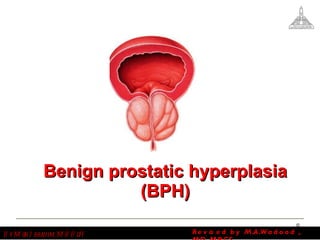
Benign prostatic hyperplasia (BPH) ©  By Mohammed Ibrahim, MBBcH Revised by M.A.Wadood , MD, MRCS By Moh.Ibrahim, MBBcH Revised by M.A.Wadood , MD, MRCS
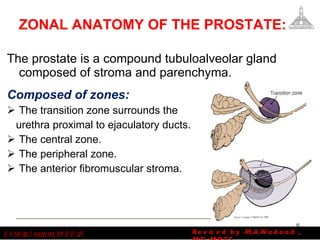
ZONAL ANATOMY OF THE PROSTATE: The prostate is a compound tubuloalveolar gland composed of stroma and parenchyma. Composed of zones: The transition zone surrounds the  urethra proximal to ejaculatory ducts. The central zone. The peripheral zone. The anterior fibromuscular stroma. ©  By Mohammed Ibrahim, MBBcH Revised by M.A.Wadood , MD, MRCS By Moh.Ibrahim, MBBcH Revised by M.A.Wadood , MD, MRCS
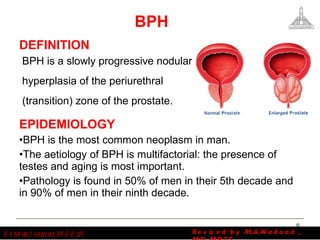
DEFINITION   BPH is a slowly progressive nodular  hyperplasia of the periurethral  (transition) zone of the prostate. EPIDEMIOLOGY  BPH is the most common neoplasm in man. The aetiology of BPH is multifactorial: the presence of testes and aging is most important. Pathology is found in 50% of men in their 5th decade and in 90% of men in their ninth decade.  ©  By Mohammed Ibrahim, MBBcH Revised by M.A.Wadood , MD, MRCS BPH By Moh.Ibrahim, MBBcH Revised by M.A.Wadood , MD, MRCS
Stages:  BPH is a progressive disease. Mild infravesical obstruction  leads to minimal S/S. Increase of infravesical obstruction  with bladder compensation by detrusor hypertrophy leads to LUT obstructive symptoms.  Severe infravesical obstruction  with bladder instability and decrease compliance leads to Irritative S/S. The obstructive component can be subdivided into: A-  Mechanical:  due to transition zone enlargement. B-  Dynamic:  due to adrenergic stimulation of stromal smooth muscle.  ©  By Mohammed Ibrahim, MBBcH Revised by M.A.Wadood , MD, MRCS PATHOPHYSIOLOGY By Moh.Ibrahim, MBBcH Revised by M.A.Wadood , MD, MRCS
The symptoms are:  obstructive (and/or) irritative S/S Obstructive S/S:  due to prostatic enlargement  Hesitancy = delayed initiation of the act.  Weak stream of urine = decrease in the force & caliber of the urinary stream  Abdominal straining  Intermittency. Sense of incomplete evacuation.  Terminal micturation dribbling.  Post voiding dribbling. ©  By Mohammed Ibrahim, MBBcH Revised by M.A.Wadood , MD, MRCS SYMPTOMS AND SIGNS  By Moh.Ibrahim, MBBcH Revised by M.A.Wadood , MD, MRCS
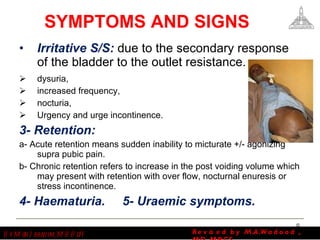
Irritative S/S:  due to the secondary response of the bladder to the outlet resistance. dysuria,  increased frequency,  nocturia,  Urgency and urge incontinence.  3- Retention:  a- Acute retention means sudden inability to micturate +/- agonizing supra pubic pain.  b- Chronic retention refers to increase in the post voiding volume which may present with retention with over flow, nocturnal enuresis or stress incontinence.  4- Haematuria.  5- Uraemic symptoms.  ©  By Mohammed Ibrahim, MBBcH Revised by M.A.Wadood , MD, MRCS SYMPTOMS AND SIGNS  By Moh.Ibrahim, MBBcH Revised by M.A.Wadood , MD, MRCS
General examination  e.g, Earthy look of uremia.  Abdominal examination:   Inspection:  a- Suprapubic bulge. b- Scars of previous operations . Palpation:  a- Loin tenderness.  b- Suprapubic tenderness. Percussion:  Suprapubic dullness. ©  By Mohammed Ibrahim, MBBcH Revised by M.A.Wadood , MD, MRCS PHYSICAL EXAMINATION By Moh.Ibrahim, MBBcH Revised by M.A.Wadood , MD, MRCS
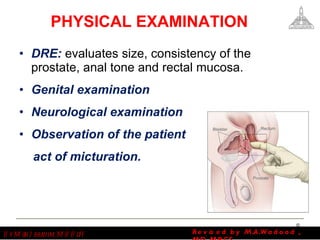
DRE:  evaluates size, consistency of the prostate, anal tone and rectal mucosa.  Genital examination Neurological examination  Observation of the patient  act of micturation. ©  By Mohammed Ibrahim, MBBcH Revised by M.A.Wadood , MD, MRCS PHYSICAL EXAMINATION By Moh.Ibrahim, MBBcH Revised by M.A.Wadood , MD, MRCS
Urine analysis and C/S.  Serum Creatinine.  Pelvi-abdominal U/S with post voiding assessment.  PSA (Prostatic specific antigen)   It is an  organ specific  (arises only from prostatic acini) but  not  disease specific   (increases with other prostatic diseases). Uroflowmetry .   ©  By Mohammed Ibrahim, MBBcH Revised by M.A.Wadood , MD, MRCS Recommended investigations By Moh.Ibrahim, MBBcH Revised by M.A.Wadood , MD, MRCS
Further imaging of UUT. (IVP)  if associated hematuria, stone diseases, or previous urologic operation. Urethrocystogram.   If previous urethral instrumentations or surgeries. Urodynamic and Pressure/flow study.   Indicated only in complicated cases as cases with previous neurologic disease or operation. Urethro cystoscopy .   TRUS & biopsy   If elevated PSA or Suspicious DRE. ©  By Mohammed Ibrahim, MBBcH Revised by M.A.Wadood , MD, MRCS Optional investigations By Moh.Ibrahim, MBBcH Revised by M.A.Wadood , MD, MRCS
Watchful waiting:  In patients with mild symptoms. Medical treatment:  Phytoherapy (Plant extract) :  mechanism of action is unknown. Alpha reductase inhibitor:   affects the epithelial component of the prostate, resulting in reduction in the size of the gland and improvement in symptoms.  Alpha-adrenoceptor blacker:   affect subtype alpha-1 adrenoreceptors. (dynamic component of obstruction). Combination. Surgical treatment:  Minimally invasive  or  open . ©  By Mohammed Ibrahim, MBBcH Revised by M.A.Wadood , MD, MRCS TREATMENT By Moh.Ibrahim, MBBcH Revised by M.A.Wadood , MD, MRCS
A- Absolute indications:  Upper  urinary tract affection. Uremia.  Recurrent attacks of acute retention.  Severe obstructive symptoms (high IPSS score).   ©  By Mohammed Ibrahim, MBBcH Revised by M.A.Wadood , MD, MRCS Indications of surgical intervention B- Relative indications:  Moderate symptoms  (moderate IPSS score).  Recurrent UTI. Hematuria.  Stone bladder. By Moh.Ibrahim, MBBcH Revised by M.A.Wadood , MD, MRCS
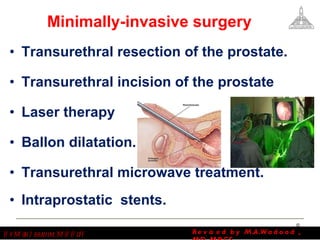
Transurethral resection of the prostate. Transurethral incision of the prostate  Laser therapy Ballon dilatation. Transurethral microwave treatment. Intraprostatic  stents.  ©  By Mohammed Ibrahim, MBBcH Revised by M.A.Wadood , MD, MRCS Minimally-invasive surgery By Moh.Ibrahim, MBBcH Revised by M.A.Wadood , MD, MRCS
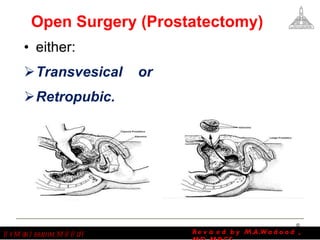
either:  Transvesical  or Retropubic.  ©  By Mohammed Ibrahim, MBBcH Revised by M.A.Wadood , MD, MRCS Open Surgery (Prostatectomy)  By Moh.Ibrahim, MBBcH Revised by M.A.Wadood , MD, MRCS
Thank You By Moh.Ibrahim, MBBcH Revised by M.A.Wadood , MD, MRCS

BPH and Obstructive Uropathy

  • 1.
    OBSTRUCTIVE UROPATHY &Benign prostatic hyperplasia (BPH) Urology Department Under-graduate courses By Moh.Ibrahim, MBBcH Revised by M.A.Wadood , MD, MRCS
  • 2.
    DEFINITION Obstructive uropathyis structural or functional hindrance of normal urine flow, sometimes leading to renal dysfunction (obstructive nephropathy). TYPES acute or chronic. partial or complete. unilateral or bilateral. © OBSTRUCTIVE UROPATHY By Mohammed Ibrahim, MBBcH Revised by M.A.Wadood , MD, MRCS By Moh.Ibrahim, MBBcH Revised by M.A.Wadood , MD, MRCS
  • 3.
    In children: the most common causes are urethral valves or stricture and stenosis at the ureterovesical or ureteropelvic junction. In young adults: the most common cause is a calculus. In older adults: the most common causes are BPH or prostate cancer, retroperitoneal or pelvic tumors, and calculi. © © By Mohammed Ibrahim, MBBcH Revised by M.A.Wadood , MD, MRCS ETIOLOGY By Moh.Ibrahim, MBBcH Revised by M.A.Wadood , MD, MRCS
  • 4.
    Dilation of thecollecting ducts and distal tubules and chronic tubular atrophy with little glomerular damage. Obstructive uropathy without dilatation can also occur when: fibrosis or a retroperitoneal tumor encases the collecting systems. Mild obstructive uropathy. an intrarenal pelvis. © By Mohammed Ibrahim, MBBcH Revised by M.A.Wadood , MD, MRCS PATHOPHYSIOLOGY By Moh.Ibrahim, MBBcH Revised by M.A.Wadood , MD, MRCS
  • 5.
    Obstructive nephropathy isrenal dysfunction (renal insufficiency, renal failure, or tubulointerstitial damage) resulting from urinary tract obstruction. Mechanism increased intratubular pressure local ischemia, UTI . © By Mohammed Ibrahim, MBBcH Revised by M.A.Wadood , MD, MRCS OBSTRUCTIVE NEPHROPATHY By Moh.Ibrahim, MBBcH Revised by M.A.Wadood , MD, MRCS
  • 6.
    Pain is common,usually along T11 to T12. Absolute anuria occurs with complete obstruction at the level of the bladder or urethra or bilateral obstruction. Infection complicating obstruction may cause: dysuria, pyuria, urgency and frequency, pyelonephritis, and occasionally septicemia. palpable flank mass, particularly in massive hydronephrosis of infancy and childhood. © By Mohammed Ibrahim, MBBcH Revised by M.A.Wadood , MD, MRCS SYMPTOMS & SIGNS By Moh.Ibrahim, MBBcH Revised by M.A.Wadood , MD, MRCS
  • 7.
    Urinalysis and serumelectrolytes, BUN, and creatinine. Imaging: for suspected ureteral or more proximal obstruction: Abdominal ultrasonography is the initial imaging test of choice in most patients without urethral abnormalities. Voiding cystourethrography and cystourethroscopy for suspected urethral obstruction. © By Mohammed Ibrahim, MBBcH Revised by M.A.Wadood , MD, MRCS DIAGNOSIS By Moh.Ibrahim, MBBcH Revised by M.A.Wadood , MD, MRCS
  • 8.
    IVU (contrast urography=intravenous pyelography [IVP]= excretory urography) Pelvi-abdominal CT is sensitive for diagnosing obstructive nephropathy and is used when obstruction cannot be shown by ultrasonography or by intravenous urography. © By Mohammed Ibrahim, MBBcH Revised by M.A.Wadood , MD, MRCS DIAGNOSIS By Moh.Ibrahim, MBBcH Revised by M.A.Wadood , MD, MRCS
  • 9.
    Antegrade or retrogradepyelography is preferred to studies that involve vascular administration of contrast agents in the azotemic patient. Radionuclide scans. MRU (Magnetic resonance of urine). © By Mohammed Ibrahim, MBBcH Revised by M.A.Wadood , MD, MRCS DIAGNOSIS By Moh.Ibrahim, MBBcH Revised by M.A.Wadood , MD, MRCS
  • 10.
    Treatment consists ofeliminating the obstruction Temporarily by: JJ stent or nephrostomy tubes. Permanently by: Surgery Instrumentation (eg, endoscopy, lithotripsy) © By Mohammed Ibrahim, MBBcH Revised by M.A.Wadood , MD, MRCS TREATMENT By Moh.Ibrahim, MBBcH Revised by M.A.Wadood , MD, MRCS
  • 11.
    Benign prostatic hyperplasia(BPH) © By Mohammed Ibrahim, MBBcH Revised by M.A.Wadood , MD, MRCS By Moh.Ibrahim, MBBcH Revised by M.A.Wadood , MD, MRCS
  • 12.
    ZONAL ANATOMY OFTHE PROSTATE: The prostate is a compound tubuloalveolar gland composed of stroma and parenchyma. Composed of zones: The transition zone surrounds the urethra proximal to ejaculatory ducts. The central zone. The peripheral zone. The anterior fibromuscular stroma. © By Mohammed Ibrahim, MBBcH Revised by M.A.Wadood , MD, MRCS By Moh.Ibrahim, MBBcH Revised by M.A.Wadood , MD, MRCS
  • 13.
    DEFINITION BPH is a slowly progressive nodular hyperplasia of the periurethral (transition) zone of the prostate. EPIDEMIOLOGY BPH is the most common neoplasm in man. The aetiology of BPH is multifactorial: the presence of testes and aging is most important. Pathology is found in 50% of men in their 5th decade and in 90% of men in their ninth decade. © By Mohammed Ibrahim, MBBcH Revised by M.A.Wadood , MD, MRCS BPH By Moh.Ibrahim, MBBcH Revised by M.A.Wadood , MD, MRCS
  • 14.
    Stages: BPHis a progressive disease. Mild infravesical obstruction leads to minimal S/S. Increase of infravesical obstruction with bladder compensation by detrusor hypertrophy leads to LUT obstructive symptoms. Severe infravesical obstruction with bladder instability and decrease compliance leads to Irritative S/S. The obstructive component can be subdivided into: A- Mechanical: due to transition zone enlargement. B- Dynamic: due to adrenergic stimulation of stromal smooth muscle. © By Mohammed Ibrahim, MBBcH Revised by M.A.Wadood , MD, MRCS PATHOPHYSIOLOGY By Moh.Ibrahim, MBBcH Revised by M.A.Wadood , MD, MRCS
  • 15.
    The symptoms are: obstructive (and/or) irritative S/S Obstructive S/S: due to prostatic enlargement Hesitancy = delayed initiation of the act. Weak stream of urine = decrease in the force & caliber of the urinary stream Abdominal straining Intermittency. Sense of incomplete evacuation. Terminal micturation dribbling. Post voiding dribbling. © By Mohammed Ibrahim, MBBcH Revised by M.A.Wadood , MD, MRCS SYMPTOMS AND SIGNS By Moh.Ibrahim, MBBcH Revised by M.A.Wadood , MD, MRCS
  • 16.
    Irritative S/S: due to the secondary response of the bladder to the outlet resistance. dysuria, increased frequency, nocturia, Urgency and urge incontinence. 3- Retention: a- Acute retention means sudden inability to micturate +/- agonizing supra pubic pain. b- Chronic retention refers to increase in the post voiding volume which may present with retention with over flow, nocturnal enuresis or stress incontinence. 4- Haematuria. 5- Uraemic symptoms. © By Mohammed Ibrahim, MBBcH Revised by M.A.Wadood , MD, MRCS SYMPTOMS AND SIGNS By Moh.Ibrahim, MBBcH Revised by M.A.Wadood , MD, MRCS
  • 17.
    General examination e.g, Earthy look of uremia. Abdominal examination: Inspection: a- Suprapubic bulge. b- Scars of previous operations . Palpation: a- Loin tenderness. b- Suprapubic tenderness. Percussion: Suprapubic dullness. © By Mohammed Ibrahim, MBBcH Revised by M.A.Wadood , MD, MRCS PHYSICAL EXAMINATION By Moh.Ibrahim, MBBcH Revised by M.A.Wadood , MD, MRCS
  • 18.
    DRE: evaluatessize, consistency of the prostate, anal tone and rectal mucosa. Genital examination Neurological examination Observation of the patient act of micturation. © By Mohammed Ibrahim, MBBcH Revised by M.A.Wadood , MD, MRCS PHYSICAL EXAMINATION By Moh.Ibrahim, MBBcH Revised by M.A.Wadood , MD, MRCS
  • 19.
    Urine analysis andC/S. Serum Creatinine. Pelvi-abdominal U/S with post voiding assessment. PSA (Prostatic specific antigen) It is an organ specific (arises only from prostatic acini) but not disease specific (increases with other prostatic diseases). Uroflowmetry .   © By Mohammed Ibrahim, MBBcH Revised by M.A.Wadood , MD, MRCS Recommended investigations By Moh.Ibrahim, MBBcH Revised by M.A.Wadood , MD, MRCS
  • 20.
    Further imaging ofUUT. (IVP) if associated hematuria, stone diseases, or previous urologic operation. Urethrocystogram. If previous urethral instrumentations or surgeries. Urodynamic and Pressure/flow study. Indicated only in complicated cases as cases with previous neurologic disease or operation. Urethro cystoscopy . TRUS & biopsy If elevated PSA or Suspicious DRE. © By Mohammed Ibrahim, MBBcH Revised by M.A.Wadood , MD, MRCS Optional investigations By Moh.Ibrahim, MBBcH Revised by M.A.Wadood , MD, MRCS
  • 21.
    Watchful waiting: In patients with mild symptoms. Medical treatment: Phytoherapy (Plant extract) : mechanism of action is unknown. Alpha reductase inhibitor: affects the epithelial component of the prostate, resulting in reduction in the size of the gland and improvement in symptoms. Alpha-adrenoceptor blacker: affect subtype alpha-1 adrenoreceptors. (dynamic component of obstruction). Combination. Surgical treatment: Minimally invasive or open . © By Mohammed Ibrahim, MBBcH Revised by M.A.Wadood , MD, MRCS TREATMENT By Moh.Ibrahim, MBBcH Revised by M.A.Wadood , MD, MRCS
  • 22.
    A- Absolute indications: Upper urinary tract affection. Uremia. Recurrent attacks of acute retention. Severe obstructive symptoms (high IPSS score).   © By Mohammed Ibrahim, MBBcH Revised by M.A.Wadood , MD, MRCS Indications of surgical intervention B- Relative indications: Moderate symptoms (moderate IPSS score). Recurrent UTI. Hematuria. Stone bladder. By Moh.Ibrahim, MBBcH Revised by M.A.Wadood , MD, MRCS
  • 23.
    Transurethral resection ofthe prostate. Transurethral incision of the prostate Laser therapy Ballon dilatation. Transurethral microwave treatment. Intraprostatic stents. © By Mohammed Ibrahim, MBBcH Revised by M.A.Wadood , MD, MRCS Minimally-invasive surgery By Moh.Ibrahim, MBBcH Revised by M.A.Wadood , MD, MRCS
  • 24.
    either: Transvesical or Retropubic. © By Mohammed Ibrahim, MBBcH Revised by M.A.Wadood , MD, MRCS Open Surgery (Prostatectomy) By Moh.Ibrahim, MBBcH Revised by M.A.Wadood , MD, MRCS
  • 25.
    Thank You ByMoh.Ibrahim, MBBcH Revised by M.A.Wadood , MD, MRCS