INFECTIVE ENDOCARDITIS
Moderator- Dr Ramkumar
Presenter – Dr Anirudh
OUTLINE
• DEFINITION
• EPIDEMIOLOGY
• CLASSIFICATION
• PATHOGENESIS
• CLINICAL FEATURES
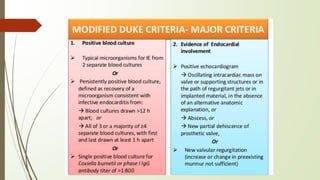
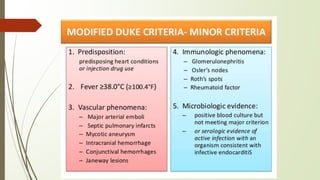
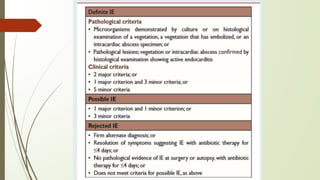
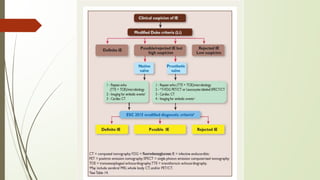
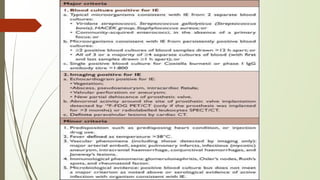
• DIAGNOSTIC CRITERIA
• INVESTIGATIONS
• TREATMENT
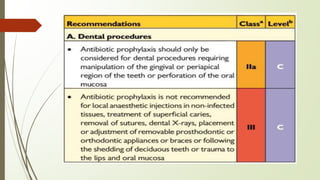
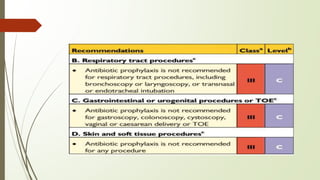
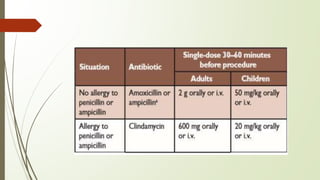
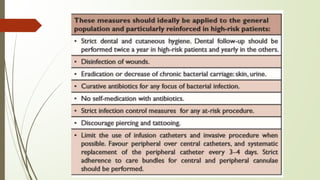
• PROPHYLAXIS
DEFINITION
• Microbial infection of endothelial surface of the heart or iatrogenic
foreign body like prosthetic valve or other intracardiac device.
• Typically involves the valves –may involve other structures of the
heart like chordae tendinae or sites of shunting.
• Majority of cases caused by streptococcus, staphylococcus,
enterococcus or fastidious gram negative coccobacillary forms.
EPIDEMIOLOGY
• The incidence of IE remains still high at
1.7–6.2 per 100,000 person years in the USA and Europe.
• But, such estimates from India are not available. Neither the
incidence nor the mortality has declined significantly, but the
pattern of IE appears to be changing globally.
• The median age of the patients has gradually increased from
the fourth decade in the early antibiotic era to the sixth and seventh
decade recently.
• ln the Indian scenario; still it is common in younger age groups. A study by
Garg N et al. in Indian patients during the last decade indicates that 76% of
the patients with IE were younger than 40 years (median age 27.6 ± 12
years).
• M.C cause in developed countries are degenerative heart diseases, illicit
I.V drug abuse, Intracardiac devices
• M.C cause in developing countries is RHD
• INFECTIVE ENDOCARDITIS
• 100% fatal if undiagnosed and untreated
• 20% fatal even if diagnosed and treated appropriately.
CLASSIFICATION
• Classified into 2 groups
1.Native valve IE
2.Prosthetic valve IE
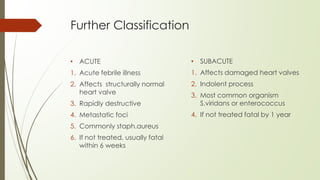
Further Classification
• ACUTE
1. Acute febrile illness
2. Affects structurally normal
heart valve
3. Rapidly destructive
4. Metastatic foci
5. Commonly staph.aureus
6. If not treated, usually fatal
within 6 weeks
• SUBACUTE
1. Affects damaged heart valves
2. Indolent process
3. Most common organism
S.viridans or enterococcus
4. If not treated fatal by 1 year
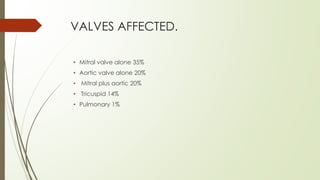
VALVES AFFECTED.
• Mitral valve alone 35%
• Aortic valve alone 20%
• Mitral plus aortic 20%
• Tricuspid 14%
• Pulmonary 1%
ETIOLOGICAL AGENTS.
• The etiologic agents
• •Streptococci: 60%-80% .
• Staphylococci: 20%-35%
• •Enterococci: 5%-18% .
• •Coagulase-positive organisms: 10%-27%
• •Coagulase-negative organisms: 1 %-3%
• •Gram-negative aerobic bacilli: 1% -13%
• •Fungi: 2%-4%
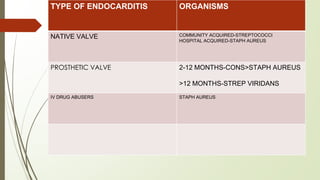
TYPE OF ENDOCARDITIS ORGANISMS
NATIVE VALVE COMMUNITY ACQUIRED-STREPTOCOCCI
HOSPITAL ACQUIRED-STAPH AUREUS
PROSTHETIC VALVE 2-12 MONTHS-CONS>STAPH AUREUS
>12 MONTHS-STREP VIRIDANS
IV DRUG ABUSERS STAPH AUREUS
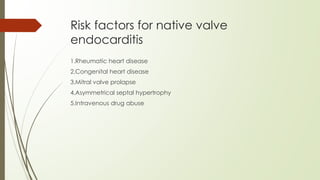
Risk factors for native valve
endocarditis
1.Rheumatic heart disease
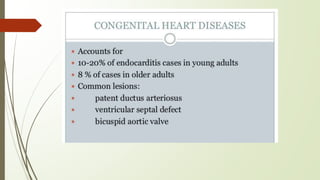
2.Congenital heart disease
3.Mitral valve prolapse
4.Asymmetrical septal hypertrophy
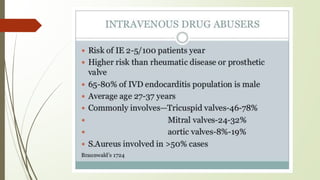
5.Intravenous drug abuse
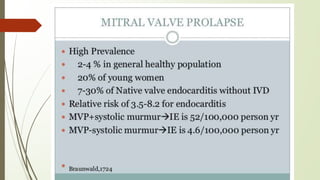
MITRAL VALVE PROLAPSE
• High Prevalence- 2-4 % in general healthy population
• 20% of young women
• 7-30% of Native valve endocarditis without IVD
• Relative risk of 3.5-8.2 for endocarditis
• IE is 52/100,000 person yr MVP-systolic murmur IE is 4.6/100,000 person yr
Prosthetic Valve Endocarditis
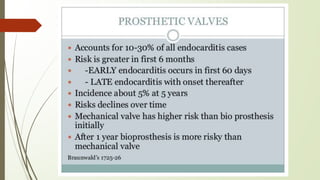
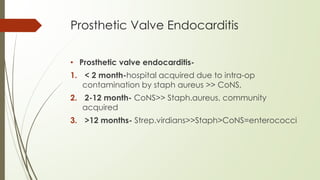
• Prosthetic valve endocarditis-
1. < 2 month-hospital acquired due to intra-op
contamination by staph aureus >> CoNS,
2. 2-12 month- CoNS>> Staph.aureus, community
acquired
3. >12 months- Strep.virdians>>Staph>CoNS=enterococci
IV Drug Abuse Endocarditis
• IV drug abuse endocarditis-Tricuspid involvement
1. MRSA
2. Polymicrobial
3. Unusual organisms-
P.aeruginosa,candida,bacillus,lactobacillus,corynebacterium
• Nosocomial-trans venous pacemaker lead and/ or implanted defibrillator
associated endocarditis
1. 5-15%-culture negative- Prior antibiotic therapy
2. Fastidious organisms- coxiella burnetti, brucella,
3. Tropheryma whipplei causes an indolent, culturenegative,afebrile form of
endocarditis
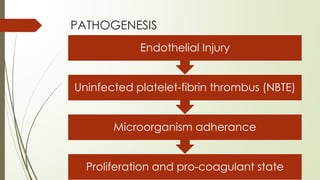
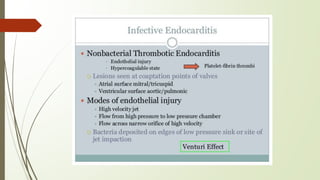
PATHOGENESIS
Proliferation and pro-coagulant state
Microorganism adherance
Uninfected platelet-fibrin thrombus (NBTE)
Endothelial Injury
• In systemic lupus erythematosus the vegetations may form on the
undersurface of valve towards ventricular side called as libman sacks
Endocarditis.
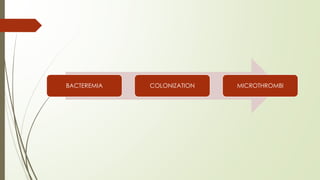
BACTEREMIA COLONIZATION MICROTHROMBI
CLINICAL FEATURES
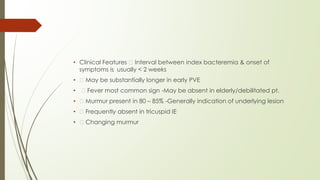
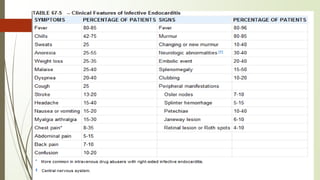
• Clinical Features Interval between index bacteremia & onset of
symptoms is usually < 2 weeks
• May be substantially longer in early PVE
• Fever most common sign -May be absent in elderly/debilitated pt.
• Murmur present in 80 – 85% -Generally indication of underlying lesion
• Frequently absent in tricuspid IE
• Changing murmur
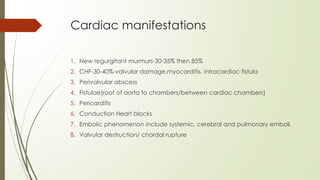
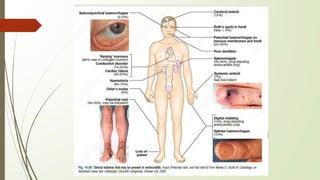
Cardiac manifestations
1. New regurgitant murmurs-30-35% then 85%
2. CHF-30-40%-valvular damage,myocarditis, intracardiac fistula
3. Perivalvular abscess
4. Fistulae(root of aorta to chambers/between cardiac chambers)
5. Pericarditis
6. Conduction Heart blocks
7. Embolic phenomenon include systemic, cerebral and pulmonary emboli.
8. Valvular destruction/ chordal rupture
Embolic complications
1. Occurs in 15-35% of patients
2. Septic infarcts can involve renal,splenic or cerebral circulation
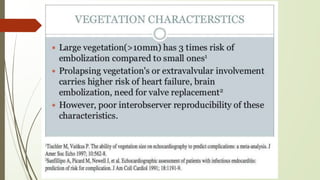
3. Risk of emboli is increased when vegetation> 1 cm.
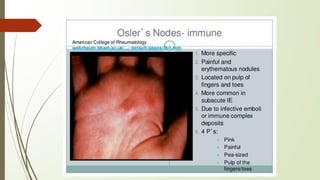
Effect on spleen,CNS,Lung
1. In spleen,infarctions and enlargement associated with hyperplasia of
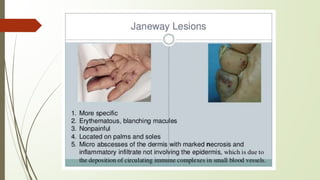
lymphoid follicles, focal necrosis and abscess.
2. In CNS,mycotic aneurysms.tend to occur at bifurcation areas, more
common at junction of MCA bifurcation.
3. In lung, more common affected with right sided IE.Pulmonary
embolism,acute pneumonia ,pleural effusion or empyema
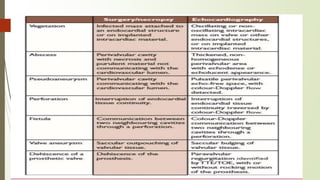
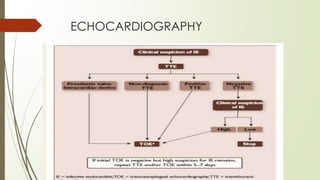
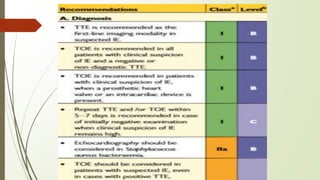
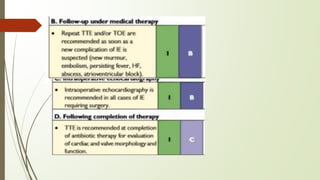
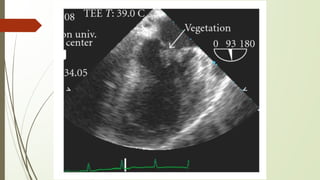
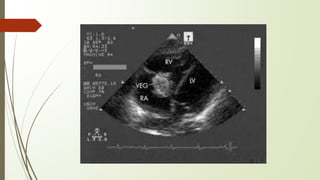
ECHOCARDIOGRAPHY
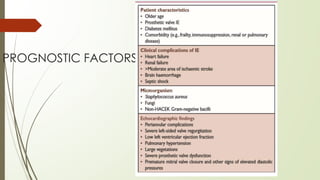
PROGNOSTIC FACTORS
•TREATMENT
-EMPIRICAL
-ORGANISM SPECIFIC
-PROPHYLAXIS
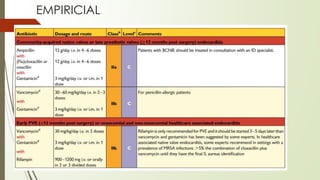
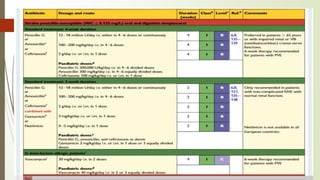
EMPIRICIAL
• STREPTOCOCCI-PENICILLIN SENSITIVE
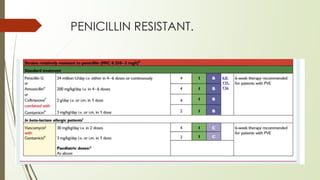
PENICILLIN RESISTANT.
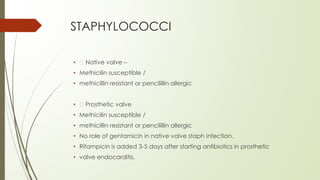
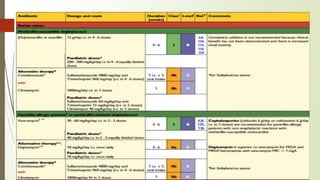
STAPHYLOCOCCI
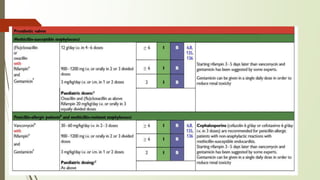
• Native valve –
• Methicilin susceptible /
• methicillin resistant or pencilillin allergic
• Prosthetic valve
• Methicilin susceptible /
• methicillin resistant or pencilillin allergic
• No role of gentamicin in native valve staph infection.
• Rifampicin is added 3-5 days after starting antibiotics in prosthetic
• valve endocarditis.
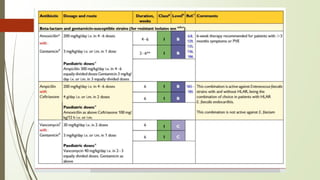
• ENTEROCOCCI
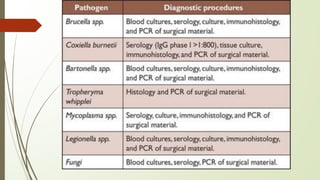
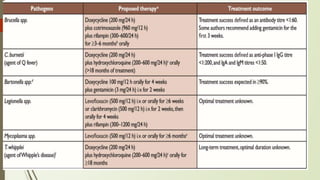
BLOOD CULTURE NEGATIVE
ENDOCARDITIS
• Blood culture–negative IE (BCNIE) refers to IE in which no causative
microorganism can be grown using the usual blood culture methods
• BCNIE can occur in up to 31% of all cases of IE and often poses
considerable diagnostic and therapeutic dilemmas.
• BCNIE most commonly arises as a consequence of previous antibiotic
administration, underlying the need for withdrawing antibiotics and
repeating blood cultures in this situation
• BCNIE can be caused by fungi or fastidious bacteria, notably obligatory
intracellular bacteria. Isolation of these microorganisms requires culturing
them on specialized media, and their growth is relatively slow.
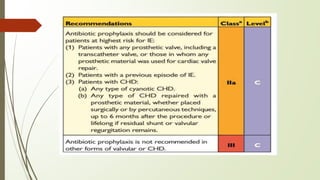
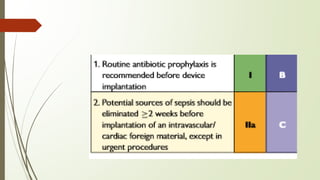
PROPHYLAXIS
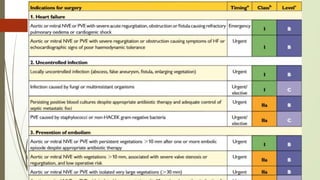
•INDICATIONS FOR SURGERY IN LEFT
SIDED ENDOCARDITIS
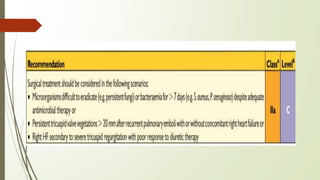
•INDICATIONS FOR SURGERY IN RIGHT
HEART ENDOCARDITIS.
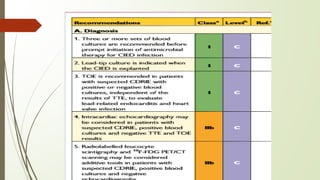
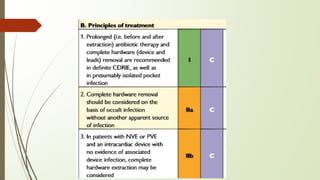
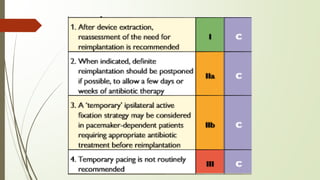
•Cardiac device related
infective endocarditis
(CDRIE)
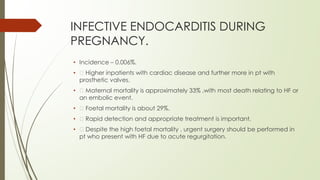
INFECTIVE ENDOCARDITIS DURING
PREGNANCY.
• Incidence – 0.006%.
• Higher inpatients with cardiac disease and further more in pt with
prosthetic valves.
• Maternal mortality is approximately 33% ,with most death relating to HF or
an embolic event.
• Foetal mortality is about 29%.
• Rapid detection and appropriate treatment is important.
• Despite the high foetal mortality , urgent surgery should be performed in
pt who present with HF due to acute regurgitation.
THANK YOU

Infective endocarditis-CARDIO PPT.pptx

  • 1.
    INFECTIVE ENDOCARDITIS Moderator- DrRamkumar Presenter – Dr Anirudh
  • 2.
    OUTLINE • DEFINITION • EPIDEMIOLOGY •CLASSIFICATION • PATHOGENESIS • CLINICAL FEATURES • DIAGNOSTIC CRITERIA • INVESTIGATIONS • TREATMENT • PROPHYLAXIS
  • 3.
    DEFINITION • Microbial infectionof endothelial surface of the heart or iatrogenic foreign body like prosthetic valve or other intracardiac device. • Typically involves the valves –may involve other structures of the heart like chordae tendinae or sites of shunting. • Majority of cases caused by streptococcus, staphylococcus, enterococcus or fastidious gram negative coccobacillary forms.
  • 4.
    EPIDEMIOLOGY • The incidenceof IE remains still high at 1.7–6.2 per 100,000 person years in the USA and Europe. • But, such estimates from India are not available. Neither the incidence nor the mortality has declined significantly, but the pattern of IE appears to be changing globally. • The median age of the patients has gradually increased from the fourth decade in the early antibiotic era to the sixth and seventh decade recently.
  • 5.
    • ln theIndian scenario; still it is common in younger age groups. A study by Garg N et al. in Indian patients during the last decade indicates that 76% of the patients with IE were younger than 40 years (median age 27.6 ± 12 years). • M.C cause in developed countries are degenerative heart diseases, illicit I.V drug abuse, Intracardiac devices • M.C cause in developing countries is RHD
  • 6.
    • INFECTIVE ENDOCARDITIS •100% fatal if undiagnosed and untreated • 20% fatal even if diagnosed and treated appropriately.
  • 7.
    CLASSIFICATION • Classified into2 groups 1.Native valve IE 2.Prosthetic valve IE
  • 8.
    Further Classification • ACUTE 1.Acute febrile illness 2. Affects structurally normal heart valve 3. Rapidly destructive 4. Metastatic foci 5. Commonly staph.aureus 6. If not treated, usually fatal within 6 weeks • SUBACUTE 1. Affects damaged heart valves 2. Indolent process 3. Most common organism S.viridans or enterococcus 4. If not treated fatal by 1 year
  • 9.
    VALVES AFFECTED. • Mitralvalve alone 35% • Aortic valve alone 20% • Mitral plus aortic 20% • Tricuspid 14% • Pulmonary 1%
  • 10.
    ETIOLOGICAL AGENTS. • Theetiologic agents • •Streptococci: 60%-80% . • Staphylococci: 20%-35% • •Enterococci: 5%-18% . • •Coagulase-positive organisms: 10%-27% • •Coagulase-negative organisms: 1 %-3% • •Gram-negative aerobic bacilli: 1% -13% • •Fungi: 2%-4%
  • 12.
    TYPE OF ENDOCARDITISORGANISMS NATIVE VALVE COMMUNITY ACQUIRED-STREPTOCOCCI HOSPITAL ACQUIRED-STAPH AUREUS PROSTHETIC VALVE 2-12 MONTHS-CONS>STAPH AUREUS >12 MONTHS-STREP VIRIDANS IV DRUG ABUSERS STAPH AUREUS
  • 13.
    Risk factors fornative valve endocarditis 1.Rheumatic heart disease 2.Congenital heart disease 3.Mitral valve prolapse 4.Asymmetrical septal hypertrophy 5.Intravenous drug abuse
  • 14.
    MITRAL VALVE PROLAPSE •High Prevalence- 2-4 % in general healthy population • 20% of young women • 7-30% of Native valve endocarditis without IVD • Relative risk of 3.5-8.2 for endocarditis • IE is 52/100,000 person yr MVP-systolic murmur IE is 4.6/100,000 person yr
  • 19.
    Prosthetic Valve Endocarditis •Prosthetic valve endocarditis- 1. < 2 month-hospital acquired due to intra-op contamination by staph aureus >> CoNS, 2. 2-12 month- CoNS>> Staph.aureus, community acquired 3. >12 months- Strep.virdians>>Staph>CoNS=enterococci
  • 20.
    IV Drug AbuseEndocarditis • IV drug abuse endocarditis-Tricuspid involvement 1. MRSA 2. Polymicrobial 3. Unusual organisms- P.aeruginosa,candida,bacillus,lactobacillus,corynebacterium • Nosocomial-trans venous pacemaker lead and/ or implanted defibrillator associated endocarditis 1. 5-15%-culture negative- Prior antibiotic therapy 2. Fastidious organisms- coxiella burnetti, brucella, 3. Tropheryma whipplei causes an indolent, culturenegative,afebrile form of endocarditis
  • 21.
    PATHOGENESIS Proliferation and pro-coagulantstate Microorganism adherance Uninfected platelet-fibrin thrombus (NBTE) Endothelial Injury
  • 23.
    • In systemiclupus erythematosus the vegetations may form on the undersurface of valve towards ventricular side called as libman sacks Endocarditis.
  • 27.
  • 28.
  • 29.
    • Clinical FeaturesInterval between index bacteremia & onset of symptoms is usually < 2 weeks • May be substantially longer in early PVE • Fever most common sign -May be absent in elderly/debilitated pt. • Murmur present in 80 – 85% -Generally indication of underlying lesion • Frequently absent in tricuspid IE • Changing murmur
  • 31.
    Cardiac manifestations 1. Newregurgitant murmurs-30-35% then 85% 2. CHF-30-40%-valvular damage,myocarditis, intracardiac fistula 3. Perivalvular abscess 4. Fistulae(root of aorta to chambers/between cardiac chambers) 5. Pericarditis 6. Conduction Heart blocks 7. Embolic phenomenon include systemic, cerebral and pulmonary emboli. 8. Valvular destruction/ chordal rupture
  • 39.
    Embolic complications 1. Occursin 15-35% of patients 2. Septic infarcts can involve renal,splenic or cerebral circulation 3. Risk of emboli is increased when vegetation> 1 cm.
  • 40.
    Effect on spleen,CNS,Lung 1.In spleen,infarctions and enlargement associated with hyperplasia of lymphoid follicles, focal necrosis and abscess. 2. In CNS,mycotic aneurysms.tend to occur at bifurcation areas, more common at junction of MCA bifurcation. 3. In lung, more common affected with right sided IE.Pulmonary embolism,acute pneumonia ,pleural effusion or empyema
  • 49.
  • 55.
  • 56.
  • 57.
  • 58.
  • 60.
  • 61.
    STAPHYLOCOCCI • Native valve– • Methicilin susceptible / • methicillin resistant or pencilillin allergic • Prosthetic valve • Methicilin susceptible / • methicillin resistant or pencilillin allergic • No role of gentamicin in native valve staph infection. • Rifampicin is added 3-5 days after starting antibiotics in prosthetic • valve endocarditis.
  • 64.
  • 66.
    BLOOD CULTURE NEGATIVE ENDOCARDITIS •Blood culture–negative IE (BCNIE) refers to IE in which no causative microorganism can be grown using the usual blood culture methods • BCNIE can occur in up to 31% of all cases of IE and often poses considerable diagnostic and therapeutic dilemmas. • BCNIE most commonly arises as a consequence of previous antibiotic administration, underlying the need for withdrawing antibiotics and repeating blood cultures in this situation • BCNIE can be caused by fungi or fastidious bacteria, notably obligatory intracellular bacteria. Isolation of these microorganisms requires culturing them on specialized media, and their growth is relatively slow.
  • 69.
  • 75.
    •INDICATIONS FOR SURGERYIN LEFT SIDED ENDOCARDITIS
  • 77.
    •INDICATIONS FOR SURGERYIN RIGHT HEART ENDOCARDITIS.
  • 79.
  • 84.
    INFECTIVE ENDOCARDITIS DURING PREGNANCY. •Incidence – 0.006%. • Higher inpatients with cardiac disease and further more in pt with prosthetic valves. • Maternal mortality is approximately 33% ,with most death relating to HF or an embolic event. • Foetal mortality is about 29%. • Rapid detection and appropriate treatment is important. • Despite the high foetal mortality , urgent surgery should be performed in pt who present with HF due to acute regurgitation.
  • 85.