Lighting


Introduction
Types of lighting systems
Assessment of lighting systems
Energy efficiency opportunities


                                  1
Introduction


Background
• Lighting energy consumption
  • 20-45% in commercial buildings
  • 3-10% in industrial plants
• Significant energy savings can be
  realized with a minimal capital
  investment

                                      2
Introduction


Basic Theory
• Light: electromagnetic waves in
  space
• Light is emitted through:
   a) Incandescence
   b) Electric discharge
   c) Electro luminescence
   d) Photoluminescence
                                    3
Introduction


Definitions and Common Terms
 Lumen
  • 1 lumen = the photometric equivalent of the watt

  • 1 lumen = luminous flux per m2 of a sphere
  with 1 m radius and a 1 candela isotropic light
  source at the centre
  • 1 watt = 683 lumens at 555 nm wavelength

 Lux
  • metric unit of measure for illuminance on a
    surface: 1 lux = 1 lumen / m2                      4
Introduction


Definitions and Common Terms
 Luminous intensity (I)
   • measured in Candela (cd)

 Luminous flux (lm)
   • 4 x luminous intensity


                                5
Introduction

Definitions and Common Terms
 Installed load efficacy
   • Average maintained illuminance on a working
     plane: lux/W/m2

 Installed load efficiency ratio
   • Target load efficacy / Installed load

 Rated luminous efficacy
   • Rated lumen output of the lamp / rated power
   consumption
   • Lumens per watt                                6
Introduction


Definitions and Common Terms
 Room index
   • Ratio for the plan dimensions of the room

 Target load efficiency
   • Installed load efficacy considered achievable
   under best efficiency
   • Lux/W/m²

 Utilization factor
   • A measure of the effectiveness of the lighting
     scheme                                           7
Introduction


Definitions and Common Terms
 The inverse square law
  • Defines the relationship between illuminance from
    a point source and distance


                                  E = Iluminance
   E=I/      d2                   I = Luminous intensity
   E1 d12 = E2 d22                d = distance

                                                      8
Introduction


Definitions and Common Terms
 Color temperature
  • Color appearance of a lamp and the light it
    produces
  • Measured in Kelvin (K)
  • Incandescent lamps: “true value” color
    temperature
  • Fluorescent and high intensity discharge
    (HID) lamps: correlated color temperature

                                                  9
Introduction

Definitions and Common Terms
 Color rendering index (CRI)
   Color       CIE general color               Typical application
 rendering    rendering Index(Ra)
  groups
    1A              Ra   > 90       Wherever accurate color rendering is
                                    required e.g. color printing inspection
    1B             80 < Ra < 90     Wherever accurate color judgments are
                                    necessary or good color rendering is
                                    required for reasons of appearance e.g.
                                    display lighting
     2             60 < Ra < 80     Wherever moderate color rendering is
                                    required
     3             40 < Ra < 60     Wherever color rendering is of little
                                    significance but marked distortion of color
                                    is unacceptable
     4             20 < Ra < 40     Wherever color rendering is of no
                                    importance at all and marked distortion of
                                    colour is acceptable

   Table 1. Applications of color rendering groups (Bureau of
                                                                                  10
   Energy Efficiency, 2005)
Training Agenda: Electricity


Introduction
Types of lighting systems
Assessment of lighting systems
Energy efficiency opportunities


                                  11
Types of Lighting Systems

• Incandescent lamps
• Tungsten Halogen Lamps
• Fluorescent lamps
• High pressure sodium lamps
• Low pressure sodium lamps
                               HID lamps
• Mercury vapour
• Metal halide
• Blended
• LED lamps                           12
Types of Lighting Systems

 Incandescent Lamps

• Emit radiation mainly in
  the visible region
• Bulb contains vacuum or
  gas filling
• Efficacy: 12 lumen / Watt
• Color rendering index: 1A
• Color temperature: 2500 –
  2700 K
• Lamp life <2000 hrs         (BEE India, 2005)
                                                  13
Types of Lighting Systems

 Tungsten-Halogen Lamps
• Tungsten filament and a halogen gas
  filled bulb
• Tungsten atoms evaporate from the hot
  filament and move to cooler wall of bulb
                                    •   Advantages:
• Efficacy: 18 lumens/Watt          •   More compact
                                    •   Longer life
• Color rendering index: 1A         •   More and whiter light

• Color temperature: warm           •   Disadvantages:
                                    •   Cost more
• Lamp life < 4000 hrs              •   Increased IR and UV
                                    •   Handling problems

                                Tungsten halogen lamps
                                                       14
                                (BEE India, 2005)
Types of Lighting Systems


    Fluorescent Lamps
•   3 – 5 times as efficient as standard incandescent
    lamps and last 10 – 20 times longer
•   Electricity passes through a gas or metallic vapor
    and causes radiation
•   Fluorescent tubes are hot cathode lamps


                                                        15
                                                © UNEP 2006
Types of Lighting Systems

 Fluorescent Lamps            Features:
                              Halo-phosphate
                              • Efficacy – 80 lumens/Watt (HF
                                gear increases this by 10%)
• Different types (T12,       • Color Rendering Index –2-3
  T10, T8 and T5)             • Color Temperature – Any
  differing in diameter       • Lamp Life – 7-15,000 hours
                              Tri-phosphor
  and efficiency              • Efficacy – 90 lumens/Watt
                              • Color Rendering Index –1A-1B
• Most efficient at           • Color Temperature – Any
  ambient temperature         • Lamp Life – 7-15,000 hours
  of 20-30 oC,
• Compact fluorescent
  lamps (CFL) have
  much smaller
  luminaries
                          Compact fluorescent lamp (CFL)
                                                      16
                          (BEE India, 2005)
Types of Lighting Systems

  High Pressure Sodium (HPS) Lamps
• Used in outdoor and industrial applications
• Consist of: ballast, high- voltage electronic starter,
  ceramic arc tube, xenon gas filling, sodium, mercury
• No starting electrodes
• High efficacy: 60 – 80 lumen/Watt
• Color rendering index: 1 - 2
• Color temperature: warm
• Lamp life < 24,000 hrs

                                                     17
                             BEE India, 2005
Types of Lighting Systems


Low Pressure Sodium (LPS) Lamps
•   Commonly included in the HID family
•   Highest efficacy: 100 - 200 lumen/Watt
•   Poorest quality light: colors appear black, white
    or grey shades
•   Limited to outdoor applications
•   Efficacy: Color rendering index: 3
•   Color temperature: yellow
•   Lamp life < 16,000 hours
                                                   18
Types of Lighting Systems

    Mercury Vapor Lamps
•    Oldest HID lamp
•    Consists of: arc tube with mercury and argon
     gas and quartz envelope, third electrode, outer
     phosphor coated bulb, outer glass envelope
•    Long life and low initial costs
•    Very poor efficacy: 30 – 65 lumens/Watt
•    Color rendering index: 3
•    Color temperature: intermediate
•    Lamp life: 16000 – 24000 hours
                                                       19
Types of Lighting Systems

  Metal Halide Lamps
• Works similar to tungsten halogen lamps
• Largest choice of color, size and rating
• Better efficacy than other HID lamps: 80 lumen/Watt
• Require high voltage ignition pulse but some have
  third electrode for starting
• Color rendering index: 1A – 2              BEE India, 2005

• Color temperature:
  3000 – 6000 K
• Lamp life:
  6000 – 20,000 hours                                    20
                                                   © UNEP 2006
Types of Lighting Systems

Blended Lamps
• “Two-in-one”: 2 light sources in 1 gas filled bulb
    • Quartz mercury discharge tube
    • Tungsten filament
• Suitable for flame proof areas
• Fit into incandescent lamps fixtures
• Efficacy: 20 – 30 lumen/Watt
• Lamp life < 8000 hours
• High power factor: 0.95                BEE India, 2005

• Typical rating: 160 W                                    21
Types of Lighting Systems

LED Lamps
•   Newest type of energy efficient lamp
•   Two types:
     • red-blue-green array
     • phosphor-coated blue lamp
•   Emit visible light in a very narrow spectrum and
    can produce “white light”
•   Used in exit signs, traffic signals, and the
    technology is rapidly progressing
•   Significant energy savings: 82 – 93%
•   Longest lamp life: 40,000 – 100,000 hours
                                                   22
Types of Lighting Systems

    Reflectors
•   Impact how much light reaches
    area and distribution pattern
•   Diffuse reflectors:
     • 70-80% reflectance but declining in time BEE India,
                                                      2005
     • painted or powder coated white finish
•   Specular reflectors:
     • 85-96% reflectance and less decline in time
     • Polished or mirror-like
     • Not suitable for industrial open-type strip
       fixtures                                       23
Types of Lighting Systems


Gear
•   Ballast
    • Current limiting device
    • Helps voltage build-up in fluorescent lights
•   Ignitors
    • Start metal halide and sodium vapor lamps


                                                     24
Types of Lighting Systems

Comparing lamps
                              Lum /
                                             Color
                              Watt                                                           Life
    Type of Lamp                           Rendering       Typical Application
                             Rang    Av                                                    (Hours)
                                             Index
                              e      g.
Incandescent                 8-18    14     Excellent     Homes, restaurants, general        1000
                                                          lighting, emergency lighting
Fluorescent Lamps            46-60   50     Good w.r.t.   Offices, shops, hospitals,         5000
                                             coating      homes
Compact fluorescent lamps    40-70   60     Very good     Hotels, shops, homes,            8000-10000
(CFL)                                                     offices
High pressure mercury        44-57   50        Fair       General lighting in factories,     5000
(HPMV)                                                    garages, car parking, flood
                                                          lighting
Halogen lamps                18-24   20     Excellent     Display, flood lighting,         2000-4000
                                                          stadium exhibition grounds,
                                                          construction areas
High pressure sodium         67-     90        Fair       General lighting in factories,   6000-12000
(HPSV) SON                   121                          ware houses, street lighting
Low pressure sodium (LPSV)   101-    150       Poor       Roadways, tunnels, canals,       6000-12000
SOX                          175                          street lighting

                                                                                                    25
Training Agenda: Electricity


Introduction
Types of lighting systems
Assessment of lighting systems
Energy efficiency opportunities


                                  26
Assessment of Lighting Systems


Designing with Light
•   Better lighting: increased productivity
•   Two main questions for designer:
    • Choose correct lighting level
    • Choose quality of light (color rendering)


                                                  27
Assessment of Lighting Systems


  Designing with Light
Recommended light levels for different tasks (BEE India, 2005)
                                Illuminance               Examples of Area of Activity
                                level (lux)
General Lighting for rooms           20       Minimum service illuminance in exterior circulating areas,
and areas used either                         outdoor stores , stockyards
infrequently
and/or casual or simple              50       Exterior walkways & platforms.
visual tasks                         70       Boiler house.
                                    100       Transformer yards, furnace rooms etc.
                                    150       Circulation areas in industry, stores and stock rooms.
                                    200       Minimum service illuminance on the task
                                    300       Medium bench & machine work, general process in chemical and
                                              food industries, casual reading and filing activities.

General lighting for                450       Hangers, inspection, drawing offices, fine bench and machine
interiors                                     assembly, colour work, critical drawing tasks.
                                    1500      Very fine bench and machine work, instrument & small precision
                                              mechanism assembly; electronic components, gauging &
                                              inspection of small intricate parts (may be partly provided by
                                              local task lighting)
Additional localized lighting       3000      Minutely detailed and precise work, e.g. Very small
for visually exacting tasks                   parts of instruments, watch making, engraving.               28
Assessment of Lighting Systems


Recommended Illuminance Levels
 Scale of illuminance
  • Illuminance for all non-working interiors > 20
    Lux
  • Factor 1.5 is the smallest significant difference
    in effect of illuminance
  • Therefore the following scale is recommended:


    20–30–50–75–100–150–200–300–500–750–1000
    –1500–2000, …Lux                             29
Assessment of Lighting Systems


Recommended Illuminance Levels

 Illuminance ranges recommended for
  interior or activity
  • Middle value (R) for working interiors

  • Higher value (H) for visual work

  • Lower value (L) where accuracy is non-
     important


                                             30
Assessment of Lighting Systems


Methodology for Efficiency Study
•    Step 1: Make inventory of lighting system
     elements and transformers
    Table: Device rating, population and use profile
     S.   Plant      Lighting       Rating in
                                                 Population   Use / Shifts as I /
     N    Locati     Device &      Watts Lamp
                                                  Numbers     II / III shifts / Day
     o.    on       Ballast Type    & Ballast


    Table: Lighting transformer/rating and population profile
     S.    Plant         Lighting                      Measurement Provisions
                                          Numbers
     N    Locatio   Transformer Rating                 Available Volts / Amps /
                                          Installed
     o.      n            (kVA)                              kW/ Energy


                                                                                      31
Assessment of Lighting Systems


Methodology for Efficiency Study

•   Step 2: Measure and document the Lux levels
•   Step 3: Measure and document the voltage and
    power consumption at input points
•   Step 4: Compare the measured Lux values with
    standard values as reference
•   Step 5: Analyze the failure rates of lamps,
    ballasts and the actual life expectancy levels


                                                     32
Assessment of Lighting Systems


Methodology for Efficiency Study
Step-6 : identify improvement options, for example:

• Maximum sunlight use options through
  transparent roof sheets
• Replacements of lamps and ballasts to more
  energy efficient types
• Selecting interior colors for light reflection
• Modifying layout as per needs
• Providing individual / group controls for
  lighting
                                                   33
Training Agenda: Electricity


Introduction
Types of lighting systems
Assessment of lighting systems
Energy efficiency opportunities


                                  34
Energy Efficiency Opportunities


Use Natural Day Lighting

• North lighting
• Glass strips across the roof
• Sky lights with fiber reinforced plastic
  (FRP)
• Atrium with FRP dome
• Natural light from
  windows
                                             35
Energy Efficiency Opportunities


De-lamping to Reduce Excess
Lighting
• Effective method to reduce energy
  consumption
• Reducing lamp height combined with
  de-lamping: illuminance hardly affected
• Complicated for series wired ballasts
• Less problematic with parallel wired
  ballast
                                          36
Energy Efficiency Opportunities

 Task Lighting
• Low wattage lamps at task
• General illuminance at lower level
• Benefits:
   • Reduce number of lighting fixtures
   • Reduce lamp wattage
   • Save considerable energy
   • Better illuminance
   • Aesthetically pleasing ambience      37
Energy Efficiency Opportunities

High Efficiency Lamps & Luminaries
 Examples (9 – 75% savings):
 • Metal halide lamps to replace mercury /
   sodium vapor lamps
 • HPSV lamps where color rendering is
   not critical
 • LED panel indicator lamps to replace
   filament lamps
 • Luminaries with mirror optics instead of
   conventional painted ones              38
Energy Efficiency Opportunities


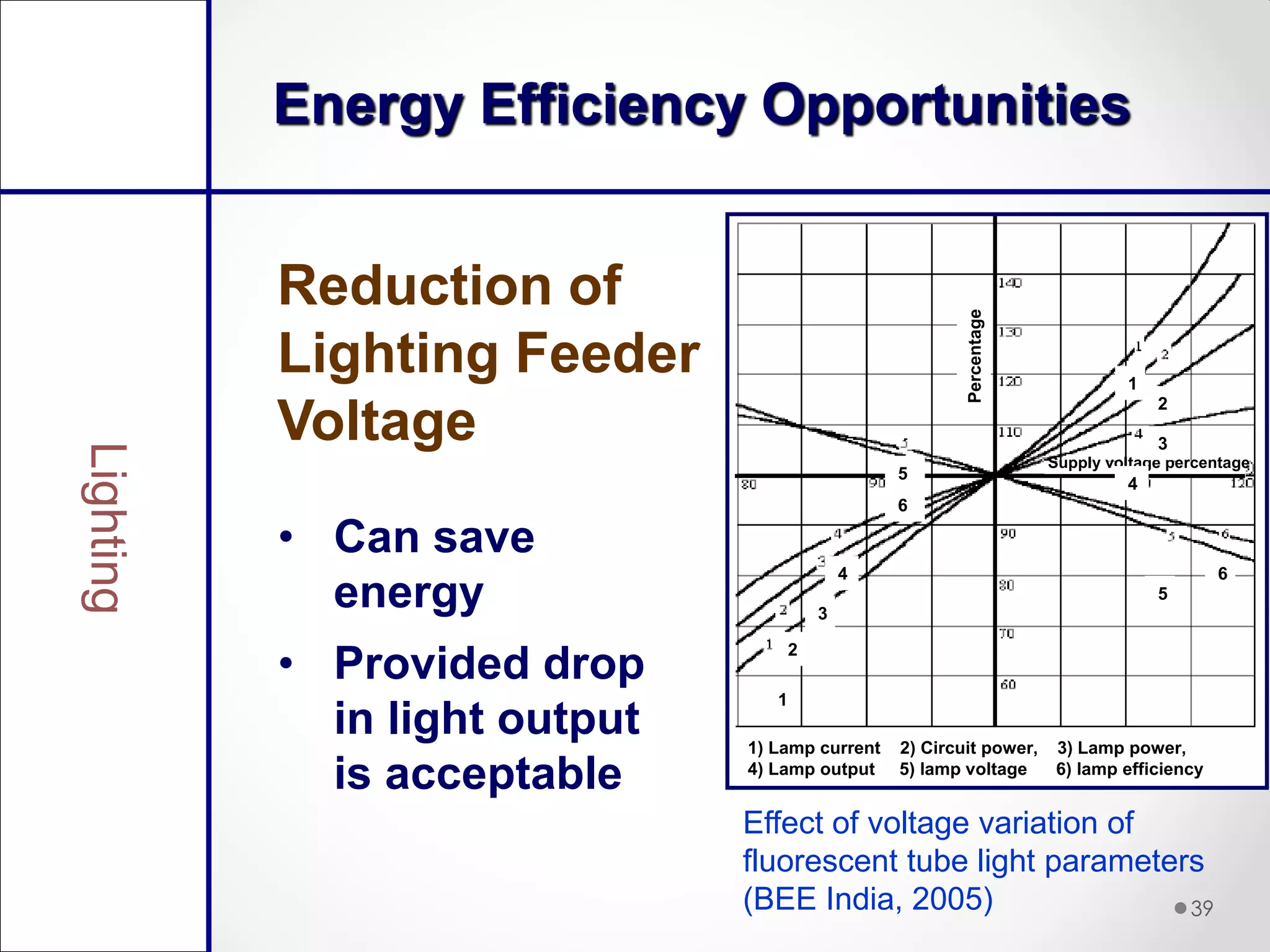
Reduction of


                                               Percentage
Lighting Feeder                                                      1
                                                                         2
Voltage                                                                  3
                                                            Supply voltage percentage
                                       5
                                                                     4
                                       6

• Can save
                                   4                                              6
  energy                       3
                                                                         5


• Provided drop
                           2

                       1
  in light output   1) Lamp current    2) Circuit power,     3) Lamp power,
  is acceptable     4) Lamp output     5) lamp voltage       6) lamp efficiency


                    Effect of voltage variation of
                    fluorescent tube light parameters
                    (BEE India, 2005)               39
Energy Efficiency Opportunities

    Electronic Ballasts instead of
    Electromagnetic Ballasts
•    Oscillators that convert supply frequency to
     about 20,000 – 30,000 Hz
•    Available for fluorescent tube lights, LPSV and
     HPSV lamps
•    Benefits in fluorescent tube lights:
      • Reduced power loss: 1 Watt instead of 10-15
        Watt
      • Improved efficacy at higher frequencies
      • Elimination of starter: no flickering
                                                       40
Energy Efficiency Opportunities


Low Loss Electromagnetic Ballasts
for Tube Lights
Loss per tube lights:
•   Standard ballasts: 10 – 15 Watts
•   Low loss ballasts: 8 - 10 Watts


                                       41
Energy Efficiency Opportunities


    Timers, Twilight Switches &
    Occupancy Sensors
•    Timers: switching of unnecessary lights
•    Twilight switches: depending on availability of
     daylight
•    Occupancy sensors: depending on presence of
     people
•    Applicable for general areas, conference
     rooms, cubicles, restrooms, exteriors

                                                       42
Energy Efficiency Opportunities


T5 Fluorescent Tube Light
•   Slimmer tubes than T12 and T8 tubes
•   Improved luminaire efficiencies by 7%, and with
    super-reflective aluminum luminaire by 11-30%
•   Mercury reduction: 3 mg instead of 15 mg per
    lamp
•   Can only be operated with electronic ballasts
    and not existing luminaries


                                                    43
Energy Efficiency Opportunities


Lighting Maintenance
• Light levels decrease >50% due to aging
  lamps and dirt on fixtures, lamps and
  room surfaces
• Maintenance options:
   • Clean equipment
   • Replace lenses
   • Keep spaces bright and clean
   • Re-lamping
                                       44

Lighting Efficiency Measures

  • 1.
    Lighting Introduction Types of lightingsystems Assessment of lighting systems Energy efficiency opportunities 1
  • 2.
    Introduction Background • Lighting energyconsumption • 20-45% in commercial buildings • 3-10% in industrial plants • Significant energy savings can be realized with a minimal capital investment 2
  • 3.
    Introduction Basic Theory • Light:electromagnetic waves in space • Light is emitted through: a) Incandescence b) Electric discharge c) Electro luminescence d) Photoluminescence 3
  • 4.
    Introduction Definitions and CommonTerms  Lumen • 1 lumen = the photometric equivalent of the watt • 1 lumen = luminous flux per m2 of a sphere with 1 m radius and a 1 candela isotropic light source at the centre • 1 watt = 683 lumens at 555 nm wavelength  Lux • metric unit of measure for illuminance on a surface: 1 lux = 1 lumen / m2 4
  • 5.
    Introduction Definitions and CommonTerms  Luminous intensity (I) • measured in Candela (cd)  Luminous flux (lm) • 4 x luminous intensity 5
  • 6.
    Introduction Definitions and CommonTerms  Installed load efficacy • Average maintained illuminance on a working plane: lux/W/m2  Installed load efficiency ratio • Target load efficacy / Installed load  Rated luminous efficacy • Rated lumen output of the lamp / rated power consumption • Lumens per watt 6
  • 7.
    Introduction Definitions and CommonTerms  Room index • Ratio for the plan dimensions of the room  Target load efficiency • Installed load efficacy considered achievable under best efficiency • Lux/W/m²  Utilization factor • A measure of the effectiveness of the lighting scheme 7
  • 8.
    Introduction Definitions and CommonTerms  The inverse square law • Defines the relationship between illuminance from a point source and distance E = Iluminance E=I/ d2 I = Luminous intensity E1 d12 = E2 d22 d = distance 8
  • 9.
    Introduction Definitions and CommonTerms  Color temperature • Color appearance of a lamp and the light it produces • Measured in Kelvin (K) • Incandescent lamps: “true value” color temperature • Fluorescent and high intensity discharge (HID) lamps: correlated color temperature 9
  • 10.
    Introduction Definitions and CommonTerms  Color rendering index (CRI) Color CIE general color Typical application rendering rendering Index(Ra) groups 1A Ra > 90 Wherever accurate color rendering is required e.g. color printing inspection 1B 80 < Ra < 90 Wherever accurate color judgments are necessary or good color rendering is required for reasons of appearance e.g. display lighting 2 60 < Ra < 80 Wherever moderate color rendering is required 3 40 < Ra < 60 Wherever color rendering is of little significance but marked distortion of color is unacceptable 4 20 < Ra < 40 Wherever color rendering is of no importance at all and marked distortion of colour is acceptable Table 1. Applications of color rendering groups (Bureau of 10 Energy Efficiency, 2005)
  • 11.
    Training Agenda: Electricity Introduction Typesof lighting systems Assessment of lighting systems Energy efficiency opportunities 11
  • 12.
    Types of LightingSystems • Incandescent lamps • Tungsten Halogen Lamps • Fluorescent lamps • High pressure sodium lamps • Low pressure sodium lamps HID lamps • Mercury vapour • Metal halide • Blended • LED lamps 12
  • 13.
    Types of LightingSystems Incandescent Lamps • Emit radiation mainly in the visible region • Bulb contains vacuum or gas filling • Efficacy: 12 lumen / Watt • Color rendering index: 1A • Color temperature: 2500 – 2700 K • Lamp life <2000 hrs (BEE India, 2005) 13
  • 14.
    Types of LightingSystems Tungsten-Halogen Lamps • Tungsten filament and a halogen gas filled bulb • Tungsten atoms evaporate from the hot filament and move to cooler wall of bulb • Advantages: • Efficacy: 18 lumens/Watt • More compact • Longer life • Color rendering index: 1A • More and whiter light • Color temperature: warm • Disadvantages: • Cost more • Lamp life < 4000 hrs • Increased IR and UV • Handling problems Tungsten halogen lamps 14 (BEE India, 2005)
  • 15.
    Types of LightingSystems Fluorescent Lamps • 3 – 5 times as efficient as standard incandescent lamps and last 10 – 20 times longer • Electricity passes through a gas or metallic vapor and causes radiation • Fluorescent tubes are hot cathode lamps 15 © UNEP 2006
  • 16.
    Types of LightingSystems Fluorescent Lamps Features: Halo-phosphate • Efficacy – 80 lumens/Watt (HF gear increases this by 10%) • Different types (T12, • Color Rendering Index –2-3 T10, T8 and T5) • Color Temperature – Any differing in diameter • Lamp Life – 7-15,000 hours Tri-phosphor and efficiency • Efficacy – 90 lumens/Watt • Color Rendering Index –1A-1B • Most efficient at • Color Temperature – Any ambient temperature • Lamp Life – 7-15,000 hours of 20-30 oC, • Compact fluorescent lamps (CFL) have much smaller luminaries Compact fluorescent lamp (CFL) 16 (BEE India, 2005)
  • 17.
    Types of LightingSystems High Pressure Sodium (HPS) Lamps • Used in outdoor and industrial applications • Consist of: ballast, high- voltage electronic starter, ceramic arc tube, xenon gas filling, sodium, mercury • No starting electrodes • High efficacy: 60 – 80 lumen/Watt • Color rendering index: 1 - 2 • Color temperature: warm • Lamp life < 24,000 hrs 17 BEE India, 2005
  • 18.
    Types of LightingSystems Low Pressure Sodium (LPS) Lamps • Commonly included in the HID family • Highest efficacy: 100 - 200 lumen/Watt • Poorest quality light: colors appear black, white or grey shades • Limited to outdoor applications • Efficacy: Color rendering index: 3 • Color temperature: yellow • Lamp life < 16,000 hours 18
  • 19.
    Types of LightingSystems Mercury Vapor Lamps • Oldest HID lamp • Consists of: arc tube with mercury and argon gas and quartz envelope, third electrode, outer phosphor coated bulb, outer glass envelope • Long life and low initial costs • Very poor efficacy: 30 – 65 lumens/Watt • Color rendering index: 3 • Color temperature: intermediate • Lamp life: 16000 – 24000 hours 19
  • 20.
    Types of LightingSystems Metal Halide Lamps • Works similar to tungsten halogen lamps • Largest choice of color, size and rating • Better efficacy than other HID lamps: 80 lumen/Watt • Require high voltage ignition pulse but some have third electrode for starting • Color rendering index: 1A – 2 BEE India, 2005 • Color temperature: 3000 – 6000 K • Lamp life: 6000 – 20,000 hours 20 © UNEP 2006
  • 21.
    Types of LightingSystems Blended Lamps • “Two-in-one”: 2 light sources in 1 gas filled bulb • Quartz mercury discharge tube • Tungsten filament • Suitable for flame proof areas • Fit into incandescent lamps fixtures • Efficacy: 20 – 30 lumen/Watt • Lamp life < 8000 hours • High power factor: 0.95 BEE India, 2005 • Typical rating: 160 W 21
  • 22.
    Types of LightingSystems LED Lamps • Newest type of energy efficient lamp • Two types: • red-blue-green array • phosphor-coated blue lamp • Emit visible light in a very narrow spectrum and can produce “white light” • Used in exit signs, traffic signals, and the technology is rapidly progressing • Significant energy savings: 82 – 93% • Longest lamp life: 40,000 – 100,000 hours 22
  • 23.
    Types of LightingSystems Reflectors • Impact how much light reaches area and distribution pattern • Diffuse reflectors: • 70-80% reflectance but declining in time BEE India, 2005 • painted or powder coated white finish • Specular reflectors: • 85-96% reflectance and less decline in time • Polished or mirror-like • Not suitable for industrial open-type strip fixtures 23
  • 24.
    Types of LightingSystems Gear • Ballast • Current limiting device • Helps voltage build-up in fluorescent lights • Ignitors • Start metal halide and sodium vapor lamps 24
  • 25.
    Types of LightingSystems Comparing lamps Lum / Color Watt Life Type of Lamp Rendering Typical Application Rang Av (Hours) Index e g. Incandescent 8-18 14 Excellent Homes, restaurants, general 1000 lighting, emergency lighting Fluorescent Lamps 46-60 50 Good w.r.t. Offices, shops, hospitals, 5000 coating homes Compact fluorescent lamps 40-70 60 Very good Hotels, shops, homes, 8000-10000 (CFL) offices High pressure mercury 44-57 50 Fair General lighting in factories, 5000 (HPMV) garages, car parking, flood lighting Halogen lamps 18-24 20 Excellent Display, flood lighting, 2000-4000 stadium exhibition grounds, construction areas High pressure sodium 67- 90 Fair General lighting in factories, 6000-12000 (HPSV) SON 121 ware houses, street lighting Low pressure sodium (LPSV) 101- 150 Poor Roadways, tunnels, canals, 6000-12000 SOX 175 street lighting 25
  • 26.
    Training Agenda: Electricity Introduction Typesof lighting systems Assessment of lighting systems Energy efficiency opportunities 26
  • 27.
    Assessment of LightingSystems Designing with Light • Better lighting: increased productivity • Two main questions for designer: • Choose correct lighting level • Choose quality of light (color rendering) 27
  • 28.
    Assessment of LightingSystems Designing with Light Recommended light levels for different tasks (BEE India, 2005) Illuminance Examples of Area of Activity level (lux) General Lighting for rooms 20 Minimum service illuminance in exterior circulating areas, and areas used either outdoor stores , stockyards infrequently and/or casual or simple 50 Exterior walkways & platforms. visual tasks 70 Boiler house. 100 Transformer yards, furnace rooms etc. 150 Circulation areas in industry, stores and stock rooms. 200 Minimum service illuminance on the task 300 Medium bench & machine work, general process in chemical and food industries, casual reading and filing activities. General lighting for 450 Hangers, inspection, drawing offices, fine bench and machine interiors assembly, colour work, critical drawing tasks. 1500 Very fine bench and machine work, instrument & small precision mechanism assembly; electronic components, gauging & inspection of small intricate parts (may be partly provided by local task lighting) Additional localized lighting 3000 Minutely detailed and precise work, e.g. Very small for visually exacting tasks parts of instruments, watch making, engraving. 28
  • 29.
    Assessment of LightingSystems Recommended Illuminance Levels  Scale of illuminance • Illuminance for all non-working interiors > 20 Lux • Factor 1.5 is the smallest significant difference in effect of illuminance • Therefore the following scale is recommended: 20–30–50–75–100–150–200–300–500–750–1000 –1500–2000, …Lux 29
  • 30.
    Assessment of LightingSystems Recommended Illuminance Levels  Illuminance ranges recommended for interior or activity • Middle value (R) for working interiors • Higher value (H) for visual work • Lower value (L) where accuracy is non- important 30
  • 31.
    Assessment of LightingSystems Methodology for Efficiency Study • Step 1: Make inventory of lighting system elements and transformers Table: Device rating, population and use profile S. Plant Lighting Rating in Population Use / Shifts as I / N Locati Device & Watts Lamp Numbers II / III shifts / Day o. on Ballast Type & Ballast Table: Lighting transformer/rating and population profile S. Plant Lighting Measurement Provisions Numbers N Locatio Transformer Rating Available Volts / Amps / Installed o. n (kVA) kW/ Energy 31
  • 32.
    Assessment of LightingSystems Methodology for Efficiency Study • Step 2: Measure and document the Lux levels • Step 3: Measure and document the voltage and power consumption at input points • Step 4: Compare the measured Lux values with standard values as reference • Step 5: Analyze the failure rates of lamps, ballasts and the actual life expectancy levels 32
  • 33.
    Assessment of LightingSystems Methodology for Efficiency Study Step-6 : identify improvement options, for example: • Maximum sunlight use options through transparent roof sheets • Replacements of lamps and ballasts to more energy efficient types • Selecting interior colors for light reflection • Modifying layout as per needs • Providing individual / group controls for lighting 33
  • 34.
    Training Agenda: Electricity Introduction Typesof lighting systems Assessment of lighting systems Energy efficiency opportunities 34
  • 35.
    Energy Efficiency Opportunities UseNatural Day Lighting • North lighting • Glass strips across the roof • Sky lights with fiber reinforced plastic (FRP) • Atrium with FRP dome • Natural light from windows 35
  • 36.
    Energy Efficiency Opportunities De-lampingto Reduce Excess Lighting • Effective method to reduce energy consumption • Reducing lamp height combined with de-lamping: illuminance hardly affected • Complicated for series wired ballasts • Less problematic with parallel wired ballast 36
  • 37.
    Energy Efficiency Opportunities Task Lighting • Low wattage lamps at task • General illuminance at lower level • Benefits: • Reduce number of lighting fixtures • Reduce lamp wattage • Save considerable energy • Better illuminance • Aesthetically pleasing ambience 37
  • 38.
    Energy Efficiency Opportunities HighEfficiency Lamps & Luminaries Examples (9 – 75% savings): • Metal halide lamps to replace mercury / sodium vapor lamps • HPSV lamps where color rendering is not critical • LED panel indicator lamps to replace filament lamps • Luminaries with mirror optics instead of conventional painted ones 38
  • 39.
    Energy Efficiency Opportunities Reductionof Percentage Lighting Feeder 1 2 Voltage 3 Supply voltage percentage 5 4 6 • Can save 4 6 energy 3 5 • Provided drop 2 1 in light output 1) Lamp current 2) Circuit power, 3) Lamp power, is acceptable 4) Lamp output 5) lamp voltage 6) lamp efficiency Effect of voltage variation of fluorescent tube light parameters (BEE India, 2005) 39
  • 40.
    Energy Efficiency Opportunities Electronic Ballasts instead of Electromagnetic Ballasts • Oscillators that convert supply frequency to about 20,000 – 30,000 Hz • Available for fluorescent tube lights, LPSV and HPSV lamps • Benefits in fluorescent tube lights: • Reduced power loss: 1 Watt instead of 10-15 Watt • Improved efficacy at higher frequencies • Elimination of starter: no flickering 40
  • 41.
    Energy Efficiency Opportunities LowLoss Electromagnetic Ballasts for Tube Lights Loss per tube lights: • Standard ballasts: 10 – 15 Watts • Low loss ballasts: 8 - 10 Watts 41
  • 42.
    Energy Efficiency Opportunities Timers, Twilight Switches & Occupancy Sensors • Timers: switching of unnecessary lights • Twilight switches: depending on availability of daylight • Occupancy sensors: depending on presence of people • Applicable for general areas, conference rooms, cubicles, restrooms, exteriors 42
  • 43.
    Energy Efficiency Opportunities T5Fluorescent Tube Light • Slimmer tubes than T12 and T8 tubes • Improved luminaire efficiencies by 7%, and with super-reflective aluminum luminaire by 11-30% • Mercury reduction: 3 mg instead of 15 mg per lamp • Can only be operated with electronic ballasts and not existing luminaries 43
  • 44.
    Energy Efficiency Opportunities LightingMaintenance • Light levels decrease >50% due to aging lamps and dirt on fixtures, lamps and room surfaces • Maintenance options: • Clean equipment • Replace lenses • Keep spaces bright and clean • Re-lamping 44