BUILDING SERVICES-II (Lighting)
K.KEDHEESWARAN M.Arch (gen)
Asst-Prof.Anna-university 2013 regulation
The Light vision of the future
4th Generation1st Generation 2nd Generation 3rd Generation
K.KEDHEESWARAN M.Arch (gen)
1.Introduction to Visual tasks
2.Factors affecting visual tasks
3.Modern theory of light and colour –Additive and substractive synthesis of
colour
4.Luminous flux – Candle – solid angle
5.Laws of illumination
6.Illumination – utilization factor – Depreciation factor –MSCP – MHCP
Sensitivity of Human Eye
•Natural light consists of seven colors having
different wavelengths.
•The average human eye is most sensitive to a
wave length of 5500 0A.
The Sensitivity Curve
Eyes are most
sensitive in the mid-
range near l = 555
nm.
K.KEDHEESWARAN M.Arch (gen)
VISUAL TASK
K.KEDHEESWARAN M.Arch (gen)
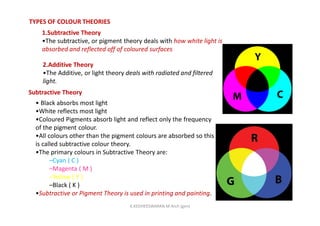
TYPES OF COLOUR THEORIES
1.Subtractive Theory
•The subtractive, or pigment theory deals with how white light is
absorbed and reflected off of coloured surfaces
2.Additive Theory
•The Additive, or light theory deals with radiated and filtered
light.
Subtractive Theory
• Black absorbs most light
•White reflects most light
•Coloured Pigments absorb light and reflect only the frequency
of the pigment colour.
•All colours other than the pigment colours are absorbed so this
is called subtractive colour theory.
•The primary colours in Subtractive Theory are:
–Cyan ( C )
–Magenta ( M )
–Yellow ( Y )
–Black ( K )
•Subtractive or Pigment Theory is used in printing and painting.
K.KEDHEESWARAN M.Arch (gen)
Black radiates no light
•White (sun) radiates all light
•Video is the process of capturing and radiating
light, therefore it uses Additive (Light) Theory not
Subtractive (Pigment) Theory.
•The primary colours in Additive Theory are:
–Red ( R )
–Green ( G )
–Blue ( B )
•The primary colours add together to make white
•Light Theory is also called Additive Theory.
•Light Theory is used in Television, theater lighting,
computer monitors, and video production.
2.Additive Theory
K.KEDHEESWARAN M.Arch (gen)
LUMINOUS FLUX AND LUMINOUS INTENSITY
K.KEDHEESWARAN M.Arch (gen)
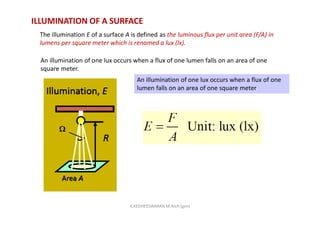
ILLUMINATION OF A SURFACE
The illumination E of a surface A is defined as the luminous flux per unit area (F/A) in
lumens per square meter which is renamed a lux (lx).
An illumination of one lux occurs when a flux of one lumen falls on an area of one
square meter.
An illumination of one lux occurs when a flux of one
lumen falls on an area of one square meter
K.KEDHEESWARAN M.Arch (gen)
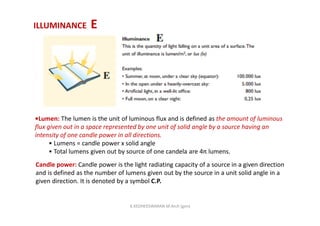
ILLUMINANCE E
•Lumen: The lumen is the unit of luminous flux and is defined as the amount of luminous
flux given out in a space represented by one unit of solid angle by a source having an
intensity of one candle power in all directions.
• Lumens = candle power x solid angle
• Total lumens given out by source of one candela are 4π lumens.
Candle power: Candle power is the light radiating capacity of a source in a given direction
and is defined as the number of lumens given out by the source in a unit solid angle in a
given direction. It is denoted by a symbol C.P.
K.KEDHEESWARAN M.Arch (gen)
SOLID ANGLE
K.KEDHEESWARAN M.Arch (gen)
MHCP & MSCP
•Mean horizontal candle power: (M.H.C.P) It is defined as the mean of candle powers in all
directions in the horizontal plane containing the source of light.
•Mean spherical candle power: ( M.S.C.P) It is defined as the mean of the candle powers in
all directions and in all planes from the source of light.
•Mean hemi-spherical candle power: (M.H.S.C.P) It is defined as the mean of candle powers
in all directions above or below the horizontal plane passing through the source of light.
Lamp Efficiency
It is defined as the visible radiations emitted by it in lumens per watt.
LAW OF ILLUMINATION
The illumination on a surface depends upon the luminous intensity, distance
between the source and surface and the direction of rays of light. It is governed by following
laws :
1.Inverse square law
2.Lambert’s cosine law
K.KEDHEESWARAN M.Arch (gen)
The following factors are required to be considered while designing the lighting scheme :
1.Illumination level
2.Quality of light
3.Co efficient of utilization
4.Depreciation factor
5.Space height ratio
FACTORS REQUIRED FOR LIGHT SCHEME
ILLUMINATION LEVEL
This is the most vital factor in deciding the number and wattage of luminaries so
that we are able to see and recognize the object properly.
Colours of the body have the property of reflecting the light in different
proportions, degree of illumination, its distance from the viewer, contrast between the object
to be seen and its surroundings.
K.KEDHEESWARAN M.Arch (gen)
Type of work recommended illumination level
BUILDING TYPE RECOMMENDED ILLUMINATION LEVEL
Schools 250-400 lumens/ meter square
Industry 1000 lumens/ meter square
Shops 250-500 lumens/ meter square
Offices 100-400 lumens/ meter square
Hotels 80-100 lumens/ meter square
Hospitals 250-3500 lumens/ meter square
CO – EFFICIENT OF UTILIZATION
A surface to be illuminated receive light either directly from the lamps or
reflected from the ceiling and walls or both.
In this case, the total flux reaching the surface will never be equal to the flux
emitted by the lamp, due to absorption by reflectors, ceiling and walls.
Utilization factor = lumens reaching at the working place
total lumens emitted by the source
Usually it varies from 0.5 to 0.8.
K.KEDHEESWARAN M.Arch (gen)
DEPRECIATION FACTOR
The total flux emitted by the source and its fitting may be reduced due to deposition
of dust upon the surfaces. Similarly quantity of light reflected from the ceiling and walls also
decreases with the passage of time. This is called as depreciation factor.
Usually it varies from 1.3 to 1.6.
SPECTRAL ENERGY DISTRIBUTION
•A spectral energy distribution (SED) is a plot of brightness or flux density versus
frequency or wavelength of light.
•It is used in many branches of astronomy to characterize astronomical sources.
•A tool to know the process of star formation is provided by the spectral energy
distribution (SED) mainly in the near- and mid-infrared light
K.KEDHEESWARAN M.Arch (gen)
Types of Artificial Lighting
•There are four basic types of lighting:
1.Incandescent,
2.Fluorescent,
3.High-intensity discharge, and
4.Low-pressure sodium
INCANDESCENT
Light is produced by a tiny coil of tungsten wire
that glows when it is heated by an electrical
current.
–shortest lives
–Inefficient
K.KEDHEESWARAN M.Arch (gen)
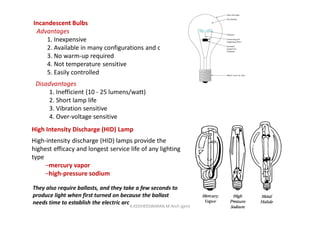
Incandescent Bulbs
Advantages
1. Inexpensive
2. Available in many configurations and colors
3. No warm-up required
4. Not temperature sensitive
5. Easily controlled
Disadvantages
1. Inefficient (10 - 25 lumens/watt)
2. Short lamp life
3. Vibration sensitive
4. Over-voltage sensitive
High Intensity Discharge (HID) Lamp
High-intensity discharge (HID) lamps provide the
highest efficacy and longest service life of any lighting
type
–mercury vapor
–high-pressure sodium
They also require ballasts, and they take a few seconds to
produce light when first turned on because the ballast
needs time to establish the electric arc
K.KEDHEESWARAN M.Arch (gen)
Sodium vapor Lamp
K.KEDHEESWARAN M.Arch (gen)
SODIUM VAPOR LAMP
•A sodium vapor lamp is a gas discharge lamp which uses sodium in an excited state
to produce light. There are two varieties of such lamps: low pressure and high pressure.
–Low Pressure Sodium Lamps (LPS)
–Spectrum of a low-pressure sodium lamp.
•The intense orange band on the left is the atomic sodium D-line emission, comprising about
90% of the visible light emission for this lamp type.
High pressure sodium (HPS) lamps are smaller and
contain additional elements such as mercury, and
produce a dark pink glow when first struck, and a
pinkish orange light when warmed.
•Some bulbs also briefly produce a pure to bluish
white light in between. This is probably from the
mercury glowing before the sodium is completely
warmed.
•The sodium D-line is the main source of light from
the HPS lamp, and it is extremely pressure
broadened by the high sodium pressures in the
lamp; due to this broadening and the emissions from
mercury, colors of objects under these lamps can be
distinguished. K.KEDHEESWARAN M.Arch (gen)
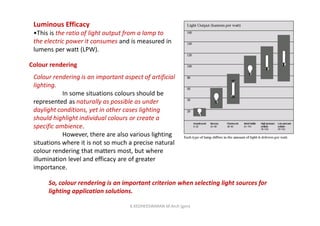
Luminous Efficacy
•This is the ratio of light output from a lamp to
the electric power it consumes and is measured in
lumens per watt (LPW).
Colour rendering
Colour rendering is an important aspect of artificial
lighting.
In some situations colours should be
represented as naturally as possible as under
daylight conditions, yet in other cases lighting
should highlight individual colours or create a
specific ambience.
However, there are also various lighting
situations where it is not so much a precise natural
colour rendering that matters most, but where
illumination level and efficacy are of greater
importance.
So, colour rendering is an important criterion when selecting light sources for
lighting application solutions.
K.KEDHEESWARAN M.Arch (gen)
•To classify light sources on their colour rendering properties the so called colour
rendering index (CRI or also denoted as Ra) has been introduced.
•The scale of the Ra ranges from 50-100.
•The following table shows the meaning of the Ra values:
•Ra = 90 - 100 Excellent colour rendering properties
•Ra = 80 - 90 Good colour rendering properties
•Ra = 60 - 80 Moderate colour rendering properties
•Ra < 60 Poor colour rendering properties
Colour rendering
Colour temperature
•Colour temperature is an important aspect in lighting applications – the choice of colour
temperature being determined by the following factors:
•Ambience
• Climate
• Level of illumination needed
• Colour scheme in an interior.
K.KEDHEESWARAN M.Arch (gen)
Color Rendering Index
(CRI)
A relative scale indicating how perceived colors illuminated by the light source
match actual colors. The higher the number the less color distortion from the
reference source.
85 -100 CRI = Excellent color rendition
75 - 85 CRI = Very Good color rendition
65 - 75 CRI = Good color rendition
55 - 65 CRI = Fair color rendition
0 – 55 CRI = Poor color rendition
K.KEDHEESWARAN M.Arch (gen)
Color Temperature (K˚)
A measure of the “warmth” or “coolness” of a light source.
≤ 3200K = “warm” or red side of spectrum
≥ 4000K = “cool” or blue side of spectrum
3500K = “neutral”
5000K = “Daylight”
K.KEDHEESWARAN M.Arch (gen)
90
Color
Temperature
Scale
Cool White - 4100K
Daylight Fluo - 6500K
North Sky - 8500K
Warm White - 3000K
HPS - 2100K
Halogen – 3100K
Incandescent – 2700K
K.KEDHEESWARAN M.Arch (gen)
M
o
D
E
R
n
L
I
G
H
T
I
N
g
LIGHTING CLASSIFICATION
Thermal radiant Discharge lamps
Incandesent lamp
1.Halogen lamp
2.L.V.halogen lamp
Low pressure High pressure
1.Flurocencent
light
2.C.F.L
3.L.P.Sodium lamp
1.Mercury lamp
2. Metal halide lamp
3. H.P.Pressure
K.KEDHEESWARAN M.Arch (gen)
M
o
D
E
R
n
Wall
Wash light
Pendent light
Chandlier
Reccessed lighting
Floor stand
Flush light
L
I
G
H
T
I
N
g
K.KEDHEESWARAN M.Arch (gen)
Table / Floor light
16 million colour combinations
High quality polycarbonate
Fully adjustable colour spectrum, white
balance
Fully adjustable brightness, light intensity
No overheating
Philips Luxeon 4 LED lamps (integrated)
Floor light, dimmable
Steel with synthetics
Electronic ballast for
flicker free start
Premium glass, steel
Wall light
Designed for Philips Tornado
up to 8W lamp
E14, max. 25W lamp
M
o
D
E
R
n
L
I
G
H
T
I
N
g
K.KEDHEESWARAN M.Arch (gen)
Neon lighting
A neon lamp is a gas discharge lamp
containing primarily neon gas at low
pressure.The term is sometimes
used for similar devices filled with
other noble gases, usually to
produce different colors
Most small neon (indicator-sized) lamps,
such as the common NE-2, break down
at between 90 and 110 volts
They are used as façade treatments,glow
boards,and sign/display boards
Lifetimes compared to other light sources, usually
ranging from 20,000 to 30,000 hours of useful life
on average, but it is not uncommon for a neon tube
to operate for 80,000 hours or more
M
o
D
E
R
n
L
I
G
H
T
I
N
g
K.KEDHEESWARAN M.Arch (gen)
LED (Light Emitting Diode)
Low cost
High energy efficient
High lumenicity
M
o
D
E
R
n
L
I
G
H
T
I
N
g
K.KEDHEESWARAN M.Arch (gen)
OLEDS Lighting (Organic light-emitting diode)
An OLED is an electronic device made by placing a series of
organic thin films between two conductors.When electrical
current is applied, a bright light is emitted.
about 200 times smaller than a human hair.
Passive-matrix,Active-matrix,,Top-emitting,Flexible,White
Types of OLEDS
Transparent
It can be
bend to
any levels
M
o
D
E
R
n
L
I
G
H
T
I
N
g
K.KEDHEESWARAN M.Arch (gen)
OLEDS lighting
White OLED
Emits bright white light
Replace fluorescent lights
Reduce energy cost for
lighting
True Color Qualities
OLED Advantages over LED and LCD
Thinner, lighter and more flexible
Low voltage, low power and
emissive source
Robust Design (Plastic Substrate)
Larger sized displays
Larger viewing angles -170o
Do not require backlight,
light generated
Brighter- good daylight visibility
M
o
D
E
R
n
L
I
G
H
T
I
N
g
K.KEDHEESWARAN M.Arch (gen)
OLEDS lighting
OLED Disadvantages
Lifetime
White, Red, Green  46,000-230,000
hours About 5-25 years
Blue  14,000 hours About 1.6 years
Expensive
Susceptible to water
Overcome multi-billion dollar L
M
o
D
E
R
n
L
I
G
H
T
I
N
g
K.KEDHEESWARAN M.Arch (gen)
VISUAL TASK
&
FACTORS AFFECTING
THE TASK
K.KEDHEESWARAN M.Arch (gen)
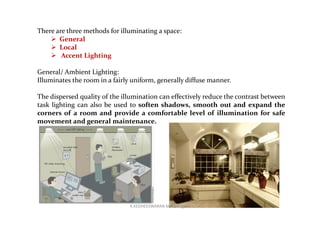
There are three methods for illuminating a space:
 General
 Local
 Accent Lighting
General/ Ambient Lighting:
Illuminates the room in a fairly uniform, generally diffuse manner.
The dispersed quality of the illumination can effectively reduce the contrast between
task lighting can also be used to soften shadows, smooth out and expand the
corners of a room and provide a comfortable level of illumination for safe
movement and general maintenance.
K.KEDHEESWARAN M.Arch (gen)
Local or Task Lighting:
Illuminates specific areas of a space for the
performance of visual tasks or activities.
The light sources are placed close to-
either above or beside- the task surface enabling
available wattage to be used more efficiently than
with general lighting.
The luminaries are normally of direct type
and adjustably in terms of brightness and in direction
is always desirable.
To minimize the risk of an unacceptable brightness
ratio between the task and surroundings task lighting
is often combined with general lighting. Depending on
the types of luminaries used local lighting can also
contribute to the general lumination of space.
K.KEDHEESWARAN M.Arch (gen)
In addition to making a visual task easier to see, local lighting can also create
a variety and interest, partition of space into a number of areas, encompass a furniture
grouping, or reinforce social character of a room.
Accent Lighting:
Accent lighting is a form of local lighting which creates focal points or
rhythmic patterns of light and dark within a space.
Instead of serving simply to illuminate a task or activity, accent lighting can
be used to relieve the monotony of general lighting, emphasize a rooms features or
high light art objects or prized possessions.
K.KEDHEESWARAN M.Arch (gen)
Lighting fixtures:
Lighting fixtures are integral parts of a
buildings electrical system, transforming
energy into usable illumination. Light
fixtures require an electrical connection or
power supply, a house assembly, and a lamp.
We are not only concerned with the shape
and form of the fixture but also with the
form of illumination it provides. Point
source give focus to a space since the area of
greatest brightness in a space tends to
attract our attention. They can be used to
highlight an area or an object of interest. A
number of point sources can be arranged to
describe rhythm and sequence. Small point
sources, when grouped, can provide glitter
and sparkle.
Direct lighting
Direct light
fixtures project 90 to 100
percent of their light
downward toward the
work area. Direct lighting
tends to create shadows.
K.KEDHEESWARAN M.Arch (gen)
Direct-indirect light fixtures distribute
light equally upward and downward. They
reflect light off the ceiling and other room
surfaces. Little light is emitted horizontally
meaning direct glare is often reduced. They
are usually used in "clean" manufacturing
areas.
Indirect light fixtures distribute 90 to 100 percent of the light
upward.
The ceiling and upper walls must be clean and highly
reflective to allow the light to reach the work area. They
provide the most even illumination of all the types of fixtures
and the least direct glare.
Indirect light fixtures are usually used in offices.
K.KEDHEESWARAN M.Arch (gen)
Shielded light fixtures use diffusers, lenses
and louvers to cover bulbs from direct view;
therefore, helping to prevent glare and
distribute light.
Diffusers are translucent or semi-
transparent (see-through) covers made
usually of glass or plastic. They are used on
the bottom or sides of light fixtures to
control brightness.
Lenses are clear or transparent glass, or
plastic covers. The lens design incorporates
prisms and flutes to distribute light in
specific ways.
Louvers are baffles that shield the
bulb from view and reflect light. The
baffles can be contoured to control
light and decrease brightness.
Parabolic louvers are specially
shaped grids that concentrate and
distribute light.
K.KEDHEESWARAN M.Arch (gen)
Linear sources can be used to give direction, emphasize the edges of planes, or
outline an area. A parallel series of linear sources can form a plane of illumination
of an area.
Volumetric sources are point sources expanded by the use of translucent
materials into spheres, globes or other three-dimensional forms.
Light fixtures can provide direct and/or indirect illumination. The form of
distribution depends on the design of the fixture as well as its placements and
orientation in a space.
Luminaries may be classified according to how they distribute the light emitted by
their lamps and their characteristic spread of their beams. This information along
with the S/MH ratio is normally supplied by the fixture manufacturer for each
luminaries.
The S/MH guideline specifies the ratio of maximum luminaire spacing to
mounting height in order to achieve an acceptable uniformity of illumination. For
most luminaries, the mounting height is measured from the luminaire to an
assumed work plane. For semi-indirect and indirect lighting systems that utilize
the ceiling plane as a reflector the mounting height is measured from the ceiling to
the work plane.
K.KEDHEESWARAN M.Arch (gen)
Details and objects that must be seen for performance of a
given activity, including immediate background of details
or objects.
VISUAL TASK
What illumination level do we require?
The amount of light varies not only with the type of work we do
but also with the age.
S.NO AGE
ILLUMINATION
LEVEL
1 20 1 1/2
2 30 2
3 40 3
4 50 6
5 60 Up to 15
K.KEDHEESWARAN M.Arch (gen)
Comfortable amount of sunlight for
reading and writing -100,000-20,000 lux
Adequate day lighting in general room – 5000-8000lux
Lighting Varies With The Type Of Work
Living room
The living room is the space where the family
spends more time. It has combined light fittings
which has a strong light(for reading, sewing),
decorative light fittings (table lamp) give off an
appropriate glow of light.
Over the DINING TABLE a single or
multiple pendant which should be able to take at
least a 100 watt lamp which will throw light directly
on to the table. For the rest of the room the light
should have 25,40 or 60 watt bulbs. For general
lighting a 100/150 watt floor lamp is needed
K.KEDHEESWARAN M.Arch (gen)
Bed room
Bulb should not be stronger than 100 watt.
Lamps for reading in bed should provide
direct concealed lighting for adequate light
over the dressing table two lamps mounted
on either side or one above the mirror are
best.
Kitchen
Kitchen lighting is often neglected. Generally kitchen is a hot place.
So cool lighting is recommended. Phillips fluorescent lighting is best
for the kitchen because of its high light output and low heat radiation.
Light fitting is easily accesible for regular cleaning.
Staircase & Verandah
An attractive a single tube fitting housing a Phillips fluorescent lamp would
be adequate.
K.KEDHEESWARAN M.Arch (gen)
CHECK LIST FOR GOOD LIGHTING;
The goal of architectural lighting is to create the visual environment that best
accomodates the functions intended . visual comfort results when we are
able to receive the visual information that we instinctly or consciously want
to know. some general guide lines for achieving good lighting are presented
below.
2.Visual conditions are also better if the visual task is seen in an
unobtrusive and unconfusing setting. the surroundings should not be so
bright or so colorful that attention is drawn away ,so dark that the task
appears excessively bright and glaring or the setting monotonous.
1.Flat surfaces should not be unevenly lit unless focus is to be placed on
art,entries,panels,etc.
K.KEDHEESWARAN M.Arch (gen)
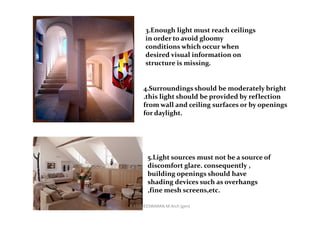
5.Light sources must not be a source of
discomfort glare. consequently ,
building openings should have
shading devices such as overhangs
,fine mesh screens,etc.
3.Enough light must reach ceilings
in order to avoid gloomy
conditions which occur when
desired visual information on
structure is missing.
4.Surroundings should be moderately bright
.this light should be provided by reflection
from wall and ceiling surfaces or by openings
for daylight.
K.KEDHEESWARAN M.Arch (gen)
7.Light must be free from
disability glare or discomfort
glare.
6.Visual conditions are improved if
the visual task can be distinguished
from its surroundings by being
brighter, more
contrasting,colorful,strongly
patterned,or a combination of two
or more of these factors.
K.KEDHEESWARAN M.Arch (gen)
8.Light sources should be selected with regard to color rendering
needs of people,finishes ,and furnishings.
9.Sufficient overall light should be provided in rooms , with focal
light on the visual task.
Avoid creating condition where the eyes must adapt too quickly
over too great a range of brightness.
K.KEDHEESWARAN M.Arch (gen)
10.Daylight should be provided through
openings to achieve contact with nature
and people
And to induce feelings of well being and
freshness . variety of light is the dominant
daily characteristics of natural light.
11.Visual conditions improve with
increasing illumination up to a point
where diminishing returns are quickly
reached.
12.Dull uniformity should be avoided. for eg,
small points of light from low wattage light
sources can contribute “sparkle” without glare.
sparkle or glitter occurs when a pleasant
composition of luminous brilliance is achieved.K.KEDHEESWARAN M.Arch (gen)
K.KEDHEESWARAN M.Arch (gen)
1.Direct lighting on table strong contrast, too harsh
for lighting faces
Pleasantness: Neutral
Clarity: Hazy, quiet impression
Spaciousness: Strong impression of confinement
2. Lighting on all walls, low intensity, suitable for
display
Pleasantness: Neutral, tending towards a more
pleasant impression
Clarity: Neutral
Spaciousness: Promotes impression of spaciousness, increased
height
3. Lighting of cove above, low intensity, pleasant for
near and distant faces
Pleasantness: Strong negative
Clarity: Strong promoting hazy, quiet impression
Spaciousness: Neutral
4. Direct lighting on table, Lighting of small wall
Pleasantness: Relatively Strong positive
Clarity: Neutral
Spaciousness: Neutral with strength in impression
of length
5. Direct lighting on table, Lighting of cove above soft subdued
effect, pleasant for near faces
Pleasantness: Relatively Strong negative
Clarity: Strong
Spaciousness: Somewhat
6. Lighting of cove above, Lighting of walls flat shadow free
Pleasantness: Strong
Clarity: Strong
Spaciousness: Strong
Lighting in office
•Lighting is an essential provision for any workplace. It is preferable to provide uniform
illumination over the entire workplace by combining both natural and artificial lighting.
• Localised lighting may be required in certain cases to cut costs and improve illumination.
Good lighting helps us to see and to recognise hazards. It can reduce visual strain and
discomfort.
•Poor lighting may affect workers' performance and health as poor visibility increases the
chances of errors being made. It also means that people work slower. Besides, natural working
posture may not be possible under poor lighting, thus resulting in musculo-skeletal strain.
Light distribution classification
K.KEDHEESWARAN M.Arch (gen)
Examples of optimum average illumination in offices
K.KEDHEESWARAN M.Arch (gen)
Electrical layout
–simple residential
–school
–commercial building
Residential building
K.KEDHEESWARAN M.Arch (gen)
SYMBOLS USED
K.KEDHEESWARAN M.Arch (gen)
SYMBOLS USED
K.KEDHEESWARAN M.Arch (gen)
SYMBOLS USED
K.KEDHEESWARAN M.Arch (gen)
L i g h t i n g D e s i g n
COMPONENTS
K.KEDHEESWARAN M.Arch (gen)
LIGHTING OPTIONS
ELECTRIC LIGHTING
Distribution of light
from luminaires
K.KEDHEESWARAN M.Arch (gen)
LUMINARIES
1. RECESSED LUMINAIRES
2. BATTENS
3. SURFACE MOUNTED
4. WATERPROOF
5. CLEANROOM
6. SURFACE MOUNTED/SUSPENDED LUMINAIRES
4
5
1
1
3
2
K.KEDHEESWARAN M.Arch (gen)
LUMINARIES
Typical characteristics
K.KEDHEESWARAN M.Arch (gen)
TASK/LOCAL LUMINAIRES
ACCENT & DISPLAY LUMINAIRES
(SPOTLIGHTS & FLOODLIGHTS) UPLIGHT LUMINAIRES
WALL-WASHING LUMINAIRES
DOWNLIGHT LUMINAIRES
K.KEDHEESWARAN M.Arch (gen)
LIGHTING CONTROLLER
1. Time-switch controls-using timer gadget
2. Photocell controls-by light sensor
3. Occupancy Controls-by IBMS,I-R Sensor
4. Dimmers-by reducing/increasing intensity
5. In-Luminaire-in fixture itself
LIGHTING DESIGN STRATEGIES BASICS OF SITE ANALYSIS
ORIENTATION DAYLIGHT FACTORS. SOLAR GAIN
OVERSHADOWING
VIEW
LIGHT TRESPASS
K.KEDHEESWARAN M.Arch (gen)
Solar Lighting Systems
The photovoltaic effect involves
the creation of a voltage (or a
corresponding electric current) in a
material upon exposure to electro-
magnetic radiation(Sun-light).
The actual amount of sunlight falling on a specific geographical
location is known as insolation—or "incident solar radiation."
The three main types of materials used for solar cells:-
1.The first type is silicon, which can be used in various forms, including single-crystalline,
multicrystalline, and amorphous.
2.The second type is polycrystalline thin films, with specific discussion of copper indium
di selenide (CIS) cadmium telluride (CdTe), and thin-film silicon.
3.The third type of material is single-crystalline thin film, focusing especially on cells made
with gallium arsenide.
A standard solar lighting system consists of following components:
1.Charge controller
2. Photo-voltaic module
3. Battery
4.Inverter
5. Light output
K.KEDHEESWARAN M.Arch (gen)
SOLAR CHARGE CONTROLLER
-"12 volt" panels put out about 16 to 20 volts,
Battery Type
-use deep-cycle lead-acid batteries
An inverter is a device that converts battery
power (DC) into alternating current (AC) of a
higher voltage.
PV MODULES IN INDIA
Single PV modules of capacities ranging from 3 Watt peak (Wp)
to 240 Watt peak (Wp)
PV module is rated in terms of
watt peak (Wp) units
1000 watts per square metre solar radiation intensity
K.KEDHEESWARAN M.Arch (gen)
Tilt angle Schematic Diagram
K.KEDHEESWARAN M.Arch (gen)
Mounting configuration
anchor base Pole is installed via
castin place steel anchor bolts
which are sized according to the
pole loading and wind zone.
Direct burial
Pole includes an integral shaft extension
which is installed below grade and reinforced
with compacted aggregate or concrete. This
mounting method may be preferred for
installations
K.KEDHEESWARAN M.Arch (gen)
LIGHT FOR HEALTH CARE CENTERS
Attractiveness and well-being-Structuring time
• The right lighting helps synchronise biological rhythms
and works in harmony with them
• Colour temperature and lighting intensity can mimic
those of natural daylight over the course of a day
• Nature is the perfect model for pleasant, refreshing
lighting
-Increased well-being
• Lighting scenes that feature variable light intensities, directions of light and light
colours create feel-good atmospheres
• Light and materials can merge into a single entity, thus lending even sterile spaces a
homely note
• Individually adjustable daylight integration speeds up patient convalescence
-Improving convenience
K.KEDHEESWARAN M.Arch (gen)
-ENSURING SAFETY
• Patients and staff alike can find their way
round more quickly
• Avoiding glare means preventing
accidents
• Uniform brightness enhances lighting
comfort
SPACE AND CAPACITY
Support for doctors and care staff
The new integrated medical wall-mounted system made our work significantly easier
-Imaging diagnostics requires low lighting levels,
for instance.
-At the same time, glare-free light and extremely
good colour rendering are needed in order to be
able to identify details and colours with high
contrast.
LIGHT FOR HEALTH CARE CENTERS
K.KEDHEESWARAN M.Arch (gen)
-Making work easier
• Functional, glare-free lighting is indispensable in
workplaces where there are exacting visual
requirements
• Emotional accent lighting provides welcome
contrasts in sterile environments
• Lighting scenes at the push of a button increase
convenience for both patients and staff
LIGHT FOR HEALTH CARE CENTERS
-Recognising details
• High, uniform illuminance creates
ideal working conditions
• Lighting scenarios can be adapted
to suit particular activities
• Proper lighting combats fatigue
Operating theatres are uniformly
illuminated with high illuminance
levels. An average lighting level 2000
lux
K.KEDHEESWARAN M.Arch (gen)
LIGHT FOR HEALTH CARE CENTERS
Minimally invasive operations are nowadays often performed
using green light lasers requiring low illuminance levels.
The surgeon’s eyes have to constantly adapt to different light
levels and this causes fatigue
Coloured lighting scenes of the kind produced by
RGB-controlled LED luminaires room, for instance
• Modular lighting and medical supply units
adapt flexibly to suit the way a room is being
used
• Modular lighting solutions meet all needs
comprehensively, from medical supply units in
patients’ rooms
• Intelligent lighting control adjusts light to suit
the visual requirements
K.KEDHEESWARAN M.Arch (gen)
LIGHT FOR HEALTH CARE CENTERS
Reducing energy consumption
• Efficient luminaires and light sources reduce energy consumption considerably
• Intelligent lighting control switches light off when it is not needed..
• Upgraded or modernised lighting solutions are a more economical efficient solution
overall
LED solutions are especially
recommended in clinics
and care facilities.
50 % reduction in CO² emissions thanks to LED lighting alone
LED, pendant
cafeteria
Waiting area
K.KEDHEESWARAN M.Arch (gen)
LIGHT FOR HEALTH CARE CENTERSExamination room
Surgery hallway
LED down light
Pre-op room
Operating theatre
K.KEDHEESWARAN M.Arch (gen)
A LEED Overview – ‘LEED with Lighting
K.KEDHEESWARAN M.Arch (gen)

building services- II Lighting

  • 1.
    BUILDING SERVICES-II (Lighting) K.KEDHEESWARANM.Arch (gen) K.KEDHEESWARAN M.Arch (gen) Asst-Prof.Anna-university 2013 regulation
  • 2.
    The Light visionof the future 4th Generation1st Generation 2nd Generation 3rd Generation K.KEDHEESWARAN M.Arch (gen)
  • 3.
    1.Introduction to Visualtasks 2.Factors affecting visual tasks 3.Modern theory of light and colour –Additive and substractive synthesis of colour 4.Luminous flux – Candle – solid angle 5.Laws of illumination 6.Illumination – utilization factor – Depreciation factor –MSCP – MHCP Sensitivity of Human Eye •Natural light consists of seven colors having different wavelengths. •The average human eye is most sensitive to a wave length of 5500 0A. The Sensitivity Curve Eyes are most sensitive in the mid- range near l = 555 nm. K.KEDHEESWARAN M.Arch (gen)
  • 4.
  • 5.
    TYPES OF COLOURTHEORIES 1.Subtractive Theory •The subtractive, or pigment theory deals with how white light is absorbed and reflected off of coloured surfaces 2.Additive Theory •The Additive, or light theory deals with radiated and filtered light. Subtractive Theory • Black absorbs most light •White reflects most light •Coloured Pigments absorb light and reflect only the frequency of the pigment colour. •All colours other than the pigment colours are absorbed so this is called subtractive colour theory. •The primary colours in Subtractive Theory are: –Cyan ( C ) –Magenta ( M ) –Yellow ( Y ) –Black ( K ) •Subtractive or Pigment Theory is used in printing and painting. K.KEDHEESWARAN M.Arch (gen)
  • 6.
    Black radiates nolight •White (sun) radiates all light •Video is the process of capturing and radiating light, therefore it uses Additive (Light) Theory not Subtractive (Pigment) Theory. •The primary colours in Additive Theory are: –Red ( R ) –Green ( G ) –Blue ( B ) •The primary colours add together to make white •Light Theory is also called Additive Theory. •Light Theory is used in Television, theater lighting, computer monitors, and video production. 2.Additive Theory K.KEDHEESWARAN M.Arch (gen)
  • 7.
    LUMINOUS FLUX ANDLUMINOUS INTENSITY K.KEDHEESWARAN M.Arch (gen)
  • 8.
    ILLUMINATION OF ASURFACE The illumination E of a surface A is defined as the luminous flux per unit area (F/A) in lumens per square meter which is renamed a lux (lx). An illumination of one lux occurs when a flux of one lumen falls on an area of one square meter. An illumination of one lux occurs when a flux of one lumen falls on an area of one square meter K.KEDHEESWARAN M.Arch (gen)
  • 9.
    ILLUMINANCE E •Lumen: Thelumen is the unit of luminous flux and is defined as the amount of luminous flux given out in a space represented by one unit of solid angle by a source having an intensity of one candle power in all directions. • Lumens = candle power x solid angle • Total lumens given out by source of one candela are 4π lumens. Candle power: Candle power is the light radiating capacity of a source in a given direction and is defined as the number of lumens given out by the source in a unit solid angle in a given direction. It is denoted by a symbol C.P. K.KEDHEESWARAN M.Arch (gen)
  • 10.
  • 11.
    MHCP & MSCP •Meanhorizontal candle power: (M.H.C.P) It is defined as the mean of candle powers in all directions in the horizontal plane containing the source of light. •Mean spherical candle power: ( M.S.C.P) It is defined as the mean of the candle powers in all directions and in all planes from the source of light. •Mean hemi-spherical candle power: (M.H.S.C.P) It is defined as the mean of candle powers in all directions above or below the horizontal plane passing through the source of light. Lamp Efficiency It is defined as the visible radiations emitted by it in lumens per watt. LAW OF ILLUMINATION The illumination on a surface depends upon the luminous intensity, distance between the source and surface and the direction of rays of light. It is governed by following laws : 1.Inverse square law 2.Lambert’s cosine law K.KEDHEESWARAN M.Arch (gen)
  • 12.
    The following factorsare required to be considered while designing the lighting scheme : 1.Illumination level 2.Quality of light 3.Co efficient of utilization 4.Depreciation factor 5.Space height ratio FACTORS REQUIRED FOR LIGHT SCHEME ILLUMINATION LEVEL This is the most vital factor in deciding the number and wattage of luminaries so that we are able to see and recognize the object properly. Colours of the body have the property of reflecting the light in different proportions, degree of illumination, its distance from the viewer, contrast between the object to be seen and its surroundings. K.KEDHEESWARAN M.Arch (gen)
  • 13.
    Type of workrecommended illumination level BUILDING TYPE RECOMMENDED ILLUMINATION LEVEL Schools 250-400 lumens/ meter square Industry 1000 lumens/ meter square Shops 250-500 lumens/ meter square Offices 100-400 lumens/ meter square Hotels 80-100 lumens/ meter square Hospitals 250-3500 lumens/ meter square CO – EFFICIENT OF UTILIZATION A surface to be illuminated receive light either directly from the lamps or reflected from the ceiling and walls or both. In this case, the total flux reaching the surface will never be equal to the flux emitted by the lamp, due to absorption by reflectors, ceiling and walls. Utilization factor = lumens reaching at the working place total lumens emitted by the source Usually it varies from 0.5 to 0.8. K.KEDHEESWARAN M.Arch (gen)
  • 14.
    DEPRECIATION FACTOR The totalflux emitted by the source and its fitting may be reduced due to deposition of dust upon the surfaces. Similarly quantity of light reflected from the ceiling and walls also decreases with the passage of time. This is called as depreciation factor. Usually it varies from 1.3 to 1.6. SPECTRAL ENERGY DISTRIBUTION •A spectral energy distribution (SED) is a plot of brightness or flux density versus frequency or wavelength of light. •It is used in many branches of astronomy to characterize astronomical sources. •A tool to know the process of star formation is provided by the spectral energy distribution (SED) mainly in the near- and mid-infrared light K.KEDHEESWARAN M.Arch (gen)
  • 15.
    Types of ArtificialLighting •There are four basic types of lighting: 1.Incandescent, 2.Fluorescent, 3.High-intensity discharge, and 4.Low-pressure sodium INCANDESCENT Light is produced by a tiny coil of tungsten wire that glows when it is heated by an electrical current. –shortest lives –Inefficient K.KEDHEESWARAN M.Arch (gen)
  • 16.
    Incandescent Bulbs Advantages 1. Inexpensive 2.Available in many configurations and colors 3. No warm-up required 4. Not temperature sensitive 5. Easily controlled Disadvantages 1. Inefficient (10 - 25 lumens/watt) 2. Short lamp life 3. Vibration sensitive 4. Over-voltage sensitive High Intensity Discharge (HID) Lamp High-intensity discharge (HID) lamps provide the highest efficacy and longest service life of any lighting type –mercury vapor –high-pressure sodium They also require ballasts, and they take a few seconds to produce light when first turned on because the ballast needs time to establish the electric arc K.KEDHEESWARAN M.Arch (gen)
  • 17.
  • 18.
    SODIUM VAPOR LAMP •Asodium vapor lamp is a gas discharge lamp which uses sodium in an excited state to produce light. There are two varieties of such lamps: low pressure and high pressure. –Low Pressure Sodium Lamps (LPS) –Spectrum of a low-pressure sodium lamp. •The intense orange band on the left is the atomic sodium D-line emission, comprising about 90% of the visible light emission for this lamp type. High pressure sodium (HPS) lamps are smaller and contain additional elements such as mercury, and produce a dark pink glow when first struck, and a pinkish orange light when warmed. •Some bulbs also briefly produce a pure to bluish white light in between. This is probably from the mercury glowing before the sodium is completely warmed. •The sodium D-line is the main source of light from the HPS lamp, and it is extremely pressure broadened by the high sodium pressures in the lamp; due to this broadening and the emissions from mercury, colors of objects under these lamps can be distinguished. K.KEDHEESWARAN M.Arch (gen)
  • 19.
    Luminous Efficacy •This isthe ratio of light output from a lamp to the electric power it consumes and is measured in lumens per watt (LPW). Colour rendering Colour rendering is an important aspect of artificial lighting. In some situations colours should be represented as naturally as possible as under daylight conditions, yet in other cases lighting should highlight individual colours or create a specific ambience. However, there are also various lighting situations where it is not so much a precise natural colour rendering that matters most, but where illumination level and efficacy are of greater importance. So, colour rendering is an important criterion when selecting light sources for lighting application solutions. K.KEDHEESWARAN M.Arch (gen)
  • 20.
    •To classify lightsources on their colour rendering properties the so called colour rendering index (CRI or also denoted as Ra) has been introduced. •The scale of the Ra ranges from 50-100. •The following table shows the meaning of the Ra values: •Ra = 90 - 100 Excellent colour rendering properties •Ra = 80 - 90 Good colour rendering properties •Ra = 60 - 80 Moderate colour rendering properties •Ra < 60 Poor colour rendering properties Colour rendering Colour temperature •Colour temperature is an important aspect in lighting applications – the choice of colour temperature being determined by the following factors: •Ambience • Climate • Level of illumination needed • Colour scheme in an interior. K.KEDHEESWARAN M.Arch (gen)
  • 21.
    Color Rendering Index (CRI) Arelative scale indicating how perceived colors illuminated by the light source match actual colors. The higher the number the less color distortion from the reference source. 85 -100 CRI = Excellent color rendition 75 - 85 CRI = Very Good color rendition 65 - 75 CRI = Good color rendition 55 - 65 CRI = Fair color rendition 0 – 55 CRI = Poor color rendition K.KEDHEESWARAN M.Arch (gen)
  • 22.
    Color Temperature (K˚) Ameasure of the “warmth” or “coolness” of a light source. ≤ 3200K = “warm” or red side of spectrum ≥ 4000K = “cool” or blue side of spectrum 3500K = “neutral” 5000K = “Daylight” K.KEDHEESWARAN M.Arch (gen)
  • 23.
    90 Color Temperature Scale Cool White -4100K Daylight Fluo - 6500K North Sky - 8500K Warm White - 3000K HPS - 2100K Halogen – 3100K Incandescent – 2700K K.KEDHEESWARAN M.Arch (gen)
  • 24.
  • 25.
    M o D E R n L I G H T I N g LIGHTING CLASSIFICATION Thermal radiantDischarge lamps Incandesent lamp 1.Halogen lamp 2.L.V.halogen lamp Low pressure High pressure 1.Flurocencent light 2.C.F.L 3.L.P.Sodium lamp 1.Mercury lamp 2. Metal halide lamp 3. H.P.Pressure K.KEDHEESWARAN M.Arch (gen)
  • 26.
    M o D E R n Wall Wash light Pendent light Chandlier Reccessedlighting Floor stand Flush light L I G H T I N g K.KEDHEESWARAN M.Arch (gen)
  • 27.
    Table / Floorlight 16 million colour combinations High quality polycarbonate Fully adjustable colour spectrum, white balance Fully adjustable brightness, light intensity No overheating Philips Luxeon 4 LED lamps (integrated) Floor light, dimmable Steel with synthetics Electronic ballast for flicker free start Premium glass, steel Wall light Designed for Philips Tornado up to 8W lamp E14, max. 25W lamp M o D E R n L I G H T I N g K.KEDHEESWARAN M.Arch (gen)
  • 28.
    Neon lighting A neonlamp is a gas discharge lamp containing primarily neon gas at low pressure.The term is sometimes used for similar devices filled with other noble gases, usually to produce different colors Most small neon (indicator-sized) lamps, such as the common NE-2, break down at between 90 and 110 volts They are used as façade treatments,glow boards,and sign/display boards Lifetimes compared to other light sources, usually ranging from 20,000 to 30,000 hours of useful life on average, but it is not uncommon for a neon tube to operate for 80,000 hours or more M o D E R n L I G H T I N g K.KEDHEESWARAN M.Arch (gen)
  • 29.
    LED (Light EmittingDiode) Low cost High energy efficient High lumenicity M o D E R n L I G H T I N g K.KEDHEESWARAN M.Arch (gen)
  • 30.
    OLEDS Lighting (Organiclight-emitting diode) An OLED is an electronic device made by placing a series of organic thin films between two conductors.When electrical current is applied, a bright light is emitted. about 200 times smaller than a human hair. Passive-matrix,Active-matrix,,Top-emitting,Flexible,White Types of OLEDS Transparent It can be bend to any levels M o D E R n L I G H T I N g K.KEDHEESWARAN M.Arch (gen)
  • 31.
    OLEDS lighting White OLED Emitsbright white light Replace fluorescent lights Reduce energy cost for lighting True Color Qualities OLED Advantages over LED and LCD Thinner, lighter and more flexible Low voltage, low power and emissive source Robust Design (Plastic Substrate) Larger sized displays Larger viewing angles -170o Do not require backlight, light generated Brighter- good daylight visibility M o D E R n L I G H T I N g K.KEDHEESWARAN M.Arch (gen)
  • 32.
    OLEDS lighting OLED Disadvantages Lifetime White,Red, Green  46,000-230,000 hours About 5-25 years Blue  14,000 hours About 1.6 years Expensive Susceptible to water Overcome multi-billion dollar L M o D E R n L I G H T I N g K.KEDHEESWARAN M.Arch (gen)
  • 33.
    VISUAL TASK & FACTORS AFFECTING THETASK K.KEDHEESWARAN M.Arch (gen)
  • 34.
    There are threemethods for illuminating a space:  General  Local  Accent Lighting General/ Ambient Lighting: Illuminates the room in a fairly uniform, generally diffuse manner. The dispersed quality of the illumination can effectively reduce the contrast between task lighting can also be used to soften shadows, smooth out and expand the corners of a room and provide a comfortable level of illumination for safe movement and general maintenance. K.KEDHEESWARAN M.Arch (gen)
  • 35.
    Local or TaskLighting: Illuminates specific areas of a space for the performance of visual tasks or activities. The light sources are placed close to- either above or beside- the task surface enabling available wattage to be used more efficiently than with general lighting. The luminaries are normally of direct type and adjustably in terms of brightness and in direction is always desirable. To minimize the risk of an unacceptable brightness ratio between the task and surroundings task lighting is often combined with general lighting. Depending on the types of luminaries used local lighting can also contribute to the general lumination of space. K.KEDHEESWARAN M.Arch (gen)
  • 36.
    In addition tomaking a visual task easier to see, local lighting can also create a variety and interest, partition of space into a number of areas, encompass a furniture grouping, or reinforce social character of a room. Accent Lighting: Accent lighting is a form of local lighting which creates focal points or rhythmic patterns of light and dark within a space. Instead of serving simply to illuminate a task or activity, accent lighting can be used to relieve the monotony of general lighting, emphasize a rooms features or high light art objects or prized possessions. K.KEDHEESWARAN M.Arch (gen)
  • 37.
    Lighting fixtures: Lighting fixturesare integral parts of a buildings electrical system, transforming energy into usable illumination. Light fixtures require an electrical connection or power supply, a house assembly, and a lamp. We are not only concerned with the shape and form of the fixture but also with the form of illumination it provides. Point source give focus to a space since the area of greatest brightness in a space tends to attract our attention. They can be used to highlight an area or an object of interest. A number of point sources can be arranged to describe rhythm and sequence. Small point sources, when grouped, can provide glitter and sparkle. Direct lighting Direct light fixtures project 90 to 100 percent of their light downward toward the work area. Direct lighting tends to create shadows. K.KEDHEESWARAN M.Arch (gen)
  • 38.
    Direct-indirect light fixturesdistribute light equally upward and downward. They reflect light off the ceiling and other room surfaces. Little light is emitted horizontally meaning direct glare is often reduced. They are usually used in "clean" manufacturing areas. Indirect light fixtures distribute 90 to 100 percent of the light upward. The ceiling and upper walls must be clean and highly reflective to allow the light to reach the work area. They provide the most even illumination of all the types of fixtures and the least direct glare. Indirect light fixtures are usually used in offices. K.KEDHEESWARAN M.Arch (gen)
  • 39.
    Shielded light fixturesuse diffusers, lenses and louvers to cover bulbs from direct view; therefore, helping to prevent glare and distribute light. Diffusers are translucent or semi- transparent (see-through) covers made usually of glass or plastic. They are used on the bottom or sides of light fixtures to control brightness. Lenses are clear or transparent glass, or plastic covers. The lens design incorporates prisms and flutes to distribute light in specific ways. Louvers are baffles that shield the bulb from view and reflect light. The baffles can be contoured to control light and decrease brightness. Parabolic louvers are specially shaped grids that concentrate and distribute light. K.KEDHEESWARAN M.Arch (gen)
  • 40.
    Linear sources canbe used to give direction, emphasize the edges of planes, or outline an area. A parallel series of linear sources can form a plane of illumination of an area. Volumetric sources are point sources expanded by the use of translucent materials into spheres, globes or other three-dimensional forms. Light fixtures can provide direct and/or indirect illumination. The form of distribution depends on the design of the fixture as well as its placements and orientation in a space. Luminaries may be classified according to how they distribute the light emitted by their lamps and their characteristic spread of their beams. This information along with the S/MH ratio is normally supplied by the fixture manufacturer for each luminaries. The S/MH guideline specifies the ratio of maximum luminaire spacing to mounting height in order to achieve an acceptable uniformity of illumination. For most luminaries, the mounting height is measured from the luminaire to an assumed work plane. For semi-indirect and indirect lighting systems that utilize the ceiling plane as a reflector the mounting height is measured from the ceiling to the work plane. K.KEDHEESWARAN M.Arch (gen)
  • 41.
    Details and objectsthat must be seen for performance of a given activity, including immediate background of details or objects. VISUAL TASK What illumination level do we require? The amount of light varies not only with the type of work we do but also with the age. S.NO AGE ILLUMINATION LEVEL 1 20 1 1/2 2 30 2 3 40 3 4 50 6 5 60 Up to 15 K.KEDHEESWARAN M.Arch (gen)
  • 42.
    Comfortable amount ofsunlight for reading and writing -100,000-20,000 lux Adequate day lighting in general room – 5000-8000lux Lighting Varies With The Type Of Work Living room The living room is the space where the family spends more time. It has combined light fittings which has a strong light(for reading, sewing), decorative light fittings (table lamp) give off an appropriate glow of light. Over the DINING TABLE a single or multiple pendant which should be able to take at least a 100 watt lamp which will throw light directly on to the table. For the rest of the room the light should have 25,40 or 60 watt bulbs. For general lighting a 100/150 watt floor lamp is needed K.KEDHEESWARAN M.Arch (gen)
  • 43.
    Bed room Bulb shouldnot be stronger than 100 watt. Lamps for reading in bed should provide direct concealed lighting for adequate light over the dressing table two lamps mounted on either side or one above the mirror are best. Kitchen Kitchen lighting is often neglected. Generally kitchen is a hot place. So cool lighting is recommended. Phillips fluorescent lighting is best for the kitchen because of its high light output and low heat radiation. Light fitting is easily accesible for regular cleaning. Staircase & Verandah An attractive a single tube fitting housing a Phillips fluorescent lamp would be adequate. K.KEDHEESWARAN M.Arch (gen)
  • 44.
    CHECK LIST FORGOOD LIGHTING; The goal of architectural lighting is to create the visual environment that best accomodates the functions intended . visual comfort results when we are able to receive the visual information that we instinctly or consciously want to know. some general guide lines for achieving good lighting are presented below. 2.Visual conditions are also better if the visual task is seen in an unobtrusive and unconfusing setting. the surroundings should not be so bright or so colorful that attention is drawn away ,so dark that the task appears excessively bright and glaring or the setting monotonous. 1.Flat surfaces should not be unevenly lit unless focus is to be placed on art,entries,panels,etc. K.KEDHEESWARAN M.Arch (gen)
  • 45.
    5.Light sources mustnot be a source of discomfort glare. consequently , building openings should have shading devices such as overhangs ,fine mesh screens,etc. 3.Enough light must reach ceilings in order to avoid gloomy conditions which occur when desired visual information on structure is missing. 4.Surroundings should be moderately bright .this light should be provided by reflection from wall and ceiling surfaces or by openings for daylight. K.KEDHEESWARAN M.Arch (gen)
  • 46.
    7.Light must befree from disability glare or discomfort glare. 6.Visual conditions are improved if the visual task can be distinguished from its surroundings by being brighter, more contrasting,colorful,strongly patterned,or a combination of two or more of these factors. K.KEDHEESWARAN M.Arch (gen)
  • 47.
    8.Light sources shouldbe selected with regard to color rendering needs of people,finishes ,and furnishings. 9.Sufficient overall light should be provided in rooms , with focal light on the visual task. Avoid creating condition where the eyes must adapt too quickly over too great a range of brightness. K.KEDHEESWARAN M.Arch (gen)
  • 48.
    10.Daylight should beprovided through openings to achieve contact with nature and people And to induce feelings of well being and freshness . variety of light is the dominant daily characteristics of natural light. 11.Visual conditions improve with increasing illumination up to a point where diminishing returns are quickly reached. 12.Dull uniformity should be avoided. for eg, small points of light from low wattage light sources can contribute “sparkle” without glare. sparkle or glitter occurs when a pleasant composition of luminous brilliance is achieved.K.KEDHEESWARAN M.Arch (gen)
  • 49.
    K.KEDHEESWARAN M.Arch (gen) 1.Directlighting on table strong contrast, too harsh for lighting faces Pleasantness: Neutral Clarity: Hazy, quiet impression Spaciousness: Strong impression of confinement 2. Lighting on all walls, low intensity, suitable for display Pleasantness: Neutral, tending towards a more pleasant impression Clarity: Neutral Spaciousness: Promotes impression of spaciousness, increased height 3. Lighting of cove above, low intensity, pleasant for near and distant faces Pleasantness: Strong negative Clarity: Strong promoting hazy, quiet impression Spaciousness: Neutral 4. Direct lighting on table, Lighting of small wall Pleasantness: Relatively Strong positive Clarity: Neutral Spaciousness: Neutral with strength in impression of length 5. Direct lighting on table, Lighting of cove above soft subdued effect, pleasant for near faces Pleasantness: Relatively Strong negative Clarity: Strong Spaciousness: Somewhat 6. Lighting of cove above, Lighting of walls flat shadow free Pleasantness: Strong Clarity: Strong Spaciousness: Strong
  • 50.
    Lighting in office •Lightingis an essential provision for any workplace. It is preferable to provide uniform illumination over the entire workplace by combining both natural and artificial lighting. • Localised lighting may be required in certain cases to cut costs and improve illumination. Good lighting helps us to see and to recognise hazards. It can reduce visual strain and discomfort. •Poor lighting may affect workers' performance and health as poor visibility increases the chances of errors being made. It also means that people work slower. Besides, natural working posture may not be possible under poor lighting, thus resulting in musculo-skeletal strain.
  • 51.
  • 52.
    K.KEDHEESWARAN M.Arch (gen) Examplesof optimum average illumination in offices
  • 53.
    K.KEDHEESWARAN M.Arch (gen) Electricallayout –simple residential –school –commercial building Residential building
  • 54.
  • 55.
  • 56.
  • 57.
    K.KEDHEESWARAN M.Arch (gen) Li g h t i n g D e s i g n COMPONENTS
  • 58.
    K.KEDHEESWARAN M.Arch (gen) LIGHTINGOPTIONS ELECTRIC LIGHTING Distribution of light from luminaires
  • 59.
    K.KEDHEESWARAN M.Arch (gen) LUMINARIES 1.RECESSED LUMINAIRES 2. BATTENS 3. SURFACE MOUNTED 4. WATERPROOF 5. CLEANROOM 6. SURFACE MOUNTED/SUSPENDED LUMINAIRES 4 5 1 1 3 2
  • 60.
  • 61.
    K.KEDHEESWARAN M.Arch (gen) TASK/LOCALLUMINAIRES ACCENT & DISPLAY LUMINAIRES (SPOTLIGHTS & FLOODLIGHTS) UPLIGHT LUMINAIRES WALL-WASHING LUMINAIRES DOWNLIGHT LUMINAIRES
  • 62.
    K.KEDHEESWARAN M.Arch (gen) LIGHTINGCONTROLLER 1. Time-switch controls-using timer gadget 2. Photocell controls-by light sensor 3. Occupancy Controls-by IBMS,I-R Sensor 4. Dimmers-by reducing/increasing intensity 5. In-Luminaire-in fixture itself LIGHTING DESIGN STRATEGIES BASICS OF SITE ANALYSIS ORIENTATION DAYLIGHT FACTORS. SOLAR GAIN OVERSHADOWING VIEW LIGHT TRESPASS
  • 63.
    K.KEDHEESWARAN M.Arch (gen) SolarLighting Systems The photovoltaic effect involves the creation of a voltage (or a corresponding electric current) in a material upon exposure to electro- magnetic radiation(Sun-light). The actual amount of sunlight falling on a specific geographical location is known as insolation—or "incident solar radiation." The three main types of materials used for solar cells:- 1.The first type is silicon, which can be used in various forms, including single-crystalline, multicrystalline, and amorphous. 2.The second type is polycrystalline thin films, with specific discussion of copper indium di selenide (CIS) cadmium telluride (CdTe), and thin-film silicon. 3.The third type of material is single-crystalline thin film, focusing especially on cells made with gallium arsenide. A standard solar lighting system consists of following components: 1.Charge controller 2. Photo-voltaic module 3. Battery 4.Inverter 5. Light output
  • 64.
    K.KEDHEESWARAN M.Arch (gen) SOLARCHARGE CONTROLLER -"12 volt" panels put out about 16 to 20 volts, Battery Type -use deep-cycle lead-acid batteries An inverter is a device that converts battery power (DC) into alternating current (AC) of a higher voltage. PV MODULES IN INDIA Single PV modules of capacities ranging from 3 Watt peak (Wp) to 240 Watt peak (Wp) PV module is rated in terms of watt peak (Wp) units 1000 watts per square metre solar radiation intensity
  • 65.
    K.KEDHEESWARAN M.Arch (gen) Tiltangle Schematic Diagram
  • 66.
    K.KEDHEESWARAN M.Arch (gen) Mountingconfiguration anchor base Pole is installed via castin place steel anchor bolts which are sized according to the pole loading and wind zone. Direct burial Pole includes an integral shaft extension which is installed below grade and reinforced with compacted aggregate or concrete. This mounting method may be preferred for installations
  • 67.
    K.KEDHEESWARAN M.Arch (gen) LIGHTFOR HEALTH CARE CENTERS Attractiveness and well-being-Structuring time • The right lighting helps synchronise biological rhythms and works in harmony with them • Colour temperature and lighting intensity can mimic those of natural daylight over the course of a day • Nature is the perfect model for pleasant, refreshing lighting -Increased well-being • Lighting scenes that feature variable light intensities, directions of light and light colours create feel-good atmospheres • Light and materials can merge into a single entity, thus lending even sterile spaces a homely note • Individually adjustable daylight integration speeds up patient convalescence -Improving convenience
  • 68.
    K.KEDHEESWARAN M.Arch (gen) -ENSURINGSAFETY • Patients and staff alike can find their way round more quickly • Avoiding glare means preventing accidents • Uniform brightness enhances lighting comfort SPACE AND CAPACITY Support for doctors and care staff The new integrated medical wall-mounted system made our work significantly easier -Imaging diagnostics requires low lighting levels, for instance. -At the same time, glare-free light and extremely good colour rendering are needed in order to be able to identify details and colours with high contrast. LIGHT FOR HEALTH CARE CENTERS
  • 69.
    K.KEDHEESWARAN M.Arch (gen) -Makingwork easier • Functional, glare-free lighting is indispensable in workplaces where there are exacting visual requirements • Emotional accent lighting provides welcome contrasts in sterile environments • Lighting scenes at the push of a button increase convenience for both patients and staff LIGHT FOR HEALTH CARE CENTERS -Recognising details • High, uniform illuminance creates ideal working conditions • Lighting scenarios can be adapted to suit particular activities • Proper lighting combats fatigue Operating theatres are uniformly illuminated with high illuminance levels. An average lighting level 2000 lux
  • 70.
    K.KEDHEESWARAN M.Arch (gen) LIGHTFOR HEALTH CARE CENTERS Minimally invasive operations are nowadays often performed using green light lasers requiring low illuminance levels. The surgeon’s eyes have to constantly adapt to different light levels and this causes fatigue Coloured lighting scenes of the kind produced by RGB-controlled LED luminaires room, for instance • Modular lighting and medical supply units adapt flexibly to suit the way a room is being used • Modular lighting solutions meet all needs comprehensively, from medical supply units in patients’ rooms • Intelligent lighting control adjusts light to suit the visual requirements
  • 71.
    K.KEDHEESWARAN M.Arch (gen) LIGHTFOR HEALTH CARE CENTERS Reducing energy consumption • Efficient luminaires and light sources reduce energy consumption considerably • Intelligent lighting control switches light off when it is not needed.. • Upgraded or modernised lighting solutions are a more economical efficient solution overall LED solutions are especially recommended in clinics and care facilities. 50 % reduction in CO² emissions thanks to LED lighting alone LED, pendant cafeteria Waiting area
  • 72.
    K.KEDHEESWARAN M.Arch (gen) LIGHTFOR HEALTH CARE CENTERSExamination room Surgery hallway LED down light Pre-op room Operating theatre
  • 73.
    K.KEDHEESWARAN M.Arch (gen) ALEED Overview – ‘LEED with Lighting
  • 74.