Lighting designShawn CondonBilly Kontos
Lighting DesignModern stage lighting is a flexible tool in the production of theatre, dance, opera and other performance arts. Several different types of stage lighting instruments are used in the pursuit of the various principles or goals of lighting.
Functions of LightingStage lighting has several functions, although to allow for artistic effect, no hard and fast rules can ever be applied. The functions of lighting include:Illumination: The simple ability to see what is occurring on stage. Any lighting design will be ineffective if the viewers cannot see the characters; unless this is the explicit intent.Revelation of form: Altering the perception of shapes onstage, particularly three-dimensional stage elements.Focus: Directing the audience's attention to an area of the stage or distracting them from another.
Functions of Lighting ctd.Mood: Setting the tone of a scene. Harsh red light has a totally different effect than soft lavender light.Location and time of day: Establishing or altering position in time and space. Blues can suggest night time while orange and red can suggest a sunrise or sunset. Use of gobos to project sky scene, moon etcProjection/stage elements: Lighting may be used to project scenery or to act as scenery onstage.Plot: A lighting event may trigger or advance the action onstage.Composition: Lighting may be used to show only the areas of the stage which the designer wants the audience to see, and to "paint a picture"
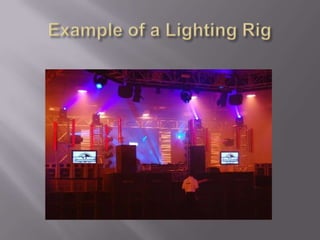
Example of a Lighting Rig
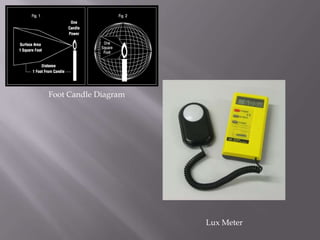
IntensityMeasured in lux, lumens and foot-candles.
Depends upon:
Power of lamp
Presence of color gels or gobos
Distance from the area to be lit and the beam or field angle of the fixture
Color and substance being lit
Neuro optics of the sceneFoot Candle DiagramLux Meter
ColorTemperature measured in KelvinGel colors are organized by several different systems maintained by the color manufacturing companiesColor also determined by intensity of lamp and color of object being lit Amber Shift- Also known as Amber Drift, occurs when the percentage of full power alamp  being run drops, the tungsten filament in the bulb glows orange instead of more nearly white
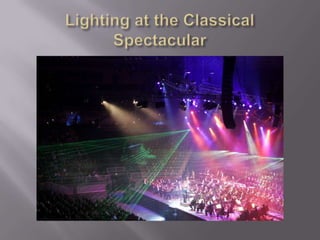
Lighting at the Classical Spectacular
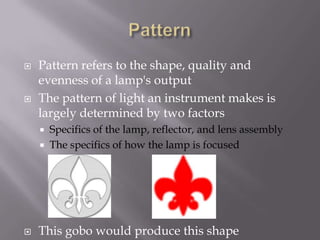
PatternPattern refers to the shape, quality and evenness of a lamp's outputThe pattern of light an instrument makes is largely determined by two factorsSpecifics of the lamp, reflector, and lens assemblyThe specifics of how the lamp is focusedThis gobo would produce this shape
FocusFocus is a term usually used to describe where an instrument is pointed. The final focus should place the "hot spot" of the beam at the actor's head level when standing at the center of the instrument's assigned "focus area" on the stage
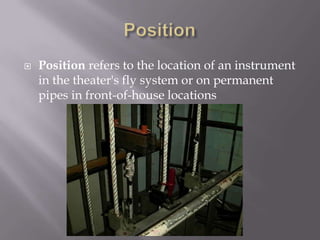
PositionPosition refers to the location of an instrument in the theater's fly system or on permanent pipes in front-of-house locations
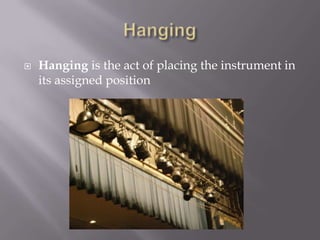
HangingHanging is the act of placing the instrument in its assigned position
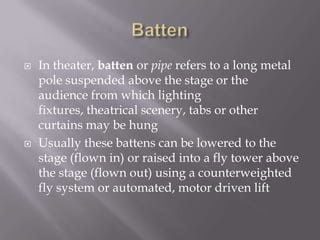
BattenIn theater, batten or pipe refers to a long metal pole suspended above the stage or the audience from which lighting fixtures, theatrical scenery, tabs or other curtains may be hungUsually these battens can be lowered to the stage (flown in) or raised into a fly tower above the stage (flown out) using a counterweighted fly system or automated, motor driven lift
Types of BattenElectric- An electric is a batten with cables run above the pipe, usually enclosed in a racewayDrapery- A drapery pipe carries travelers, tormentor legs, borders, or tabs. Full-stage drapes can be very heavy, weighing hundreds of pounds, especially the grand drape. Clouds- Many theaters have built in shells designed to reflect sound produced on stage back into the audience. Set- Elements of the set which are relatively flat or light can be flown in on battens.Storage- Some theatres use spare battens to store unneeded scenery or lighting instruments. This practice is generally discouraged due to the hazard created by overhead storage.
GoboA physical template attached to a lighting source, used to control the shape of emitted lightit is sometimes desirable to manipulate the shape of the light which is cast over a space or objectTo do so, a piece of material with patterned holes through which light passes is placed in the beam of light to allow only the desired "shape" or pattern through, while blocking the rest of the light, casting a specific shadow/light into the space
Gobo UseMay be used in connection with projectors and simpler light source  to create lighting scenes in a theatrical applicationSimple gobos incorporated into automated lighting systems are popular at nightclubs and other musical venues to create moving shapesMay also be used for architectural lighting as well as in interior design as in projecting a company logo on a wall or other feature
Gobo ctd.A theatrical gobo may be made from either sheet metal or borosilicate glass depending upon the complexity of the designGlass gobos can include colored areas made of multiple layers of dichroic glass one for each color glued on an aluminum or chrome coated black and white gobo New technologies make it possible to turn a color photo into a glass gobo
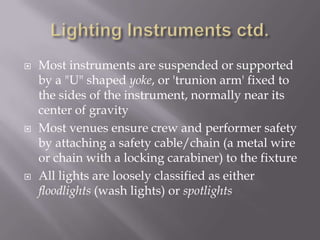
Lighting InstrumentsA lighting instrument is a device that produces controlled lighting as part of the effects a lighting designer brings to a showThe term lighting instrument is preferred to light to avoid confusion between light and light sourcesMost theatrical light bulbs (or lamps, the term usually preferred) are Tungsten-Halogen or Quartz-Halogen
Types of InstrumentsThere are a variety of instruments frequently used in the theater. Although they vary in many ways they all have the following four basic components in one form or other:Box/Housing - a metal or plastic container to house the whole instrument and prevent light from spilling in unwanted directions.Light Source (lamp).Lens or opening - the gap in the housing where the light is intended to come out.Reflector - behind or around the light source in such a way as to direct more light towards the lens or opening.
Lighting Instruments ctd.Most instruments are suspended or supported by a "U" shaped yoke, or 'trunion arm' fixed to the sides of the instrument, normally near its center of gravityMost venues ensure crew and performer safety by attaching a safety cable/chain (a metal wire or chain with a locking carabiner) to the fixtureAll lights are loosely classified as either floodlights (wash lights) or spotlights
Types of FixturesWithin the groups of "wash" and "spot" light, there are other, more specific types of fixturesTraditionally theatre and stage lighting has been of the "generic" type. These are lights which are focussed, geled, and then simply dimmed to give the effect the designer wants. In recent years the emergence of moving lights (or automated lights) has had a substantial impact of theatre and stage lighting
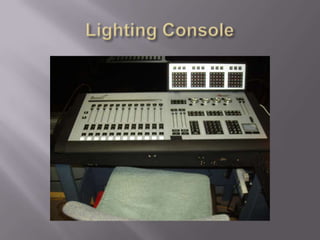
Lighting ControlsLighting control tools might best be described as anything that changes the quality of the lightControllers are commonly lighting consoles designed for sophisticated control over very large numbers of dimmers or luminaires, but may be simpler devices which play back stored sequences of lighting states with minimal user interfaces. Consoles are also referred to as lighting desks or light-boards
Lighting Console
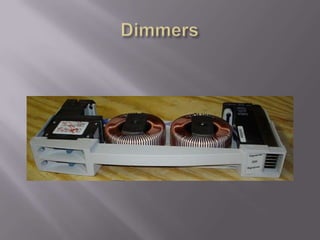
DimmersA dimmer is a device used to vary the electrical power delivered to the instrument’s lampAs power to the lamp decreases, the light fades or dimsFades can be either UP or DOWN, that is increasing or decreasing the intensityToday, most dimmers are solid state, although many mechanical dimmers still exist
Dimmers ctd.Dimmers are often found in large racks that draw large amounts of three-phase electrical powerThe dimmers themselves are often removable modules that range from a 20-amp, 2.4 Kilowatt unit to a 50-amp or even a 100-amp unitConstant Power Modules are used to supply non-dimming current to other electrical devices (like smoke machines, chain winches, or scenic motors)

Lighting Powerpoint

  • 1.
  • 2.
    Lighting DesignModern stagelighting is a flexible tool in the production of theatre, dance, opera and other performance arts. Several different types of stage lighting instruments are used in the pursuit of the various principles or goals of lighting.
  • 3.
    Functions of LightingStagelighting has several functions, although to allow for artistic effect, no hard and fast rules can ever be applied. The functions of lighting include:Illumination: The simple ability to see what is occurring on stage. Any lighting design will be ineffective if the viewers cannot see the characters; unless this is the explicit intent.Revelation of form: Altering the perception of shapes onstage, particularly three-dimensional stage elements.Focus: Directing the audience's attention to an area of the stage or distracting them from another.
  • 4.
    Functions of Lightingctd.Mood: Setting the tone of a scene. Harsh red light has a totally different effect than soft lavender light.Location and time of day: Establishing or altering position in time and space. Blues can suggest night time while orange and red can suggest a sunrise or sunset. Use of gobos to project sky scene, moon etcProjection/stage elements: Lighting may be used to project scenery or to act as scenery onstage.Plot: A lighting event may trigger or advance the action onstage.Composition: Lighting may be used to show only the areas of the stage which the designer wants the audience to see, and to "paint a picture"
  • 5.
    Example of aLighting Rig
  • 6.
    IntensityMeasured in lux,lumens and foot-candles.
  • 7.
  • 8.
  • 9.
    Presence of colorgels or gobos
  • 10.
    Distance from thearea to be lit and the beam or field angle of the fixture
  • 11.
  • 12.
    Neuro optics ofthe sceneFoot Candle DiagramLux Meter
  • 13.
    ColorTemperature measured inKelvinGel colors are organized by several different systems maintained by the color manufacturing companiesColor also determined by intensity of lamp and color of object being lit Amber Shift- Also known as Amber Drift, occurs when the percentage of full power alamp being run drops, the tungsten filament in the bulb glows orange instead of more nearly white
  • 14.
    Lighting at theClassical Spectacular
  • 15.
    PatternPattern refers tothe shape, quality and evenness of a lamp's outputThe pattern of light an instrument makes is largely determined by two factorsSpecifics of the lamp, reflector, and lens assemblyThe specifics of how the lamp is focusedThis gobo would produce this shape
  • 16.
    FocusFocus is aterm usually used to describe where an instrument is pointed. The final focus should place the "hot spot" of the beam at the actor's head level when standing at the center of the instrument's assigned "focus area" on the stage
  • 17.
    PositionPosition refers tothe location of an instrument in the theater's fly system or on permanent pipes in front-of-house locations
  • 18.
    HangingHanging is theact of placing the instrument in its assigned position
  • 19.
    BattenIn theater, battenor pipe refers to a long metal pole suspended above the stage or the audience from which lighting fixtures, theatrical scenery, tabs or other curtains may be hungUsually these battens can be lowered to the stage (flown in) or raised into a fly tower above the stage (flown out) using a counterweighted fly system or automated, motor driven lift
  • 20.
    Types of BattenElectric-An electric is a batten with cables run above the pipe, usually enclosed in a racewayDrapery- A drapery pipe carries travelers, tormentor legs, borders, or tabs. Full-stage drapes can be very heavy, weighing hundreds of pounds, especially the grand drape. Clouds- Many theaters have built in shells designed to reflect sound produced on stage back into the audience. Set- Elements of the set which are relatively flat or light can be flown in on battens.Storage- Some theatres use spare battens to store unneeded scenery or lighting instruments. This practice is generally discouraged due to the hazard created by overhead storage.
  • 21.
    GoboA physical templateattached to a lighting source, used to control the shape of emitted lightit is sometimes desirable to manipulate the shape of the light which is cast over a space or objectTo do so, a piece of material with patterned holes through which light passes is placed in the beam of light to allow only the desired "shape" or pattern through, while blocking the rest of the light, casting a specific shadow/light into the space
  • 22.
    Gobo UseMay beused in connection with projectors and simpler light source to create lighting scenes in a theatrical applicationSimple gobos incorporated into automated lighting systems are popular at nightclubs and other musical venues to create moving shapesMay also be used for architectural lighting as well as in interior design as in projecting a company logo on a wall or other feature
  • 23.
    Gobo ctd.A theatricalgobo may be made from either sheet metal or borosilicate glass depending upon the complexity of the designGlass gobos can include colored areas made of multiple layers of dichroic glass one for each color glued on an aluminum or chrome coated black and white gobo New technologies make it possible to turn a color photo into a glass gobo
  • 24.
    Lighting InstrumentsA lightinginstrument is a device that produces controlled lighting as part of the effects a lighting designer brings to a showThe term lighting instrument is preferred to light to avoid confusion between light and light sourcesMost theatrical light bulbs (or lamps, the term usually preferred) are Tungsten-Halogen or Quartz-Halogen
  • 25.
    Types of InstrumentsThereare a variety of instruments frequently used in the theater. Although they vary in many ways they all have the following four basic components in one form or other:Box/Housing - a metal or plastic container to house the whole instrument and prevent light from spilling in unwanted directions.Light Source (lamp).Lens or opening - the gap in the housing where the light is intended to come out.Reflector - behind or around the light source in such a way as to direct more light towards the lens or opening.
  • 26.
    Lighting Instruments ctd.Mostinstruments are suspended or supported by a "U" shaped yoke, or 'trunion arm' fixed to the sides of the instrument, normally near its center of gravityMost venues ensure crew and performer safety by attaching a safety cable/chain (a metal wire or chain with a locking carabiner) to the fixtureAll lights are loosely classified as either floodlights (wash lights) or spotlights
  • 27.
    Types of FixturesWithinthe groups of "wash" and "spot" light, there are other, more specific types of fixturesTraditionally theatre and stage lighting has been of the "generic" type. These are lights which are focussed, geled, and then simply dimmed to give the effect the designer wants. In recent years the emergence of moving lights (or automated lights) has had a substantial impact of theatre and stage lighting
  • 28.
    Lighting ControlsLighting controltools might best be described as anything that changes the quality of the lightControllers are commonly lighting consoles designed for sophisticated control over very large numbers of dimmers or luminaires, but may be simpler devices which play back stored sequences of lighting states with minimal user interfaces. Consoles are also referred to as lighting desks or light-boards
  • 29.
  • 30.
    DimmersA dimmer isa device used to vary the electrical power delivered to the instrument’s lampAs power to the lamp decreases, the light fades or dimsFades can be either UP or DOWN, that is increasing or decreasing the intensityToday, most dimmers are solid state, although many mechanical dimmers still exist
  • 31.
    Dimmers ctd.Dimmers areoften found in large racks that draw large amounts of three-phase electrical powerThe dimmers themselves are often removable modules that range from a 20-amp, 2.4 Kilowatt unit to a 50-amp or even a 100-amp unitConstant Power Modules are used to supply non-dimming current to other electrical devices (like smoke machines, chain winches, or scenic motors)