CASE STUDY NO. 12-PD 1067
THE WATER CODE OF THE
PHILIPPINES
ADAMSON UNIVERSITY
CIVIL ENGINEERING DEPARTMENT
CE 428C-WATER RESOURCES ENGINEERING
Presented By: Alabata| Concepcion| Panganiban |
Presented To: Dr. Tomas U. Ganiron, Jr
The objectives of this Code are:
a. To establish the basic principles and framework relating to
the appropriation, control and conservation of water resources
and to achieve the optimum development and rational
utilization of these resources;
b. To define the extent of the rights and obligation of water
users and owners including the protection and regulation of
such rights;
c. To adopt a basic law governing the ownership,
appropriation, utilization, exploitation, development,
conservation and protection of water resources and rights to
land related thereto; and
d. To identify the administrative agencies which will enforce
this Code.
The underlying principles of this code
a. All waters belong to the State.
b. All waters that belong to the state can not be the
subject to acquisitive prescription.(sic)
c. The state may allow the use or development of
waters by administration concession.
d. The utilization, exploitation, development,
conservation and protection of water resources
shall be subject to the control and regulation of the
government through the National Water Resources
Council.
Preference in the use and development of waters
shall consider current usages and be responsive to
the changing needs of the country.
WATERS
As used in the Water Code,
refers to water under the
ground, water above the
ground, water in the
atmosphere and the waters
of the sea within the
territorial jurisdiction of the
Philippines.
OWNERSHIP OF WATERS
a. Rivers and their natural beds;
b. Continuous or intermittent waters of springs
and brooks running in their natural beds and the
beds themselves
c. Natural lakes and lagoons;
d. All other categories of surface waters such as
water flowing over lands, water form rainfall
whether natural or artificial, and water from
agriculture runoff, seepage and drainage;
e. Atmospheric water;
f. Subterranean or ground water; and
g. Seawater
OWNERSHIP OF WATERS
The following waters found on private lands:
a. Continuous or intermittent waters rising on
such lands;
b. Lakes and lagoons naturally waters rising on
such lands;
c. Rainwater and falling on
such lands;
d. Subterranean or ground
waters; and,
e. Waters in swamps and
marshes.
All belongs to the State
ARTICLE 6
• The owner of the land where the
water is found may use the same for
domestic purposes without securing
a permit, provided that such use
shall be registered, when required by
the National Water Resources
Council.
• The Council, however, may regulate
such use when there is (1) wastage,
or (2) in times of emergency.
ARTICLE 7
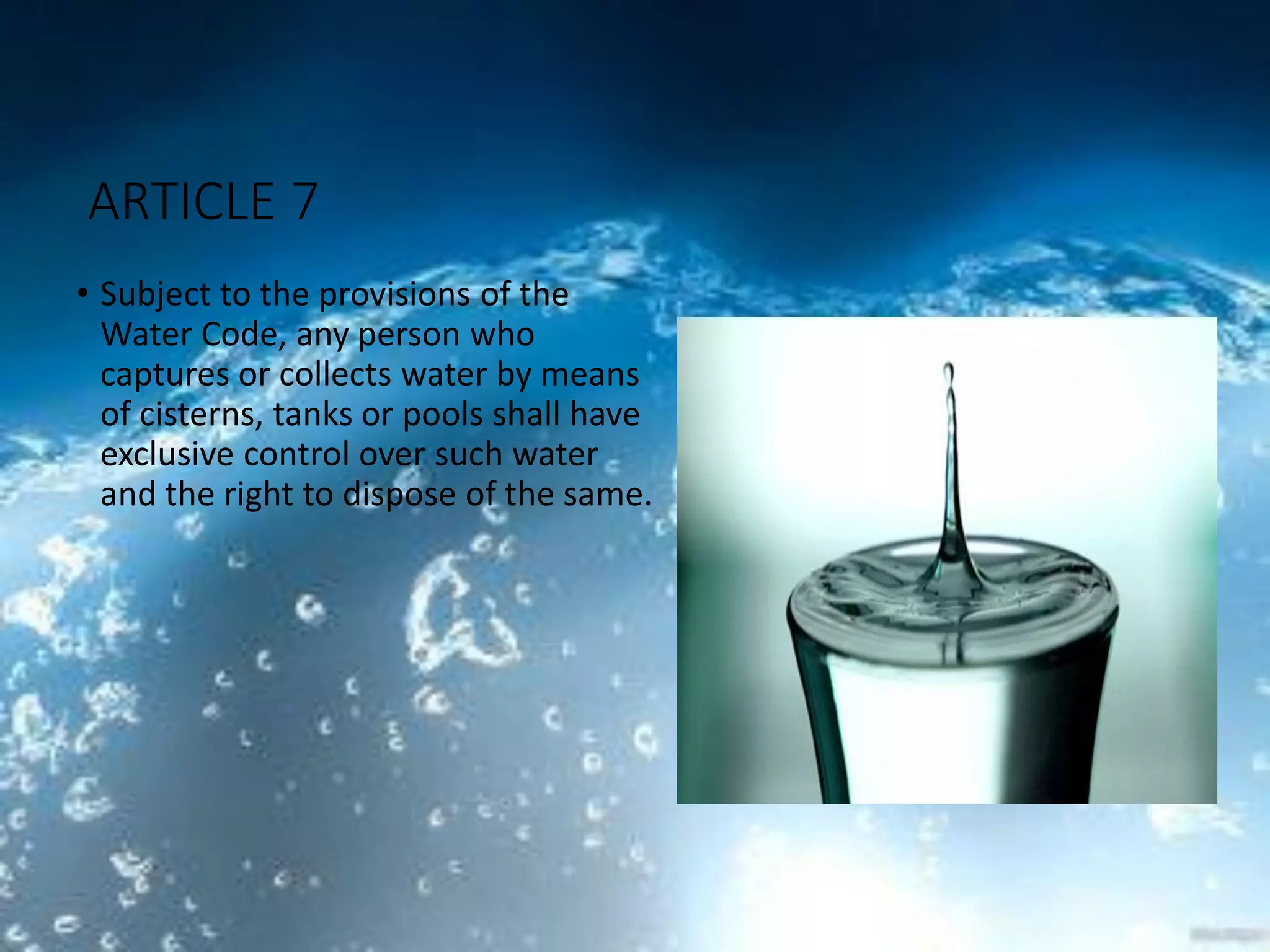
• Subject to the provisions of the
Water Code, any person who
captures or collects water by means
of cisterns, tanks or pools shall have
exclusive control over such water
and the right to dispose of the same.
APPROPRIATION OF WATERS
• As used in the Water Code, is the acquisition of rights over the use of
waters or the taking or diverting of waters from a natural source in
the manner and for any purpose allowed by law.
APPROPRIATION OF WATERS
 a. Domestic
 b. Municipal
 c. Irrigation
APPROPRIATION OF WATERS
 d. Power generation
 e. Fisheries
 f. Livestock raising
APPROPRIATION OF WATERS
 g. Industrial
 h. Recreational, and
 i. Other purposes
•WATER RIGHT – is the privilege granted by
the government to appropriate and use
water.
•WATER PERMIT – is the document
evidencing the water right.
 (GENERAL RULE) No person, including government
instrumentalities or government-owned corporations, shall
appropriate water without a water right, which shall be
evidenced by a document known as a water permit.
(EXCEPTION) Any person may appropriate or use natural
bodies of water without securing a water permit for any of the
following:
1. Appropriation of water by means of handcarried
receptacles; and
2. Bathing or washing, watering or dipping of domestic or farm
animals, and navigation of watercrafts or transportation of
logs and other objects by floatation.
 REGALIAN DOCTRINE – is
the doctrine recognized
in our constitution
whereby ownership of
minerals and all forces of
potential energy and
other natural resources
are reserved for the State
(see Article XII, Section 2,
1987 Constitution).
UTILIZATION OF WATERS
• development of water resources shall consider security of
the State, multiple use, beneficial effects, adverse effects
and cost of development.
• The utilization of subterranean or ground water shall be
coordinated with that of surface waters such as rivers,
streams, springs and lakes, so that a superior right in
one is not adversely affected by an inferior right in the
other.
• Water contained in open canals, aqueducts or reservoirs
of private persons may be used by any person for
domestic purpose or for watering plants.
• Works for the storage, diversion, distribution and
utilization of water resources shall contain adequate
provision for the prevention and control of diseases.
UTILIZATION OF WATERS
 When the reuse of waste water is feasible, it shall be
limited as much as possible to such uses other than
direct human consumption.
 Drainage systems shall be so constructed that their
outlets are rivers, lakes, the sea, natural bodies of water,
such other water course as may be approved by the
proper government agency
 Lower estates are obliged to receive the waters which
naturally and without the intervention of man flow from
the higher estates, as well as the stones or earth which
they carry with them.
 The banks or rivers and streams and the shores of the
seas and lakes throughout their entire length and within
a zone of three (3) meters in urban areas, twenty (20)
meters in agricultural areas and forty (40) meters in
forest areas, along their margins, are subject to the
easement of public use in the interest of recreation,
navigation, floatage, fishing and salvage.
CONTROL OF WATERS
• To promote the best interest and the coordinated
protection of flood plain lands.
• The government may construction necessary flood
control structures in declared flood control areas, and for
this purpose it shall have a legal easement as wide as
may be needed along and adjacent to the river bank and
outside the bed or channel of the river.
• River beds, sand bars and tidal flats may not be
cultivated except upon prior permission.
• The impounding of water in ponds or reservoirs may be
prohibited by the Council upon consultation with the
Department of Health if it is dangerous to public health.
OTHER PROVISIONS
 ARTICLE 11: The State, for reasons of public policy, may declare
waters not previously appropriated, in whole or in part, exempt
from appropriation for any or all purposes and, thereupon, such
waters may not be appropriated for those purposes.
 ARTICLE 12: Waters appropriated for a particular purpose may be
applied for another purpose only upon approval of the Council
and on condition that the new use does not unduly prejudice the
rights of other permittees, or require an increase in the volume
of water.
 ARTICLE 15: Only citizens of the Philippines, of legal age, as well
as juridical persons, who are duly qualified by law to exploit and
develop water resources, may apply for water permits.
• ARTICLE 20: The measure and limit of appropriation of water shall be
beneficial use.
• BENEFICIAL USE OF WATER is the utilization of water in the right
amount during the period that the water is needed for producing the
benefits for which the water is appropriated.
 ARTICLE 25: A holder of a water permit may demand the
establishment of easements necessary for the construction and
maintenance of the works and facilities needed for the beneficial
use of the waters to be appropriated, subject to the requirements of
just compensation and to the following conditions:
1. That he is the owner, lessee, mortgagee or one having real right
over the land upon which he proposes to use water; and
2. That the proposed easement is the most convenient and the least
onerous to the servient estate.
Easements relating to the appropriation and use of waters may be
modified by agreement of the contracting parties provided the same
is not contrary to law or prejudicial to third persons.
 ARTICLE 29: Water permits may be revoked after due notice
and hearing on GROUNDS of:
1. Non-use;
2. Gross violation of the conditions imposed in the permit;
3. Unauthorized sale of water;
4. Willful failure or refusal to comply with rules and
regulations or any lawful order;
5. Pollution;
6. Public nuisance; or
7. Acts detrimental to public health and safety;
8. When the appropriator is found to be disqualified under the
law to exploit and develop natural resources of the
Philippines;
9. When, in the case of irrigation, the land is converted to non-
agricultural purposes; and
10. Other similar grounds.
• ARTICLE 39: Except in cases of emergency to save life or property, the
construction or repair of the following works shall be undertaken only
after the plans and specifications therefor, as may be required by the
Council, are approved by the proper government agency:
1. Dams for the diversion or storage of water;
2. Structures for the use of water power;
3. Installation for the utilization of subterranean or ground water and
4. Other structures for utilization of water resources.
 ARTICLE 76: The establishment of cemeteries and waste
disposal areas that may affect the source of a water supply or
a reservoir for domestic or municipal use shall be subject to
the rules and regulations promulgated by the Department of
Health.
 ARTICLE 79: The administration and enforcement of the
provisions of this Code, including the granting of permits and
the imposition of penalties for administrative violation thereof,
are hereby vested in the Council, and except in regard to those
functions which under the Code are specifically conferred
upon other agencies of the government, the Council is hereby
empowered to make all decisions and determinations
provided for in this Code.
THE END
Alabata, Rufert
Concepcion,
Shariff
Panganiban,
Lance

Case Study No. 12-Presidential Decree No. 1067

  • 1.
    CASE STUDY NO.12-PD 1067 THE WATER CODE OF THE PHILIPPINES ADAMSON UNIVERSITY CIVIL ENGINEERING DEPARTMENT CE 428C-WATER RESOURCES ENGINEERING Presented By: Alabata| Concepcion| Panganiban | Presented To: Dr. Tomas U. Ganiron, Jr
  • 2.
    The objectives ofthis Code are: a. To establish the basic principles and framework relating to the appropriation, control and conservation of water resources and to achieve the optimum development and rational utilization of these resources; b. To define the extent of the rights and obligation of water users and owners including the protection and regulation of such rights; c. To adopt a basic law governing the ownership, appropriation, utilization, exploitation, development, conservation and protection of water resources and rights to land related thereto; and d. To identify the administrative agencies which will enforce this Code.
  • 3.
    The underlying principlesof this code a. All waters belong to the State. b. All waters that belong to the state can not be the subject to acquisitive prescription.(sic) c. The state may allow the use or development of waters by administration concession. d. The utilization, exploitation, development, conservation and protection of water resources shall be subject to the control and regulation of the government through the National Water Resources Council. Preference in the use and development of waters shall consider current usages and be responsive to the changing needs of the country.
  • 4.
    WATERS As used inthe Water Code, refers to water under the ground, water above the ground, water in the atmosphere and the waters of the sea within the territorial jurisdiction of the Philippines.
  • 5.
    OWNERSHIP OF WATERS a.Rivers and their natural beds; b. Continuous or intermittent waters of springs and brooks running in their natural beds and the beds themselves c. Natural lakes and lagoons; d. All other categories of surface waters such as water flowing over lands, water form rainfall whether natural or artificial, and water from agriculture runoff, seepage and drainage; e. Atmospheric water; f. Subterranean or ground water; and g. Seawater
  • 6.
    OWNERSHIP OF WATERS Thefollowing waters found on private lands: a. Continuous or intermittent waters rising on such lands; b. Lakes and lagoons naturally waters rising on such lands; c. Rainwater and falling on such lands; d. Subterranean or ground waters; and, e. Waters in swamps and marshes. All belongs to the State
  • 7.
    ARTICLE 6 • Theowner of the land where the water is found may use the same for domestic purposes without securing a permit, provided that such use shall be registered, when required by the National Water Resources Council. • The Council, however, may regulate such use when there is (1) wastage, or (2) in times of emergency.
  • 8.
    ARTICLE 7 • Subjectto the provisions of the Water Code, any person who captures or collects water by means of cisterns, tanks or pools shall have exclusive control over such water and the right to dispose of the same.
  • 9.
    APPROPRIATION OF WATERS •As used in the Water Code, is the acquisition of rights over the use of waters or the taking or diverting of waters from a natural source in the manner and for any purpose allowed by law.
  • 10.
    APPROPRIATION OF WATERS a. Domestic  b. Municipal  c. Irrigation
  • 11.
    APPROPRIATION OF WATERS d. Power generation  e. Fisheries  f. Livestock raising
  • 12.
    APPROPRIATION OF WATERS g. Industrial  h. Recreational, and  i. Other purposes
  • 13.
    •WATER RIGHT –is the privilege granted by the government to appropriate and use water. •WATER PERMIT – is the document evidencing the water right.
  • 14.
     (GENERAL RULE)No person, including government instrumentalities or government-owned corporations, shall appropriate water without a water right, which shall be evidenced by a document known as a water permit. (EXCEPTION) Any person may appropriate or use natural bodies of water without securing a water permit for any of the following: 1. Appropriation of water by means of handcarried receptacles; and 2. Bathing or washing, watering or dipping of domestic or farm animals, and navigation of watercrafts or transportation of logs and other objects by floatation.
  • 15.
     REGALIAN DOCTRINE– is the doctrine recognized in our constitution whereby ownership of minerals and all forces of potential energy and other natural resources are reserved for the State (see Article XII, Section 2, 1987 Constitution).
  • 16.
    UTILIZATION OF WATERS •development of water resources shall consider security of the State, multiple use, beneficial effects, adverse effects and cost of development. • The utilization of subterranean or ground water shall be coordinated with that of surface waters such as rivers, streams, springs and lakes, so that a superior right in one is not adversely affected by an inferior right in the other. • Water contained in open canals, aqueducts or reservoirs of private persons may be used by any person for domestic purpose or for watering plants. • Works for the storage, diversion, distribution and utilization of water resources shall contain adequate provision for the prevention and control of diseases.
  • 17.
    UTILIZATION OF WATERS When the reuse of waste water is feasible, it shall be limited as much as possible to such uses other than direct human consumption.  Drainage systems shall be so constructed that their outlets are rivers, lakes, the sea, natural bodies of water, such other water course as may be approved by the proper government agency  Lower estates are obliged to receive the waters which naturally and without the intervention of man flow from the higher estates, as well as the stones or earth which they carry with them.  The banks or rivers and streams and the shores of the seas and lakes throughout their entire length and within a zone of three (3) meters in urban areas, twenty (20) meters in agricultural areas and forty (40) meters in forest areas, along their margins, are subject to the easement of public use in the interest of recreation, navigation, floatage, fishing and salvage.
  • 18.
    CONTROL OF WATERS •To promote the best interest and the coordinated protection of flood plain lands. • The government may construction necessary flood control structures in declared flood control areas, and for this purpose it shall have a legal easement as wide as may be needed along and adjacent to the river bank and outside the bed or channel of the river. • River beds, sand bars and tidal flats may not be cultivated except upon prior permission. • The impounding of water in ponds or reservoirs may be prohibited by the Council upon consultation with the Department of Health if it is dangerous to public health.
  • 19.
    OTHER PROVISIONS  ARTICLE11: The State, for reasons of public policy, may declare waters not previously appropriated, in whole or in part, exempt from appropriation for any or all purposes and, thereupon, such waters may not be appropriated for those purposes.  ARTICLE 12: Waters appropriated for a particular purpose may be applied for another purpose only upon approval of the Council and on condition that the new use does not unduly prejudice the rights of other permittees, or require an increase in the volume of water.  ARTICLE 15: Only citizens of the Philippines, of legal age, as well as juridical persons, who are duly qualified by law to exploit and develop water resources, may apply for water permits.
  • 20.
    • ARTICLE 20:The measure and limit of appropriation of water shall be beneficial use. • BENEFICIAL USE OF WATER is the utilization of water in the right amount during the period that the water is needed for producing the benefits for which the water is appropriated.
  • 21.
     ARTICLE 25:A holder of a water permit may demand the establishment of easements necessary for the construction and maintenance of the works and facilities needed for the beneficial use of the waters to be appropriated, subject to the requirements of just compensation and to the following conditions: 1. That he is the owner, lessee, mortgagee or one having real right over the land upon which he proposes to use water; and 2. That the proposed easement is the most convenient and the least onerous to the servient estate. Easements relating to the appropriation and use of waters may be modified by agreement of the contracting parties provided the same is not contrary to law or prejudicial to third persons.
  • 22.
     ARTICLE 29:Water permits may be revoked after due notice and hearing on GROUNDS of: 1. Non-use; 2. Gross violation of the conditions imposed in the permit; 3. Unauthorized sale of water; 4. Willful failure or refusal to comply with rules and regulations or any lawful order; 5. Pollution; 6. Public nuisance; or 7. Acts detrimental to public health and safety; 8. When the appropriator is found to be disqualified under the law to exploit and develop natural resources of the Philippines; 9. When, in the case of irrigation, the land is converted to non- agricultural purposes; and 10. Other similar grounds.
  • 23.
    • ARTICLE 39:Except in cases of emergency to save life or property, the construction or repair of the following works shall be undertaken only after the plans and specifications therefor, as may be required by the Council, are approved by the proper government agency: 1. Dams for the diversion or storage of water; 2. Structures for the use of water power; 3. Installation for the utilization of subterranean or ground water and 4. Other structures for utilization of water resources.
  • 24.
     ARTICLE 76:The establishment of cemeteries and waste disposal areas that may affect the source of a water supply or a reservoir for domestic or municipal use shall be subject to the rules and regulations promulgated by the Department of Health.  ARTICLE 79: The administration and enforcement of the provisions of this Code, including the granting of permits and the imposition of penalties for administrative violation thereof, are hereby vested in the Council, and except in regard to those functions which under the Code are specifically conferred upon other agencies of the government, the Council is hereby empowered to make all decisions and determinations provided for in this Code.
  • 25.