
LIGHTING DESIGN OF COMMERCIAL AND RESIDENTIAL SPECES 
Student:- 
Mohd. Nadeem 
MSc Interior Designer 
Commercial Space Designer 
DezyneE’coleCollege 
www.dezyneecol.com
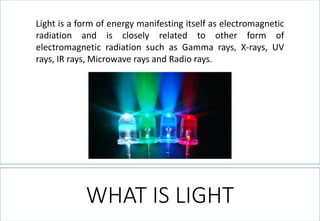
WHAT IS LIGHT 
LightisaformofenergymanifestingitselfaselectromagneticradiationandiscloselyrelatedtootherformofelectromagneticradiationsuchasGammarays,X-rays,UVrays,IRrays,MicrowaveraysandRadiorays.
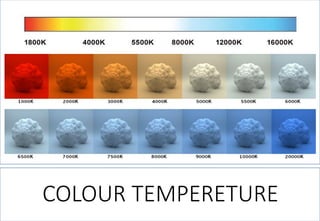
COLOUR TEMPERETURE OUTDOOR/INDOOR 
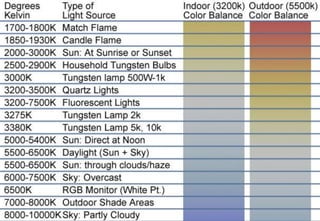
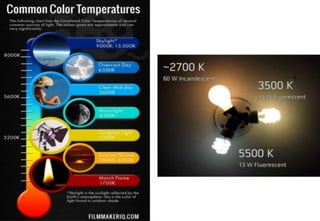
•Colour temperature is a characteristic visible light. In practice, Colour temperature is only meaningful of light sources that do in fact correspond some what closely to the radiation of some black body. 
•The Colour temperature of the electromagnetic radiation emitted from an ideal black body is defined as its surface temperature in KELVINS. 
•Colour temperature over 5000K are called cool Colour (bluefish white), while lower Colour temperature (2700-3000K) are called warm Colour (yellowish white through red).
COLOUR TEMPERETURE OUTDOOR/INDOOR 
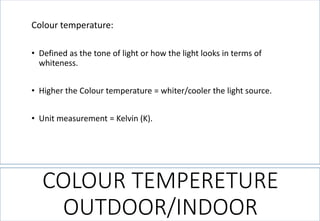
Colour temperature: 
•Defined as the tone of light or how the light looks in terms of whiteness. 
•Higher the Colour temperature = whiter/cooler the light source. 
•Unit measurement = Kelvin (K).
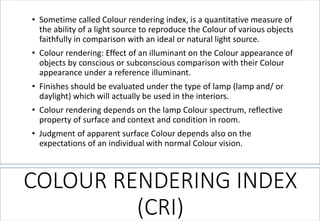
•Sometime called Colour rendering index, is a quantitative measure of the ability of a light source to reproduce the Colour of various objects faithfully in comparison with an ideal or natural light source. 
•Colour rendering: Effect of an illuminant on the Colour appearance of objects by conscious or subconscious comparison with their Colour appearance under a reference illuminant. 
•Finishes should be evaluated under the type of lamp (lamp and/ or daylight) which will actually be used in the interiors. 
•Colour rendering depends on the lamp Colour spectrum, reflective property of surface and context and condition in room. 
•Judgment of apparent surface Colour depends also on the expectations of an individual with normal Colour vision. 
COLOUR RENDERING INDEX(CRI)
COLOUR TEMPERETURE
LIGHTING FIXTURES 
•Lighting fixtures is integral of building electrical system, transforming energy into usable illumination. 
•Light fixture requires: electrical connection (power supply), lamp holder, lamp (design to defuse, reflect focus light). 
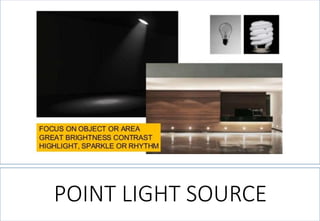
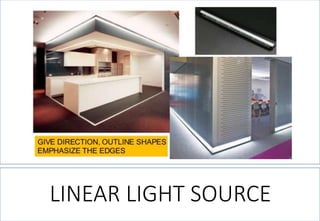
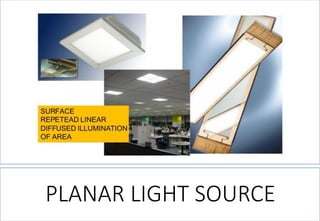
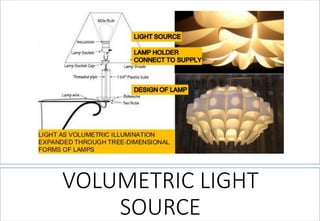
•Form of lighting fixtures, lighting sources, light illumination: Point source, linear sources, planar sources, volumetric sources.
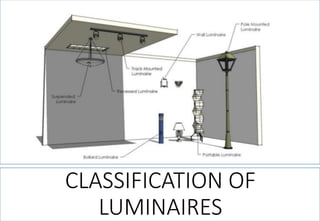
LIGHTING LUMINAIRE 
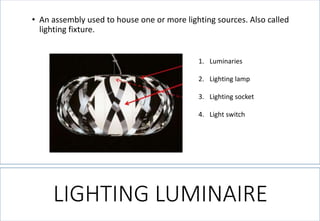
•An assembly used to house one or more lighting sources. Also called lighting fixture. 
1.Luminaries 
2.Lighting lamp 
3.Lighting socket 
4.Light switch
CLASSIFICATION OF LUMINAIRES 
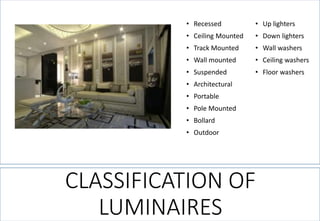
•Recessed 
•Ceiling Mounted 
•Track Mounted 
•Wall mounted 
•Suspended 
•Architectural 
•Portable 
•Pole Mounted 
•Bollard 
•Outdoor 
•Up lighters 
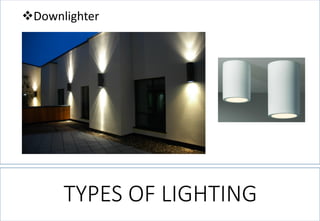
•Down lighters 
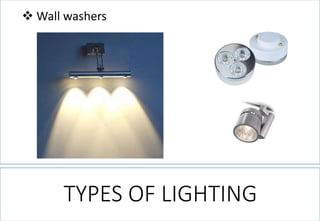
•Wall washers 
•Ceiling washers 
•Floor washers
CLASSIFICATION OF LUMINAIRES
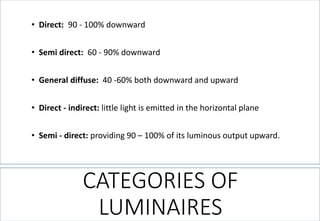
CATEGORIES OF LUMINAIRES 
•Direct: 90 -100% downward 
•Semi direct: 60 -90% downward 
•General diffuse: 40 -60% both downward and upward 
•Direct -indirect: little light is emitted in the horizontal plane 
•Semi -direct: providing 90 –100% of its luminous output upward.
POINT LIGHT SOURCE
LINEAR LIGHT SOURCE
PLANAR LIGHT SOURCE
VOLUMETRIC LIGHT SOURCE
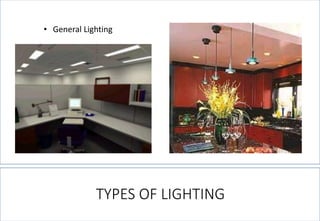
TYPES OF LIGHTING 
•General Lighting
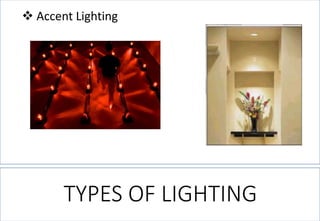
TYPES OF LIGHTING 
Accent Lighting
TYPES OF LIGHTING 
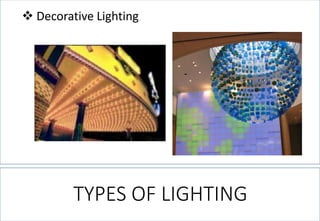
Decorative Lighting
TYPES OF LIGHTING 
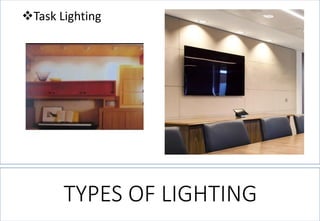
Task Lighting
TYPES OF LIGHTING 
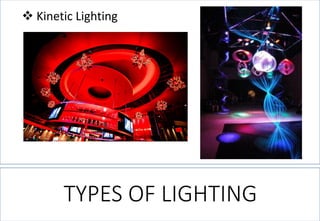
Kinetic Lighting
Wall washers 
TYPES OF LIGHTING
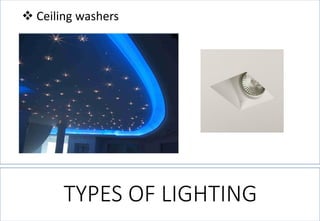
Ceiling washers 
TYPES OF LIGHTING
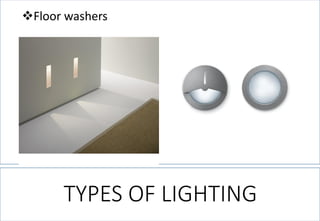
Floor washers 
TYPES OF LIGHTING
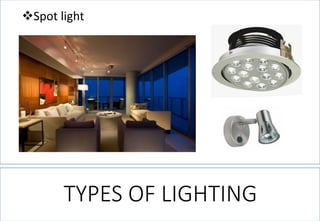
Spot light 
TYPES OF LIGHTING
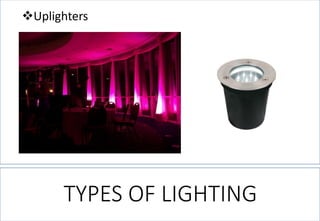
Uplighters 
TYPES OF LIGHTING
Downlighter 
TYPES OF LIGHTING
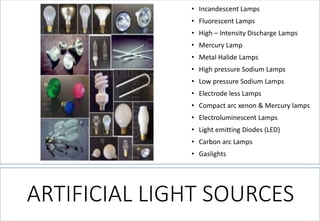
ARTIFICIAL LIGHT SOURCES 
•Incandescent Lamps 
•Fluorescent Lamps 
•High –Intensity Discharge Lamps 
•Mercury Lamp 
•Metal Halide Lamps 
•High pressure Sodium Lamps 
•Low pressure Sodium Lamps 
•Electrode less Lamps 
•Compact arc xenon & Mercury lamps 
•Electroluminescent Lamps 
•Light emitting Diodes (LED) 
•Carbon arc Lamps 
•Gaslights
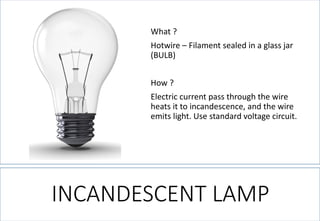
INCANDESCENT LAMP 
What ? 
Hotwire –Filament sealed in a glass jar (BULB) 
How ? 
Electric current pass through the wire heats it to incandescence, and the wire emits light. Use standard voltage circuit.
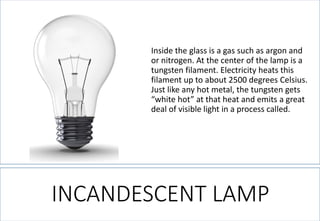
Inside the glass is a gas such as argon and or nitrogen. At the center of the lamp is a tungsten filament. Electricity heats this filament up to about 2500 degrees Celsius. Just like any hot metal, the tungsten gets “white hot” at that heat and emits a great deal of visible light in a process called. 
INCANDESCENT LAMP
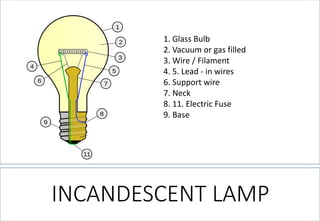
1. Glass Bulb 
2. Vacuum or gas filled 
3. Wire / Filament 
4. 5. Lead -in wires 
6. Support wire 
7. Neck 
8. 11. Electric Fuse 
9. Base 
INCANDESCENT LAMP
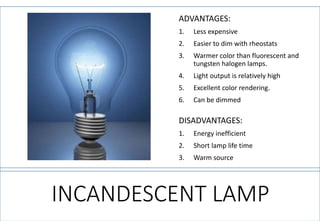
ADVANTAGES: 
1.Less expensive 
2.Easier to dim with rheostats 
3.Warmer color than fluorescent and tungsten halogen lamps. 
4.Light output is relatively high 
5.Excellent color rendering. 
6.Can be dimmed 
DISADVANTAGES: 
1.Energy inefficient 
2.Short lamp life time 
3.Warm source 
INCANDESCENT LAMP
INCANDESCENT LAMP 
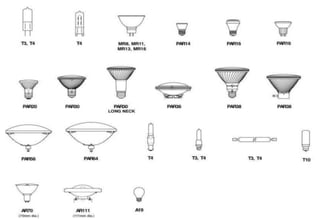
Shape of lamp: 
Around 100 combinations of glass and quartz bulb shapes and sizes. 
SYMBOLS: 
1stpart = One or more letters indicates the shape of bulb 
2ndPart = number indicated diameter of the bulb in eights of an inch. 
EXAMPLE: A19 = arbitrary shaped, 19/8 inch diameter
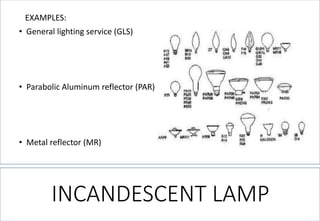
EXAMPLES: 
•General lighting service (GLS) 
•Parabolic Aluminum reflector (PAR) 
•Metal reflector (MR) 
INCANDESCENT LAMP
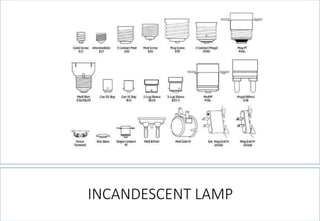
BASE IDENTIFICATION: 
1.SMALL BASE; BAYONET, BIPIN, CANDELABRA, INTERMEDIATE, MINIATURE,MINI-CANDELABRA, TWIST-AND-LOCK, PIN 
2.MEDIUM BASE 
3.LARGE BASE; MOGUL SCREW, MOGUL BIPOST 
INCANDESCENT LAMP
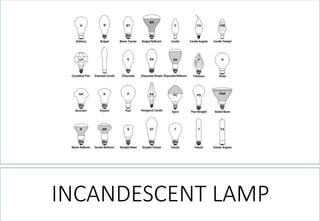
Shape of lamp: 
Around 100 combinations of glass and quartz bulb shapes and sizes. 
SYMBOLS: 
1stpart = One or more letters indicates the shape of bulb 
2ndPart = number indicated diameter of the bulb in eights of an inch. 
EXAMPLE: A19 = arbitrary shaped, 19/8 inch diameter 
INCANDESCENT LAMP
INCANDESCENT LAMP
INCANDESCENT LAMP
INCANDESCENT LAMP 
LAMP LIFE TIME: 
1.STANDARD-LIFE LAMP: high temperature for the filament to operates, emits more light, shorter life time –“burns out”. 
2.LONG-LIFE LAMP: given wattage produces less light, designed for long life. 
LAMP EFFICIENCY = LIGHT PRODUCED (LUMENS, lm)/ELECTRICITY CONSUMED (WATTS W) 
3.LIGHT OUTPUT: Insert gas (Argon, Nitrogen, Krypton) slows bulb blackening caused by condensation on the bulb wall
INCANDESCENT LAMP 
Bulbs are sold by WATTS –Measure of power consumed 
LUMENS tells much light lamp emits 
HOURS OF OPERATION is produced life-time(750-1000H, up to 2500H for extended service lamps) 
ENERGY SAVING LAMPS –Reduced wattage, reduced light output
INCANDESCENT LAMP 
LAMP TYPES: 
1.NON DIRECTIONAL (emits light in all directions –A, C, G, P, PS, S and T shapes, requires additional external elements for brightness, glare and distribution control) 
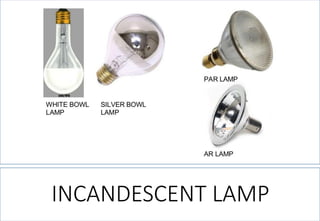
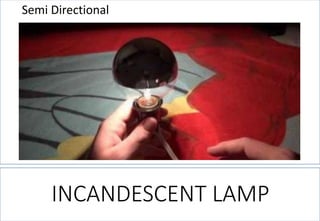
2.SEMI DIRECTIONAL (silver bowl or white bowl lamps, coating on inner side of bulb, reduce filament glare) 
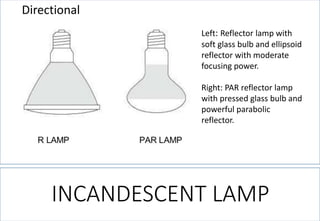
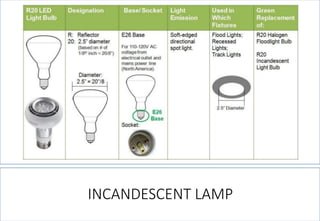
3.DIRECTIONAL (complete optical systems: source, reflector, lens or filament shield, R, AR, MR, PAR built-in beam control)
INCANDESCENT LAMP
INCANDESCENT LAMP 
Semi Directional
INCANDESCENT LAMP 
Left: Reflector lamp with soft glass bulb and ellipsoid reflector with moderate focusing power. 
Right: PAR reflector lamp with pressed glass bulb and powerful parabolic reflector. 
Directional
INCANDESCENT LAMP
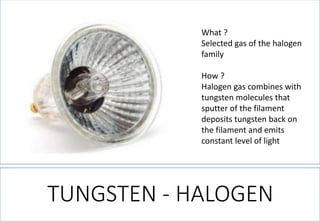
What ? 
Selected gas of the halogen family 
How ? 
Halogen gas combines with tungsten molecules that sputter of the filament deposits tungsten back on the filament and emits constant level of light 
TUNGSTEN -HALOGEN
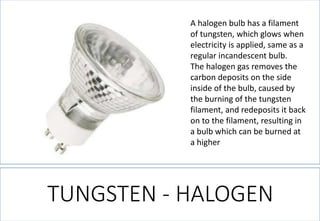
A halogen bulb has a filament of tungsten, which glows when electricity is applied, same as a regular incandescent bulb. 
The halogen gas removes the carbon deposits on the side inside of the bulb, caused by the burning of the tungsten filament, and redeposits it back on to the filament, resulting in a bulb which can be burned at a higher 
TUNGSTEN -HALOGEN
TUNGSTEN -HALOGEN 
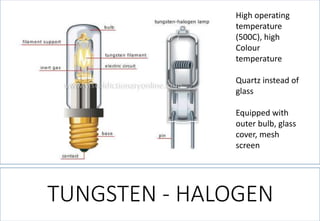
High operating temperature (500C), high Colour temperature 
Quartz instead of glass 
Equipped with outer bulb, glass cover, mesh screen
TUNGSTEN -HALOGEN 
Advantages 
1.High Colour temperature make them “whiter” than standard incandescent lamps 
2.Longer life time 
3.Great efficiency 
4.Compact in shape and size 
They come in many shapes and sizes, some directional others note, some quite small other the size of regular bulb, some fit into normal sockets other require special sockets and voltage to work.
TUNGSTEN -HALOGEN 
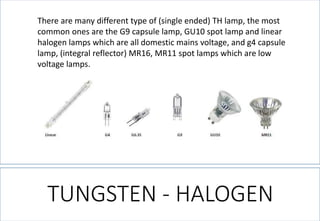
There are many different type of (single ended) TH lamp, the most common ones are the G9 capsule lamp, GU10 spot lamp and linear halogen lamps which are all domestic mains voltage, and g4 capsule lamp, (integral reflector) MR16, MR11 spot lamps which are low voltage lamps.
LOW –VOLTAGE LAMPS 
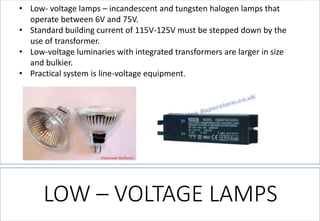
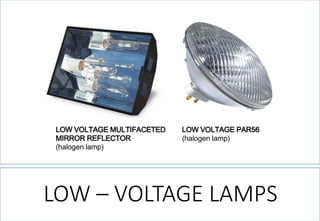
•Low-voltage lamps –incandescent and tungsten halogen lamps that operate between 6V and 75V. 
•Standard building current of 115V-125V must be stepped down by the use of transformer. 
•Low-voltage luminaries with integrated transformers are larger in size and bulkier. 
•Practical system is line-voltage equipment.
LOW –VOLTAGE LAMPS
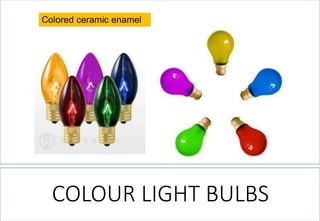
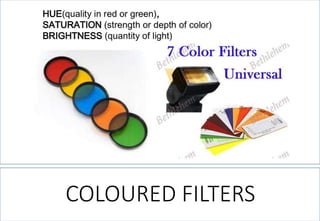
COLOUR LIGHT BULBS
COLOURED FILTERS
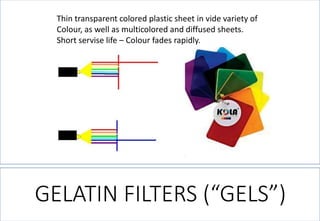
GELATIN FILTERS (“GELS”) 
Thin transparent colored plastic sheet in vide variety of Colour, as well as multicolored and diffused sheets. Short servise life –Colour fades rapidly.
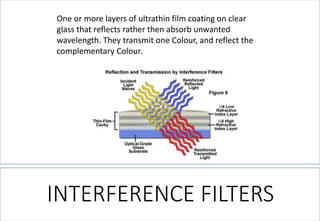
INTERFERENCE FILTERS 
One or more layers of ultrathin film coating on clear glass that reflects rather then absorb unwanted wavelength. They transmit one Colour, and reflect the complementary Colour.
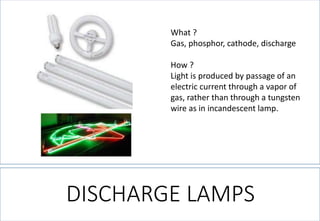
What ? 
Gas, phosphor, cathode, discharge 
How ? 
Light is produced by passage of an electric current through a vapor of gas, rather than through a tungsten wire as in incandescent lamp. 
DISCHARGE LAMPS
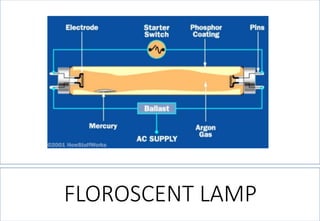
FLOROSCENT LAMP
FLOURESCENT LAMP 
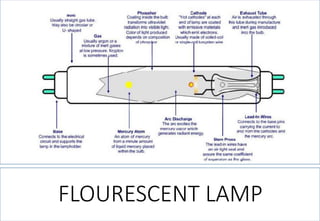
The Classic fluorescent lamp design, which has fallen mostly by the wayside, used a special starter switch mechanism to light up the tube. 
The conventional starter switch is a small discharge bulb, containing neon or some other gas. The bulb has two electrodes positioned right next to each other. When electricity is initially passed through the bypass circuit, an electrical arc jumps between these electrode to make a connection. This arc lights the bulb in the same way a larger arc lights a fluorescent bulb.
FLOURESCENT LAMP
FLOURESCENT LAMP 
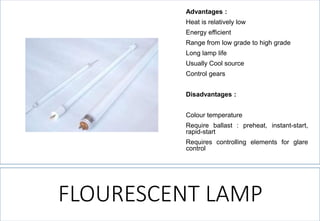
Advantages: 
Heatisrelativelylow 
Energyefficient 
Rangefromlowgradetohighgrade 
Longlamplife 
UsuallyCoolsource 
Controlgears 
Disadvantages: 
Colourtemperature 
Requireballast:preheat,instant-start, rapid-start 
Requirescontrollingelementsforglarecontrol
FLOURESCENT LAMP 
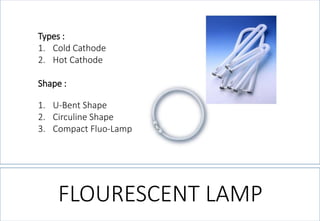
Types: 
1.ColdCathode 
2.HotCathode 
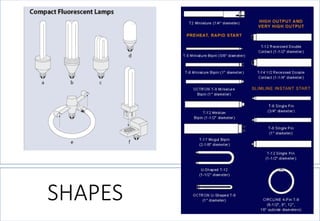
Shape: 
1.U-BentShape 
2.CirculineShape 
3.CompactFluo-Lamp
SHAPES
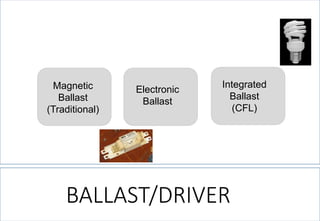
BALLAST/DRIVER 
Integrated 
Ballast (CFL) 
Magnetic 
Ballast 
(Traditional) 
Electronic 
Ballast
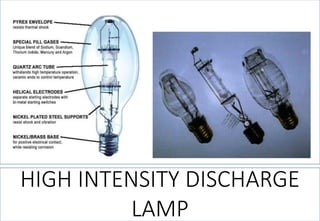
HIGH INTENSITY DISCHARGE LAMP 
Typeofelectricalgas-dischargelampwhichproduceslightbymeansofanelectricarcbetweentungstenelectrodeshousedinsideatranslucentortransparentfusedquartzorfusedaluminaarctube. 
Thistubeisfilledwithbothgasandmetalsalts.Thegasfacilitatesthearc’sinitialstrike.Oncethearcisstarted,itheatsandevaporatesthemetalsaltsformingaplasma,whichgreatlyincreasestheintensityoflightproducedbythearcandreducesitspowerconsumption.High-intensitydischargelampsareatypeofarclamp.
HIGH INTENSITY DISCHARGE LAMP
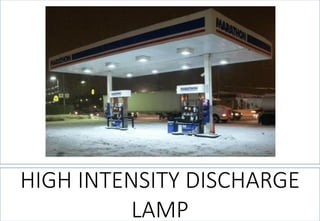
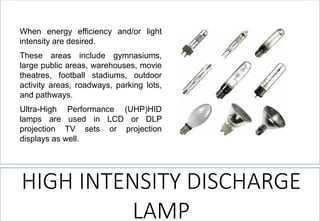
Whenenergyefficiencyand/orlightintensityaredesired. 
Theseareasincludegymnasiums, largepublicareas,warehouses,movietheatres,footballstadiums,outdooractivityareas,roadways,parkinglots, andpathways. 
Ultra-HighPerformance(UHP)HIDlampsareusedinLCDorDLPprojectionTVsetsorprojectiondisplaysaswell. 
HIGH INTENSITY DISCHARGE LAMP
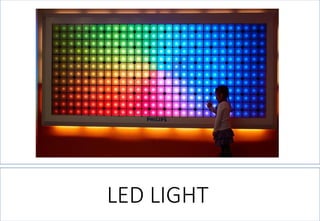
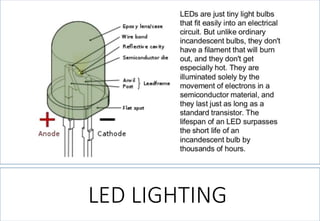
LED LIGHT 
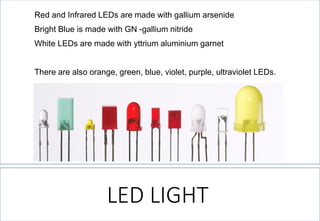
Redand Infrared LEDs are made with gallium arsenide 
Bright Blue is made with GN -gallium nitride 
WhiteLEDs are made with yttrium aluminium garnet 
There are also orange, green, blue, violet, purple, ultraviolet LEDs.
LED LIGHT
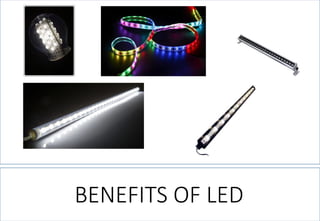
BENEFITS OF LED
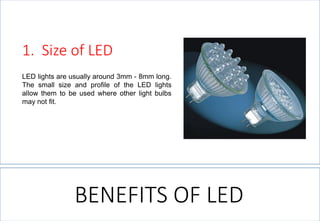
LEDlightsareusuallyaround3mm-8mmlong. ThesmallsizeandprofileoftheLEDlightsallowthemtobeusedwhereotherlightbulbsmaynotfit. 
1.SizeofLED 
BENEFITS OF LED
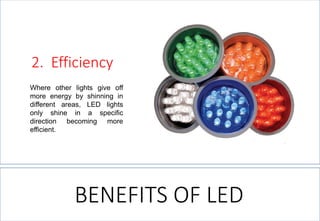
Whereotherlightsgiveoffmoreenergybyshinningindifferentareas,LEDlightsonlyshineinaspecificdirectionbecomingmoreefficient. 
2.Efficiency 
BENEFITS OF LED
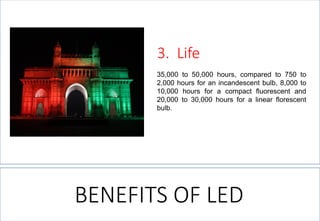
35,000to50,000hours,comparedto750to2,000hoursforanincandescentbulb,8,000to10,000hoursforacompactfluorescentand20,000to30,000hoursforalinearflorescentbulb. 
3. Life 
BENEFITS OF LED
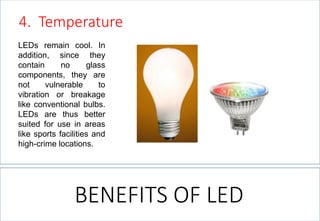
LEDsremaincool.Inaddition,sincetheycontainnoglasscomponents,theyarenotvulnerabletovibrationorbreakagelikeconventionalbulbs. LEDsarethusbettersuitedforuseinareaslikesportsfacilitiesandhigh-crimelocations. 
4. Temperature 
BENEFITS OF LED
LED LIGHTING
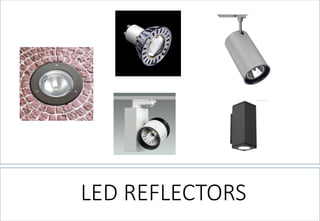
LED REFLECTORS
LAMPS 
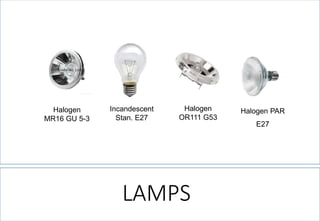
Halogen MR16 GU 5-3 
Incandescent Stan. E27 
Halogen OR111 G53 
Halogen PAR 
E27
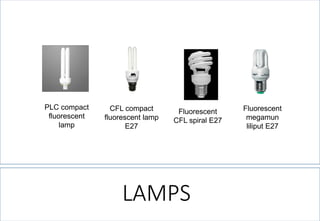
PLC compact fluorescent lamp 
CFL compact fluorescent lamp E27 
Fluorescent CFL spiral E27 
Fluorescent megamun liliput E27 
LAMPS
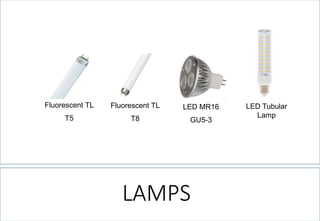
Fluorescent TL 
T5 
Fluorescent TL 
T8 
LED MR16 
GU5-3 
LED Tubular Lamp 
LAMPS
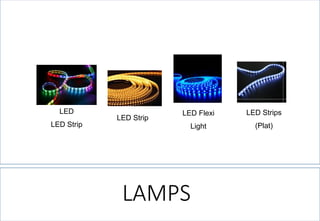
LED 
LED Strip 
LED Strip 
LED Flexi 
Light 
LED Strips 
(Plat) 
LAMPS
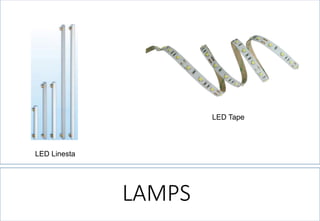
LED Linesta 
LED Tape 
LAMPS
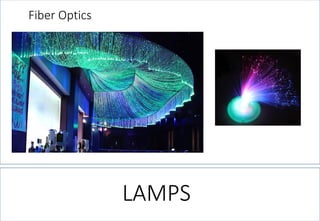
Fiber Optics 
LAMPS
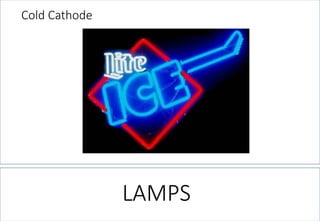
Cold Cathode 
LAMPS
THANK YOU

Lighting Design Project (Mohd. nadeem MSC. Interior Design)

  • 1.
    LIGHTING DESIGN OFCOMMERCIAL AND RESIDENTIAL SPECES Student:- Mohd. Nadeem MSc Interior Designer Commercial Space Designer DezyneE’coleCollege www.dezyneecol.com
  • 2.
    WHAT IS LIGHT LightisaformofenergymanifestingitselfaselectromagneticradiationandiscloselyrelatedtootherformofelectromagneticradiationsuchasGammarays,X-rays,UVrays,IRrays,MicrowaveraysandRadiorays.
  • 3.
    COLOUR TEMPERETURE OUTDOOR/INDOOR •Colour temperature is a characteristic visible light. In practice, Colour temperature is only meaningful of light sources that do in fact correspond some what closely to the radiation of some black body. •The Colour temperature of the electromagnetic radiation emitted from an ideal black body is defined as its surface temperature in KELVINS. •Colour temperature over 5000K are called cool Colour (bluefish white), while lower Colour temperature (2700-3000K) are called warm Colour (yellowish white through red).
  • 4.
    COLOUR TEMPERETURE OUTDOOR/INDOOR Colour temperature: •Defined as the tone of light or how the light looks in terms of whiteness. •Higher the Colour temperature = whiter/cooler the light source. •Unit measurement = Kelvin (K).
  • 7.
    •Sometime called Colourrendering index, is a quantitative measure of the ability of a light source to reproduce the Colour of various objects faithfully in comparison with an ideal or natural light source. •Colour rendering: Effect of an illuminant on the Colour appearance of objects by conscious or subconscious comparison with their Colour appearance under a reference illuminant. •Finishes should be evaluated under the type of lamp (lamp and/ or daylight) which will actually be used in the interiors. •Colour rendering depends on the lamp Colour spectrum, reflective property of surface and context and condition in room. •Judgment of apparent surface Colour depends also on the expectations of an individual with normal Colour vision. COLOUR RENDERING INDEX(CRI)
  • 8.
  • 9.
    LIGHTING FIXTURES •Lightingfixtures is integral of building electrical system, transforming energy into usable illumination. •Light fixture requires: electrical connection (power supply), lamp holder, lamp (design to defuse, reflect focus light). •Form of lighting fixtures, lighting sources, light illumination: Point source, linear sources, planar sources, volumetric sources.
  • 10.
    LIGHTING LUMINAIRE •Anassembly used to house one or more lighting sources. Also called lighting fixture. 1.Luminaries 2.Lighting lamp 3.Lighting socket 4.Light switch
  • 11.
    CLASSIFICATION OF LUMINAIRES •Recessed •Ceiling Mounted •Track Mounted •Wall mounted •Suspended •Architectural •Portable •Pole Mounted •Bollard •Outdoor •Up lighters •Down lighters •Wall washers •Ceiling washers •Floor washers
  • 12.
  • 13.
    CATEGORIES OF LUMINAIRES •Direct: 90 -100% downward •Semi direct: 60 -90% downward •General diffuse: 40 -60% both downward and upward •Direct -indirect: little light is emitted in the horizontal plane •Semi -direct: providing 90 –100% of its luminous output upward.
  • 14.
  • 15.
  • 16.
  • 17.
  • 18.
    TYPES OF LIGHTING •General Lighting
  • 19.
    TYPES OF LIGHTING Accent Lighting
  • 20.
    TYPES OF LIGHTING Decorative Lighting
  • 21.
    TYPES OF LIGHTING Task Lighting
  • 22.
    TYPES OF LIGHTING Kinetic Lighting
  • 23.
  • 24.
  • 25.
  • 26.
  • 27.
  • 28.
  • 29.
    ARTIFICIAL LIGHT SOURCES •Incandescent Lamps •Fluorescent Lamps •High –Intensity Discharge Lamps •Mercury Lamp •Metal Halide Lamps •High pressure Sodium Lamps •Low pressure Sodium Lamps •Electrode less Lamps •Compact arc xenon & Mercury lamps •Electroluminescent Lamps •Light emitting Diodes (LED) •Carbon arc Lamps •Gaslights
  • 30.
    INCANDESCENT LAMP What? Hotwire –Filament sealed in a glass jar (BULB) How ? Electric current pass through the wire heats it to incandescence, and the wire emits light. Use standard voltage circuit.
  • 31.
    Inside the glassis a gas such as argon and or nitrogen. At the center of the lamp is a tungsten filament. Electricity heats this filament up to about 2500 degrees Celsius. Just like any hot metal, the tungsten gets “white hot” at that heat and emits a great deal of visible light in a process called. INCANDESCENT LAMP
  • 32.
    1. Glass Bulb 2. Vacuum or gas filled 3. Wire / Filament 4. 5. Lead -in wires 6. Support wire 7. Neck 8. 11. Electric Fuse 9. Base INCANDESCENT LAMP
  • 33.
    ADVANTAGES: 1.Less expensive 2.Easier to dim with rheostats 3.Warmer color than fluorescent and tungsten halogen lamps. 4.Light output is relatively high 5.Excellent color rendering. 6.Can be dimmed DISADVANTAGES: 1.Energy inefficient 2.Short lamp life time 3.Warm source INCANDESCENT LAMP
  • 34.
    INCANDESCENT LAMP Shapeof lamp: Around 100 combinations of glass and quartz bulb shapes and sizes. SYMBOLS: 1stpart = One or more letters indicates the shape of bulb 2ndPart = number indicated diameter of the bulb in eights of an inch. EXAMPLE: A19 = arbitrary shaped, 19/8 inch diameter
  • 35.
    EXAMPLES: •General lightingservice (GLS) •Parabolic Aluminum reflector (PAR) •Metal reflector (MR) INCANDESCENT LAMP
  • 36.
    BASE IDENTIFICATION: 1.SMALLBASE; BAYONET, BIPIN, CANDELABRA, INTERMEDIATE, MINIATURE,MINI-CANDELABRA, TWIST-AND-LOCK, PIN 2.MEDIUM BASE 3.LARGE BASE; MOGUL SCREW, MOGUL BIPOST INCANDESCENT LAMP
  • 37.
    Shape of lamp: Around 100 combinations of glass and quartz bulb shapes and sizes. SYMBOLS: 1stpart = One or more letters indicates the shape of bulb 2ndPart = number indicated diameter of the bulb in eights of an inch. EXAMPLE: A19 = arbitrary shaped, 19/8 inch diameter INCANDESCENT LAMP
  • 38.
  • 39.
  • 40.
    INCANDESCENT LAMP LAMPLIFE TIME: 1.STANDARD-LIFE LAMP: high temperature for the filament to operates, emits more light, shorter life time –“burns out”. 2.LONG-LIFE LAMP: given wattage produces less light, designed for long life. LAMP EFFICIENCY = LIGHT PRODUCED (LUMENS, lm)/ELECTRICITY CONSUMED (WATTS W) 3.LIGHT OUTPUT: Insert gas (Argon, Nitrogen, Krypton) slows bulb blackening caused by condensation on the bulb wall
  • 41.
    INCANDESCENT LAMP Bulbsare sold by WATTS –Measure of power consumed LUMENS tells much light lamp emits HOURS OF OPERATION is produced life-time(750-1000H, up to 2500H for extended service lamps) ENERGY SAVING LAMPS –Reduced wattage, reduced light output
  • 42.
    INCANDESCENT LAMP LAMPTYPES: 1.NON DIRECTIONAL (emits light in all directions –A, C, G, P, PS, S and T shapes, requires additional external elements for brightness, glare and distribution control) 2.SEMI DIRECTIONAL (silver bowl or white bowl lamps, coating on inner side of bulb, reduce filament glare) 3.DIRECTIONAL (complete optical systems: source, reflector, lens or filament shield, R, AR, MR, PAR built-in beam control)
  • 43.
  • 44.
  • 45.
    INCANDESCENT LAMP Left:Reflector lamp with soft glass bulb and ellipsoid reflector with moderate focusing power. Right: PAR reflector lamp with pressed glass bulb and powerful parabolic reflector. Directional
  • 46.
  • 47.
    What ? Selectedgas of the halogen family How ? Halogen gas combines with tungsten molecules that sputter of the filament deposits tungsten back on the filament and emits constant level of light TUNGSTEN -HALOGEN
  • 48.
    A halogen bulbhas a filament of tungsten, which glows when electricity is applied, same as a regular incandescent bulb. The halogen gas removes the carbon deposits on the side inside of the bulb, caused by the burning of the tungsten filament, and redeposits it back on to the filament, resulting in a bulb which can be burned at a higher TUNGSTEN -HALOGEN
  • 49.
    TUNGSTEN -HALOGEN Highoperating temperature (500C), high Colour temperature Quartz instead of glass Equipped with outer bulb, glass cover, mesh screen
  • 50.
    TUNGSTEN -HALOGEN Advantages 1.High Colour temperature make them “whiter” than standard incandescent lamps 2.Longer life time 3.Great efficiency 4.Compact in shape and size They come in many shapes and sizes, some directional others note, some quite small other the size of regular bulb, some fit into normal sockets other require special sockets and voltage to work.
  • 51.
    TUNGSTEN -HALOGEN Thereare many different type of (single ended) TH lamp, the most common ones are the G9 capsule lamp, GU10 spot lamp and linear halogen lamps which are all domestic mains voltage, and g4 capsule lamp, (integral reflector) MR16, MR11 spot lamps which are low voltage lamps.
  • 53.
    LOW –VOLTAGE LAMPS •Low-voltage lamps –incandescent and tungsten halogen lamps that operate between 6V and 75V. •Standard building current of 115V-125V must be stepped down by the use of transformer. •Low-voltage luminaries with integrated transformers are larger in size and bulkier. •Practical system is line-voltage equipment.
  • 54.
  • 55.
  • 56.
  • 57.
    GELATIN FILTERS (“GELS”) Thin transparent colored plastic sheet in vide variety of Colour, as well as multicolored and diffused sheets. Short servise life –Colour fades rapidly.
  • 58.
    INTERFERENCE FILTERS Oneor more layers of ultrathin film coating on clear glass that reflects rather then absorb unwanted wavelength. They transmit one Colour, and reflect the complementary Colour.
  • 59.
    What ? Gas,phosphor, cathode, discharge How ? Light is produced by passage of an electric current through a vapor of gas, rather than through a tungsten wire as in incandescent lamp. DISCHARGE LAMPS
  • 60.
  • 61.
    FLOURESCENT LAMP TheClassic fluorescent lamp design, which has fallen mostly by the wayside, used a special starter switch mechanism to light up the tube. The conventional starter switch is a small discharge bulb, containing neon or some other gas. The bulb has two electrodes positioned right next to each other. When electricity is initially passed through the bypass circuit, an electrical arc jumps between these electrode to make a connection. This arc lights the bulb in the same way a larger arc lights a fluorescent bulb.
  • 62.
  • 63.
    FLOURESCENT LAMP Advantages: Heatisrelativelylow Energyefficient Rangefromlowgradetohighgrade Longlamplife UsuallyCoolsource Controlgears Disadvantages: Colourtemperature Requireballast:preheat,instant-start, rapid-start Requirescontrollingelementsforglarecontrol
  • 64.
    FLOURESCENT LAMP Types: 1.ColdCathode 2.HotCathode Shape: 1.U-BentShape 2.CirculineShape 3.CompactFluo-Lamp
  • 65.
  • 66.
    BALLAST/DRIVER Integrated Ballast(CFL) Magnetic Ballast (Traditional) Electronic Ballast
  • 67.
    HIGH INTENSITY DISCHARGELAMP Typeofelectricalgas-dischargelampwhichproduceslightbymeansofanelectricarcbetweentungstenelectrodeshousedinsideatranslucentortransparentfusedquartzorfusedaluminaarctube. Thistubeisfilledwithbothgasandmetalsalts.Thegasfacilitatesthearc’sinitialstrike.Oncethearcisstarted,itheatsandevaporatesthemetalsaltsformingaplasma,whichgreatlyincreasestheintensityoflightproducedbythearcandreducesitspowerconsumption.High-intensitydischargelampsareatypeofarclamp.
  • 68.
  • 69.
  • 70.
    Whenenergyefficiencyand/orlightintensityaredesired. Theseareasincludegymnasiums, largepublicareas,warehouses,movietheatres,footballstadiums,outdooractivityareas,roadways,parkinglots,andpathways. Ultra-HighPerformance(UHP)HIDlampsareusedinLCDorDLPprojectionTVsetsorprojectiondisplaysaswell. HIGH INTENSITY DISCHARGE LAMP
  • 71.
    LED LIGHT RedandInfrared LEDs are made with gallium arsenide Bright Blue is made with GN -gallium nitride WhiteLEDs are made with yttrium aluminium garnet There are also orange, green, blue, violet, purple, ultraviolet LEDs.
  • 72.
  • 73.
  • 74.
  • 75.
  • 76.
  • 77.
  • 78.
  • 79.
  • 80.
    LAMPS Halogen MR16GU 5-3 Incandescent Stan. E27 Halogen OR111 G53 Halogen PAR E27
  • 81.
    PLC compact fluorescentlamp CFL compact fluorescent lamp E27 Fluorescent CFL spiral E27 Fluorescent megamun liliput E27 LAMPS
  • 82.
    Fluorescent TL T5 Fluorescent TL T8 LED MR16 GU5-3 LED Tubular Lamp LAMPS
  • 83.
    LED LED Strip LED Strip LED Flexi Light LED Strips (Plat) LAMPS
  • 84.
    LED Linesta LEDTape LAMPS
  • 85.
  • 86.
  • 87.