SUBMITTED BY:-
REENA NAGAR
LALITA RANI
PRIYANKA
VASHISHT
MANISHA FOGAAT
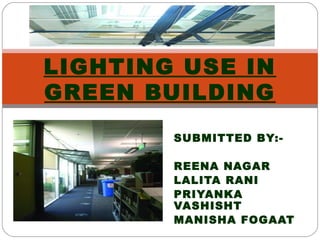
LIGHTING USE IN
GREEN BUILDING
INTRODUCTION
LIGHTING, ENERGY AND GREENHOUSE
 
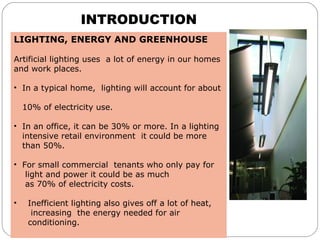
Artificial lighting uses  a lot of energy in our homes 
and work places. 
•  In a typical home,  lighting will account for about 
    
   10% of electricity use. 
•  In an office, it can be 30% or more. In a lighting  
   intensive retail environment  it could be more 
   than 50%.
•  For small commercial  tenants who only pay for   
    light and power it could be as much 
    as 70% of electricity costs.
 
•    Inefficient lighting also gives off a lot of heat,    
      increasing  the energy needed for air  
     conditioning. 
REDUCE THE NEED FOR ARTIFICIAL
LIGHTING
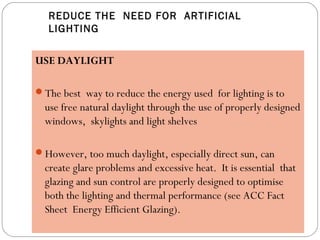
USE DAYLIGHT
The best way to reduce the energy used for lighting is to
use free natural daylight through the use of properly designed
windows, skylights and light shelves
However, too much daylight, especially direct sun, can
create glare problems and excessive heat. It is essential that
glazing and sun control are properly designed to optimise
both the lighting and thermal performance (see ACC Fact
Sheet Energy Efficient Glazing).
USE THE RIGHT AMOUNT OF LIGHT
 Recommended Characteristics and examples
Illuminance
 40 lux Corridors, walkways
 80 lux Interiors used internittently. Change rooms, liver
storage areas loading bays, stairs
 160 lux Staff canteens, entrance halls, etc
 240 Continuously occupied areas with easy visual tasks
of reading, writing, typing, enquiry desks,
libraries
 
 320 Routine office tasks of reading, writing,typing,
enquiry desks, libraries
 
 600lux Drawing boards, town planning and enquiry counters
dedicated to viewing paper plans
ONLY USE LIGHTS
WHEN THEY ARE
REQUIRED
The simplest way is to switch
off unnecessary lights.
Automatic controls can be
used to turn lights on and off,
and even control the amount
of artificial light according to
available natural light levels..
TYPES OF LIGHTING
 
• There are several types of lighting
technologies in common use in
buildings: incandescent, discharge
and, more recently, light emitting
diodes.
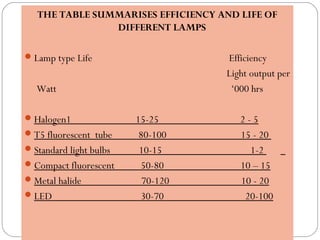
THE TABLE SUMMARISES EFFICIENCY AND LIFE OF
DIFFERENT LAMPS
Lamp type Life Efficiency
Light output per
Watt ‘000 hrs
 
Halogen1 15-25 2 - 5
T5 fluorescent tube 80-100 15 - 20 
Standard light bulbs 10-15 1-2  
Compact fluorescent 50-80 10 – 15
Metal halide 70-120 10 - 20
LED 30-70 20-100
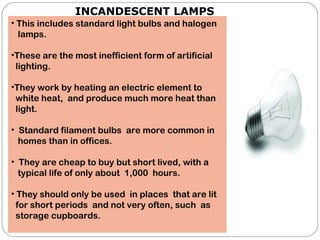
INCANDESCENT LAMPS
• This includes standard light bulbs and halogen
lamps.
•These are the most inefficient form of artificial
lighting.
•They work by heating an electric element to
white heat, and produce much more heat than
light.
 
• Standard filament bulbs are more common in
homes than in offices.
• They are cheap to buy but short lived, with a
typical life of only about 1,000 hours.
• They should only be used in places that are lit
for short periods and not very often, such as
storage cupboards.
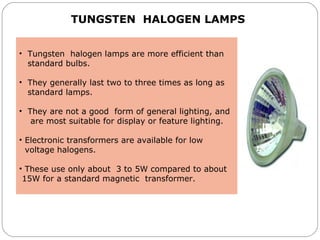
•  Tungsten  halogen lamps are more efficient than  
   standard bulbs. 
•  They generally last two to three times as long as  
   standard lamps. 
•  They are not a good  form of general lighting, and 
    are most suitable for display or feature lighting. 
 
• Electronic transformers are available for low    
  voltage halogens. 
• These use only about  3 to 5W compared to about   
 15W for a standard magnetic  transformer.
TUNGSTEN HALOGEN LAMPS
DISCHARGE LAMPS
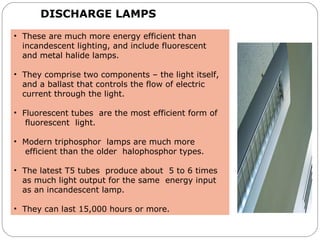
• These are much more energy efficient than
incandescent lighting, and include fluorescent
and metal halide lamps.
• They comprise two components – the light itself,
and a ballast that controls the flow of electric
current through the light.
• Fluorescent tubes are the most efficient form of
fluorescent light.
• Modern triphosphor lamps are much more
efficient than the older halophosphor types.
• The latest T5 tubes produce about 5 to 6 times
as much light output for the same energy input
as an incandescent lamp.
• They can last 15,000 hours or more.
COMPACT FLUORESCENT LAMPS (CFLS)
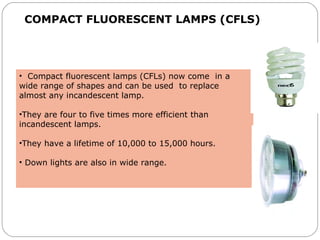
• Compact fluorescent lamps (CFLs) now come in a
wide range of shapes and can be used to replace
almost any incandescent lamp.
•They are four to five times more efficient than
incandescent lamps.
•They have a lifetime of 10,000 to 15,000 hours.
• Down lights are also in wide range.
METAL HALIDE LAMP
• metal halide lamps are another type of discharge
lamp.
• They produced a crisp wide light.
• Fewer fitting are needed for their higher light output.
• They are most suitable for up lighting and for area
light indoor pools
LED
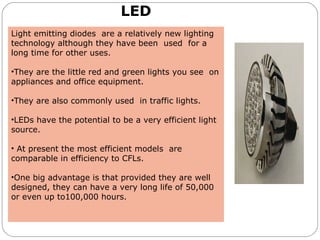
Light emitting diodes are a relatively new lighting
technology although they have been used for a
long time for other uses.
•They are the little red and green lights you see on
appliances and office equipment.
•They are also commonly used in traffic lights.
•LEDs have the potential to be a very efficient light
source.
• At present the most efficient models are
comparable in efficiency to CFLs.
•One big advantage is that provided they are well
designed, they can have a very long life of 50,000
or even up to100,000 hours.
LIGHT FITTINGS
• Efficient lighting is also a function of the light fitting.
• A poor fitting might result in only half the light produced
by the lamp actually reaching the room.
• A good fitting will only reduce it by about 20%.
CONTROLS
• There are a range of controls to allow the more efficient use of
lighting.
• The type of system used will depend greatly on the type of space –
whether it is open plan or an individual office, for example.
• Manual switches are the most cost effective and flexible provided
people use them sensibly.
• Simple timers can be used to turn lights on and off at preset times.
Occupancy sensors are particularly suitable for meeting rooms,
storage areas and washrooms.
• Light sensors can be used to control perimeter lighting, and are
important if a building has been designed to use daylight.
•Automatic dimming controls are the most sophisticated. They
monitor the lighting level in the room and adjust the light output
accordingly.
THANK YOU

Lighting ppt 1

  • 1.
    SUBMITTED BY:- REENA NAGAR LALITARANI PRIYANKA VASHISHT MANISHA FOGAAT LIGHTING USE IN GREEN BUILDING
  • 2.
    INTRODUCTION LIGHTING, ENERGY ANDGREENHOUSE   Artificial lighting uses  a lot of energy in our homes  and work places.  •  In a typical home,  lighting will account for about          10% of electricity use.  •  In an office, it can be 30% or more. In a lighting      intensive retail environment  it could be more     than 50%. •  For small commercial  tenants who only pay for        light and power it could be as much      as 70% of electricity costs.   •    Inefficient lighting also gives off a lot of heat,           increasing  the energy needed for air        conditioning. 
  • 3.
    REDUCE THE NEEDFOR ARTIFICIAL LIGHTING USE DAYLIGHT The best way to reduce the energy used for lighting is to use free natural daylight through the use of properly designed windows, skylights and light shelves However, too much daylight, especially direct sun, can create glare problems and excessive heat. It is essential that glazing and sun control are properly designed to optimise both the lighting and thermal performance (see ACC Fact Sheet Energy Efficient Glazing).
  • 4.
    USE THE RIGHTAMOUNT OF LIGHT  Recommended Characteristics and examples Illuminance  40 lux Corridors, walkways  80 lux Interiors used internittently. Change rooms, liver storage areas loading bays, stairs  160 lux Staff canteens, entrance halls, etc  240 Continuously occupied areas with easy visual tasks of reading, writing, typing, enquiry desks, libraries    320 Routine office tasks of reading, writing,typing, enquiry desks, libraries    600lux Drawing boards, town planning and enquiry counters dedicated to viewing paper plans
  • 5.
    ONLY USE LIGHTS WHENTHEY ARE REQUIRED The simplest way is to switch off unnecessary lights. Automatic controls can be used to turn lights on and off, and even control the amount of artificial light according to available natural light levels.. TYPES OF LIGHTING   • There are several types of lighting technologies in common use in buildings: incandescent, discharge and, more recently, light emitting diodes.
  • 6.
    THE TABLE SUMMARISESEFFICIENCY AND LIFE OF DIFFERENT LAMPS Lamp type Life Efficiency Light output per Watt ‘000 hrs   Halogen1 15-25 2 - 5 T5 fluorescent tube 80-100 15 - 20  Standard light bulbs 10-15 1-2   Compact fluorescent 50-80 10 – 15 Metal halide 70-120 10 - 20 LED 30-70 20-100
  • 7.
    INCANDESCENT LAMPS • Thisincludes standard light bulbs and halogen lamps. •These are the most inefficient form of artificial lighting. •They work by heating an electric element to white heat, and produce much more heat than light.   • Standard filament bulbs are more common in homes than in offices. • They are cheap to buy but short lived, with a typical life of only about 1,000 hours. • They should only be used in places that are lit for short periods and not very often, such as storage cupboards.
  • 8.
  • 9.
    DISCHARGE LAMPS • Theseare much more energy efficient than incandescent lighting, and include fluorescent and metal halide lamps. • They comprise two components – the light itself, and a ballast that controls the flow of electric current through the light. • Fluorescent tubes are the most efficient form of fluorescent light. • Modern triphosphor lamps are much more efficient than the older halophosphor types. • The latest T5 tubes produce about 5 to 6 times as much light output for the same energy input as an incandescent lamp. • They can last 15,000 hours or more.
  • 10.
    COMPACT FLUORESCENT LAMPS(CFLS) • Compact fluorescent lamps (CFLs) now come in a wide range of shapes and can be used to replace almost any incandescent lamp. •They are four to five times more efficient than incandescent lamps. •They have a lifetime of 10,000 to 15,000 hours. • Down lights are also in wide range.
  • 11.
    METAL HALIDE LAMP •metal halide lamps are another type of discharge lamp. • They produced a crisp wide light. • Fewer fitting are needed for their higher light output. • They are most suitable for up lighting and for area light indoor pools
  • 12.
    LED Light emitting diodesare a relatively new lighting technology although they have been used for a long time for other uses. •They are the little red and green lights you see on appliances and office equipment. •They are also commonly used in traffic lights. •LEDs have the potential to be a very efficient light source. • At present the most efficient models are comparable in efficiency to CFLs. •One big advantage is that provided they are well designed, they can have a very long life of 50,000 or even up to100,000 hours.
  • 13.
    LIGHT FITTINGS • Efficientlighting is also a function of the light fitting. • A poor fitting might result in only half the light produced by the lamp actually reaching the room. • A good fitting will only reduce it by about 20%.
  • 14.
    CONTROLS • There area range of controls to allow the more efficient use of lighting. • The type of system used will depend greatly on the type of space – whether it is open plan or an individual office, for example. • Manual switches are the most cost effective and flexible provided people use them sensibly. • Simple timers can be used to turn lights on and off at preset times. Occupancy sensors are particularly suitable for meeting rooms, storage areas and washrooms. • Light sensors can be used to control perimeter lighting, and are important if a building has been designed to use daylight. •Automatic dimming controls are the most sophisticated. They monitor the lighting level in the room and adjust the light output accordingly.
  • 15.

Editor's Notes

  • #2 Hearst tower in NYC
  • #3 House in California
  • #4 (Storm water runoff)
  • #5 Leadership in Energy and Environmental Design
  • #8 House in California
  • #9 House in California
  • #10 House in California
  • #11 House in California
  • #12 House in California
  • #13 House in California
  • #14 House in California
  • #15 House in California
  • #16 House in California