Overview of Lighting Design Using  DIALUX 4.6 IIEE-ERCSA Annual Convention 14 November 2008 Prepared by   Michael T. Santiago, REE LAD Engineer Saudi Lighting Co. Ltd.
Development of Lighting Why is Lighting Design Important? Relevant  Lighting Terms Criteria in Lighting Design What is Dialux and Why use it Dialux 4.6 Overview Presentation Proper What’s in it for me? history importance definitions criteria Dialux 4.6
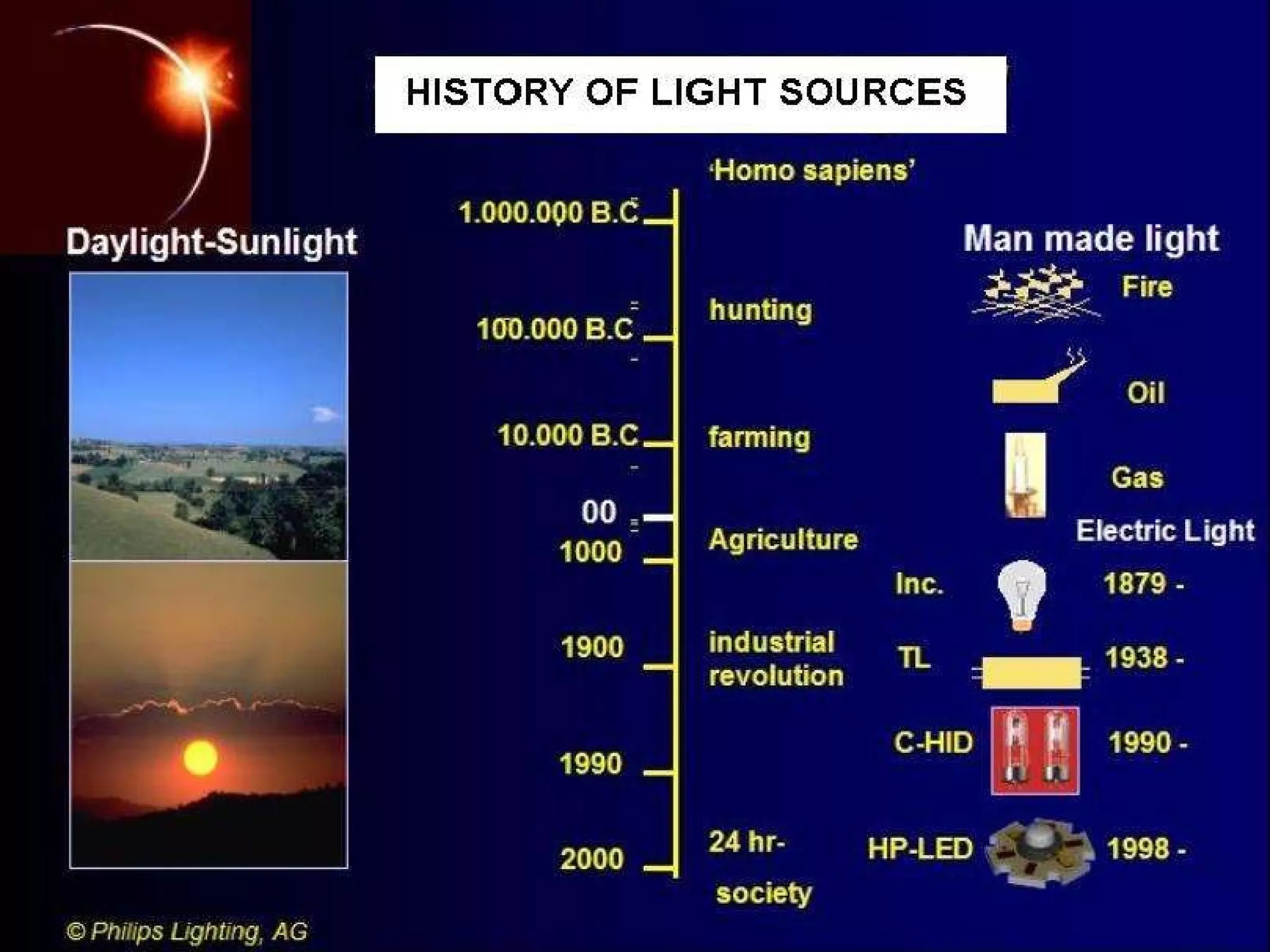
A Brief History of Lighting Design
SOURCE:  IESNA LIGHTING GUIDE history importance definitions criteria Dialux 4.6
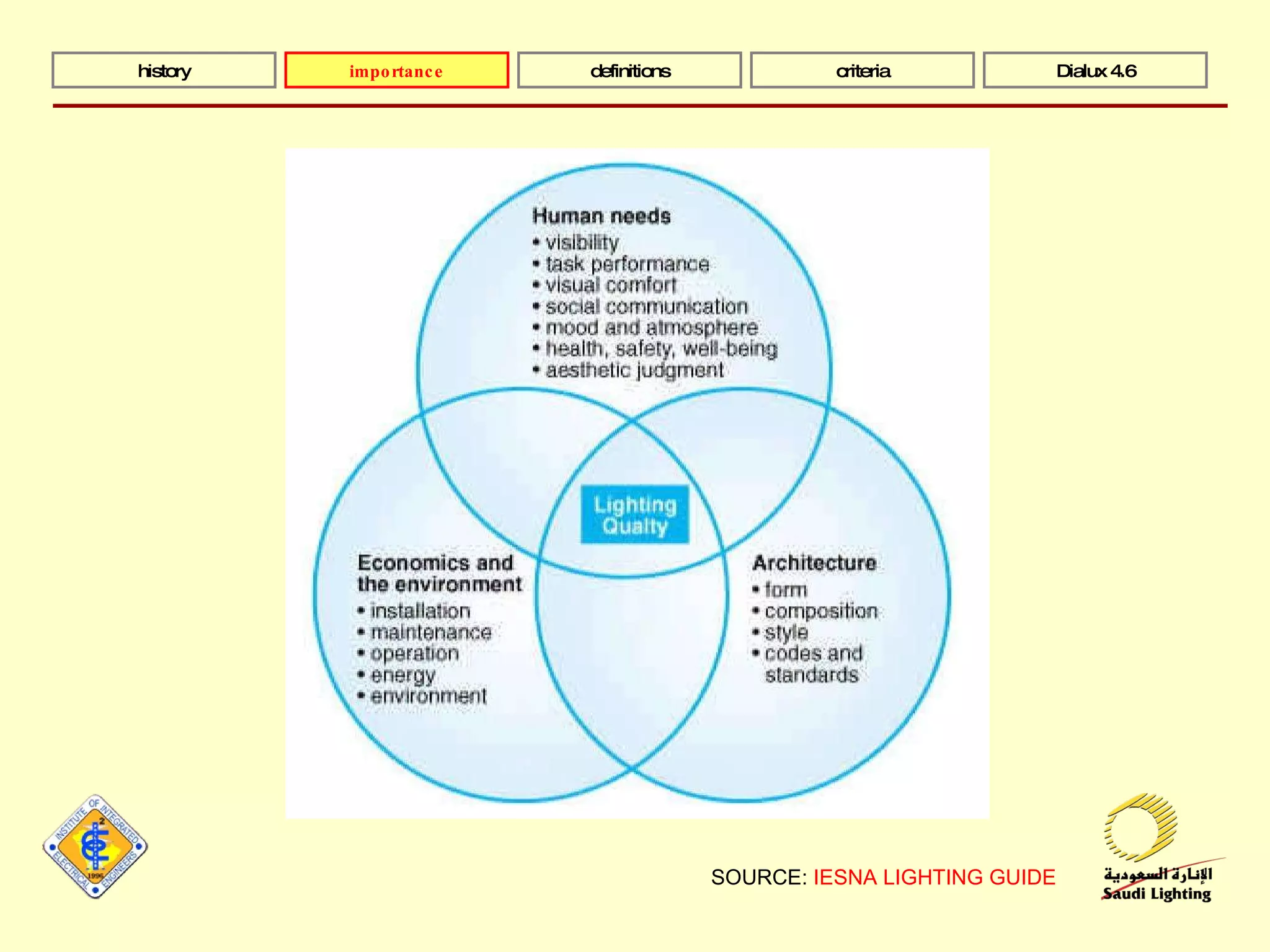
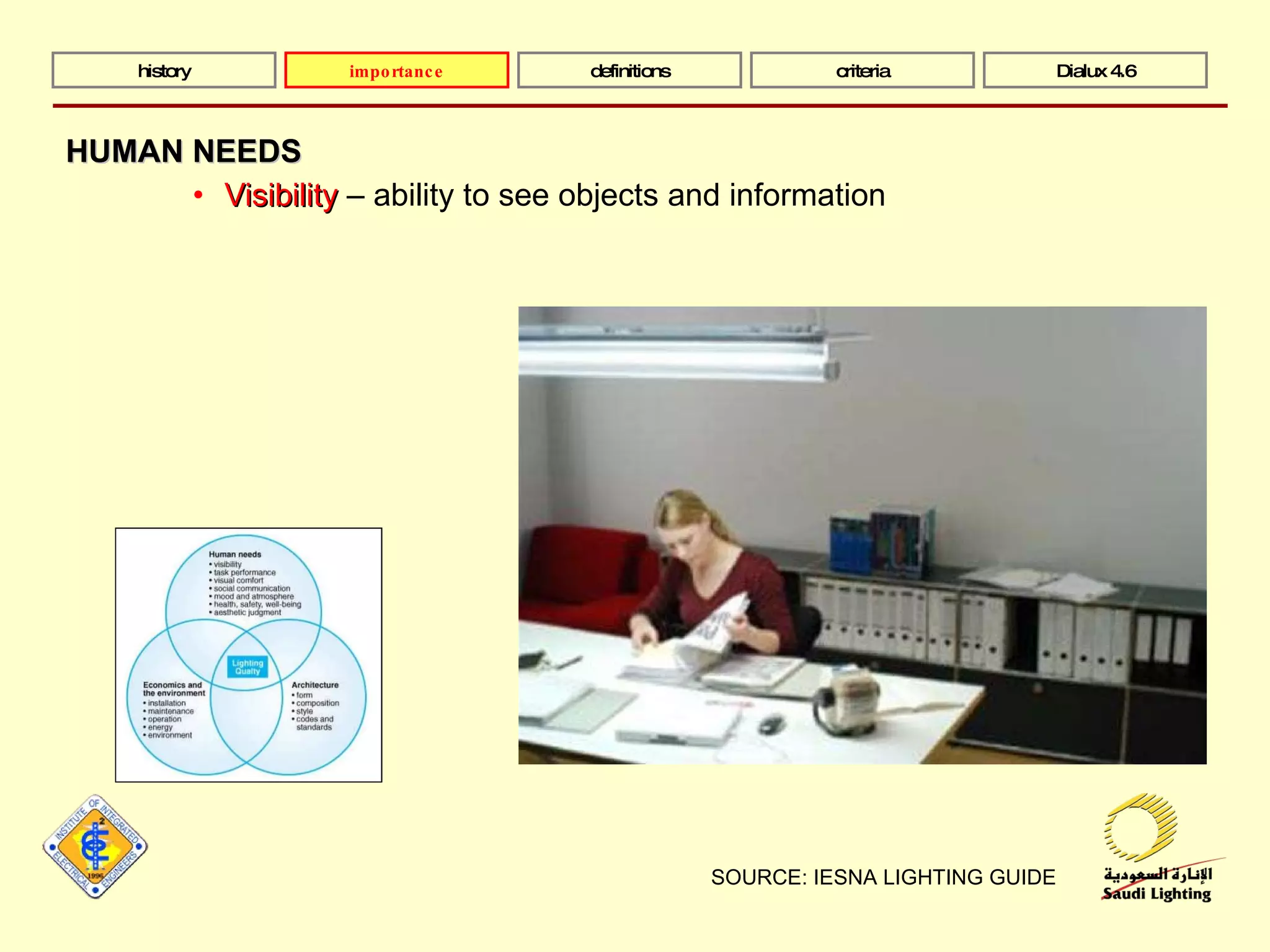
HUMAN NEEDS Visibility  – ability to see objects and information SOURCE: IESNA LIGHTING GUIDE history definitions criteria Dialux 4.6 importance
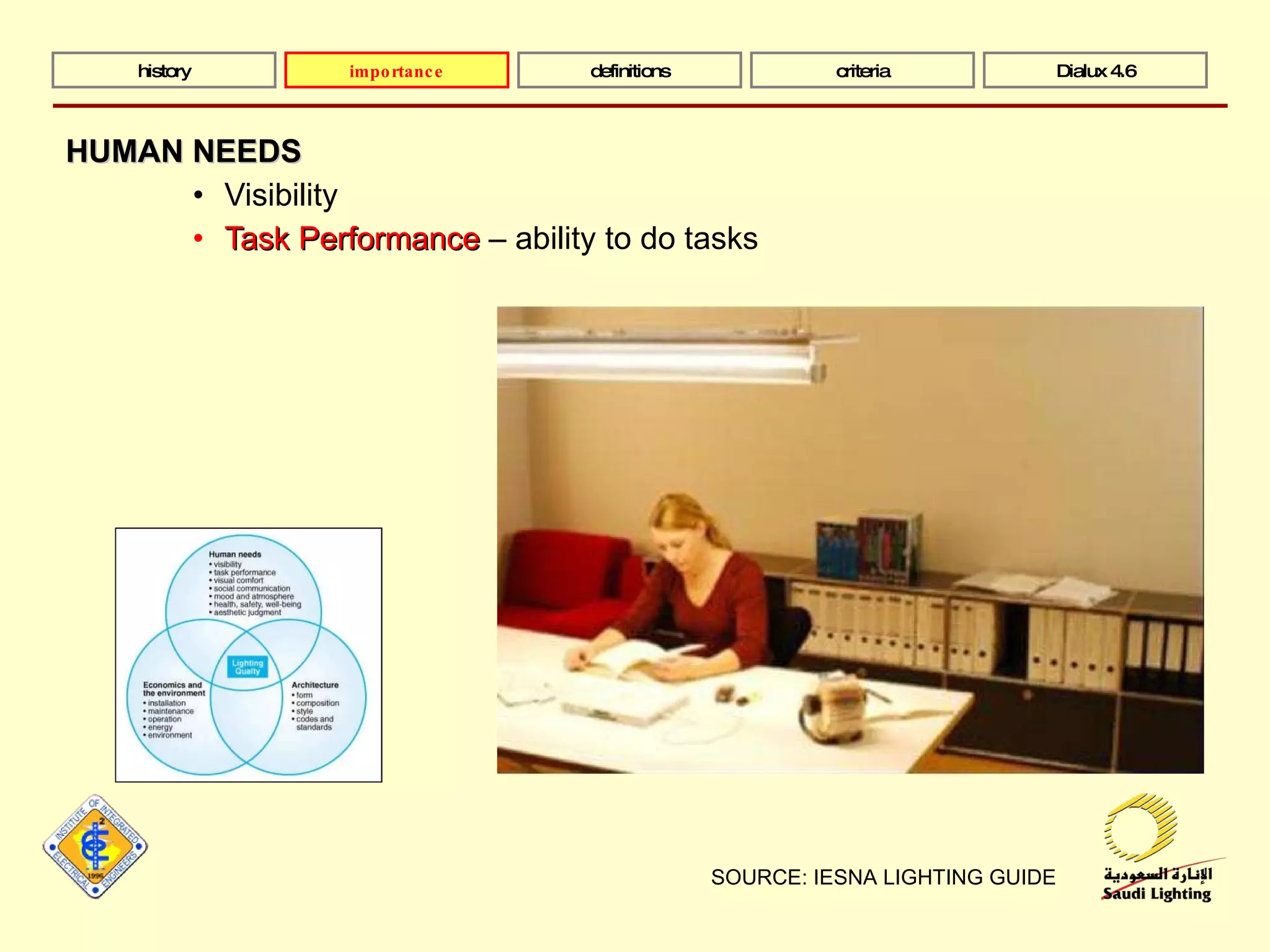
HUMAN NEEDS Visibility Task Performance  – ability to do tasks SOURCE: IESNA LIGHTING GUIDE history definitions criteria Dialux 4.6 importance
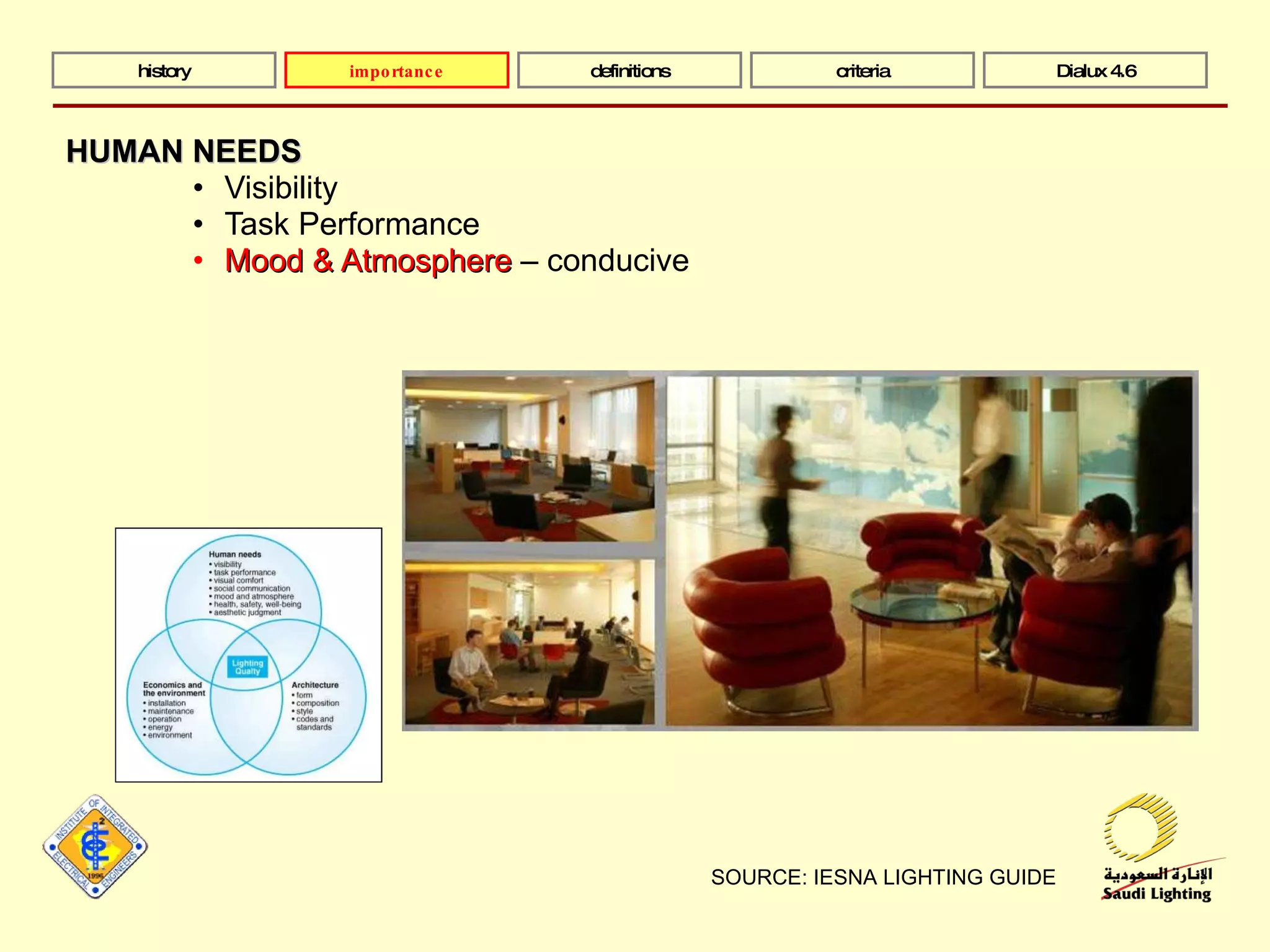
HUMAN NEEDS Visibility Task Performance Mood & Atmosphere  – conducive SOURCE: IESNA LIGHTING GUIDE history definitions criteria Dialux 4.6 importance
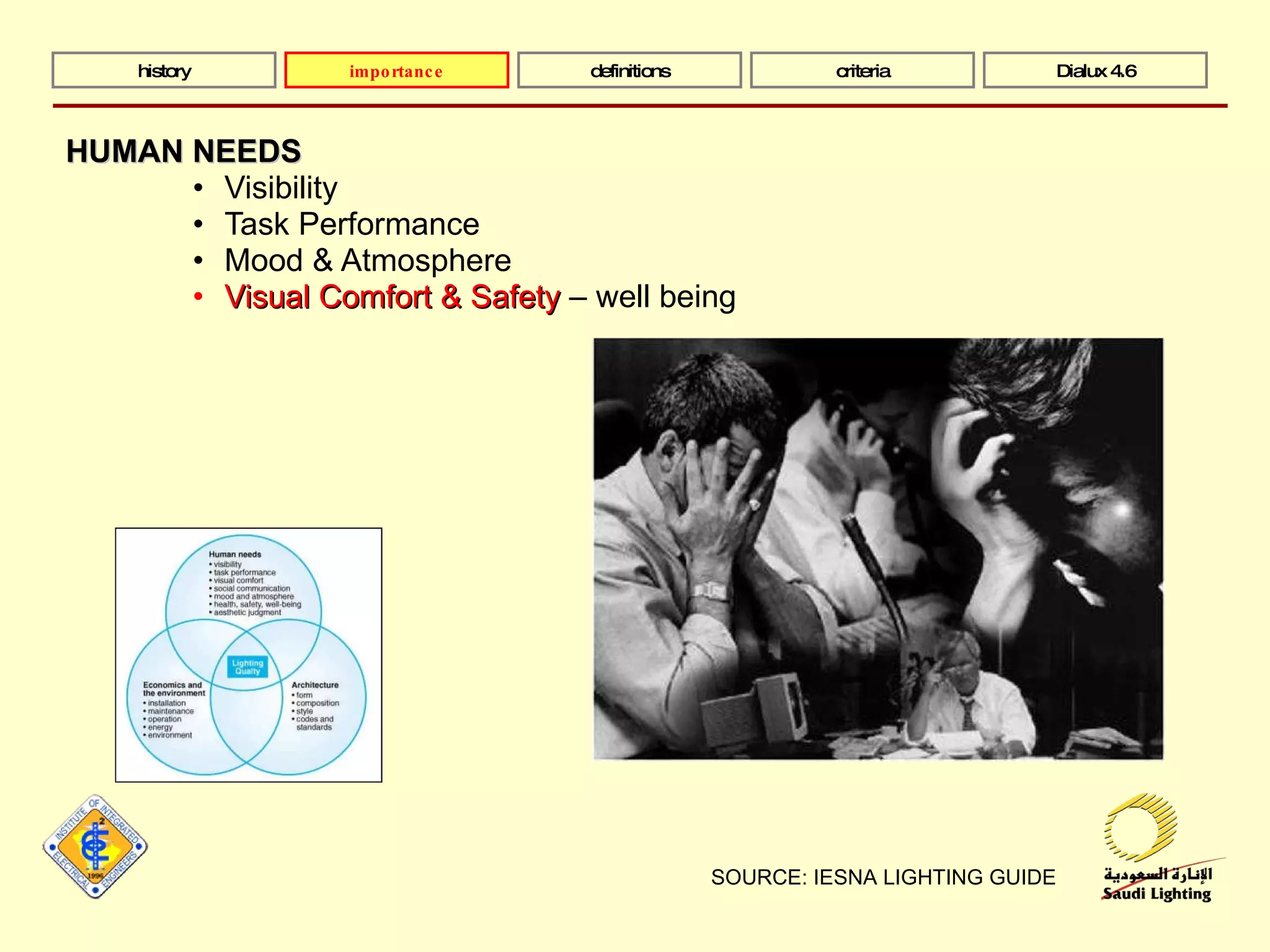
HUMAN NEEDS Visibility Task Performance Mood & Atmosphere Visual Comfort & Safety  – well being SOURCE: IESNA LIGHTING GUIDE history definitions criteria Dialux 4.6 importance
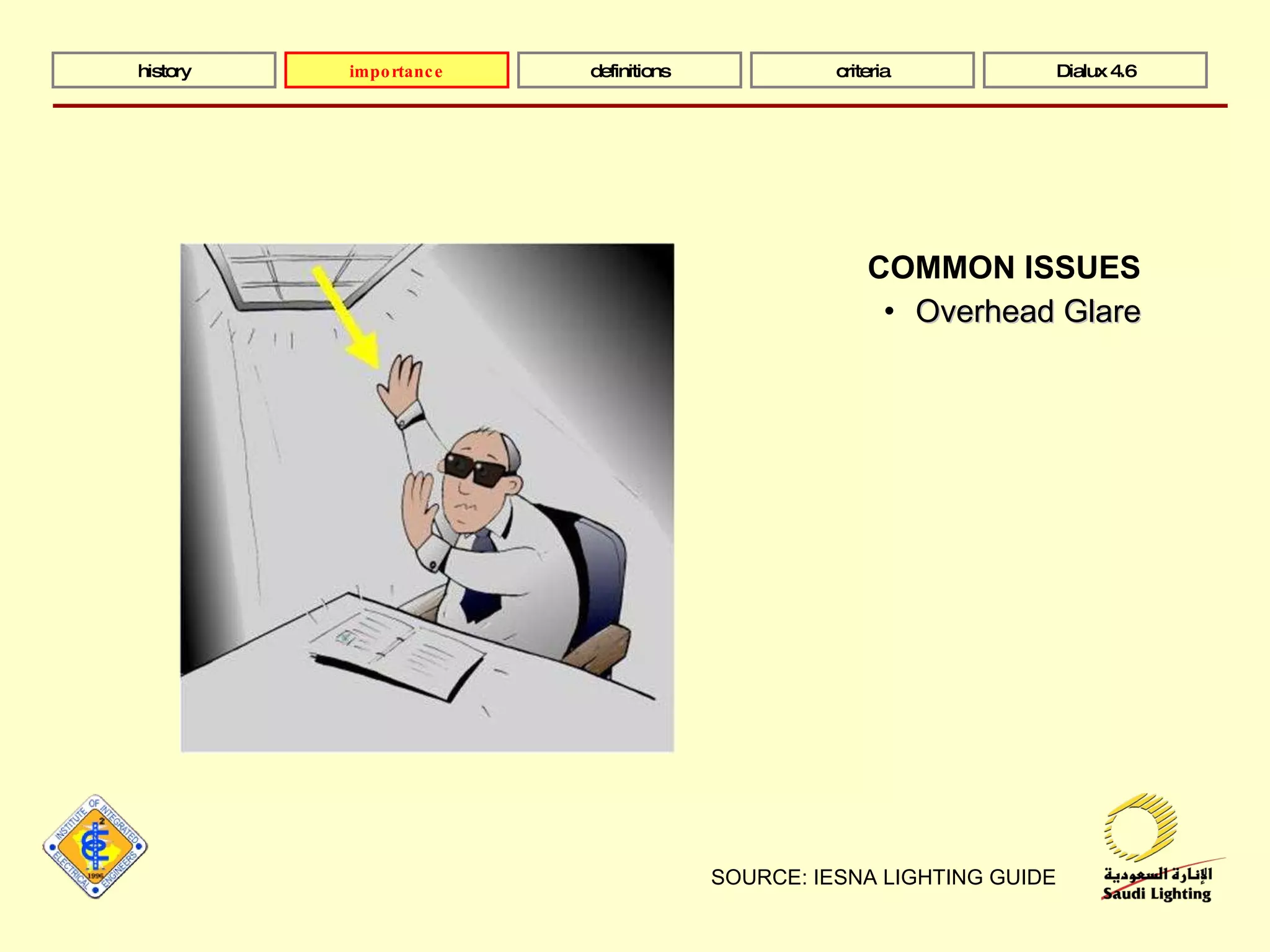
COMMON ISSUES Overhead Glare SOURCE: IESNA LIGHTING GUIDE history definitions criteria Dialux 4.6 importance
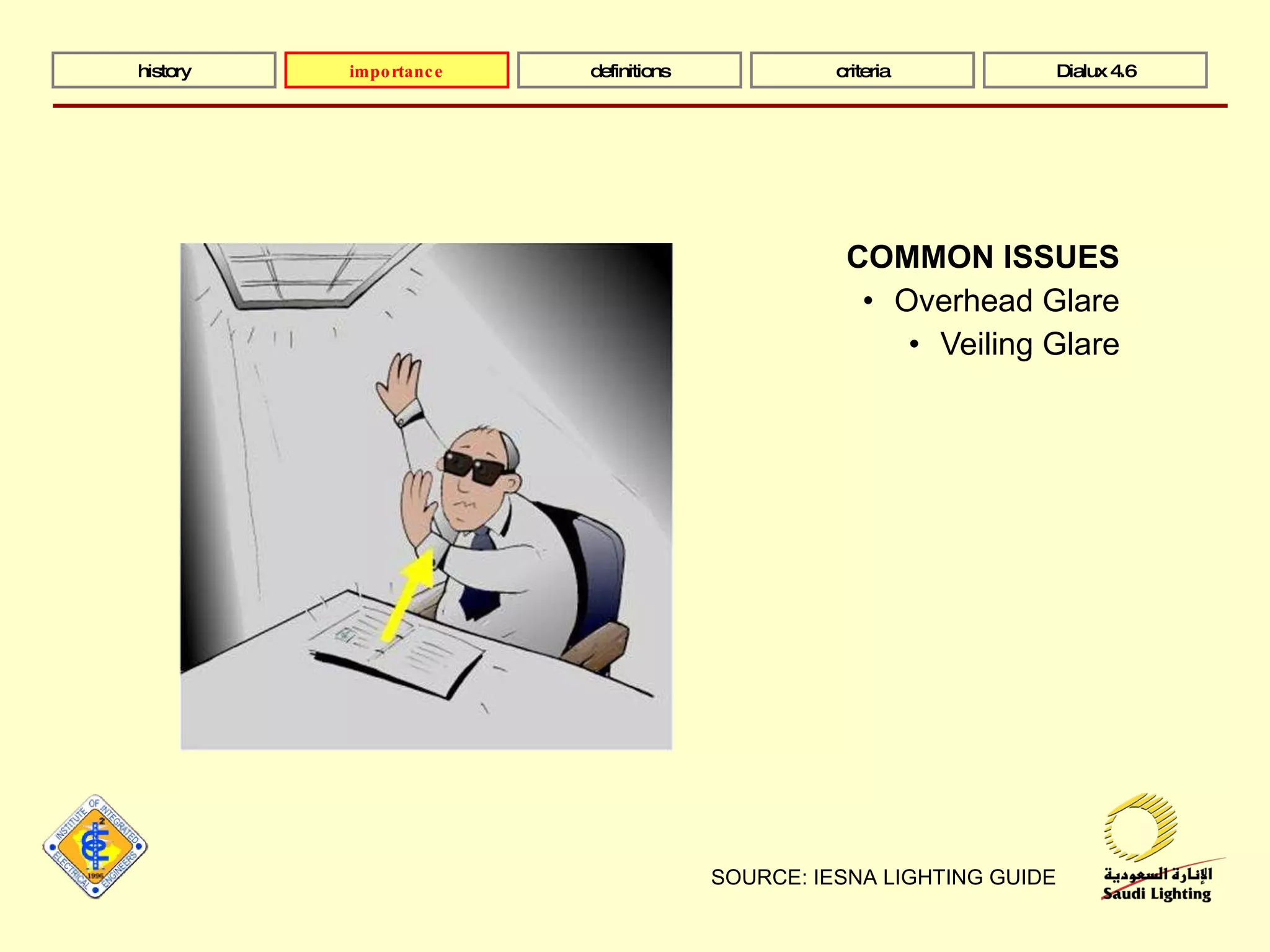
COMMON ISSUES Overhead Glare Veiling Glare SOURCE: IESNA LIGHTING GUIDE history definitions criteria Dialux 4.6 importance
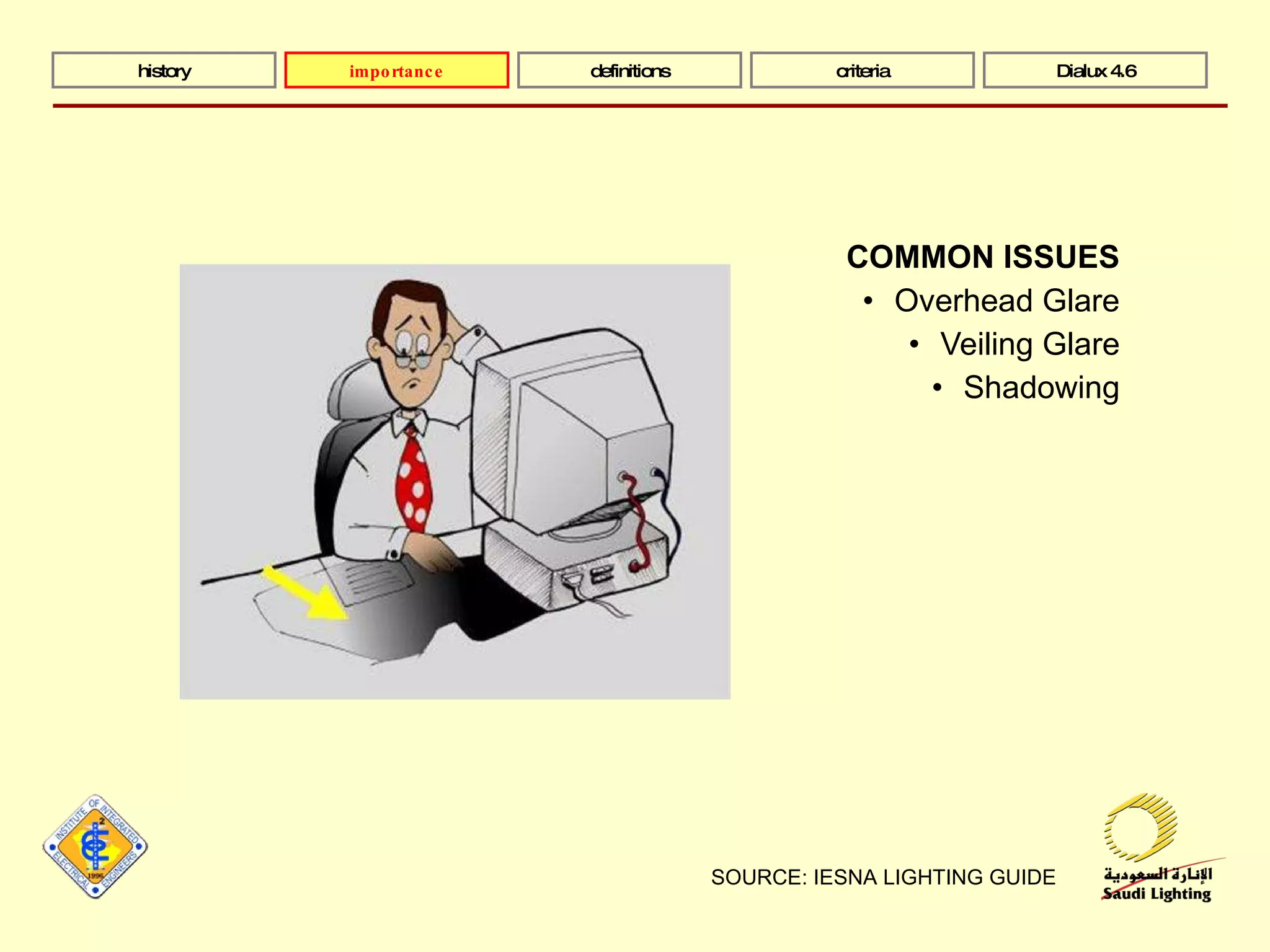
COMMON ISSUES Overhead Glare Veiling Glare Shadowing SOURCE: IESNA LIGHTING GUIDE history definitions criteria Dialux 4.6 importance
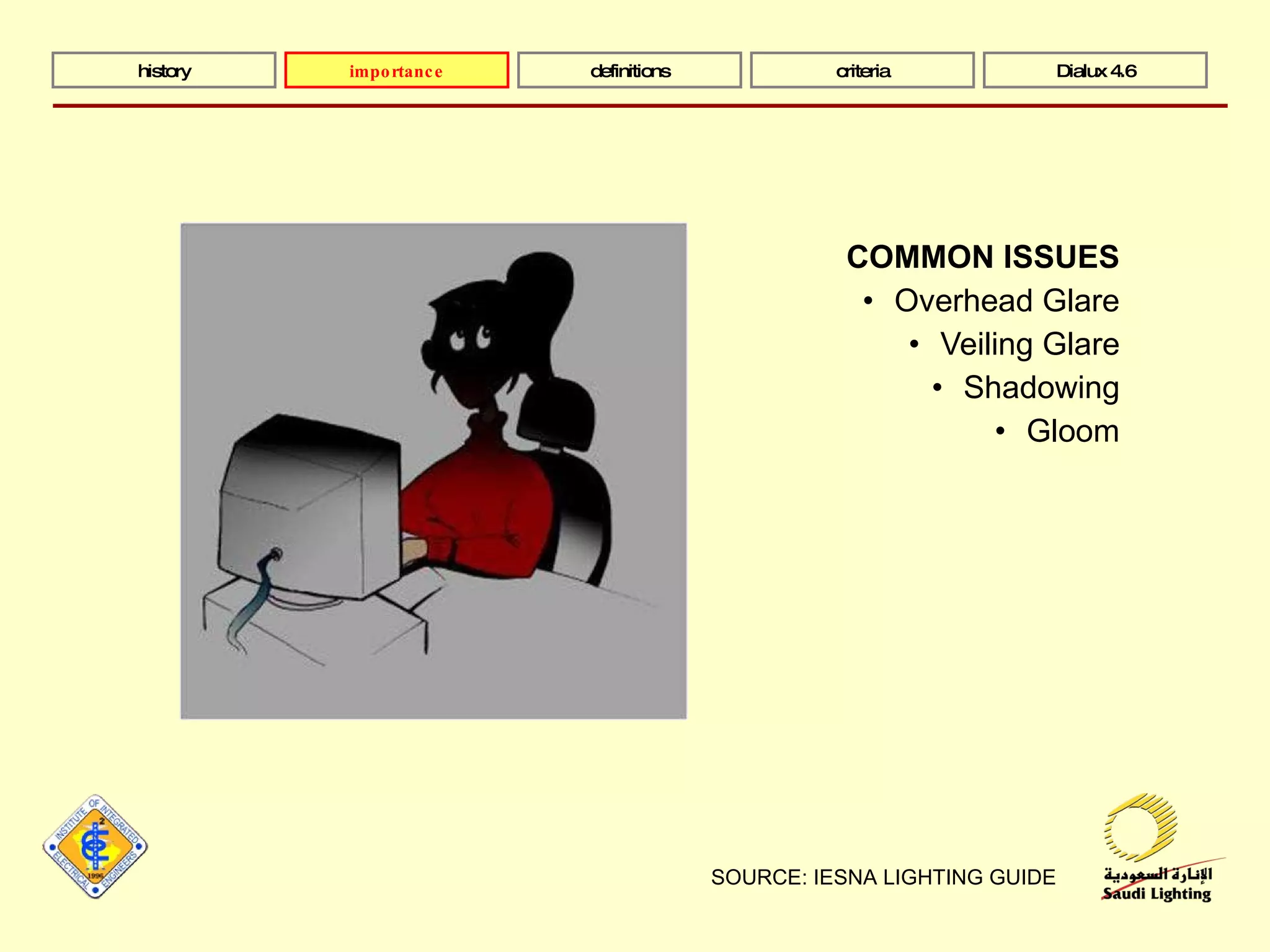
COMMON ISSUES Overhead Glare Veiling Glare Shadowing Gloom SOURCE: IESNA LIGHTING GUIDE history definitions criteria Dialux 4.6 importance
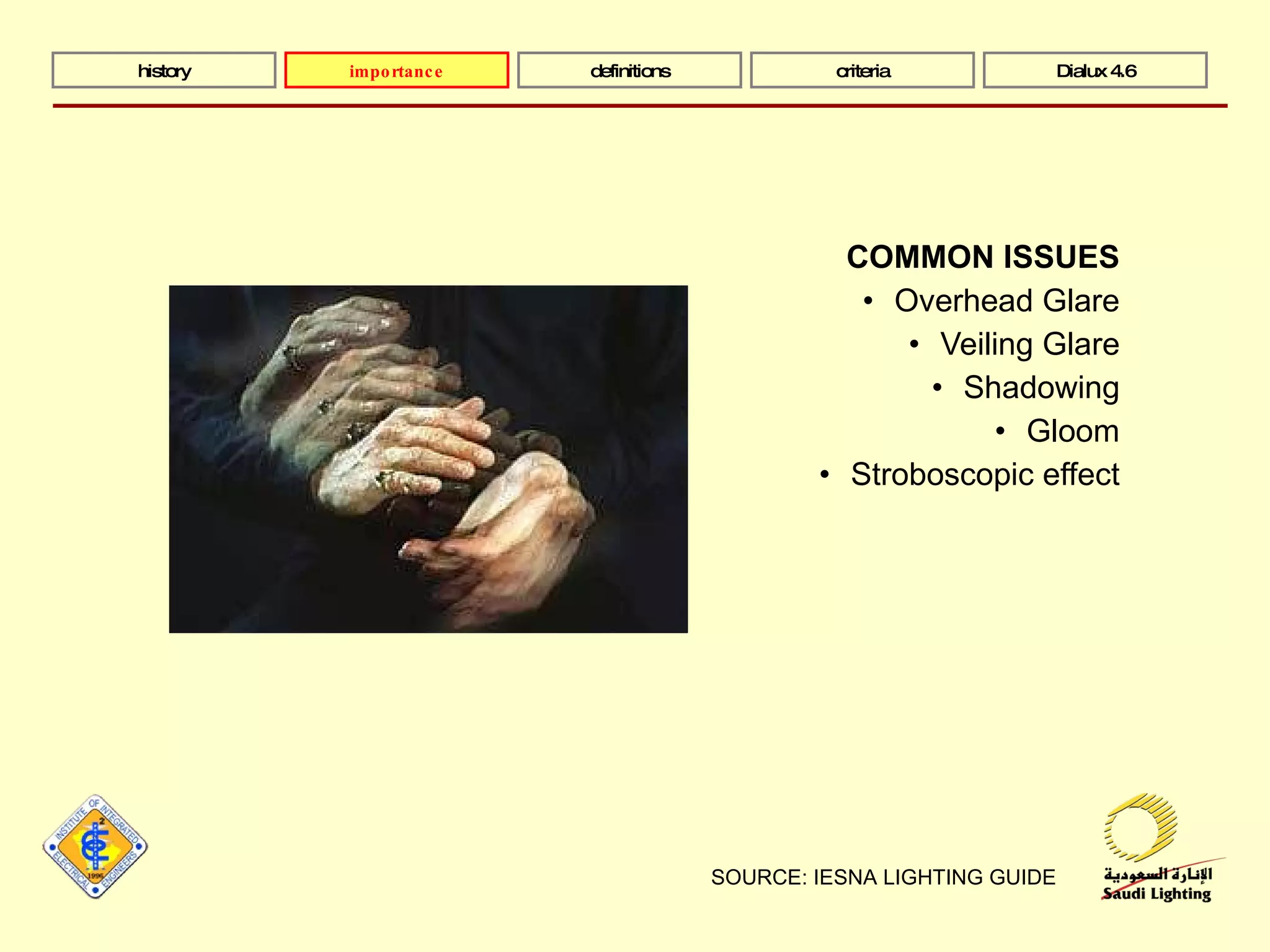
COMMON ISSUES Overhead Glare Veiling Glare Shadowing Gloom Stroboscopic effect SOURCE: IESNA LIGHTING GUIDE history definitions criteria Dialux 4.6 importance
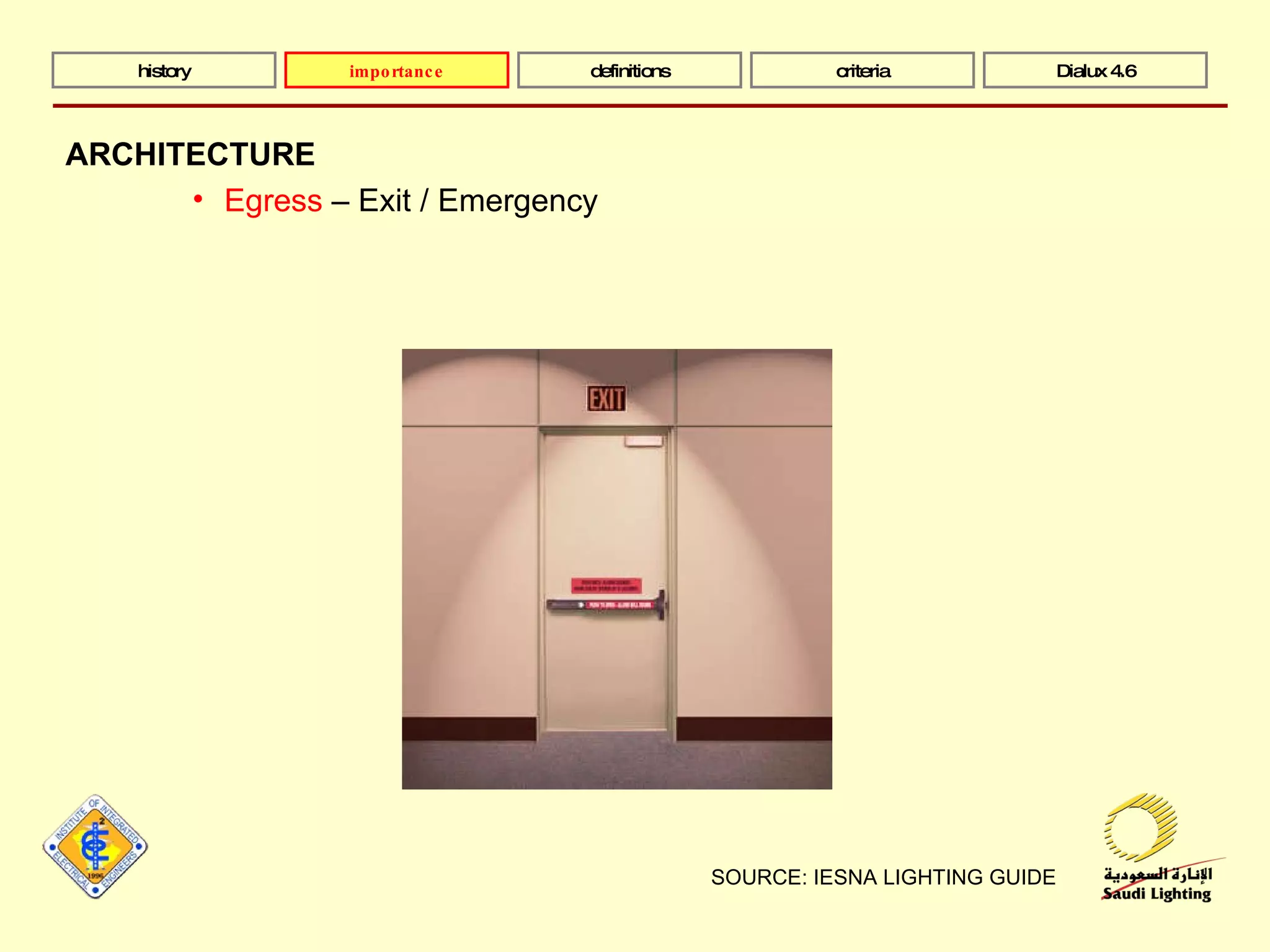
SOURCE: IESNA LIGHTING GUIDE history definitions criteria Dialux 4.6 ARCHITECTURE Egress  – Exit / Emergency importance
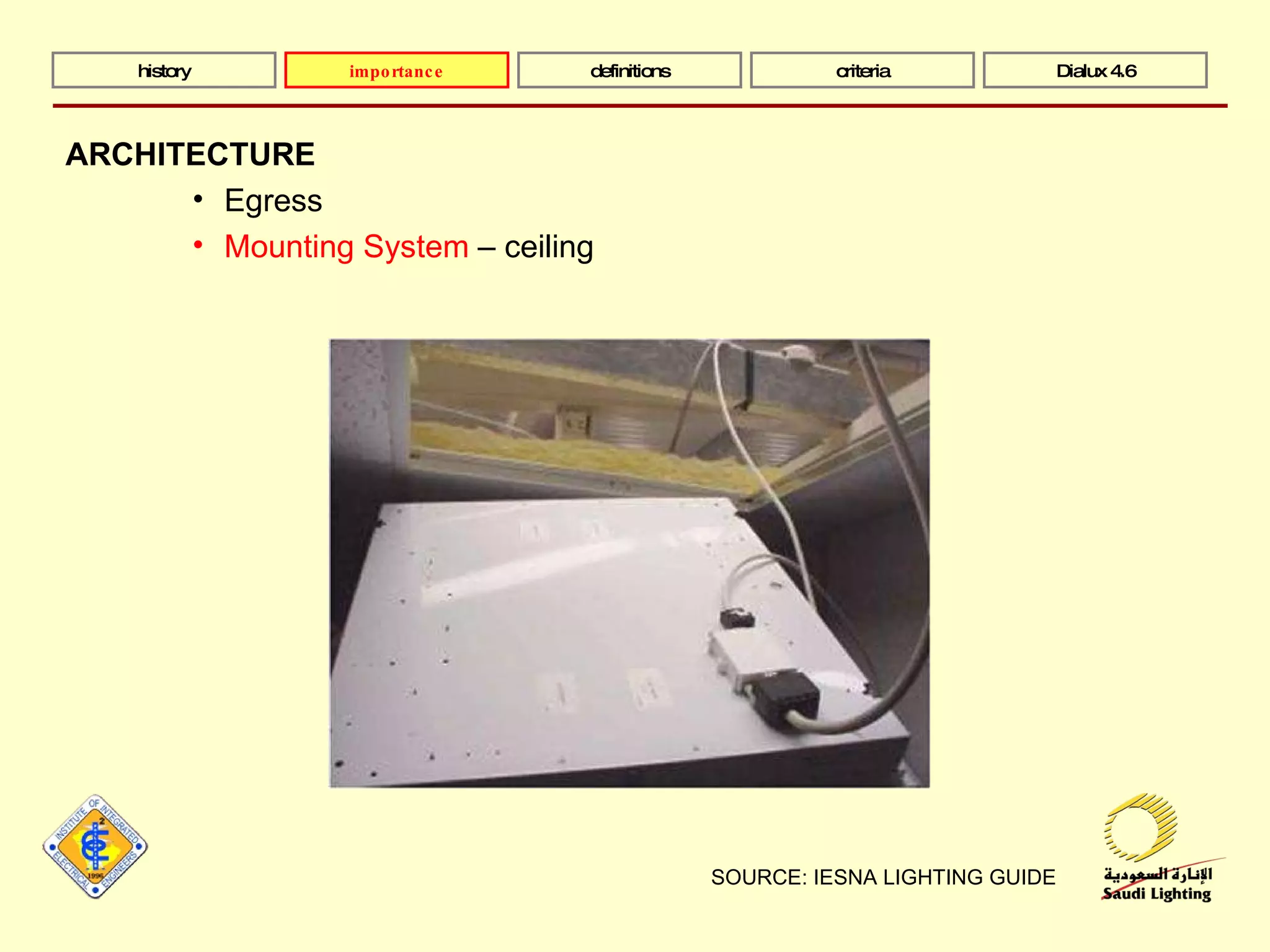
SOURCE: IESNA LIGHTING GUIDE history definitions criteria Dialux 4.6 ARCHITECTURE Egress Mounting System  – ceiling  importance
SOURCE: IESNA LIGHTING GUIDE history definitions criteria Dialux 4.6 ECONOMICS Use of HF Control Gears – HPF Use of Electronic Control Gears – Dimmable Use of Daylighting – with indoor photocells Recommendation in using CFL – efficacy ENVIRONMENT Limiting the use of incandescent lamps Avoidance of spill light – light pollution Saving of Energy importance
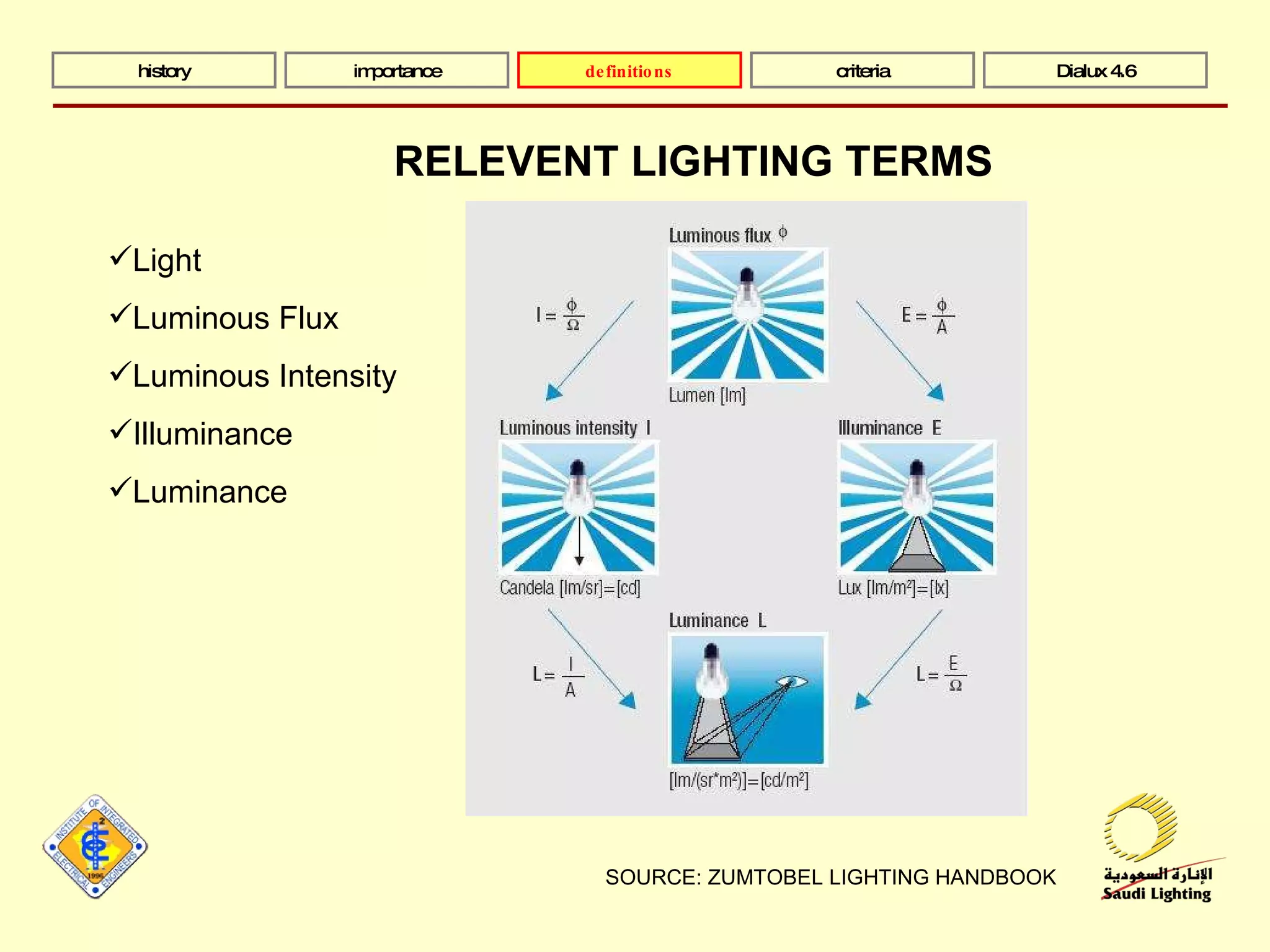
SOURCE: ZUMTOBEL LIGHTING HANDBOOK history importance definitions criteria Dialux 4.6 RELEVENT LIGHTING TERMS Light Luminous Flux Luminous Intensity Illuminance Luminance
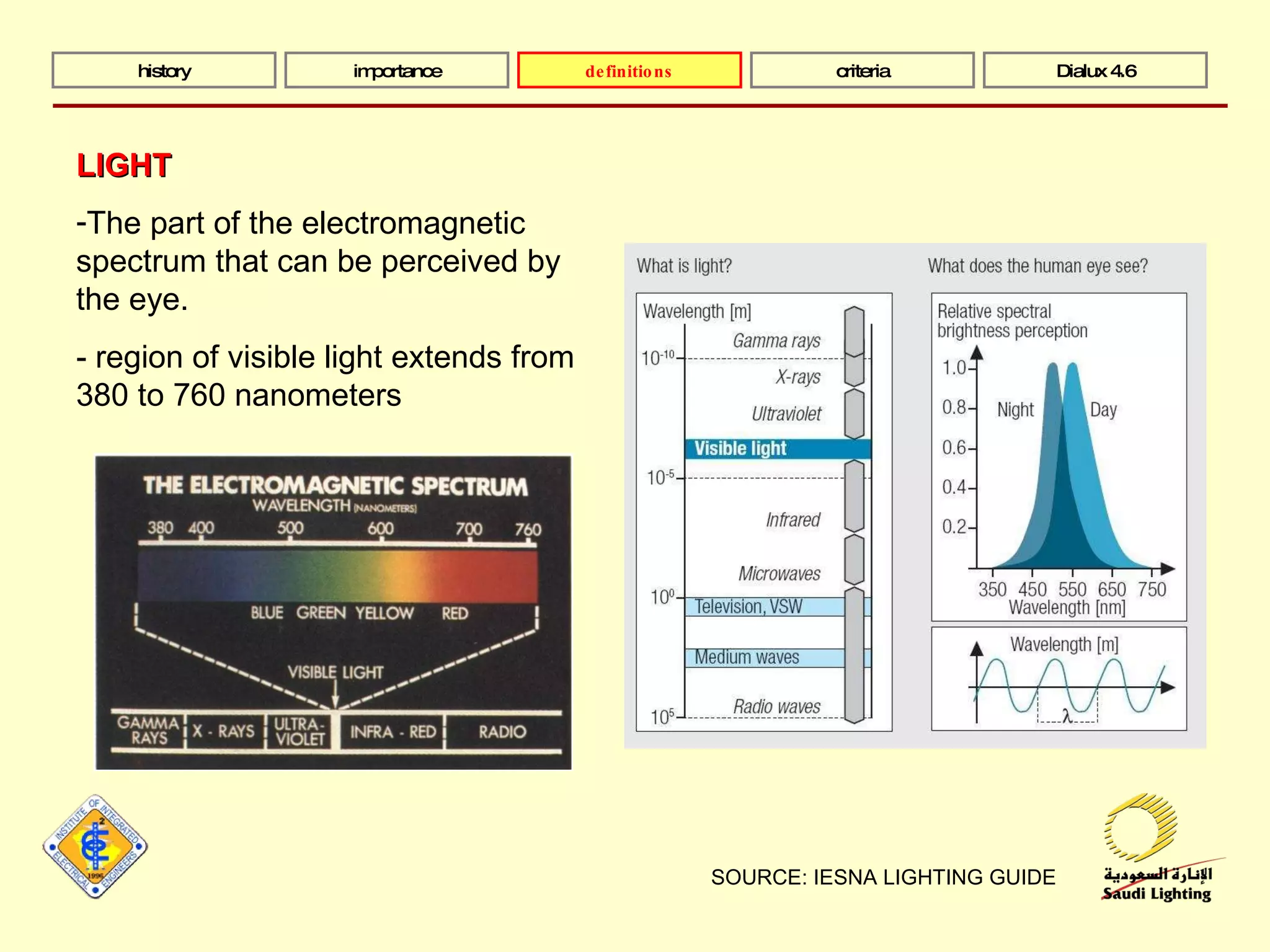
SOURCE: IESNA LIGHTING GUIDE history importance definitions criteria Dialux 4.6 LIGHT The part of the electromagnetic spectrum that can be perceived by the eye. - region of visible light extends from 380 to 760 nanometers
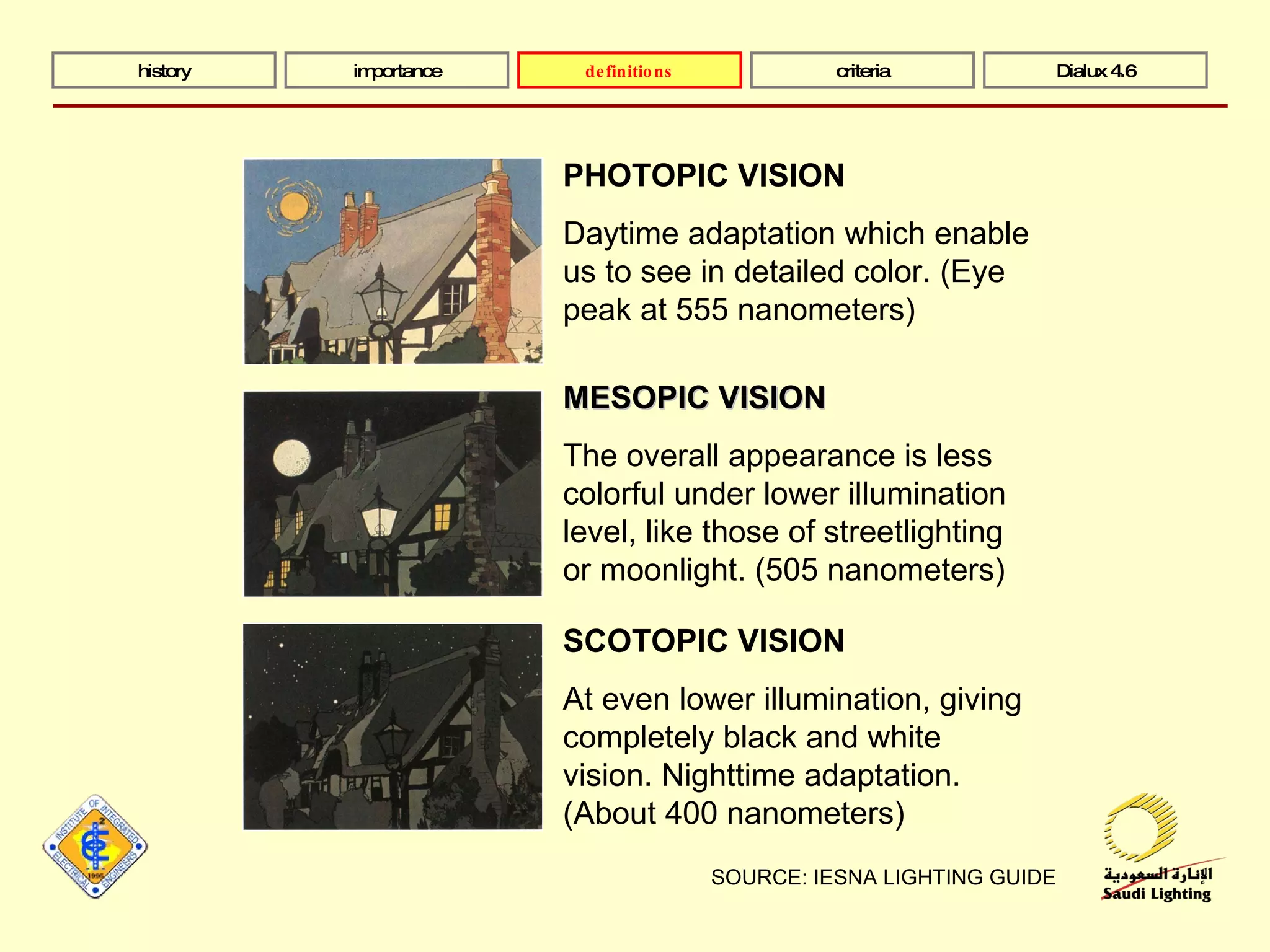
SOURCE: IESNA LIGHTING GUIDE history importance definitions criteria Dialux 4.6 PHOTOPIC VISION Daytime adaptation which enable us to see in detailed color. (Eye peak at 555 nanometers) SCOTOPIC VISION At even lower illumination, giving completely black and white vision. Nighttime adaptation. (About 400 nanometers) MESOPIC VISION The overall appearance is less colorful under lower illumination level, like those of streetlighting or moonlight. (505 nanometers)
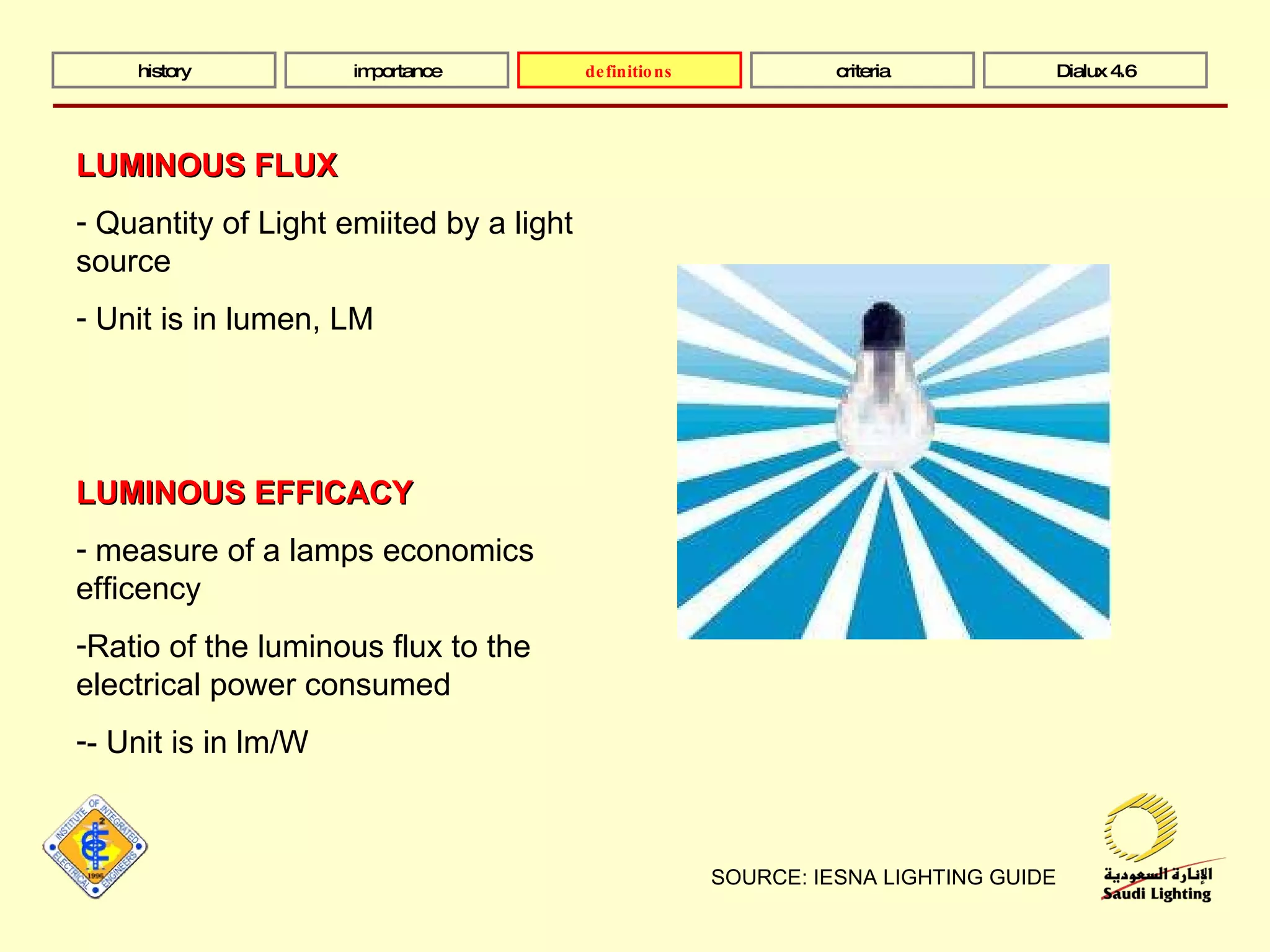
SOURCE: IESNA LIGHTING GUIDE history importance definitions criteria Dialux 4.6 LUMINOUS FLUX Quantity of Light emiited by a light source Unit is in lumen, LM LUMINOUS EFFICACY measure of a lamps economics efficency Ratio of the luminous flux to the electrical power consumed - Unit is in lm/W
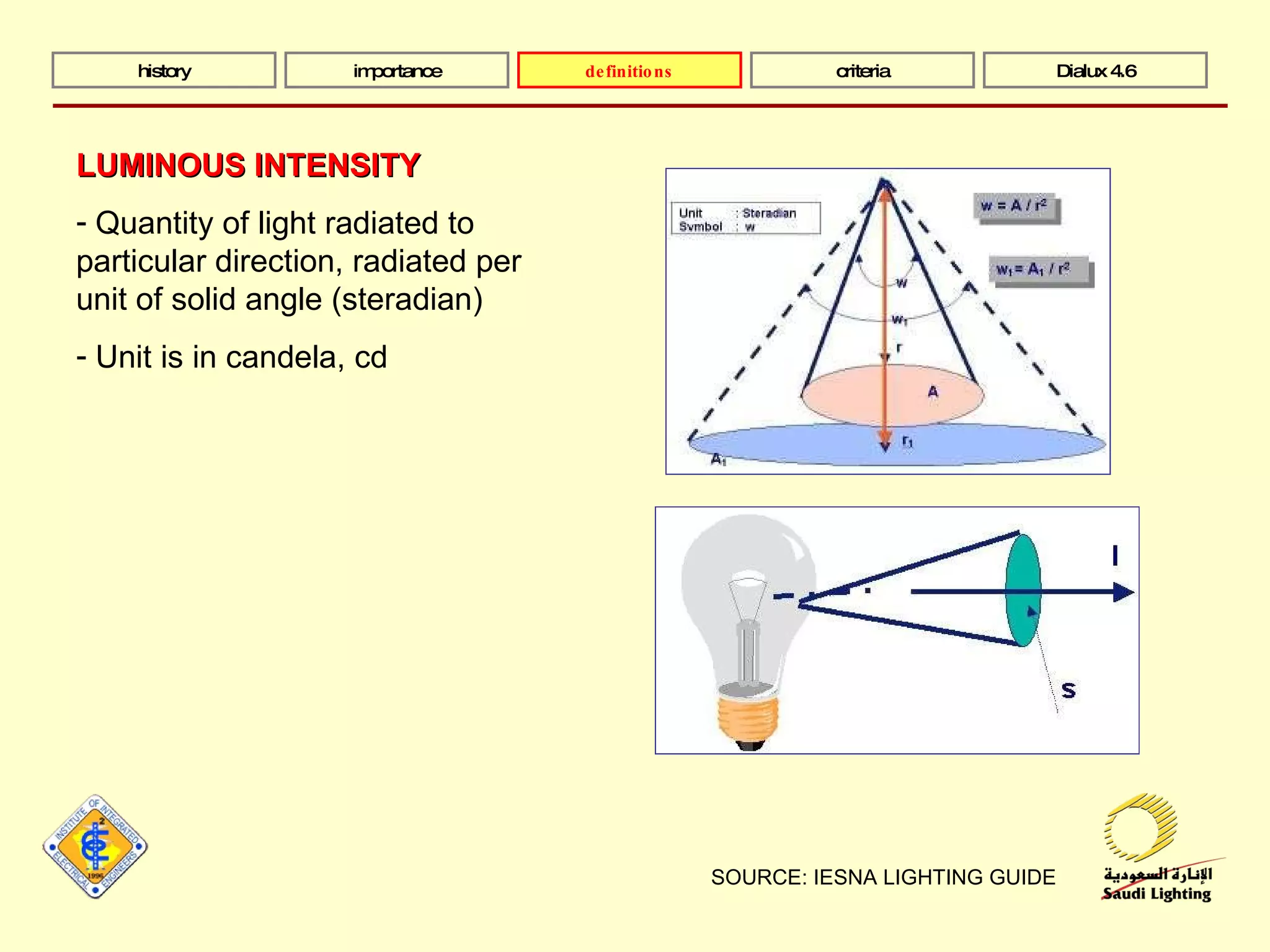
SOURCE: IESNA LIGHTING GUIDE history importance definitions criteria Dialux 4.6 LUMINOUS INTENSITY Quantity of light radiated to particular direction, radiated per unit of solid angle (steradian) Unit is in candela, cd
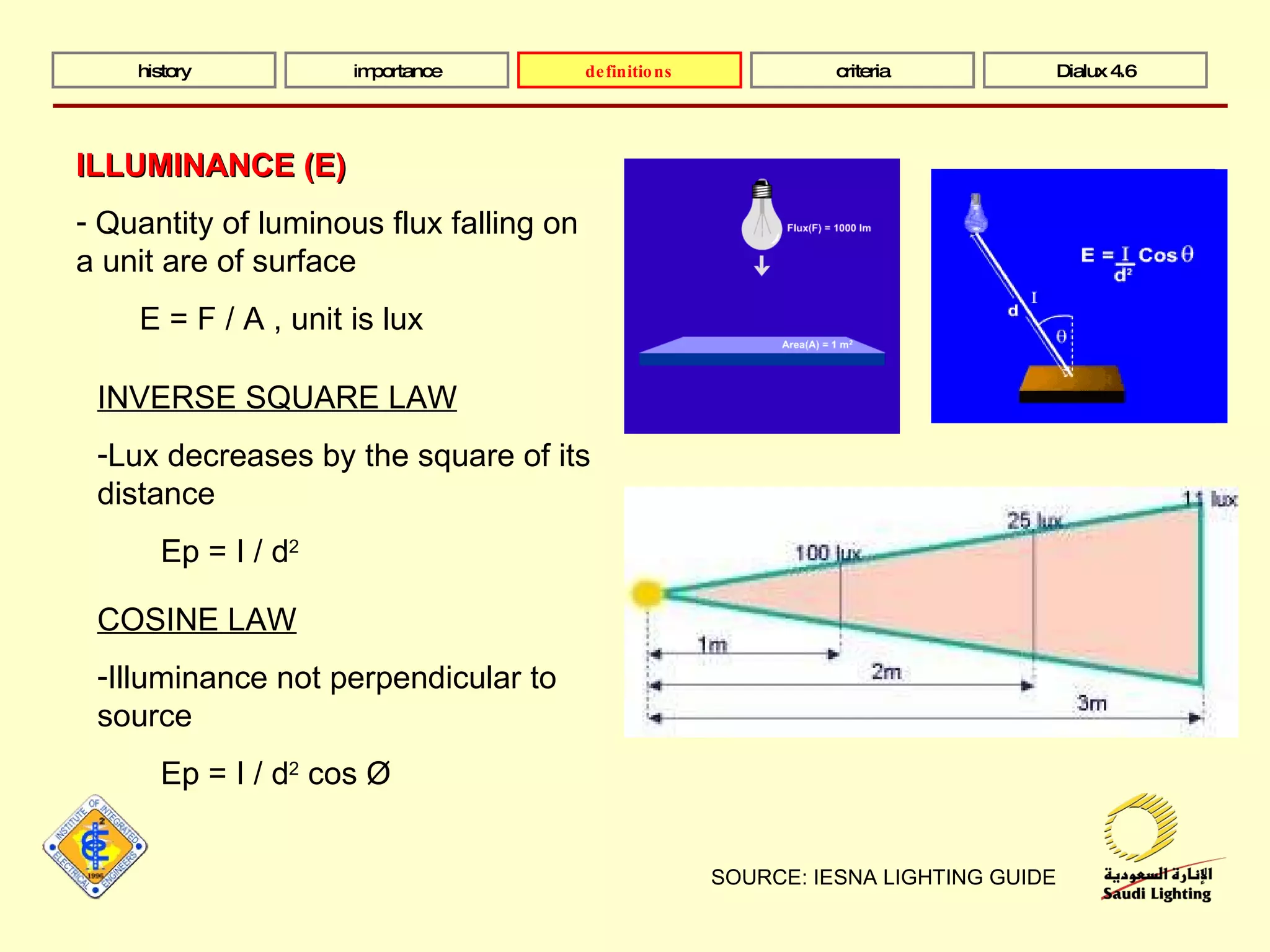
SOURCE: IESNA LIGHTING GUIDE history importance definitions criteria Dialux 4.6 ILLUMINANCE (E) Quantity of luminous flux falling on a unit are of surface E = F / A , unit is lux INVERSE SQUARE LAW Lux decreases by the square of its distance Ep = I / d 2 COSINE LAW Illuminance not perpendicular to source Ep = I / d 2  cos  Ø
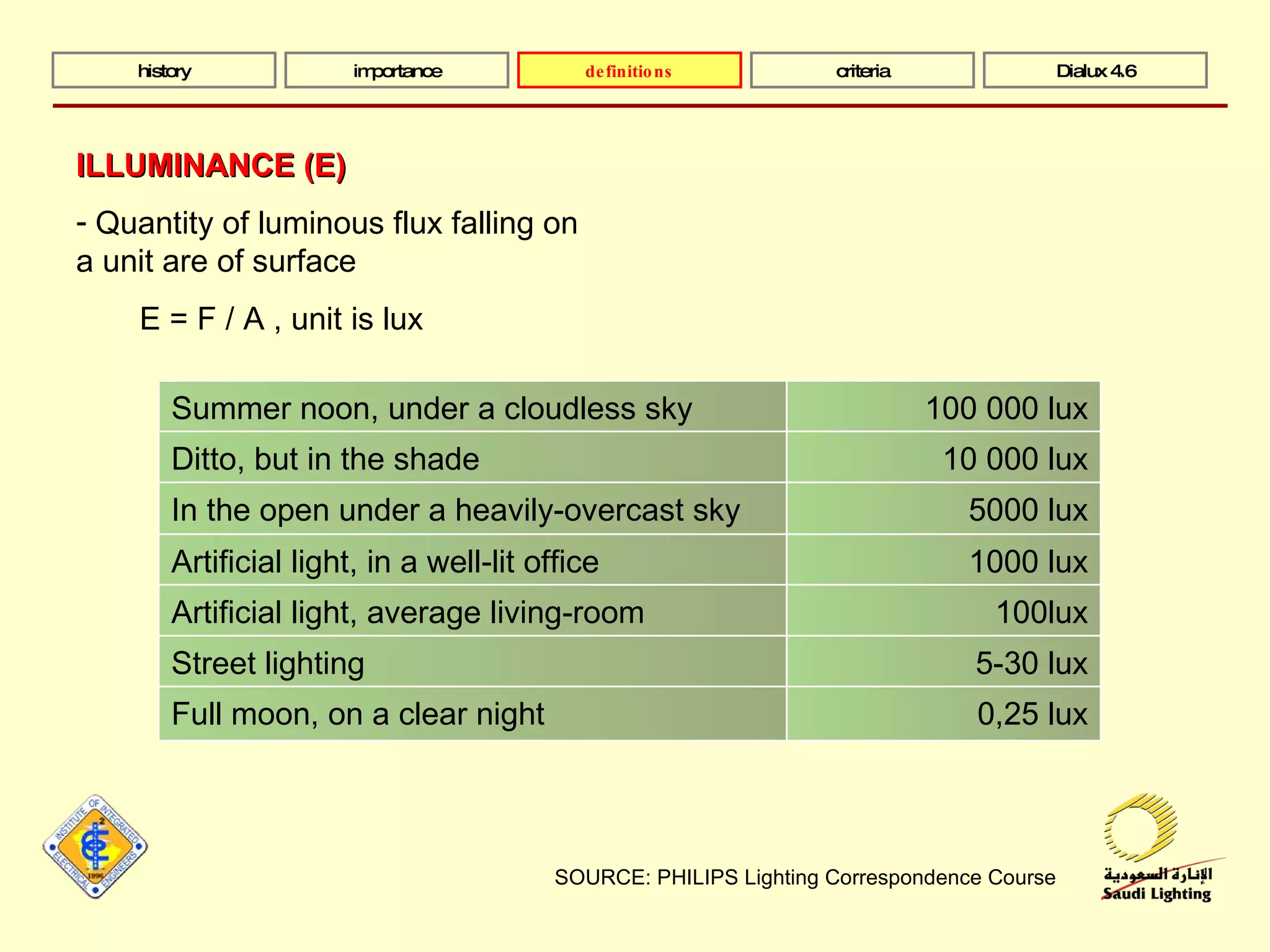
SOURCE: PHILIPS Lighting Correspondence Course history importance definitions criteria Dialux 4.6 ILLUMINANCE (E) Quantity of luminous flux falling on a unit are of surface E = F / A , unit is lux Summer noon, under a cloudless sky 100 000 lux Ditto, but in the shade 10 000 lux In the open under a heavily-overcast sky 5000 lux Artificial light, in a well-lit office 1000 lux Artificial light, average living-room 100lux Street lighting 5-30 lux Full moon, on a clear night 0,25 lux
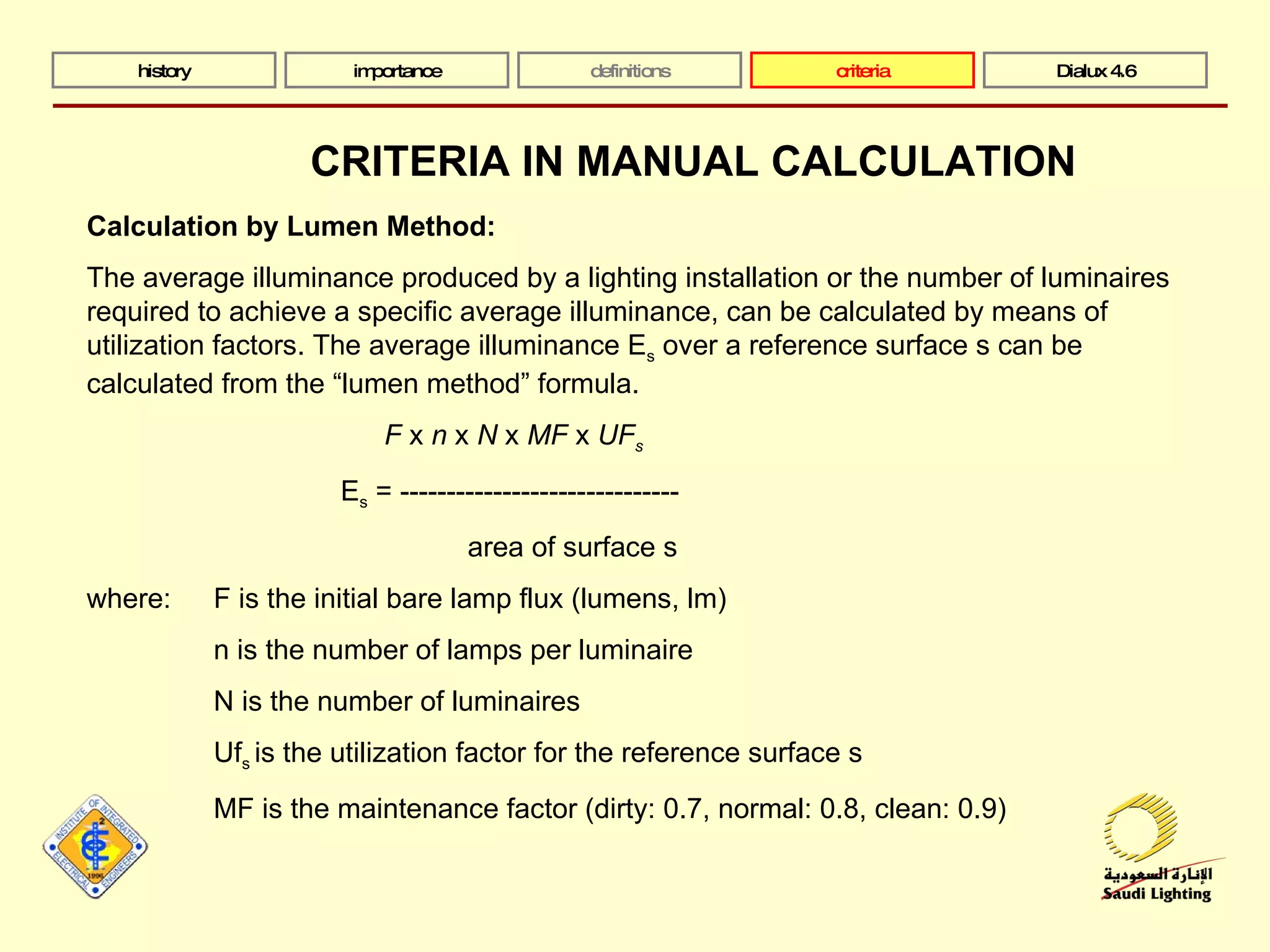
history importance definitions criteria Dialux 4.6 Calculation by Lumen Method: The average illuminance produced by a lighting installation or the number of luminaires required to achieve a specific average illuminance, can be calculated by means of utilization factors. The average illuminance E s  over a reference surface s can be calculated from the “lumen method” formula. F  x  n  x  N  x  MF  x  UF s E s  = ------------------------------ area of surface s where: F is the initial bare lamp flux (lumens, lm) n is the number of lamps per luminaire N is the number of luminaires Uf s  is the utilization factor for the reference surface s MF is the maintenance factor (dirty: 0.7, normal: 0.8, clean: 0.9) CRITERIA IN MANUAL CALCULATION
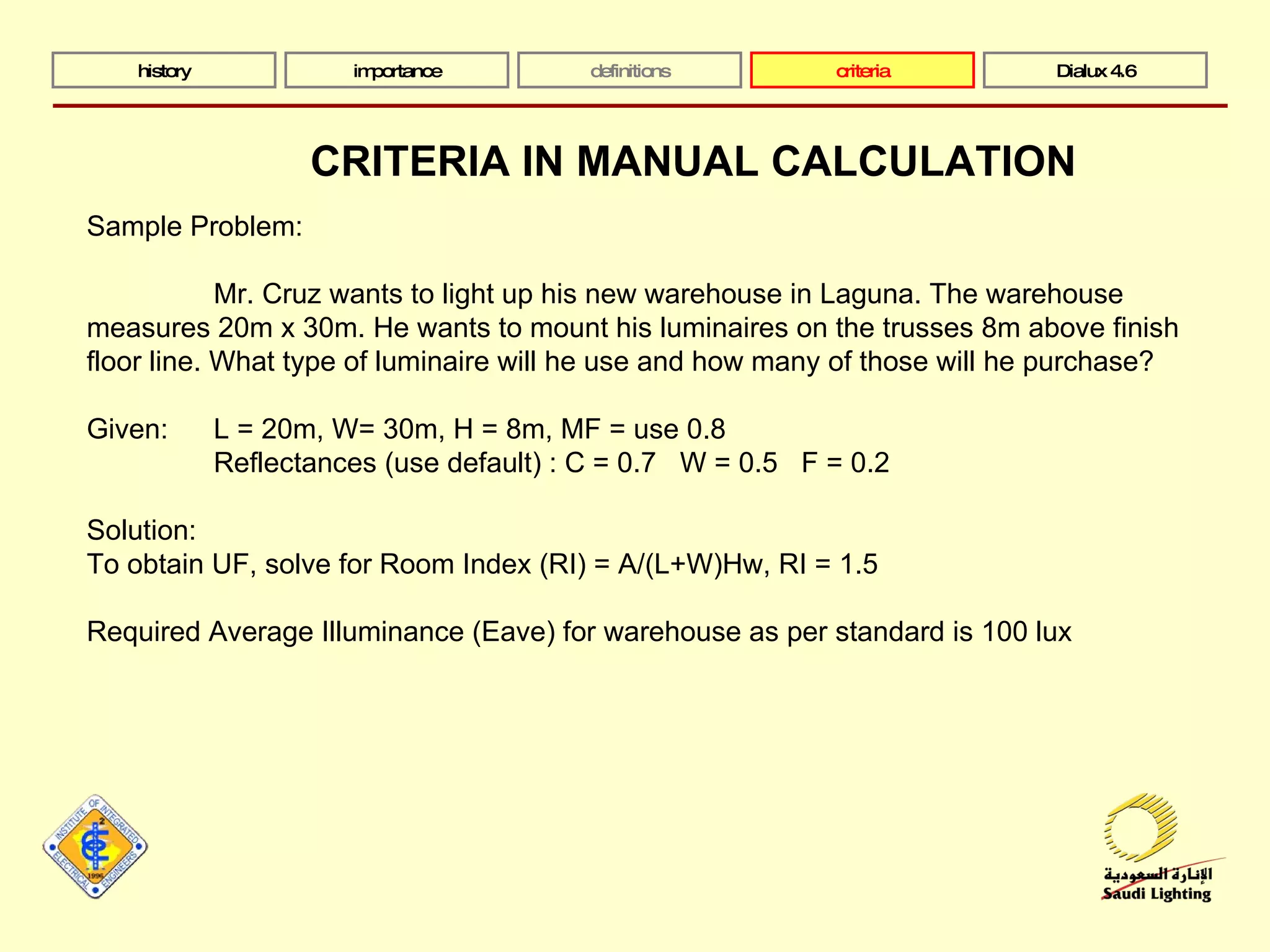
history importance definitions criteria Dialux 4.6 Sample Problem: Mr. Cruz wants to light up his new warehouse in Laguna. The warehouse measures 20m x 30m. He wants to mount his luminaires on the trusses 8m above finish floor line. What type of luminaire will he use and how many of those will he purchase? Given: L = 20m, W= 30m, H = 8m, MF = use 0.8 Reflectances (use default) : C = 0.7  W = 0.5  F = 0.2  Solution:  To obtain UF, solve for Room Index (RI) = A/(L+W)Hw, RI = 1.5 Required Average Illuminance (Eave) for warehouse as per standard is 100 lux CRITERIA IN MANUAL CALCULATION
history importance definitions criteria Dialux 4.6 CRITERIA IN MANUAL CALCULATION
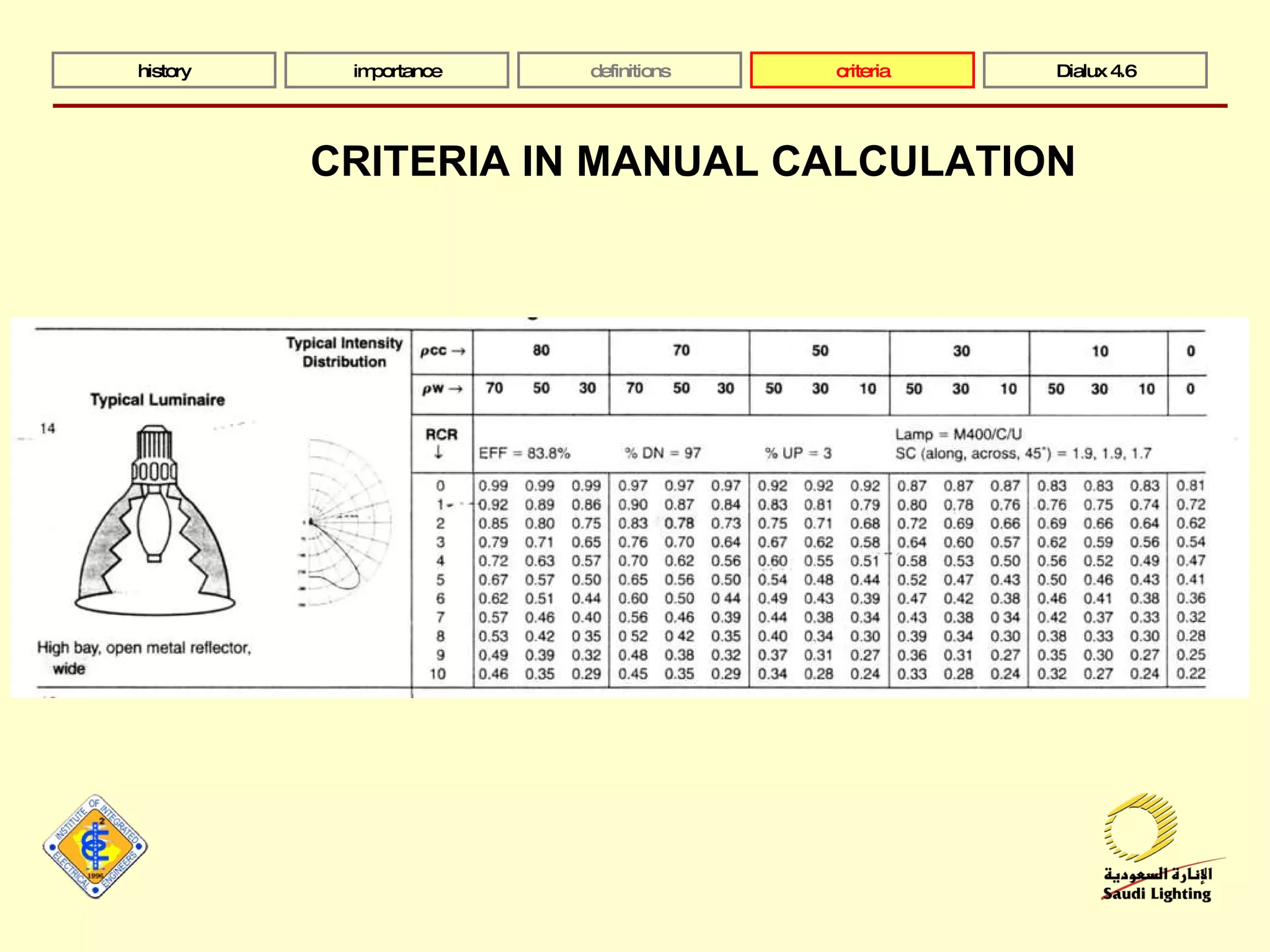
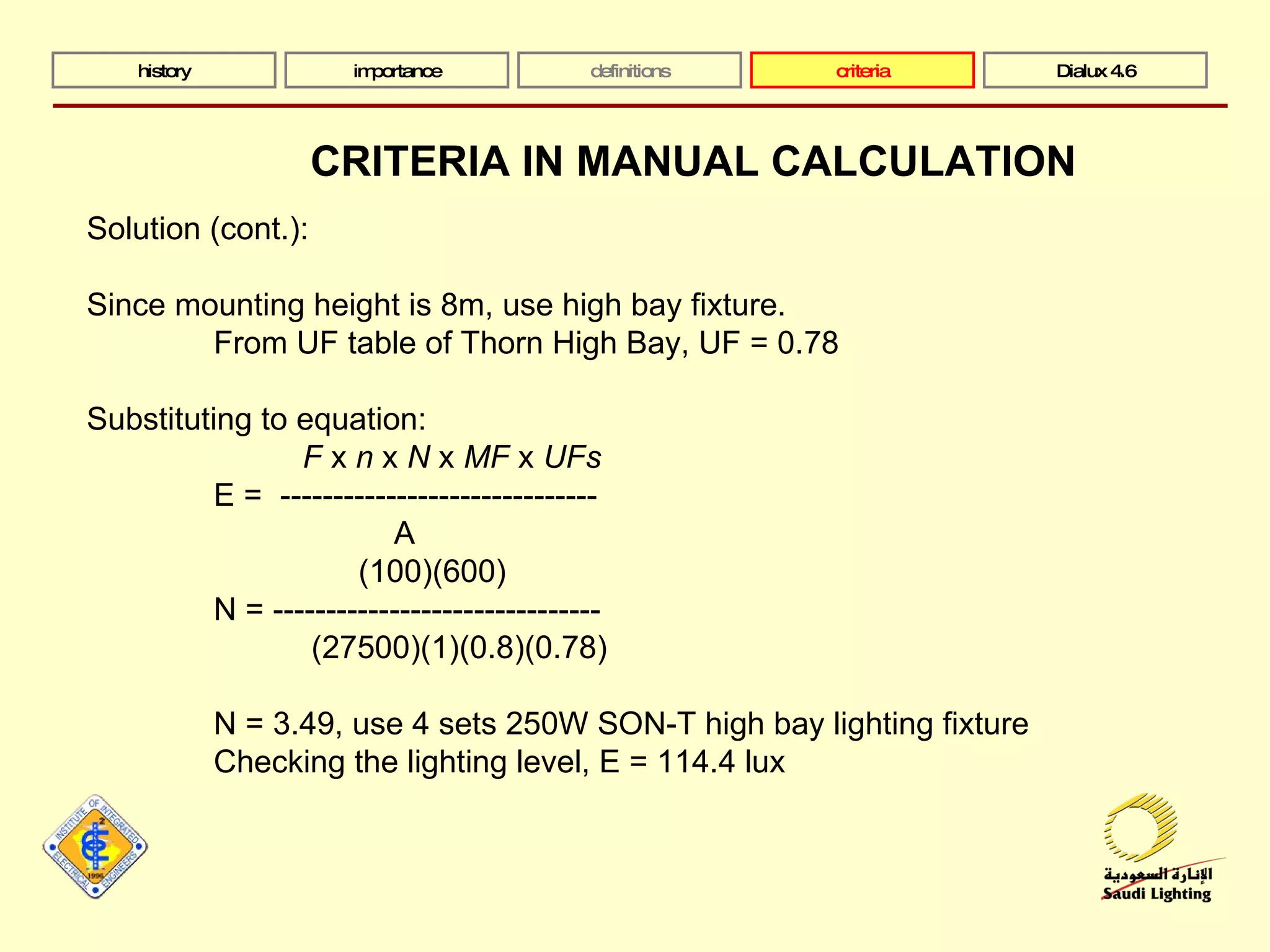
history importance definitions criteria Dialux 4.6 Solution (cont.):  Since mounting height is 8m, use high bay fixture. From UF table of Thorn High Bay, UF = 0.78 Substituting to equation:   F  x  n  x  N  x  MF  x  UFs E =  ------------------------------   A   (100)(600) N = -------------------------------   (27500)(1)(0.8)(0.78) N = 3.49, use 4 sets 250W SON-T high bay lighting fixture Checking the lighting level, E = 114.4 lux CRITERIA IN MANUAL CALCULATION
history importance definitions criteria Dialux 4.6 DIALUX 4.6 HISTORY - a software project launched by Dial GmbH - It started in 1994 in Dial, Ludenscheid, Germany - lighting design tool which is continually updated and adapted to the requirements of the planners
history importance definitions criteria Dialux 4.6 WHY SHOULD I USE IT? ~ A complete software package FREE OF CHARGE with photo realistic visualization.  ~ Available in all main languages of the world (26 languages at present)  ~ Import and export to and from all CAD programmes in .dxf and .dwg format  ~ Import and use 3ds file format for more realistic models ~ Creation of films for the presentation of photo realistic visualization  ~ DIALux is independent and manufacturer-neutral.  ~ Incorporates the latest norms and standards as well as the accepted approaches in any respective country ~ Functional in most common Operating Systems ~ Also available, Dialux Light, for quick indoor calculation ~ Ready customizable Indoor, Road, Area and Sports lighting calculation  ~ Available wizard for easy calculations
history importance definitions criteria Dialux 4.6 WHERE CAN I DOWNLOAD IT? http://dial.de/CMS/English/Articles/DIAL/DIAL.html?ID=1
history importance definitions criteria Dialux 4.6 DIALUX BASIC OPERATOR USE TRAINING ARE YOU READY?

Overview of Lighting Design using Dialux 4.6

  • 1.
    Overview of LightingDesign Using DIALUX 4.6 IIEE-ERCSA Annual Convention 14 November 2008 Prepared by Michael T. Santiago, REE LAD Engineer Saudi Lighting Co. Ltd.
  • 2.
    Development of LightingWhy is Lighting Design Important? Relevant Lighting Terms Criteria in Lighting Design What is Dialux and Why use it Dialux 4.6 Overview Presentation Proper What’s in it for me? history importance definitions criteria Dialux 4.6
  • 3.
    A Brief Historyof Lighting Design
  • 4.
    SOURCE: IESNALIGHTING GUIDE history importance definitions criteria Dialux 4.6
  • 5.
    HUMAN NEEDS Visibility – ability to see objects and information SOURCE: IESNA LIGHTING GUIDE history definitions criteria Dialux 4.6 importance
  • 6.
    HUMAN NEEDS VisibilityTask Performance – ability to do tasks SOURCE: IESNA LIGHTING GUIDE history definitions criteria Dialux 4.6 importance
  • 7.
    HUMAN NEEDS VisibilityTask Performance Mood & Atmosphere – conducive SOURCE: IESNA LIGHTING GUIDE history definitions criteria Dialux 4.6 importance
  • 8.
    HUMAN NEEDS VisibilityTask Performance Mood & Atmosphere Visual Comfort & Safety – well being SOURCE: IESNA LIGHTING GUIDE history definitions criteria Dialux 4.6 importance
  • 9.
    COMMON ISSUES OverheadGlare SOURCE: IESNA LIGHTING GUIDE history definitions criteria Dialux 4.6 importance
  • 10.
    COMMON ISSUES OverheadGlare Veiling Glare SOURCE: IESNA LIGHTING GUIDE history definitions criteria Dialux 4.6 importance
  • 11.
    COMMON ISSUES OverheadGlare Veiling Glare Shadowing SOURCE: IESNA LIGHTING GUIDE history definitions criteria Dialux 4.6 importance
  • 12.
    COMMON ISSUES OverheadGlare Veiling Glare Shadowing Gloom SOURCE: IESNA LIGHTING GUIDE history definitions criteria Dialux 4.6 importance
  • 13.
    COMMON ISSUES OverheadGlare Veiling Glare Shadowing Gloom Stroboscopic effect SOURCE: IESNA LIGHTING GUIDE history definitions criteria Dialux 4.6 importance
  • 14.
    SOURCE: IESNA LIGHTINGGUIDE history definitions criteria Dialux 4.6 ARCHITECTURE Egress – Exit / Emergency importance
  • 15.
    SOURCE: IESNA LIGHTINGGUIDE history definitions criteria Dialux 4.6 ARCHITECTURE Egress Mounting System – ceiling importance
  • 16.
    SOURCE: IESNA LIGHTINGGUIDE history definitions criteria Dialux 4.6 ECONOMICS Use of HF Control Gears – HPF Use of Electronic Control Gears – Dimmable Use of Daylighting – with indoor photocells Recommendation in using CFL – efficacy ENVIRONMENT Limiting the use of incandescent lamps Avoidance of spill light – light pollution Saving of Energy importance
  • 17.
    SOURCE: ZUMTOBEL LIGHTINGHANDBOOK history importance definitions criteria Dialux 4.6 RELEVENT LIGHTING TERMS Light Luminous Flux Luminous Intensity Illuminance Luminance
  • 18.
    SOURCE: IESNA LIGHTINGGUIDE history importance definitions criteria Dialux 4.6 LIGHT The part of the electromagnetic spectrum that can be perceived by the eye. - region of visible light extends from 380 to 760 nanometers
  • 19.
    SOURCE: IESNA LIGHTINGGUIDE history importance definitions criteria Dialux 4.6 PHOTOPIC VISION Daytime adaptation which enable us to see in detailed color. (Eye peak at 555 nanometers) SCOTOPIC VISION At even lower illumination, giving completely black and white vision. Nighttime adaptation. (About 400 nanometers) MESOPIC VISION The overall appearance is less colorful under lower illumination level, like those of streetlighting or moonlight. (505 nanometers)
  • 20.
    SOURCE: IESNA LIGHTINGGUIDE history importance definitions criteria Dialux 4.6 LUMINOUS FLUX Quantity of Light emiited by a light source Unit is in lumen, LM LUMINOUS EFFICACY measure of a lamps economics efficency Ratio of the luminous flux to the electrical power consumed - Unit is in lm/W
  • 21.
    SOURCE: IESNA LIGHTINGGUIDE history importance definitions criteria Dialux 4.6 LUMINOUS INTENSITY Quantity of light radiated to particular direction, radiated per unit of solid angle (steradian) Unit is in candela, cd
  • 22.
    SOURCE: IESNA LIGHTINGGUIDE history importance definitions criteria Dialux 4.6 ILLUMINANCE (E) Quantity of luminous flux falling on a unit are of surface E = F / A , unit is lux INVERSE SQUARE LAW Lux decreases by the square of its distance Ep = I / d 2 COSINE LAW Illuminance not perpendicular to source Ep = I / d 2 cos Ø
  • 23.
    SOURCE: PHILIPS LightingCorrespondence Course history importance definitions criteria Dialux 4.6 ILLUMINANCE (E) Quantity of luminous flux falling on a unit are of surface E = F / A , unit is lux Summer noon, under a cloudless sky 100 000 lux Ditto, but in the shade 10 000 lux In the open under a heavily-overcast sky 5000 lux Artificial light, in a well-lit office 1000 lux Artificial light, average living-room 100lux Street lighting 5-30 lux Full moon, on a clear night 0,25 lux
  • 24.
    history importance definitionscriteria Dialux 4.6 Calculation by Lumen Method: The average illuminance produced by a lighting installation or the number of luminaires required to achieve a specific average illuminance, can be calculated by means of utilization factors. The average illuminance E s over a reference surface s can be calculated from the “lumen method” formula. F x n x N x MF x UF s E s = ------------------------------ area of surface s where: F is the initial bare lamp flux (lumens, lm) n is the number of lamps per luminaire N is the number of luminaires Uf s is the utilization factor for the reference surface s MF is the maintenance factor (dirty: 0.7, normal: 0.8, clean: 0.9) CRITERIA IN MANUAL CALCULATION
  • 25.
    history importance definitionscriteria Dialux 4.6 Sample Problem: Mr. Cruz wants to light up his new warehouse in Laguna. The warehouse measures 20m x 30m. He wants to mount his luminaires on the trusses 8m above finish floor line. What type of luminaire will he use and how many of those will he purchase? Given: L = 20m, W= 30m, H = 8m, MF = use 0.8 Reflectances (use default) : C = 0.7 W = 0.5 F = 0.2 Solution: To obtain UF, solve for Room Index (RI) = A/(L+W)Hw, RI = 1.5 Required Average Illuminance (Eave) for warehouse as per standard is 100 lux CRITERIA IN MANUAL CALCULATION
  • 26.
    history importance definitionscriteria Dialux 4.6 CRITERIA IN MANUAL CALCULATION
  • 27.
    history importance definitionscriteria Dialux 4.6 Solution (cont.): Since mounting height is 8m, use high bay fixture. From UF table of Thorn High Bay, UF = 0.78 Substituting to equation: F x n x N x MF x UFs E = ------------------------------ A (100)(600) N = ------------------------------- (27500)(1)(0.8)(0.78) N = 3.49, use 4 sets 250W SON-T high bay lighting fixture Checking the lighting level, E = 114.4 lux CRITERIA IN MANUAL CALCULATION
  • 28.
    history importance definitionscriteria Dialux 4.6 DIALUX 4.6 HISTORY - a software project launched by Dial GmbH - It started in 1994 in Dial, Ludenscheid, Germany - lighting design tool which is continually updated and adapted to the requirements of the planners
  • 29.
    history importance definitionscriteria Dialux 4.6 WHY SHOULD I USE IT? ~ A complete software package FREE OF CHARGE with photo realistic visualization. ~ Available in all main languages of the world (26 languages at present) ~ Import and export to and from all CAD programmes in .dxf and .dwg format ~ Import and use 3ds file format for more realistic models ~ Creation of films for the presentation of photo realistic visualization ~ DIALux is independent and manufacturer-neutral. ~ Incorporates the latest norms and standards as well as the accepted approaches in any respective country ~ Functional in most common Operating Systems ~ Also available, Dialux Light, for quick indoor calculation ~ Ready customizable Indoor, Road, Area and Sports lighting calculation ~ Available wizard for easy calculations
  • 30.
    history importance definitionscriteria Dialux 4.6 WHERE CAN I DOWNLOAD IT? http://dial.de/CMS/English/Articles/DIAL/DIAL.html?ID=1
  • 31.
    history importance definitionscriteria Dialux 4.6 DIALUX BASIC OPERATOR USE TRAINING ARE YOU READY?