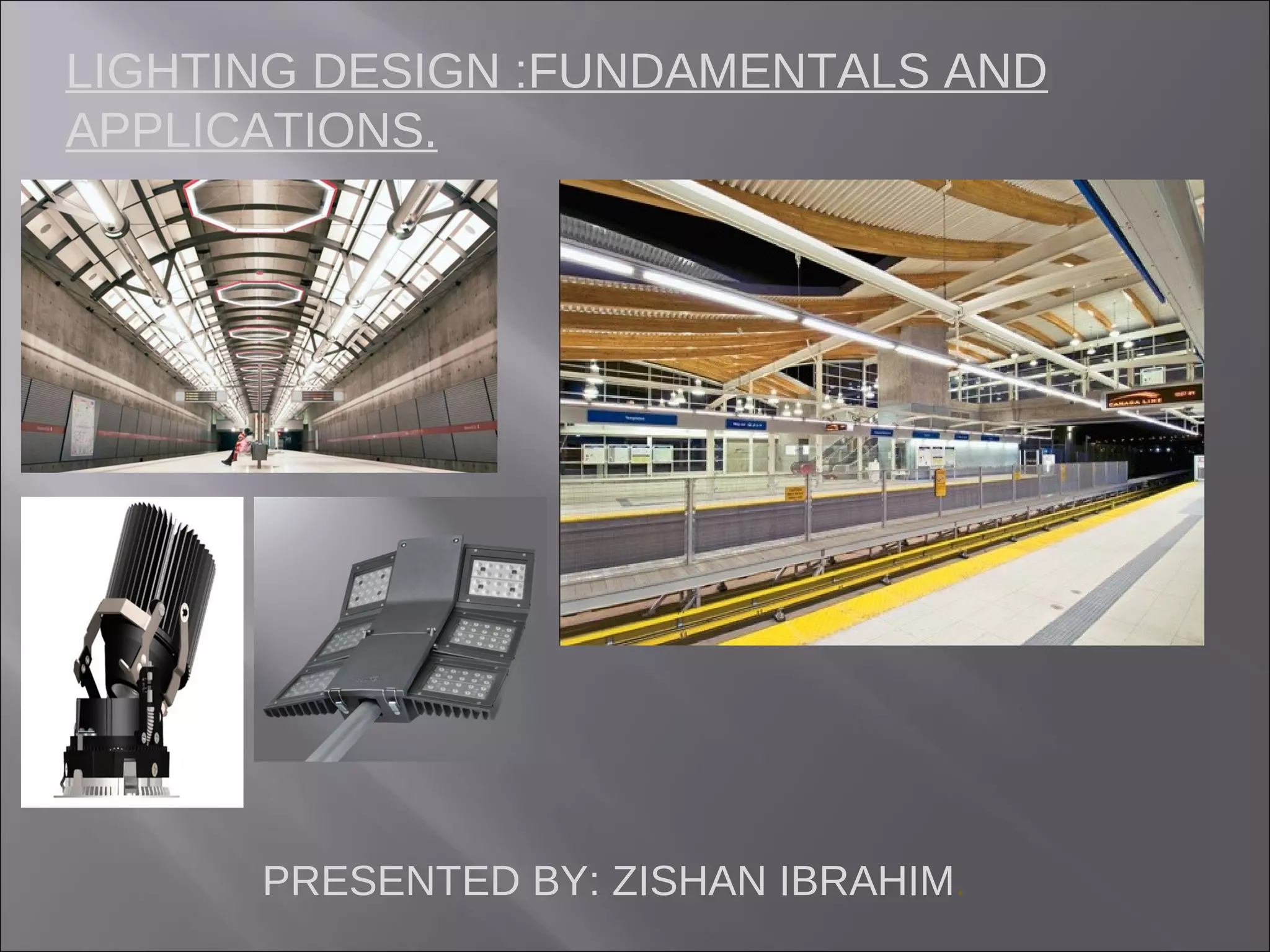
LIGHTING DESIGN :FUNDAMENTALS AND
APPLICATIONS.

PRESENTED BY: ZISHAN IBRAHIM.
BASIC CONCEPTS/ PROPERTIES OF LIGHT.
PHOTOMETRIC QUANTITIES: MEASURING LIGHT.
ILLUMINATION QUALITY.
LAMPS: INCANDESCENT, FLOURESCENT …..
LUMINAIRES.
QUANTITY AND QUALITY OF LIGHT.
LIGHTING CONTROL SYSTEMS.
CURRENT STATE OF ART EUIPMENTS AND PRACTICES.
INTRODUCTION:
WHAT IS LIGHT:
• WHAT WE PERCEIVE AS LIGHT IS A NARROW WAVELENGTH
BAND OF ELECTROMAGNETIC RADIATION FROM 380 TO 780 nm.
• THIS ENERGY RADIATION SHOWS DUAL CHARACTERISTICS: IT
CONSISTS OF ENERGY PARTICLES PHOTONS BUT ALSO SHOWS
TRANSVERERSE WAVE MOTION.
• THE WAVELENGTH DETERMINES ITS COLOUR.
• THE HUMAN’S EYE SENSITIVITY VARIES WITH WAVELENGHT , IT
IS GREATEST AROUND 550 nm (YELLOW).
TRANSMISSION:
• MATERIALS W.R.T LIGHT CAN BE REFFERED TO AS :
TRANSPARENT, OPAQUE AND TRANSLUCENT.
• LIGHT INCIDENT ON A SURFACE IS DISTRIBUTED IN
THREE WAYS : REFLECTED, ABSORBED AND
TRANSMITTED.
• SOME IMPORTANT PROPERTIES OF THE OBJECT ARE
DESCRIBED BY : REFLECTANCE-R, ABSORBANCE-A AND
TRANSMITTANCE-T
IN ALL CAES
R+A+T=1.
PHOTOMETRIC QUANTITIES:
Basic parameters used in lighting
Luminous flux – Luminous intensity – Illuminance – Luminance.
The intensity of light source is
measured in units of candella
(CD.), defined as intensity of 1/60
sq. cm. sphere of a black body at
melting pt. temp.of platinum.
Luminous flux:
Measured in lumens (lm.)
One lumen is flow of light emitted by
a unit intensity point source, within
unit solid angle.
As sphere subtends 4∏ (12.56) at its
centre , I cd. Source emits 12.56 lm.
In all directions.

illumination:
Amount of lux falling on unit area
lm/m2 which is lux.
Luminance:
The luminance is the only
basic lighting parameter that
is perceived by the eye.
It specifies the brightness of
a surface and is essentially
dependent on its reflectance
(finish and colour).
OPERATING RATIOS IN LIGHTING TECHNOLOGY:
Colour:
• Colour is the way we distinguish different wavelengths of light.
• It involves both the spectral characteristics of the light itself, the spectral
reflectance of the illuminated surface as well as the perception of the
observer.
• The colour of a light source depends on the spectral composition of the
light emitted by it.
• The apparent colour of a light reflecting surface, on the other hand, is
determined by two characteristics: the spectral composition of the light by
which it is illuminated, and the spectral reflectance characteristics of the
surface.
• A coloured surface is coloured because it reflects wavelengths selectively.
The spectral reflectance of red paint, for example, shows that it reflects a high
percentage of the red wavelengths and little or none of the blue end of the
spectrum.
• But an object painted red can only appear red if the light falling on it contains
sufficient red radiation, so that this can be reflected. Moreover, it will appear dark
when illuminated with a light source having no red radiation.

Mixing light of different colours

• When coloured light beams are mixed,
the result will always be brighter than the
individual
colours, and if the right colours are mixed
in the right intensities, the result will be
white light.
• This is known as additive colour
mixing. The three basic light colours are
red, green and violet-blue.
• These are called the primary colours and
additive mixing of these colours will
produce all other light colours, including
white.
Subtractive colour mixing:
• Subtractive colour mixing occurs for
example when coloured paints are
mixed on a palette.
yellow + magenta = red
yellow + cyan = green
magenta + cyan = violet-blue
but
yellow + magenta + cyan = black
CIE chromaticity diagram:
• A graphic representation of the range of
light colours visible to the human eye is
given by the CIE* chromaticity diagram.
• The saturated colours red, green and
violet are located at the corners of the
triangle with intermediate spectral colours
along the sloping sides, and magenta at
the bottom.
• Going inwards, they become lighter and
diluted at the same time.
• The centre of the triangle -where all
colours meet- is white.
• The colour values are numerically plotted
along the right-angled x- and y-axis.Thus,
each light colour can be defined by its xand y-values, which are called chromaticity
coordinates, or colour point.
Colour rendering:
•Although light sources may have the same colour appearance, this
doesn’t necessarily mean that coloured surfaces will look the same under
them.
•Two lights that appear the same white, may be the result of different
blends of wavelengths.
•Colour rendering is an important aspect
of artificial lighting. In some situations
colours should be represented as
naturally as possible as under daylight
conditions, yet in other cases lighting
should highlight individual colours or
create a specific ambience.

•To classify light sources on their colour
rendering
properties the so called
colour rendering index (CRI or also
denoted as Ra) has been introduced.
•The light reflected from the rocking
horse enters the eye of the observer
forming in his brain an image as
depicted in the top right corner. In the
bottom picture the light falling on the
horse has no red radiation.
•This means that no light will
be reflected from the red parts of the
rocking horse and these parts will
appear dark to an observer as can be
seen.
•Both pictures indicate that the
spectrum of the light source plays an
important role in the way we perceive
the colour of objects.
•The general colour rendering index Ra,
derived from a set of eight test colours
taken from everyday live, is used to
evaluate the colour rendering
characteristics of a lamp. Its theoretical
•maximum value is 100.
•The lower the colour rendering index the
worse the colour rendering characteristics
of the lamp.
•For practical purposes the colour
rendering indices are divided into different
levels. DIN EN 12464-1 states six of these
levels
Colour temperature:
•Described as the colour impression of a perfect black-body radiator at certain
temperatures.
•This concept can be best explained with the help of familiar thermal radiators like
the filament of an incandescent lamp or an iron bar.
•When these materials are heated to a temperature of 1000 K their colour
appearance will be red, at 2000-3000 K they will look yellow white, at 4000 K
neutral white, and at 5000-7000 K cool white. In other words: the higher the colour
temperature, the cooler the impression of the white light becomes.
Colour temperature is an important aspect in lighting applications – the choice of
colour temperature being determined by the following factors:

• Ambience: warm-white creates a cosy, inviting ambience; neutral/ cool-white
creates a business-like ambience.
• Climate: inhabitants of cooler geographical regions generally prefer a warmer
light, whilst inhabitants of (sub)-tropical areas prefer, in general, a cooler light.
• Level of illumination needed. Intuitively, we take daylight as a natural reference.
A warm-white light is daylight at the end of the day, at a lower lighting level. Coolwhite light is daylight during the middle part of day. This means that in
interior lighting, low illumination levels should be achieved with warm-white light.
When a very high lighting level is needed, this should be realised with a neutral or
cool white light.
• Colour scheme in an interior. Colours like red and orange are shown to
advantage with a warm-white light, cool colours like blue and green look somewhat
more saturated under a cool-white light.
All lamps with a most similar colour
temperature of over 5300 K belong to the
group of daylight white (tw) light sources,
like e.g. daylight white luorescent lamps.
High pressure mercury lamps and “white”
luorescent lamps belong to the group of
lamps with neutral white (nw) light colours
with colour temperatures between 3300 K
and 5300 K.
Incandescent lamps and “warm tint”
fluorescent lamps belong to the group
of lamps with warm white (ww) light colours
with a colour temperature under 3300 K.
Incandescent Lamps:
One of the oldest electric lighting
technologies.
Light is produced by passing a current
through a tungsten filament.
Least efficient – (4 to 24 lumens/watt).
Lamp life ~ 1,000 hours.

Tugnsten-Halogen Lamps:
A type of incandescent lamp.
Encloses the tungsten filament in a
quartz capsule filled with halogen gas.
Halogen gas combines with the
vaporized tungsten and redeposits it
on the filament.
More efficient.
Lasts longer (up to 6,000 hrs.)
High Intensity Discharge (HID) Lamps:
produces light by means of an
electric arc between tungsten
electrodes housed inside a
translucent or transparent fused
quartz or fused alumina (ceramic)
arc tube filled with special gases.

Arc tube can be filled by various types of
gases and metal salts.
HID lamps are used in industrial high bay
applications, gymnasiums, outdoor lighting,
parking decks, street lights.
Efficient (up to 150 lumens/watt).
Long Life (up to 25,000 hours).
Drawback – take up to 15 minutes to come
up to full light after power outage.
Types of HIDs
Mercury Vapor (obsolete)
Sodium Vapor
High pressure
Low pressure
Metal Halide
Arc tube contains argon,
mercury, and metal halides.
Gives better color temperature
and CRI.
Most common HID in use today.
Recent Improvements.
Allow higher pressure &
temperature.
Better efficiency, better CRI and
better lumen maintenance.
Pulse Start vs. older Probe Start
Ceramic vs. older Quartz arc tube
Fluorescent Lamps
Most common commercial lighting
technology.
High Efficicacy: up to 100 lumens/watt.
Improvements made in the last 15 years.
T12: 1.5 inch in diameter.
T8: 1 inch in diameter.
~30% more efficient than T12.
T5: 5/8 inch in diameter.
~40% more efficient than T12.
Phosphor crystals Mercury atom

Configurations

Linear (8 ft., 4 ft., 2 ft., 1 ft.)
Ubend (fit in a 2 ft. x 2 ft. fixture).
Circular (rare, obsolete).
Fixtures can be 4, 3, 2, or 1 lamp per
fixture.

Output Categories

Standard Output (430 mA).
High Output (800 mA).
Very High Output (1,500 mA).

Electron

Electrode
Compact Fluorescent Lamps (CFLs)

Fluorescent lamp that is small in size (~2
in. diameter, 3 to 5 in. in length).
Developed as replacement for
incandescent lamps.
Two Main Types
Ballast-integrated.
Ballast non-integrated (allows only
lamp to be replaced).
•Excellent color available – comparable to
incandescent
•Many choices (sizes, shapes, wattages,
output, etc.)
•Wide Range of CRI and Color
Temperatures
•Energy Efficient (3.5 to 4 times
incandescent)
•Long Life (generally 10,000 hours –
lasts 12 times longer than standard 750
hour incandescent lamps)
•Less expensive dimming now available (010v dimming to 5%)
•Available for outdoor use with amalgam
technology
Ballasts
Auxiliary component that performs 3
functions:
Provides higher starting voltage.
Provides operating voltage.
Limits operating current.
Old type ballasts were
electromagnetic.
New ballasts are electronic.
Lighter, less noisy, no lamp flicker,
dimming capability).
•DEFINITION: The fraction of rated lamp lumens produced by a specific
lamp-ballast combination
•APPLICATIONS: High Ballast Factor
(1.00-1.30)

Increases output
AND energy
consumption

Typical Ballast Factor
(0.85-0.95)

Comparable light output in
one-to-one replacement

Low Ballast Factor
(0.47-0.83)

Decreases light output
AND energy consumption

•For optimal efficiency lamps and ballasts must be properly matched.
•Maximize energy savings by selecting electronic ballasts with ballast
factor that provides target illuminance.
Ballast Circuit Types
Instant Start Ballast – starts lamp instantly with higher starting
voltage. Efficient but may shorten lamp life.
Rapid Start – delay of about 0.5 seconds to start; supplies starting
current to heat the filament prior to starting and continues during
operation. Uses 2 to 4 watts more than an instant start ballast.
Programmed Rapid Start - delay of about 0.5 seconds to start;
starting current heats the filament prior to starting, then cuts off
during operation.
Light Emitting Diodes (LED):
Latest Lighting Technology.
Invented in 1962.
In the past, used as indicator lights,
automotive lights, and traffic lights; now
being introduced for indoor and outdoor
lighting.
LED is a semiconductor technology.
Electroluminescence. Electrons recombine
with holes in the semiconductor, releasing
photons.

Lower energy consumption.
Longer lifetime (50,000 to 100,000 hrs).
Smaller size.
Faster switching.
Greater durability and reliability.
Cycling.
Dimming
Comparison of LED with a Fluorescent Lamp:
EverLED-TR

Popular T8 Brand
Fluorescent

22W 

34W 

Equivalent 

2850

85

85

5000K 

5000K 

Life Expectancy 12 hrs per 
start / 3 hrs per start

  10 years 10 
years 

  20000 hours 16000 
hours 

Light output at 0° C 

20% increase 

50% decrease 

 
Watt Rating, typical B.F. = 0.8 
Lumens, initial 
CRI 
Color Temperature 
Lighting
Lighting

Lighting

  • 1.
    LIGHTING DESIGN :FUNDAMENTALSAND APPLICATIONS. PRESENTED BY: ZISHAN IBRAHIM.
  • 2.
    BASIC CONCEPTS/ PROPERTIESOF LIGHT. PHOTOMETRIC QUANTITIES: MEASURING LIGHT. ILLUMINATION QUALITY. LAMPS: INCANDESCENT, FLOURESCENT ….. LUMINAIRES. QUANTITY AND QUALITY OF LIGHT. LIGHTING CONTROL SYSTEMS. CURRENT STATE OF ART EUIPMENTS AND PRACTICES.
  • 3.
    INTRODUCTION: WHAT IS LIGHT: •WHAT WE PERCEIVE AS LIGHT IS A NARROW WAVELENGTH BAND OF ELECTROMAGNETIC RADIATION FROM 380 TO 780 nm.
  • 4.
    • THIS ENERGYRADIATION SHOWS DUAL CHARACTERISTICS: IT CONSISTS OF ENERGY PARTICLES PHOTONS BUT ALSO SHOWS TRANSVERERSE WAVE MOTION. • THE WAVELENGTH DETERMINES ITS COLOUR. • THE HUMAN’S EYE SENSITIVITY VARIES WITH WAVELENGHT , IT IS GREATEST AROUND 550 nm (YELLOW).
  • 5.
    TRANSMISSION: • MATERIALS W.R.TLIGHT CAN BE REFFERED TO AS : TRANSPARENT, OPAQUE AND TRANSLUCENT. • LIGHT INCIDENT ON A SURFACE IS DISTRIBUTED IN THREE WAYS : REFLECTED, ABSORBED AND TRANSMITTED. • SOME IMPORTANT PROPERTIES OF THE OBJECT ARE DESCRIBED BY : REFLECTANCE-R, ABSORBANCE-A AND TRANSMITTANCE-T IN ALL CAES R+A+T=1.
  • 6.
    PHOTOMETRIC QUANTITIES: Basic parametersused in lighting Luminous flux – Luminous intensity – Illuminance – Luminance. The intensity of light source is measured in units of candella (CD.), defined as intensity of 1/60 sq. cm. sphere of a black body at melting pt. temp.of platinum.
  • 7.
    Luminous flux: Measured inlumens (lm.) One lumen is flow of light emitted by a unit intensity point source, within unit solid angle. As sphere subtends 4∏ (12.56) at its centre , I cd. Source emits 12.56 lm. In all directions. illumination: Amount of lux falling on unit area lm/m2 which is lux.
  • 8.
    Luminance: The luminance isthe only basic lighting parameter that is perceived by the eye. It specifies the brightness of a surface and is essentially dependent on its reflectance (finish and colour).
  • 9.
    OPERATING RATIOS INLIGHTING TECHNOLOGY:
  • 10.
    Colour: • Colour isthe way we distinguish different wavelengths of light. • It involves both the spectral characteristics of the light itself, the spectral reflectance of the illuminated surface as well as the perception of the observer. • The colour of a light source depends on the spectral composition of the light emitted by it. • The apparent colour of a light reflecting surface, on the other hand, is determined by two characteristics: the spectral composition of the light by which it is illuminated, and the spectral reflectance characteristics of the surface. • A coloured surface is coloured because it reflects wavelengths selectively. The spectral reflectance of red paint, for example, shows that it reflects a high percentage of the red wavelengths and little or none of the blue end of the spectrum.
  • 11.
    • But anobject painted red can only appear red if the light falling on it contains sufficient red radiation, so that this can be reflected. Moreover, it will appear dark when illuminated with a light source having no red radiation. Mixing light of different colours • When coloured light beams are mixed, the result will always be brighter than the individual colours, and if the right colours are mixed in the right intensities, the result will be white light. • This is known as additive colour mixing. The three basic light colours are red, green and violet-blue. • These are called the primary colours and additive mixing of these colours will produce all other light colours, including white.
  • 12.
    Subtractive colour mixing: •Subtractive colour mixing occurs for example when coloured paints are mixed on a palette. yellow + magenta = red yellow + cyan = green magenta + cyan = violet-blue but yellow + magenta + cyan = black
  • 13.
    CIE chromaticity diagram: •A graphic representation of the range of light colours visible to the human eye is given by the CIE* chromaticity diagram. • The saturated colours red, green and violet are located at the corners of the triangle with intermediate spectral colours along the sloping sides, and magenta at the bottom. • Going inwards, they become lighter and diluted at the same time. • The centre of the triangle -where all colours meet- is white. • The colour values are numerically plotted along the right-angled x- and y-axis.Thus, each light colour can be defined by its xand y-values, which are called chromaticity coordinates, or colour point.
  • 14.
    Colour rendering: •Although lightsources may have the same colour appearance, this doesn’t necessarily mean that coloured surfaces will look the same under them. •Two lights that appear the same white, may be the result of different blends of wavelengths.
  • 15.
    •Colour rendering isan important aspect of artificial lighting. In some situations colours should be represented as naturally as possible as under daylight conditions, yet in other cases lighting should highlight individual colours or create a specific ambience. •To classify light sources on their colour rendering properties the so called colour rendering index (CRI or also denoted as Ra) has been introduced.
  • 16.
    •The light reflectedfrom the rocking horse enters the eye of the observer forming in his brain an image as depicted in the top right corner. In the bottom picture the light falling on the horse has no red radiation. •This means that no light will be reflected from the red parts of the rocking horse and these parts will appear dark to an observer as can be seen. •Both pictures indicate that the spectrum of the light source plays an important role in the way we perceive the colour of objects.
  • 17.
    •The general colourrendering index Ra, derived from a set of eight test colours taken from everyday live, is used to evaluate the colour rendering characteristics of a lamp. Its theoretical •maximum value is 100. •The lower the colour rendering index the worse the colour rendering characteristics of the lamp. •For practical purposes the colour rendering indices are divided into different levels. DIN EN 12464-1 states six of these levels
  • 18.
    Colour temperature: •Described asthe colour impression of a perfect black-body radiator at certain temperatures. •This concept can be best explained with the help of familiar thermal radiators like the filament of an incandescent lamp or an iron bar. •When these materials are heated to a temperature of 1000 K their colour appearance will be red, at 2000-3000 K they will look yellow white, at 4000 K neutral white, and at 5000-7000 K cool white. In other words: the higher the colour temperature, the cooler the impression of the white light becomes.
  • 19.
    Colour temperature isan important aspect in lighting applications – the choice of colour temperature being determined by the following factors: • Ambience: warm-white creates a cosy, inviting ambience; neutral/ cool-white creates a business-like ambience. • Climate: inhabitants of cooler geographical regions generally prefer a warmer light, whilst inhabitants of (sub)-tropical areas prefer, in general, a cooler light. • Level of illumination needed. Intuitively, we take daylight as a natural reference. A warm-white light is daylight at the end of the day, at a lower lighting level. Coolwhite light is daylight during the middle part of day. This means that in interior lighting, low illumination levels should be achieved with warm-white light. When a very high lighting level is needed, this should be realised with a neutral or cool white light. • Colour scheme in an interior. Colours like red and orange are shown to advantage with a warm-white light, cool colours like blue and green look somewhat more saturated under a cool-white light.
  • 20.
    All lamps witha most similar colour temperature of over 5300 K belong to the group of daylight white (tw) light sources, like e.g. daylight white luorescent lamps. High pressure mercury lamps and “white” luorescent lamps belong to the group of lamps with neutral white (nw) light colours with colour temperatures between 3300 K and 5300 K. Incandescent lamps and “warm tint” fluorescent lamps belong to the group of lamps with warm white (ww) light colours with a colour temperature under 3300 K.
  • 21.
    Incandescent Lamps: One ofthe oldest electric lighting technologies. Light is produced by passing a current through a tungsten filament. Least efficient – (4 to 24 lumens/watt). Lamp life ~ 1,000 hours. Tugnsten-Halogen Lamps: A type of incandescent lamp. Encloses the tungsten filament in a quartz capsule filled with halogen gas. Halogen gas combines with the vaporized tungsten and redeposits it on the filament. More efficient. Lasts longer (up to 6,000 hrs.)
  • 22.
    High Intensity Discharge(HID) Lamps: produces light by means of an electric arc between tungsten electrodes housed inside a translucent or transparent fused quartz or fused alumina (ceramic) arc tube filled with special gases. Arc tube can be filled by various types of gases and metal salts. HID lamps are used in industrial high bay applications, gymnasiums, outdoor lighting, parking decks, street lights. Efficient (up to 150 lumens/watt). Long Life (up to 25,000 hours). Drawback – take up to 15 minutes to come up to full light after power outage.
  • 23.
    Types of HIDs MercuryVapor (obsolete) Sodium Vapor High pressure Low pressure Metal Halide Arc tube contains argon, mercury, and metal halides. Gives better color temperature and CRI.
  • 24.
    Most common HIDin use today. Recent Improvements. Allow higher pressure & temperature. Better efficiency, better CRI and better lumen maintenance. Pulse Start vs. older Probe Start Ceramic vs. older Quartz arc tube
  • 25.
    Fluorescent Lamps Most commoncommercial lighting technology. High Efficicacy: up to 100 lumens/watt. Improvements made in the last 15 years. T12: 1.5 inch in diameter. T8: 1 inch in diameter. ~30% more efficient than T12. T5: 5/8 inch in diameter. ~40% more efficient than T12. Phosphor crystals Mercury atom Configurations Linear (8 ft., 4 ft., 2 ft., 1 ft.) Ubend (fit in a 2 ft. x 2 ft. fixture). Circular (rare, obsolete). Fixtures can be 4, 3, 2, or 1 lamp per fixture. Output Categories Standard Output (430 mA). High Output (800 mA). Very High Output (1,500 mA). Electron Electrode
  • 26.
    Compact Fluorescent Lamps(CFLs) Fluorescent lamp that is small in size (~2 in. diameter, 3 to 5 in. in length). Developed as replacement for incandescent lamps. Two Main Types Ballast-integrated. Ballast non-integrated (allows only lamp to be replaced).
  • 27.
    •Excellent color available– comparable to incandescent •Many choices (sizes, shapes, wattages, output, etc.) •Wide Range of CRI and Color Temperatures •Energy Efficient (3.5 to 4 times incandescent) •Long Life (generally 10,000 hours – lasts 12 times longer than standard 750 hour incandescent lamps) •Less expensive dimming now available (010v dimming to 5%) •Available for outdoor use with amalgam technology
  • 28.
    Ballasts Auxiliary component thatperforms 3 functions: Provides higher starting voltage. Provides operating voltage. Limits operating current. Old type ballasts were electromagnetic. New ballasts are electronic. Lighter, less noisy, no lamp flicker, dimming capability).
  • 29.
    •DEFINITION: The fractionof rated lamp lumens produced by a specific lamp-ballast combination •APPLICATIONS: High Ballast Factor (1.00-1.30) Increases output AND energy consumption Typical Ballast Factor (0.85-0.95) Comparable light output in one-to-one replacement Low Ballast Factor (0.47-0.83) Decreases light output AND energy consumption •For optimal efficiency lamps and ballasts must be properly matched. •Maximize energy savings by selecting electronic ballasts with ballast factor that provides target illuminance.
  • 30.
    Ballast Circuit Types InstantStart Ballast – starts lamp instantly with higher starting voltage. Efficient but may shorten lamp life. Rapid Start – delay of about 0.5 seconds to start; supplies starting current to heat the filament prior to starting and continues during operation. Uses 2 to 4 watts more than an instant start ballast. Programmed Rapid Start - delay of about 0.5 seconds to start; starting current heats the filament prior to starting, then cuts off during operation.
  • 31.
    Light Emitting Diodes(LED): Latest Lighting Technology. Invented in 1962. In the past, used as indicator lights, automotive lights, and traffic lights; now being introduced for indoor and outdoor lighting. LED is a semiconductor technology. Electroluminescence. Electrons recombine with holes in the semiconductor, releasing photons. Lower energy consumption. Longer lifetime (50,000 to 100,000 hrs). Smaller size. Faster switching. Greater durability and reliability. Cycling. Dimming
  • 32.
    Comparison of LEDwith a Fluorescent Lamp: EverLED-TR Popular T8 Brand Fluorescent 22W  34W  Equivalent  2850 85 85 5000K  5000K  Life Expectancy 12 hrs per  start / 3 hrs per start   10 years 10  years    20000 hours 16000  hours  Light output at 0° C  20% increase  50% decrease    Watt Rating, typical B.F. = 0.8  Lumens, initial  CRI  Color Temperature