CAPITAL STRUCTURE
THEORIES
(BY RAHUL DHAMIJA)
MEANING OF CAPITAL STRUCTURE
• Capital Structure refers to the proportion between various
long-term sources of finance.
• It includes Equity Share Capital, Reserves and
Surplus, Preference Share capital, Loan, Debentures and other
such long-term sources of finance.
• Under this some sources are less costly but more risky on the
contrary some are more costly and less risky.
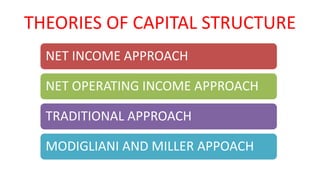
THEORIES OF CAPITAL STRUCTURE
NET INCOME APPROACH
NET OPERATING INCOME APPROACH
TRADITIONAL APPROACH
MODIGLIANI AND MILLER APPOACH
Net Income (NI) Approach:
• This approach was suggested by DURAND
• According to This approach a change in the
financial leverage(ratio of debt to equity) affect
the value of the firm .
• Explanation :
I. The total value of the firm is increased by
lowering its cost of capital.
• When cost of capital is lowest and the value of the
firm is greatest, we call it the optimum capital
structure for the firm
• and, at this point, the market price per share is
maximised.
• The same is possible continuously by lowering its
cost of capital by the use of debt capital.
ASSUMPTIONS
• (i) Cost of Debt (Kd) is less than Cost of Equity
(Ke);
• (ii) There are no taxes; and
• (iii) The use of debt does not change the risk
perception of the investors since the degree of
leverage is increased to that extent.
NET OPERATING INCOME APPROACH
• Net Operating Income (NOI) Approach
advocated by David Durand.
• This approach is opposite to the net income
approach.
• This approach consider that the capital
structure decisions is irrelevant for the value
of the firm .
ASSUMPTIONS
• Cost of debt is less than equity
• Risk perception of lenders donot change
• No corporate tax
• Explanation :
• The Net Operating Income (NOI) approach advocates that the
cost of equity (Ke) increases with the increase in the financial
leverage.
• This is due to increased risk assumed by the equity
shareholders due to the use of more debt by the firm.
• To compensate for increased risk, shareholders would expect
a higher rate of return on their investments.
• As such, the cost of equity (Ke) increases as a result of
increased financial leverage whereas the cost of debt (Kd)
remains constant as the financial risk of lenders is not
affected.
• Therefore, the advantage of using the cheaper source of
funds, i.e. the debt is exactly offset by the increased cost of
equity.
Traditional Approach:
• The traditional approach establishes a
compromise or a midway between the Net
Income Approach and the Net Operating Income
Approach.
• The crux of the traditional approach is that
through judicious use of debt, a firm can reduce
its overall cost of capital (Ko) and can increase the
value of the firm.
• The rationale behind this view is that debt is a
relatively cheaper source of funds as compared to
equity shares.
• However, it occurs within a reasonable limit of
debt. If the proportion of debt is increased
beyond a certain point the overall cost of capital
starts increasing and firm’s market value begins
to decline.
• Thus, an optimum capital structure exists, and
it occurs at that degree of financial leverage
where overall cost of capital is minimum and
the value of the firm is maximum.
• Thus under this approach three stages are
occurred.
The Modigliani-Miller Approach:
• The Modigliani-Miller Approach is similar to the net
operating income approach when taxes are ignored.
• The theory proves that there is no relationship
between the capital structure decision and the value of
the firm and its overall cost of capital.
• However it is an improvement over the net operating
income approach as it provides the behavioural
justification for the contention that capital structure
decision is not related to overall cost of capital.
(i) The Modigliani-Miller Approach – When the
Taxes are Ignored:
• The theory propounds that a change in capital
structure (i.e., debt-equity ratio) does not affect the
overall cost of capital and the total value of the firm.
• The reason behind the theory is that although the
debt is cheaper to equity, with the increased use of
debt as a source of finance, the cost of equity increases
and this increase in the cost of equity offsets the
advantage of the low cost of debt.
• The theory further propounds that beyond a
certain limit of debt, the cost of debt increases
(due to the increased financial risk) but the
cost of equity falls thereby again keeping the
overall cost of capital constant.
• Cost of equity falls due to arbitrage process.
ASSUMPTIONS
• The investors are free to buy or sell securities;
• There are no transaction costs, i.e., the cost of
buying and selling securities do not exist;
• Investors behave rationally.
• The dividend payout ratio is 100%, i.e. all the
earnings are distributed to the shareholders.
• There are no corporate taxes.
ARBITRAGE PROCESS
• Arbitration process involves buying and selling
of those securities which are out of
equilibrium in the capital market.
• It involves buying of securities whose prices
are lower (undervalued securities) and selling
those securities whose prices are higher
(overvalued securities).
• Buying of undervalued securities will increase
their demand and will result in raising their
prices and the selling of overvalued securities
will increase their supply thereby bringing
down their prices.
• This will continue till the equilibrium is
restored.
(ii) MM Approach – When Corporate Taxes are
Assumed to Exist:
• Modigliani and Miller agree that the value of the firm
will increase and cost of capital will decline with the
use of debt if corporate taxes are considered.
• Since interest on debt is tax-deductible, the effective
cost of borrowing will be less than the rate of interest.
Hence, the value of the levered firm would exceed that
of the unlevered firm by an amount equal to the
levered firm’s debts multiplied by the tax rate.
• GET DETAIL COURSE OF NTA NET COMMERCE
IN FREE AT UNACADEMY
• JUST FOLLOW ME ON UNACADEMY
• BY SEARCHING RAHUL ( + LESSON NAME )

5 capital structure theories

  • 1.
  • 2.
    MEANING OF CAPITALSTRUCTURE • Capital Structure refers to the proportion between various long-term sources of finance. • It includes Equity Share Capital, Reserves and Surplus, Preference Share capital, Loan, Debentures and other such long-term sources of finance. • Under this some sources are less costly but more risky on the contrary some are more costly and less risky.
  • 3.
    THEORIES OF CAPITALSTRUCTURE NET INCOME APPROACH NET OPERATING INCOME APPROACH TRADITIONAL APPROACH MODIGLIANI AND MILLER APPOACH
  • 4.
    Net Income (NI)Approach: • This approach was suggested by DURAND • According to This approach a change in the financial leverage(ratio of debt to equity) affect the value of the firm . • Explanation : I. The total value of the firm is increased by lowering its cost of capital.
  • 5.
    • When costof capital is lowest and the value of the firm is greatest, we call it the optimum capital structure for the firm • and, at this point, the market price per share is maximised. • The same is possible continuously by lowering its cost of capital by the use of debt capital.
  • 6.
    ASSUMPTIONS • (i) Costof Debt (Kd) is less than Cost of Equity (Ke); • (ii) There are no taxes; and • (iii) The use of debt does not change the risk perception of the investors since the degree of leverage is increased to that extent.
  • 7.
    NET OPERATING INCOMEAPPROACH • Net Operating Income (NOI) Approach advocated by David Durand. • This approach is opposite to the net income approach. • This approach consider that the capital structure decisions is irrelevant for the value of the firm .
  • 8.
    ASSUMPTIONS • Cost ofdebt is less than equity • Risk perception of lenders donot change • No corporate tax
  • 9.
    • Explanation : •The Net Operating Income (NOI) approach advocates that the cost of equity (Ke) increases with the increase in the financial leverage. • This is due to increased risk assumed by the equity shareholders due to the use of more debt by the firm. • To compensate for increased risk, shareholders would expect a higher rate of return on their investments.
  • 10.
    • As such,the cost of equity (Ke) increases as a result of increased financial leverage whereas the cost of debt (Kd) remains constant as the financial risk of lenders is not affected. • Therefore, the advantage of using the cheaper source of funds, i.e. the debt is exactly offset by the increased cost of equity.
  • 11.
    Traditional Approach: • Thetraditional approach establishes a compromise or a midway between the Net Income Approach and the Net Operating Income Approach. • The crux of the traditional approach is that through judicious use of debt, a firm can reduce its overall cost of capital (Ko) and can increase the value of the firm.
  • 12.
    • The rationalebehind this view is that debt is a relatively cheaper source of funds as compared to equity shares. • However, it occurs within a reasonable limit of debt. If the proportion of debt is increased beyond a certain point the overall cost of capital starts increasing and firm’s market value begins to decline.
  • 13.
    • Thus, anoptimum capital structure exists, and it occurs at that degree of financial leverage where overall cost of capital is minimum and the value of the firm is maximum. • Thus under this approach three stages are occurred.
  • 14.
    The Modigliani-Miller Approach: •The Modigliani-Miller Approach is similar to the net operating income approach when taxes are ignored. • The theory proves that there is no relationship between the capital structure decision and the value of the firm and its overall cost of capital. • However it is an improvement over the net operating income approach as it provides the behavioural justification for the contention that capital structure decision is not related to overall cost of capital.
  • 15.
    (i) The Modigliani-MillerApproach – When the Taxes are Ignored: • The theory propounds that a change in capital structure (i.e., debt-equity ratio) does not affect the overall cost of capital and the total value of the firm. • The reason behind the theory is that although the debt is cheaper to equity, with the increased use of debt as a source of finance, the cost of equity increases and this increase in the cost of equity offsets the advantage of the low cost of debt.
  • 16.
    • The theoryfurther propounds that beyond a certain limit of debt, the cost of debt increases (due to the increased financial risk) but the cost of equity falls thereby again keeping the overall cost of capital constant. • Cost of equity falls due to arbitrage process.
  • 17.
    ASSUMPTIONS • The investorsare free to buy or sell securities; • There are no transaction costs, i.e., the cost of buying and selling securities do not exist; • Investors behave rationally. • The dividend payout ratio is 100%, i.e. all the earnings are distributed to the shareholders. • There are no corporate taxes.
  • 18.
    ARBITRAGE PROCESS • Arbitrationprocess involves buying and selling of those securities which are out of equilibrium in the capital market. • It involves buying of securities whose prices are lower (undervalued securities) and selling those securities whose prices are higher (overvalued securities).
  • 19.
    • Buying ofundervalued securities will increase their demand and will result in raising their prices and the selling of overvalued securities will increase their supply thereby bringing down their prices. • This will continue till the equilibrium is restored.
  • 20.
    (ii) MM Approach– When Corporate Taxes are Assumed to Exist: • Modigliani and Miller agree that the value of the firm will increase and cost of capital will decline with the use of debt if corporate taxes are considered. • Since interest on debt is tax-deductible, the effective cost of borrowing will be less than the rate of interest. Hence, the value of the levered firm would exceed that of the unlevered firm by an amount equal to the levered firm’s debts multiplied by the tax rate.
  • 21.
    • GET DETAILCOURSE OF NTA NET COMMERCE IN FREE AT UNACADEMY • JUST FOLLOW ME ON UNACADEMY • BY SEARCHING RAHUL ( + LESSON NAME )