S.BINTHIA
Department of Management Studies
V.V.Vanniaperumal College for Women
Virudhunagar.
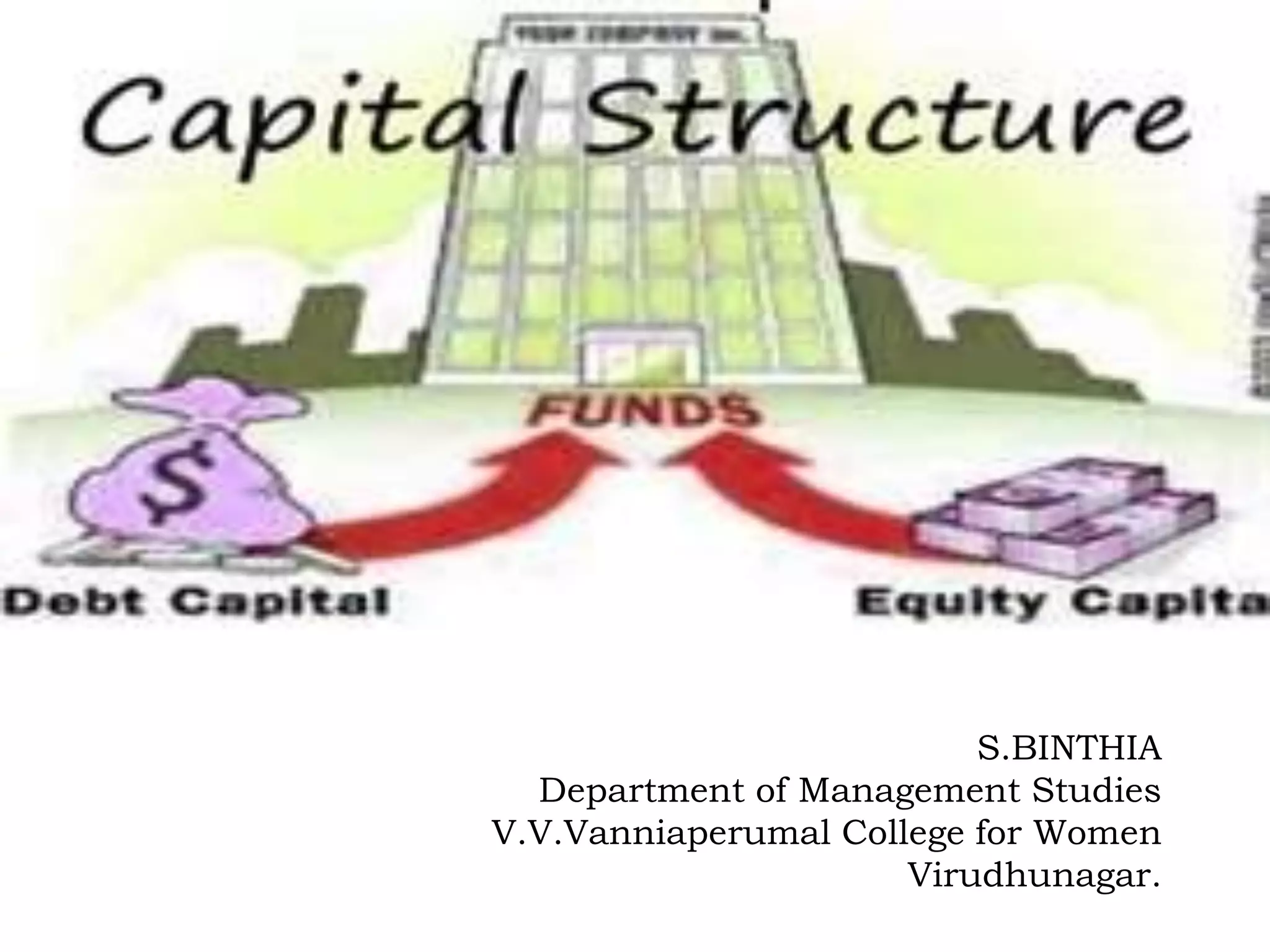
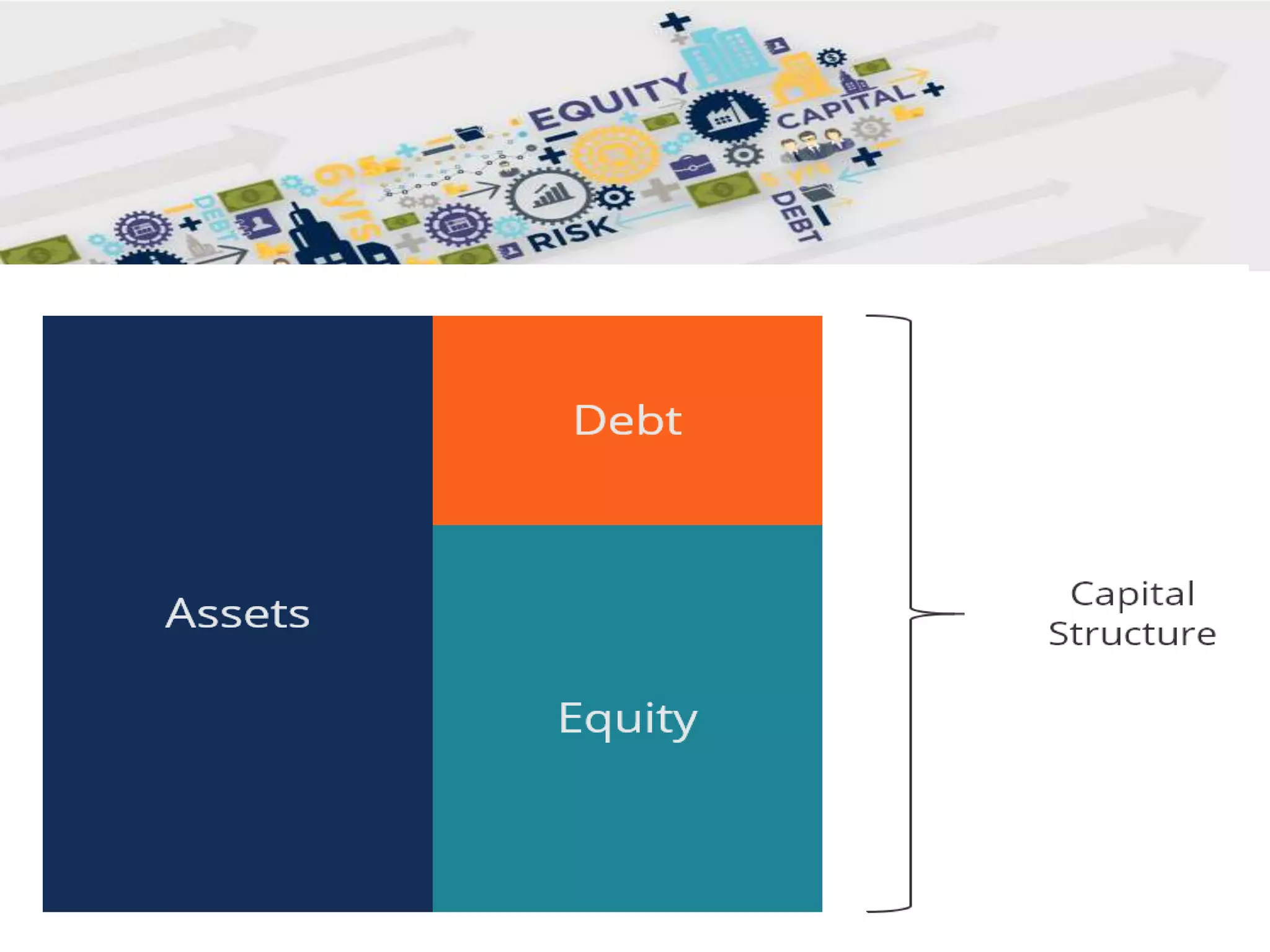
Capital Structure
Capital structure refers to the proportions or
combinations of equity share capital, preference share
capital, debentures, long-term loans, retained earnings
and other long-term sources of funds in the total
amount of capital which a firm should raise to run its
business.
“Capital structure of a company refers to the
make-up of its capitalisation and it includes all long-
term capital resources viz., loans, reserves, shares
and bonds.”—Gerstenberg.
“Capital structure is the combination of debt
and equity securities that comprise a firm’s financing
of its assets.”—John J. Hampton.
(a) With the issue of equity share only;
(b) With the issue of both equity share and preference
shares.
(c) With the issue of equity shares and debentures,
and
(d) With the issue of equity shares, preference shares
and debentures.
Patterns of Capital Structure
Major factors influencing capital
structure are as follows:
1. Financial Leverage or Trading on Equity
2. Expected Cash Flows
3. Stability of Sales
4. Control over the Company
5. Flexibility of Financial Structure
6. Cost of Floating the Capital
7. Period of Financing
8. Market Conditions
9. Types of Investors
10. Legal Requirements.
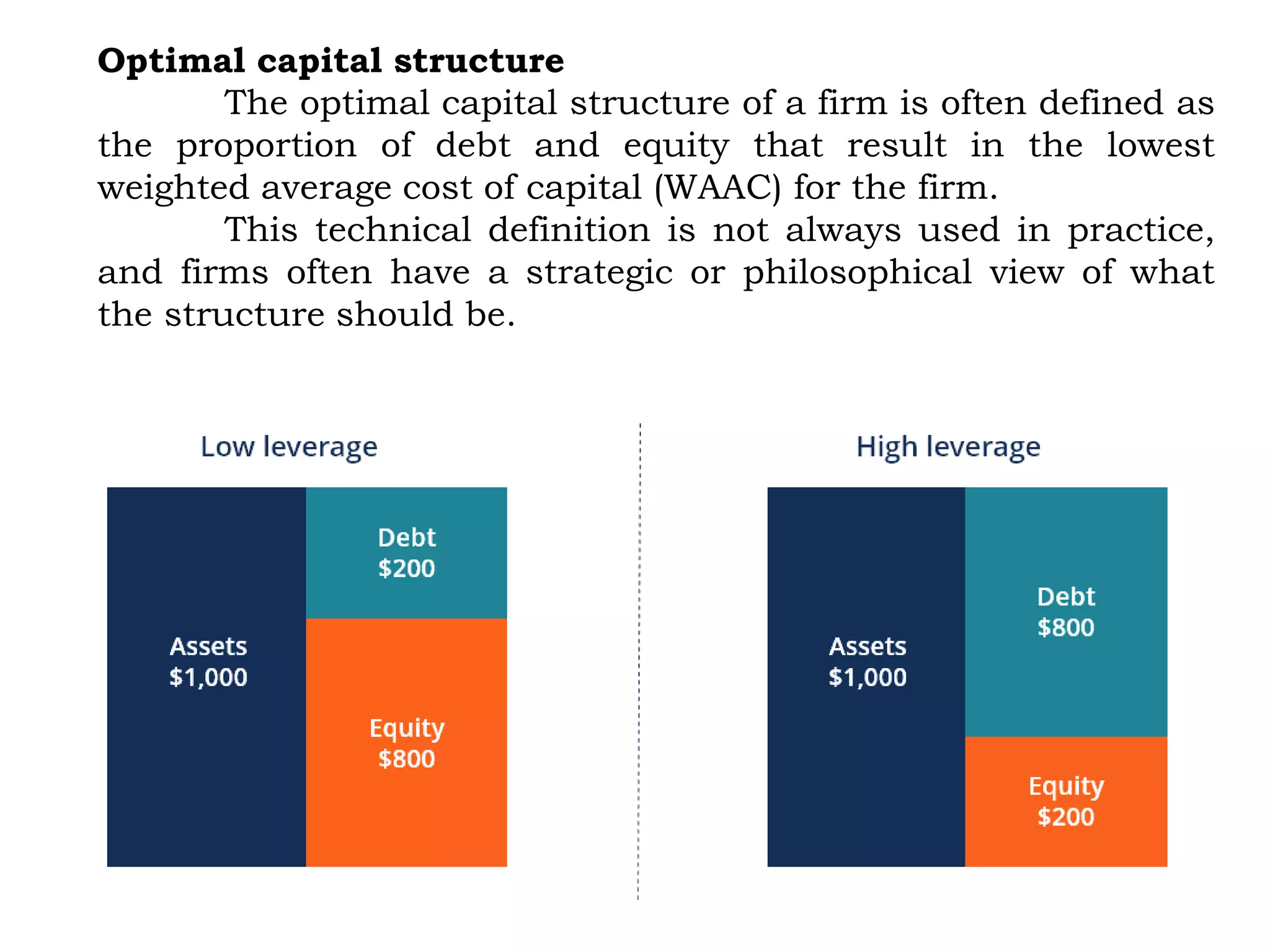
Optimal capital structure
The optimal capital structure of a firm is often defined as
the proportion of debt and equity that result in the lowest
weighted average cost of capital (WAAC) for the firm.
This technical definition is not always used in practice,
and firms often have a strategic or philosophical view of what
the structure should be.
Importance of Capital
Structure:
1. Increase in value of the
firm
2. Utilisation of available
funds
3. Maximisation of return
4. Minimisation of cost of
capital
5. Solvency or liquidity
position
6. Flexibility
7. Undisturbed controlling
8. Minimisation of financial
risk
Theories of Capital Structure
Net Income Approach
Net Operating Income Approach
Traditional Approach
Modigliani and Miller Approach
A firm can minimise the weighted average
cost of capital and increase the value of the firm
as well as market price of equity shares by using
debt financing to the maximum possible extent.
The theory propounds that a company can
increase its value and decrease the overall cost
of capital by increasing the proportion of debt in
its capital structure.
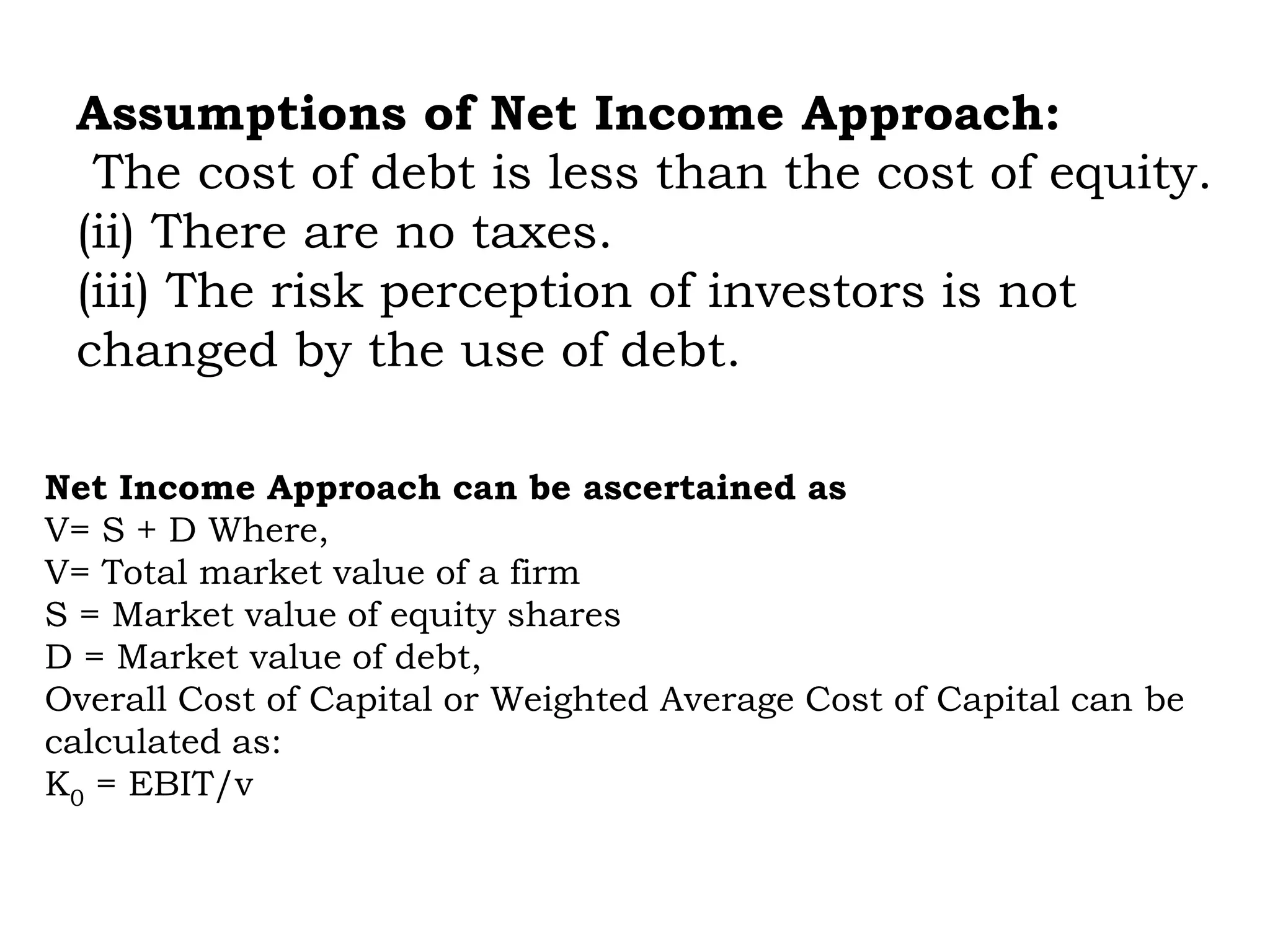
Assumptions of Net Income Approach:
The cost of debt is less than the cost of equity.
(ii) There are no taxes.
(iii) The risk perception of investors is not
changed by the use of debt.
Net Income Approach can be ascertained as
V= S + D Where,
V= Total market value of a firm
S = Market value of equity shares
D = Market value of debt,
Overall Cost of Capital or Weighted Average Cost of Capital can be
calculated as:
K0 = EBIT/v
Change in the capital structure of a company
does not affect the market value of the firm and the
overall cost of capital remains constant irrespective
of the method of financing.
It implies that the overall cost of capital
remains the same whether the debt-equity mix is 50:
50 or 20:80 or 0:100.
There is nothing as an optimal capital
structure and every capital structure is the optimum
capital structure.
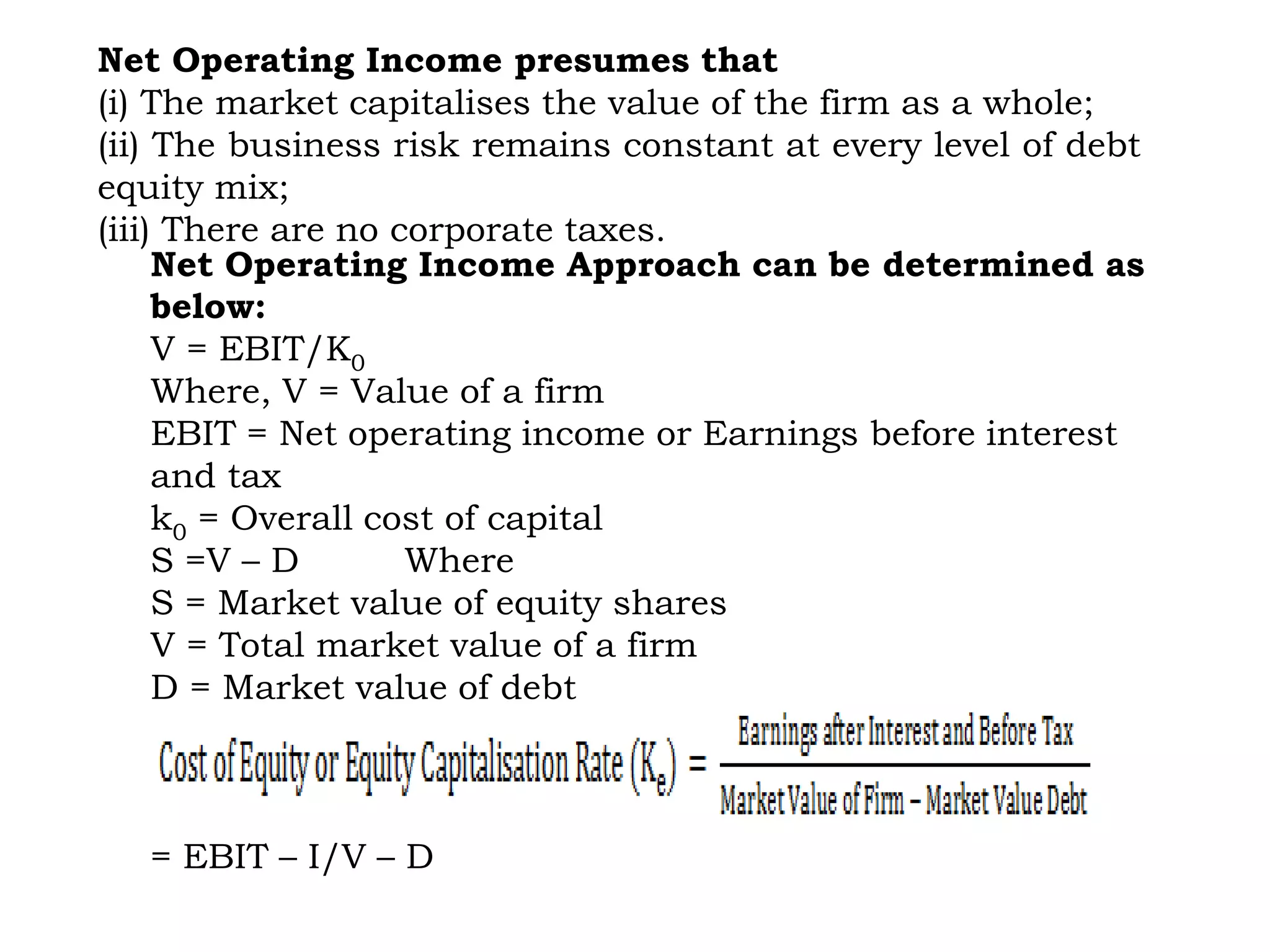
Net Operating Income presumes that
(i) The market capitalises the value of the firm as a whole;
(ii) The business risk remains constant at every level of debt
equity mix;
(iii) There are no corporate taxes.
Net Operating Income Approach can be determined as
below:
V = EBIT/K0
Where, V = Value of a firm
EBIT = Net operating income or Earnings before interest
and tax
k0 = Overall cost of capital
S =V – D Where
S = Market value of equity shares
V = Total market value of a firm
D = Market value of debt
= EBIT – I/V – D
The traditional approach, also known as Intermediate
approach.
It is a compromise between the two extremes of net
income approach and net operating income approach.
The value of the firm can be increased initially or the cost
of capital can be decreased by using more debt as the debt is a
cheaper source of funds than equity.
Optimum capital structure can be reached by a proper
debt-equity mix.
The cost of equity increases because increased debt
increases the financial risk of the equity shareholders.
Overall cost of capital decreases up to a certain point,
remains more or less unchanged for moderate increase in debt
1. There is no corporate taxes
2. There is a perfect market
3. Investors act rationally
4. The expected earnings of all the firms
have identical risk characteristics
5. The cut off point of investment in a firm
is capitalisation rate.
6. There are no transaction change
7. There are no retained earnings.

Capital structure

  • 1.
    S.BINTHIA Department of ManagementStudies V.V.Vanniaperumal College for Women Virudhunagar.
  • 2.
    Capital Structure Capital structurerefers to the proportions or combinations of equity share capital, preference share capital, debentures, long-term loans, retained earnings and other long-term sources of funds in the total amount of capital which a firm should raise to run its business. “Capital structure of a company refers to the make-up of its capitalisation and it includes all long- term capital resources viz., loans, reserves, shares and bonds.”—Gerstenberg. “Capital structure is the combination of debt and equity securities that comprise a firm’s financing of its assets.”—John J. Hampton.
  • 3.
    (a) With theissue of equity share only; (b) With the issue of both equity share and preference shares. (c) With the issue of equity shares and debentures, and (d) With the issue of equity shares, preference shares and debentures. Patterns of Capital Structure
  • 4.
    Major factors influencingcapital structure are as follows: 1. Financial Leverage or Trading on Equity 2. Expected Cash Flows 3. Stability of Sales 4. Control over the Company 5. Flexibility of Financial Structure 6. Cost of Floating the Capital 7. Period of Financing 8. Market Conditions 9. Types of Investors 10. Legal Requirements.
  • 6.
    Optimal capital structure Theoptimal capital structure of a firm is often defined as the proportion of debt and equity that result in the lowest weighted average cost of capital (WAAC) for the firm. This technical definition is not always used in practice, and firms often have a strategic or philosophical view of what the structure should be.
  • 7.
    Importance of Capital Structure: 1.Increase in value of the firm 2. Utilisation of available funds 3. Maximisation of return 4. Minimisation of cost of capital 5. Solvency or liquidity position 6. Flexibility 7. Undisturbed controlling 8. Minimisation of financial risk
  • 8.
    Theories of CapitalStructure Net Income Approach Net Operating Income Approach Traditional Approach Modigliani and Miller Approach
  • 10.
    A firm canminimise the weighted average cost of capital and increase the value of the firm as well as market price of equity shares by using debt financing to the maximum possible extent. The theory propounds that a company can increase its value and decrease the overall cost of capital by increasing the proportion of debt in its capital structure.
  • 11.
    Assumptions of NetIncome Approach: The cost of debt is less than the cost of equity. (ii) There are no taxes. (iii) The risk perception of investors is not changed by the use of debt. Net Income Approach can be ascertained as V= S + D Where, V= Total market value of a firm S = Market value of equity shares D = Market value of debt, Overall Cost of Capital or Weighted Average Cost of Capital can be calculated as: K0 = EBIT/v
  • 13.
    Change in thecapital structure of a company does not affect the market value of the firm and the overall cost of capital remains constant irrespective of the method of financing. It implies that the overall cost of capital remains the same whether the debt-equity mix is 50: 50 or 20:80 or 0:100. There is nothing as an optimal capital structure and every capital structure is the optimum capital structure.
  • 14.
    Net Operating Incomepresumes that (i) The market capitalises the value of the firm as a whole; (ii) The business risk remains constant at every level of debt equity mix; (iii) There are no corporate taxes. Net Operating Income Approach can be determined as below: V = EBIT/K0 Where, V = Value of a firm EBIT = Net operating income or Earnings before interest and tax k0 = Overall cost of capital S =V – D Where S = Market value of equity shares V = Total market value of a firm D = Market value of debt = EBIT – I/V – D
  • 16.
    The traditional approach,also known as Intermediate approach. It is a compromise between the two extremes of net income approach and net operating income approach. The value of the firm can be increased initially or the cost of capital can be decreased by using more debt as the debt is a cheaper source of funds than equity. Optimum capital structure can be reached by a proper debt-equity mix. The cost of equity increases because increased debt increases the financial risk of the equity shareholders. Overall cost of capital decreases up to a certain point, remains more or less unchanged for moderate increase in debt
  • 18.
    1. There isno corporate taxes 2. There is a perfect market 3. Investors act rationally 4. The expected earnings of all the firms have identical risk characteristics 5. The cut off point of investment in a firm is capitalisation rate. 6. There are no transaction change 7. There are no retained earnings.