WELCOME
presented by
Yogavathi H S
Frist M. com
Govt. first grade college
for women hnp
CAPITAL STRUCTURE
Capital structure
o Capital structure forms part of the study of financing
decision
o Financing decision is concerned with the procurement
of the required long- term funds at the proper time.
o Financing decision is concerned with the
indentification of the sources from which funds can be
raised and the determination of the amount of funds
that can be raised from each source.
o Thes aspects of financing decision make up the
structure of an enterprise.
Definition and meaning of capital structure
According to C.W.Gerstenberg, the term ‘capital
structure ,refers to the make –up, from or composition
of a firm`s capitalization , i.e, the types of securities to
be issued and the relative proportion of each type of
securities in the total capitalization”.
In the words of weston and brigam, “capital structure
is the permanent financing of the ration of the firm
represented by long term debt, preferred stock , and
net worth”.
Importance
 Capital structure determine the risk assumed by the
firm
 Capital structure determine the cost of capital of the
firm
 It affect the flexibility and liquidity of the firm
 It affect control of the owner of the firm
DITERMINANT OF CAPITAL STRUCTURE
 Nature and size of the firm
 Stability of the earning
 Stages of life cycle of the firm
 Cash flow ability of the firm
 Cost of capital
 Rate of corporate tax
 Retainig control
 Flexibility
 Trading on equity
APPROCHES OR THEORIES OF CAPITAL
STRUCTURE
1. Net Income approach or theory
2. Net operating Income approach or theory
3. Traditional approach or theory
4. Modigliani –miller approach or theory
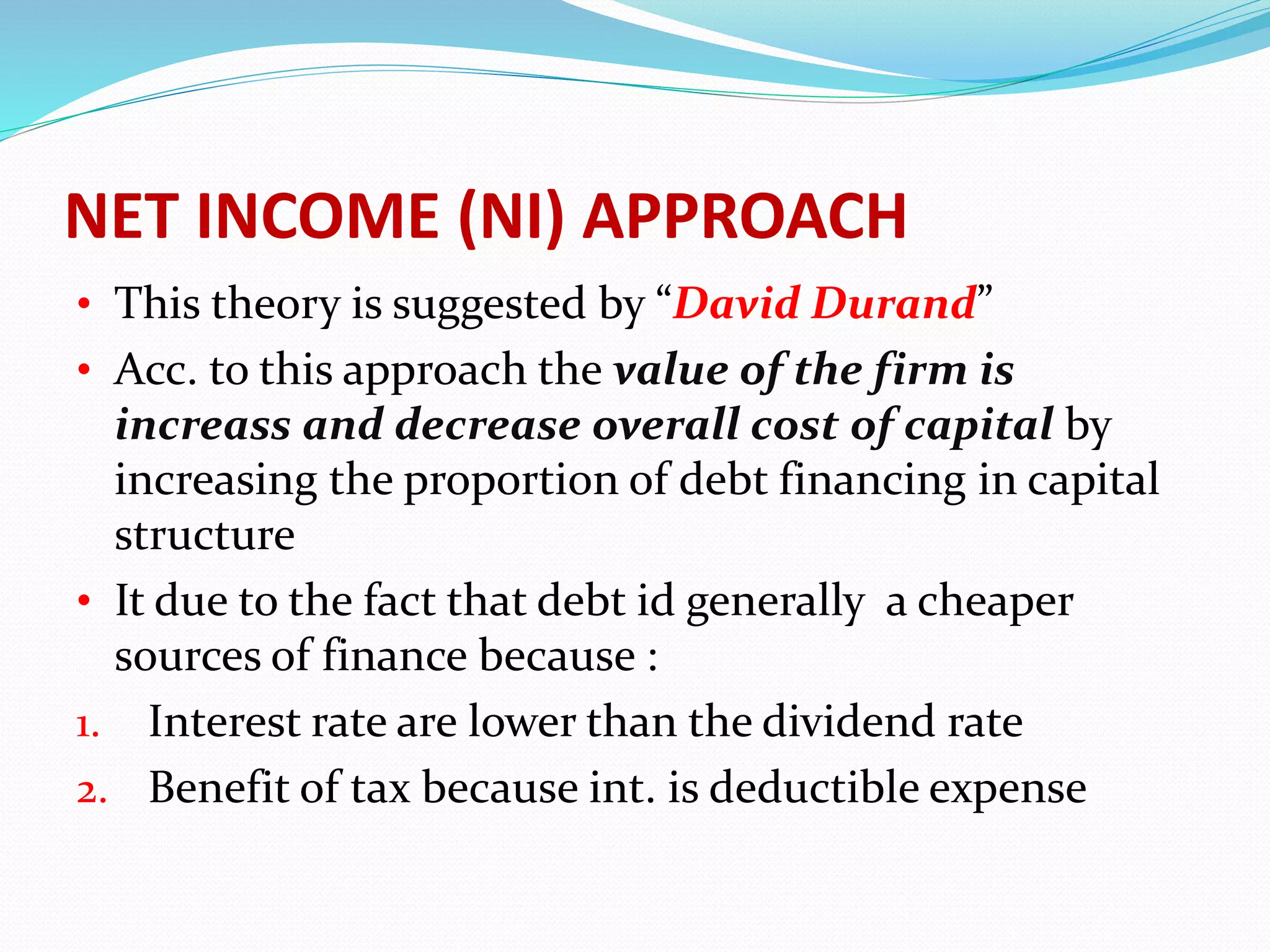
NET INCOME (NI) APPROACH
• This theory is suggested by “David Durand”
• Acc. to this approach the value of the firm is
increass and decrease overall cost of capital by
increasing the proportion of debt financing in capital
structure
• It due to the fact that debt id generally a cheaper
sources of finance because :
1. Interest rate are lower than the dividend rate
2. Benefit of tax because int. is deductible expense
ASSUMPTION OF NET INCOME APPROACH
The cost of debt is lower than cost of equity
The risk perception of the investor is not changed by
the use of debt
There is no corporate tax
The effect of leverage on the cost
of capital under NI approach
NET OPERATING INCOME APPROACH
 This theory was propounded by “ David Durand” and
is also known as irrelevant theory.
 Acc . To this theory, the total market value of the firm
is not affected by the change in the capital structure
and the overall cost of capital remain constant
irrespective of debt – equity ratio
ASSUMPTION OF NET OPERATING
INCOME APPROCH
THE market capitalizes the value of the firm as a whole
. Thus ,the split between debt and equity is not
important.
The cost of debt is lower than cost of equity
The risk perception of the investor is not changed by
the use of debt
There is no corporate tax
The effect of leverage on the cost of capital
under NOI approach
TRADITIONAL APPROACH
 This approach is the midway of NI approach and NOI
approach. And also known as intermediate approach.
 Acc. To this, the value of firm can be increased initially or
cost of capital can be decreased by using more debt as the
debt is a cheaper source of fund than equity.
 After that optimum capital structure can be reached by a
proper debt- equity mix .
TRADITIONAL APPROACH
MODIGLINI – MILLER APPROACH
 They have given two approach
 In the absence of corporate taxes
 When corporate taxes exist
ASSUMPTION
 Capital market are perfect
 Homogeneous risk classes of firm
 Expectations about the net operating income
 100% payout ration
 No corporate tax
Thank you

capital_structure.pptx

  • 1.
    WELCOME presented by Yogavathi HS Frist M. com Govt. first grade college for women hnp
  • 2.
  • 3.
    Capital structure o Capitalstructure forms part of the study of financing decision o Financing decision is concerned with the procurement of the required long- term funds at the proper time. o Financing decision is concerned with the indentification of the sources from which funds can be raised and the determination of the amount of funds that can be raised from each source. o Thes aspects of financing decision make up the structure of an enterprise.
  • 4.
    Definition and meaningof capital structure According to C.W.Gerstenberg, the term ‘capital structure ,refers to the make –up, from or composition of a firm`s capitalization , i.e, the types of securities to be issued and the relative proportion of each type of securities in the total capitalization”. In the words of weston and brigam, “capital structure is the permanent financing of the ration of the firm represented by long term debt, preferred stock , and net worth”.
  • 5.
    Importance  Capital structuredetermine the risk assumed by the firm  Capital structure determine the cost of capital of the firm  It affect the flexibility and liquidity of the firm  It affect control of the owner of the firm
  • 6.
    DITERMINANT OF CAPITALSTRUCTURE  Nature and size of the firm  Stability of the earning  Stages of life cycle of the firm  Cash flow ability of the firm  Cost of capital  Rate of corporate tax  Retainig control  Flexibility  Trading on equity
  • 7.
    APPROCHES OR THEORIESOF CAPITAL STRUCTURE 1. Net Income approach or theory 2. Net operating Income approach or theory 3. Traditional approach or theory 4. Modigliani –miller approach or theory
  • 8.
    NET INCOME (NI)APPROACH • This theory is suggested by “David Durand” • Acc. to this approach the value of the firm is increass and decrease overall cost of capital by increasing the proportion of debt financing in capital structure • It due to the fact that debt id generally a cheaper sources of finance because : 1. Interest rate are lower than the dividend rate 2. Benefit of tax because int. is deductible expense
  • 9.
    ASSUMPTION OF NETINCOME APPROACH The cost of debt is lower than cost of equity The risk perception of the investor is not changed by the use of debt There is no corporate tax
  • 10.
    The effect ofleverage on the cost of capital under NI approach
  • 11.
    NET OPERATING INCOMEAPPROACH  This theory was propounded by “ David Durand” and is also known as irrelevant theory.  Acc . To this theory, the total market value of the firm is not affected by the change in the capital structure and the overall cost of capital remain constant irrespective of debt – equity ratio
  • 12.
    ASSUMPTION OF NETOPERATING INCOME APPROCH THE market capitalizes the value of the firm as a whole . Thus ,the split between debt and equity is not important. The cost of debt is lower than cost of equity The risk perception of the investor is not changed by the use of debt There is no corporate tax
  • 13.
    The effect ofleverage on the cost of capital under NOI approach
  • 14.
    TRADITIONAL APPROACH  Thisapproach is the midway of NI approach and NOI approach. And also known as intermediate approach.  Acc. To this, the value of firm can be increased initially or cost of capital can be decreased by using more debt as the debt is a cheaper source of fund than equity.  After that optimum capital structure can be reached by a proper debt- equity mix .
  • 15.
  • 16.
    MODIGLINI – MILLERAPPROACH  They have given two approach  In the absence of corporate taxes  When corporate taxes exist ASSUMPTION  Capital market are perfect  Homogeneous risk classes of firm  Expectations about the net operating income  100% payout ration  No corporate tax
  • 17.