5-25-2
Limits Population GrowthLimits Population Growth
Concept to UnderstandConcept to Understand
No population can continue to growNo population can continue to grow
indefinitely because of limitations onindefinitely because of limitations on
resources and because of competitionresources and because of competition
among species for those resources.among species for those resources.
Population SizePopulation Size
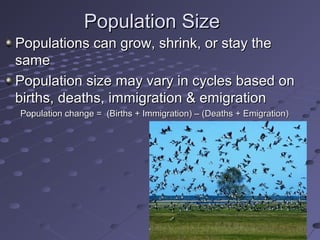
Populations can grow, shrink, or stay thePopulations can grow, shrink, or stay the
samesame
Population size may vary in cycles based onPopulation size may vary in cycles based on
births, deaths, immigration & emigrationbirths, deaths, immigration & emigration
Population change = (Births + Immigration) – (Deaths + Emigration)Population change = (Births + Immigration) – (Deaths + Emigration)
Reproductive patternsReproductive patterns
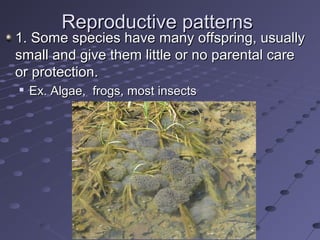
1. Some species have many offspring, usually1. Some species have many offspring, usually
small and give them little or no parental caresmall and give them little or no parental care
or protection.or protection.

Ex. Algae, frogs, most insectsEx. Algae, frogs, most insects
Reproductive patternsReproductive patterns
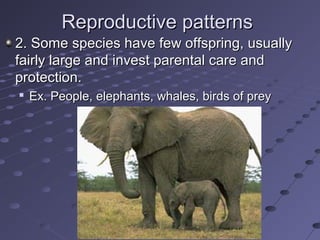
2. Some species have few offspring, usually2. Some species have few offspring, usually
fairly large and invest parental care andfairly large and invest parental care and
protection.protection.

Ex. People, elephants, whales, birds of preyEx. People, elephants, whales, birds of prey
Population LimitsPopulation Limits
• No population can growNo population can grow
indefinitelyindefinitely
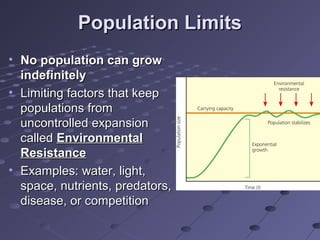
• Limiting factors that keepLimiting factors that keep
populations frompopulations from
uncontrolled expansionuncontrolled expansion
calledcalled EnvironmentalEnvironmental
ResistanceResistance
• Examples: water, light,Examples: water, light,
space, nutrients, predators,space, nutrients, predators,
disease, or competitiondisease, or competition
Population LimitsPopulation Limits
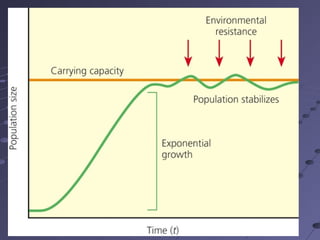
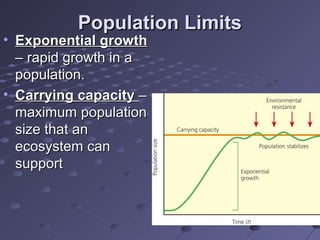
• Exponential growthExponential growth
– rapid growth in a– rapid growth in a
population.population.
• Carrying capacityCarrying capacity ––
maximum populationmaximum population
size that ansize that an
ecosystem canecosystem can
supportsupport
Population CrashPopulation Crash
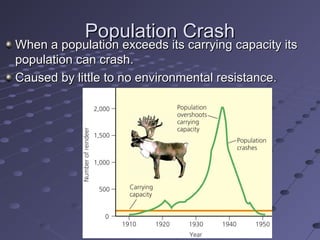
When a population exceeds its carrying capacity itsWhen a population exceeds its carrying capacity its
population can crash.population can crash.
Caused by little to no environmental resistance.Caused by little to no environmental resistance.
Population CrashPopulation Crash
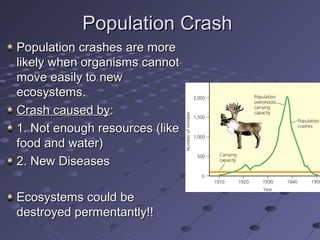
Population crashes are morePopulation crashes are more
likely when organisms cannotlikely when organisms cannot
move easily to newmove easily to new
ecosystems.ecosystems.
Crash caused byCrash caused by::
1. Not enough resources (like1. Not enough resources (like
food and water)food and water)
2. New Diseases2. New Diseases
Ecosystems could beEcosystems could be
destroyed permentantly!!destroyed permentantly!!
Humans Not Except fromHumans Not Except from
Population ControlsPopulation Controls
Bubonic plague (14Bubonic plague (14thth
century) 25 million killedcentury) 25 million killed
Famine in Ireland (1845) – 1 million died & 3Famine in Ireland (1845) – 1 million died & 3
million emigrated to USmillion emigrated to US
AIDS – 27 million dies 2 million each yearAIDS – 27 million dies 2 million each year
Technology, social, and cultural changesTechnology, social, and cultural changes
extended earth’s carrying capacity for humansextended earth’s carrying capacity for humans
Expand indefinitely or reach carryingExpand indefinitely or reach carrying
capacity?capacity?
5-3 How Do Communities and Ecosystems5-3 How Do Communities and Ecosystems
Respond to Changing EnvironmentalRespond to Changing Environmental
Conditions?Conditions?
Concept 5-3Concept 5-3 The structure and speciesThe structure and species
composition of communities andcomposition of communities and
ecosystems change in response toecosystems change in response to
changing environmental conditionschanging environmental conditions
through a process called ecologicalthrough a process called ecological
succession.succession.
SuccessionSuccession
SuccessionSuccession – the gradual, sequential– the gradual, sequential
re-growth of species in an areare-growth of species in an area
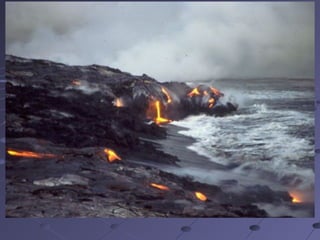
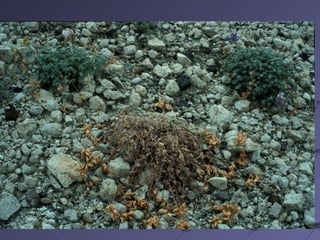
1. Primary succession1. Primary succession – the– the
development of a community in an areadevelopment of a community in an area
that has not supported life previouslythat has not supported life previously

Ex. Bare rock, volcanic island,Ex. Bare rock, volcanic island,
Mosses are usually first life.Mosses are usually first life.
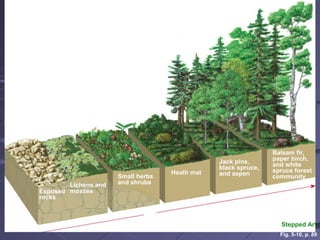
Time
Balsam fir,
paper birch,
and white
spruce forest
community
Jack pine,
black spruce,
and aspenHeath mat
Small herbs
and shrubsLichens and
mossesExposed
rocks
Stepped Art
Fig. 5-10, p. 89
SuccessionSuccession
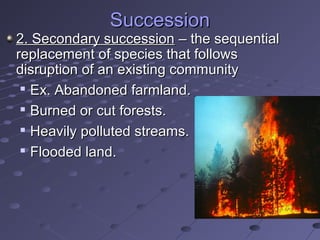
2. Secondary succession2. Secondary succession – the sequential– the sequential
replacement of species that followsreplacement of species that follows
disruption of an existing communitydisruption of an existing community

Ex. Abandoned farmland.Ex. Abandoned farmland.

Burned or cut forests.Burned or cut forests.

Heavily polluted streams.Heavily polluted streams.

Flooded land.Flooded land.
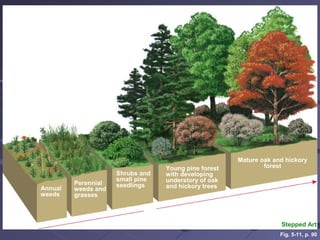
Annual
weeds
Mature oak and hickory
forestYoung pine forest
with developing
understory of oak
and hickory trees
Time
Shrubs and
small pine
seedlingsPerennial
weeds and
grasses
Stepped Art
Fig. 5-11, p. 90
Limits to ChangeLimits to Change
Inertia (persistence)Inertia (persistence) is the ability of a livingis the ability of a living
system, such as a grassland or forest, to survivesystem, such as a grassland or forest, to survive
moderate disturbances.moderate disturbances.
ResilienceResilience is the ability of a living system to beis the ability of a living system to be
restored through secondary succession after arestored through secondary succession after a
more severe disturbance.more severe disturbance.
Ex. Tropical rain forest: inertia – yes resilient – noEx. Tropical rain forest: inertia – yes resilient – no
Ex. Grassland: inertia – no resilient - yesEx. Grassland: inertia – no resilient - yes

5 2 population growth

  • 1.
  • 2.
    Concept to UnderstandConceptto Understand No population can continue to growNo population can continue to grow indefinitely because of limitations onindefinitely because of limitations on resources and because of competitionresources and because of competition among species for those resources.among species for those resources.
  • 3.
    Population SizePopulation Size Populationscan grow, shrink, or stay thePopulations can grow, shrink, or stay the samesame Population size may vary in cycles based onPopulation size may vary in cycles based on births, deaths, immigration & emigrationbirths, deaths, immigration & emigration Population change = (Births + Immigration) – (Deaths + Emigration)Population change = (Births + Immigration) – (Deaths + Emigration)
  • 4.
    Reproductive patternsReproductive patterns 1.Some species have many offspring, usually1. Some species have many offspring, usually small and give them little or no parental caresmall and give them little or no parental care or protection.or protection.  Ex. Algae, frogs, most insectsEx. Algae, frogs, most insects
  • 5.
    Reproductive patternsReproductive patterns 2.Some species have few offspring, usually2. Some species have few offspring, usually fairly large and invest parental care andfairly large and invest parental care and protection.protection.  Ex. People, elephants, whales, birds of preyEx. People, elephants, whales, birds of prey
  • 6.
    Population LimitsPopulation Limits •No population can growNo population can grow indefinitelyindefinitely • Limiting factors that keepLimiting factors that keep populations frompopulations from uncontrolled expansionuncontrolled expansion calledcalled EnvironmentalEnvironmental ResistanceResistance • Examples: water, light,Examples: water, light, space, nutrients, predators,space, nutrients, predators, disease, or competitiondisease, or competition
  • 8.
    Population LimitsPopulation Limits •Exponential growthExponential growth – rapid growth in a– rapid growth in a population.population. • Carrying capacityCarrying capacity –– maximum populationmaximum population size that ansize that an ecosystem canecosystem can supportsupport
  • 9.
    Population CrashPopulation Crash Whena population exceeds its carrying capacity itsWhen a population exceeds its carrying capacity its population can crash.population can crash. Caused by little to no environmental resistance.Caused by little to no environmental resistance.
  • 10.
    Population CrashPopulation Crash Populationcrashes are morePopulation crashes are more likely when organisms cannotlikely when organisms cannot move easily to newmove easily to new ecosystems.ecosystems. Crash caused byCrash caused by:: 1. Not enough resources (like1. Not enough resources (like food and water)food and water) 2. New Diseases2. New Diseases Ecosystems could beEcosystems could be destroyed permentantly!!destroyed permentantly!!
  • 11.
    Humans Not ExceptfromHumans Not Except from Population ControlsPopulation Controls Bubonic plague (14Bubonic plague (14thth century) 25 million killedcentury) 25 million killed Famine in Ireland (1845) – 1 million died & 3Famine in Ireland (1845) – 1 million died & 3 million emigrated to USmillion emigrated to US AIDS – 27 million dies 2 million each yearAIDS – 27 million dies 2 million each year Technology, social, and cultural changesTechnology, social, and cultural changes extended earth’s carrying capacity for humansextended earth’s carrying capacity for humans Expand indefinitely or reach carryingExpand indefinitely or reach carrying capacity?capacity?
  • 12.
    5-3 How DoCommunities and Ecosystems5-3 How Do Communities and Ecosystems Respond to Changing EnvironmentalRespond to Changing Environmental Conditions?Conditions? Concept 5-3Concept 5-3 The structure and speciesThe structure and species composition of communities andcomposition of communities and ecosystems change in response toecosystems change in response to changing environmental conditionschanging environmental conditions through a process called ecologicalthrough a process called ecological succession.succession.
  • 13.
    SuccessionSuccession SuccessionSuccession – thegradual, sequential– the gradual, sequential re-growth of species in an areare-growth of species in an area 1. Primary succession1. Primary succession – the– the development of a community in an areadevelopment of a community in an area that has not supported life previouslythat has not supported life previously  Ex. Bare rock, volcanic island,Ex. Bare rock, volcanic island, Mosses are usually first life.Mosses are usually first life.
  • 16.
    Time Balsam fir, paper birch, andwhite spruce forest community Jack pine, black spruce, and aspenHeath mat Small herbs and shrubsLichens and mossesExposed rocks Stepped Art Fig. 5-10, p. 89
  • 17.
    SuccessionSuccession 2. Secondary succession2.Secondary succession – the sequential– the sequential replacement of species that followsreplacement of species that follows disruption of an existing communitydisruption of an existing community  Ex. Abandoned farmland.Ex. Abandoned farmland.  Burned or cut forests.Burned or cut forests.  Heavily polluted streams.Heavily polluted streams.  Flooded land.Flooded land.
  • 18.
    Annual weeds Mature oak andhickory forestYoung pine forest with developing understory of oak and hickory trees Time Shrubs and small pine seedlingsPerennial weeds and grasses Stepped Art Fig. 5-11, p. 90
  • 19.
    Limits to ChangeLimitsto Change Inertia (persistence)Inertia (persistence) is the ability of a livingis the ability of a living system, such as a grassland or forest, to survivesystem, such as a grassland or forest, to survive moderate disturbances.moderate disturbances. ResilienceResilience is the ability of a living system to beis the ability of a living system to be restored through secondary succession after arestored through secondary succession after a more severe disturbance.more severe disturbance. Ex. Tropical rain forest: inertia – yes resilient – noEx. Tropical rain forest: inertia – yes resilient – no Ex. Grassland: inertia – no resilient - yesEx. Grassland: inertia – no resilient - yes

Editor's Notes

  • #17 Figure 5.10: Primary ecological succession. Over almost a thousand years, plant communities developed, starting on bare rock exposed by a retreating glacier on Isle Royal, Michigan (USA) in northern Lake Superior. The details of this process vary from one site to another. Question: What are two ways in which lichens, mosses, and plants might get started growing on bare rock?
  • #19 Active Figure 5.11: Natural ecological restoration of disturbed land. Secondary ecological succession of plant communities on an abandoned farm field in the U.S. state of North Carolina. It took 150–200 years after the farmland was abandoned for the area to become covered with a mature oak and hickory forest. A new disturbance such as deforestation or fire would create conditions favoring pioneer species such as annual weeds. In the absence of new disturbances, secondary succession would recur over time, but not necessarily in the same sequence shown here. Questions: Do you think the annual weeds (left) would continue to thrive in the mature forest (right)? Why or why not? See an animation based on this figure at CengageNOW.