Presenter : M.UMAIR
By the end of the lecture students will be able to understand:
• Definition of epidural anesthesia
• Advantages of epidural anesthesia
• Physiology of epidural anesthesia
• Effect of epidural anesthesia
• Dosage, volume and concentration of epidural anesthesia
• Factors effecting the effects of epidural anesthesia
• Levels of epidural anesthesia
• Techniques and preparation of epidural anesthesia
• Contraindication and cautions of epidural anesthesia
Epidural analgesia is the administration of
opioids and/or local anesthetics into the
epidural space.
•
•
•
•
• EPIDURALANESTHESIA
• One advantage of an epidural is that the muscle
blockade can range from none to complete and can be
regulated and changed by:
Choice of drug
Concentration of LA
Dosage
Level of injection
• ADVANTAGES
• Epidural techniques allow for the placement of
a continuous catheter which is especially
useful for:
• Cases of unpredictable duration
• Prolonged postoperative analgesia
• Chronic pain control
• Obstetric analgesia & anesthesia
• PHYSIOLOGY
• Local anesthetics or other solutions injected into
the epidural space (steroids, narcotics) spread
anatomically
• Horizontal spread is to the region of the dural
cuffs with diffusion into the CSF and leakage
through the intervertebral foramen into
paravertebral spaces
• Longitudinal spread is preferentially cephalad in
direction
• PHYSIOLOGY
• Possible sites of anesthetic action include:
• Paravertebral nerve roots
• Intradural spinal roots
• Dorsal and ventral spinal roots
• Dorsal root ganglia
• The spinal cord
• The brain itself (by diffusion)
• PHYSIOLOGY
• Because epidural anesthesia is DIFFUSION dependent,
relatively LARGE volumes of LAare needed to achieve a
block that spans several dermatomes
• The block ONLY goes as high or low as you regulate it (by
volume)
• It is a DIFFERENTIAL block
Absorbed local anaesthetic
Moderate blood levels
Antiarrhythmic
Maintenance of normal CO
Minimal reduction in vascular tone
No measurable effects on
HR,CO,MAP or TPR
Lidocaine may ↑CO, which is balanced
by ↓TPR, MAP changed
High blood levels(toxic) ↓CO, ↓HR
Decreased contractility ↓ MAP
If convulsions occur hypoxia results in Bupivacane (very high levels ) – VT,
further reduction in CO VF, cardiac arrest
Vascular dilatation ↓TPR
•
•
•
•
•
•
•
•
•
SPREAD OF ANESTHESIA
• The factors that affect the level of the epidural block
are:
Injection site
Dose
Volume
Concentration
Position
Age
Height and weight
Pregnancy
Speed of injection
• INJECTION SITE
• Unlike spinal anesthesia, produces a segmental
block that spreads both caudally and cranially
• Injection site is arguably the most important
determinant of the spread of an epidural block
• The injection site should be in the middle of the
range of dermatomes that needs to be
anesthetized and closest to the main nerve roots
involved
DOSE, VOLUME & CONCENTRATION
• Within the range typically used for surgical anesthesia,
drug CONCENTRATION is relatively unimportant in
determining block spread
• DOSE & VOLUME, however, are important variables
in determining both spread and quality of the epidural
block obtained
DOSE, VOLUME & CONCENTRATION
• If drug CONCENTRATION is held constant, increasing the
volume of LA (and thereby increasing the DOSE) results in
significantly greater average spread
• DOSE = volume x concentration (i.E. 15cc x 2.5mg/cc =
37.5mg; 20cc x 2.5mg/cc = 50mg)
• The CONCENTRATION of the LA generally affects the
DENSITY of the block, NOT the spread
DOSE, VOLUME & CONCENTRATION
• So a small volume of a more concentrated LAwill
produce a very limited BUT very strong block
• But take the same DOSE and double the volume, the
spread will increase BUT the strength of the block may
not be as intense
POSITION
• Lateral position may be preferred position to optimize
spread
• Sitting position has anatomical advantages
• Studies have shown small to NO differences in spread
of block when comparing the two position
AGE
• Most (but NOT all) studies that have examined the
effect of age on epidural blocks have demonstrated a
greater spread in older patients
• This is thought to be related to a less compliant epidural
space and dura mater
• Even so, the clinical effect is usuallyA
T MOST an
increase of no more than three or four dermatomes
HEIGHTAND WEIGHT
• The correlation between patient height or weight and
spread of epidural block is very weak at best and seems
to have no clinical significance
• The only instance where it may have an effect is in
EXTREMEL
YTALL people (greater than 6’6”) or in
EXTREMELY SHORT (less than 4’10”) or in
MORBIDLY obese patients
PREGNANCY
• Studies examining the effect of pregnancy on spread of
epidural blocks are conflicting
• Some have shown a greater spread at TERM and early
in pregnancy
• Other studies have shown no significant differences in
level of spread between pregnant and non-pregnant
patients
SPEED OF INJECTION
• Rapid injection may increase the level of spread or
decrease the time it takes for the block to set
• Drugs should, in fact, be injected SLOWLY to avoid
rapid increases in CSF pressure, headache and
increased intracranial pressures
• Also, incremental bolus vs. Slow, steady injection has
shown NO difference in level of spread in multiple
studies
SPEED OF INJECTION
• All solutions should be injected in increments of 3-5cc
every 3 minutes and titrated to the desired anesthetic
level
• If a catheter has been placed and injecting through the
catheter, then the catheter needs to be aspirated prior to
every injection to show no CSF is present
SPEED OF INJECTION
• This gradual administration of medication slows
the rate of onset of the anesthetic level and
controls the development of the sympathetic
blockade
• The spinal isALL or none, whereas the epidural
can be brought up gradually, slowing whatever
hypotensive response
ONSET OF BLOCKADE
• The onset of an epidural block can usually be
detected within 5 minutes in the dermatomes
immediately surrounding the injection site
• The time to PEAK effect differs somewhat
among different LA’s
• Shorter acting drugs usually reach their
maximum spread in 15-20 minutes
• Longer acting la’s usually reach their maximum
spread in 20-25 minutes
• Increasing the DOSE of LASPEEDS the onset
of both motor and sensory block
•
•
•
•
•
DURATION OF BLOCK
The DURATION of the epidural block depends on:
The LAitself
Dose given
Patient age
Use of adrenergic agonists
LOCALANESTHETICS & DURATION
• Choice of LA is the most important factor in
determining DURATION of the block
• Chlorprocaine is shortest, lidocaine & mepivicaine are
intermediate and bupivicaine and ropivicaine produce
the longest lasting epidural blocks
DOSE AND AGE
• DOSE: increasing the DOSE of a LAresults in
increased durationAND density of the block
• AGE: there are conflicting studies, but the majority
seem to show a longer duration of action in the elderly
population. The exact reason is unknown and more
studies need to be performed
ADRENERGIC AGENTS AND
DURATION
• Epinephrine in a concentration of 5 micrograms/cc
(1:200,000) is the most common adrenergic agent
added to epidural la’s
• It has been shown to prolong the blocks of lidocaine
and mepivicaine by as much as 80%
• Epinephrine has been shown NOT to significantly
prolong the duration of anesthesia when added to
concentrated solutions of bupivicaine and ropivicaine
used for surgical anesthesia
ADRENERGIC AGENTS AND
DURATION
• However, when added to more dilute concentrations
of bupivicaine, as used for OB analgesia, it has been
shown to increase the durationAND quality of the
block
• The mechanism proposed, is that through
vasoconstriction, it slows the systemic absorption and
elimination of the LA
• Why it does not work with higher concentrations of
bupivicaine and ropivicaine is not clearly understood
TECHNIQUE
Preoperative preparation
• Review of anesthetic preoperative evaluation and recent lab
values. Surgical and anesthesia consents are checked
• Iv access established; generous with fluid if permissible
• Low-dose anxiolytic
• Monitors: ecg, nibp, pulse oximeter
• Epidural set
• Emergency equipment
• Personnel: provider positioning
• Communications
TECHNIQUE
PREPARATION
• Place patient in optimal position
• Prepare skin over a wide area with povidine
iodine
• Fenestrated sterile drape
• Find the interspace along the midline
TECHNIQUE
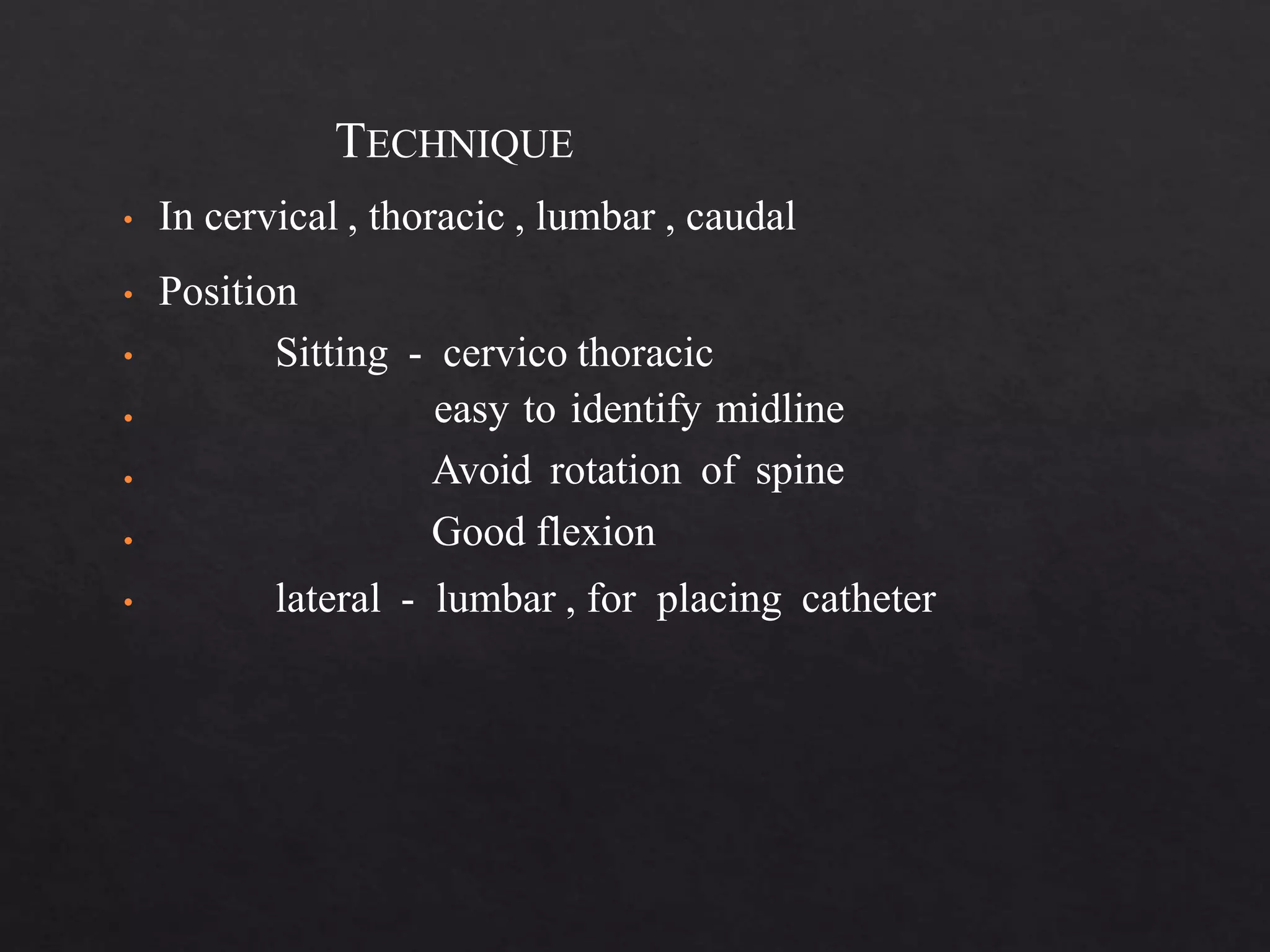
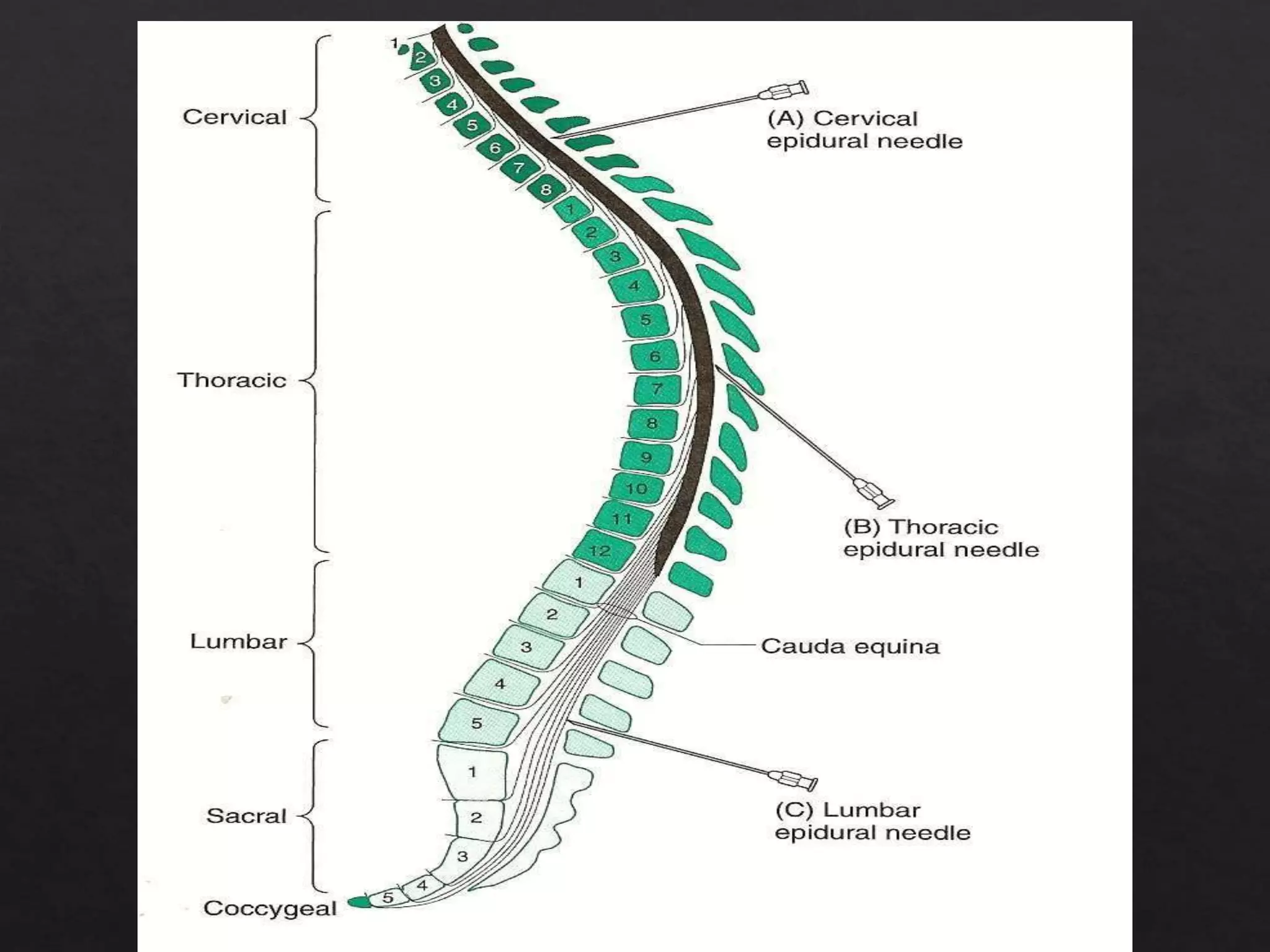
• In cervical , thoracic , lumbar , caudal
•
•
•
•
• Position
• Sitting - cervico thoracic
easy to identify midline
Avoid rotation of spine
Good flexion
lateral - lumbar , for placing catheter
• TECHNIQUE
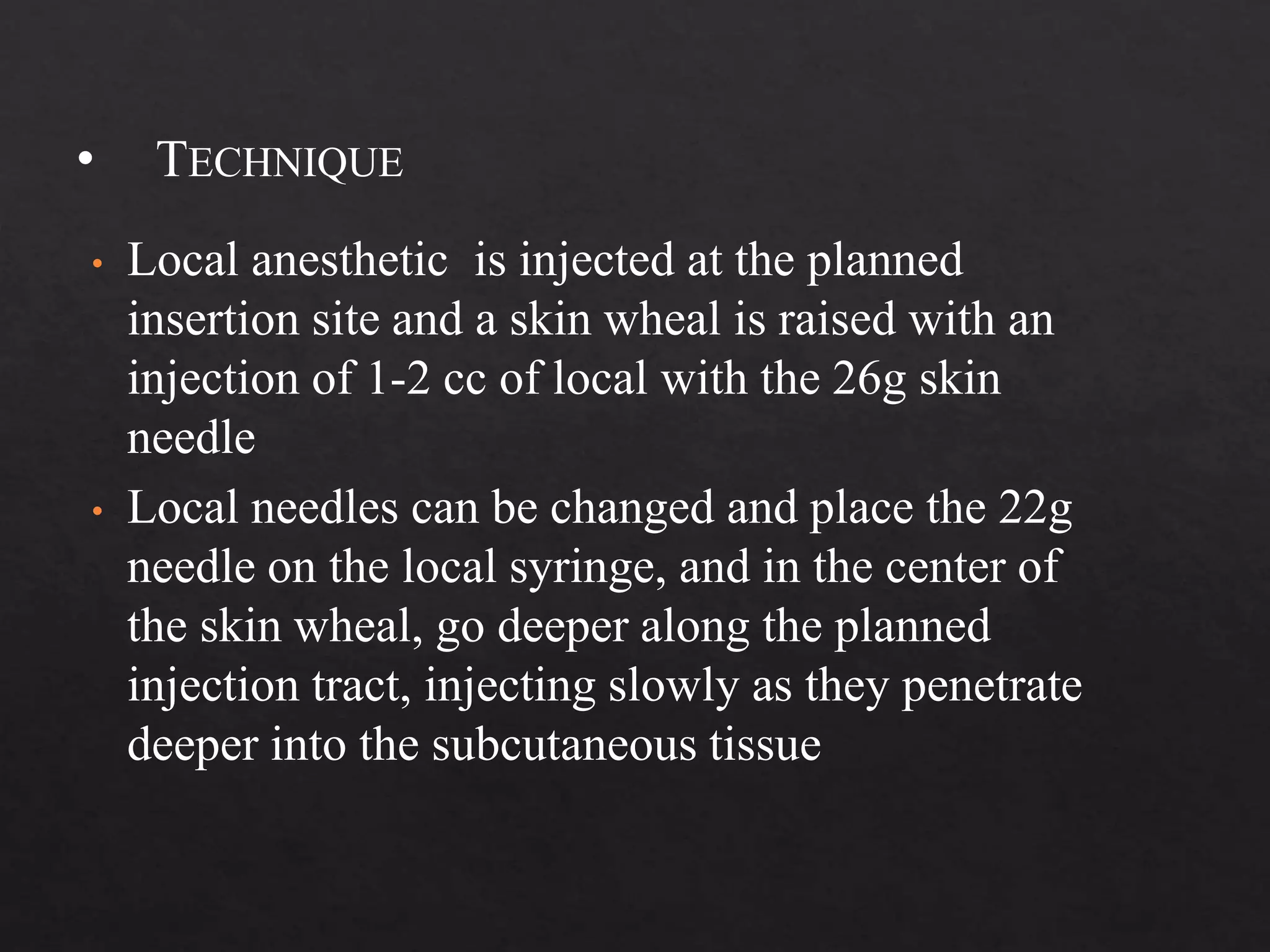
• Local anesthetic is injected at the planned
insertion site and a skin wheal is raised with an
injection of 1-2 cc of local with the 26g skin
needle
• Local needles can be changed and place the 22g
needle on the local syringe, and in the center of
the skin wheal, go deeper along the planned
injection tract, injecting slowly as they penetrate
deeper into the subcutaneous tissue
TECHNIQUE
• The epidural is most often performed with a 16,
17 or 18 gauge needle with a BLUNTED tip
designed to facilitate passage of a catheter into
the epidural space at the beginning or end of the
procedure
• The blunted tip is also designed specially to
AVOID puncture of the dura and if it comes in
contact with the dura, the lack of a sharp point
will hopefully just inwardly push the dura
without puncturing it
TECHNIQUE
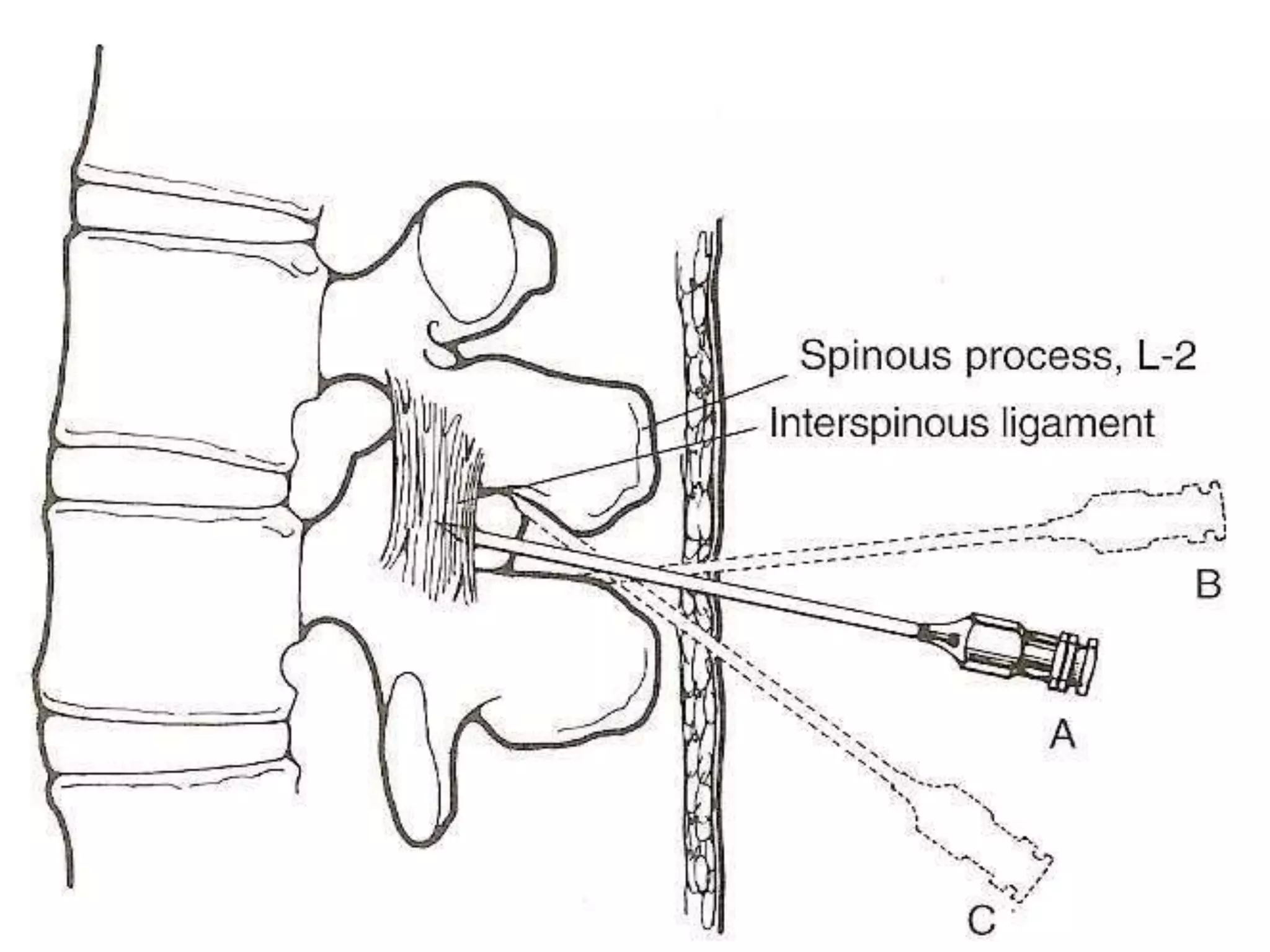
• The epidural needle is place bevel up and
introduced into the skin
• It is passed slowly through the supraspinous
ligament and seated in the interspinous ligament
before the stylet is removed
• It can tell that the needle is seated in the
interspinous ligament by letting go of the
needle; it should still be supported in the same
position, not drop down
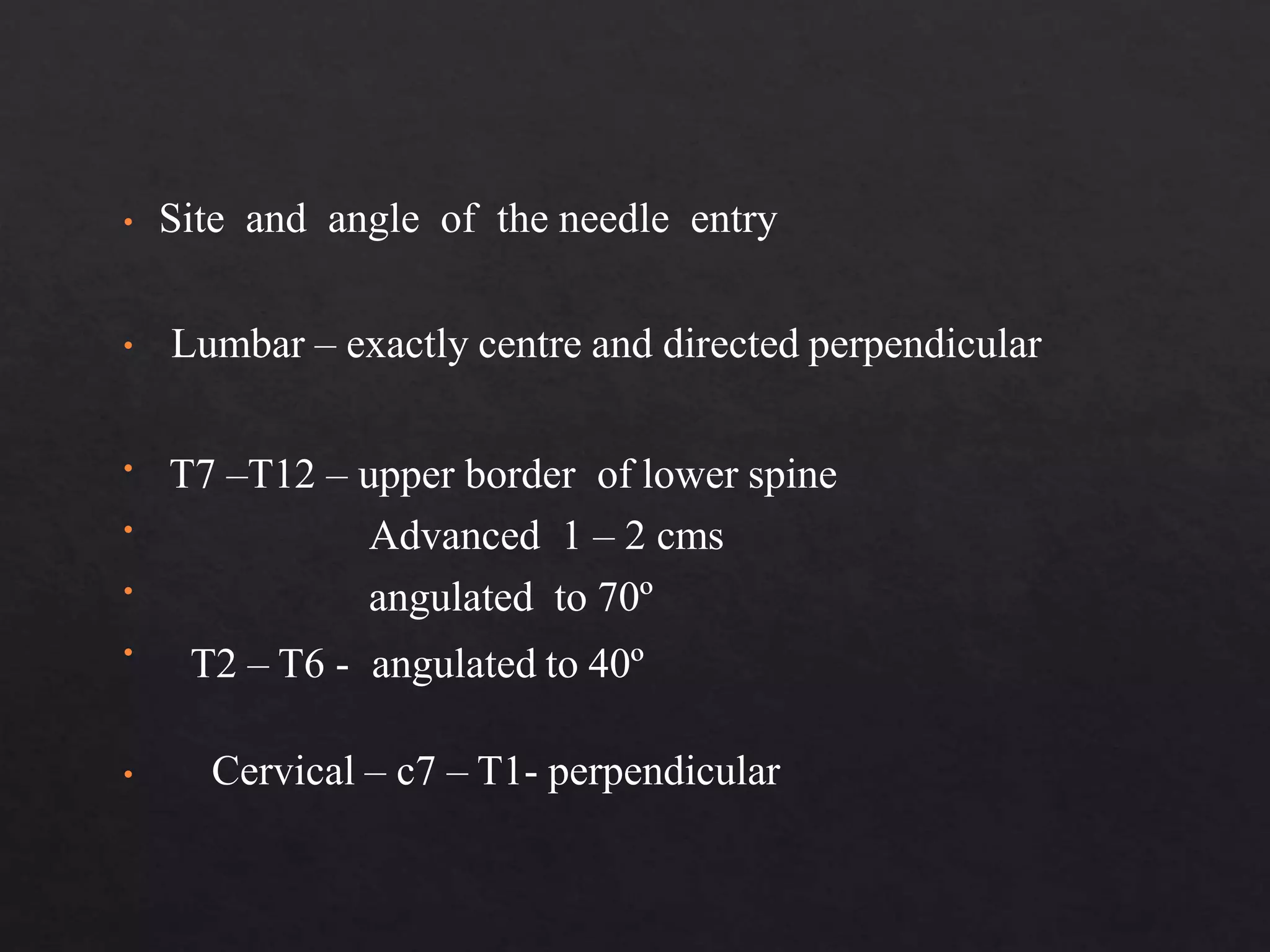
• Site and angle of the needle entry
• Lumbar – exactly centre and directed perpendicular
•
•
T7 –T12 – upper border of lower spine
Advanced 1 – 2 cms
angulated to 70º
T2 – T6 - angulated to 40º
•
•
• Cervical – c7 – T1- perpendicular
Insertion
• Stylet is removed and a well lubricated glass syringe
with air or saline is attached
• Needle and syringe is advanced slowly with the left
hand , while the thumb of right hand keeps constant
pressure over the plunger of the syringe
• When the needle bevel passes through ligamentum
flavum andenters the epidural space , sudden loss
of resistance to injection occurs
Confirmation
• Sudden disappearence of resistence
• Sudden ease of injection of air
• Hanging drop sign
• Capillary tube method of odom (movement of air
bubble in a capillary tube attached to hub)
TECHNIQUE
• The syringe/needle combo should only be
moved 0.5-1cm at a time and then tested for
resistance or LOR
• The syringe/needle combo is advanced by
applying pressure to the NEEDLE and not the
syringe
• As the needle passes through the ligamentum
flavum, resistance increases and you may feel a
distinct “pop” as you pass through it
• Once it pass through the LF, will experience an
immediate LOR and then the tip of the needle
will be in the epidural space
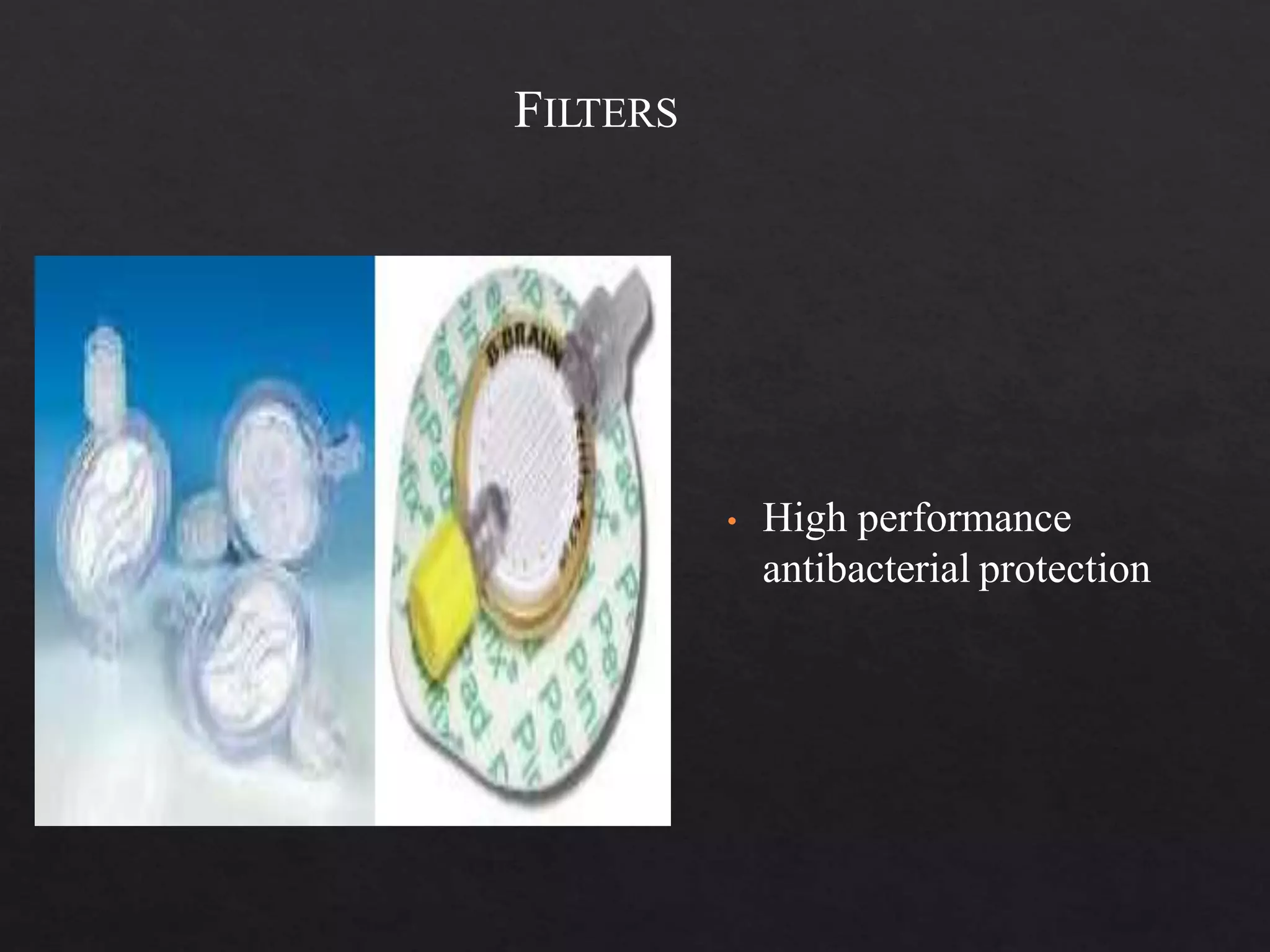
FILTERS
• High performance
antibacterial protection
CONTRAINDICA
TIONS ABSOLUTE
• Infection
• Patient refusal
• Coagulopathy or other bleeding diathesis
• Severe hypovolemia
• Increased intracranial tension
• Severe aortic stenosis
• Severe mitral stenosis
CONCLUSION
• Despite these important advantages, epidural anesthesia
offers advantages, too
• Chief among them are the lower risk of PDPH, less
hypotension, the ability to prolong or extend the block
using an indwelling catheter, and options to use the
same catheter for postoperative analgesia
CONCLUSION
• Despite the advantages and disadvantages of
BOTH techniques and even done with very
experienced hands, BOTH blocks can have
systemic, toxic reactions and complications
• Be vigilant, be cautious, and be prepared to
handle all the emergencies and complications
that can occur with BOTH
• Again, always be prepared to convert to GAat a
moment’s notice
Thank you
75

epidural anaesthesia.pptx

  • 1.
  • 2.
    By the endof the lecture students will be able to understand: • Definition of epidural anesthesia • Advantages of epidural anesthesia • Physiology of epidural anesthesia • Effect of epidural anesthesia • Dosage, volume and concentration of epidural anesthesia • Factors effecting the effects of epidural anesthesia • Levels of epidural anesthesia • Techniques and preparation of epidural anesthesia • Contraindication and cautions of epidural anesthesia
  • 3.
    Epidural analgesia isthe administration of opioids and/or local anesthetics into the epidural space.
  • 4.
    • • • • • EPIDURALANESTHESIA • Oneadvantage of an epidural is that the muscle blockade can range from none to complete and can be regulated and changed by: Choice of drug Concentration of LA Dosage Level of injection
  • 5.
    • ADVANTAGES • Epiduraltechniques allow for the placement of a continuous catheter which is especially useful for: • Cases of unpredictable duration • Prolonged postoperative analgesia • Chronic pain control • Obstetric analgesia & anesthesia
  • 6.
    • PHYSIOLOGY • Localanesthetics or other solutions injected into the epidural space (steroids, narcotics) spread anatomically • Horizontal spread is to the region of the dural cuffs with diffusion into the CSF and leakage through the intervertebral foramen into paravertebral spaces • Longitudinal spread is preferentially cephalad in direction
  • 7.
    • PHYSIOLOGY • Possiblesites of anesthetic action include: • Paravertebral nerve roots • Intradural spinal roots • Dorsal and ventral spinal roots • Dorsal root ganglia • The spinal cord • The brain itself (by diffusion)
  • 8.
    • PHYSIOLOGY • Becauseepidural anesthesia is DIFFUSION dependent, relatively LARGE volumes of LAare needed to achieve a block that spans several dermatomes • The block ONLY goes as high or low as you regulate it (by volume) • It is a DIFFERENTIAL block
  • 9.
    Absorbed local anaesthetic Moderateblood levels Antiarrhythmic Maintenance of normal CO Minimal reduction in vascular tone No measurable effects on HR,CO,MAP or TPR Lidocaine may ↑CO, which is balanced by ↓TPR, MAP changed High blood levels(toxic) ↓CO, ↓HR Decreased contractility ↓ MAP If convulsions occur hypoxia results in Bupivacane (very high levels ) – VT, further reduction in CO VF, cardiac arrest Vascular dilatation ↓TPR
  • 10.
    • • • • • • • • • SPREAD OF ANESTHESIA •The factors that affect the level of the epidural block are: Injection site Dose Volume Concentration Position Age Height and weight Pregnancy Speed of injection
  • 11.
    • INJECTION SITE •Unlike spinal anesthesia, produces a segmental block that spreads both caudally and cranially • Injection site is arguably the most important determinant of the spread of an epidural block • The injection site should be in the middle of the range of dermatomes that needs to be anesthetized and closest to the main nerve roots involved
  • 13.
    DOSE, VOLUME &CONCENTRATION • Within the range typically used for surgical anesthesia, drug CONCENTRATION is relatively unimportant in determining block spread • DOSE & VOLUME, however, are important variables in determining both spread and quality of the epidural block obtained
  • 14.
    DOSE, VOLUME &CONCENTRATION • If drug CONCENTRATION is held constant, increasing the volume of LA (and thereby increasing the DOSE) results in significantly greater average spread • DOSE = volume x concentration (i.E. 15cc x 2.5mg/cc = 37.5mg; 20cc x 2.5mg/cc = 50mg) • The CONCENTRATION of the LA generally affects the DENSITY of the block, NOT the spread
  • 15.
    DOSE, VOLUME &CONCENTRATION • So a small volume of a more concentrated LAwill produce a very limited BUT very strong block • But take the same DOSE and double the volume, the spread will increase BUT the strength of the block may not be as intense
  • 17.
    POSITION • Lateral positionmay be preferred position to optimize spread • Sitting position has anatomical advantages • Studies have shown small to NO differences in spread of block when comparing the two position
  • 18.
    AGE • Most (butNOT all) studies that have examined the effect of age on epidural blocks have demonstrated a greater spread in older patients • This is thought to be related to a less compliant epidural space and dura mater • Even so, the clinical effect is usuallyA T MOST an increase of no more than three or four dermatomes
  • 19.
    HEIGHTAND WEIGHT • Thecorrelation between patient height or weight and spread of epidural block is very weak at best and seems to have no clinical significance • The only instance where it may have an effect is in EXTREMEL YTALL people (greater than 6’6”) or in EXTREMELY SHORT (less than 4’10”) or in MORBIDLY obese patients
  • 20.
    PREGNANCY • Studies examiningthe effect of pregnancy on spread of epidural blocks are conflicting • Some have shown a greater spread at TERM and early in pregnancy • Other studies have shown no significant differences in level of spread between pregnant and non-pregnant patients
  • 21.
    SPEED OF INJECTION •Rapid injection may increase the level of spread or decrease the time it takes for the block to set • Drugs should, in fact, be injected SLOWLY to avoid rapid increases in CSF pressure, headache and increased intracranial pressures • Also, incremental bolus vs. Slow, steady injection has shown NO difference in level of spread in multiple studies
  • 22.
    SPEED OF INJECTION •All solutions should be injected in increments of 3-5cc every 3 minutes and titrated to the desired anesthetic level • If a catheter has been placed and injecting through the catheter, then the catheter needs to be aspirated prior to every injection to show no CSF is present
  • 23.
    SPEED OF INJECTION •This gradual administration of medication slows the rate of onset of the anesthetic level and controls the development of the sympathetic blockade • The spinal isALL or none, whereas the epidural can be brought up gradually, slowing whatever hypotensive response
  • 25.
    ONSET OF BLOCKADE •The onset of an epidural block can usually be detected within 5 minutes in the dermatomes immediately surrounding the injection site • The time to PEAK effect differs somewhat among different LA’s • Shorter acting drugs usually reach their maximum spread in 15-20 minutes • Longer acting la’s usually reach their maximum spread in 20-25 minutes • Increasing the DOSE of LASPEEDS the onset of both motor and sensory block
  • 27.
    • • • • • DURATION OF BLOCK TheDURATION of the epidural block depends on: The LAitself Dose given Patient age Use of adrenergic agonists
  • 28.
    LOCALANESTHETICS & DURATION •Choice of LA is the most important factor in determining DURATION of the block • Chlorprocaine is shortest, lidocaine & mepivicaine are intermediate and bupivicaine and ropivicaine produce the longest lasting epidural blocks
  • 29.
    DOSE AND AGE •DOSE: increasing the DOSE of a LAresults in increased durationAND density of the block • AGE: there are conflicting studies, but the majority seem to show a longer duration of action in the elderly population. The exact reason is unknown and more studies need to be performed
  • 30.
    ADRENERGIC AGENTS AND DURATION •Epinephrine in a concentration of 5 micrograms/cc (1:200,000) is the most common adrenergic agent added to epidural la’s • It has been shown to prolong the blocks of lidocaine and mepivicaine by as much as 80% • Epinephrine has been shown NOT to significantly prolong the duration of anesthesia when added to concentrated solutions of bupivicaine and ropivicaine used for surgical anesthesia
  • 31.
    ADRENERGIC AGENTS AND DURATION •However, when added to more dilute concentrations of bupivicaine, as used for OB analgesia, it has been shown to increase the durationAND quality of the block • The mechanism proposed, is that through vasoconstriction, it slows the systemic absorption and elimination of the LA • Why it does not work with higher concentrations of bupivicaine and ropivicaine is not clearly understood
  • 33.
    TECHNIQUE Preoperative preparation • Reviewof anesthetic preoperative evaluation and recent lab values. Surgical and anesthesia consents are checked • Iv access established; generous with fluid if permissible • Low-dose anxiolytic • Monitors: ecg, nibp, pulse oximeter • Epidural set • Emergency equipment • Personnel: provider positioning • Communications
  • 34.
  • 35.
    PREPARATION • Place patientin optimal position • Prepare skin over a wide area with povidine iodine • Fenestrated sterile drape • Find the interspace along the midline
  • 36.
    TECHNIQUE • In cervical, thoracic , lumbar , caudal • • • • • Position • Sitting - cervico thoracic easy to identify midline Avoid rotation of spine Good flexion lateral - lumbar , for placing catheter
  • 37.
    • TECHNIQUE • Localanesthetic is injected at the planned insertion site and a skin wheal is raised with an injection of 1-2 cc of local with the 26g skin needle • Local needles can be changed and place the 22g needle on the local syringe, and in the center of the skin wheal, go deeper along the planned injection tract, injecting slowly as they penetrate deeper into the subcutaneous tissue
  • 38.
    TECHNIQUE • The epiduralis most often performed with a 16, 17 or 18 gauge needle with a BLUNTED tip designed to facilitate passage of a catheter into the epidural space at the beginning or end of the procedure • The blunted tip is also designed specially to AVOID puncture of the dura and if it comes in contact with the dura, the lack of a sharp point will hopefully just inwardly push the dura without puncturing it
  • 40.
    TECHNIQUE • The epiduralneedle is place bevel up and introduced into the skin • It is passed slowly through the supraspinous ligament and seated in the interspinous ligament before the stylet is removed • It can tell that the needle is seated in the interspinous ligament by letting go of the needle; it should still be supported in the same position, not drop down
  • 42.
    • Site andangle of the needle entry • Lumbar – exactly centre and directed perpendicular • • T7 –T12 – upper border of lower spine Advanced 1 – 2 cms angulated to 70º T2 – T6 - angulated to 40º • • • Cervical – c7 – T1- perpendicular
  • 44.
    Insertion • Stylet isremoved and a well lubricated glass syringe with air or saline is attached • Needle and syringe is advanced slowly with the left hand , while the thumb of right hand keeps constant pressure over the plunger of the syringe
  • 45.
    • When theneedle bevel passes through ligamentum flavum andenters the epidural space , sudden loss of resistance to injection occurs Confirmation • Sudden disappearence of resistence • Sudden ease of injection of air • Hanging drop sign • Capillary tube method of odom (movement of air bubble in a capillary tube attached to hub)
  • 46.
    TECHNIQUE • The syringe/needlecombo should only be moved 0.5-1cm at a time and then tested for resistance or LOR • The syringe/needle combo is advanced by applying pressure to the NEEDLE and not the syringe • As the needle passes through the ligamentum flavum, resistance increases and you may feel a distinct “pop” as you pass through it • Once it pass through the LF, will experience an immediate LOR and then the tip of the needle will be in the epidural space
  • 49.
  • 50.
    CONTRAINDICA TIONS ABSOLUTE • Infection •Patient refusal • Coagulopathy or other bleeding diathesis • Severe hypovolemia • Increased intracranial tension • Severe aortic stenosis • Severe mitral stenosis
  • 51.
    CONCLUSION • Despite theseimportant advantages, epidural anesthesia offers advantages, too • Chief among them are the lower risk of PDPH, less hypotension, the ability to prolong or extend the block using an indwelling catheter, and options to use the same catheter for postoperative analgesia
  • 52.
    CONCLUSION • Despite theadvantages and disadvantages of BOTH techniques and even done with very experienced hands, BOTH blocks can have systemic, toxic reactions and complications • Be vigilant, be cautious, and be prepared to handle all the emergencies and complications that can occur with BOTH • Again, always be prepared to convert to GAat a moment’s notice
  • 53.