This document summarizes a technical seminar on 4G technology presented by Rahul Jha. 4G refers to fourth generation wireless technology capable of speeds from 100Mbps to 1Gbps. Key features of 4G include high quality of service, high security, ability to provide any service anywhere at any time, and more security and speed compared to 3G. While a few countries have started commercial 4G networks, 4G promises faster internet access on mobile devices closer to home broadband speeds.
Overview of a technical seminar on 4G technology presented by Rahul Jha from SUS College of Engg. & Technology.
4G refers to the fourth generation of mobile technology offering 100Mbps to 1Gbps speeds and features like mobile multimedia and global mobility support.
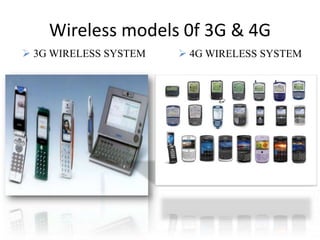
Key differences between 3G and 4G include significant improvements in data transfer rates, bandwidth, and internet service quality.
Insights into countries currently utilizing 4G services, noting early adopters like the Scandinavian nations and others worldwide.
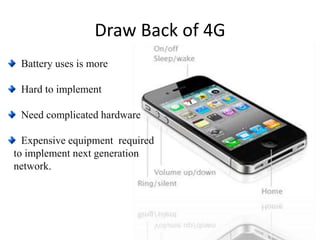
Challenges in implementing 4G include increased battery usage, complex hardware needs, and high equipment costs, impacting effective deployment.
4G services offer personalized information, enhanced multimedia support, and high-speed communication for various sectors and applications.
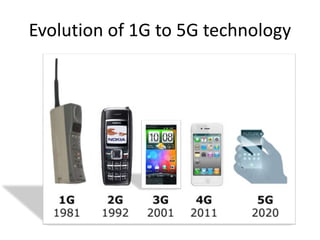
An overview of the progression from 1G to 5G, highlighting 5G's capabilities for complete wireless communication and its support for the wireless web.
4G serves as a convergence platform enhancing coverage, bandwidth, and service variety, culminating in a summary of key takeaways.
Final thank you acknowledgment from the presenter, concluding the seminar.
“4G Technology”
4G technologyrefer to or short name of fourth
Generation which was started from late 2000s.
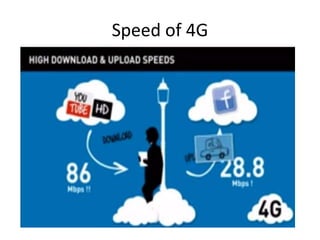
Capable of providing 100Mbps – 1Gbps speed.
One of the basic term used to describe 4G is
MAGIC.
MAGIC:
Mobile Multimedia
Anytime Anywhere
Global Mobility Support
Integrated Wireless Solution
Customized Personal Services
Also known as Mobile Broadband
Everywhere.
4.
What to expectfrom 4G?
4G services should make it much
quicker to surf the web on your
mobile, tablets and laptops -
speeds will be nearer to what you
currently experience with home
broadband.
5.
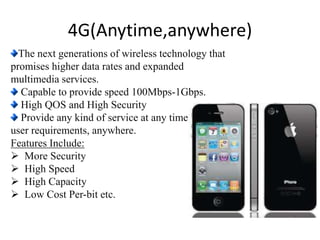
The next generationsof wireless technology that
promises higher data rates and expanded
multimedia services.
Capable to provide speed 100Mbps-1Gbps.
High QOS and High Security
Provide any kind of service at any time as per
user requirements, anywhere.
Features Include:
More Security
High Speed
High Capacity
Low Cost Per-bit etc.
4G(Anytime,anywhere)
6.
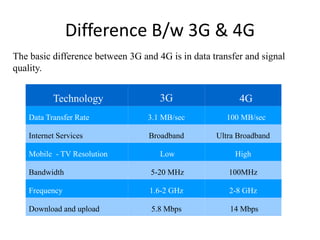
Technology 3G 4G
DataTransfer Rate 3.1 MB/sec 100 MB/sec
Internet Services Broadband Ultra Broadband
Mobile - TV Resolution Low High
Bandwidth 5-20 MHz 100MHz
Frequency 1.6-2 GHz 2-8 GHz
Download and upload 5.8 Mbps 14 Mbps
The basic difference between 3G and 4G is in data transfer and signal
quality.
Difference B/w 3G & 4G
Except for theScandinavian Countries (Northern
Europe that includes Denmark and two of the
nations of Scandinavian , Norway and Sweden. ), a
few countries have started the 4G commercially.
In the US, Sprint Nextel and Others Germany ,
Spain, China , Japan and England are also using
the 4G services and mobiles .
Countries Have 4G
Support interactive multimedia
Userfriendliness
High speed, high capacity and
low cost per bit
Higher band widths
Terminal Heterogeneity
Network Heterogeneity
Features of 4G Wireless Systems
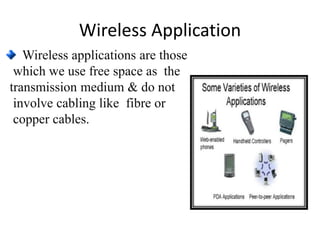
Wireless applications arethose
which we use free space as the
transmission medium & do not
involve cabling like fibre or
copper cables.
Wireless Application
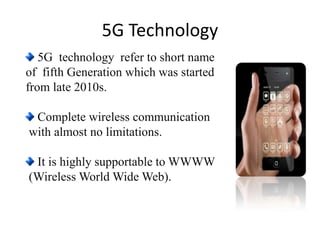
5G technology referto short name
of fifth Generation which was started
from late 2010s.
Complete wireless communication
with almost no limitations.
It is highly supportable to WWWW
(Wireless World Wide Web).
5G Technology
18.
4G will bea Convergence Platform
providing clear advantages in terms of
Coverage, Bandwidth, Power
Consumption, variety of Services,
ranging from Pop-Up advertisements
to Location-Based services and IP
Data casting ones.
Conclusion