Presented By:
VIKASH KUMAR
12206125
M-Tech, 2nd Year (C&I)
CONTENTS
 INTRODUCTION
WHAT IS 4G ?
EVOLUTION OF 4G
3G Vs 4G
SYSTEM KEY COMPONENTS OF 4G
• System standards
• Multiplexing and access schemes
• IPv6 SUPPORT
•Advanced antenna systems
•Software-defined radio (SDR)
APPLICATIONS
REFERENCES
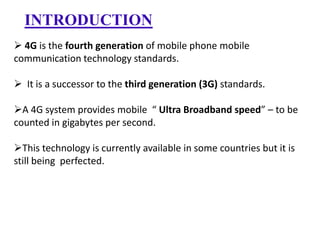
INTRODUCTION
 4G is the fourth generation of mobile phone mobile
communication technology standards.

 It is a successor to the third generation (3G) standards.
A 4G system provides mobile “ Ultra Broadband speed” – to be
counted in gigabytes per second.
This technology is currently available in some countries but it is
still being perfected.
WHAT IS 4G ?
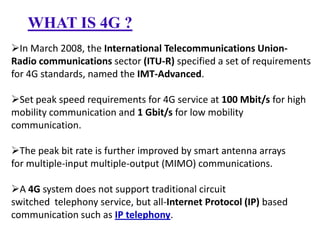
In March 2008, the International Telecommunications UnionRadio communications sector (ITU-R) specified a set of requirements
for 4G standards, named the IMT-Advanced.
Set peak speed requirements for 4G service at 100 Mbit/s for high
mobility communication and 1 Gbit/s for low mobility
communication.
The peak bit rate is further improved by smart antenna arrays
for multiple-input multiple-output (MIMO) communications.

A 4G system does not support traditional circuit
switched telephony service, but all-Internet Protocol (IP) based
communication such as IP telephony.
EVOLUTION OF 4G
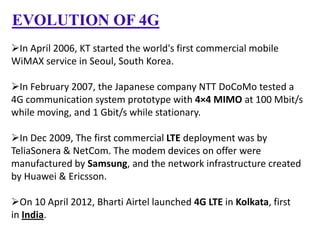
In April 2006, KT started the world's first commercial mobile
WiMAX service in Seoul, South Korea.
In February 2007, the Japanese company NTT DoCoMo tested a
4G communication system prototype with 4×4 MIMO at 100 Mbit/s
while moving, and 1 Gbit/s while stationary.

In Dec 2009, The first commercial LTE deployment was by
TeliaSonera & NetCom. The modem devices on offer were
manufactured by Samsung, and the network infrastructure created
by Huawei & Ericsson.
On 10 April 2012, Bharti Airtel launched 4G LTE in Kolkata, first
in India.
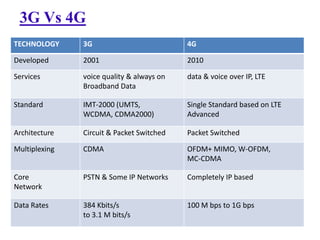
3G Vs 4G
TECHNOLOGY

3G

4G

Developed

2001

2010

Services

voice quality & always on
Broadband Data

data & voice over IP, LTE

Standard

IMT-2000 (UMTS,
WCDMA, CDMA2000)

Single Standard based on LTE
Advanced

Architecture

Circuit & Packet Switched

Packet Switched

Multiplexing

CDMA

OFDM+ MIMO, W-OFDM,
MC-CDMA

Core
Network

PSTN & Some IP Networks

Completely IP based

Data Rates

384 Kbits/s
to 3.1 M bits/s

100 M bps to 1G bps
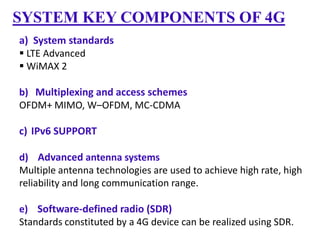
SYSTEM KEY COMPONENTS OF 4G
a) System standards
 LTE Advanced
 WiMAX 2
b) Multiplexing and access schemes
OFDM+ MIMO, W–OFDM, MC-CDMA

c) IPv6 SUPPORT
d) Advanced antenna systems
Multiple antenna technologies are used to achieve high rate, high
reliability and long communication range.
e) Software-defined radio (SDR)
Standards constituted by a 4G device can be realized using SDR.
SYSTEM KEY COMPONENTS OF 4G
a) System standards
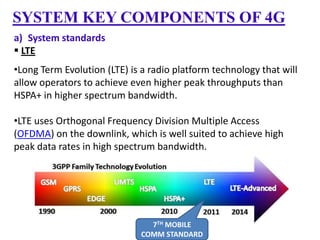
 LTE
•Long Term Evolution (LTE) is a radio platform technology that will
allow operators to achieve even higher peak throughputs than
HSPA+ in higher spectrum bandwidth.

•LTE uses Orthogonal Frequency Division Multiple Access
(OFDMA) on the downlink, which is well suited to achieve high
peak data rates in high spectrum bandwidth.

7TH MOBILE
COMM STANDARD
LTE capabilities include:
•Downlink peak data rates up to 326 Mbps with 20 MHz bandwidth

•Uplink peak data rates up to 86.4 Mbps with 20 MHz bandwidth
•Operation in both TDD and FDD modes
•Scalable bandwidth up to 20 MHz, covering 1.4 MHz, 3 MHz, 5
MHz, 10 MHz, 15 MHz, and 20 MHz in the study phase
•Reduced latency, up to 10 milliseconds (ms) round-trip times
between user equipment and the base station, and to less than 100
ms transition times from inactive to active
SYSTEM KEY COMPONENTS OF 4G
a) System standards
 WiMAX 2
• WiMAX stands for Worldwide Interoperability for Microwave
Access. WiMAX 2 also called Wireless MAN-Advanced has become
the first true 4G technology to be approved by the IEEE and ITU.
• This technology supports MIMO, femto cells, self-organizing
networks & relays, and multicarrier operation. It supports both
120Mbps downlink and 60Mbps uplink speeds
•The unique and excellent infrastructure of WiMAX is offering UltraWideband and providing range from 2 to 10 GHz and outstanding
time response.
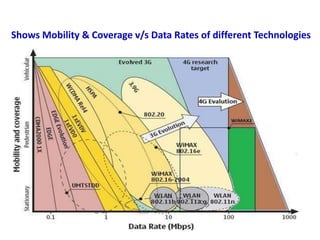
Shows Mobility & Coverage v/s Data Rates of different Technologies
SYSTEM KEY COMPONENTS OF 4G
b) Multiplexing and access schemes
 OFDM
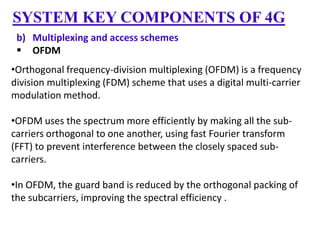
•Orthogonal frequency-division multiplexing (OFDM) is a frequency
division multiplexing (FDM) scheme that uses a digital multi-carrier
modulation method.
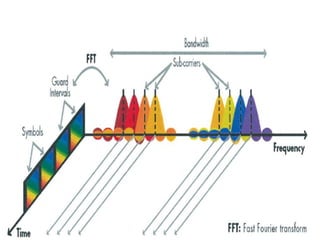
•OFDM uses the spectrum more efficiently by making all the subcarriers orthogonal to one another, using fast Fourier transform
(FFT) to prevent interference between the closely spaced subcarriers.
•In OFDM, the guard band is reduced by the orthogonal packing of
the subcarriers, improving the spectral efficiency .


OFDM….

•Since each carrier in an OFDM signal has a very narrow bandwidth
(i.e. few kHz), the resulting symbol rate is low.
•Due to the orthogonal nature of the modulation, these multiple
sub-carriers overlap in the frequency domain, but do not cause
Inter-Carrier Interference (ICI).

•In OFDM, the guard band is reduced by the orthogonal packing of
the subcarriers, improving the spectral efficiency.
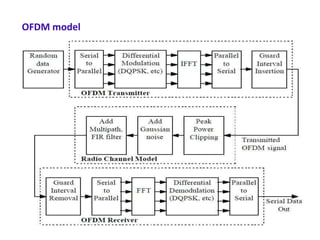
OFDM model
SYSTEM KEY COMPONENTS OF 4G
c) IPv6 SUPPORT

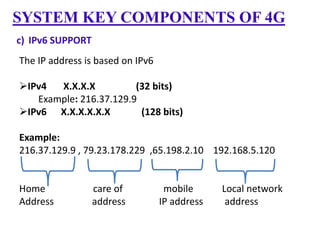
The IP address is based on IPv6
IPv4
X.X.X.X
(32 bits)
Example: 216.37.129.9
IPv6 X.X.X.X.X.X
(128 bits)
Example:
216.37.129.9 , 79.23.178.229 ,65.198.2.10 192.168.5.120

Home
Address

care of
address

mobile
IP address

Local network
address
c) IPv6 SUPPORT…
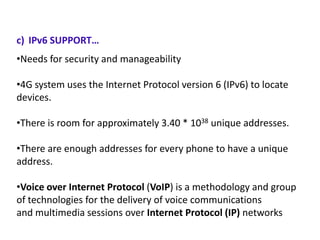
•Needs for security and manageability

•4G system uses the Internet Protocol version 6 (IPv6) to locate
devices.
•There is room for approximately 3.40 * 1038 unique addresses.
•There are enough addresses for every phone to have a unique
address.

•Voice over Internet Protocol (VoIP) is a methodology and group
of technologies for the delivery of voice communications
and multimedia sessions over Internet Protocol (IP) networks
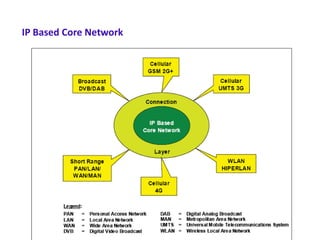
IP Based Core Network
SYSTEM KEY COMPONENTS OF 4G
d) Advanced antenna systems
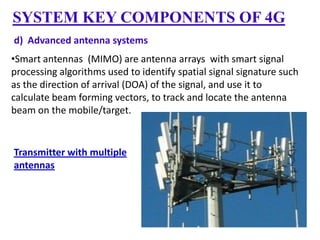
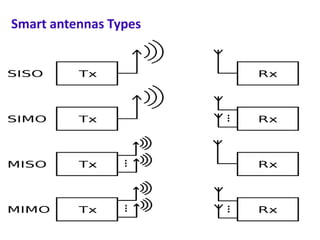
•Smart antennas (MIMO) are antenna arrays with smart signal
processing algorithms used to identify spatial signal signature such
as the direction of arrival (DOA) of the signal, and use it to
calculate beam forming vectors, to track and locate the antenna
beam on the mobile/target.

Transmitter with multiple
antennas
Smart antennas Types
d) Advanced antenna systems…..
• It offers significant increases in data throughput and link range
without additional bandwidth or increased transmit power.
• It achieves this goal by spreading the same total transmit
power over the antennas to achieve an array gain that
improves the spectral efficiency and to achieve a diversity
gain that improves the link reliability.
Example of advanced antenna:
1. Switched Beam Antenna
2. Adaptive Array Antennas
SYSTEM KEY COMPONENTS OF 4G
e) Software-defined radio (SDR)
Due to the constant evolution of mobile communication systems
(2G, 3G, and 4G), the wireless industry is facing problems in global
roaming to provide different services to the mobile subscribers. SDR
technology promises to solve these problems by implementing the
radio functionality as software modules running on a generic
hardware platform.
•The main purpose of SDR is to make a user terminal operate in
different kinds of wireless networks, overcoming
power, cost, size, and compatibility limitations.
•Flexibility and reconfigurability
•Interoperability
•Connectivity
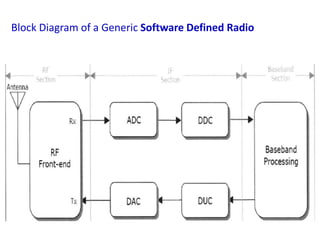
Block Diagram of a Generic Software Defined Radio
APPLICATIONS
 mobile web access
 IP telephony
gaming services
high-definition mobile TV
video conferencing
3D television
cloud computing
REFERENCES
• http://www.4gamericas.org/index.cfm?fuseaction=page&sectionid=2
49
• http://freewimaxinfo.com/wimax-technology.html
• http://en.wikipedia.org/wiki/
• 4G Evolution and Multiplexing Techniques with solution to
implementation challenges (2012 International Conference on CyberEnabled Distributed Computing and Knowledge Discover) by M.Kaleem Iqbal.

• 4G: The Future Mobile Technology by Mohsin Jamil l, Shahan Parwaiz,
University of Sheffield, United Kingdom.
4G Technology by VIKASH

4G Technology by VIKASH

  • 1.
  • 2.
    CONTENTS  INTRODUCTION WHAT IS4G ? EVOLUTION OF 4G 3G Vs 4G SYSTEM KEY COMPONENTS OF 4G • System standards • Multiplexing and access schemes • IPv6 SUPPORT •Advanced antenna systems •Software-defined radio (SDR) APPLICATIONS REFERENCES
  • 3.
    INTRODUCTION  4G isthe fourth generation of mobile phone mobile communication technology standards.  It is a successor to the third generation (3G) standards. A 4G system provides mobile “ Ultra Broadband speed” – to be counted in gigabytes per second. This technology is currently available in some countries but it is still being perfected.
  • 4.
    WHAT IS 4G? In March 2008, the International Telecommunications UnionRadio communications sector (ITU-R) specified a set of requirements for 4G standards, named the IMT-Advanced. Set peak speed requirements for 4G service at 100 Mbit/s for high mobility communication and 1 Gbit/s for low mobility communication. The peak bit rate is further improved by smart antenna arrays for multiple-input multiple-output (MIMO) communications. A 4G system does not support traditional circuit switched telephony service, but all-Internet Protocol (IP) based communication such as IP telephony.
  • 5.
    EVOLUTION OF 4G InApril 2006, KT started the world's first commercial mobile WiMAX service in Seoul, South Korea. In February 2007, the Japanese company NTT DoCoMo tested a 4G communication system prototype with 4×4 MIMO at 100 Mbit/s while moving, and 1 Gbit/s while stationary. In Dec 2009, The first commercial LTE deployment was by TeliaSonera & NetCom. The modem devices on offer were manufactured by Samsung, and the network infrastructure created by Huawei & Ericsson. On 10 April 2012, Bharti Airtel launched 4G LTE in Kolkata, first in India.
  • 6.
    3G Vs 4G TECHNOLOGY 3G 4G Developed 2001 2010 Services voicequality & always on Broadband Data data & voice over IP, LTE Standard IMT-2000 (UMTS, WCDMA, CDMA2000) Single Standard based on LTE Advanced Architecture Circuit & Packet Switched Packet Switched Multiplexing CDMA OFDM+ MIMO, W-OFDM, MC-CDMA Core Network PSTN & Some IP Networks Completely IP based Data Rates 384 Kbits/s to 3.1 M bits/s 100 M bps to 1G bps
  • 7.
    SYSTEM KEY COMPONENTSOF 4G a) System standards  LTE Advanced  WiMAX 2 b) Multiplexing and access schemes OFDM+ MIMO, W–OFDM, MC-CDMA c) IPv6 SUPPORT d) Advanced antenna systems Multiple antenna technologies are used to achieve high rate, high reliability and long communication range. e) Software-defined radio (SDR) Standards constituted by a 4G device can be realized using SDR.
  • 8.
    SYSTEM KEY COMPONENTSOF 4G a) System standards  LTE •Long Term Evolution (LTE) is a radio platform technology that will allow operators to achieve even higher peak throughputs than HSPA+ in higher spectrum bandwidth. •LTE uses Orthogonal Frequency Division Multiple Access (OFDMA) on the downlink, which is well suited to achieve high peak data rates in high spectrum bandwidth. 7TH MOBILE COMM STANDARD
  • 9.
    LTE capabilities include: •Downlinkpeak data rates up to 326 Mbps with 20 MHz bandwidth •Uplink peak data rates up to 86.4 Mbps with 20 MHz bandwidth •Operation in both TDD and FDD modes •Scalable bandwidth up to 20 MHz, covering 1.4 MHz, 3 MHz, 5 MHz, 10 MHz, 15 MHz, and 20 MHz in the study phase •Reduced latency, up to 10 milliseconds (ms) round-trip times between user equipment and the base station, and to less than 100 ms transition times from inactive to active
  • 10.
    SYSTEM KEY COMPONENTSOF 4G a) System standards  WiMAX 2 • WiMAX stands for Worldwide Interoperability for Microwave Access. WiMAX 2 also called Wireless MAN-Advanced has become the first true 4G technology to be approved by the IEEE and ITU. • This technology supports MIMO, femto cells, self-organizing networks & relays, and multicarrier operation. It supports both 120Mbps downlink and 60Mbps uplink speeds •The unique and excellent infrastructure of WiMAX is offering UltraWideband and providing range from 2 to 10 GHz and outstanding time response.
  • 11.
    Shows Mobility &Coverage v/s Data Rates of different Technologies
  • 12.
    SYSTEM KEY COMPONENTSOF 4G b) Multiplexing and access schemes  OFDM •Orthogonal frequency-division multiplexing (OFDM) is a frequency division multiplexing (FDM) scheme that uses a digital multi-carrier modulation method. •OFDM uses the spectrum more efficiently by making all the subcarriers orthogonal to one another, using fast Fourier transform (FFT) to prevent interference between the closely spaced subcarriers. •In OFDM, the guard band is reduced by the orthogonal packing of the subcarriers, improving the spectral efficiency .
  • 13.
     OFDM…. •Since each carrierin an OFDM signal has a very narrow bandwidth (i.e. few kHz), the resulting symbol rate is low. •Due to the orthogonal nature of the modulation, these multiple sub-carriers overlap in the frequency domain, but do not cause Inter-Carrier Interference (ICI). •In OFDM, the guard band is reduced by the orthogonal packing of the subcarriers, improving the spectral efficiency.
  • 15.
  • 16.
    SYSTEM KEY COMPONENTSOF 4G c) IPv6 SUPPORT The IP address is based on IPv6 IPv4 X.X.X.X (32 bits) Example: 216.37.129.9 IPv6 X.X.X.X.X.X (128 bits) Example: 216.37.129.9 , 79.23.178.229 ,65.198.2.10 192.168.5.120 Home Address care of address mobile IP address Local network address
  • 17.
    c) IPv6 SUPPORT… •Needsfor security and manageability •4G system uses the Internet Protocol version 6 (IPv6) to locate devices. •There is room for approximately 3.40 * 1038 unique addresses. •There are enough addresses for every phone to have a unique address. •Voice over Internet Protocol (VoIP) is a methodology and group of technologies for the delivery of voice communications and multimedia sessions over Internet Protocol (IP) networks
  • 18.
  • 19.
    SYSTEM KEY COMPONENTSOF 4G d) Advanced antenna systems •Smart antennas (MIMO) are antenna arrays with smart signal processing algorithms used to identify spatial signal signature such as the direction of arrival (DOA) of the signal, and use it to calculate beam forming vectors, to track and locate the antenna beam on the mobile/target. Transmitter with multiple antennas
  • 20.
  • 21.
    d) Advanced antennasystems….. • It offers significant increases in data throughput and link range without additional bandwidth or increased transmit power. • It achieves this goal by spreading the same total transmit power over the antennas to achieve an array gain that improves the spectral efficiency and to achieve a diversity gain that improves the link reliability. Example of advanced antenna: 1. Switched Beam Antenna 2. Adaptive Array Antennas
  • 22.
    SYSTEM KEY COMPONENTSOF 4G e) Software-defined radio (SDR) Due to the constant evolution of mobile communication systems (2G, 3G, and 4G), the wireless industry is facing problems in global roaming to provide different services to the mobile subscribers. SDR technology promises to solve these problems by implementing the radio functionality as software modules running on a generic hardware platform. •The main purpose of SDR is to make a user terminal operate in different kinds of wireless networks, overcoming power, cost, size, and compatibility limitations. •Flexibility and reconfigurability •Interoperability •Connectivity
  • 23.
    Block Diagram ofa Generic Software Defined Radio
  • 24.
    APPLICATIONS  mobile webaccess  IP telephony gaming services high-definition mobile TV video conferencing 3D television cloud computing
  • 25.
    REFERENCES • http://www.4gamericas.org/index.cfm?fuseaction=page&sectionid=2 49 • http://freewimaxinfo.com/wimax-technology.html •http://en.wikipedia.org/wiki/ • 4G Evolution and Multiplexing Techniques with solution to implementation challenges (2012 International Conference on CyberEnabled Distributed Computing and Knowledge Discover) by M.Kaleem Iqbal. • 4G: The Future Mobile Technology by Mohsin Jamil l, Shahan Parwaiz, University of Sheffield, United Kingdom.