OVERVIEW
o What is 4G ?
o Evolution of Mobile technology
o Features
o 4G hardware and software
o Technologies
o Applications
o Advantages and Disadvantages
o Conclusion
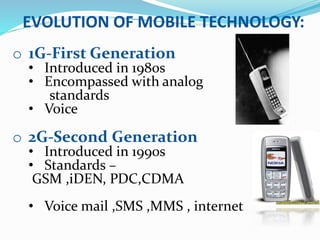
o 1G-First Generation
• Introduced in 1980s
• Encompassed with analog
standards
• Voice
o 2G-Second Generation
• Introduced in 1990s
• Standards –
GSM ,iDEN, PDC,CDMA
• Voice mail ,SMS ,MMS , internet
EVOLUTION OF MOBILE TECHNOLOGY:
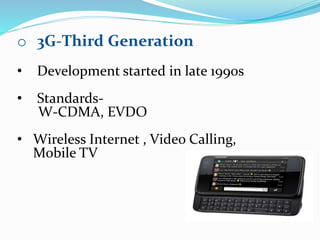
o 3G-Third Generation
• Development started in late 1990s
• Standards-
W-CDMA, EVDO
• Wireless Internet , Video Calling,
Mobile TV
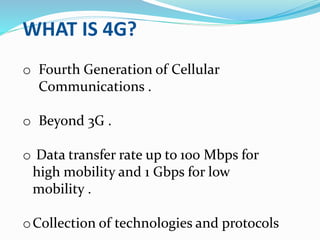
WHAT IS 4G?
o Fourth Generation of Cellular
Communications .
o Beyond 3G .
o Data transfer rate up to 100 Mbps for
high mobility and 1 Gbps for low
mobility .
oCollection of technologies and protocols
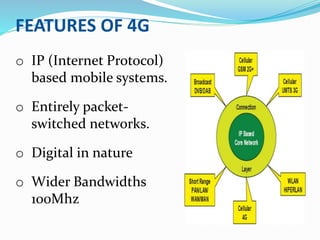
FEATURES OF 4G
o IP (Internet Protocol)
based mobile systems.
o Entirely packet-
switched networks.
o Digital in nature
o Wider Bandwidths
100Mhz
o 10 times faster than current 3G
o Global mobility and service portability.
o User Friendly.
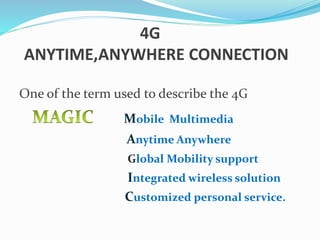
4G
ANYTIME,ANYWHERE CONNECTION
One of the term used to describe the 4G
Mobile Multimedia
Anytime Anywhere
Global Mobility support
Integrated wireless solution
Customized personal service.
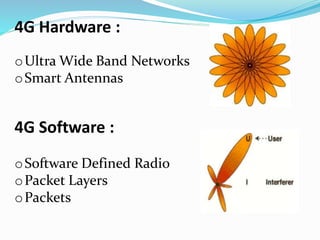
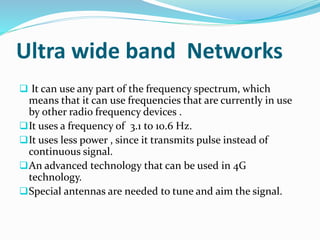
4G Hardware :
oUltra Wide Band Networks
oSmart Antennas
4G Software :
oSoftware Defined Radio
oPacket Layers
oPackets
Ultra wide band Networks
 It can use any part of the frequency spectrum, which
means that it can use frequencies that are currently in use
by other radio frequency devices .
It uses a frequency of 3.1 to 10.6 Hz.
It uses less power , since it transmits pulse instead of
continuous signal.
An advanced technology that can be used in 4G
technology.
Special antennas are needed to tune and aim the signal.
Software defined radio(SDR)
 A software defined radio is one that can be configured to
any radio or frequency standard through the use of
software.
 The phone should automatically switch from operating on
a CDMA frequency to a TDMA frequency whenever it is
required.
 Roaming can be an issue with different standards, but with
a software defined radio, users can just download the
interface upon entering new territory, or the software could
just download automatically
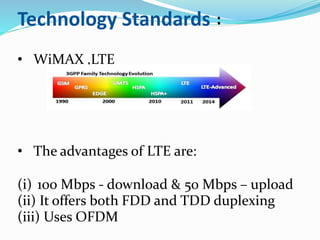
Technology Standards :
• WiMAX ,LTE
• The advantages of LTE are:
(i) 100 Mbps - download & 50 Mbps – upload
(ii) It offers both FDD and TDD duplexing
(iii) Uses OFDM
WIMAX:
o World Interoperability for Microwave
Access
o WiMax technology might not achieve the
required rate in a high-density area .
o useful when it is bundled with IPTV.
o The wireless bandwidth will be roughly
3Mbps/1.5Mbps
LTE(Long Term Evolution)
 LTE stands for Long Term Evolution
 Next Generation mobile broadband technology
 Promises data transfer rates of 100 Mbps
 Based on UMTS 3G technology
 Optimized for All-IP traffic
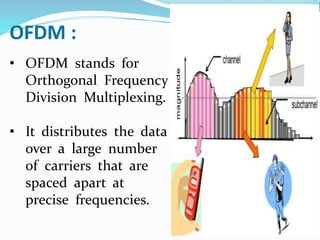
OFDM :
• OFDM stands for
Orthogonal Frequency
Division Multiplexing.
• It distributes the data
over a large number
of carriers that are
spaced apart at
precise frequencies.
Applications :
• Virtual Presence
• Virtual Navigation
• Crisis Management Application
• Telegeoprocessing, telemedicine
• Security
ADVANTAGES OF 4G:
• High usability: anytime, anywhere, and with any
technology.
• Support for multimedia services at low transmission
cost.
• Higher bandwidth, tight network security.
DISADVANTAGES OF 4G :
• Expensive.
• Battery uses are more.
• Hard to implement
• Need complicated hardware.
CONCLUSION
 Delivers true speeds without wires.
 Faster -- more bandwidth
 Completely portable
 3 times faster than 3G
 4G is broadband technology that will give us
richer ,pleasurable internet experience
4G MOBILE COMMUNICATION SYSTEM

4G MOBILE COMMUNICATION SYSTEM

  • 2.
    OVERVIEW o What is4G ? o Evolution of Mobile technology o Features o 4G hardware and software o Technologies o Applications o Advantages and Disadvantages o Conclusion
  • 3.
    o 1G-First Generation •Introduced in 1980s • Encompassed with analog standards • Voice o 2G-Second Generation • Introduced in 1990s • Standards – GSM ,iDEN, PDC,CDMA • Voice mail ,SMS ,MMS , internet EVOLUTION OF MOBILE TECHNOLOGY:
  • 4.
    o 3G-Third Generation •Development started in late 1990s • Standards- W-CDMA, EVDO • Wireless Internet , Video Calling, Mobile TV
  • 5.
    WHAT IS 4G? oFourth Generation of Cellular Communications . o Beyond 3G . o Data transfer rate up to 100 Mbps for high mobility and 1 Gbps for low mobility . oCollection of technologies and protocols
  • 6.
    FEATURES OF 4G oIP (Internet Protocol) based mobile systems. o Entirely packet- switched networks. o Digital in nature o Wider Bandwidths 100Mhz
  • 7.
    o 10 timesfaster than current 3G o Global mobility and service portability. o User Friendly.
  • 8.
    4G ANYTIME,ANYWHERE CONNECTION One ofthe term used to describe the 4G Mobile Multimedia Anytime Anywhere Global Mobility support Integrated wireless solution Customized personal service.
  • 9.
    4G Hardware : oUltraWide Band Networks oSmart Antennas 4G Software : oSoftware Defined Radio oPacket Layers oPackets
  • 10.
    Ultra wide bandNetworks  It can use any part of the frequency spectrum, which means that it can use frequencies that are currently in use by other radio frequency devices . It uses a frequency of 3.1 to 10.6 Hz. It uses less power , since it transmits pulse instead of continuous signal. An advanced technology that can be used in 4G technology. Special antennas are needed to tune and aim the signal.
  • 11.
    Software defined radio(SDR) A software defined radio is one that can be configured to any radio or frequency standard through the use of software.  The phone should automatically switch from operating on a CDMA frequency to a TDMA frequency whenever it is required.  Roaming can be an issue with different standards, but with a software defined radio, users can just download the interface upon entering new territory, or the software could just download automatically
  • 12.
    Technology Standards : •WiMAX ,LTE • The advantages of LTE are: (i) 100 Mbps - download & 50 Mbps – upload (ii) It offers both FDD and TDD duplexing (iii) Uses OFDM
  • 13.
    WIMAX: o World Interoperabilityfor Microwave Access o WiMax technology might not achieve the required rate in a high-density area . o useful when it is bundled with IPTV. o The wireless bandwidth will be roughly 3Mbps/1.5Mbps
  • 14.
    LTE(Long Term Evolution) LTE stands for Long Term Evolution  Next Generation mobile broadband technology  Promises data transfer rates of 100 Mbps  Based on UMTS 3G technology  Optimized for All-IP traffic
  • 15.
    OFDM : • OFDMstands for Orthogonal Frequency Division Multiplexing. • It distributes the data over a large number of carriers that are spaced apart at precise frequencies.
  • 16.
    Applications : • VirtualPresence • Virtual Navigation • Crisis Management Application • Telegeoprocessing, telemedicine • Security
  • 17.
    ADVANTAGES OF 4G: •High usability: anytime, anywhere, and with any technology. • Support for multimedia services at low transmission cost. • Higher bandwidth, tight network security.
  • 18.
    DISADVANTAGES OF 4G: • Expensive. • Battery uses are more. • Hard to implement • Need complicated hardware.
  • 19.
    CONCLUSION  Delivers truespeeds without wires.  Faster -- more bandwidth  Completely portable  3 times faster than 3G  4G is broadband technology that will give us richer ,pleasurable internet experience